Supervised by: Mr. Ahmed Imran
Impact of Psychological Factors on Investment
Decision Making Mediating by Risk Perception
UIMS-PMAS Arid Agriculture University
Rawalpindi, Pakistan
LUBNA RIAZ
11-arid-3593
Introduction
 The most critical challenge faced by the investors is the investment
decision;
 they act in a rational manner and usually follow their instincts and
emotional biases while making investment decisions.
 Previous studies reveals the importance of various psychological factors
- affect the investment decisions.
 Psychologists found that decisions could be influenced by unavoidable
psychological and emotional factors;
 will help the investors to select a better investment decision (Chira and
Adams, 2008).
 To avoid repeating the mistakes in future.
 Behavioral finance is becoming an integral part of the decision-making
process,
 because it greatly influences investors’ behavior regarding decision
making (Chin, 2012).
2
3
Variables Introduction
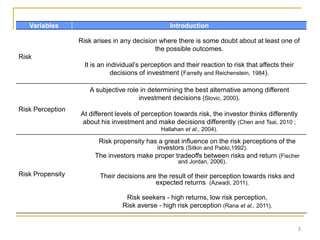
Risk
Risk arises in any decision where there is some doubt about at least one of
the possible outcomes.
It is an individual’s perception and their reaction to risk that affects their
decisions of investment (Farrelly and Reichenstein, 1984).
Risk Perception
A subjective role in determining the best alternative among different
investment decisions (Slovic, 2000).
At different levels of perception towards risk, the investor thinks differently
about his investment and make decisions differently (Chen and Tsai, 2010 ;
Hallahan et al., 2004).
Risk Propensity
Risk propensity has a great influence on the risk perceptions of the
investors (Sitkin and Pablo,1992).
The investors make proper tradeoffs between risks and return (Fischer
and Jordan, 2006).
Their decisions are the result of their perception towards risks and
expected returns (Azwadi, 2011).
Risk seekers - high returns, low risk perception,
Risk averse - high risk perception (Rana et al., 2011).
4
Variables Introduction
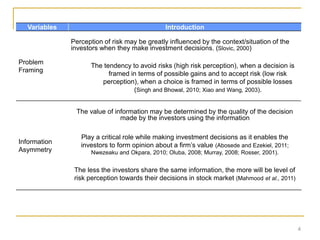
Problem
Framing
Perception of risk may be greatly influenced by the context/situation of the
investors when they make investment decisions. (Slovic, 2000)
The tendency to avoid risks (high risk perception), when a decision is
framed in terms of possible gains and to accept risk (low risk
perception), when a choice is framed in terms of possible losses
(Singh and Bhowal, 2010; Xiao and Wang, 2003).
Information
Asymmetry
The value of information may be determined by the quality of the decision
made by the investors using the information
Play a critical role while making investment decisions as it enables the
investors to form opinion about a firm’s value (Abosede and Ezekiel, 2011;
Nwezeaku and Okpara, 2010; Oluba, 2008; Murray, 2008; Rosser, 2001).
The less the investors share the same information, the more will be level of
risk perception towards their decisions in stock market (Mahmood et al., 2011)
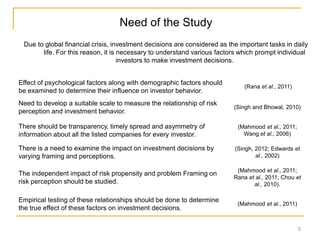
Need of the Study
Due to global financial crisis, investment decisions are considered as the important tasks in daily
life. For this reason, it is necessary to understand various factors which prompt individual
investors to make investment decisions.
5
Effect of psychological factors along with demographic factors should
be examined to determine their influence on investor behavior.
(Rana et al., 2011)
Need to develop a suitable scale to measure the relationship of risk
perception and investment behavior.
(Singh and Bhowal, 2010)
There should be transparency, timely spread and asymmetry of
information about all the listed companies for every investor.
(Mahmood et al., 2011;
Wang et al., 2006)
There is a need to examine the impact on investment decisions by
varying framing and perceptions.
(Singh, 2012; Edwards et
al., 2002)
The independent impact of risk propensity and problem Framing on
risk perception should be studied.
(Mahmood et al., 2011;
Rana et al., 2011; Chou et
al., 2010).
Empirical testing of these relationships should be done to determine
the true effect of these factors on investment decisions.
(Mahmood et al., 2011)
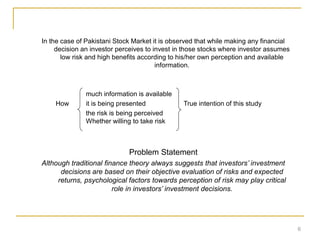
In the case of Pakistani Stock Market it is observed that while making any financial
decision an investor perceives to invest in those stocks where investor assumes
low risk and high benefits according to his/her own perception and available
information.
much information is available
How it is being presented True intention of this study
the risk is being perceived
Whether willing to take risk
Problem Statement
Although traditional finance theory always suggests that investors’ investment
decisions are based on their objective evaluation of risks and expected
returns, psychological factors towards perception of risk may play critical
role in investors’ investment decisions.
6
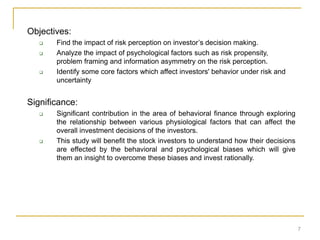
Objectives:
 Find the impact of risk perception on investor’s decision making.
 Analyze the impact of psychological factors such as risk propensity,
problem framing and information asymmetry on the risk perception.
 Identify some core factors which affect investors' behavior under risk and
uncertainty
Significance:
 Significant contribution in the area of behavioral finance through exploring
the relationship between various physiological factors that can affect the
overall investment decisions of the investors.
 This study will benefit the stock investors to understand how their decisions
are effected by the behavioral and psychological biases which will give
them an insight to overcome these biases and invest rationally.
7
8
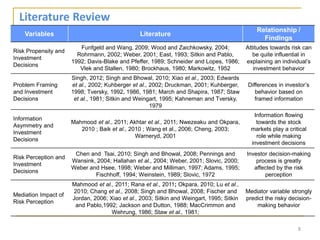
Variables Literature
Relationship /
Findings
Risk Propensity and
Investment
Decisions
Funfgeld and Wang, 2009; Wood and Zaichkowsky, 2004;
Rohrmann, 2002; Weber, 2001; East, 1993; Sitkin and Pablo,
1992; Davis-Blake and Pfeffer, 1989; Schneider and Lopes, 1986;
Vlek and Stallen, 1980; Brockhaus, 1980; Markowitz, 1952
Attitudes towards risk can
be quite influential in
explaining an individual’s
investment behavior
Problem Framing
and Investment
Decisions
Singh, 2012; Singh and Bhowal, 2010; Xiao et al., 2003; Edwards
et al., 2002; Kuhberger et al., 2002; Druckman, 2001; Kuhberger,
1998; Tversky, 1992, 1986, 1981; March and Shapira, 1987; Staw
et al., 1981; Sitkin and Weingart, 1995; Kahneman and Tversky,
1979
Differences in investor’s
behavior based on
framed information
Information
Asymmetry and
Investment
Decisions
Mahmood et al., 2011; Akhtar et al., 2011; Nwezeaku and Okpara,
2010 ; Baik et al., 2010 ; Wang et al., 2006; Cheng, 2003;
Warneryd, 2001
Information flowing
towards the stock
markets play a critical
role while making
investment decisions
Risk Perception and
Investment
Decisions
Chen and Tsai, 2010; Singh and Bhowal, 2008; Pennings and
Wansink, 2004; Hallahan et al., 2004; Weber, 2001; Slovic, 2000;
Weber and Hsee, 1998; Weber and Milliman, 1997; Adams, 1995;
Fischhoff, 1994; Weinstein, 1989; Slovic, 1972
Investor decision-making
process is greatly
affected by the risk
perception
Mediation Impact of
Risk Perception
Mahmood et al., 2011; Rana et al., 2011; Okpara, 2010; Lu et al.,
2010; Chang et al., 2008; Singh and Bhowal, 2008; Fischer and
Jordan, 2006; Xiao et al., 2003; Sitkin and Weingart, 1995; Sitkin
and Pablo,1992; Jackson and Dutton, 1988; MacCrimmon and
Wehrung, 1986; Staw et al., 1981;
Mediator variable strongly
predict the risky decision-
making behavior
Literature Review
Direct Effects:
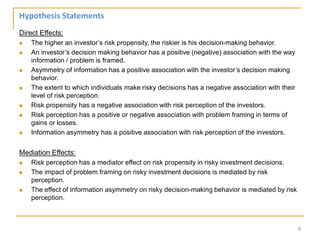
 The higher an investor’s risk propensity, the riskier is his decision-making behavior.
 An investor’s decision making behavior has a positive (negative) association with the way
information / problem is framed.
 Asymmetry of information has a positive association with the investor’s decision making
behavior.
 The extent to which individuals make risky decisions has a negative association with their
level of risk perception.
 Risk propensity has a negative association with risk perception of the investors.
 Risk perception has a positive or negative association with problem framing in terms of
gains or losses.
 Information asymmetry has a positive association with risk perception of the investors.
Mediation Effects:
 Risk perception has a mediator effect on risk propensity in risky investment decisions.
 The impact of problem framing on risky investment decisions is mediated by risk
perception.
 The effect of information asymmetry on risky decision-making behavior is mediated by risk
perception.
9
Hypothesis Statements
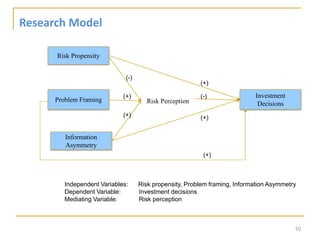
Research Model
Risk Propensity
Problem Framing
(-)
(+)
(+)
Risk Perception
(-)
(+)
(+)
Information
Asymmetry
Investment
Decisions
(+)
10
Independent Variables: Risk propensity, Problem framing, Information Asymmetry
Dependent Variable: Investment decisions
Mediating Variable: Risk perception
Materials and Method
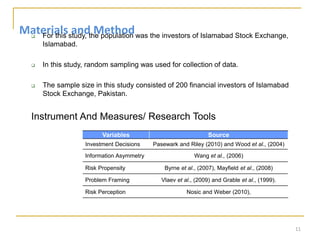
 For this study, the population was the investors of Islamabad Stock Exchange,
Islamabad.
 In this study, random sampling was used for collection of data.
 The sample size in this study consisted of 200 financial investors of Islamabad
Stock Exchange, Pakistan.
Instrument And Measures/ Research Tools
11
Variables Source
Investment Decisions Pasewark and Riley (2010) and Wood et al., (2004)
Information Asymmetry Wang et al., (2006)
Risk Propensity Byrne et al., (2007), Mayfield et al., (2008)
Problem Framing Vlaev et al., (2009) and Grable et al., (1999).
Risk Perception Nosic and Weber (2010),
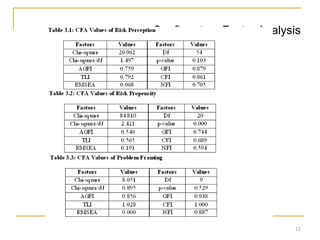
Confirmatory Factor Analysis
12
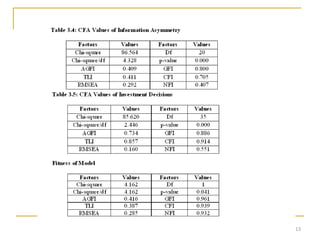
13
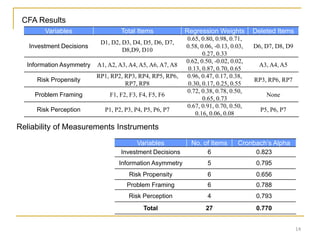
14
Variables No. of Items Cronbach’s Alpha
Investment Decisions 6 0.823
Information Asymmetry 5 0.795
Risk Propensity 6 0.656
Problem Framing 6 0.788
Risk Perception 4 0.793
Total 27 0.770
Variables Total Items Regression Weights Deleted Items
Investment Decisions
D1, D2, D3, D4, D5, D6, D7,
D8,D9, D10
0.65, 0.80, 0.98, 0.71,
0.58, 0.06, -0.13, 0.03,
0.27, 0.33
D6, D7, D8, D9
Information Asymmetry A1, A2, A3, A4, A5, A6, A7, A8
0.62, 0.50, -0.02, 0.02,
0.13, 0.87, 0.70, 0.65
A3, A4, A5
Risk Propensity
RP1, RP2, RP3, RP4, RP5, RP6,
RP7, RP8
0.96, 0.47, 0.17, 0.38,
0.30, 0.17, 0.25, 0.55
RP3, RP6, RP7
Problem Framing F1, F2, F3, F4, F5, F6
0.72, 0.38, 0.78, 0.50,
0.65, 0.73
None
Risk Perception P1, P2, P3, P4, P5, P6, P7
0.67, 0.91, 0.70, 0.50,
0.16, 0.06, 0.08
P5, P6, P7
Reliability of Measurements Instruments
CFA Results
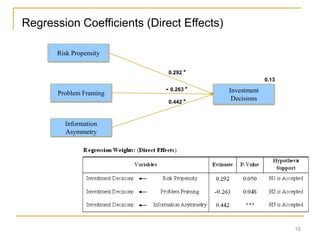
Regression Coefficients (Direct Effects)
Risk Propensity
Problem Framing
- 0.263 *
0.292 *
0.442 *
Information
Asymmetry
Investment
Decisions
0.13
15
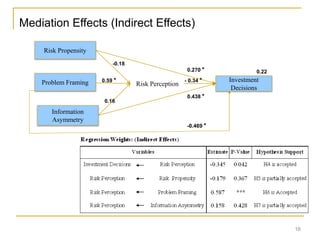
Mediation Effects (Indirect Effects)
Risk Propensity
Problem Framing - 0.34 *
0.270 *
-0.469 *
Risk Perception
0.59 *
0.16
0.438 *
Information
Asymmetry
Investment
Decisions
0.22
-0.18
16
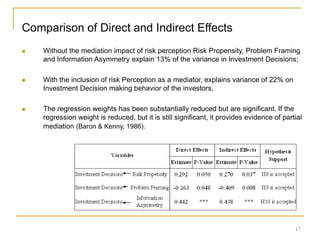
Comparison of Direct and Indirect Effects
 Without the mediation impact of risk perception Risk Propensity, Problem Framing
and Information Asymmetry explain 13% of the variance in Investment Decisions;
 With the inclusion of risk Perception as a mediator, explains variance of 22% on
Investment Decision making behavior of the investors.
 The regression weights has been substantially reduced but are significant. If the
regression weight is reduced, but it is still significant, it provides evidence of partial
mediation (Baron & Kenny, 1986).
17
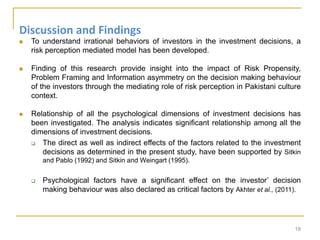
Discussion and Findings
 To understand irrational behaviors of investors in the investment decisions, a
risk perception mediated model has been developed.
 Finding of this research provide insight into the impact of Risk Propensity,
Problem Framing and Information asymmetry on the decision making behaviour
of the investors through the mediating role of risk perception in Pakistani culture
context.
 Relationship of all the psychological dimensions of investment decisions has
been investigated. The analysis indicates significant relationship among all the
dimensions of investment decisions.
 The direct as well as indirect effects of the factors related to the investment
decisions as determined in the present study, have been supported by Sitkin
and Pablo (1992) and Sitkin and Weingart (1995).
 Psychological factors have a significant effect on the investor’ decision
making behaviour was also declared as critical factors by Akhter et al., (2011).
18
19
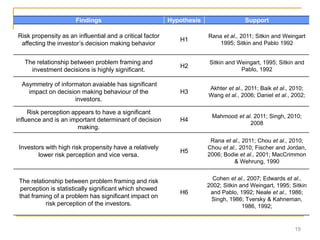
Findings Hypothesis Support
Risk propensity as an influential and a critical factor
affecting the investor’s decision making behavior
H1
Rana et al., 2011; Sitkin and Weingart
1995; Sitkin and Pablo 1992
The relationship between problem framing and
investment decisions is highly significant.
H2
Sitkin and Weingart, 1995; Sitkin and
Pablo, 1992
Asymmetry of informaton avaiable has significant
impact on decision making behaviour of the
investors.
H3
Akhter et al., 2011; Baik et al., 2010;
Wang et al., 2006; Daniel et al., 2002;
Risk perception appears to have a significant
influence and is an important determinant of decision
making.
H4
Mahmood et al. 2011; Singh, 2010;
2008
Investors with high risk propensity have a relatively
lower risk perception and vice versa.
H5
Rana et al., 2011; Chou et al., 2010;
Chou et al., 2010; Fischer and Jordan,
2006; Bodie et al., 2001; MacCrimmon
& Wehrung, 1990
The relationship between problem framing and risk
perception is statistically significant which showed
that framing of a problem has significant impact on
risk perception of the investors.
H6
Cohen et al., 2007; Edwards et al.,
2002; Sitkin and Weingart, 1995; Sitkin
and Pablo, 1992; Neale et al., 1986;
Singh, 1986; Tversky & Kahneman,
1986, 1992;
20
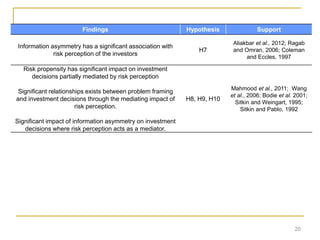
Findings Hypothesis Support
Information asymmetry has a significant association with
risk perception of the investors
H7
Aliakbar et al., 2012; Ragab
and Omran, 2006; Coleman
and Eccles, 1997
Risk propensity has significant impact on investment
decisions partially mediated by risk perception
Significant relationships exists between problem framing
and investment decisions through the mediating impact of
risk perception.
Significant impact of information asymmetry on investment
decisions where risk perception acts as a mediator.
H8, H9, H10
Mahmood et al., 2011; Wang
et al., 2006; Bodie et al. 2001;
Sitkin and Weingart, 1995;
Sitkin and Pablo, 1992
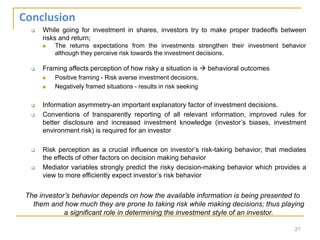
 While going for investment in shares, investors try to make proper tradeoffs between
risks and return;
 The returns expectations from the investments strengthen their investment behavior
although they perceive risk towards the investment decisions.
 Framing affects perception of how risky a situation is  behavioral outcomes
 Positive framing - Risk averse investment decisions,
 Negatively framed situations - results in risk seeking
 Information asymmetry-an important explanatory factor of investment decisions.
 Conventions of transparently reporting of all relevant information, improved rules for
better disclosure and increased investment knowledge (investor’s biases, investment
environment risk) is required for an investor
 Risk perception as a crucial influence on investor’s risk-taking behavior; that mediates
the effects of other factors on decision making behavior
 Mediator variables strongly predict the risky decision-making behavior which provides a
view to more efficiently expect investor’s risk behavior
The investor’s behavior depends on how the available information is being presented to
them and how much they are prone to taking risk while making decisions; thus playing
a significant role in determining the investment style of an investor.
21
Conclusion
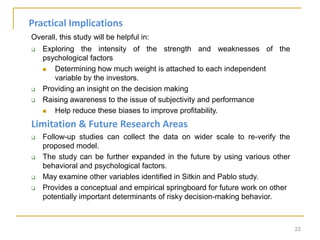
Overall, this study will be helpful in:
 Exploring the intensity of the strength and weaknesses of the
psychological factors
 Determining how much weight is attached to each independent
variable by the investors.
 Providing an insight on the decision making
 Raising awareness to the issue of subjectivity and performance
 Help reduce these biases to improve profitability.
Limitation & Future Research Areas
 Follow-up studies can collect the data on wider scale to re-verify the
proposed model.
 The study can be further expanded in the future by using various other
behavioral and psychological factors.
 May examine other variables identified in Sitkin and Pablo study.
 Provides a conceptual and empirical springboard for future work on other
potentially important determinants of risky decision-making behavior.
22
Practical Implications
Thank You !
23

Presentation.ppt

  • 1.
    Supervised by: Mr.Ahmed Imran Impact of Psychological Factors on Investment Decision Making Mediating by Risk Perception UIMS-PMAS Arid Agriculture University Rawalpindi, Pakistan LUBNA RIAZ 11-arid-3593
  • 2.
    Introduction  The mostcritical challenge faced by the investors is the investment decision;  they act in a rational manner and usually follow their instincts and emotional biases while making investment decisions.  Previous studies reveals the importance of various psychological factors - affect the investment decisions.  Psychologists found that decisions could be influenced by unavoidable psychological and emotional factors;  will help the investors to select a better investment decision (Chira and Adams, 2008).  To avoid repeating the mistakes in future.  Behavioral finance is becoming an integral part of the decision-making process,  because it greatly influences investors’ behavior regarding decision making (Chin, 2012). 2
  • 3.
    3 Variables Introduction Risk Risk arisesin any decision where there is some doubt about at least one of the possible outcomes. It is an individual’s perception and their reaction to risk that affects their decisions of investment (Farrelly and Reichenstein, 1984). Risk Perception A subjective role in determining the best alternative among different investment decisions (Slovic, 2000). At different levels of perception towards risk, the investor thinks differently about his investment and make decisions differently (Chen and Tsai, 2010 ; Hallahan et al., 2004). Risk Propensity Risk propensity has a great influence on the risk perceptions of the investors (Sitkin and Pablo,1992). The investors make proper tradeoffs between risks and return (Fischer and Jordan, 2006). Their decisions are the result of their perception towards risks and expected returns (Azwadi, 2011). Risk seekers - high returns, low risk perception, Risk averse - high risk perception (Rana et al., 2011).
  • 4.
    4 Variables Introduction Problem Framing Perception ofrisk may be greatly influenced by the context/situation of the investors when they make investment decisions. (Slovic, 2000) The tendency to avoid risks (high risk perception), when a decision is framed in terms of possible gains and to accept risk (low risk perception), when a choice is framed in terms of possible losses (Singh and Bhowal, 2010; Xiao and Wang, 2003). Information Asymmetry The value of information may be determined by the quality of the decision made by the investors using the information Play a critical role while making investment decisions as it enables the investors to form opinion about a firm’s value (Abosede and Ezekiel, 2011; Nwezeaku and Okpara, 2010; Oluba, 2008; Murray, 2008; Rosser, 2001). The less the investors share the same information, the more will be level of risk perception towards their decisions in stock market (Mahmood et al., 2011)
  • 5.
    Need of theStudy Due to global financial crisis, investment decisions are considered as the important tasks in daily life. For this reason, it is necessary to understand various factors which prompt individual investors to make investment decisions. 5 Effect of psychological factors along with demographic factors should be examined to determine their influence on investor behavior. (Rana et al., 2011) Need to develop a suitable scale to measure the relationship of risk perception and investment behavior. (Singh and Bhowal, 2010) There should be transparency, timely spread and asymmetry of information about all the listed companies for every investor. (Mahmood et al., 2011; Wang et al., 2006) There is a need to examine the impact on investment decisions by varying framing and perceptions. (Singh, 2012; Edwards et al., 2002) The independent impact of risk propensity and problem Framing on risk perception should be studied. (Mahmood et al., 2011; Rana et al., 2011; Chou et al., 2010). Empirical testing of these relationships should be done to determine the true effect of these factors on investment decisions. (Mahmood et al., 2011)
  • 6.
    In the caseof Pakistani Stock Market it is observed that while making any financial decision an investor perceives to invest in those stocks where investor assumes low risk and high benefits according to his/her own perception and available information. much information is available How it is being presented True intention of this study the risk is being perceived Whether willing to take risk Problem Statement Although traditional finance theory always suggests that investors’ investment decisions are based on their objective evaluation of risks and expected returns, psychological factors towards perception of risk may play critical role in investors’ investment decisions. 6
  • 7.
    Objectives:  Find theimpact of risk perception on investor’s decision making.  Analyze the impact of psychological factors such as risk propensity, problem framing and information asymmetry on the risk perception.  Identify some core factors which affect investors' behavior under risk and uncertainty Significance:  Significant contribution in the area of behavioral finance through exploring the relationship between various physiological factors that can affect the overall investment decisions of the investors.  This study will benefit the stock investors to understand how their decisions are effected by the behavioral and psychological biases which will give them an insight to overcome these biases and invest rationally. 7
  • 8.
    8 Variables Literature Relationship / Findings RiskPropensity and Investment Decisions Funfgeld and Wang, 2009; Wood and Zaichkowsky, 2004; Rohrmann, 2002; Weber, 2001; East, 1993; Sitkin and Pablo, 1992; Davis-Blake and Pfeffer, 1989; Schneider and Lopes, 1986; Vlek and Stallen, 1980; Brockhaus, 1980; Markowitz, 1952 Attitudes towards risk can be quite influential in explaining an individual’s investment behavior Problem Framing and Investment Decisions Singh, 2012; Singh and Bhowal, 2010; Xiao et al., 2003; Edwards et al., 2002; Kuhberger et al., 2002; Druckman, 2001; Kuhberger, 1998; Tversky, 1992, 1986, 1981; March and Shapira, 1987; Staw et al., 1981; Sitkin and Weingart, 1995; Kahneman and Tversky, 1979 Differences in investor’s behavior based on framed information Information Asymmetry and Investment Decisions Mahmood et al., 2011; Akhtar et al., 2011; Nwezeaku and Okpara, 2010 ; Baik et al., 2010 ; Wang et al., 2006; Cheng, 2003; Warneryd, 2001 Information flowing towards the stock markets play a critical role while making investment decisions Risk Perception and Investment Decisions Chen and Tsai, 2010; Singh and Bhowal, 2008; Pennings and Wansink, 2004; Hallahan et al., 2004; Weber, 2001; Slovic, 2000; Weber and Hsee, 1998; Weber and Milliman, 1997; Adams, 1995; Fischhoff, 1994; Weinstein, 1989; Slovic, 1972 Investor decision-making process is greatly affected by the risk perception Mediation Impact of Risk Perception Mahmood et al., 2011; Rana et al., 2011; Okpara, 2010; Lu et al., 2010; Chang et al., 2008; Singh and Bhowal, 2008; Fischer and Jordan, 2006; Xiao et al., 2003; Sitkin and Weingart, 1995; Sitkin and Pablo,1992; Jackson and Dutton, 1988; MacCrimmon and Wehrung, 1986; Staw et al., 1981; Mediator variable strongly predict the risky decision- making behavior Literature Review
  • 9.
    Direct Effects:  Thehigher an investor’s risk propensity, the riskier is his decision-making behavior.  An investor’s decision making behavior has a positive (negative) association with the way information / problem is framed.  Asymmetry of information has a positive association with the investor’s decision making behavior.  The extent to which individuals make risky decisions has a negative association with their level of risk perception.  Risk propensity has a negative association with risk perception of the investors.  Risk perception has a positive or negative association with problem framing in terms of gains or losses.  Information asymmetry has a positive association with risk perception of the investors. Mediation Effects:  Risk perception has a mediator effect on risk propensity in risky investment decisions.  The impact of problem framing on risky investment decisions is mediated by risk perception.  The effect of information asymmetry on risky decision-making behavior is mediated by risk perception. 9 Hypothesis Statements
  • 10.
    Research Model Risk Propensity ProblemFraming (-) (+) (+) Risk Perception (-) (+) (+) Information Asymmetry Investment Decisions (+) 10 Independent Variables: Risk propensity, Problem framing, Information Asymmetry Dependent Variable: Investment decisions Mediating Variable: Risk perception
  • 11.
    Materials and Method For this study, the population was the investors of Islamabad Stock Exchange, Islamabad.  In this study, random sampling was used for collection of data.  The sample size in this study consisted of 200 financial investors of Islamabad Stock Exchange, Pakistan. Instrument And Measures/ Research Tools 11 Variables Source Investment Decisions Pasewark and Riley (2010) and Wood et al., (2004) Information Asymmetry Wang et al., (2006) Risk Propensity Byrne et al., (2007), Mayfield et al., (2008) Problem Framing Vlaev et al., (2009) and Grable et al., (1999). Risk Perception Nosic and Weber (2010),
  • 12.
  • 13.
  • 14.
    14 Variables No. ofItems Cronbach’s Alpha Investment Decisions 6 0.823 Information Asymmetry 5 0.795 Risk Propensity 6 0.656 Problem Framing 6 0.788 Risk Perception 4 0.793 Total 27 0.770 Variables Total Items Regression Weights Deleted Items Investment Decisions D1, D2, D3, D4, D5, D6, D7, D8,D9, D10 0.65, 0.80, 0.98, 0.71, 0.58, 0.06, -0.13, 0.03, 0.27, 0.33 D6, D7, D8, D9 Information Asymmetry A1, A2, A3, A4, A5, A6, A7, A8 0.62, 0.50, -0.02, 0.02, 0.13, 0.87, 0.70, 0.65 A3, A4, A5 Risk Propensity RP1, RP2, RP3, RP4, RP5, RP6, RP7, RP8 0.96, 0.47, 0.17, 0.38, 0.30, 0.17, 0.25, 0.55 RP3, RP6, RP7 Problem Framing F1, F2, F3, F4, F5, F6 0.72, 0.38, 0.78, 0.50, 0.65, 0.73 None Risk Perception P1, P2, P3, P4, P5, P6, P7 0.67, 0.91, 0.70, 0.50, 0.16, 0.06, 0.08 P5, P6, P7 Reliability of Measurements Instruments CFA Results
  • 15.
    Regression Coefficients (DirectEffects) Risk Propensity Problem Framing - 0.263 * 0.292 * 0.442 * Information Asymmetry Investment Decisions 0.13 15
  • 16.
    Mediation Effects (IndirectEffects) Risk Propensity Problem Framing - 0.34 * 0.270 * -0.469 * Risk Perception 0.59 * 0.16 0.438 * Information Asymmetry Investment Decisions 0.22 -0.18 16
  • 17.
    Comparison of Directand Indirect Effects  Without the mediation impact of risk perception Risk Propensity, Problem Framing and Information Asymmetry explain 13% of the variance in Investment Decisions;  With the inclusion of risk Perception as a mediator, explains variance of 22% on Investment Decision making behavior of the investors.  The regression weights has been substantially reduced but are significant. If the regression weight is reduced, but it is still significant, it provides evidence of partial mediation (Baron & Kenny, 1986). 17
  • 18.
    Discussion and Findings To understand irrational behaviors of investors in the investment decisions, a risk perception mediated model has been developed.  Finding of this research provide insight into the impact of Risk Propensity, Problem Framing and Information asymmetry on the decision making behaviour of the investors through the mediating role of risk perception in Pakistani culture context.  Relationship of all the psychological dimensions of investment decisions has been investigated. The analysis indicates significant relationship among all the dimensions of investment decisions.  The direct as well as indirect effects of the factors related to the investment decisions as determined in the present study, have been supported by Sitkin and Pablo (1992) and Sitkin and Weingart (1995).  Psychological factors have a significant effect on the investor’ decision making behaviour was also declared as critical factors by Akhter et al., (2011). 18
  • 19.
    19 Findings Hypothesis Support Riskpropensity as an influential and a critical factor affecting the investor’s decision making behavior H1 Rana et al., 2011; Sitkin and Weingart 1995; Sitkin and Pablo 1992 The relationship between problem framing and investment decisions is highly significant. H2 Sitkin and Weingart, 1995; Sitkin and Pablo, 1992 Asymmetry of informaton avaiable has significant impact on decision making behaviour of the investors. H3 Akhter et al., 2011; Baik et al., 2010; Wang et al., 2006; Daniel et al., 2002; Risk perception appears to have a significant influence and is an important determinant of decision making. H4 Mahmood et al. 2011; Singh, 2010; 2008 Investors with high risk propensity have a relatively lower risk perception and vice versa. H5 Rana et al., 2011; Chou et al., 2010; Chou et al., 2010; Fischer and Jordan, 2006; Bodie et al., 2001; MacCrimmon & Wehrung, 1990 The relationship between problem framing and risk perception is statistically significant which showed that framing of a problem has significant impact on risk perception of the investors. H6 Cohen et al., 2007; Edwards et al., 2002; Sitkin and Weingart, 1995; Sitkin and Pablo, 1992; Neale et al., 1986; Singh, 1986; Tversky & Kahneman, 1986, 1992;
  • 20.
    20 Findings Hypothesis Support Informationasymmetry has a significant association with risk perception of the investors H7 Aliakbar et al., 2012; Ragab and Omran, 2006; Coleman and Eccles, 1997 Risk propensity has significant impact on investment decisions partially mediated by risk perception Significant relationships exists between problem framing and investment decisions through the mediating impact of risk perception. Significant impact of information asymmetry on investment decisions where risk perception acts as a mediator. H8, H9, H10 Mahmood et al., 2011; Wang et al., 2006; Bodie et al. 2001; Sitkin and Weingart, 1995; Sitkin and Pablo, 1992
  • 21.
     While goingfor investment in shares, investors try to make proper tradeoffs between risks and return;  The returns expectations from the investments strengthen their investment behavior although they perceive risk towards the investment decisions.  Framing affects perception of how risky a situation is  behavioral outcomes  Positive framing - Risk averse investment decisions,  Negatively framed situations - results in risk seeking  Information asymmetry-an important explanatory factor of investment decisions.  Conventions of transparently reporting of all relevant information, improved rules for better disclosure and increased investment knowledge (investor’s biases, investment environment risk) is required for an investor  Risk perception as a crucial influence on investor’s risk-taking behavior; that mediates the effects of other factors on decision making behavior  Mediator variables strongly predict the risky decision-making behavior which provides a view to more efficiently expect investor’s risk behavior The investor’s behavior depends on how the available information is being presented to them and how much they are prone to taking risk while making decisions; thus playing a significant role in determining the investment style of an investor. 21 Conclusion
  • 22.
    Overall, this studywill be helpful in:  Exploring the intensity of the strength and weaknesses of the psychological factors  Determining how much weight is attached to each independent variable by the investors.  Providing an insight on the decision making  Raising awareness to the issue of subjectivity and performance  Help reduce these biases to improve profitability. Limitation & Future Research Areas  Follow-up studies can collect the data on wider scale to re-verify the proposed model.  The study can be further expanded in the future by using various other behavioral and psychological factors.  May examine other variables identified in Sitkin and Pablo study.  Provides a conceptual and empirical springboard for future work on other potentially important determinants of risky decision-making behavior. 22 Practical Implications
  • 23.