English Presentation
Presentation Members:
➢Hamza Khaliq (02-131232-059)
➢Shamraiz Tasawar (02-131232-112)
➢Hassan Asif (02-131232-113)
ESSAY
WRITING
The word essay is defined in “The concise Oxford Dictionary” as
“literary composition(usually prose and short)on any
subject.”Properly speaking, it is a written composition giving
expression to one’s own personal ideas or opinions on some
topic; but the term usually covers also any written composition,
whether it expresses personal opinion , or gives Information on
any given subject , or details of a narrative or description.
Introduction
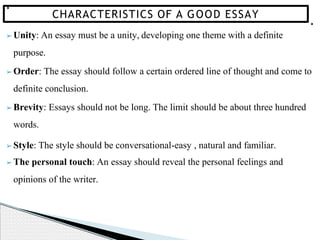
CHARACTERISTICS OF A GOOD ESSAY
➢Unity: An essay must be a unity, developing one theme with a definite
purpose.
➢Order: The essay should follow a certain ordered line of thought and come to
definite conclusion.
➢Brevity: Essays should not be long. The limit should be about three hundred
words.
➢Style: The style should be conversational-easy , natural and familiar.
➢The personal touch: An essay should reveal the personal feelings and
opinions of the writer.
➢Reflective Essays: A reflective essay consist of reflections or thoughts on some
topic, which is generally of an abstract nature.
➢Narrative Essays: A narrative essay consists mainly in the narration of some
event, or series of events.
➢Descriptive Essays: A descriptive essay consists of a description of some place
or thing.
➢Expository Essays: An expository essay consists of an exposition or explanation
of some subject.
➢Imaginative Essays: Essays on subjects such as the feelings and experiences of
the sailor wrecked on a desert island may be called imaginative essays.
CLASSIFICATION OF ESSAY
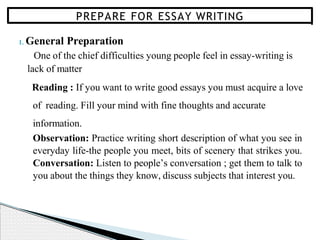
1. General Preparation
One of the chief difficulties young people feel in essay-writing is
lack of matter
Reading : If you want to write good essays you must acquire a love
of reading. Fill your mind with fine thoughts and accurate
information.
Observation: Practice writing short description of what you see in
everyday life-the people you meet, bits of scenery that strikes you.
Conversation: Listen to people’s conversation ; get them to talk to
you about the things they know, discuss subjects that interest you.
PREPARE FOR ESSAY WRITING
2. Special Preparation
The first thing we must do is to define the subject.
➢Defining the Subject- It is very important that you should have a clear
and accurate conception of the subject of the essay before you attempt to
write on it-what exactly it is and what it is not.
➢Collecting materials- Collect materials material for your essay before
you can write it.
➢Selection- when you think you have collected enough material for your
essay, read over the notes you have jotted down to select the points most
suitable for your purpose.
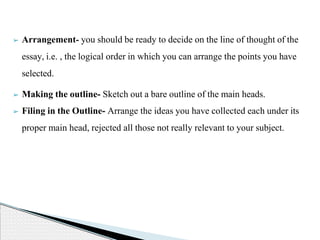
➢ Arrangement- you should be ready to decide on the line of thought of the
essay, i.e. , the logical order in which you can arrange the points you have
selected.
➢ Making the outline- Sketch out a bare outline of the main heads.
➢ Filing in the Outline- Arrange the ideas you have collected each under its
proper main head, rejected all those not really relevant to your subject.
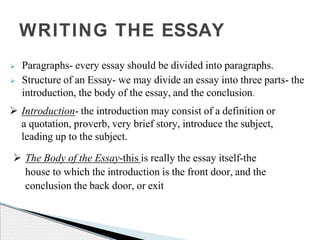
➢ Paragraphs- every essay should be divided into paragraphs.
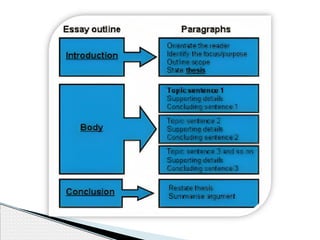
➢ Structure of an Essay- we may divide an essay into three parts- the
introduction, the body of the essay, and the conclusion.
➢ Introduction- the introduction may consist of a definition or
a quotation, proverb, very brief story, introduce the subject,
leading up to the subject.
WRITING THE ESSAY
➢ The Body of the Essay-this is really the essay itself-the
house to which the introduction is the front door, and the
conclusion the back door, or exit
Conclusion:
Your conclusion is your chance to have the last word on the
subject.
The conclusion is the final paragraph in an essay. It has
three purposes:
•It signals the end of the essay.
•It reminds the reader of your main points.
•Summarize Main Points: In this we summarize the main
idea of Essay.
-Use Roman numerals for major sections: I for
introduction, II for body, and III for conclusion.
-Capital letters label body paragraphs: A, B, C, etc.
-Numbers for subpoints: 1, 2, 3, etc. in each paragraph.
-Lowercase letters for specific details: a, b, c, etc. under
subpoints.
➢ Formal outline system:
ESSAY OUTLINING
Thank you

Presentation-On-Essay-writing

  • 1.
  • 2.
    Presentation Members: ➢Hamza Khaliq(02-131232-059) ➢Shamraiz Tasawar (02-131232-112) ➢Hassan Asif (02-131232-113)
  • 3.
  • 4.
    The word essayis defined in “The concise Oxford Dictionary” as “literary composition(usually prose and short)on any subject.”Properly speaking, it is a written composition giving expression to one’s own personal ideas or opinions on some topic; but the term usually covers also any written composition, whether it expresses personal opinion , or gives Information on any given subject , or details of a narrative or description. Introduction
  • 5.
    CHARACTERISTICS OF AGOOD ESSAY ➢Unity: An essay must be a unity, developing one theme with a definite purpose. ➢Order: The essay should follow a certain ordered line of thought and come to definite conclusion. ➢Brevity: Essays should not be long. The limit should be about three hundred words. ➢Style: The style should be conversational-easy , natural and familiar. ➢The personal touch: An essay should reveal the personal feelings and opinions of the writer.
  • 6.
    ➢Reflective Essays: Areflective essay consist of reflections or thoughts on some topic, which is generally of an abstract nature. ➢Narrative Essays: A narrative essay consists mainly in the narration of some event, or series of events. ➢Descriptive Essays: A descriptive essay consists of a description of some place or thing. ➢Expository Essays: An expository essay consists of an exposition or explanation of some subject. ➢Imaginative Essays: Essays on subjects such as the feelings and experiences of the sailor wrecked on a desert island may be called imaginative essays. CLASSIFICATION OF ESSAY
  • 7.
    1. General Preparation Oneof the chief difficulties young people feel in essay-writing is lack of matter Reading : If you want to write good essays you must acquire a love of reading. Fill your mind with fine thoughts and accurate information. Observation: Practice writing short description of what you see in everyday life-the people you meet, bits of scenery that strikes you. Conversation: Listen to people’s conversation ; get them to talk to you about the things they know, discuss subjects that interest you. PREPARE FOR ESSAY WRITING
  • 8.
    2. Special Preparation Thefirst thing we must do is to define the subject. ➢Defining the Subject- It is very important that you should have a clear and accurate conception of the subject of the essay before you attempt to write on it-what exactly it is and what it is not. ➢Collecting materials- Collect materials material for your essay before you can write it. ➢Selection- when you think you have collected enough material for your essay, read over the notes you have jotted down to select the points most suitable for your purpose.
  • 9.
    ➢ Arrangement- youshould be ready to decide on the line of thought of the essay, i.e. , the logical order in which you can arrange the points you have selected. ➢ Making the outline- Sketch out a bare outline of the main heads. ➢ Filing in the Outline- Arrange the ideas you have collected each under its proper main head, rejected all those not really relevant to your subject.
  • 10.
    ➢ Paragraphs- everyessay should be divided into paragraphs. ➢ Structure of an Essay- we may divide an essay into three parts- the introduction, the body of the essay, and the conclusion. ➢ Introduction- the introduction may consist of a definition or a quotation, proverb, very brief story, introduce the subject, leading up to the subject. WRITING THE ESSAY ➢ The Body of the Essay-this is really the essay itself-the house to which the introduction is the front door, and the conclusion the back door, or exit
  • 11.
    Conclusion: Your conclusion isyour chance to have the last word on the subject. The conclusion is the final paragraph in an essay. It has three purposes: •It signals the end of the essay. •It reminds the reader of your main points. •Summarize Main Points: In this we summarize the main idea of Essay.
  • 12.
    -Use Roman numeralsfor major sections: I for introduction, II for body, and III for conclusion. -Capital letters label body paragraphs: A, B, C, etc. -Numbers for subpoints: 1, 2, 3, etc. in each paragraph. -Lowercase letters for specific details: a, b, c, etc. under subpoints. ➢ Formal outline system: ESSAY OUTLINING
  • 14.