1
GIBBERELLINS- The growth
hormones shaping plant development
Physiological role and Bioassay of Gibberellins
Submitted by – DEBDATTA GHOSH,
22583073
2
INTRODUCTION TO GIBBERELLINS:
• Gibberellins (GAs) are a group of plant hormones that
regulate various aspects of plant growth and development.
• They are terpenoid compounds, derived from the
isoprenoid pathway, and exhibit diverse biological
activities.
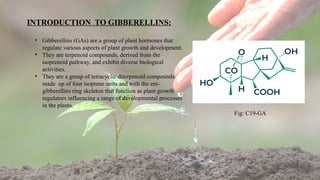
• They are a group of tetracyclic diterpenoid compounds
made up of four isoprene units and with the ent-
gibberellins ring skeleton that function as plant growth
regulators influencing a range of developmental processes
in the plants.
Fig: C19-GA
3
DISCOVERY OF GIBBERELLINS:
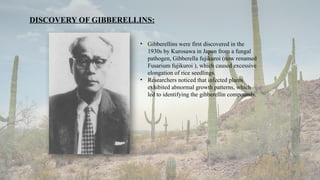
• Gibberellins were first discovered in the
1930s by Kurosawa in Japan from a fungal
pathogen, Gibberella fujikuroi (now renamed
Fusarium fujikuroi ), which caused excessive
elongation of rice seedlings.
• Researchers noticed that infected plants
exhibited abnormal growth patterns, which
led to identifying the gibberellin compounds.
4
TYPES OF GIBBERELLINS:
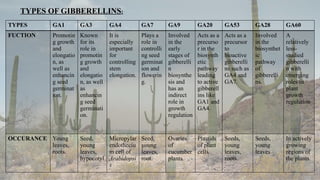
TYPES GA1 GA3 GA4 GA7 GA9 GA20 GA53 GA28 GA60
FUCTION Promotin
g growth
and
elongatio
n, as
well as
enhancin
g seed
germinat
ion.
Known
for its
role in
promotin
g growth
and
elongatio
n, as well
as
enhancin
g seed
germinati
on.
It is
especially
important
for
controlling
stem
elongation.
Plays a
role in
controlli
ng seed
germinat
ion and
flowerin
g.
Involved
in the
early
stages of
gibberelli
n
biosynthe
sis and
has an
indirect
role in
growth
regulation
.
Acts as a
precurso
r in the
biosynth
etic
pathway
leading
to active
gibberell
ins like
GA1 and
GA4.
Acts as a
precursor
to
bioactive
gibberelli
ns such as
GA4 and
GA7.
Involved
in the
biosynthet
ic
pathway
of
gibberelli
ns.
A
relatively
less-
studied
gibberelli
n with
emerging
roles in
plant
growth
regulation
.
OCCURANCE Young
leaves,
roots.
Seed,
young
leaves,
hypocotyl
Micropylar
endotheciu
m cell of
Arabidopsi
s
Seed,
young
leaves,
root.
Ovaries
of
cucumber
plants
Plastids
of plant
cells.
Seeds,
young
leaves,
roots.
Seeds,
young
leaves
In actively
growing
regions of
the plants.
5
BIOSYNTHESIS OF GIBBERELLINS:
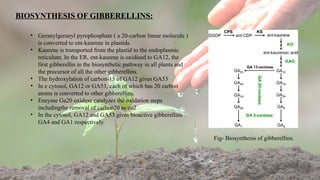
• Geranylgeranyl pyrophosphate ( a 20-carbon linear molecule )
is converted to ent-kaurene in plastids.
• Kaurene is transported from the plastid to the endoplasmic
reticulum. In the ER, ent-kaurene is oxidised to GA12, the
first gibberellin in the biosynthetic pathway in all plants and
the precursor of all the other gibberellins.
• The hydroxylation of carbon-13 of GA12 gives GA53
• In e cytosol, GA12 or GA53, each of which has 20 carbon
atoms is converted to other gibberellins.
• Enzyme Ga20 oxidase catalyzes the oxidation steps
includingthe removal of carbon20 as co2
• In the cytosol, GA12 and GA53 gives bioactive gibberellins
GA4 and GA1 respectively.
Fig- Biosynthesis of gibberellins.
6
PHYSIOLOGICAL
EFFECTS OF
GIBBERELLINS
7
STEM ELONGATION AS A PHYSIOLOGICAL ROLE:
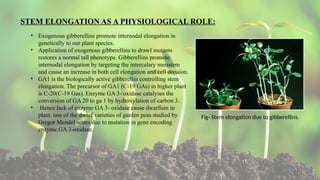
• Exogenous gibberellins promote internodal elongation in
genetically to our plant species.
• Application of exogenous gibberellins to drawf mutants
restores a normal tall phenotype. Gibberellins promote
internodal elongation by targeting the intercalary meristem
and cause an increase in both cell elongation and cell division.
• GA1 is the biologically active gibberellin controlling stem
elongation. The precursor of GA1 (C-19 GAs) in higher plant
is C-20(C-19 Gas). Enzyme GA 3- oxidase catalyses the
conversion of GA 20 to ga 1 by hydroxylation of carbon 3.
• Hence lack of enzyme GA 3- oxidase cause dwarfism in
plant. one of the dwarf varieties of garden peas studied by
Gregor Mendel arises due to mutation in gene encoding
enzyme GA 3-oxidase.
Fig- Stem elongation due to gibberellins.
8
FLOWERING AND SEX DETERMINATION AS PHYSIOLOGICAL ROLE
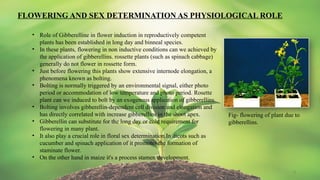
• Role of Gibberelline in flower induction in reproductively competent
plants has been established in long day and binneal species.
• In these plants, flowering in non inductive conditions can we achieved by
the application of gibberellins. rossette plants (such as spinach cabbage)
generally do not flower in rossette form.
• Just before flowering this plants show extensive internode elongation, a
phenomena known as bolting.
• Bolting is normally triggered by an environmental signal, either photo
period or accommodation of low temperature and photo period. Rosette
plant can we induced to bolt by an exogenous application of gibberellins.
• Bolting involves gibberellin-dependent cell division and elongation and
has directly correlated with increase gibberellins in the shoot apex.
• Gibberellin can substitute for the long day or cold requirement for
flowering in many plant.
• It also play a crucial role in floral sex determination.In dicots such as
cucumber and spinach application of it promotes the formation of
staminate flower.
• On the other hand in maize it's a process stamen development.
Fig- flowering of plant due to
gibberellins.
9
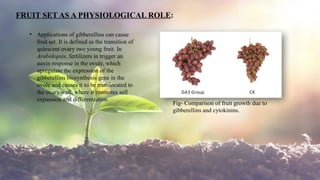
FRUIT SET AS A PHYSIOLOGICAL ROLE:
• Applications of gibberellins can cause
fruit set. It is defined as the transition of
quiescent ovary two young fruit. In
Arabidopsis, fertilizers in trigger an
auxin response in the ovule, which
upregulate the expression of the
gibberellins biosynthesis gene in the
ovule and causes it to be translocated to
the ovary wall, where it promotes sell
expansion and differentiation.
Fig- Comparison of fruit growth due to
gibberellins and cytokinins.
10
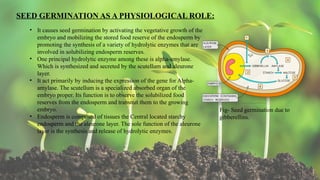
SEED GERMINATION AS A PHYSIOLOGICAL ROLE:
• It causes seed germination by activating the vegetative growth of the
embryo and mobilizing the stored food reserve of the endosperm by
promoting the synthesis of a variety of hydrolytic enzymes that are
involved in solubilizing endosperm reserves.
• One principal hydrolytic enzyme among these is alpha-amylase.
Which is synthesized and secreted by the scutellum and aleurone
layer.
• It act primarily by inducing the expression of the gene for Alpha-
amylase. The scutellum is a specialized absorbed organ of the
embryo proper. Its function is to observe the solubilized food
reserves from the endosperm and transmit them to the growing
embryo.
• Endosperm is composed of tissues the Central located starchy
endosperm and the aleurone layer. The sole function of the aleurone
layer is the synthesis and release of hydrolytic enzymes.
Fig- Seed germination due to
gibberellins.
11
BIOASSAY OF
GIBBERELLINS
12
INTRODUCTION TO BIOASSAY/BIOLOGICALASSAY:
• Bio essay is defined as the estimation and determination of concentration or potency of a
physical, chemical or biological agent using measuring and comparing the magnitude of
response of the test with that of standard over a suitable biological system understanding set of
conditions.
• Bio Assay are extremely sensitive and specific tests that can determine the biological activity of
a particular hormone by showing its detective effect on a specific part of plant material.
• THE FOLLOWINGS ARE THE VARIOUS BIOASSAY FOR GIBBERELLIN:
• Barley endosperm bioassay
• Dwarf pea bioassay
• Lettuce hypocotyl bioassay
• Dwarf corn bioassay
13
DWARF CORN TEST:
PRINCIPLE:
• This bio essay is based on the pad that gibberellin elongates the internode and in the case of
corn this also increases the length of the leaf sheath which encloses the internode
STEPS INVOLVED:
A known amount of test solution is applied to the first unfolding leaf of corn seedlings when they
are 6 to 7 days
Allowed to grow for 6 or 7 more days till the first and the second leaves are fully developed
Measure the increase in length of the first leaf sheath
The increase is plotted against the concentration of the hormone within limits that are directly
proportional to each other
14
BARLEY ENDOSPERM BIOASSAY:
PRINCIPLE:
• Based on the fact that during germination of grains such as barley with oats, gibberellin is
released from the embryo which moves to the aleurone cells where it induces synthesis of Alpha
amylase this enzyme hydroxic starch into simple reducing sugar
STEMS INVOLVED:
Barley seeds are cut half transversely and emerald person is discarded
Endosperm hubs are sterilized and allowed to imbibe water for 3 days
Endosperm halves are now transfer to a flowers containing a buffer and cacl2 along with their
solution
Incubation of the experimental set up for 24 hours are 25 degree centigrade with shaking
The seed residue is filtered off and the supernatant is analysed for Alpha amylase activity
Alpha amylase released from Barley half seed is proportional to the logarithm of
gibberellin concentration
15
REFERENCES:
• Plant growth substances: principles and Application; by
Areca
• Fundamentals of plant Physiology; by V.K Jain
• Growth and Development; by Lalit Shrivastava
• Life sciences: fundamentals and practices; by Pranav
Kumar
16
THANK YOU!!!

Presentation1.pptxghghghghghghghghghghghg

  • 1.
    1 GIBBERELLINS- The growth hormonesshaping plant development Physiological role and Bioassay of Gibberellins Submitted by – DEBDATTA GHOSH, 22583073
  • 2.
    2 INTRODUCTION TO GIBBERELLINS: •Gibberellins (GAs) are a group of plant hormones that regulate various aspects of plant growth and development. • They are terpenoid compounds, derived from the isoprenoid pathway, and exhibit diverse biological activities. • They are a group of tetracyclic diterpenoid compounds made up of four isoprene units and with the ent- gibberellins ring skeleton that function as plant growth regulators influencing a range of developmental processes in the plants. Fig: C19-GA
  • 3.
    3 DISCOVERY OF GIBBERELLINS: •Gibberellins were first discovered in the 1930s by Kurosawa in Japan from a fungal pathogen, Gibberella fujikuroi (now renamed Fusarium fujikuroi ), which caused excessive elongation of rice seedlings. • Researchers noticed that infected plants exhibited abnormal growth patterns, which led to identifying the gibberellin compounds.
  • 4.
    4 TYPES OF GIBBERELLINS: TYPESGA1 GA3 GA4 GA7 GA9 GA20 GA53 GA28 GA60 FUCTION Promotin g growth and elongatio n, as well as enhancin g seed germinat ion. Known for its role in promotin g growth and elongatio n, as well as enhancin g seed germinati on. It is especially important for controlling stem elongation. Plays a role in controlli ng seed germinat ion and flowerin g. Involved in the early stages of gibberelli n biosynthe sis and has an indirect role in growth regulation . Acts as a precurso r in the biosynth etic pathway leading to active gibberell ins like GA1 and GA4. Acts as a precursor to bioactive gibberelli ns such as GA4 and GA7. Involved in the biosynthet ic pathway of gibberelli ns. A relatively less- studied gibberelli n with emerging roles in plant growth regulation . OCCURANCE Young leaves, roots. Seed, young leaves, hypocotyl Micropylar endotheciu m cell of Arabidopsi s Seed, young leaves, root. Ovaries of cucumber plants Plastids of plant cells. Seeds, young leaves, roots. Seeds, young leaves In actively growing regions of the plants.
  • 5.
    5 BIOSYNTHESIS OF GIBBERELLINS: •Geranylgeranyl pyrophosphate ( a 20-carbon linear molecule ) is converted to ent-kaurene in plastids. • Kaurene is transported from the plastid to the endoplasmic reticulum. In the ER, ent-kaurene is oxidised to GA12, the first gibberellin in the biosynthetic pathway in all plants and the precursor of all the other gibberellins. • The hydroxylation of carbon-13 of GA12 gives GA53 • In e cytosol, GA12 or GA53, each of which has 20 carbon atoms is converted to other gibberellins. • Enzyme Ga20 oxidase catalyzes the oxidation steps includingthe removal of carbon20 as co2 • In the cytosol, GA12 and GA53 gives bioactive gibberellins GA4 and GA1 respectively. Fig- Biosynthesis of gibberellins.
  • 6.
  • 7.
    7 STEM ELONGATION ASA PHYSIOLOGICAL ROLE: • Exogenous gibberellins promote internodal elongation in genetically to our plant species. • Application of exogenous gibberellins to drawf mutants restores a normal tall phenotype. Gibberellins promote internodal elongation by targeting the intercalary meristem and cause an increase in both cell elongation and cell division. • GA1 is the biologically active gibberellin controlling stem elongation. The precursor of GA1 (C-19 GAs) in higher plant is C-20(C-19 Gas). Enzyme GA 3- oxidase catalyses the conversion of GA 20 to ga 1 by hydroxylation of carbon 3. • Hence lack of enzyme GA 3- oxidase cause dwarfism in plant. one of the dwarf varieties of garden peas studied by Gregor Mendel arises due to mutation in gene encoding enzyme GA 3-oxidase. Fig- Stem elongation due to gibberellins.
  • 8.
    8 FLOWERING AND SEXDETERMINATION AS PHYSIOLOGICAL ROLE • Role of Gibberelline in flower induction in reproductively competent plants has been established in long day and binneal species. • In these plants, flowering in non inductive conditions can we achieved by the application of gibberellins. rossette plants (such as spinach cabbage) generally do not flower in rossette form. • Just before flowering this plants show extensive internode elongation, a phenomena known as bolting. • Bolting is normally triggered by an environmental signal, either photo period or accommodation of low temperature and photo period. Rosette plant can we induced to bolt by an exogenous application of gibberellins. • Bolting involves gibberellin-dependent cell division and elongation and has directly correlated with increase gibberellins in the shoot apex. • Gibberellin can substitute for the long day or cold requirement for flowering in many plant. • It also play a crucial role in floral sex determination.In dicots such as cucumber and spinach application of it promotes the formation of staminate flower. • On the other hand in maize it's a process stamen development. Fig- flowering of plant due to gibberellins.
  • 9.
    9 FRUIT SET ASA PHYSIOLOGICAL ROLE: • Applications of gibberellins can cause fruit set. It is defined as the transition of quiescent ovary two young fruit. In Arabidopsis, fertilizers in trigger an auxin response in the ovule, which upregulate the expression of the gibberellins biosynthesis gene in the ovule and causes it to be translocated to the ovary wall, where it promotes sell expansion and differentiation. Fig- Comparison of fruit growth due to gibberellins and cytokinins.
  • 10.
    10 SEED GERMINATION ASA PHYSIOLOGICAL ROLE: • It causes seed germination by activating the vegetative growth of the embryo and mobilizing the stored food reserve of the endosperm by promoting the synthesis of a variety of hydrolytic enzymes that are involved in solubilizing endosperm reserves. • One principal hydrolytic enzyme among these is alpha-amylase. Which is synthesized and secreted by the scutellum and aleurone layer. • It act primarily by inducing the expression of the gene for Alpha- amylase. The scutellum is a specialized absorbed organ of the embryo proper. Its function is to observe the solubilized food reserves from the endosperm and transmit them to the growing embryo. • Endosperm is composed of tissues the Central located starchy endosperm and the aleurone layer. The sole function of the aleurone layer is the synthesis and release of hydrolytic enzymes. Fig- Seed germination due to gibberellins.
  • 11.
  • 12.
    12 INTRODUCTION TO BIOASSAY/BIOLOGICALASSAY: •Bio essay is defined as the estimation and determination of concentration or potency of a physical, chemical or biological agent using measuring and comparing the magnitude of response of the test with that of standard over a suitable biological system understanding set of conditions. • Bio Assay are extremely sensitive and specific tests that can determine the biological activity of a particular hormone by showing its detective effect on a specific part of plant material. • THE FOLLOWINGS ARE THE VARIOUS BIOASSAY FOR GIBBERELLIN: • Barley endosperm bioassay • Dwarf pea bioassay • Lettuce hypocotyl bioassay • Dwarf corn bioassay
  • 13.
    13 DWARF CORN TEST: PRINCIPLE: •This bio essay is based on the pad that gibberellin elongates the internode and in the case of corn this also increases the length of the leaf sheath which encloses the internode STEPS INVOLVED: A known amount of test solution is applied to the first unfolding leaf of corn seedlings when they are 6 to 7 days Allowed to grow for 6 or 7 more days till the first and the second leaves are fully developed Measure the increase in length of the first leaf sheath The increase is plotted against the concentration of the hormone within limits that are directly proportional to each other
  • 14.
    14 BARLEY ENDOSPERM BIOASSAY: PRINCIPLE: •Based on the fact that during germination of grains such as barley with oats, gibberellin is released from the embryo which moves to the aleurone cells where it induces synthesis of Alpha amylase this enzyme hydroxic starch into simple reducing sugar STEMS INVOLVED: Barley seeds are cut half transversely and emerald person is discarded Endosperm hubs are sterilized and allowed to imbibe water for 3 days Endosperm halves are now transfer to a flowers containing a buffer and cacl2 along with their solution Incubation of the experimental set up for 24 hours are 25 degree centigrade with shaking The seed residue is filtered off and the supernatant is analysed for Alpha amylase activity Alpha amylase released from Barley half seed is proportional to the logarithm of gibberellin concentration
  • 15.
    15 REFERENCES: • Plant growthsubstances: principles and Application; by Areca • Fundamentals of plant Physiology; by V.K Jain • Growth and Development; by Lalit Shrivastava • Life sciences: fundamentals and practices; by Pranav Kumar
  • 16.