GROUP 9
PRESENTATION
BSED 1 (ST. Joseph)
Objectives:
•To understand what is Rossi-Forel Scale and who are the 2 persons
involved.
•To be able to understand what will going to do during and after an
earthquake.
• Discuss some information's about Active and Inactive Volcanoes in
the Philippines.
• List the definititive characteristics that quality, certain Earth
materials as minerals.
•Demonstrate an understanding of the International System of
Units.
•To be able to understand measurements in both the English system
of units and the SI (System International ) system of units.
•To understanding a Weather Map is to understand the Weather
Symbols that are used on the Map.
Cherry
Grisola
ROSSI-FOREL
SCALE
An arbitrary numerical scale
of intensity of seismic
disturbances ranging from
one for a barely perceptible
tremor to 10 for an
earthquake of the highest
intensity.
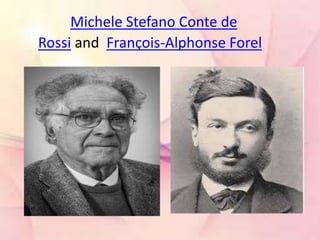
Michele Stefano Conte de
Rossi and François-Alphonse Forel
The Rossi–Forel Scale was one of the
first seismic scales to reflect
earthquake intensities. Developed
by Michele Stefano Conte De
Rossi of Italy and François-Alphonse
Forel of Switzerland in the late 18th
century, it was used for about two
decades until the introduction of
the Mercalli intensity scale in 1902.
The 1873 version of the Rossi–Forel
Scale had 10 intensity levels:
• I. Micro seismic
tremor
• II. Extremely feeble
tremor
• III. Feeble tremor
• IV. Slight tremor
• V. Moderate tremor
• VI. Strong tremor
• VII. Very strong
tremor
• VIII. Damaging tremor
• IX. Devastating
tremor
• X. Extremely high
intensity tremor
Richter
Magnitude
Scale
The Richter magnitude scale (also
Richter scale) assigns a magnitude
number to quantify the energy
released by an earthquake. The Richter
scale is a base-10 logarithmic scale,
which defines magnitude as the
logarithm of the ratio of the amplitude
of the seismic waves to an arbitrary,
minor amplitude.
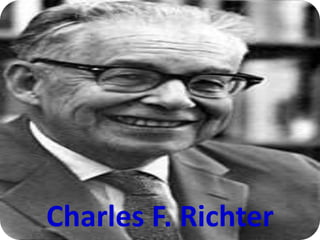
Charles F. Richter
Charles F. Richter, renowned seismologist, is a
professor emeritus of seismology at the
California Institute of Technology. He received
his Ph.D. from Caltech in 1928. He is best known
to the public for the Richter magnitude scale
and he is equally recognized in the scientific
community for his books Elementary
Seismology and Seismicity of the
Earth (coauthored with B. Gutenberg, 1954). Dr.
Richter is probably the only man in the world
who has a seismograph in his living room. Now
71, he retired from Caltech in July 1970.
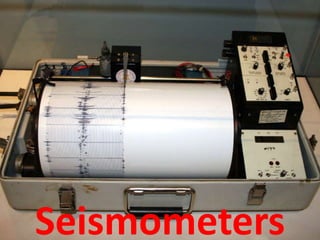
Seismometers
Seismometers are instruments that
measure motions of the ground,
including those of seismic
waves generated
by earthquakes, volcanic eruptions,
and other seismic sources. Records of
seismic waves allow seismologists to
map the interior of the Earth, and
locate and measure the size of these
different sources.
Gladys
Cunanan
How can
Earthquake
damage be
reduced?
• In areas where earthquakes
are likely, knowing where to
build and how to build can
help reduce injury, loss of life,
and property damage during
a quake. Knowing what to do
when a quake strikes can also
help prevent injuries and
deaths.
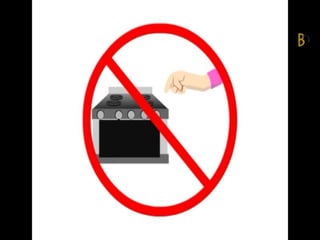
What to do
during an
Earthquake?
What to do
immediately
after an
Earthquake?
•Check yourself and others for injuries .
•Check water , gas and electric lines for damage.
•Turn on the radio . Don’t use the phone unless it’s
an emergency.
•Stay out of damage buildings.
•Be careful around broken glass and debris.
•Be careful of chimneys(they may fall on you)
•Stay away from beaches.
•Stay away from damage areas.
•If you’re at school or work , follow the emergency
plan or the instructions of the person in charge.
•Expect aftershocks.
Elsa
Magpantay
Top Ten(10)
Most Active
Volcanoes in
the Philippines
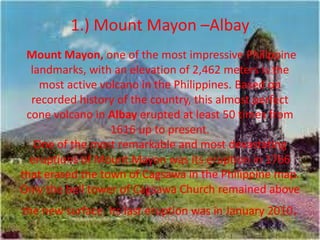
1.) Mount Mayon –Albay
Mount Mayon, one of the most impressive Philippine
landmarks, with an elevation of 2,462 meters is the
most active volcano in the Philippines. Based on
recorded history of the country, this almost perfect
cone volcano in Albay erupted at least 50 times from
1616 up to present.
One of the most remarkable and most devastating
eruptions of Mount Mayon was its eruption in 1766
that erased the town of Cagsawa in the Philippine map.
Only the bell tower of Cagsawa Church remained above
the new surface. Its last eruption was in January 2010.
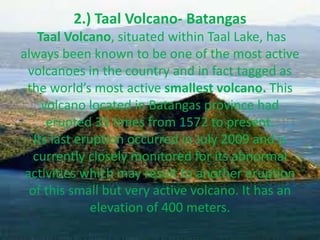
2.) Taal Volcano- Batangas
Taal Volcano, situated within Taal Lake, has
always been known to be one of the most active
volcanoes in the country and in fact tagged as
the world’s most active smallest volcano. This
volcano located in Batangas province had
erupted 33 times from 1572 to present.
Its last eruption occurred in July 2009 and is
currently closely monitored for its abnormal
activities which may result to another eruption
of this small but very active volcano. It has an
elevation of 400 meters.
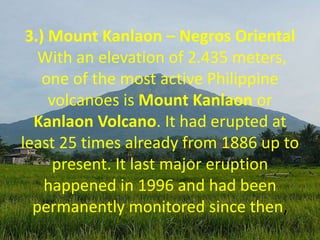
3.) Mount Kanlaon – Negros Oriental
With an elevation of 2.435 meters,
one of the most active Philippine
volcanoes is Mount Kanlaon or
Kanlaon Volcano. It had erupted at
least 25 times already from 1886 up to
present. It last major eruption
happened in 1996 and had been
permanently monitored since then,
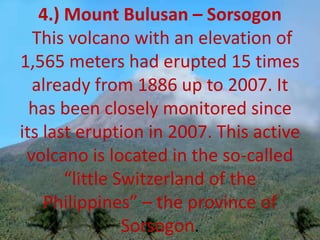
4.) Mount Bulusan – Sorsogon
This volcano with an elevation of
1,565 meters had erupted 15 times
already from 1886 up to 2007. It
has been closely monitored since
its last eruption in 2007. This active
volcano is located in the so-called
“little Switzerland of the
Philippines” – the province of
Sorsogon.
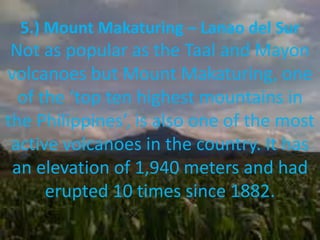
5.) Mount Makaturing – Lanao del Sur
Not as popular as the Taal and Mayon
volcanoes but Mount Makaturing, one
of the ‘top ten highest mountains in
the Philippines’, is also one of the most
active volcanoes in the country. It has
an elevation of 1,940 meters and had
erupted 10 times since 1882.
6. a) Musuan Volcano – Bukidnon
Another not-so-famous volcano is
Musuan Volcano located in the
province of Bukidnon. With an
elevation of 646 meters only, it is one
of the most active volcanoes in the
Philippines and had erupted 8 times in
a span of 21 years from 1866 to 1887.
Its last threatening activity of strong
seismic swarm occurred in 1976 but
has not erupted since then.
6. b) Mount Ragang – Lanao del Sur
Mount Ragang in Lanao del Sur, which
is another tall mountain in the
Philippines, is another active volcano
that had erupted 8 times and tied with
Musuan Volcano as the countries 6th
most active volcano. Its last recorded
eruption happened in 1916 or 94 years
ago.
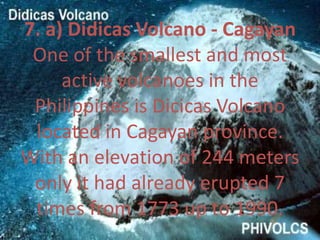
7. a) Didicas Volcano - Cagayan
One of the smallest and most
active volcanoes in the
Philippines is Dicicas Volcano
located in Cagayan province.
With an elevation of 244 meters
only it had already erupted 7
times from 1773 up to 1990.
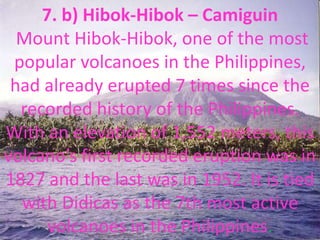
7. b) Hibok-Hibok – Camiguin
Mount Hibok-Hibok, one of the most
popular volcanoes in the Philippines,
had already erupted 7 times since the
recorded history of the Philippines.
With an elevation of 1,552 meters, this
volcano’s first recorded eruption was in
1827 and the last was in 1952. It is tied
with Didicas as the 7th most active
volcanoes in the Philippines.
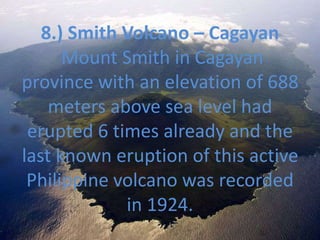
8.) Smith Volcano – Cagayan
Mount Smith in Cagayan
province with an elevation of 688
meters above sea level had
erupted 6 times already and the
last known eruption of this active
Philippine volcano was recorded
in 1924.
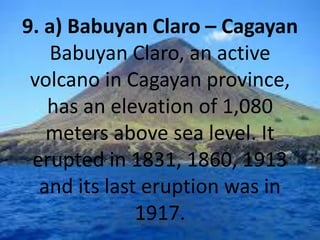
9. a) Babuyan Claro – Cagayan
Babuyan Claro, an active
volcano in Cagayan province,
has an elevation of 1,080
meters above sea level. It
erupted in 1831, 1860, 1913
and its last eruption was in
1917.
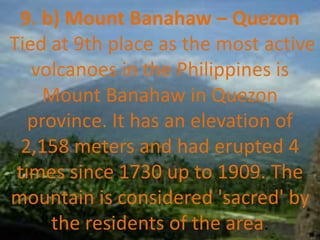
9. b) Mount Banahaw – Quezon
Tied at 9th place as the most active
volcanoes in the Philippines is
Mount Banahaw in Quezon
province. It has an elevation of
2,158 meters and had erupted 4
times since 1730 up to 1909. The
mountain is considered 'sacred' by
the residents of the area.
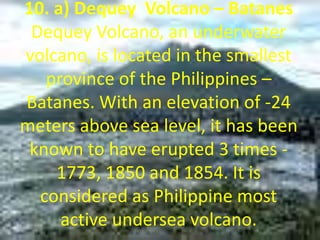
10. a) Dequey Volcano – Batanes
Dequey Volcano, an underwater
volcano, is located in the smallest
province of the Philippines –
Batanes. With an elevation of -24
meters above sea level, it has been
known to have erupted 3 times -
1773, 1850 and 1854. It is
considered as Philippine most
active undersea volcano.
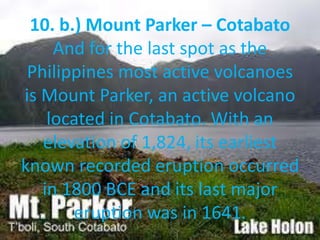
10. b.) Mount Parker – Cotabato
And for the last spot as the
Philippines most active volcanoes
is Mount Parker, an active volcano
located in Cotabato. With an
elevation of 1,824, its earliest
known recorded eruption occurred
in 1800 BCE and its last major
eruption was in 1641.
Top Ten(10)
In-Active
Volcanoes in
the Philippines
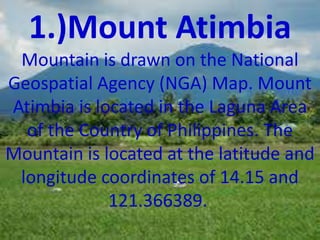
1.)Mount Atimbia
Mountain is drawn on the National
Geospatial Agency (NGA) Map. Mount
Atimbia is located in the Laguna Area
of the Country of Philippines. The
Mountain is located at the latitude and
longitude coordinates of 14.15 and
121.366389.
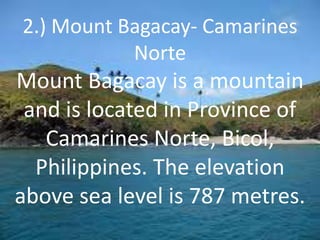
2.) Mount Bagacay- Camarines
Norte
Mount Bagacay is a mountain
and is located in Province of
Camarines Norte, Bicol,
Philippines. The elevation
above sea level is 787 metres.
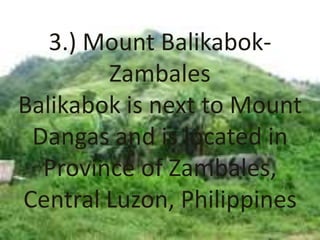
3.) Mount Balikabok-
Zambales
Balikabok is next to Mount
Dangas and is located in
Province of Zambales,
Central Luzon, Philippines
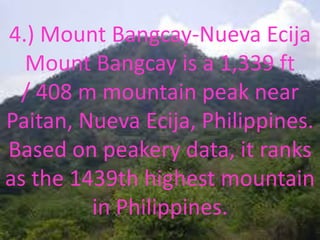
4.) Mount Bangcay-Nueva Ecija
Mount Bangcay is a 1,339 ft
/ 408 m mountain peak near
Paitan, Nueva Ecija, Philippines.
Based on peakery data, it ranks
as the 1439th highest mountain
in Philippines.
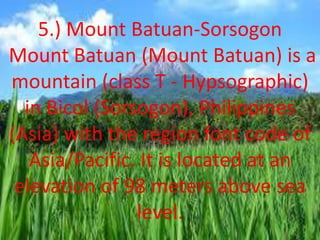
5.) Mount Batuan-Sorsogon
Mount Batuan (Mount Batuan) is a
mountain (class T - Hypsographic)
in Bicol (Sorsogon), Philippines
(Asia) with the region font code of
Asia/Pacific. It is located at an
elevation of 98 meters above sea
level.
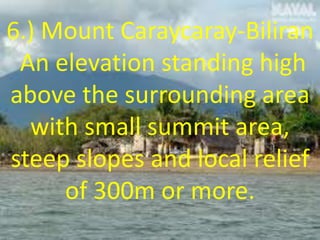
6.) Mount Caraycaray-Biliran
An elevation standing high
above the surrounding area
with small summit area,
steep slopes and local relief
of 300m or more.
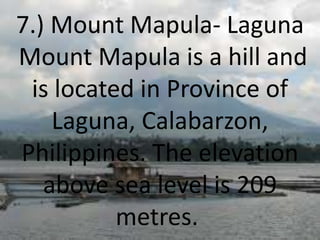
7.) Mount Mapula- Laguna
Mount Mapula is a hill and
is located in Province of
Laguna, Calabarzon,
Philippines. The elevation
above sea level is 209
metres.
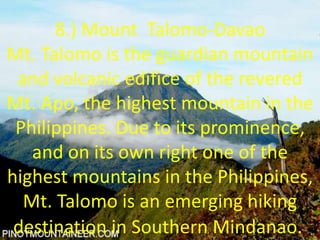
8.) Mount Talomo-Davao
Mt. Talomo is the guardian mountain
and volcanic edifice of the revered
Mt. Apo, the highest mountain in the
Philippines. Due to its prominence,
and on its own right one of the
highest mountains in the Philippines,
Mt. Talomo is an emerging hiking
destination in Southern Mindanao.
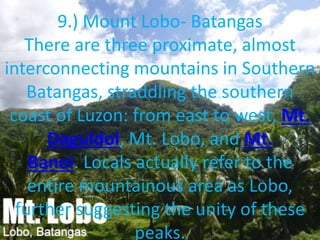
9.) Mount Lobo- Batangas
There are three proximate, almost
interconnecting mountains in Southern
Batangas, straddling the southern
coast of Luzon: from east to west, Mt.
Daguldol, Mt. Lobo, and Mt.
Banoi. Locals actually refer to the
entire mountainous area as Lobo,
further suggesting the unity of these
peaks.
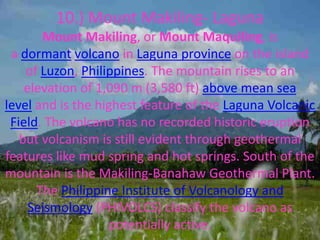
10.) Mount Makiling- Laguna
Mount Makiling, or Mount Maquiling, is
a dormant volcano in Laguna province on the island
of Luzon, Philippines. The mountain rises to an
elevation of 1,090 m (3,580 ft) above mean sea
level and is the highest feature of the Laguna Volcanic
Field. The volcano has no recorded historic eruption
but volcanism is still evident through geothermal
features like mud spring and hot springs. South of the
mountain is the Makiling-Banahaw Geothermal Plant.
The Philippine Institute of Volcanology and
Seismology (PHIVOLCS) classify the volcano as
potentially active.
Meg
Reyes
10 Common
Minerals of the
Earths Crust, their
Uses and
Occurrences
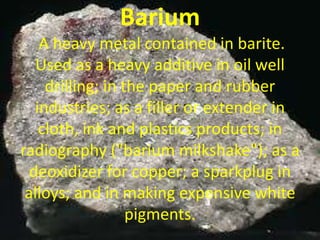
Barium
A heavy metal contained in barite.
Used as a heavy additive in oil well
drilling; in the paper and rubber
industries; as a filler or extender in
cloth, ink and plastics products; in
radiography ("barium milkshake"); as a
deoxidizer for copper; a sparkplug in
alloys; and in making expensive white
pigments.
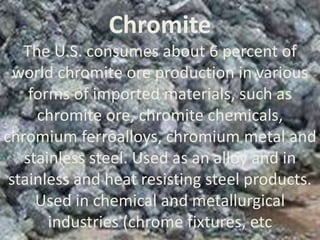
Chromite
The U.S. consumes about 6 percent of
world chromite ore production in various
forms of imported materials, such as
chromite ore, chromite chemicals,
chromium ferroalloys, chromium metal and
stainless steel. Used as an alloy and in
stainless and heat resisting steel products.
Used in chemical and metallurgical
industries (chrome fixtures, etc
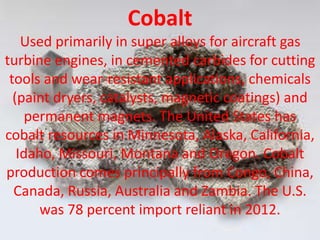
Cobalt
Used primarily in super alloys for aircraft gas
turbine engines, in cemented carbides for cutting
tools and wear-resistant applications, chemicals
(paint dryers, catalysts, magnetic coatings) and
permanent magnets. The United States has
cobalt resources in Minnesota, Alaska, California,
Idaho, Missouri, Montana and Oregon. Cobalt
production comes principally from Congo, China,
Canada, Russia, Australia and Zambia. The U.S.
was 78 percent import reliant in 2012.
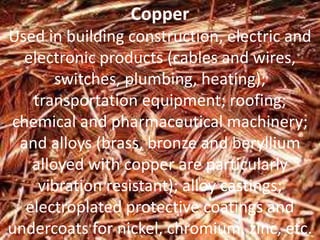
Copper
Used in building construction, electric and
electronic products (cables and wires,
switches, plumbing, heating);
transportation equipment; roofing;
chemical and pharmaceutical machinery;
and alloys (brass, bronze and beryllium
alloyed with copper are particularly
vibration resistant); alloy castings;
electroplated protective coatings and
undercoats for nickel, chromium, zinc, etc.
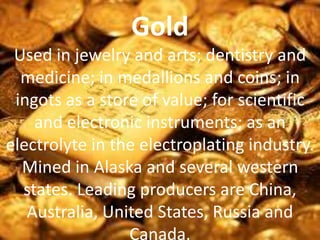
Gold
Used in jewelry and arts; dentistry and
medicine; in medallions and coins; in
ingots as a store of value; for scientific
and electronic instruments; as an
electrolyte in the electroplating industry.
Mined in Alaska and several western
states. Leading producers are China,
Australia, United States, Russia and
Canada.
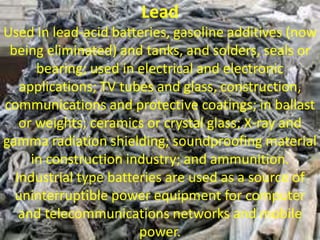
Lead
Used in lead-acid batteries, gasoline additives (now
being eliminated) and tanks, and solders, seals or
bearing; used in electrical and electronic
applications; TV tubes and glass, construction,
communications and protective coatings; in ballast
or weights; ceramics or crystal glass; X-ray and
gamma radiation shielding; soundproofing material
in construction industry; and ammunition.
Industrial type batteries are used as a source of
uninterruptible power equipment for computer
and telecommunications networks and mobile
power.
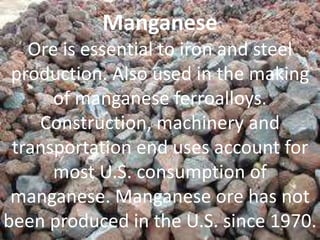
Manganese
Ore is essential to iron and steel
production. Also used in the making
of manganese ferroalloys.
Construction, machinery and
transportation end uses account for
most U.S. consumption of
manganese. Manganese ore has not
been produced in the U.S. since 1970.
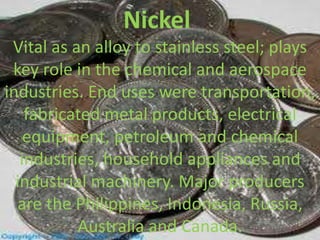
Nickel
Vital as an alloy to stainless steel; plays
key role in the chemical and aerospace
industries. End uses were transportation,
fabricated metal products, electrical
equipment, petroleum and chemical
industries, household appliances and
industrial machinery. Major producers
are the Philippines, Indonesia, Russia,
Australia and Canada.
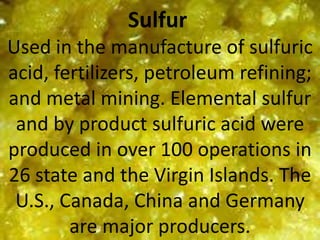
Sulfur
Used in the manufacture of sulfuric
acid, fertilizers, petroleum refining;
and metal mining. Elemental sulfur
and by product sulfuric acid were
produced in over 100 operations in
26 state and the Virgin Islands. The
U.S., Canada, China and Germany
are major producers.
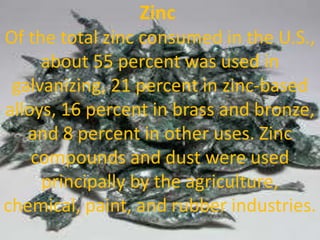
Zinc
Of the total zinc consumed in the U.S.,
about 55 percent was used in
galvanizing, 21 percent in zinc-based
alloys, 16 percent in brass and bronze,
and 8 percent in other uses. Zinc
compounds and dust were used
principally by the agriculture,
chemical, paint, and rubber industries.
Darlene Faye
Noay
International
System of
Units:
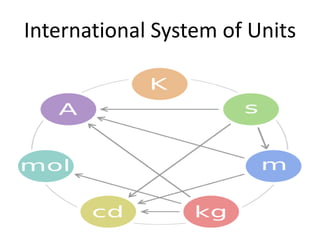
• A complete metric system of units
of measurement for scientists;
fundamental quantities are length(meter) and
mass(kilogram) and time (second) and electric
current(ampere) and temperature (kelvin) and
amount of matter (mole) and
luminous intensity (candela). The International
System of Units, universally abbreviated SI (from
the French Le Système International d’Unités), is
the modern metric system of measurement. Long
the dominant system used in science, the SI is
rapidly becoming the dominant measurement
system used in international commerce.
International System of Units
SI system
of Units
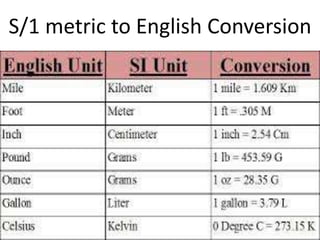
• The SI system of units (often referred
to as the metric system) is the official
system for measurements in nearly all
countries of the world, but not in US.
As our society and economy become
more global in scope’ it is increasingly
important to fully comprehend both
the English and the SI system of units
and to accurately and conveniently
convert from one system to another.
S/1 metric to English Conversion
Weather
Map
Symbols
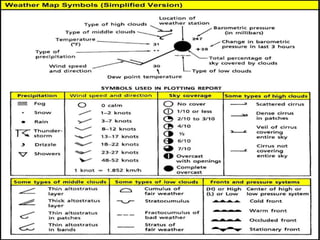
• Weather map symbols were created
as a method of reporting
meteorological data in mass
quantities to weather analyzing
agencies such as the National
Weather Service. The symbols are a
form of shorthand used when writing
out the
information longhand becomes
difficult.
Presentation1 group 9 new

Presentation1 group 9 new

  • 1.
  • 2.
    Objectives: •To understand whatis Rossi-Forel Scale and who are the 2 persons involved. •To be able to understand what will going to do during and after an earthquake. • Discuss some information's about Active and Inactive Volcanoes in the Philippines. • List the definititive characteristics that quality, certain Earth materials as minerals. •Demonstrate an understanding of the International System of Units. •To be able to understand measurements in both the English system of units and the SI (System International ) system of units. •To understanding a Weather Map is to understand the Weather Symbols that are used on the Map.
  • 3.
  • 4.
  • 5.
    An arbitrary numericalscale of intensity of seismic disturbances ranging from one for a barely perceptible tremor to 10 for an earthquake of the highest intensity.
  • 6.
    Michele Stefano Contede Rossi and François-Alphonse Forel
  • 7.
    The Rossi–Forel Scalewas one of the first seismic scales to reflect earthquake intensities. Developed by Michele Stefano Conte De Rossi of Italy and François-Alphonse Forel of Switzerland in the late 18th century, it was used for about two decades until the introduction of the Mercalli intensity scale in 1902.
  • 8.
    The 1873 versionof the Rossi–Forel Scale had 10 intensity levels: • I. Micro seismic tremor • II. Extremely feeble tremor • III. Feeble tremor • IV. Slight tremor • V. Moderate tremor • VI. Strong tremor • VII. Very strong tremor • VIII. Damaging tremor • IX. Devastating tremor • X. Extremely high intensity tremor
  • 9.
  • 10.
    The Richter magnitudescale (also Richter scale) assigns a magnitude number to quantify the energy released by an earthquake. The Richter scale is a base-10 logarithmic scale, which defines magnitude as the logarithm of the ratio of the amplitude of the seismic waves to an arbitrary, minor amplitude.
  • 11.
  • 12.
    Charles F. Richter,renowned seismologist, is a professor emeritus of seismology at the California Institute of Technology. He received his Ph.D. from Caltech in 1928. He is best known to the public for the Richter magnitude scale and he is equally recognized in the scientific community for his books Elementary Seismology and Seismicity of the Earth (coauthored with B. Gutenberg, 1954). Dr. Richter is probably the only man in the world who has a seismograph in his living room. Now 71, he retired from Caltech in July 1970.
  • 13.
  • 14.
    Seismometers are instrumentsthat measure motions of the ground, including those of seismic waves generated by earthquakes, volcanic eruptions, and other seismic sources. Records of seismic waves allow seismologists to map the interior of the Earth, and locate and measure the size of these different sources.
  • 15.
  • 16.
  • 17.
    • In areaswhere earthquakes are likely, knowing where to build and how to build can help reduce injury, loss of life, and property damage during a quake. Knowing what to do when a quake strikes can also help prevent injuries and deaths.
  • 18.
    What to do duringan Earthquake?
  • 30.
  • 31.
    •Check yourself andothers for injuries . •Check water , gas and electric lines for damage. •Turn on the radio . Don’t use the phone unless it’s an emergency. •Stay out of damage buildings. •Be careful around broken glass and debris. •Be careful of chimneys(they may fall on you) •Stay away from beaches. •Stay away from damage areas. •If you’re at school or work , follow the emergency plan or the instructions of the person in charge. •Expect aftershocks.
  • 32.
  • 33.
  • 34.
    1.) Mount Mayon–Albay Mount Mayon, one of the most impressive Philippine landmarks, with an elevation of 2,462 meters is the most active volcano in the Philippines. Based on recorded history of the country, this almost perfect cone volcano in Albay erupted at least 50 times from 1616 up to present. One of the most remarkable and most devastating eruptions of Mount Mayon was its eruption in 1766 that erased the town of Cagsawa in the Philippine map. Only the bell tower of Cagsawa Church remained above the new surface. Its last eruption was in January 2010.
  • 35.
    2.) Taal Volcano-Batangas Taal Volcano, situated within Taal Lake, has always been known to be one of the most active volcanoes in the country and in fact tagged as the world’s most active smallest volcano. This volcano located in Batangas province had erupted 33 times from 1572 to present. Its last eruption occurred in July 2009 and is currently closely monitored for its abnormal activities which may result to another eruption of this small but very active volcano. It has an elevation of 400 meters.
  • 36.
    3.) Mount Kanlaon– Negros Oriental With an elevation of 2.435 meters, one of the most active Philippine volcanoes is Mount Kanlaon or Kanlaon Volcano. It had erupted at least 25 times already from 1886 up to present. It last major eruption happened in 1996 and had been permanently monitored since then,
  • 37.
    4.) Mount Bulusan– Sorsogon This volcano with an elevation of 1,565 meters had erupted 15 times already from 1886 up to 2007. It has been closely monitored since its last eruption in 2007. This active volcano is located in the so-called “little Switzerland of the Philippines” – the province of Sorsogon.
  • 38.
    5.) Mount Makaturing– Lanao del Sur Not as popular as the Taal and Mayon volcanoes but Mount Makaturing, one of the ‘top ten highest mountains in the Philippines’, is also one of the most active volcanoes in the country. It has an elevation of 1,940 meters and had erupted 10 times since 1882.
  • 39.
    6. a) MusuanVolcano – Bukidnon Another not-so-famous volcano is Musuan Volcano located in the province of Bukidnon. With an elevation of 646 meters only, it is one of the most active volcanoes in the Philippines and had erupted 8 times in a span of 21 years from 1866 to 1887. Its last threatening activity of strong seismic swarm occurred in 1976 but has not erupted since then.
  • 40.
    6. b) MountRagang – Lanao del Sur Mount Ragang in Lanao del Sur, which is another tall mountain in the Philippines, is another active volcano that had erupted 8 times and tied with Musuan Volcano as the countries 6th most active volcano. Its last recorded eruption happened in 1916 or 94 years ago.
  • 41.
    7. a) DidicasVolcano - Cagayan One of the smallest and most active volcanoes in the Philippines is Dicicas Volcano located in Cagayan province. With an elevation of 244 meters only it had already erupted 7 times from 1773 up to 1990.
  • 42.
    7. b) Hibok-Hibok– Camiguin Mount Hibok-Hibok, one of the most popular volcanoes in the Philippines, had already erupted 7 times since the recorded history of the Philippines. With an elevation of 1,552 meters, this volcano’s first recorded eruption was in 1827 and the last was in 1952. It is tied with Didicas as the 7th most active volcanoes in the Philippines.

  • 43.
    8.) Smith Volcano– Cagayan Mount Smith in Cagayan province with an elevation of 688 meters above sea level had erupted 6 times already and the last known eruption of this active Philippine volcano was recorded in 1924.
  • 44.
    9. a) BabuyanClaro – Cagayan Babuyan Claro, an active volcano in Cagayan province, has an elevation of 1,080 meters above sea level. It erupted in 1831, 1860, 1913 and its last eruption was in 1917.
  • 45.
    9. b) MountBanahaw – Quezon Tied at 9th place as the most active volcanoes in the Philippines is Mount Banahaw in Quezon province. It has an elevation of 2,158 meters and had erupted 4 times since 1730 up to 1909. The mountain is considered 'sacred' by the residents of the area.
  • 46.
    10. a) DequeyVolcano – Batanes Dequey Volcano, an underwater volcano, is located in the smallest province of the Philippines – Batanes. With an elevation of -24 meters above sea level, it has been known to have erupted 3 times - 1773, 1850 and 1854. It is considered as Philippine most active undersea volcano.
  • 47.
    10. b.) MountParker – Cotabato And for the last spot as the Philippines most active volcanoes is Mount Parker, an active volcano located in Cotabato. With an elevation of 1,824, its earliest known recorded eruption occurred in 1800 BCE and its last major eruption was in 1641.
  • 48.
  • 49.
    1.)Mount Atimbia Mountain isdrawn on the National Geospatial Agency (NGA) Map. Mount Atimbia is located in the Laguna Area of the Country of Philippines. The Mountain is located at the latitude and longitude coordinates of 14.15 and 121.366389.
  • 50.
    2.) Mount Bagacay-Camarines Norte Mount Bagacay is a mountain and is located in Province of Camarines Norte, Bicol, Philippines. The elevation above sea level is 787 metres.
  • 51.
    3.) Mount Balikabok- Zambales Balikabokis next to Mount Dangas and is located in Province of Zambales, Central Luzon, Philippines
  • 52.
    4.) Mount Bangcay-NuevaEcija Mount Bangcay is a 1,339 ft / 408 m mountain peak near Paitan, Nueva Ecija, Philippines. Based on peakery data, it ranks as the 1439th highest mountain in Philippines.
  • 53.
    5.) Mount Batuan-Sorsogon MountBatuan (Mount Batuan) is a mountain (class T - Hypsographic) in Bicol (Sorsogon), Philippines (Asia) with the region font code of Asia/Pacific. It is located at an elevation of 98 meters above sea level.
  • 54.
    6.) Mount Caraycaray-Biliran Anelevation standing high above the surrounding area with small summit area, steep slopes and local relief of 300m or more.
  • 55.
    7.) Mount Mapula-Laguna Mount Mapula is a hill and is located in Province of Laguna, Calabarzon, Philippines. The elevation above sea level is 209 metres.
  • 56.
    8.) Mount Talomo-Davao Mt.Talomo is the guardian mountain and volcanic edifice of the revered Mt. Apo, the highest mountain in the Philippines. Due to its prominence, and on its own right one of the highest mountains in the Philippines, Mt. Talomo is an emerging hiking destination in Southern Mindanao.

  • 57.
    9.) Mount Lobo-Batangas There are three proximate, almost interconnecting mountains in Southern Batangas, straddling the southern coast of Luzon: from east to west, Mt. Daguldol, Mt. Lobo, and Mt. Banoi. Locals actually refer to the entire mountainous area as Lobo, further suggesting the unity of these peaks.
  • 58.
    10.) Mount Makiling-Laguna Mount Makiling, or Mount Maquiling, is a dormant volcano in Laguna province on the island of Luzon, Philippines. The mountain rises to an elevation of 1,090 m (3,580 ft) above mean sea level and is the highest feature of the Laguna Volcanic Field. The volcano has no recorded historic eruption but volcanism is still evident through geothermal features like mud spring and hot springs. South of the mountain is the Makiling-Banahaw Geothermal Plant. The Philippine Institute of Volcanology and Seismology (PHIVOLCS) classify the volcano as potentially active.

  • 59.
  • 60.
    10 Common Minerals ofthe Earths Crust, their Uses and Occurrences
  • 61.
    Barium A heavy metalcontained in barite. Used as a heavy additive in oil well drilling; in the paper and rubber industries; as a filler or extender in cloth, ink and plastics products; in radiography ("barium milkshake"); as a deoxidizer for copper; a sparkplug in alloys; and in making expensive white pigments.
  • 62.
    Chromite The U.S. consumesabout 6 percent of world chromite ore production in various forms of imported materials, such as chromite ore, chromite chemicals, chromium ferroalloys, chromium metal and stainless steel. Used as an alloy and in stainless and heat resisting steel products. Used in chemical and metallurgical industries (chrome fixtures, etc
  • 63.
    Cobalt Used primarily insuper alloys for aircraft gas turbine engines, in cemented carbides for cutting tools and wear-resistant applications, chemicals (paint dryers, catalysts, magnetic coatings) and permanent magnets. The United States has cobalt resources in Minnesota, Alaska, California, Idaho, Missouri, Montana and Oregon. Cobalt production comes principally from Congo, China, Canada, Russia, Australia and Zambia. The U.S. was 78 percent import reliant in 2012.
  • 64.
    Copper Used in buildingconstruction, electric and electronic products (cables and wires, switches, plumbing, heating); transportation equipment; roofing; chemical and pharmaceutical machinery; and alloys (brass, bronze and beryllium alloyed with copper are particularly vibration resistant); alloy castings; electroplated protective coatings and undercoats for nickel, chromium, zinc, etc.
  • 65.
    Gold Used in jewelryand arts; dentistry and medicine; in medallions and coins; in ingots as a store of value; for scientific and electronic instruments; as an electrolyte in the electroplating industry. Mined in Alaska and several western states. Leading producers are China, Australia, United States, Russia and Canada.
  • 66.
    Lead Used in lead-acidbatteries, gasoline additives (now being eliminated) and tanks, and solders, seals or bearing; used in electrical and electronic applications; TV tubes and glass, construction, communications and protective coatings; in ballast or weights; ceramics or crystal glass; X-ray and gamma radiation shielding; soundproofing material in construction industry; and ammunition. Industrial type batteries are used as a source of uninterruptible power equipment for computer and telecommunications networks and mobile power.
  • 67.
    Manganese Ore is essentialto iron and steel production. Also used in the making of manganese ferroalloys. Construction, machinery and transportation end uses account for most U.S. consumption of manganese. Manganese ore has not been produced in the U.S. since 1970.
  • 68.
    Nickel Vital as analloy to stainless steel; plays key role in the chemical and aerospace industries. End uses were transportation, fabricated metal products, electrical equipment, petroleum and chemical industries, household appliances and industrial machinery. Major producers are the Philippines, Indonesia, Russia, Australia and Canada.
  • 69.
    Sulfur Used in themanufacture of sulfuric acid, fertilizers, petroleum refining; and metal mining. Elemental sulfur and by product sulfuric acid were produced in over 100 operations in 26 state and the Virgin Islands. The U.S., Canada, China and Germany are major producers.
  • 70.
    Zinc Of the totalzinc consumed in the U.S., about 55 percent was used in galvanizing, 21 percent in zinc-based alloys, 16 percent in brass and bronze, and 8 percent in other uses. Zinc compounds and dust were used principally by the agriculture, chemical, paint, and rubber industries.
  • 71.
  • 72.
  • 73.
    • A completemetric system of units of measurement for scientists; fundamental quantities are length(meter) and mass(kilogram) and time (second) and electric current(ampere) and temperature (kelvin) and amount of matter (mole) and luminous intensity (candela). The International System of Units, universally abbreviated SI (from the French Le Système International d’Unités), is the modern metric system of measurement. Long the dominant system used in science, the SI is rapidly becoming the dominant measurement system used in international commerce.
  • 74.
  • 75.
  • 76.
    • The SIsystem of units (often referred to as the metric system) is the official system for measurements in nearly all countries of the world, but not in US. As our society and economy become more global in scope’ it is increasingly important to fully comprehend both the English and the SI system of units and to accurately and conveniently convert from one system to another.
  • 77.
    S/1 metric toEnglish Conversion
  • 78.
  • 79.
    • Weather mapsymbols were created as a method of reporting meteorological data in mass quantities to weather analyzing agencies such as the National Weather Service. The symbols are a form of shorthand used when writing out the information longhand becomes difficult.