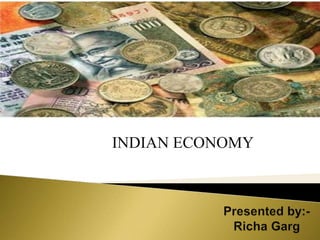

INDIAN ECONOMY
The Indian economy , the third largest economy in the world
in terms of PURCHASING POWER, is going to touch new
height in coming years.
According to global investment bank by 2035 India would be
3RD largest .
Economy of the work just after US and CHINA. It will grow
to 60% of size of the US. Economy
The History of India economy can be broadly divided into
three phase:
Pre-Colonial
Colonial
Post Colonial
Pre- Colonial:- The economy history of India since INDUS VALLEY
civilization to 1700 AD can be categorized under this phase. During this
Phase Indian economy was very well developed.
Colonial:- The arrival of East India Company in India caused a huge strain
to the Indian economy. During this phase Indians share of world income
deceived from 22.3% to 38% in 1952
Post Colonial:- After India got independence from colonial rule in 1947,
the process of rebuilding started various policies and schemes were
formulated.
Indian Economy is bound for slower growth. In recent months,
Indian government has introduced Pro business economic
reforms and outlined plans to increase.
Spending on capital investment and large scale social
programs.
In the first three months of 2013 the GDP growth slowed to
4.8%
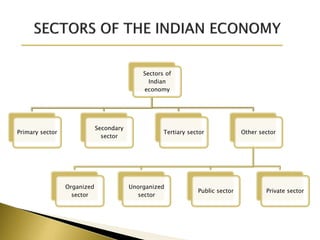
Sectors of
Indian
economy
Primary sector
Secondary
sector
Tertiary sector Other sector
Organized
sector
Unorganized
sector
Public sector Private sector
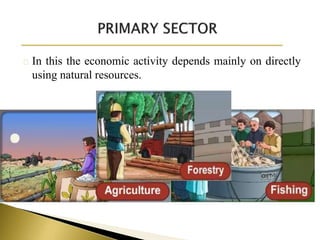
In this the economic activity depends mainly on directly
using natural resources.
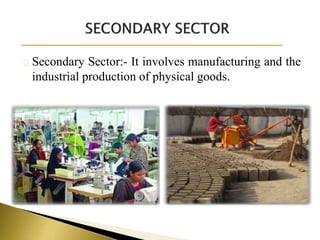
Secondary Sector:- It involves manufacturing and the
industrial production of physical goods.
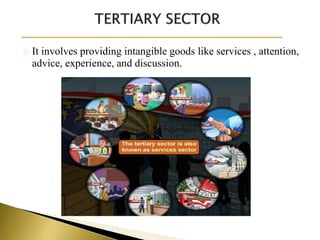
It involves providing intangible goods like services , attention,
advice, experience, and discussion.
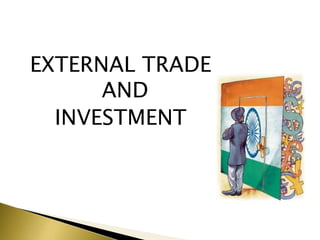
EXTERNAL TRADE
AND
INVESTMENT
What is External Trade ?
Exchange of capital, goods, and services across international
borders or territories.
Importance Of External Trade
International trade is exchange of capital, goods, and services
across international borders or territories.
International trade is the backbone of our modern, commercial
world, as producers in various nations try to profit from an
expanded market.
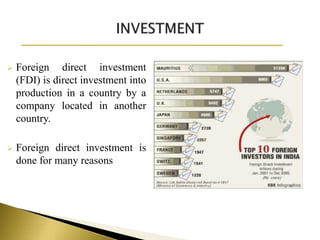
 Foreign direct investment
(FDI) is direct investment into
production in a country by a
company located in another
country.
 Foreign direct investment is
done for many reasons
India is well placed to benefit from globalization and
outsourcing.
There is much scope for increases in efficiency.
Demographics of India are favorable.
Positive Growth Forecasts.
Inflation.
Poor educational standard.
Poor Infrastructure.
Balance of payment deterioration.
High level of debt
Large budget deficit
Rigid labor laws
Slowdown in growth
If these problems are solved then the future for India looks
bright, India might well become one of the superpowers of the
21st Century. India country with Potentials for ‘sustaining’
development!!
Together we will make a difference.
Presentation1

Presentation1

  • 1.
  • 2.
    The Indian economy, the third largest economy in the world in terms of PURCHASING POWER, is going to touch new height in coming years. According to global investment bank by 2035 India would be 3RD largest . Economy of the work just after US and CHINA. It will grow to 60% of size of the US. Economy
  • 3.
    The History ofIndia economy can be broadly divided into three phase: Pre-Colonial Colonial Post Colonial Pre- Colonial:- The economy history of India since INDUS VALLEY civilization to 1700 AD can be categorized under this phase. During this Phase Indian economy was very well developed. Colonial:- The arrival of East India Company in India caused a huge strain to the Indian economy. During this phase Indians share of world income deceived from 22.3% to 38% in 1952 Post Colonial:- After India got independence from colonial rule in 1947, the process of rebuilding started various policies and schemes were formulated.
  • 4.
    Indian Economy isbound for slower growth. In recent months, Indian government has introduced Pro business economic reforms and outlined plans to increase. Spending on capital investment and large scale social programs. In the first three months of 2013 the GDP growth slowed to 4.8%
  • 5.
    Sectors of Indian economy Primary sector Secondary sector Tertiarysector Other sector Organized sector Unorganized sector Public sector Private sector
  • 6.
    In this theeconomic activity depends mainly on directly using natural resources.
  • 7.
    Secondary Sector:- Itinvolves manufacturing and the industrial production of physical goods.
  • 8.
    It involves providingintangible goods like services , attention, advice, experience, and discussion.
  • 9.
  • 10.
    What is ExternalTrade ? Exchange of capital, goods, and services across international borders or territories. Importance Of External Trade International trade is exchange of capital, goods, and services across international borders or territories. International trade is the backbone of our modern, commercial world, as producers in various nations try to profit from an expanded market.
  • 11.
     Foreign directinvestment (FDI) is direct investment into production in a country by a company located in another country.  Foreign direct investment is done for many reasons
  • 12.
    India is wellplaced to benefit from globalization and outsourcing. There is much scope for increases in efficiency. Demographics of India are favorable. Positive Growth Forecasts.
  • 13.
    Inflation. Poor educational standard. PoorInfrastructure. Balance of payment deterioration. High level of debt Large budget deficit Rigid labor laws Slowdown in growth
  • 14.
    If these problemsare solved then the future for India looks bright, India might well become one of the superpowers of the 21st Century. India country with Potentials for ‘sustaining’ development!! Together we will make a difference.