Evidences for Evolution
1. Paleontological evidences
• Fossil are remains of hard parts of life-forms found in rocks.
2. Morphology and comparative anatomy
Homologous & Analogous organs
• Palaeontology Fossil
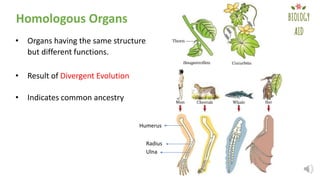
Homologous Organs
• Organs having the same structure
but different functions.
Humerus
Radius
Ulna
• Result of Divergent Evolution
• Indicates common ancestry
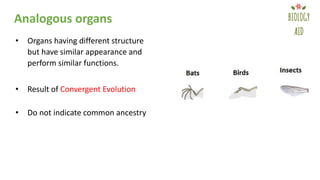
Analogous organs
• Organs having different structure
but have similar appearance and
perform similar functions.
• Result of Convergent Evolution
• Do not indicate common ancestry
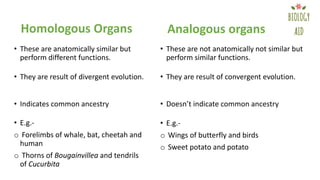
• These are anatomically similar but
perform different functions.
• These are not anatomically not similar but
perform similar functions.
Homologous Organs Analogous organs
• They are result of divergent evolution. • They are result of convergent evolution.
• Indicates common ancestry • Doesn’t indicate common ancestry
• E.g.-
o Forelimbs of whale, bat, cheetah and
human
o Thorns of Bougainvillea and tendrils
of Cucurbita
• E.g.-
o Wings of butterfly and birds
o Sweet potato and potato
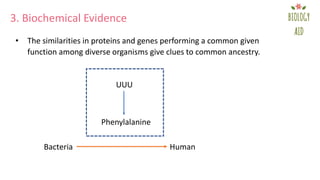
3. Biochemical Evidence
• The similarities in proteins and genes performing a common given
function among diverse organisms give clues to common ancestry.
UUU
Phenylalanine
Bacteria Human
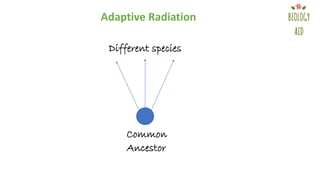
Adaptive Radiation
Common
Ancestor
Different species
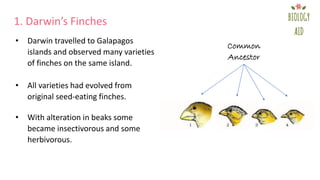
1. Darwin’s Finches
• Darwin travelled to Galapagos
islands and observed many varieties
of finches on the same island.
• All varieties had evolved from
original seed-eating finches.
• With alteration in beaks some
became insectivorous and some
herbivorous.
Common
Ancestor
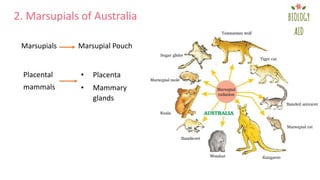
2. Marsupials of Australia
Marsupials Marsupial Pouch
Placental
mammals
• Placenta
• Mammary
glands
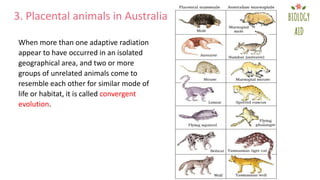
3. Placental animals in Australia
When more than one adaptive radiation
appear to have occurred in an isolated
geographical area, and two or more
groups of unrelated animals come to
resemble each other for similar mode of
life or habitat, it is called convergent
evolution.

Presentation1 (1).pdf

  • 1.
    Evidences for Evolution 1.Paleontological evidences • Fossil are remains of hard parts of life-forms found in rocks. 2. Morphology and comparative anatomy Homologous & Analogous organs • Palaeontology Fossil
  • 2.
    Homologous Organs • Organshaving the same structure but different functions. Humerus Radius Ulna • Result of Divergent Evolution • Indicates common ancestry
  • 3.
    Analogous organs • Organshaving different structure but have similar appearance and perform similar functions. • Result of Convergent Evolution • Do not indicate common ancestry
  • 4.
    • These areanatomically similar but perform different functions. • These are not anatomically not similar but perform similar functions. Homologous Organs Analogous organs • They are result of divergent evolution. • They are result of convergent evolution. • Indicates common ancestry • Doesn’t indicate common ancestry • E.g.- o Forelimbs of whale, bat, cheetah and human o Thorns of Bougainvillea and tendrils of Cucurbita • E.g.- o Wings of butterfly and birds o Sweet potato and potato
  • 5.
    3. Biochemical Evidence •The similarities in proteins and genes performing a common given function among diverse organisms give clues to common ancestry. UUU Phenylalanine Bacteria Human
  • 6.
  • 7.
    1. Darwin’s Finches •Darwin travelled to Galapagos islands and observed many varieties of finches on the same island. • All varieties had evolved from original seed-eating finches. • With alteration in beaks some became insectivorous and some herbivorous. Common Ancestor
  • 8.
    2. Marsupials ofAustralia Marsupials Marsupial Pouch Placental mammals • Placenta • Mammary glands
  • 9.
    3. Placental animalsin Australia When more than one adaptive radiation appear to have occurred in an isolated geographical area, and two or more groups of unrelated animals come to resemble each other for similar mode of life or habitat, it is called convergent evolution.