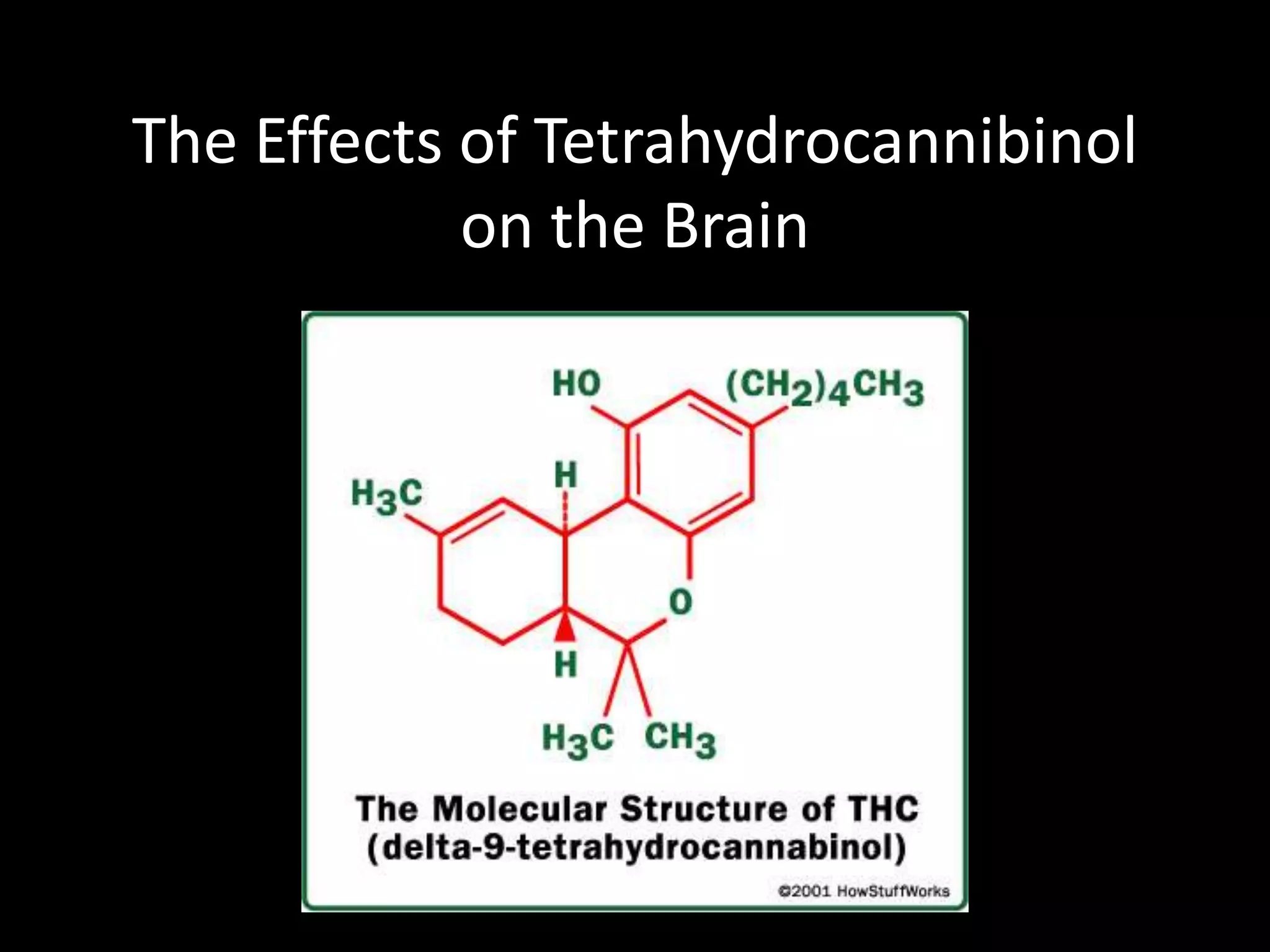
The Effects of Tetrahydrocannibinol
            on the Brain
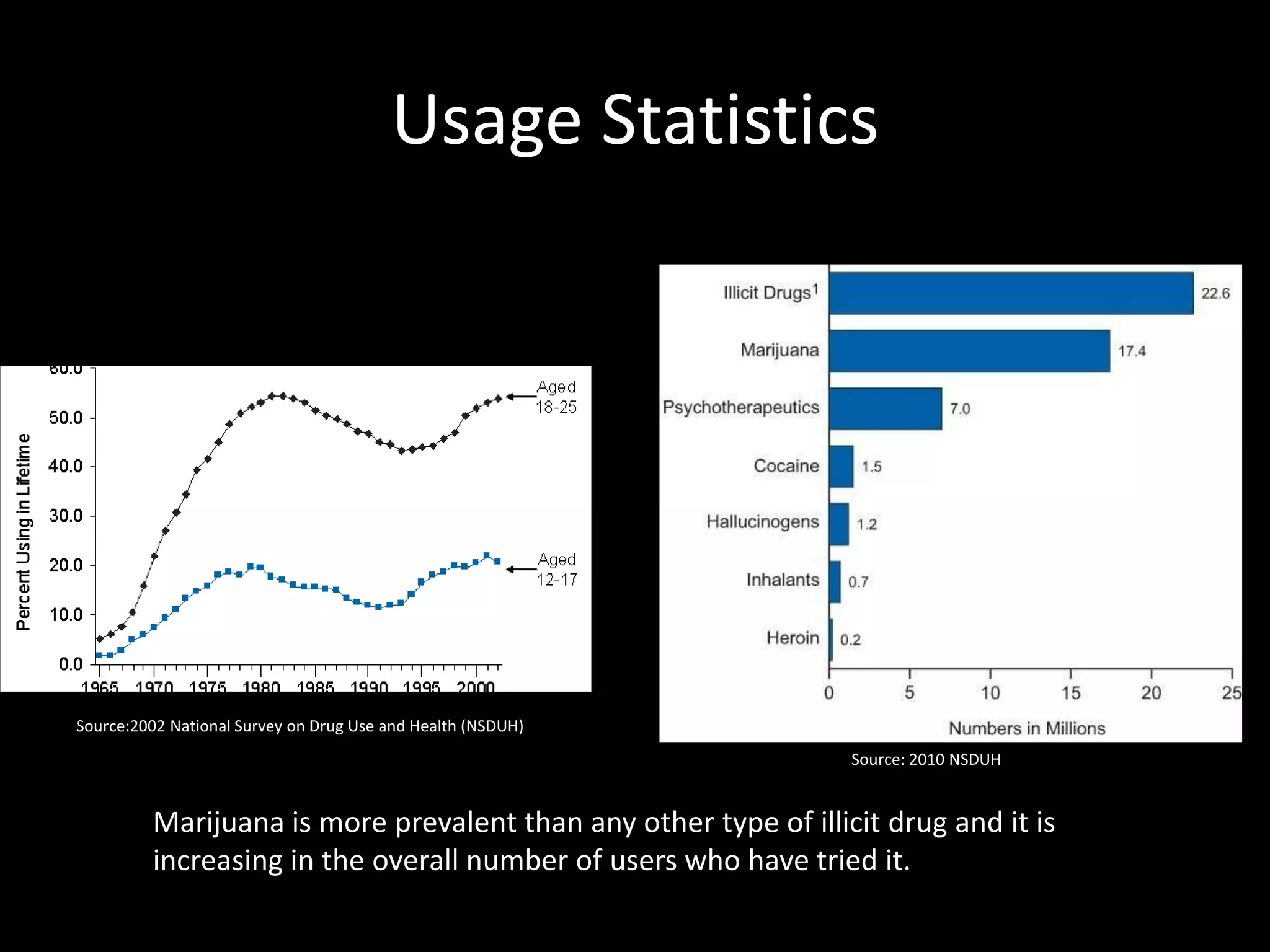
Usage Statistics


Source:2002 National Survey on Drug Use and Health (NSDUH)
                                                                 Source: 2010 NSDUH


         Marijuana is more prevalent than any other type of illicit drug and it is
         increasing in the overall number of users who have tried it.
Methods of usage and Reaching the Brain
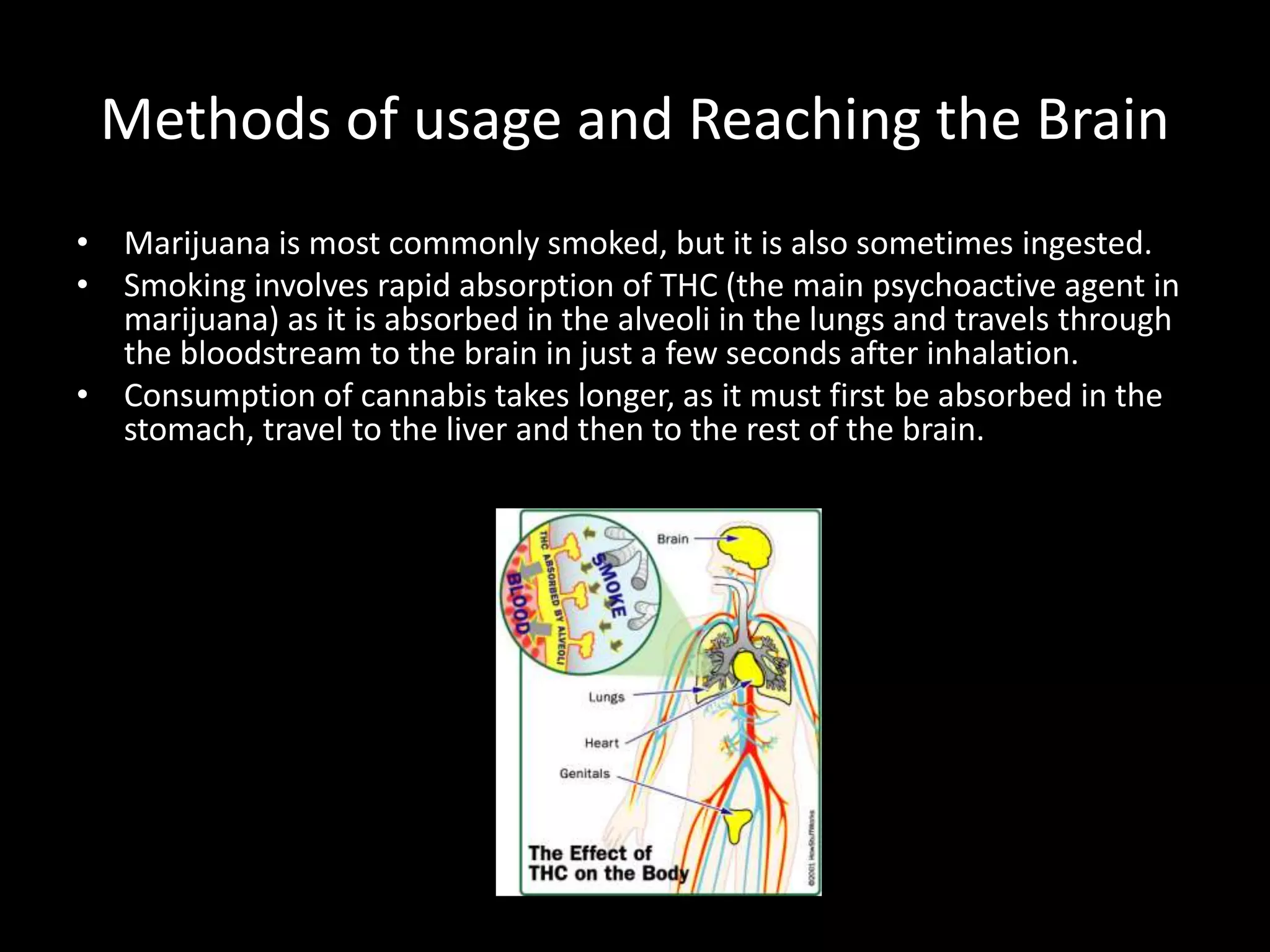
• Marijuana is most commonly smoked, but it is also sometimes ingested.
• Smoking involves rapid absorption of THC (the main psychoactive agent in
  marijuana) as it is absorbed in the alveoli in the lungs and travels through
  the bloodstream to the brain in just a few seconds after inhalation.
• Consumption of cannabis takes longer, as it must first be absorbed in the
  stomach, travel to the liver and then to the rest of the brain.


                                  Source: Howstufforks.com
Methods of Action in the Brain
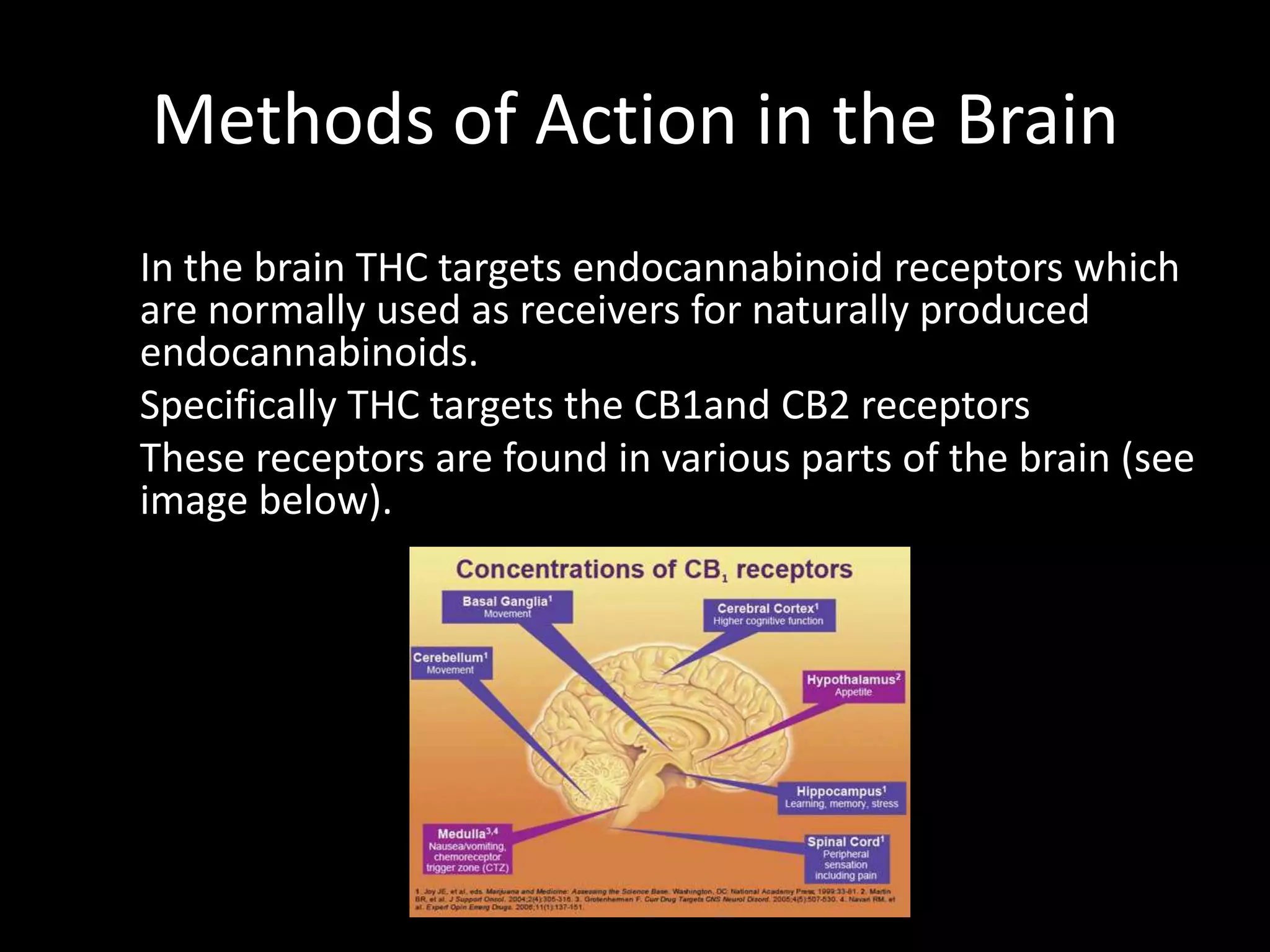
In the brain THC targets endocannabinoid receptors which
are normally used as receivers for naturally produced
endocannabinoids.
Specifically THC targets the CB1and CB2 receptors
These receptors are found in various parts of the brain (see
image below).
Methods of Action in the Brain (cont.)
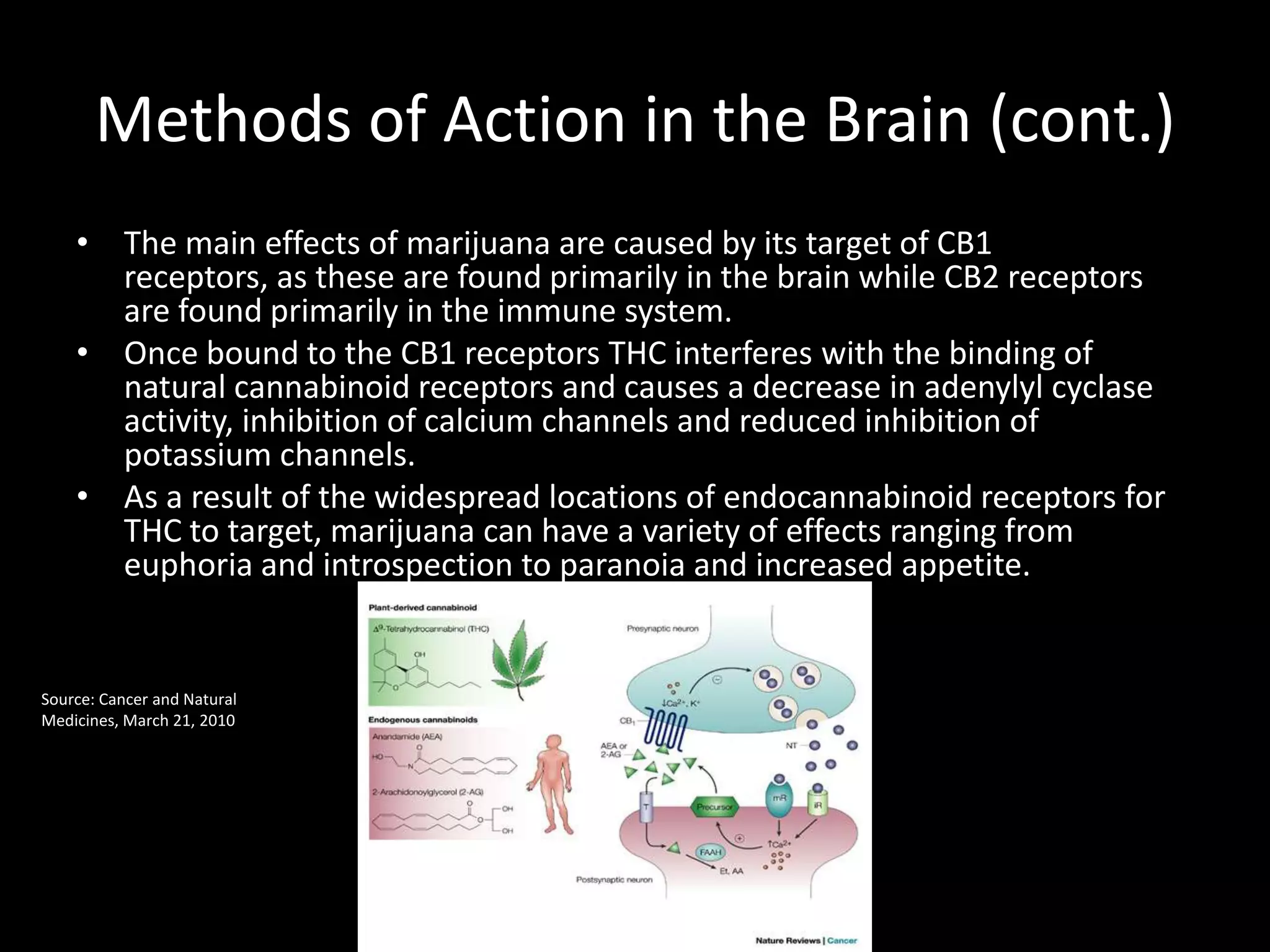
    • The main effects of marijuana are caused by its target of CB1
      receptors, as these are found primarily in the brain while CB2 receptors
      are found primarily in the immune system.
    • Once bound to the CB1 receptors THC interferes with the binding of
      natural cannabinoid receptors and causes a decrease in adenylyl cyclase
      activity, inhibition of calcium channels and reduced inhibition of
      potassium channels.
    • As a result of the widespread locations of endocannabinoid receptors for
      THC to target, marijuana can have a variety of effects ranging from
      euphoria and introspection to paranoia and increased appetite.


Source: Cancer and Natural
Medicines, March 21, 2010
Long-Term Effects of Marijuana Use
       (Psychosis and Depression)
• The overall effects of marijuana over time are still hotly contested.
• One of the common correlation with marijuana usage is between
  usage and depression and psychosis.
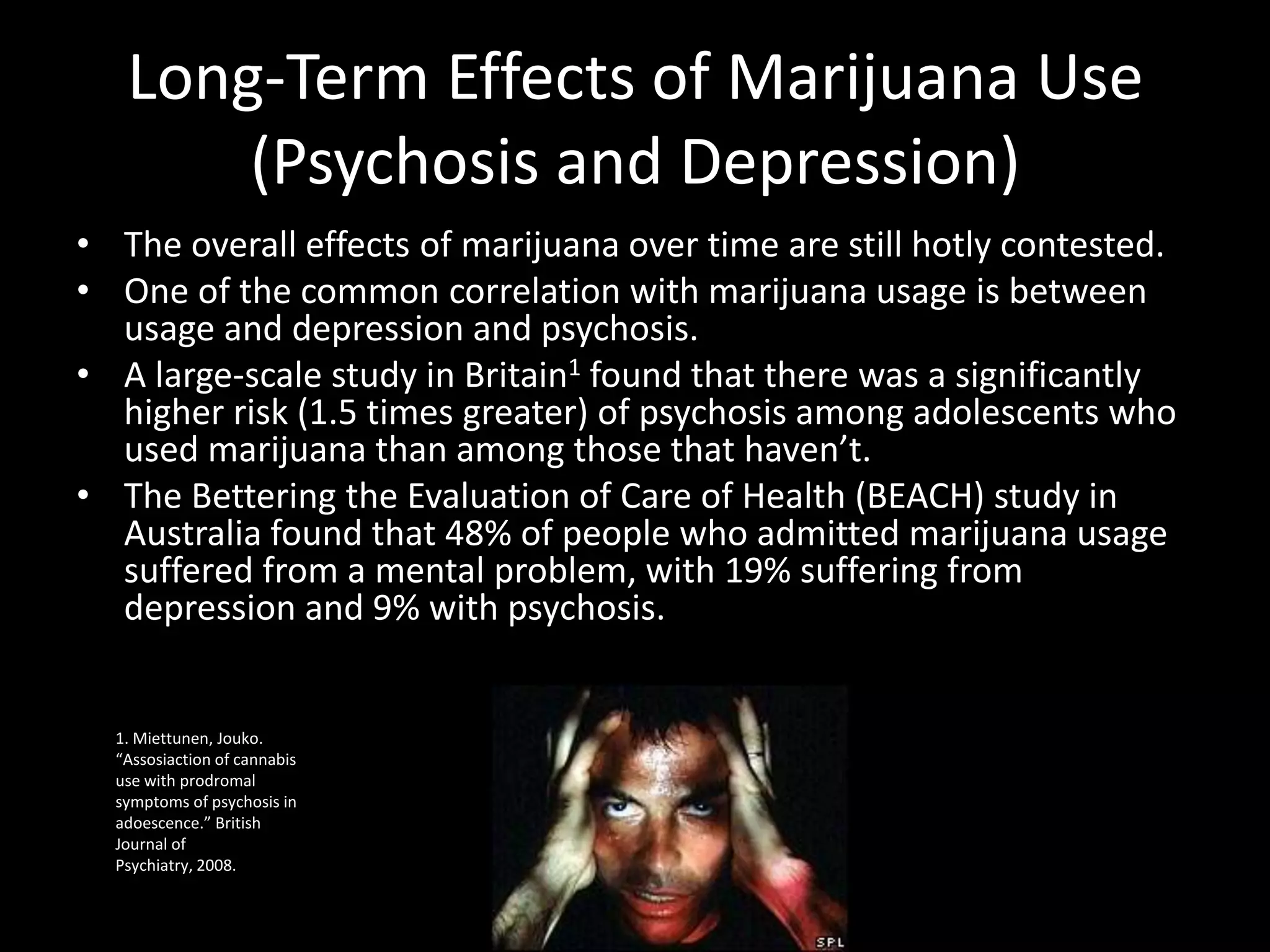
• A large-scale study in Britain1 found that there was a significantly
  higher risk (1.5 times greater) of psychosis among adolescents who
  used marijuana than among those that haven’t.
• The Bettering the Evaluation of Care of Health (BEACH) study in
  Australia found that 48% of people who admitted marijuana usage
  suffered from a mental problem, with 19% suffering from
  depression and 9% with psychosis.


  1. Miettunen, Jouko.
  “Assosiaction of cannabis
  use with prodromal
  symptoms of psychosis in
  adoescence.” British
  Journal of
  Psychiatry, 2008.
Long-Term Effects of Marijuana
                    Use(Correlation vs Causation)
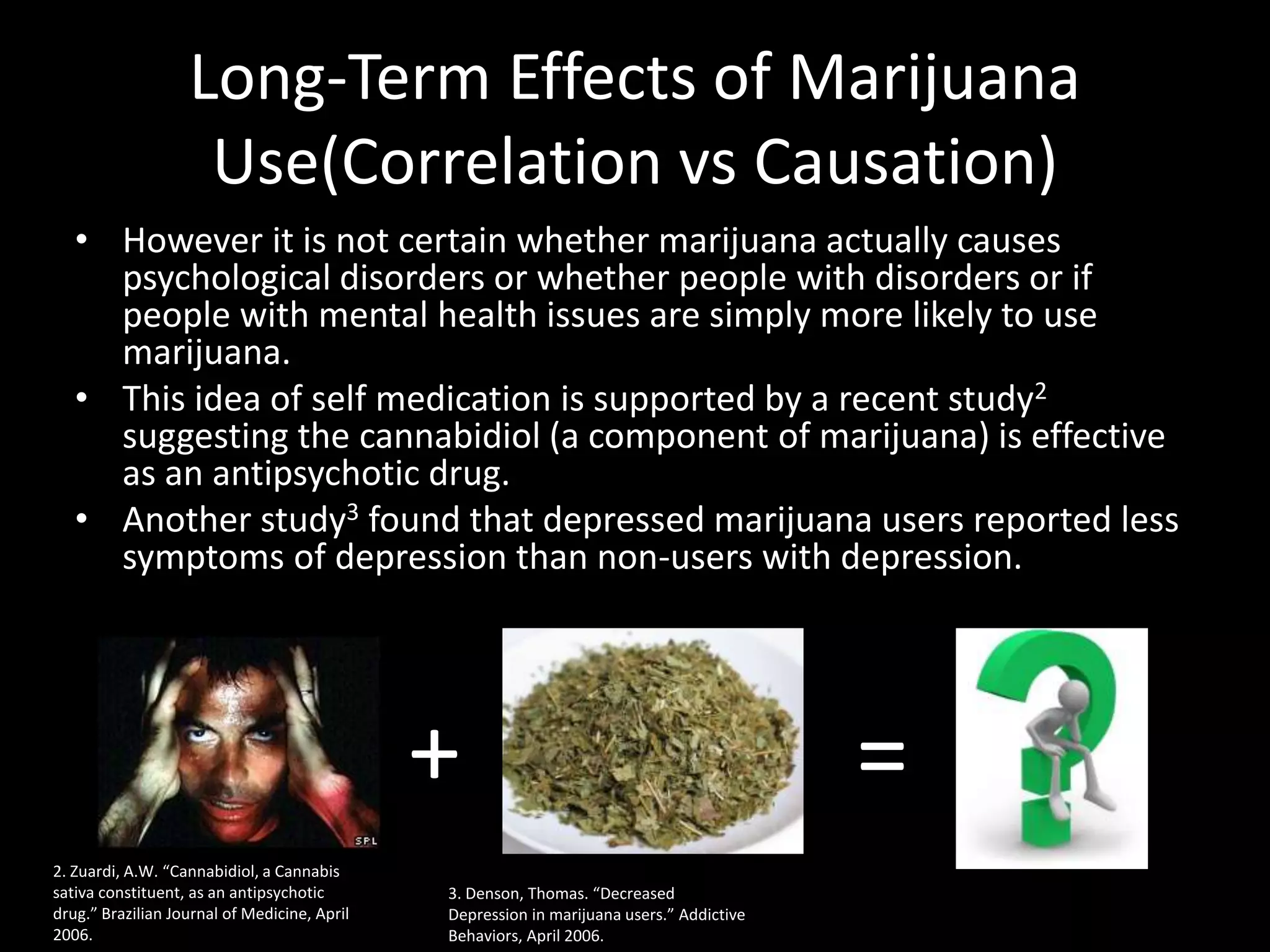
   • However it is not certain whether marijuana actually causes
     psychological disorders or whether people with disorders or if
     people with mental health issues are simply more likely to use
     marijuana.
   • This idea of self medication is supported by a recent study2
     suggesting the cannabidiol (a component of marijuana) is effective
     as an antipsychotic drug.
   • Another study3 found that depressed marijuana users reported less
     symptoms of depression than non-users with depression.


                                              +                                           =
2. Zuardi, A.W. “Cannabidiol, a Cannabis
sativa constituent, as an antipsychotic       3. Denson, Thomas. “Decreased
drug.” Brazilian Journal of Medicine, April   Depression in marijuana users.” Addictive
2006.                                         Behaviors, April 2006.
Long-Term Effects of Marijuana Use
               (Gateway Drug)
• One common attack on marijuana has been its effect
  as a gateway drug, either through social factors or
  physiological changes made to brain chemistry by the
  drug itself.
• However, a recent study4 found that adolescents who
  used marijuana were no more likely to develop a
  substance abuse issue than those who did not.

4. Tarter, Ralph. “Predictors of
Marijuana Use in Adolescents
Before and After Licit Drug Use:
Examination of the Gateway
Hypothesis.” American Journal of
Psychiatry, 2006.
Long Term Effects of Marijuana Use
                         (Brain Damage)
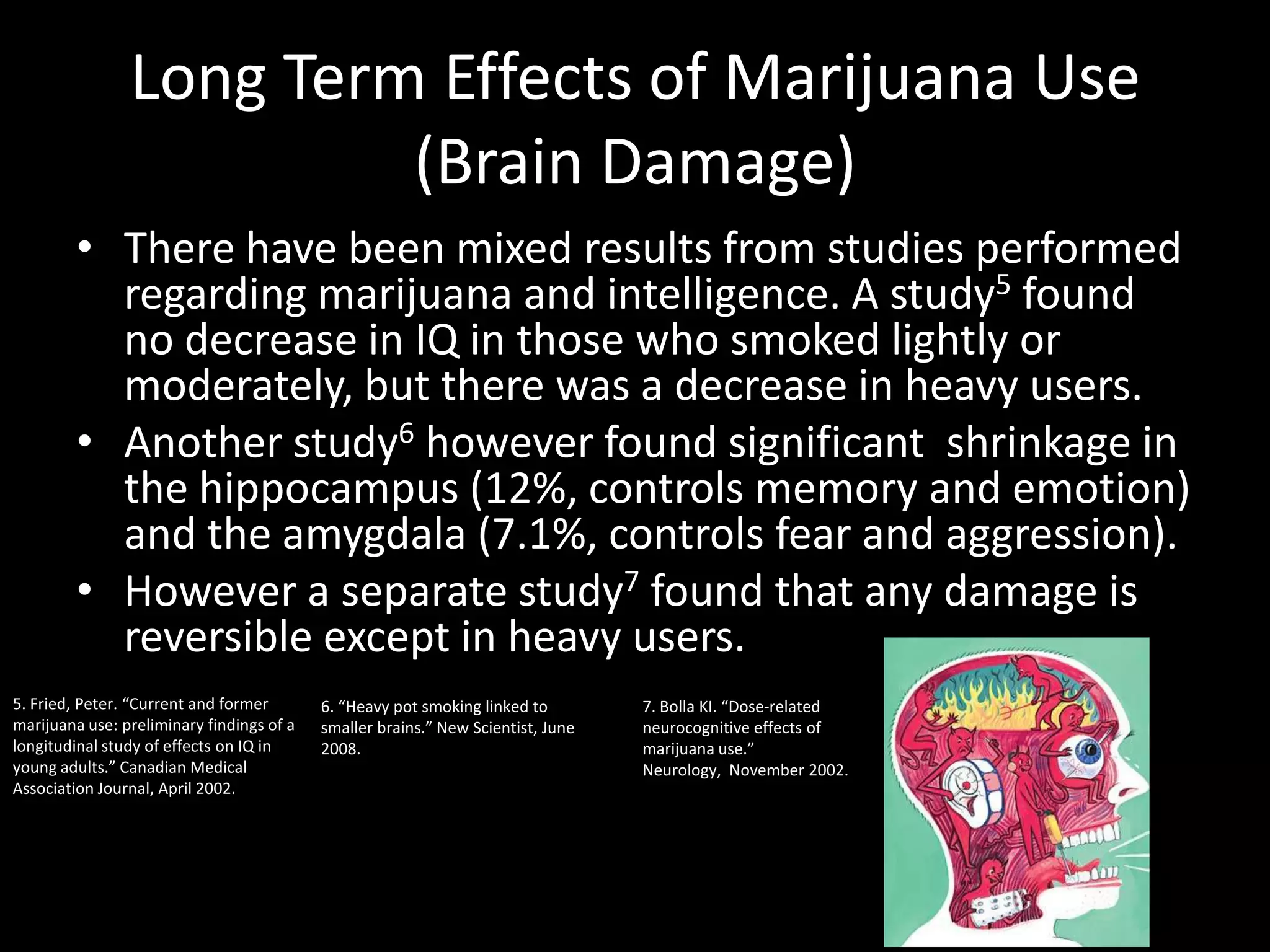
         • There have been mixed results from studies performed
           regarding marijuana and intelligence. A study5 found
           no decrease in IQ in those who smoked lightly or
           moderately, but there was a decrease in heavy users.
         • Another study6 however found significant shrinkage in
           the hippocampus (12%, controls memory and emotion)
           and the amygdala (7.1%, controls fear and aggression).
         • However a separate study7 found that any damage is
           reversible except in heavy users.
5. Fried, Peter. “Current and former       6. “Heavy pot smoking linked to        7. Bolla KI. “Dose-related
marijuana use: preliminary findings of a   smaller brains.” New Scientist, June   neurocognitive effects of
longitudinal study of effects on IQ in     2008.                                  marijuana use.”
young adults.” Canadian Medical                                                   Neurology, November 2002.
Association Journal, April 2002.
Long Term Effects of Marijuana Use
              (Addiction)
• Cannabis withdrawal has been studied8, and withdrawal
  usually lasts for 10-14 days and is associated with irritability
  and anxiety along with decreased appetite, indicating there
  that there is at least some physical dependence associated
  with marijuana usage
• Overall the addictive and withdrawal effects of marijuana
  are much less than those of opiates, stimulants or
  alcohol, and are never life-threatening.


  8. Kouri, Elena M. “Abstinence symptoms during
  withdrawal from chronic marijuana use.”
  Experimental and Clinical
  Psychophramacology, Nov 2000.
Areas for Further Study
• While there are many areas in need of study
  regarding marijuana and the
  brain, understanding better how marijuana
  affects light and moderate users, and the
  relationship between smoking and mental
  health are perhaps most important.
Conclusions
• The main conclusion here is that marijuana still
  requires additionally study. Many of the results found
  are conflicting or inconclusive, and even strong
  correlations do not necessarily show causation.
• The one thing that is clear is that heavy marijuana
  usage is bad for the brain. It causes shrinkage of
  important parts of the brain and heavy enough usage
  can make this damage permanent.
• Given that over 50% of youths will try marijuana at
  some point during their lifetime, and this trend seems
  to be increasing rather than decreasing, the need for
  greater understanding in this area is definite.

Presentation1

  • 1.
    The Effects ofTetrahydrocannibinol on the Brain
  • 2.
    Usage Statistics Source:2002 NationalSurvey on Drug Use and Health (NSDUH) Source: 2010 NSDUH Marijuana is more prevalent than any other type of illicit drug and it is increasing in the overall number of users who have tried it.
  • 3.
    Methods of usageand Reaching the Brain • Marijuana is most commonly smoked, but it is also sometimes ingested. • Smoking involves rapid absorption of THC (the main psychoactive agent in marijuana) as it is absorbed in the alveoli in the lungs and travels through the bloodstream to the brain in just a few seconds after inhalation. • Consumption of cannabis takes longer, as it must first be absorbed in the stomach, travel to the liver and then to the rest of the brain. Source: Howstufforks.com
  • 4.
    Methods of Actionin the Brain In the brain THC targets endocannabinoid receptors which are normally used as receivers for naturally produced endocannabinoids. Specifically THC targets the CB1and CB2 receptors These receptors are found in various parts of the brain (see image below).
  • 5.
    Methods of Actionin the Brain (cont.) • The main effects of marijuana are caused by its target of CB1 receptors, as these are found primarily in the brain while CB2 receptors are found primarily in the immune system. • Once bound to the CB1 receptors THC interferes with the binding of natural cannabinoid receptors and causes a decrease in adenylyl cyclase activity, inhibition of calcium channels and reduced inhibition of potassium channels. • As a result of the widespread locations of endocannabinoid receptors for THC to target, marijuana can have a variety of effects ranging from euphoria and introspection to paranoia and increased appetite. Source: Cancer and Natural Medicines, March 21, 2010
  • 6.
    Long-Term Effects ofMarijuana Use (Psychosis and Depression) • The overall effects of marijuana over time are still hotly contested. • One of the common correlation with marijuana usage is between usage and depression and psychosis. • A large-scale study in Britain1 found that there was a significantly higher risk (1.5 times greater) of psychosis among adolescents who used marijuana than among those that haven’t. • The Bettering the Evaluation of Care of Health (BEACH) study in Australia found that 48% of people who admitted marijuana usage suffered from a mental problem, with 19% suffering from depression and 9% with psychosis. 1. Miettunen, Jouko. “Assosiaction of cannabis use with prodromal symptoms of psychosis in adoescence.” British Journal of Psychiatry, 2008.
  • 7.
    Long-Term Effects ofMarijuana Use(Correlation vs Causation) • However it is not certain whether marijuana actually causes psychological disorders or whether people with disorders or if people with mental health issues are simply more likely to use marijuana. • This idea of self medication is supported by a recent study2 suggesting the cannabidiol (a component of marijuana) is effective as an antipsychotic drug. • Another study3 found that depressed marijuana users reported less symptoms of depression than non-users with depression. + = 2. Zuardi, A.W. “Cannabidiol, a Cannabis sativa constituent, as an antipsychotic 3. Denson, Thomas. “Decreased drug.” Brazilian Journal of Medicine, April Depression in marijuana users.” Addictive 2006. Behaviors, April 2006.
  • 8.
    Long-Term Effects ofMarijuana Use (Gateway Drug) • One common attack on marijuana has been its effect as a gateway drug, either through social factors or physiological changes made to brain chemistry by the drug itself. • However, a recent study4 found that adolescents who used marijuana were no more likely to develop a substance abuse issue than those who did not. 4. Tarter, Ralph. “Predictors of Marijuana Use in Adolescents Before and After Licit Drug Use: Examination of the Gateway Hypothesis.” American Journal of Psychiatry, 2006.
  • 9.
    Long Term Effectsof Marijuana Use (Brain Damage) • There have been mixed results from studies performed regarding marijuana and intelligence. A study5 found no decrease in IQ in those who smoked lightly or moderately, but there was a decrease in heavy users. • Another study6 however found significant shrinkage in the hippocampus (12%, controls memory and emotion) and the amygdala (7.1%, controls fear and aggression). • However a separate study7 found that any damage is reversible except in heavy users. 5. Fried, Peter. “Current and former 6. “Heavy pot smoking linked to 7. Bolla KI. “Dose-related marijuana use: preliminary findings of a smaller brains.” New Scientist, June neurocognitive effects of longitudinal study of effects on IQ in 2008. marijuana use.” young adults.” Canadian Medical Neurology, November 2002. Association Journal, April 2002.
  • 10.
    Long Term Effectsof Marijuana Use (Addiction) • Cannabis withdrawal has been studied8, and withdrawal usually lasts for 10-14 days and is associated with irritability and anxiety along with decreased appetite, indicating there that there is at least some physical dependence associated with marijuana usage • Overall the addictive and withdrawal effects of marijuana are much less than those of opiates, stimulants or alcohol, and are never life-threatening. 8. Kouri, Elena M. “Abstinence symptoms during withdrawal from chronic marijuana use.” Experimental and Clinical Psychophramacology, Nov 2000.
  • 11.
    Areas for FurtherStudy • While there are many areas in need of study regarding marijuana and the brain, understanding better how marijuana affects light and moderate users, and the relationship between smoking and mental health are perhaps most important.
  • 12.
    Conclusions • The mainconclusion here is that marijuana still requires additionally study. Many of the results found are conflicting or inconclusive, and even strong correlations do not necessarily show causation. • The one thing that is clear is that heavy marijuana usage is bad for the brain. It causes shrinkage of important parts of the brain and heavy enough usage can make this damage permanent. • Given that over 50% of youths will try marijuana at some point during their lifetime, and this trend seems to be increasing rather than decreasing, the need for greater understanding in this area is definite.