James Withers
Theocracy - a form of government in which a
Deity is recognized as the supreme civil ruler, but
 the Deity's laws are interpreted by ecclesiastical
authorities (bishops, mullahs, etc.); a government
           subject to religious authority.
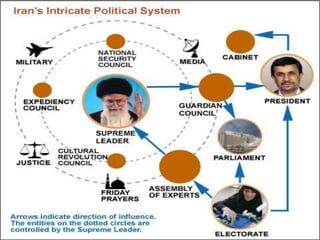
According to the constitution Iran, the
  Islamic Republic of Iran is a republic with
  nominal separation of powers among the
 executive, judicial, and legislative branches.
The senior figure in the system is the faqih, an
            expert in religious law
LegislativePower
Judiciary Power

Executive power
   The parliament is a
    bicameral legislature,
    consisting of the Majlis
    and the Council of
    Guardians. The Majlis
    comprises 290 deputies
    who are elected for four-
    year terms on the basis of
    universal suffrage. Five of
    these seats are reserved
    for special representatives
    of officially recognized
    religious minorities.
   The parliament is
    responsible for making
    laws.
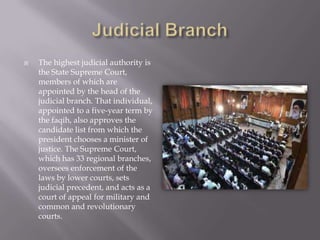
   The highest judicial authority is
    the State Supreme Court,
    members of which are
    appointed by the head of the
    judicial branch. That individual,
    appointed to a five-year term by
    the faqih, also approves the
    candidate list from which the
    president chooses a minister of
    justice. The Supreme Court,
    which has 33 regional branches,
    oversees enforcement of the
    laws by lower courts, sets
    judicial precedent, and acts as a
    court of appeal for military and
    common and revolutionary
    courts.
   The faqih, is elected by a majority vote
    of the Assembly of Experts, an 86-
    member body of senior clergymen
    who are elected by popular vote every
    five years. The faqih is responsible for
    choosing the commanders of the
    military services and the head of the
    judiciary, setting general state policy,
    declaring war and peace,
    commanding the armed forces,
    initiating and supervising
    amendments to the constitution, and
    supervising a variety of influential
    parastatal foundations and
    organizations. The executive branch is
    headed by the president, who in
    practice is the second-highest
    government official. He is elected in
    national elections every four years
    and is limited to two consecutive
    terms. The constitution specifies that
    the president must be a Shia Muslim.
Presentation1 (1) (3)

Presentation1 (1) (3)

  • 1.
  • 2.
    Theocracy - aform of government in which a Deity is recognized as the supreme civil ruler, but the Deity's laws are interpreted by ecclesiastical authorities (bishops, mullahs, etc.); a government subject to religious authority.
  • 3.
    According to theconstitution Iran, the Islamic Republic of Iran is a republic with nominal separation of powers among the executive, judicial, and legislative branches. The senior figure in the system is the faqih, an expert in religious law
  • 4.
  • 5.
    The parliament is a bicameral legislature, consisting of the Majlis and the Council of Guardians. The Majlis comprises 290 deputies who are elected for four- year terms on the basis of universal suffrage. Five of these seats are reserved for special representatives of officially recognized religious minorities.  The parliament is responsible for making laws.
  • 6.
    The highest judicial authority is the State Supreme Court, members of which are appointed by the head of the judicial branch. That individual, appointed to a five-year term by the faqih, also approves the candidate list from which the president chooses a minister of justice. The Supreme Court, which has 33 regional branches, oversees enforcement of the laws by lower courts, sets judicial precedent, and acts as a court of appeal for military and common and revolutionary courts.
  • 7.
    The faqih, is elected by a majority vote of the Assembly of Experts, an 86- member body of senior clergymen who are elected by popular vote every five years. The faqih is responsible for choosing the commanders of the military services and the head of the judiciary, setting general state policy, declaring war and peace, commanding the armed forces, initiating and supervising amendments to the constitution, and supervising a variety of influential parastatal foundations and organizations. The executive branch is headed by the president, who in practice is the second-highest government official. He is elected in national elections every four years and is limited to two consecutive terms. The constitution specifies that the president must be a Shia Muslim.