A model for sustainableA model for sustainable
investment ininvestment in
agricultural researchagricultural research
for developmentfor development
The Case of the West Africa AgriculturalThe Case of the West Africa Agricultural
Productivity Program (WAAPP)Productivity Program (WAAPP)
Harold Roy-Macauley
16 July, 2013 – Accra, Ghana
Presentation Plan
• Potential of agriculture in development
• Investment in agricultural research for
development
• WAAPP as a model for sustained
investment in agricultural research for
development
• Conclusion
Potential of agriculture in development
Agriculture is the engine for economic
growth and development in Africa
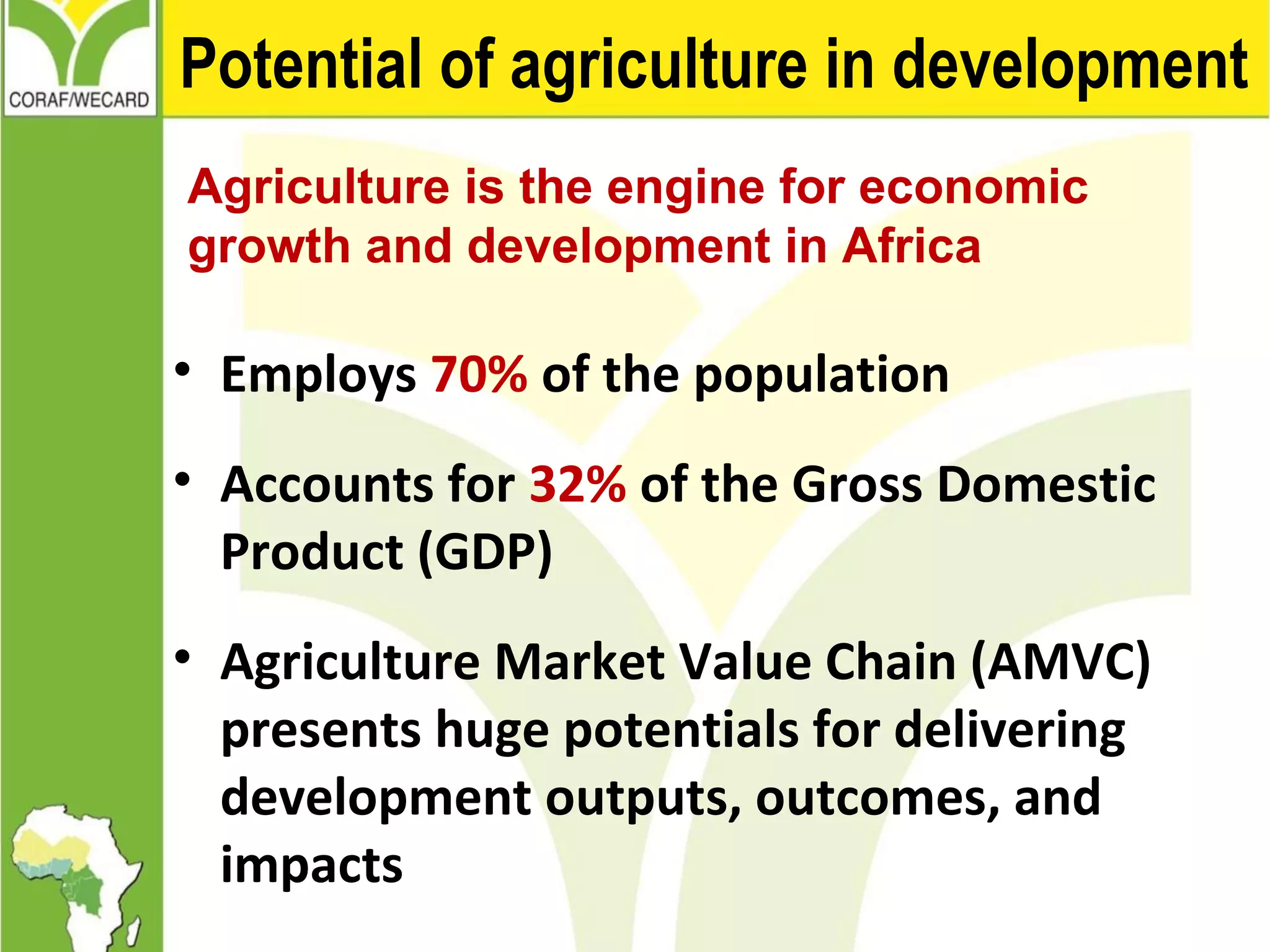
• Employs 70% of the population
• Accounts for 32% of the Gross Domestic
Product (GDP)
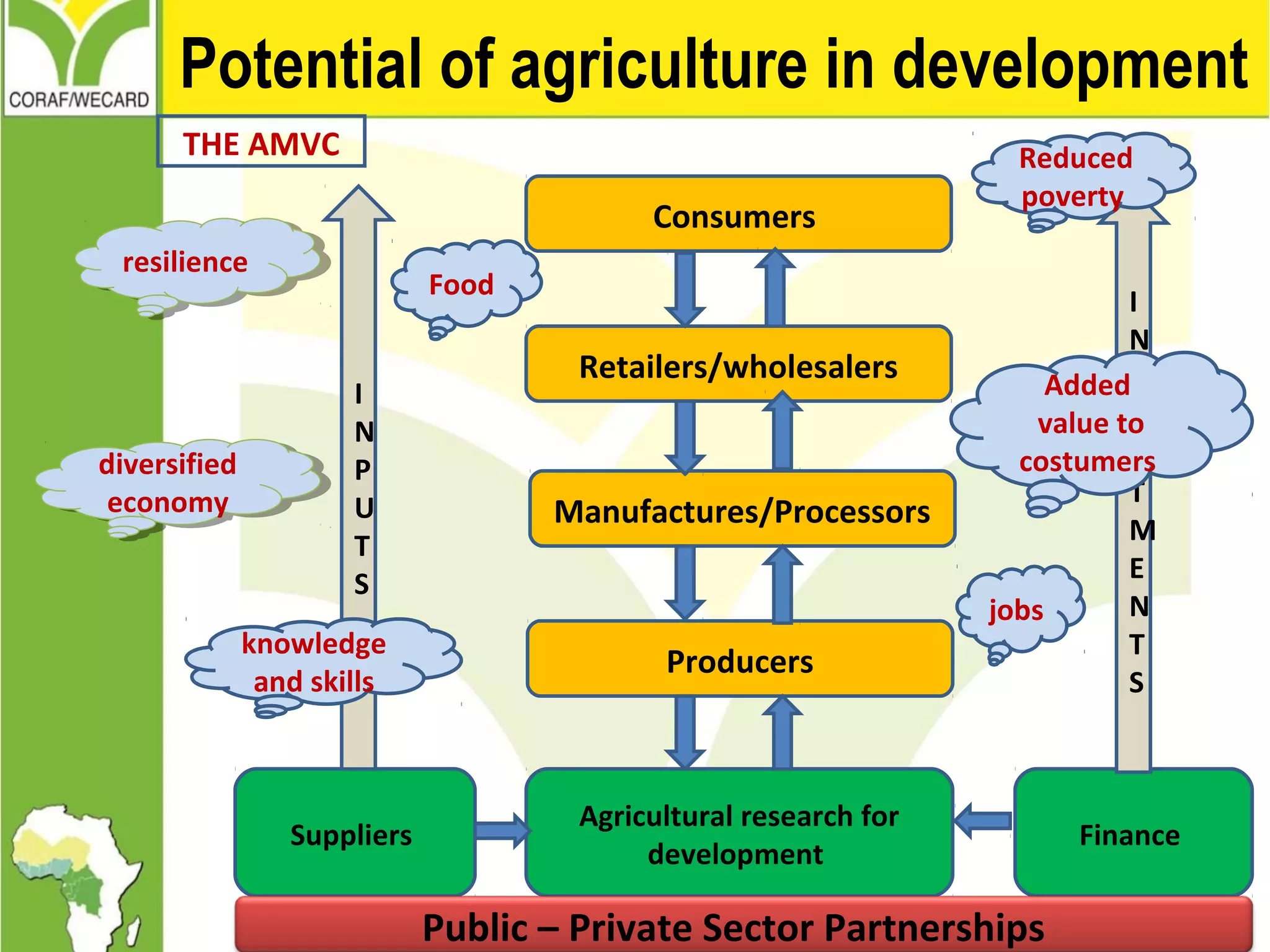
• Agriculture Market Value Chain (AMVC)
presents huge potentials for delivering
development outputs, outcomes, and
impacts
Potential of agriculture in development
Suppliers
Agricultural research for
development
Finance
Producers
Retailers/wholesalers
Consumers
Manufactures/Processors
THE AMVC
I
N
P
U
T
S
I
N
V
E
S
T
M
E
N
T
S
Food
jobs
knowledge
and skills
Reduced
poverty
Added
value to
costumers
resilienceresilience
diversified
economy
diversified
economy
Public – Private Sector Partnerships
Potential of agriculture in development
Unlock the potential of agriculture & fulfill vision
of African Heads of States - 6% annual agricultural
growth rate by 2015
• Costly process of structural reforms and
policy changes
• Countries are on the recovery path
• Long term challenge facing agriculture :
bridging the growth & productivity gap to
accelerate poverty reduction
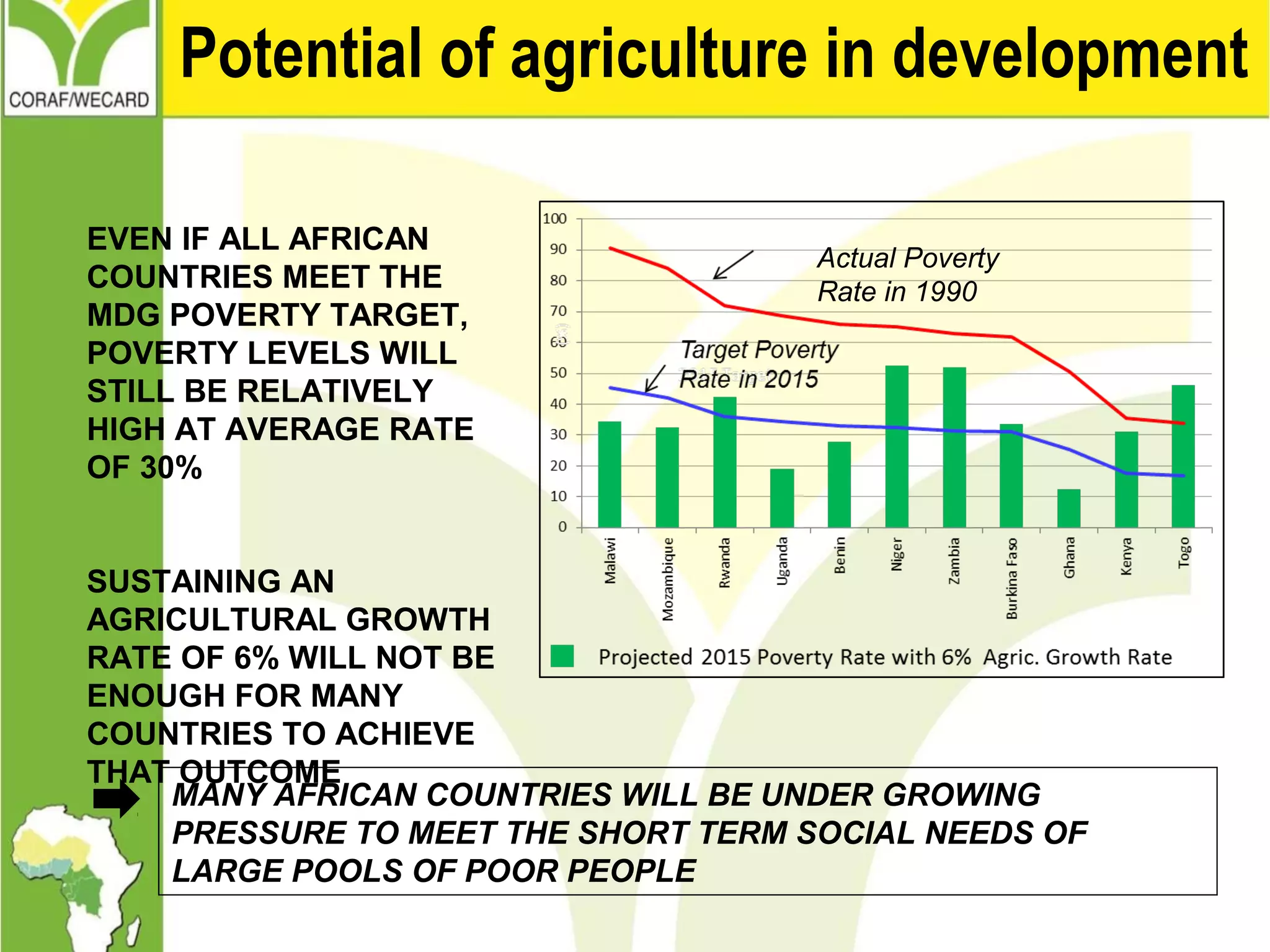
Actual Poverty
Rate in 1990
EVEN IF ALL AFRICAN
COUNTRIES MEET THE
MDG POVERTY TARGET,
POVERTY LEVELS WILL
STILL BE RELATIVELY
HIGH AT AVERAGE RATE
OF 30%
SUSTAINING AN
AGRICULTURAL GROWTH
RATE OF 6% WILL NOT BE
ENOUGH FOR MANY
COUNTRIES TO ACHIEVE
THAT OUTCOME
MANY AFRICAN COUNTRIES WILL BE UNDER GROWING
PRESSURE TO MEET THE SHORT TERM SOCIAL NEEDS OF
LARGE POOLS OF POOR PEOPLE
Potential of agriculture in development
• Governments and development partners
are recognizing the importance of investing
in agriculture
• Foreign Direct Investment (FDI) flows to
developing countries doubled in 2006–08,
but the share going to the agrifood sector is
small – less than 5 percent of total
• Long term challenge facing agriculture
would be bridging the expenditure gap to
accelerate growth
LONG TERM CHALLENGE FACING AGRICULTURE #2:
BRIDGING THE EXPENDITURE GAP TO ACCELERATE GROWTH
Actual Poverty Rate
in 1990
Source: Dollar a Day Poverty Rates from World Bank, PovCal Net, 2008 [poverty line $1.25];
Projected CAADP Poverty Rates from various IFPRI country CAADP Growth
Simulation Studies
THE FUNDING
REQUIREMENTS TO
ACHIEVE A 6% GROWTH
IN THE AGRICULTURAL
SECTOR WOULD IMPLY
DOUBLE DIGIT BUDGET
GROWTH RATES
AFRICAN COUNTRIES
WILL THEREFORE FIND
THEMSELVES IN SEVERE
BUDGETARY TRADE
OFFS:
1.HAVING TO FINANCE THE GROWING
SHORT TERM SOCIAL NEEDS OF LARGE
POOLS OF POOR PEOPLE
2.WHILE INVESTING MORE IN LONG
TERM GROWTH
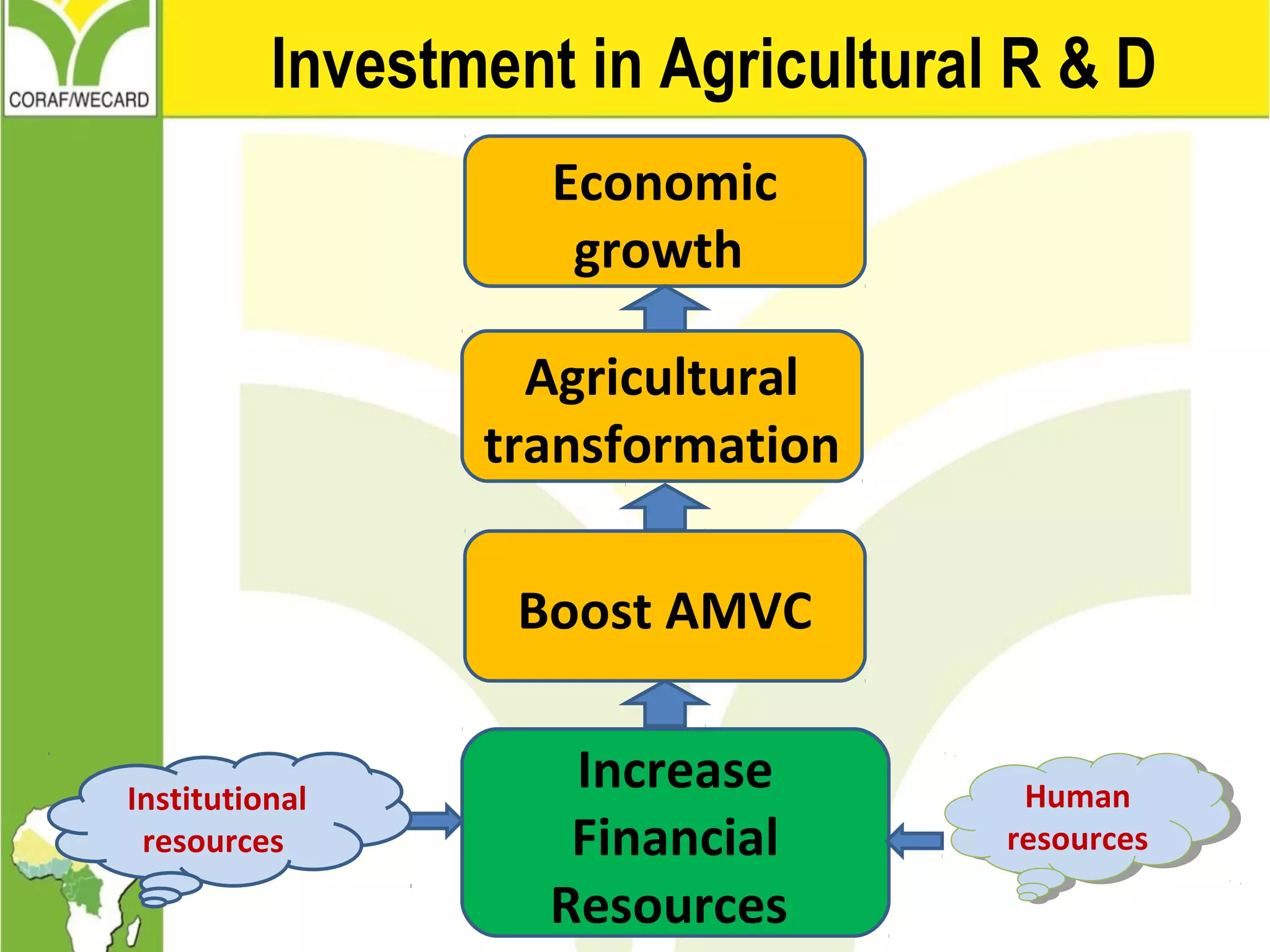
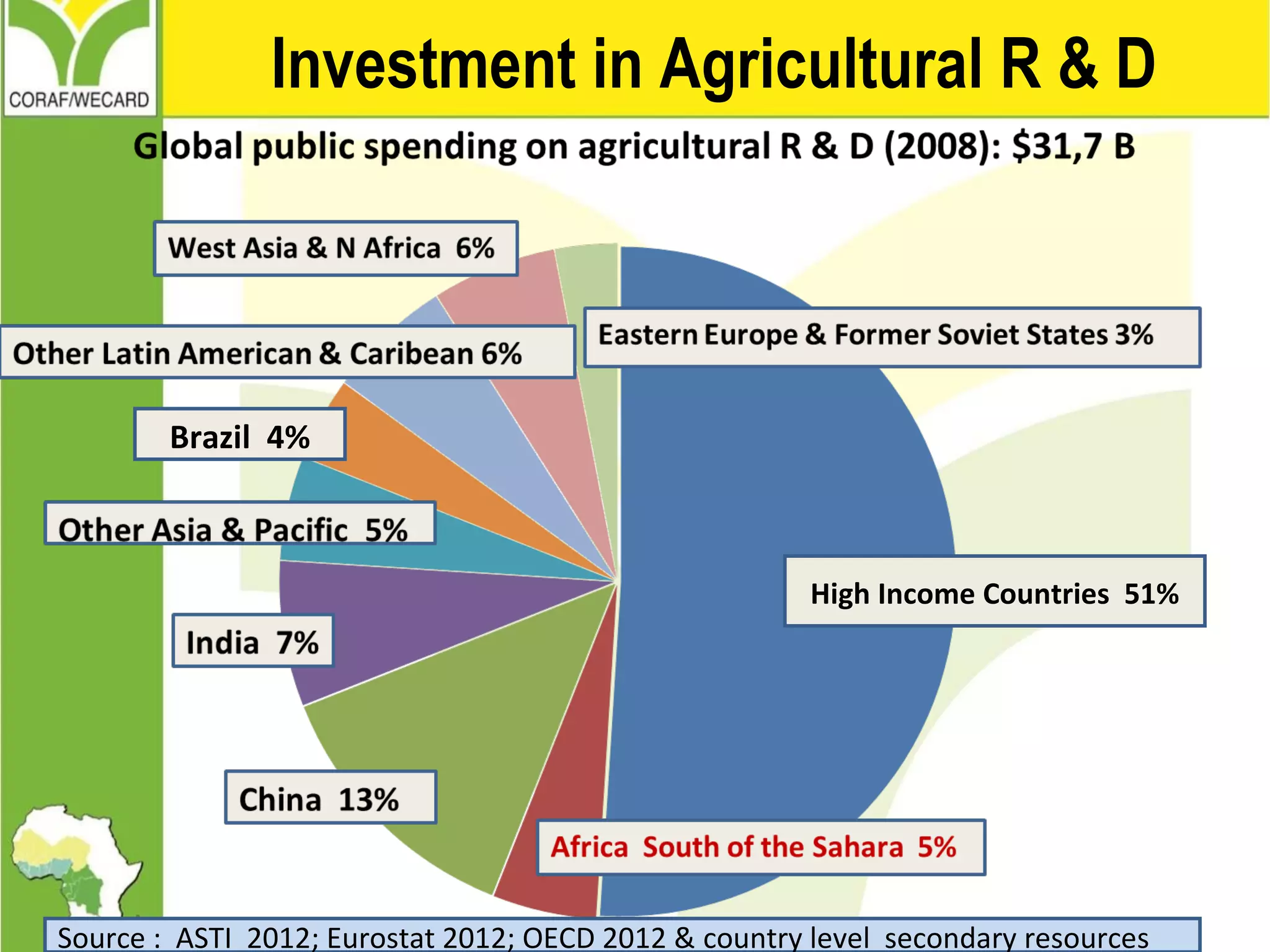
Investment in Agricultural R & D
Increase
Financial
Resources
Boost AMVC
Economic
growth
Agricultural
transformation
Institutional
resources
Human
resources
Human
resources
Investment in Agricultural R & D
Brazil 4%
High Income Countries 51%
Source : ASTI 2012; Eurostat 2012; OECD 2012 & country level secondary resources
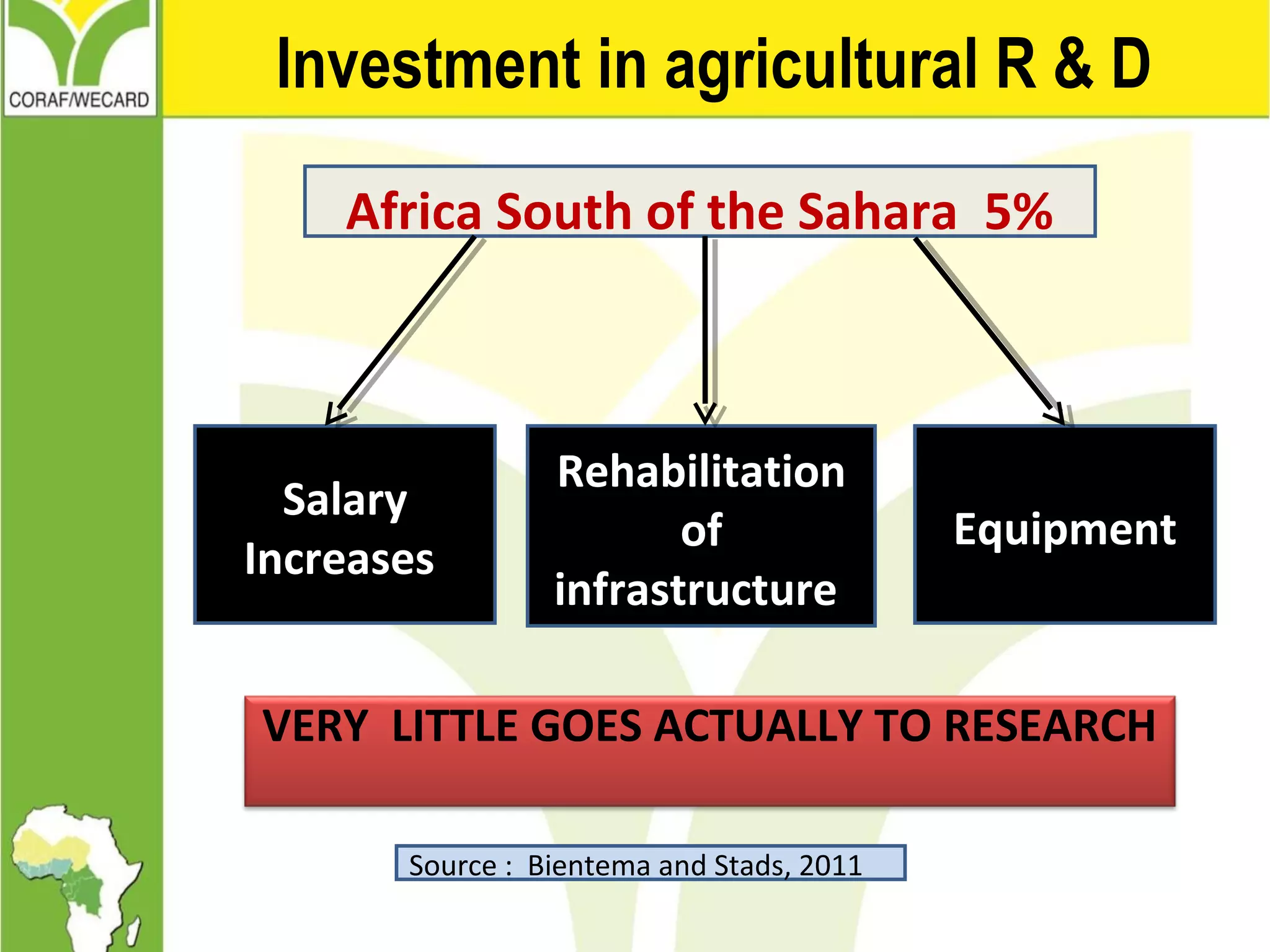
Investment in agricultural R & D
Africa South of the Sahara 5%
Salary
Increases
Rehabilitation
of
infrastructure
Equipment
Source : Bientema and Stads, 2011
VERY LITTLE GOES ACTUALLY TO RESEARCH
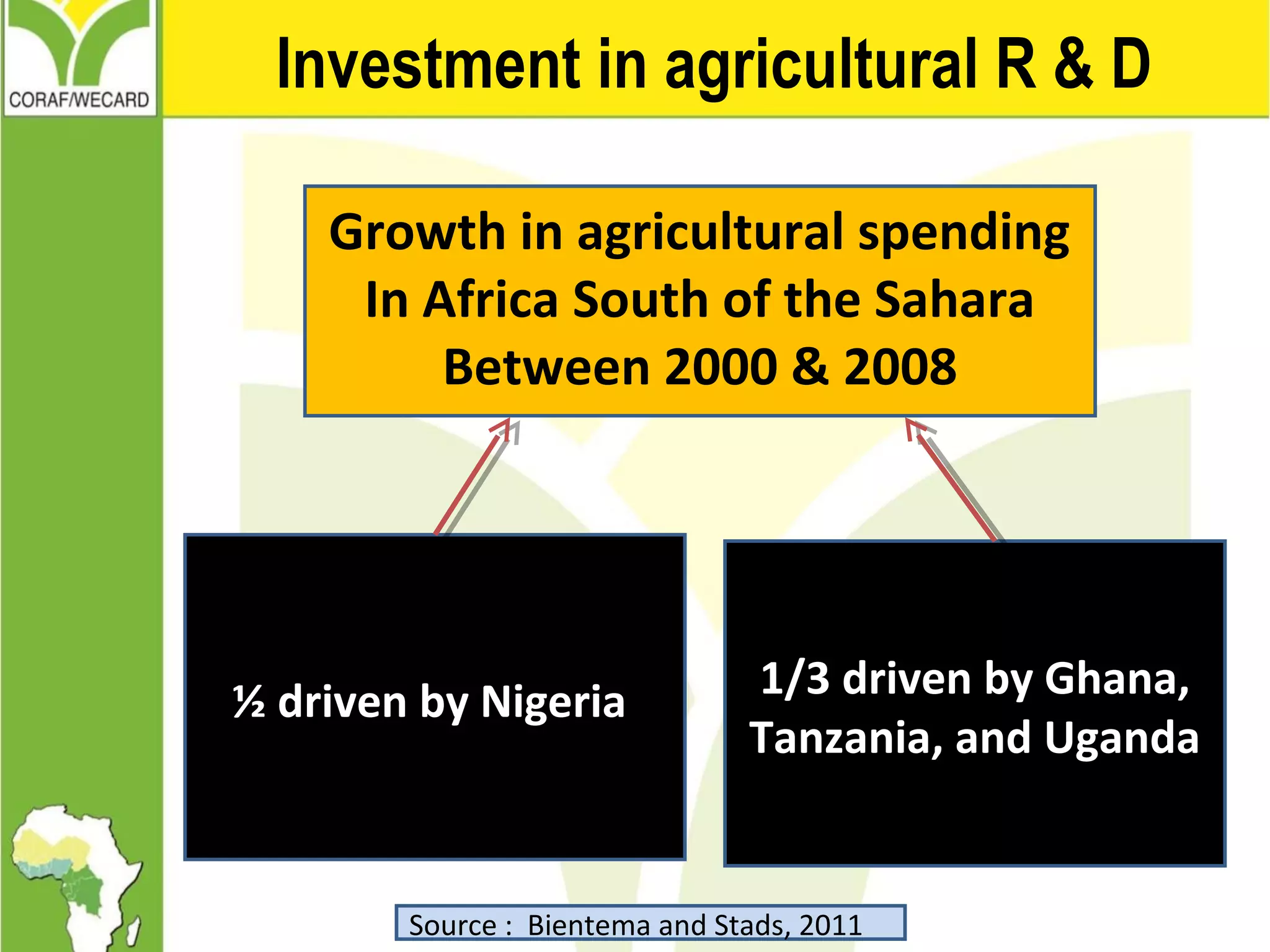
Investment in agricultural R & D
Growth in agricultural spending
In Africa South of the Sahara
Between 2000 & 2008
1/3 driven by Ghana,
Tanzania, and Uganda
½ driven by Nigeria
Source : Bientema and Stads, 2011
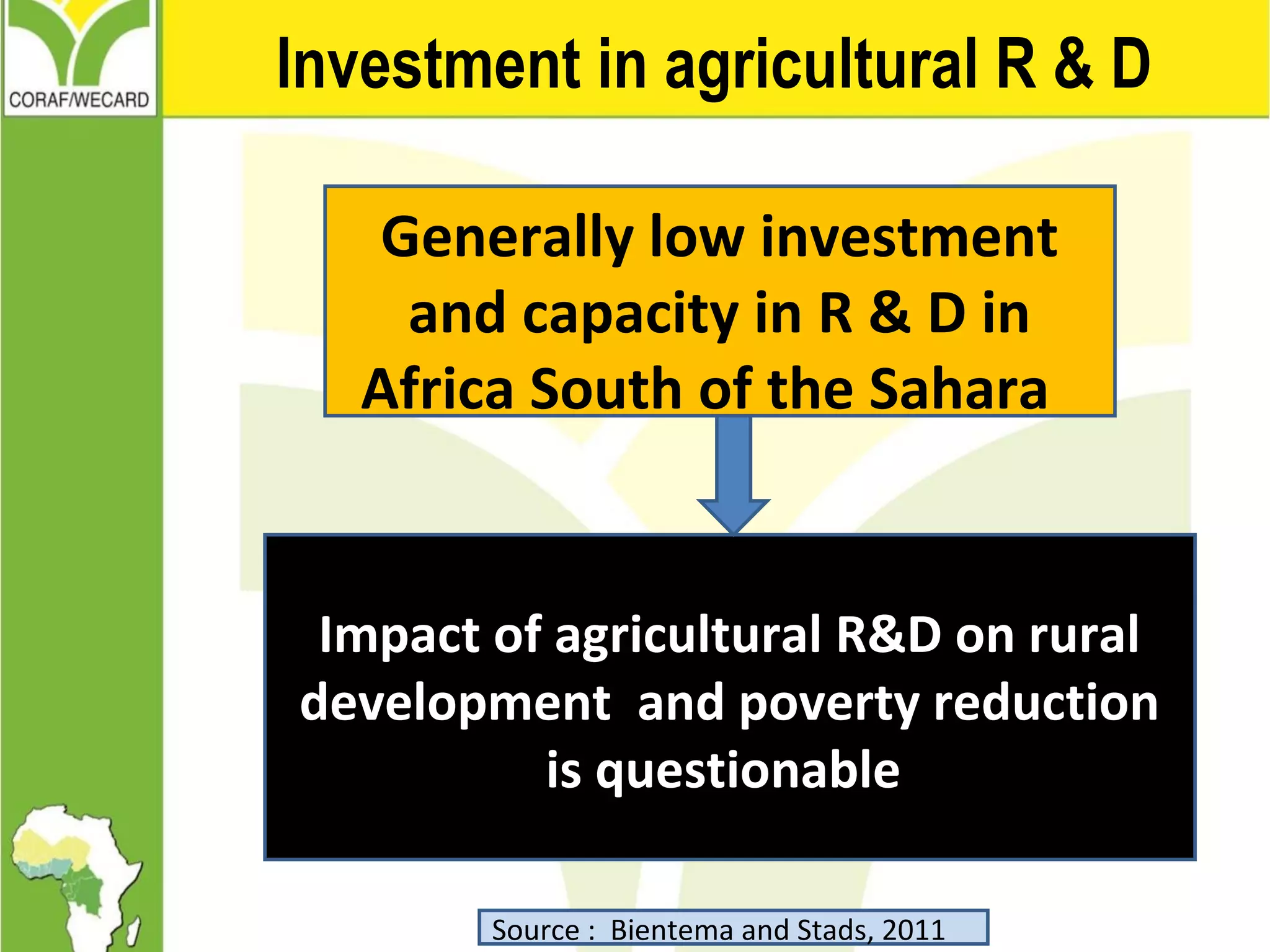
Investment in agricultural R & D
Generally low investment
and capacity in R & D in
Africa South of the Sahara
Impact of agricultural R&D on rural
development and poverty reduction
is questionable
Source : Bientema and Stads, 2011
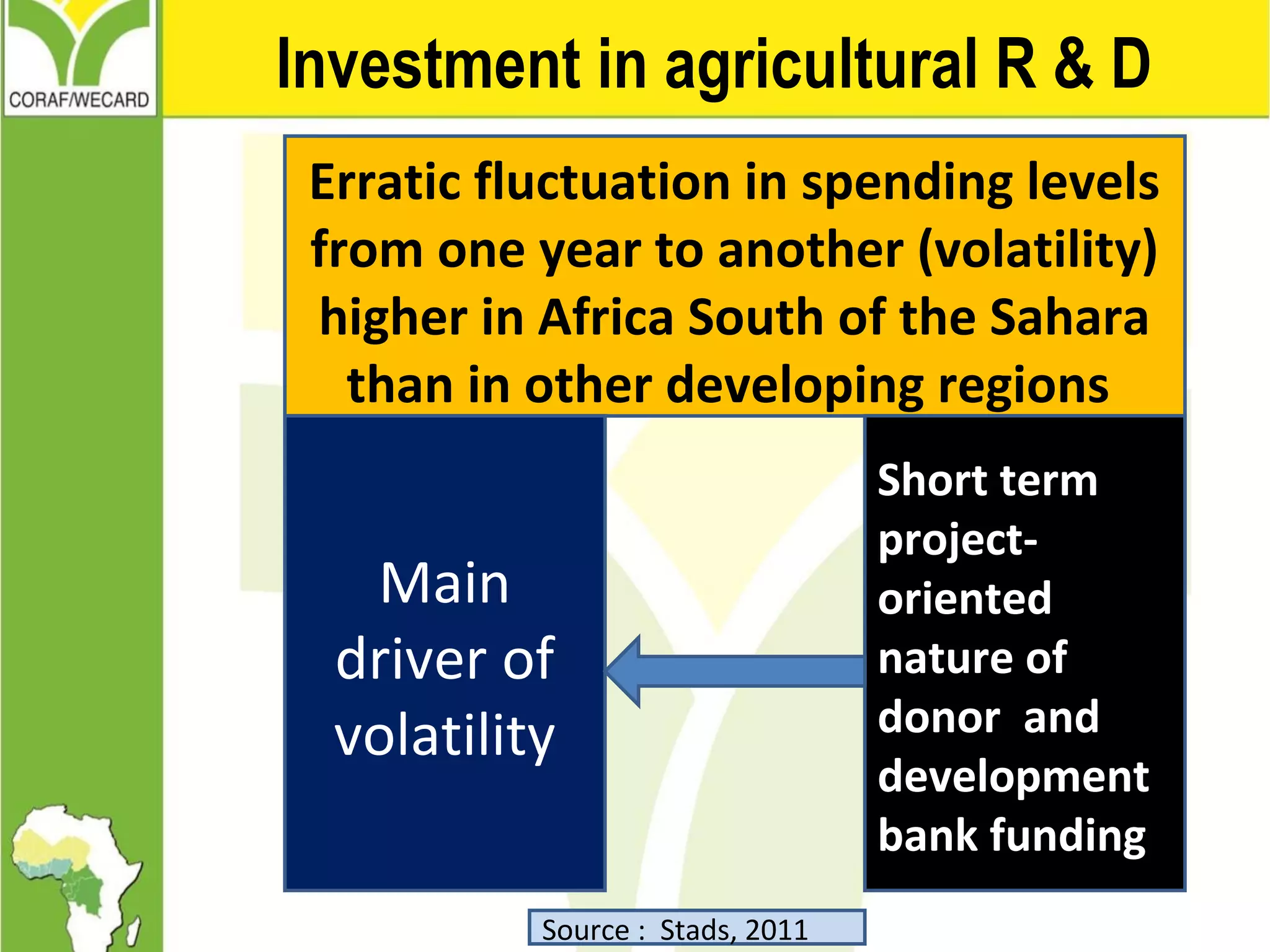
Investment in agricultural R & D
Erratic fluctuation in spending levels
from one year to another (volatility)
higher in Africa South of the Sahara
than in other developing regions
Short term
project-
oriented
nature of
donor and
development
bank funding
Source : Stads, 2011
Main
driver of
volatility
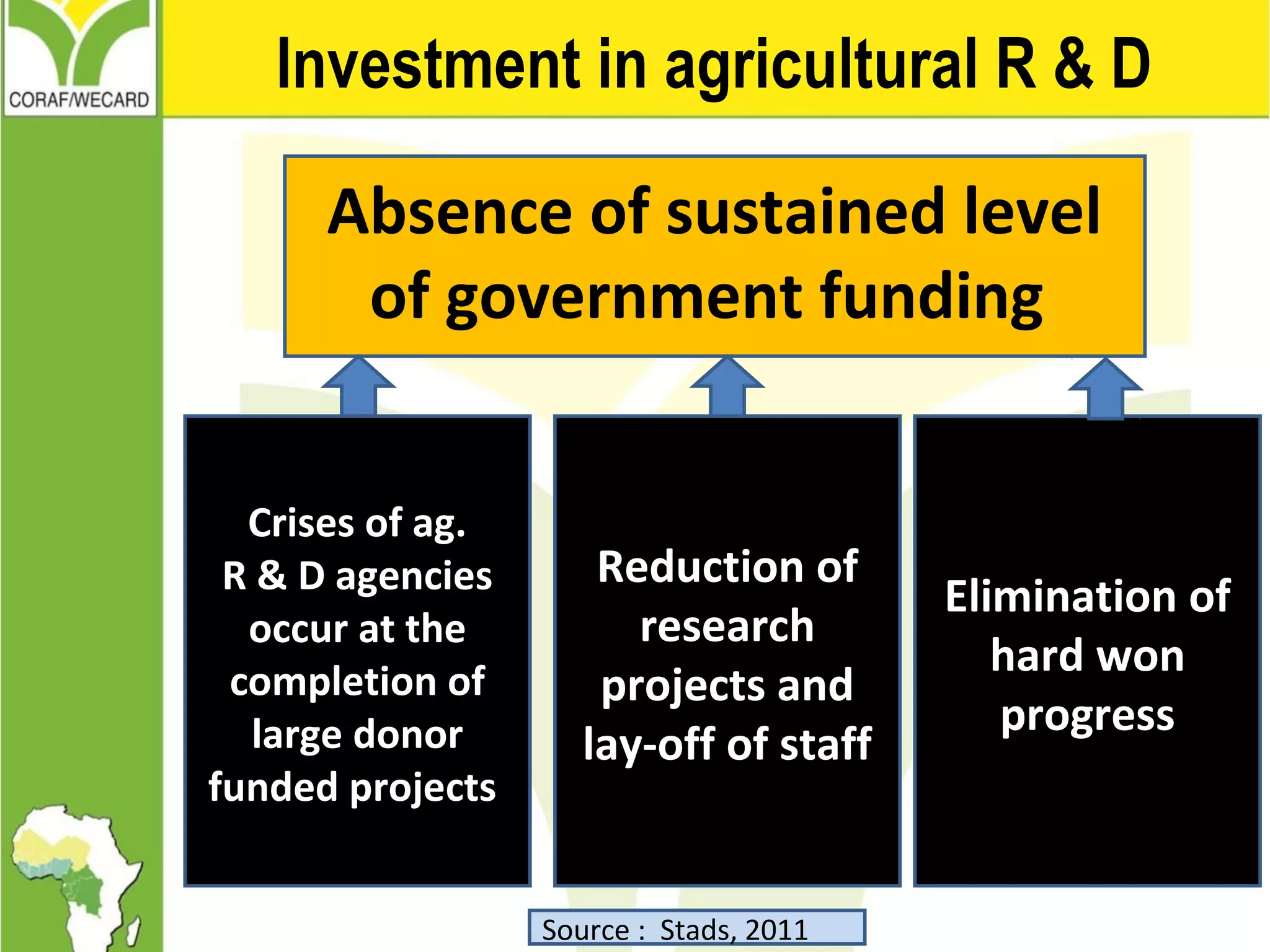
Investment in agricultural R & D
Absence of sustained level
of government funding
Source : Stads, 2011
Reduction of
research
projects and
lay-off of staff
Crises of ag.
R & D agencies
occur at the
completion of
large donor
funded projects
Elimination of
hard won
progress
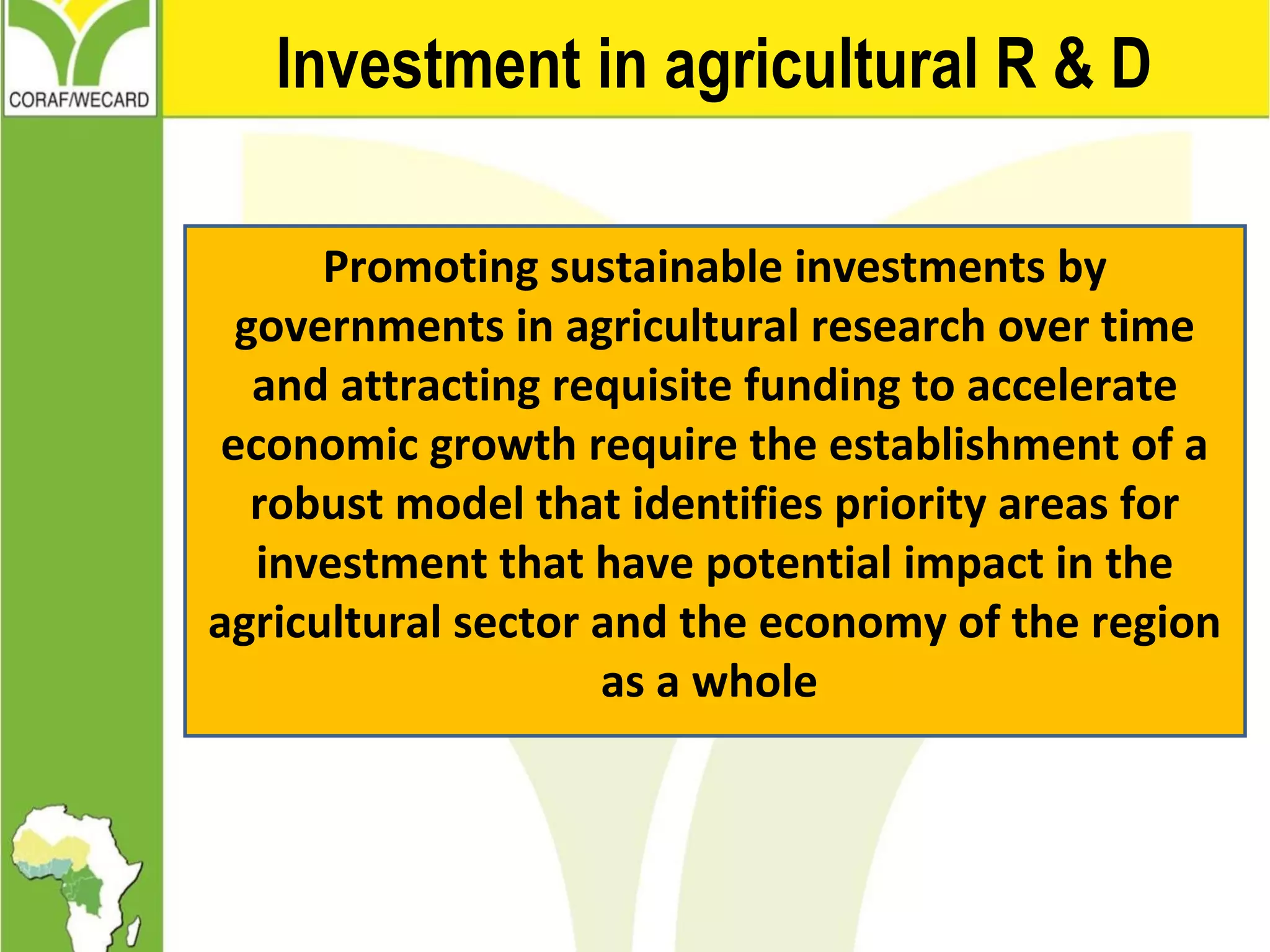
Investment in agricultural R & D
Promoting sustainable investments by
governments in agricultural research over time
and attracting requisite funding to accelerate
economic growth require the establishment of a
robust model that identifies priority areas for
investment that have potential impact in the
agricultural sector and the economy of the region
as a whole
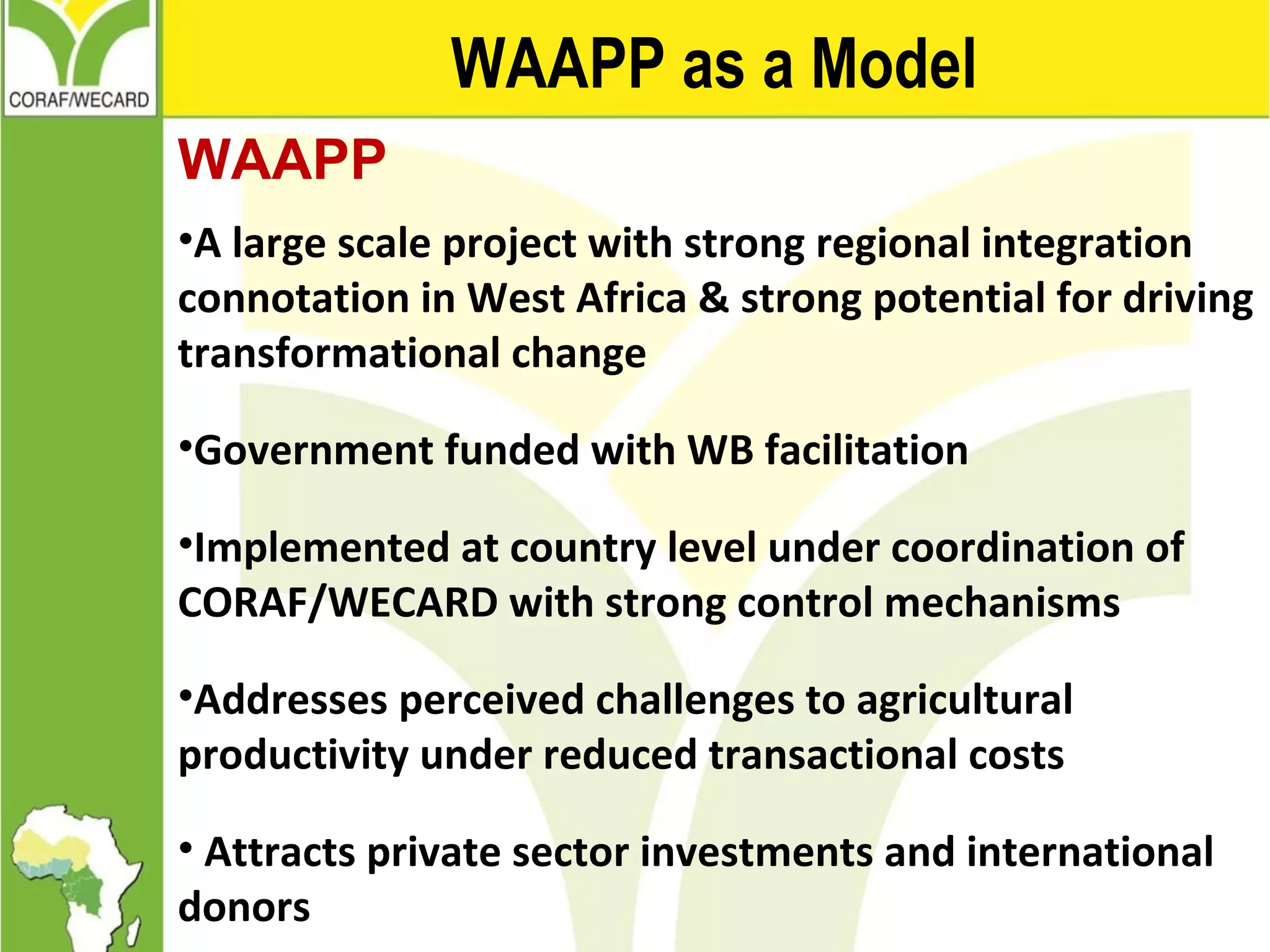
WAAPP as a Model
WAAPP
•A large scale project with strong regional integration
connotation in West Africa & strong potential for driving
transformational change
•Government funded with WB facilitation
•Implemented at country level under coordination of
CORAF/WECARD with strong control mechanisms
•Addresses perceived challenges to agricultural
productivity under reduced transactional costs
• Attracts private sector investments and international
donors
WAAPP as a Model
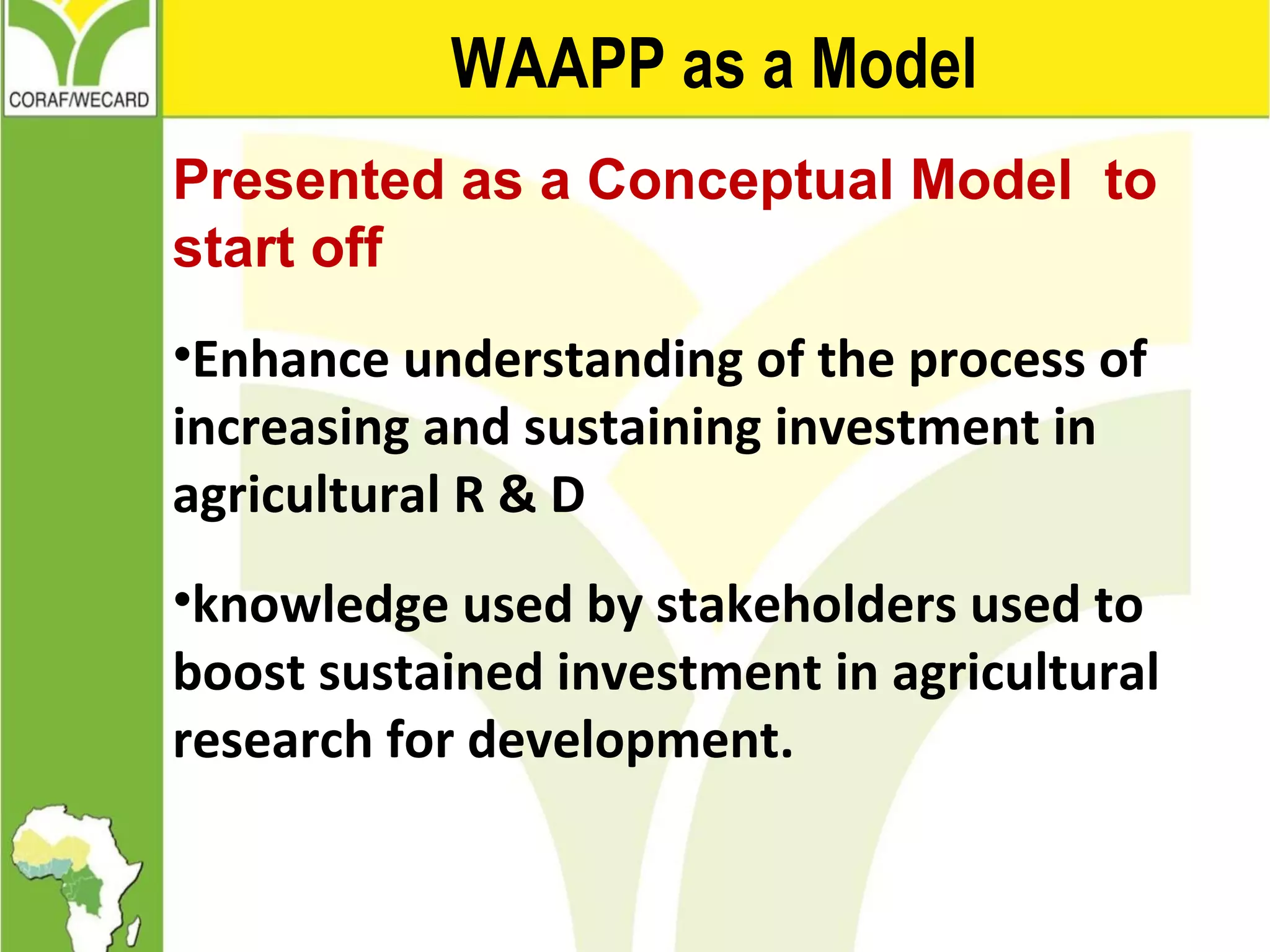
Presented as a Conceptual Model to
start off
•Enhance understanding of the process of
increasing and sustaining investment in
agricultural R & D
•knowledge used by stakeholders used to
boost sustained investment in agricultural
research for development.
WAAPP as a Model
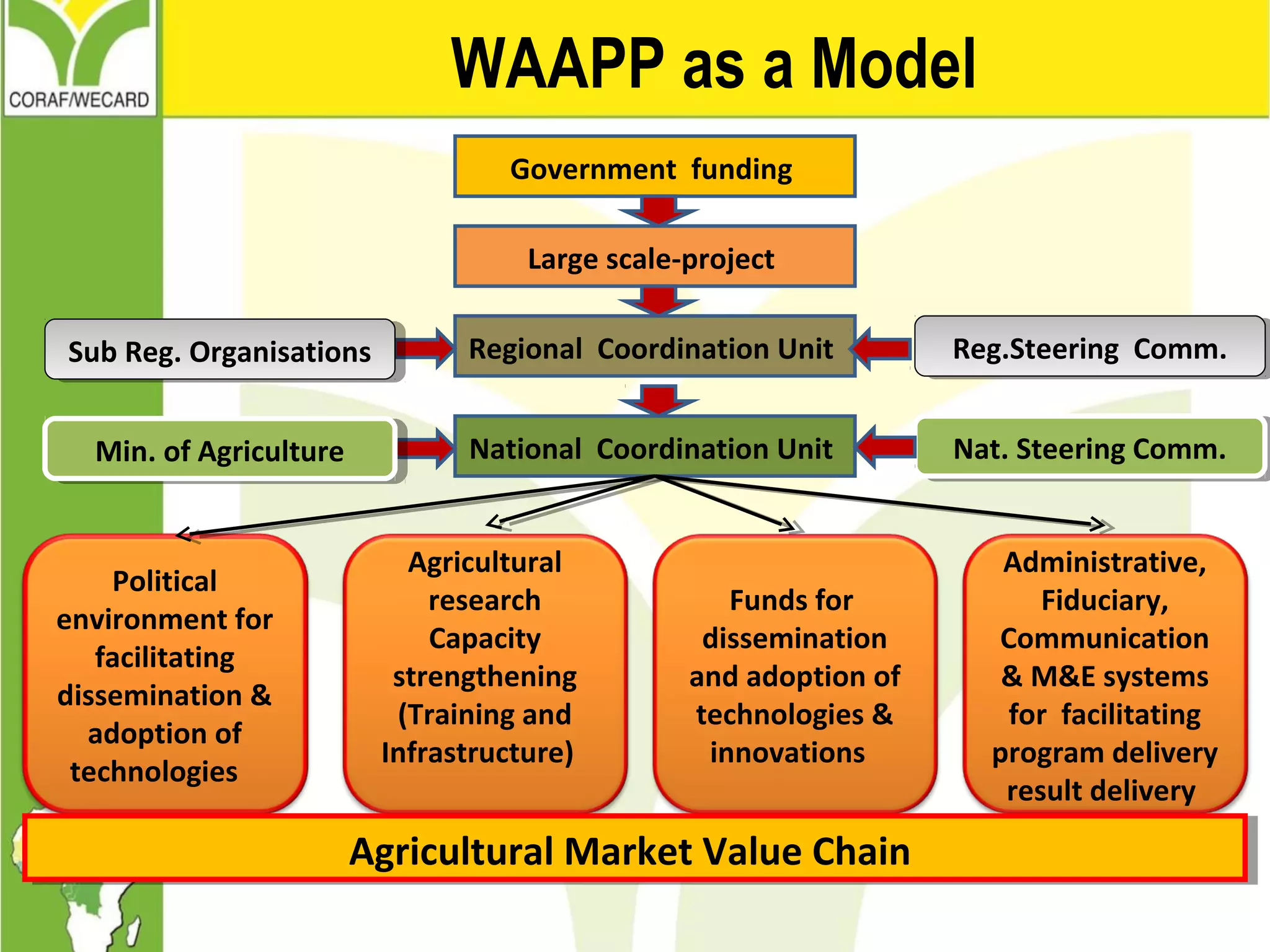
Large scale-project
Government funding
Regional Coordination Unit
National Coordination Unit
Political
environment for
facilitating
dissemination &
adoption of
technologies
Agricultural
research
Capacity
strengthening
(Training and
Infrastructure)
Funds for
dissemination
and adoption of
technologies &
innovations
Administrative,
Fiduciary,
Communication
& M&E systems
for facilitating
program delivery
result delivery
Agricultural Market Value ChainAgricultural Market Value Chain
Nat. Steering Comm.Nat. Steering Comm.
Reg.Steering Comm.Reg.Steering Comm.Sub Reg. OrganisationsSub Reg. Organisations
Min. of AgricultureMin. of Agriculture
WAAPP Financing
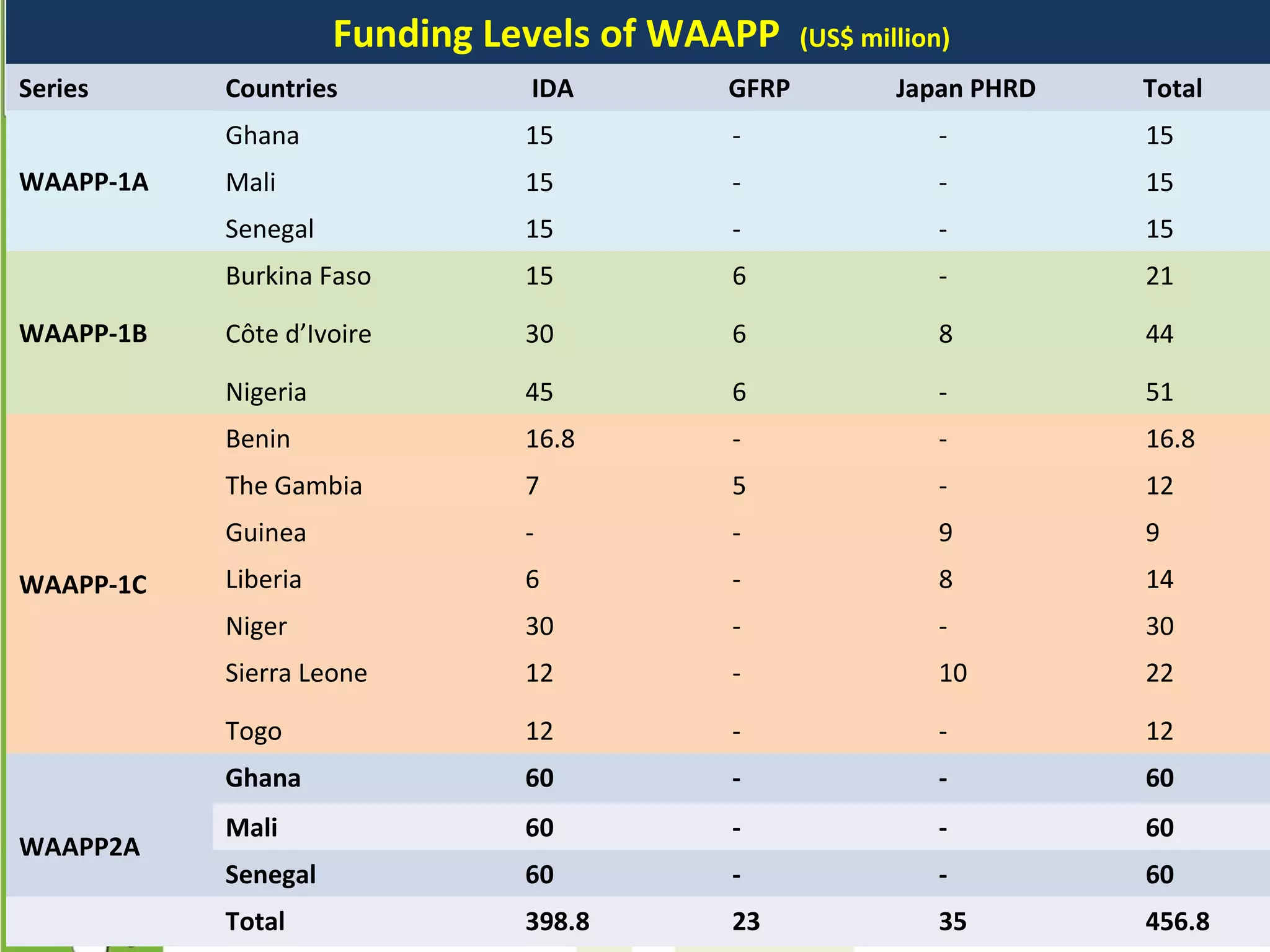
Funding Levels of WAAPP (US$ million)
Series Countries IDA GFRP Japan PHRD Total
WAAPP-1A
Ghana 15 - - 15
Mali 15 - - 15
Senegal 15 - - 15
WAAPP-1B
Burkina Faso 15 6 - 21
Côte d’Ivoire 30 6 8 44
Nigeria 45 6 - 51
WAAPP-1C
Benin 16.8 - - 16.8
The Gambia 7 5 - 12
Guinea - - 9 9
Liberia 6 - 8 14
Niger 30 - - 30
Sierra Leone 12 - 10 22
Togo 12 - - 12
WAAPP2A
Ghana 60 - - 60
Mali 60 - - 60
Senegal 60 - - 60
Total 398.8 23 35 456.8
WAAPP as model
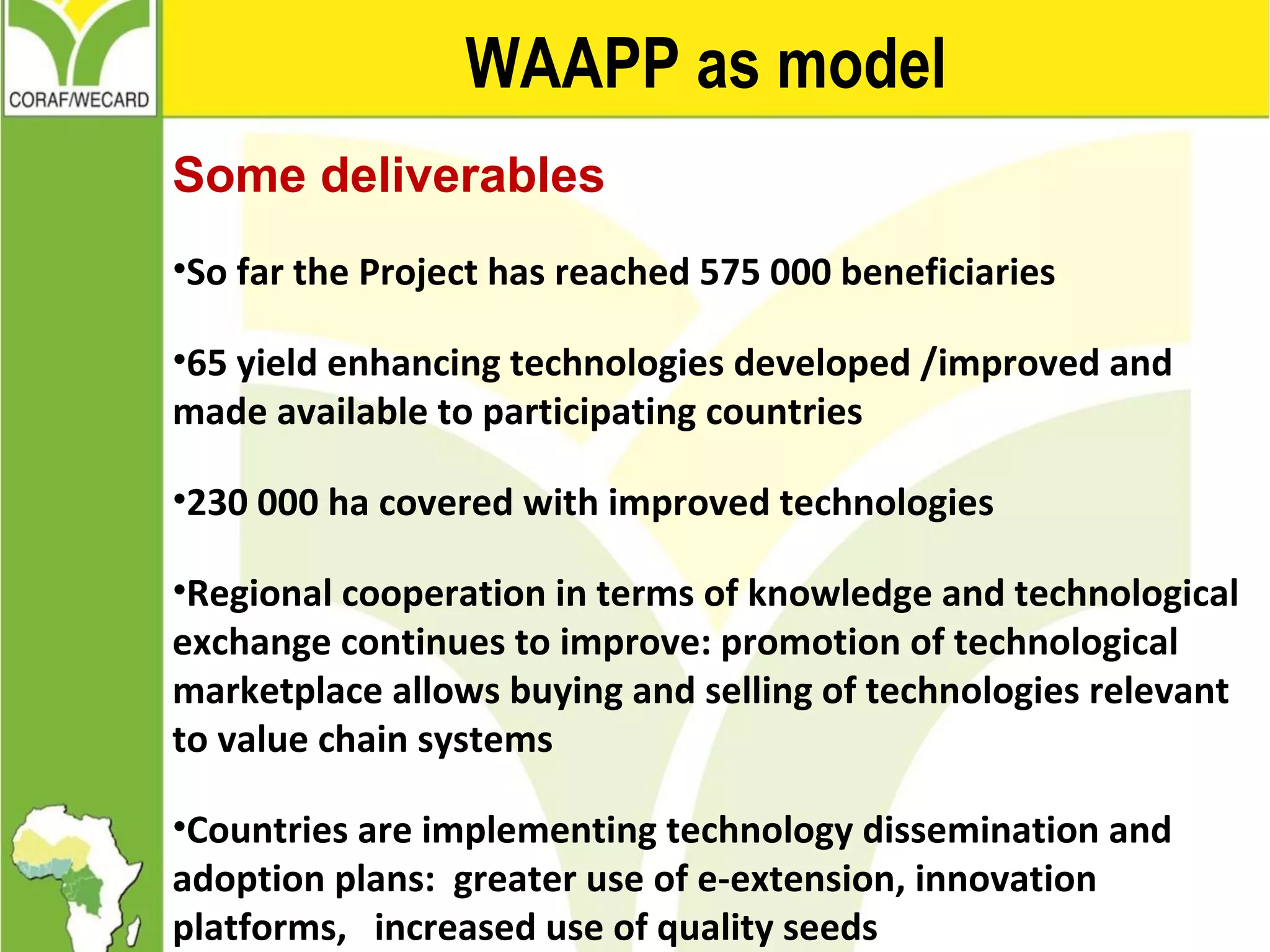
Some deliverables
•So far the Project has reached 575 000 beneficiaries
•65 yield enhancing technologies developed /improved and
made available to participating countries
•230 000 ha covered with improved technologies
•Regional cooperation in terms of knowledge and technological
exchange continues to improve: promotion of technological
marketplace allows buying and selling of technologies relevant
to value chain systems
•Countries are implementing technology dissemination and
adoption plans: greater use of e-extension, innovation
platforms, increased use of quality seeds
Conclusions & Recommendations
• A Conceptual Model for sustainable
investment in agricultural R & D
• Encourage extensive testing in all sub-
regions of Africa
• Encourage further analysis and scaling
up to an economic model to give it
more value
Merci pour votre attention
Secrétariat exécutifSecrétariat exécutif
Tél (221) 33 869 96 18Tél (221) 33 869 96 18
Fax (221) 33 869 96 31Fax (221) 33 869 96 31
E-mail:E-mail: secoraf@coraf.orgsecoraf@coraf.org
Web:Web: www.coraf.orgwww.coraf.org

Presentation waapp as a model hrm

  • 1.
    A model forsustainableA model for sustainable investment ininvestment in agricultural researchagricultural research for developmentfor development The Case of the West Africa AgriculturalThe Case of the West Africa Agricultural Productivity Program (WAAPP)Productivity Program (WAAPP) Harold Roy-Macauley 16 July, 2013 – Accra, Ghana
  • 2.
    Presentation Plan • Potentialof agriculture in development • Investment in agricultural research for development • WAAPP as a model for sustained investment in agricultural research for development • Conclusion
  • 3.
    Potential of agriculturein development Agriculture is the engine for economic growth and development in Africa • Employs 70% of the population • Accounts for 32% of the Gross Domestic Product (GDP) • Agriculture Market Value Chain (AMVC) presents huge potentials for delivering development outputs, outcomes, and impacts
  • 4.
    Potential of agriculturein development Suppliers Agricultural research for development Finance Producers Retailers/wholesalers Consumers Manufactures/Processors THE AMVC I N P U T S I N V E S T M E N T S Food jobs knowledge and skills Reduced poverty Added value to costumers resilienceresilience diversified economy diversified economy Public – Private Sector Partnerships
  • 5.
    Potential of agriculturein development Unlock the potential of agriculture & fulfill vision of African Heads of States - 6% annual agricultural growth rate by 2015 • Costly process of structural reforms and policy changes • Countries are on the recovery path • Long term challenge facing agriculture : bridging the growth & productivity gap to accelerate poverty reduction
  • 6.
    Actual Poverty Rate in1990 EVEN IF ALL AFRICAN COUNTRIES MEET THE MDG POVERTY TARGET, POVERTY LEVELS WILL STILL BE RELATIVELY HIGH AT AVERAGE RATE OF 30% SUSTAINING AN AGRICULTURAL GROWTH RATE OF 6% WILL NOT BE ENOUGH FOR MANY COUNTRIES TO ACHIEVE THAT OUTCOME MANY AFRICAN COUNTRIES WILL BE UNDER GROWING PRESSURE TO MEET THE SHORT TERM SOCIAL NEEDS OF LARGE POOLS OF POOR PEOPLE Potential of agriculture in development
  • 7.
    Potential of agriculturein development • Governments and development partners are recognizing the importance of investing in agriculture • Foreign Direct Investment (FDI) flows to developing countries doubled in 2006–08, but the share going to the agrifood sector is small – less than 5 percent of total • Long term challenge facing agriculture would be bridging the expenditure gap to accelerate growth
  • 8.
    LONG TERM CHALLENGEFACING AGRICULTURE #2: BRIDGING THE EXPENDITURE GAP TO ACCELERATE GROWTH Actual Poverty Rate in 1990 Source: Dollar a Day Poverty Rates from World Bank, PovCal Net, 2008 [poverty line $1.25]; Projected CAADP Poverty Rates from various IFPRI country CAADP Growth Simulation Studies THE FUNDING REQUIREMENTS TO ACHIEVE A 6% GROWTH IN THE AGRICULTURAL SECTOR WOULD IMPLY DOUBLE DIGIT BUDGET GROWTH RATES AFRICAN COUNTRIES WILL THEREFORE FIND THEMSELVES IN SEVERE BUDGETARY TRADE OFFS: 1.HAVING TO FINANCE THE GROWING SHORT TERM SOCIAL NEEDS OF LARGE POOLS OF POOR PEOPLE 2.WHILE INVESTING MORE IN LONG TERM GROWTH
  • 9.
    Investment in AgriculturalR & D Increase Financial Resources Boost AMVC Economic growth Agricultural transformation Institutional resources Human resources Human resources
  • 10.
    Investment in AgriculturalR & D Brazil 4% High Income Countries 51% Source : ASTI 2012; Eurostat 2012; OECD 2012 & country level secondary resources
  • 11.
    Investment in agriculturalR & D Africa South of the Sahara 5% Salary Increases Rehabilitation of infrastructure Equipment Source : Bientema and Stads, 2011 VERY LITTLE GOES ACTUALLY TO RESEARCH
  • 12.
    Investment in agriculturalR & D Growth in agricultural spending In Africa South of the Sahara Between 2000 & 2008 1/3 driven by Ghana, Tanzania, and Uganda ½ driven by Nigeria Source : Bientema and Stads, 2011
  • 13.
    Investment in agriculturalR & D Generally low investment and capacity in R & D in Africa South of the Sahara Impact of agricultural R&D on rural development and poverty reduction is questionable Source : Bientema and Stads, 2011
  • 14.
    Investment in agriculturalR & D Erratic fluctuation in spending levels from one year to another (volatility) higher in Africa South of the Sahara than in other developing regions Short term project- oriented nature of donor and development bank funding Source : Stads, 2011 Main driver of volatility
  • 15.
    Investment in agriculturalR & D Absence of sustained level of government funding Source : Stads, 2011 Reduction of research projects and lay-off of staff Crises of ag. R & D agencies occur at the completion of large donor funded projects Elimination of hard won progress
  • 16.
    Investment in agriculturalR & D Promoting sustainable investments by governments in agricultural research over time and attracting requisite funding to accelerate economic growth require the establishment of a robust model that identifies priority areas for investment that have potential impact in the agricultural sector and the economy of the region as a whole
  • 17.
    WAAPP as aModel WAAPP •A large scale project with strong regional integration connotation in West Africa & strong potential for driving transformational change •Government funded with WB facilitation •Implemented at country level under coordination of CORAF/WECARD with strong control mechanisms •Addresses perceived challenges to agricultural productivity under reduced transactional costs • Attracts private sector investments and international donors
  • 18.
    WAAPP as aModel Presented as a Conceptual Model to start off •Enhance understanding of the process of increasing and sustaining investment in agricultural R & D •knowledge used by stakeholders used to boost sustained investment in agricultural research for development.
  • 19.
    WAAPP as aModel Large scale-project Government funding Regional Coordination Unit National Coordination Unit Political environment for facilitating dissemination & adoption of technologies Agricultural research Capacity strengthening (Training and Infrastructure) Funds for dissemination and adoption of technologies & innovations Administrative, Fiduciary, Communication & M&E systems for facilitating program delivery result delivery Agricultural Market Value ChainAgricultural Market Value Chain Nat. Steering Comm.Nat. Steering Comm. Reg.Steering Comm.Reg.Steering Comm.Sub Reg. OrganisationsSub Reg. Organisations Min. of AgricultureMin. of Agriculture
  • 20.
    WAAPP Financing Funding Levelsof WAAPP (US$ million) Series Countries IDA GFRP Japan PHRD Total WAAPP-1A Ghana 15 - - 15 Mali 15 - - 15 Senegal 15 - - 15 WAAPP-1B Burkina Faso 15 6 - 21 Côte d’Ivoire 30 6 8 44 Nigeria 45 6 - 51 WAAPP-1C Benin 16.8 - - 16.8 The Gambia 7 5 - 12 Guinea - - 9 9 Liberia 6 - 8 14 Niger 30 - - 30 Sierra Leone 12 - 10 22 Togo 12 - - 12 WAAPP2A Ghana 60 - - 60 Mali 60 - - 60 Senegal 60 - - 60 Total 398.8 23 35 456.8
  • 21.
    WAAPP as model Somedeliverables •So far the Project has reached 575 000 beneficiaries •65 yield enhancing technologies developed /improved and made available to participating countries •230 000 ha covered with improved technologies •Regional cooperation in terms of knowledge and technological exchange continues to improve: promotion of technological marketplace allows buying and selling of technologies relevant to value chain systems •Countries are implementing technology dissemination and adoption plans: greater use of e-extension, innovation platforms, increased use of quality seeds
  • 22.
    Conclusions & Recommendations •A Conceptual Model for sustainable investment in agricultural R & D • Encourage extensive testing in all sub- regions of Africa • Encourage further analysis and scaling up to an economic model to give it more value
  • 23.
    Merci pour votreattention Secrétariat exécutifSecrétariat exécutif Tél (221) 33 869 96 18Tél (221) 33 869 96 18 Fax (221) 33 869 96 31Fax (221) 33 869 96 31 E-mail:E-mail: secoraf@coraf.orgsecoraf@coraf.org Web:Web: www.coraf.orgwww.coraf.org