INSIGHTS OF XXI C. MUSEUM
             MANAGEMENT.

LITHUANIAN SEA MUSEUM – THEORY VS.
                     PRACTICE


                                                  V.Lankeliene
Head Of International Affairs and Project Management Department
                                       Lithuanian Sea Museum
                                    3rd – 4th October 2011 Riga
MUSEUM
Museum (XIX - XX c.):
- institution the aim of which is to reveal the
  history of nation, to present its exclusivity,
  consolidate its ambitions as free and
  independent state;
- preserve objects, which best exemplify history
  of nature, human activities, culture and
  education ;

Museum (XXI c.):
-   already crossed boundaries of history;
-   heritage object – multi-aspect meaningful
    medium of information and its carrier;
-   activities are closely connected with functions
    of culture, education, information
    dissemination and social responsibility;
-   new theories – eco museology (museums),
    social inclusion, museum 2.0 and etc.
XXI c. museum :
consciously selects, preserves and researches objects of reality
  ensuring their furthter use for the focused development of the
  person and nation world-view.
not only educates, but also engages, shakes up, touches more
  emotions and soul, not only mind;
looking for all possibilities to change its function from museum –
  temple to the museum – forum (agora, laboratory)
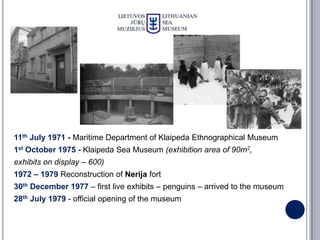
11th July 1971 - Maritime Department of Klaipeda Ethnographical Museum
1st October 1975 - Klaipeda Sea Museum (exhibition area of 90m2,
exhibits on display – 600)
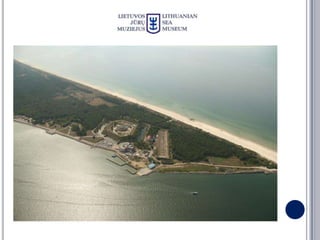
1972 – 1979 Reconstruction of Nerija fort
30th December 1977 – first live exhibits – penguins – arrived to the museum
28th July 1979 - official opening of the museum
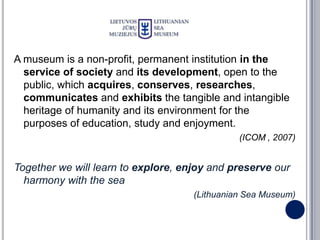
A museum is a non-profit, permanent institution in the
  service of society and its development, open to the
  public, which acquires, conserves, researches,
  communicates and exhibits the tangible and intangible
  heritage of humanity and its environment for the
  purposes of education, study and enjoyment.
                                               (ICOM , 2007)


Together we will learn to explore, enjoy and preserve our
  harmony with the sea
                                     (Lithuanian Sea Museum)
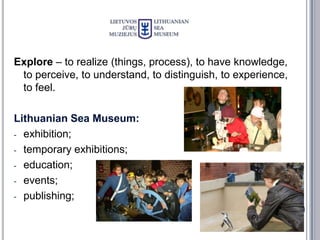
Explore – to realize (things, process), to have knowledge,
 to perceive, to understand, to distinguish, to experience,
 to feel.

Lithuanian Sea Museum:
- exhibition;

- temporary exhibitions;

- education;

- events;

- publishing;
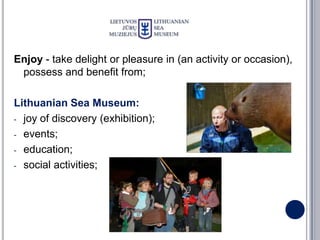
Enjoy - take delight or pleasure in (an activity or occasion),
 possess and benefit from;

Lithuanian Sea Museum:
- joy of discovery (exhibition);

- events;

- education;

- social activities;
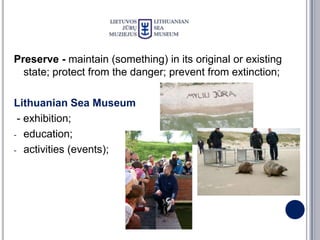
Preserve - maintain (something) in its original or existing
  state; protect from the danger; prevent from extinction;

Lithuanian Sea Museum
 - exhibition;
- education;

- activities (events);
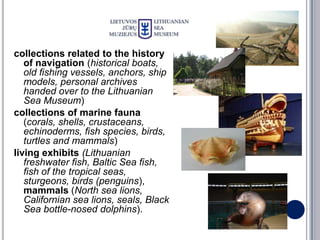
collections related to the history
   of navigation (historical boats,
   old fishing vessels, anchors, ship
   models, personal archives
   handed over to the Lithuanian
   Sea Museum)
collections of marine fauna
   (corals, shells, crustaceans,
   echinoderms, fish species, birds,
   turtles and mammals)
living exhibits (Lithuanian
   freshwater fish, Baltic Sea fish,
   fish of the tropical seas,
   sturgeons, birds (penguins),
   mammals (North sea lions,
   Californian sea lions, seals, Black
   Sea bottle-nosed dolphins).
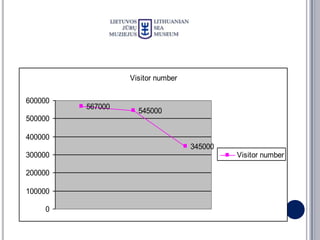
Visitor number

600000
         567000
                    545000
500000

400000
                                   345000
300000                                      Visitor number

200000

100000

    0
Main question:
Who we are:
Museum?
Zoo?
Hospital?
MUSEUM?

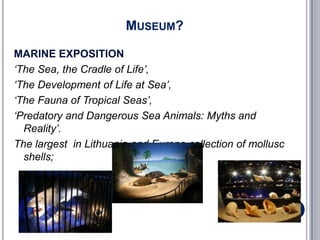
MARINE EXPOSITION
‘The Sea, the Cradle of Life’,
‘The Development of Life at Sea’,
‘The Fauna of Tropical Seas’,
‘Predatory and Dangerous Sea Animals: Myths and
  Reality’.
The largest in Lithuania and Europe collection of mollusc
  shells;
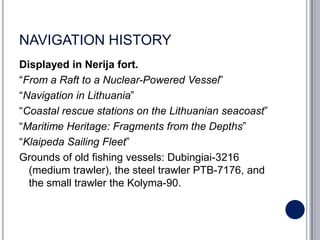
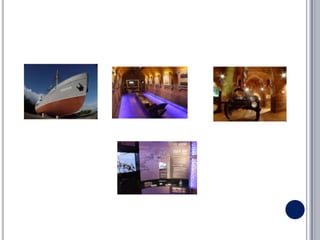
NAVIGATION HISTORY
Displayed in Nerija fort.
“From a Raft to a Nuclear-Powered Vessel”
“Navigation in Lithuania”
“Coastal rescue stations on the Lithuanian seacoast”
“Maritime Heritage: Fragments from the Depths”
“Klaipeda Sailing Fleet”
Grounds of old fishing vessels: Dubingiai-3216
  (medium trawler), the steel trawler PTB-7176, and
  the small trawler the Kolyma-90.
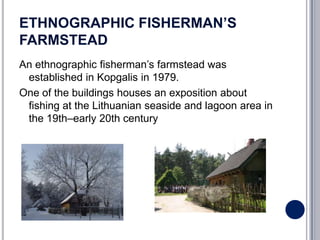
ETHNOGRAPHIC FISHERMAN’S
FARMSTEAD
An ethnographic fisherman’s farmstead was
 established in Kopgalis in 1979.
One of the buildings houses an exposition about
 fishing at the Lithuanian seaside and lagoon area in
 the 19th–early 20th century
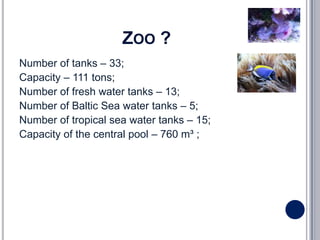
ZOO ?
Number of tanks – 33;
Capacity – 111 tons;
Number of fresh water tanks – 13;
Number of Baltic Sea water tanks – 5;
Number of tropical sea water tanks – 15;
Capacity of the central pool – 760 m³ ;
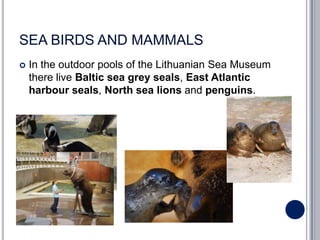
SEA BIRDS AND MAMMALS
   In the outdoor pools of the Lithuanian Sea Museum
    there live Baltic sea grey seals, East Atlantic
    harbour seals, North sea lions and penguins.
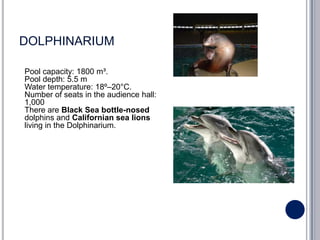
DOLPHINARIUM

Pool capacity: 1800 m³.
Pool depth: 5.5 m
Water temperature: 18º–20°C.
Number of seats in the audience hall:
1,000
There are Black Sea bottle-nosed
dolphins and Californian sea lions
living in the Dolphinarium.
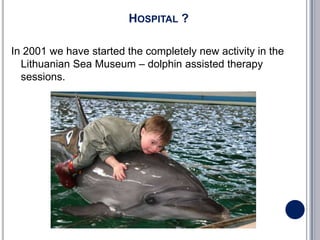
HOSPITAL ?

In 2001 we have started the completely new activity in the
  Lithuanian Sea Museum – dolphin assisted therapy
  sessions.
Since 2001, when LSM has started DAT – we have
  welcomed more that 400 families rising disable
  children (autism, Asperger sindrom, cerebral
  paralysis, sindrom of Daun)
At this moment we have prepared the education
  programme (in cooperation with Klaipeda
  University) for medicals (master degree), which is
  part of alternative therapies modul.
DAT for the LSM is enlargement of activities, more
  challenges and more responsibility.
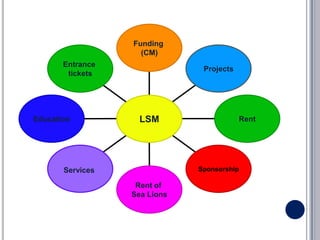
Funding
                    (CM)
       Entrance
                               Projects
        tickets


Education           LSM                   Rent


       Services               Sponsorship

                   Rent of
                  Sea Lions
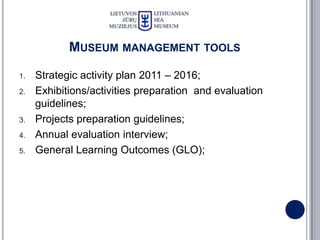
MUSEUM MANAGEMENT TOOLS

1.   Strategic activity plan 2011 – 2016;
2.   Exhibitions/activities preparation and evaluation
     guidelines;
3.   Projects preparation guidelines;
4.   Annual evaluation interview;
5.   General Learning Outcomes (GLO);
Exhibition/activity preparation and evaluation
                        guidelines

I step - to gather information and to use your own
  experience.

Presentation v.lankeliene

  • 1.
    INSIGHTS OF XXIC. MUSEUM MANAGEMENT. LITHUANIAN SEA MUSEUM – THEORY VS. PRACTICE V.Lankeliene Head Of International Affairs and Project Management Department Lithuanian Sea Museum 3rd – 4th October 2011 Riga
  • 2.
    MUSEUM Museum (XIX -XX c.): - institution the aim of which is to reveal the history of nation, to present its exclusivity, consolidate its ambitions as free and independent state; - preserve objects, which best exemplify history of nature, human activities, culture and education ; Museum (XXI c.): - already crossed boundaries of history; - heritage object – multi-aspect meaningful medium of information and its carrier; - activities are closely connected with functions of culture, education, information dissemination and social responsibility; - new theories – eco museology (museums), social inclusion, museum 2.0 and etc.
  • 3.
    XXI c. museum: consciously selects, preserves and researches objects of reality ensuring their furthter use for the focused development of the person and nation world-view. not only educates, but also engages, shakes up, touches more emotions and soul, not only mind; looking for all possibilities to change its function from museum – temple to the museum – forum (agora, laboratory)
  • 4.
    11th July 1971- Maritime Department of Klaipeda Ethnographical Museum 1st October 1975 - Klaipeda Sea Museum (exhibition area of 90m2, exhibits on display – 600) 1972 – 1979 Reconstruction of Nerija fort 30th December 1977 – first live exhibits – penguins – arrived to the museum 28th July 1979 - official opening of the museum
  • 6.
    A museum isa non-profit, permanent institution in the service of society and its development, open to the public, which acquires, conserves, researches, communicates and exhibits the tangible and intangible heritage of humanity and its environment for the purposes of education, study and enjoyment. (ICOM , 2007) Together we will learn to explore, enjoy and preserve our harmony with the sea (Lithuanian Sea Museum)
  • 7.
    Explore – torealize (things, process), to have knowledge, to perceive, to understand, to distinguish, to experience, to feel. Lithuanian Sea Museum: - exhibition; - temporary exhibitions; - education; - events; - publishing;
  • 8.
    Enjoy - takedelight or pleasure in (an activity or occasion), possess and benefit from; Lithuanian Sea Museum: - joy of discovery (exhibition); - events; - education; - social activities;
  • 9.
    Preserve - maintain(something) in its original or existing state; protect from the danger; prevent from extinction; Lithuanian Sea Museum - exhibition; - education; - activities (events);
  • 10.
    collections related tothe history of navigation (historical boats, old fishing vessels, anchors, ship models, personal archives handed over to the Lithuanian Sea Museum) collections of marine fauna (corals, shells, crustaceans, echinoderms, fish species, birds, turtles and mammals) living exhibits (Lithuanian freshwater fish, Baltic Sea fish, fish of the tropical seas, sturgeons, birds (penguins), mammals (North sea lions, Californian sea lions, seals, Black Sea bottle-nosed dolphins).
  • 11.
    Visitor number 600000 567000 545000 500000 400000 345000 300000 Visitor number 200000 100000 0
  • 12.
    Main question: Who weare: Museum? Zoo? Hospital?
  • 13.
    MUSEUM? MARINE EXPOSITION ‘The Sea,the Cradle of Life’, ‘The Development of Life at Sea’, ‘The Fauna of Tropical Seas’, ‘Predatory and Dangerous Sea Animals: Myths and Reality’. The largest in Lithuania and Europe collection of mollusc shells;
  • 14.
    NAVIGATION HISTORY Displayed inNerija fort. “From a Raft to a Nuclear-Powered Vessel” “Navigation in Lithuania” “Coastal rescue stations on the Lithuanian seacoast” “Maritime Heritage: Fragments from the Depths” “Klaipeda Sailing Fleet” Grounds of old fishing vessels: Dubingiai-3216 (medium trawler), the steel trawler PTB-7176, and the small trawler the Kolyma-90.
  • 16.
    ETHNOGRAPHIC FISHERMAN’S FARMSTEAD An ethnographicfisherman’s farmstead was established in Kopgalis in 1979. One of the buildings houses an exposition about fishing at the Lithuanian seaside and lagoon area in the 19th–early 20th century
  • 17.
    ZOO ? Number oftanks – 33; Capacity – 111 tons; Number of fresh water tanks – 13; Number of Baltic Sea water tanks – 5; Number of tropical sea water tanks – 15; Capacity of the central pool – 760 m³ ;
  • 18.
    SEA BIRDS ANDMAMMALS  In the outdoor pools of the Lithuanian Sea Museum there live Baltic sea grey seals, East Atlantic harbour seals, North sea lions and penguins.
  • 19.
    DOLPHINARIUM Pool capacity: 1800m³. Pool depth: 5.5 m Water temperature: 18º–20°C. Number of seats in the audience hall: 1,000 There are Black Sea bottle-nosed dolphins and Californian sea lions living in the Dolphinarium.
  • 20.
    HOSPITAL ? In 2001we have started the completely new activity in the Lithuanian Sea Museum – dolphin assisted therapy sessions.
  • 21.
    Since 2001, whenLSM has started DAT – we have welcomed more that 400 families rising disable children (autism, Asperger sindrom, cerebral paralysis, sindrom of Daun) At this moment we have prepared the education programme (in cooperation with Klaipeda University) for medicals (master degree), which is part of alternative therapies modul. DAT for the LSM is enlargement of activities, more challenges and more responsibility.
  • 22.
    Funding (CM) Entrance Projects tickets Education LSM Rent Services Sponsorship Rent of Sea Lions
  • 23.
    MUSEUM MANAGEMENT TOOLS 1. Strategic activity plan 2011 – 2016; 2. Exhibitions/activities preparation and evaluation guidelines; 3. Projects preparation guidelines; 4. Annual evaluation interview; 5. General Learning Outcomes (GLO);
  • 24.
    Exhibition/activity preparation andevaluation guidelines I step - to gather information and to use your own experience.

Editor's Notes

  • #11 These three kinds of collection requires different attitude looking for the inventive ways of displaying them and presenting to the public.