Presentation
Techniques
YICAP_Key Manager
23/06/2021
By Sitthiches Chenruay
(Khru TongkanT)
10 Ways to Build
Top Presentation
Skills in
Accounting and
Finance by Robert
Half (2017)
How to improve your presentation
skills
1) Face your fears.
2)Do your homework.
3)Practice, practice, practice.
4)Stand and deliver.
5)Anticipate questions.
How to create strong presentation
slides
BEGIN WITH A CLEAR
OUTLINE.
LET YOUR TITLES GUIDE THE
WAY.
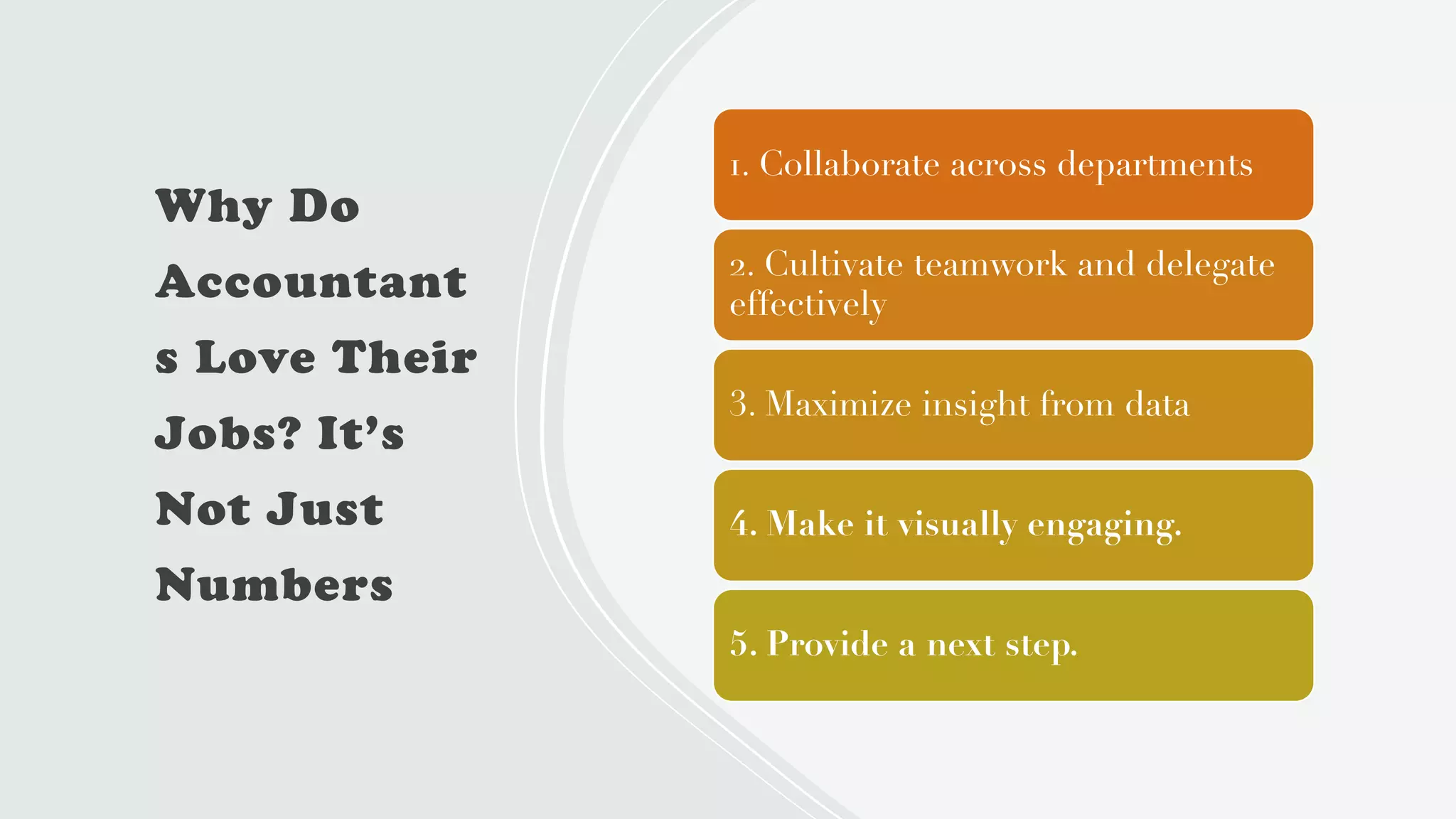
Why Do
Accountant
s Love Their
Jobs? It’s
Not Just
Numbers
1. Collaborate across departments
2. Cultivate teamwork and delegate
effectively
3. Maximize insight from data
4. Make it visually engaging.
5. Provide a next step.
1. Begin with a clear outline.
WEʼVE ALL SEEN
PRESENTATIONS
THAT GO NOWHERE
FAST.
THAT OFTEN
HAPPENS BECAUSE
THE PRESENTER
DOESN'T HAVE A
HANDLE ON WHERE
TO GO WITH THE
PRESENTATION.
GRAB A PEN AND
PAPER BEFORE YOU
OPEN YOUR
PRESENTATION
SOFTWARE.
START CREATING
YOUR
PRESENTATION BY
WRITING AN
OUTLINE, WITH
SPECIFIC FOCUS ON
YOUR GOALS AND
WHAT YOU WANT
TO ACCOMPLISH BY
THE TIME YOUʼRE
DONE.
THIS WILL HELP
YOU STICK TO THE
SCRIPT WHEN ITʼS
TIME TO PUT THE
DECK TOGETHER.
2. Let your titles guide the way.
Each slide’s title should provide context and explain the slide’s content,
including the conclusion. For example,
“A Third of Managers Regret Not Taking Enough Vacation Time” is
better than just “Vacation Time.”
A more descriptive title keeps your audience focused on the message.
Also san-serif fonts that are easy to read.
Titles should generally be between 36 and 44 font, and other content
should be at least a 24-point font, with a 20-point font for captions,
3. Keep your slides succinct.
Don't overwhelm your audience with
too many words and numbers on your
slides. Yes, you love your numbers,
but don’t go number-happy. When
deciding what to place on a slide,
remember your slides should support
what you’re saying, not the other way
around.
A slide with too much information is
challenging to read. You’re essentially
asking your audience to read and
listen at the same time. Again, don’t
make your audience work. If your
presentation needs to be shared as a
handout or forwarded to others,
consider making two versions: a
slimmed-down version to talk
through and a sharable version with
more explanatory text.
4. Make it visually
engaging.
No, a page or screenshot from Excel
doesn’t really count as an image. Use simple
photos or illustrations that support your
message. A well-chosen image is a nice break
from text that can grab your audience’s
attention and help reinforce your message. You
can find professional stock images on sites like
Shutterstock. Also consider colors, and make
sure your text and background colors contrast
well.
5. Provide a next
step.
Don’t just end your presentation by
saying thank you; give a call to action.
Close your presentation by including a
slide that mentions what you’d like the
audience to do with the information
you shared with them.
Once you
improve
your
presentation
skills
Once you improve your presentation skills, you
can assume you've added valuable skills to
your career toolbox. Not only will that help you
succeed in your role, it will also help you
advance in your accounting and finance career.
https://www.roberthalf.com/blog/salaries-
and-skills/accountants-need-hard-and-soft-
skills-for-success
8 ways to
improve your
presentation
skills
Reference: https://mycareer.aicpa-
cima.com/article /8_ways_to_prese
ntation_skills /
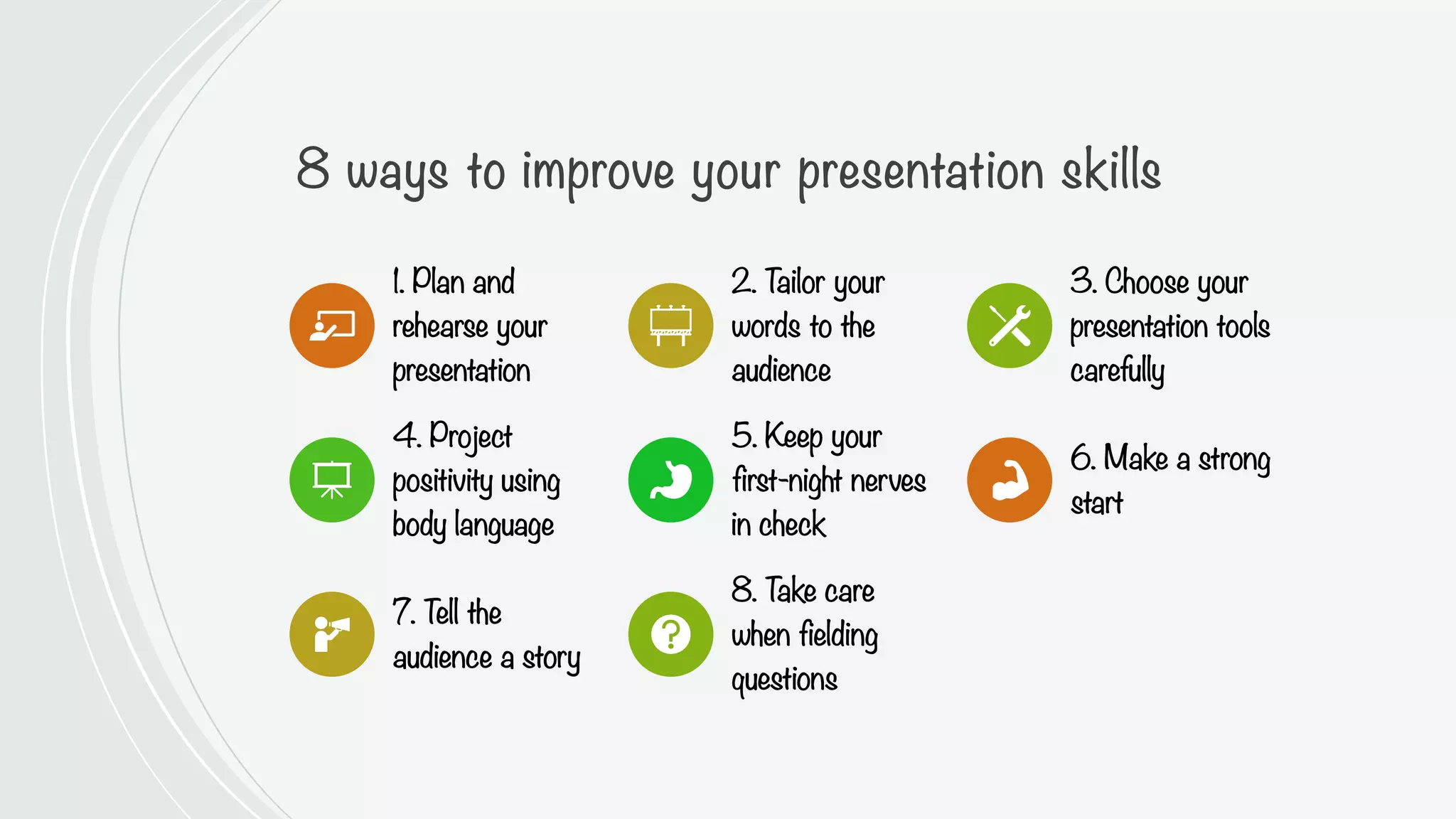
8 ways to improve your presentation skills
1. Plan and
rehearse your
presentation
2. T
ailor your
words to the
audience
3. Choose your
presentation tools
carefully
4. Project
positivity using
body language
5. Keep your
first-night nerves
in check
6. Make a strong
start
7. Tell the
audience a story
8. T
ake care
when fielding
questions
Management accountants can
no longer tuck themselves
away in the back office,
knowing that they will never
be asked to step into the
limelight. The ability to make a
good presentation is now a
key skill...
1.Plan and rehearse your presentation
Few people are able to make a brilliant
presentation off the cuff, so careful
preparation is vital. In most cases, simplicity
works best, so resist the temptation to be
too clever by half. Focus on how to get your
message over to the audience clearly and
concisely.
“Knowing your topic is the single most important
point,” says Dave Coker, a finance lecturer at the
London School of Business & Finance. He warns
against delivering material produced by others and
stresses the need for rehearsal. “Every
presentation I give is rehearsed, sometimes as
many as 100 times if it’s a new topic. Time your
presentation and keep a timer running to ensure
that you’re keeping on schedule,” he adds.
2 Tailor your words
to the audience
“Because of a lack of presenting skills, training or talent,
most finance professionals treat all presentations in the
same way, with the result being a one-dimensional style,
a lack of relevance and an indifferent reaction,” claims
Rob Brown, author of How to Build Your Reputation
(Ecademy Press, 2007). “But, when they consider the
different audiences, objectives and ways to deliver the
message, their chances of hitting the mark increase
dramatically.”
2 Tailor your words to the
audience
With so many different potential audiences, it’s important to
tailor your message, says Phil Sheridan, senior managing
director at recruitment consultancy Robert Half UK. “Imagine
you’re introducing information on your company’s UK Gaap-
IFRS convergence to your IT team: in this case, it’s best to
keep your speech free of jargon and acronyms. Instead of
explaining the financial implications, focus on how you think it
will make a difference to IT systems and processes.”
3 Choose your
presentation tools
carefully
It’s best to decide which presentation
tools to use right at the outset, advises
Giles McIntyre, senior manager at
recruitment consultancy Hays
Accountancy & Finance. But it’s also
important to ensure that the venue can
cope with what you’ve chosen.
“Have a plan B”
“Have a plan B,” he says. “For
example, if you have a PowerPoint
presentation, ensure that you print it
out and arrive at the location early
to check that all is in working order.”
Make your slides easy to read
Make your slides easy to read, Coker stresses.
“I’m pretty disciplined: I use bullet points only and no
more than six per slide. Density is a turn-off, so your
points should be structured as single, simple sentences
that you can talk about for protracted periods.
The worst thing is to stand up reading slides – boring!”
4 Project positivity
using body language
“You don’t need to dance around the room to be a good
presenter,” according to John McLachlan, a former FD in industry who is now MD of
Monkey Puzzle Training & Consultancy.
“You actually project more authority and come across as more
credible if you stand still and move only to accentuate specific points
with hand or arm gestures,” he says.
“People often see entertaining presenters and think that
they need to copy them in order to be good. This isn’t true.
You need to be you.”
Strong Presence
Richard Newman, director of UK Body Talk, a presentation
skills training company, points out that great actors such as
Sir Anthony Hopkins and Dame Judi Dench build their stage
presence by controlling their posture.
“Most people stand off-centre, with their weight on one foot,
so they look like a pushover,” he says. “Make sure that you
project yourself as a strong presence, regardless of your
audience, as your message deserves to get noticed.”
5 Keep your first-
night nerves in check
Most presenters are likely to feel some
butterflies in their stomach, even if they’re
seasoned performers. Newman points out
that nervousness creates tension in your
body, which hinders you from projecting
your natural charisma.
Relax
“The easiest way to overcome
this is to clench any tense
areas of your body for a few
seconds and then relax them,”
he advises. “This is great
before an important meeting
in helping you to stay calm
and in control.”
Pause
Another way to control nerves is to
pause before saying anything. It was a
trick perfected by the Hollywood star
John Wayne.
“He was asked how he delivered
powerful lines,” Newman says. “Wayne
said: ‘Simple. I just count to two…
Then I say it. That way everyone is
thinking: what’s he gonna say?’”
6 Make a strong
start
You need to grab your audience at the beginning or
they will soon switch off.
“Some good things to do are to thank the previous
presenter for a great talk, thank the organisers for the
invitation to speak, if that’s appropriate, or make a
reference to the nice food or venue,”
McLachlan suggests, but he warns against some
common openers.
No Self-effacing jokes/ Make
fun of others
“Self-effacing jokes such as ʻthis wonʼt take long and
then you can get to the drinksʼ will merely take away
your credibility,” he says. “Similarly, making fun of
others doesnʼt make you look good to your audience,
even if the people youʼre talking about can take it.
The audience may not know that and this will present
you as someone who needs to put others down to feel
good.”
7 Tell the audience a
story
Financial managers are so au fait with
the numbers that they often assume that
others have the same enthusiasm, but
people outside the profession are
unlikely to be engaged, particularly by
the more technical aspects, says Sue
Binks, a senior consultant at the Roffey
Park leadership institute.
Storytelling can be a useful
technique
“Storytelling can be a useful technique in dealing with
this,” she says. “This may mean talking about real
scenarios or fictional ones, but the idea is to talk
about how real people use the data, or what happens
if they donʼt spot the underlying message. Build your
knowledge and understanding of how your business
operates and then use this information to show the
context behind the figures.
Highlight specific
examples
Highlight specific examples, such
as business wins. This will not only
demonstrate your knowledge, but
also engage the audience, helping
them to understand how their
contributions fit into the wider
picture.”
8 Take care when
fielding questions
Usually, questions from members of the
audience will focus on what they feel are
the most important issues. It’s helpful to
consider before your presentation what
people are likely to ask and prepare some
outline responses.
Coker advises taking a
tough line with irrelevant
queries.
“You donʼt want to turn
off most of your
audience, so donʼt be
afraid to terminate off-
topic questions,” he says.
Reference
https://mycareer.aicpa-
cima.com/article /8_ways_to_presentation_skills /
Now, letʼs try
your turn
Some sources for Taxation on Value-
Added-Tax
https://www.slideshare.net/kulbeerbumrah/value-added-tax-
35624073
I recommended this
https://www.slideshare.net/horizon8586/value-added-
tax?next_slideshow=1
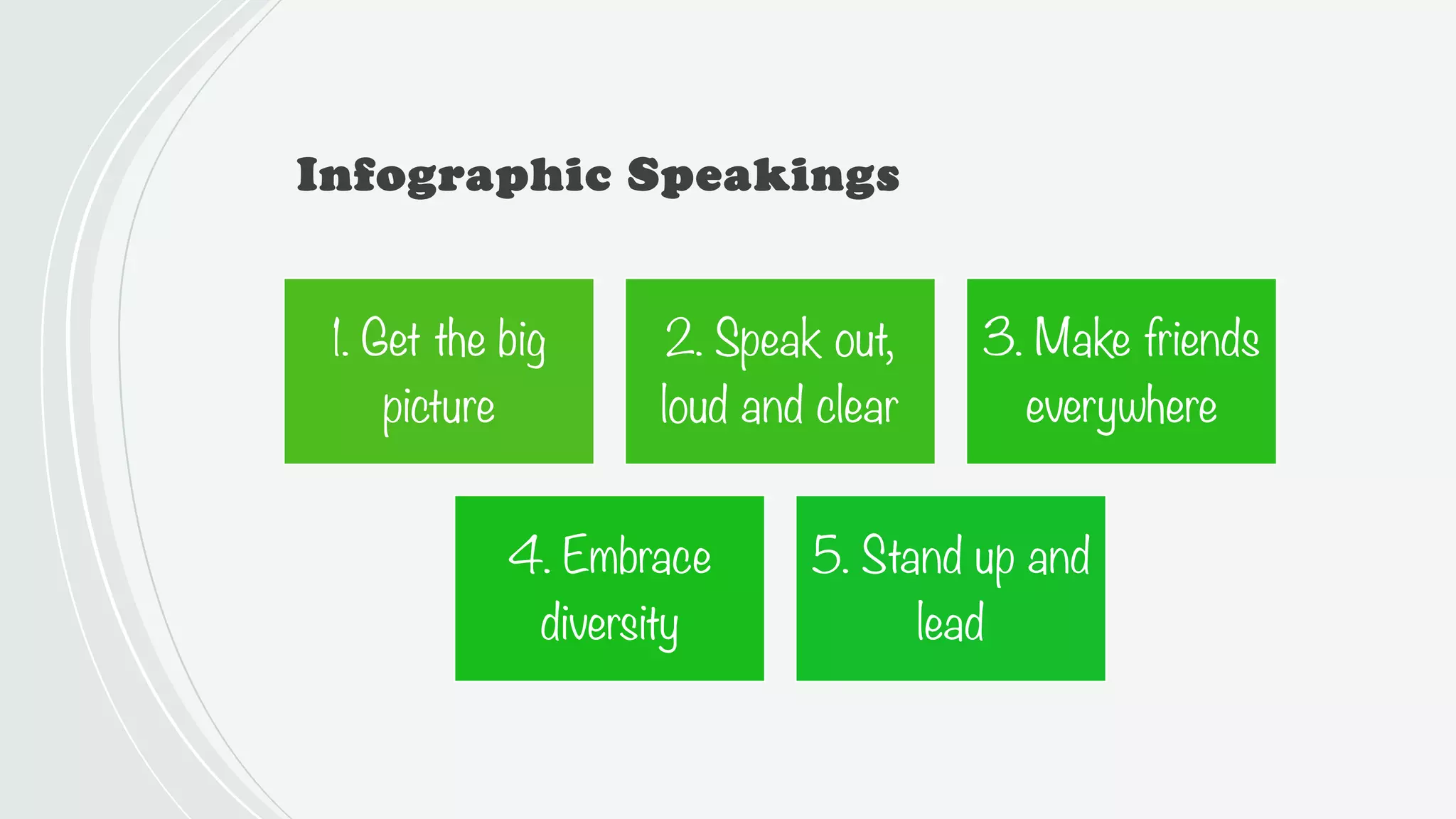
Infographic Speakings
1. Get the big
picture
2. Speak out,
loud and clear
3. Make friends
everywhere
4. Embrace
diversity
5. Stand up and
lead
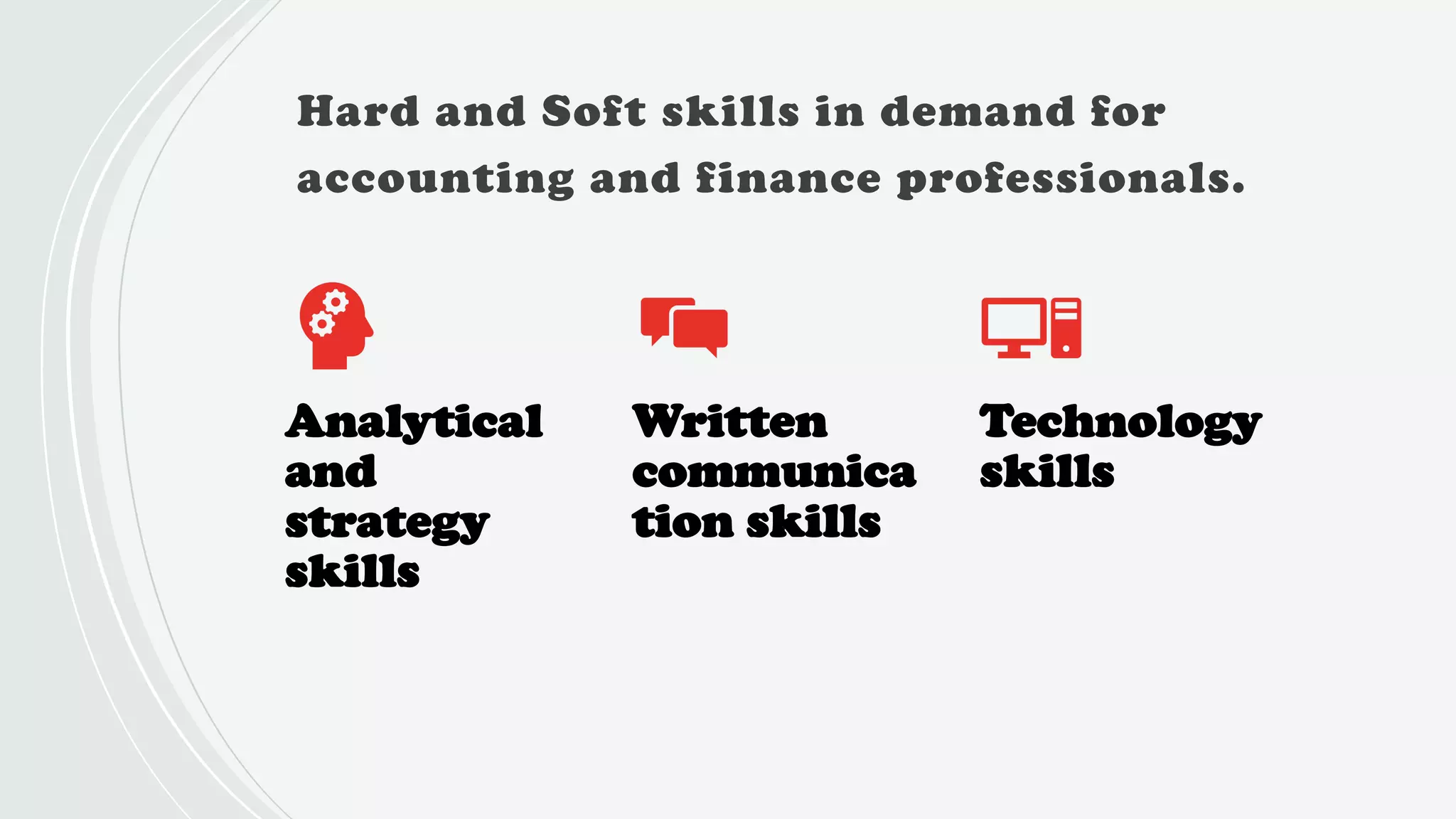
Hard and Soft skills in demand for
accounting and finance professionals.
Analytical
and
strategy
skills
Written
communica
tion skills
Technology
skills
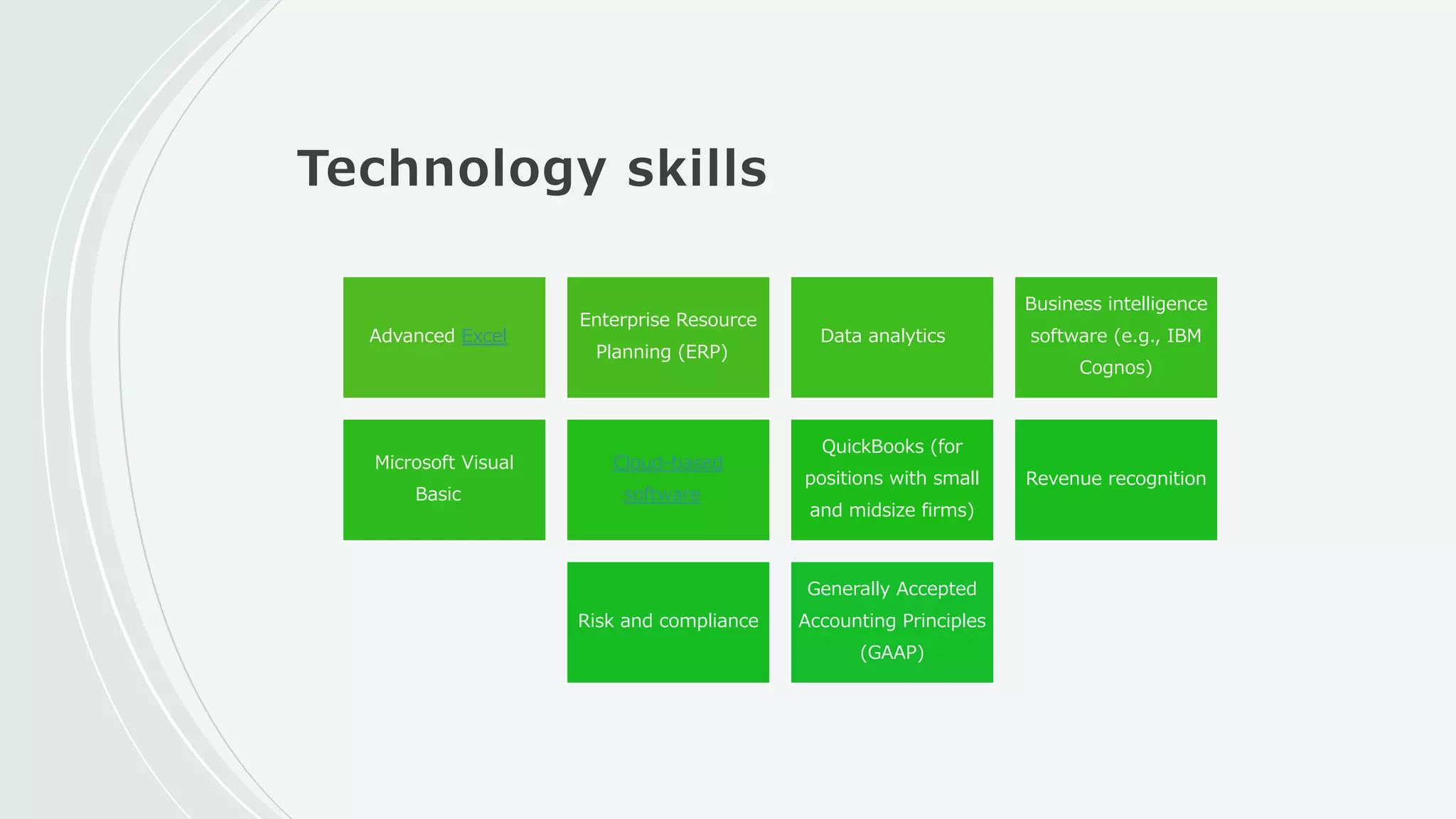
Technology skills
Advanced Excel
Enterprise Resource
Planning (ERP)
Data analytics
Business intelligence
software (e.g., IBM
Cognos)
Microsoft Visual
Basic
Cloud-based
software
QuickBooks (for
positions with small
and midsize firms)
Revenue recognition
Risk and compliance
Generally Accepted
Accounting Principles
(GAAP)
Ask for
professional
training
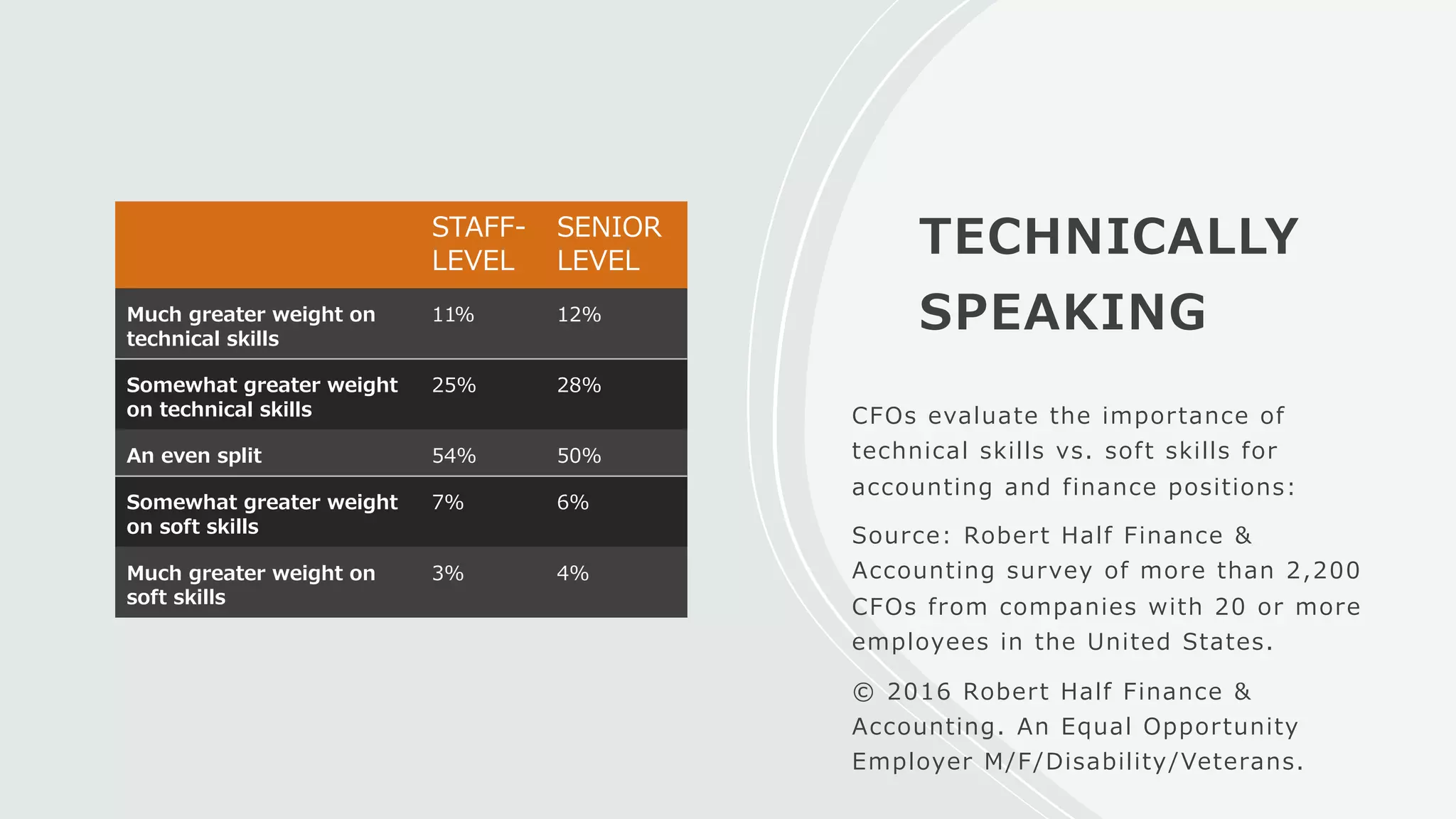
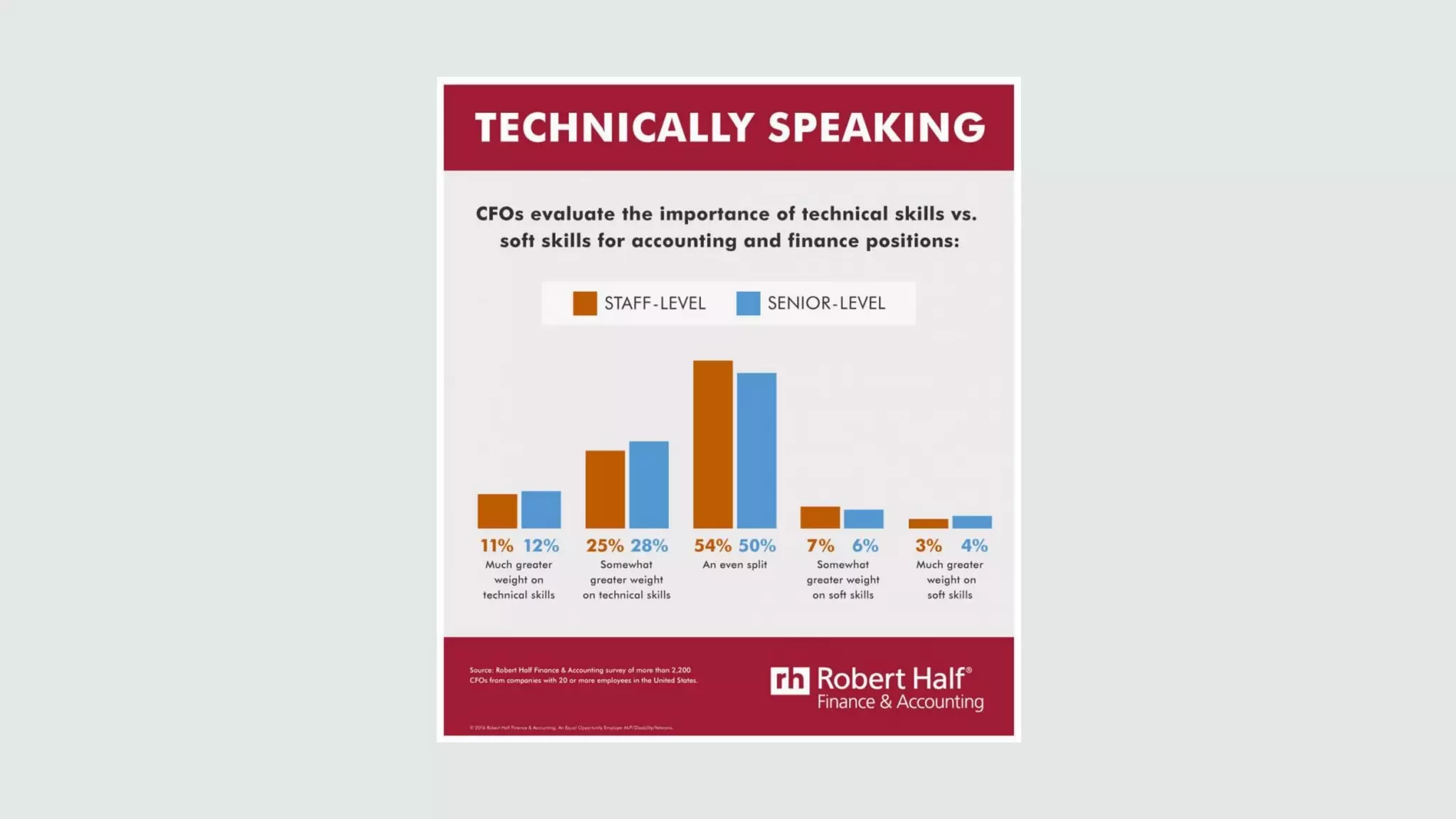
TECHNICALLY
SPEAKING
CFOs evaluate the importance of
technical skills vs. soft skills for
accounting and finance positions:
Source: Robert Half Finance &
Accounting survey of more than 2,200
CFOs from companies with 20 or more
employees in the United States.
© 2016 Robert Half Finance &
Accounting. An Equal Opportunity
Employer M/F/Disability/Veterans.
STAFF-
LEVEL
SENIOR
LEVEL
Much greater weight on
technical skills
11% 12%
Somewhat greater weight
on technical skills
25% 28%
An even split 54% 50%
Somewhat greater weight
on soft skills
7% 6%
Much greater weight on
soft skills
3% 4%

Presentation techniques.key manager.23.06.2021

  • 1.
  • 2.
    10 Ways toBuild Top Presentation Skills in Accounting and Finance by Robert Half (2017) How to improve your presentation skills 1) Face your fears. 2)Do your homework. 3)Practice, practice, practice. 4)Stand and deliver. 5)Anticipate questions.
  • 3.
    How to createstrong presentation slides BEGIN WITH A CLEAR OUTLINE. LET YOUR TITLES GUIDE THE WAY.
  • 4.
    Why Do Accountant s LoveTheir Jobs? It’s Not Just Numbers 1. Collaborate across departments 2. Cultivate teamwork and delegate effectively 3. Maximize insight from data 4. Make it visually engaging. 5. Provide a next step.
  • 5.
    1. Begin witha clear outline. WEʼVE ALL SEEN PRESENTATIONS THAT GO NOWHERE FAST. THAT OFTEN HAPPENS BECAUSE THE PRESENTER DOESN'T HAVE A HANDLE ON WHERE TO GO WITH THE PRESENTATION. GRAB A PEN AND PAPER BEFORE YOU OPEN YOUR PRESENTATION SOFTWARE. START CREATING YOUR PRESENTATION BY WRITING AN OUTLINE, WITH SPECIFIC FOCUS ON YOUR GOALS AND WHAT YOU WANT TO ACCOMPLISH BY THE TIME YOUʼRE DONE. THIS WILL HELP YOU STICK TO THE SCRIPT WHEN ITʼS TIME TO PUT THE DECK TOGETHER.
  • 6.
    2. Let yourtitles guide the way. Each slide’s title should provide context and explain the slide’s content, including the conclusion. For example, “A Third of Managers Regret Not Taking Enough Vacation Time” is better than just “Vacation Time.” A more descriptive title keeps your audience focused on the message. Also san-serif fonts that are easy to read. Titles should generally be between 36 and 44 font, and other content should be at least a 24-point font, with a 20-point font for captions,
  • 7.
    3. Keep yourslides succinct. Don't overwhelm your audience with too many words and numbers on your slides. Yes, you love your numbers, but don’t go number-happy. When deciding what to place on a slide, remember your slides should support what you’re saying, not the other way around. A slide with too much information is challenging to read. You’re essentially asking your audience to read and listen at the same time. Again, don’t make your audience work. If your presentation needs to be shared as a handout or forwarded to others, consider making two versions: a slimmed-down version to talk through and a sharable version with more explanatory text.
  • 8.
    4. Make itvisually engaging. No, a page or screenshot from Excel doesn’t really count as an image. Use simple photos or illustrations that support your message. A well-chosen image is a nice break from text that can grab your audience’s attention and help reinforce your message. You can find professional stock images on sites like Shutterstock. Also consider colors, and make sure your text and background colors contrast well.
  • 9.
    5. Provide anext step. Don’t just end your presentation by saying thank you; give a call to action. Close your presentation by including a slide that mentions what you’d like the audience to do with the information you shared with them.
  • 10.
    Once you improve your presentation skills Once youimprove your presentation skills, you can assume you've added valuable skills to your career toolbox. Not only will that help you succeed in your role, it will also help you advance in your accounting and finance career. https://www.roberthalf.com/blog/salaries- and-skills/accountants-need-hard-and-soft- skills-for-success
  • 11.
    8 ways to improveyour presentation skills Reference: https://mycareer.aicpa- cima.com/article /8_ways_to_prese ntation_skills /
  • 12.
    8 ways toimprove your presentation skills 1. Plan and rehearse your presentation 2. T ailor your words to the audience 3. Choose your presentation tools carefully 4. Project positivity using body language 5. Keep your first-night nerves in check 6. Make a strong start 7. Tell the audience a story 8. T ake care when fielding questions
  • 13.
    Management accountants can nolonger tuck themselves away in the back office, knowing that they will never be asked to step into the limelight. The ability to make a good presentation is now a key skill...
  • 14.
    1.Plan and rehearseyour presentation Few people are able to make a brilliant presentation off the cuff, so careful preparation is vital. In most cases, simplicity works best, so resist the temptation to be too clever by half. Focus on how to get your message over to the audience clearly and concisely. “Knowing your topic is the single most important point,” says Dave Coker, a finance lecturer at the London School of Business & Finance. He warns against delivering material produced by others and stresses the need for rehearsal. “Every presentation I give is rehearsed, sometimes as many as 100 times if it’s a new topic. Time your presentation and keep a timer running to ensure that you’re keeping on schedule,” he adds.
  • 15.
    2 Tailor yourwords to the audience “Because of a lack of presenting skills, training or talent, most finance professionals treat all presentations in the same way, with the result being a one-dimensional style, a lack of relevance and an indifferent reaction,” claims Rob Brown, author of How to Build Your Reputation (Ecademy Press, 2007). “But, when they consider the different audiences, objectives and ways to deliver the message, their chances of hitting the mark increase dramatically.”
  • 16.
    2 Tailor yourwords to the audience With so many different potential audiences, it’s important to tailor your message, says Phil Sheridan, senior managing director at recruitment consultancy Robert Half UK. “Imagine you’re introducing information on your company’s UK Gaap- IFRS convergence to your IT team: in this case, it’s best to keep your speech free of jargon and acronyms. Instead of explaining the financial implications, focus on how you think it will make a difference to IT systems and processes.”

  • 17.
    3 Choose your presentationtools carefully It’s best to decide which presentation tools to use right at the outset, advises Giles McIntyre, senior manager at recruitment consultancy Hays Accountancy & Finance. But it’s also important to ensure that the venue can cope with what you’ve chosen.
  • 18.
    “Have a planB” “Have a plan B,” he says. “For example, if you have a PowerPoint presentation, ensure that you print it out and arrive at the location early to check that all is in working order.”
  • 19.
    Make your slideseasy to read Make your slides easy to read, Coker stresses. “I’m pretty disciplined: I use bullet points only and no more than six per slide. Density is a turn-off, so your points should be structured as single, simple sentences that you can talk about for protracted periods. The worst thing is to stand up reading slides – boring!”
  • 20.
    4 Project positivity usingbody language “You don’t need to dance around the room to be a good presenter,” according to John McLachlan, a former FD in industry who is now MD of Monkey Puzzle Training & Consultancy. “You actually project more authority and come across as more credible if you stand still and move only to accentuate specific points with hand or arm gestures,” he says. “People often see entertaining presenters and think that they need to copy them in order to be good. This isn’t true. You need to be you.”
  • 21.
    Strong Presence Richard Newman,director of UK Body Talk, a presentation skills training company, points out that great actors such as Sir Anthony Hopkins and Dame Judi Dench build their stage presence by controlling their posture. “Most people stand off-centre, with their weight on one foot, so they look like a pushover,” he says. “Make sure that you project yourself as a strong presence, regardless of your audience, as your message deserves to get noticed.”
  • 22.
    5 Keep yourfirst- night nerves in check Most presenters are likely to feel some butterflies in their stomach, even if they’re seasoned performers. Newman points out that nervousness creates tension in your body, which hinders you from projecting your natural charisma.
  • 23.
    Relax “The easiest wayto overcome this is to clench any tense areas of your body for a few seconds and then relax them,” he advises. “This is great before an important meeting in helping you to stay calm and in control.”
  • 24.
    Pause Another way tocontrol nerves is to pause before saying anything. It was a trick perfected by the Hollywood star John Wayne. “He was asked how he delivered powerful lines,” Newman says. “Wayne said: ‘Simple. I just count to two… Then I say it. That way everyone is thinking: what’s he gonna say?’”
  • 25.
    6 Make astrong start You need to grab your audience at the beginning or they will soon switch off. “Some good things to do are to thank the previous presenter for a great talk, thank the organisers for the invitation to speak, if that’s appropriate, or make a reference to the nice food or venue,” McLachlan suggests, but he warns against some common openers.
  • 26.
    No Self-effacing jokes/Make fun of others “Self-effacing jokes such as ʻthis wonʼt take long and then you can get to the drinksʼ will merely take away your credibility,” he says. “Similarly, making fun of others doesnʼt make you look good to your audience, even if the people youʼre talking about can take it. The audience may not know that and this will present you as someone who needs to put others down to feel good.”
  • 27.
    7 Tell theaudience a story Financial managers are so au fait with the numbers that they often assume that others have the same enthusiasm, but people outside the profession are unlikely to be engaged, particularly by the more technical aspects, says Sue Binks, a senior consultant at the Roffey Park leadership institute.
  • 28.
    Storytelling can bea useful technique “Storytelling can be a useful technique in dealing with this,” she says. “This may mean talking about real scenarios or fictional ones, but the idea is to talk about how real people use the data, or what happens if they donʼt spot the underlying message. Build your knowledge and understanding of how your business operates and then use this information to show the context behind the figures.
  • 29.
    Highlight specific examples Highlight specificexamples, such as business wins. This will not only demonstrate your knowledge, but also engage the audience, helping them to understand how their contributions fit into the wider picture.”
  • 30.
    8 Take carewhen fielding questions Usually, questions from members of the audience will focus on what they feel are the most important issues. It’s helpful to consider before your presentation what people are likely to ask and prepare some outline responses.
  • 31.
    Coker advises takinga tough line with irrelevant queries. “You donʼt want to turn off most of your audience, so donʼt be afraid to terminate off- topic questions,” he says.
  • 32.
  • 33.
  • 34.
    Some sources forTaxation on Value- Added-Tax https://www.slideshare.net/kulbeerbumrah/value-added-tax- 35624073 I recommended this https://www.slideshare.net/horizon8586/value-added- tax?next_slideshow=1
  • 35.
    Infographic Speakings 1. Getthe big picture 2. Speak out, loud and clear 3. Make friends everywhere 4. Embrace diversity 5. Stand up and lead
  • 36.
    Hard and Softskills in demand for accounting and finance professionals. Analytical and strategy skills Written communica tion skills Technology skills
  • 37.
    Technology skills Advanced Excel EnterpriseResource Planning (ERP) Data analytics Business intelligence software (e.g., IBM Cognos) Microsoft Visual Basic Cloud-based software QuickBooks (for positions with small and midsize firms) Revenue recognition Risk and compliance Generally Accepted Accounting Principles (GAAP)
  • 38.
  • 40.
    TECHNICALLY SPEAKING CFOs evaluate theimportance of technical skills vs. soft skills for accounting and finance positions: Source: Robert Half Finance & Accounting survey of more than 2,200 CFOs from companies with 20 or more employees in the United States. © 2016 Robert Half Finance & Accounting. An Equal Opportunity Employer M/F/Disability/Veterans. STAFF- LEVEL SENIOR LEVEL Much greater weight on technical skills 11% 12% Somewhat greater weight on technical skills 25% 28% An even split 54% 50% Somewhat greater weight on soft skills 7% 6% Much greater weight on soft skills 3% 4%