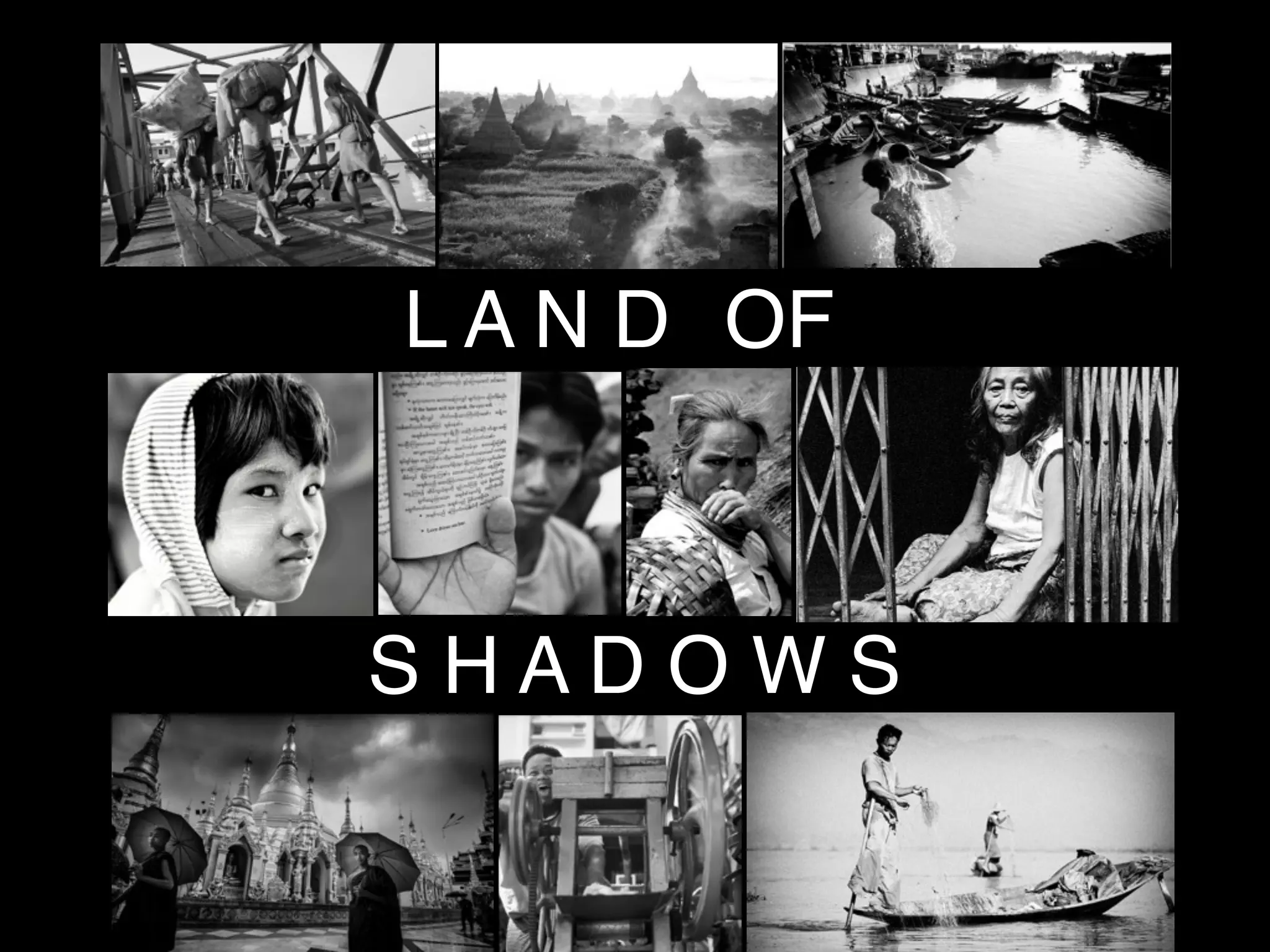
L A N D
S H A D O W S
OF
Land that is caught between
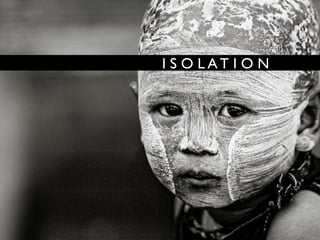
I S O L A T I O N
and...
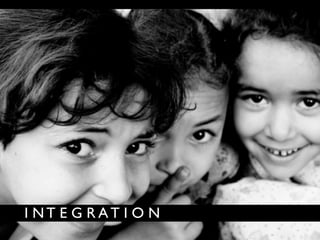
I N T E G R A T I O N
Land that is caught between
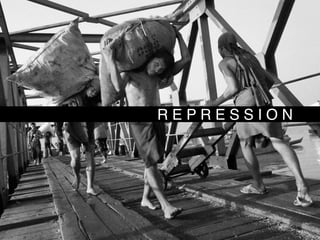
R E P R E S S I O N
and...
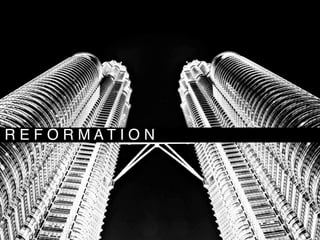
R E F O R M A T I O N
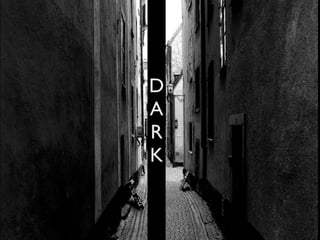
Land that is caught between
D
A
R
K
and...
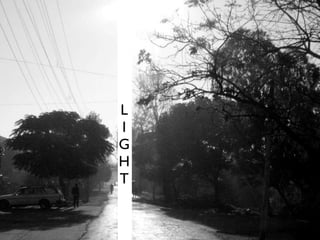
L
I
G
H
T
MYANMAR [PRINT]
Land of Shadows
Analysis of media landscape in Myanmar; a
country that is transiting from military rule
to democracy political system.
Explore the opportunities and challenges of
print media that transiting countries like
Myanmar will have in the near future.
Research Topic
Contents
Part 1 [Introduction]
• Brief Country Profile
• Timeline of Print Media
Part II [Landscape of Print Media]
Comparison between Pre-media Reformation Efforts and
Present
• Overview
• Global Perspective
• Print Media Landscape
• Media - Government Relations
• Print Media Structure and Policies
• Print Media Ownership
• Roles of Print Media
• Comparative Print Media Coverage
• Impact on Journalists in Myanmar
Part III [Road to Freedom]
• Opportunities & Challenges
• Conclusion
• References
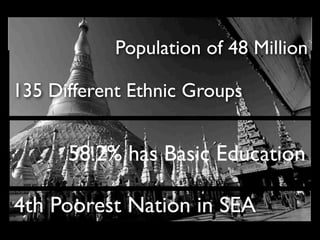
Population of 48 Million
4th Poorest Nation in SEA
135 Different Ethnic Groups
58.2% has Basic Education
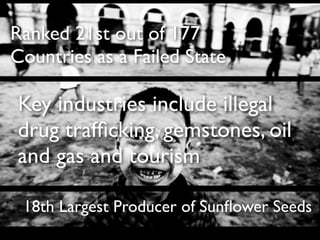
18th Largest Producer of Sunflower Seeds
Ranked 21st out of 177
Countries as a Failed State
Key industries include illegal
drug trafficking, gemstones, oil
and gas and tourism
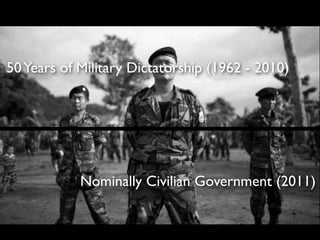
Nominally Civilian Government (2011)
50Years of Military Dictatorship (1962 - 2010)
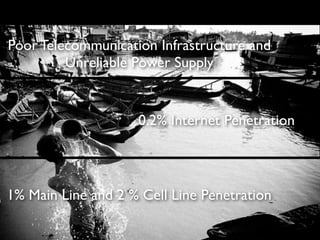
0.2% Internet Penetration
1% Main Line and 2 % Cell Line Penetration
Poor Telecommunication Infrastructure and
Unreliable Power Supply
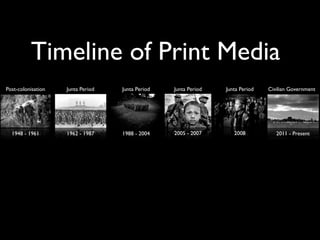
Post-colonisation Junta Period Junta Period Junta Period Junta Period Civilian Government
1948 - 1961 1962 - 1987 1988 - 2004 2005 - 2007 2008 2011 - Present
Timeline of Print Media
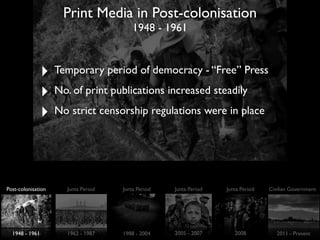
Print Media in Post-colonisation
1948 - 1961
‣ Temporary period of democracy - “Free” Press
‣ No. of print publications increased steadily
‣ No strict censorship regulations were in place
Post-colonisation Junta Period Junta Period Junta Period Junta Period Civilian Government
1948 - 1961 1962 - 1987 1988 - 2004 2005 - 2007 2008 2011 - Present
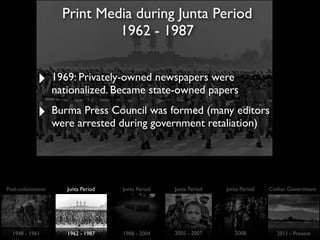
Print Media during Junta Period
1962 - 1987
‣ 1969: Privately-owned newspapers were
nationalized. Became state-owned papers
‣ Burma Press Council was formed (many editors
were arrested during government retaliation)
Post-colonisation Junta Period Junta Period Junta Period Junta Period Civilian Government
1948 - 1961 1962 - 1987 1988 - 2004 2005 - 2007 2008 2011 - Present
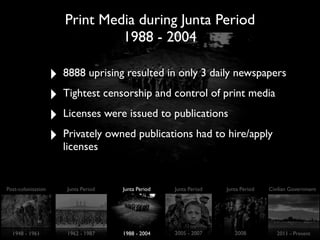
Print Media during Junta Period
1988 - 2004
‣ 8888 uprising resulted in only 3 daily newspapers
‣ Tightest censorship and control of print media
‣ Licenses were issued to publications
‣ Privately owned publications had to hire/apply
licenses
Post-colonisation Junta Period Junta Period Junta Period Junta Period Civilian Government
1948 - 1961 1962 - 1987 1988 - 2004 2005 - 2007 2008 2011 - Present
Post-colonisation Junta Period Junta Period Junta Period Junta Period Civilian Government
1948 - 1961 1962 - 1987 1988 - 2004 2005 - 2007 2008 2011 - Present
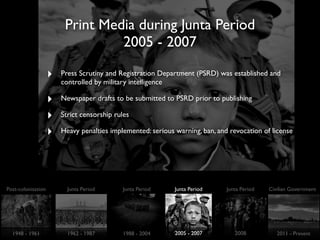
‣ Press Scrutiny and Registration Department (PSRD) was established and
controlled by military intelligence
‣ Newspaper drafts to be submitted to PSRD prior to publishing
‣ Strict censorship rules
‣ Heavy penalties implemented: serious warning, ban, and revocation of license
Print Media during Junta Period
2005 - 2007
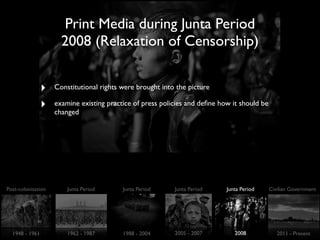
Print Media during Junta Period
2008 (Relaxation of Censorship)
‣ Constitutional rights were brought into the picture
‣ examine existing practice of press policies and define how it should be
changed
Post-colonisation Junta Period Junta Period Junta Period Junta Period Civilian Government
1948 - 1961 1962 - 1987 1988 - 2004 2005 - 2007 2008 2011 - Present
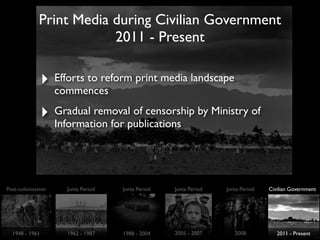
Print Media during Civilian Government
2011 - Present
‣ Efforts to reform print media landscape
commences
‣ Gradual removal of censorship by Ministry of
Information for publications
Post-colonisation Junta Period Junta Period Junta Period Junta Period Civilian Government
1948 - 1961 1962 - 1987 1988 - 2004 2005 - 2007 2008 2011 - Present
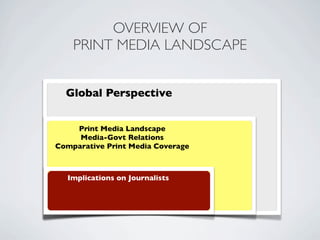
OVERVIEW OF
PRINT MEDIA LANDSCAPE
Global Perspective
Print Media Landscape
Media-Govt Relations
Comparative Print Media Coverage
Implications on Journalists
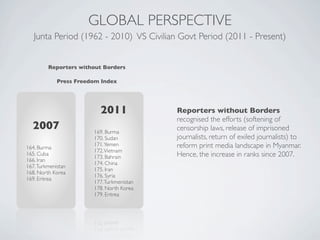
GLOBAL PERSPECTIVE
2011
169. Burma
170. Sudan
171.Yemen
172.Vietnam
173. Bahrain
174. China
175. Iran
176. Syria
177.Turkmenistan
178. North Korea
179. Eritrea
2007
164. Burma
165. Cuba
166. Iran
167.Turkmenistan
168. North Korea
169. Eritrea
Reporters without Borders
Press Freedom Index
Junta Period (1962 - 2010) VS Civilian Govt Period (2011 - Present)
Reporters without Borders
recognised the efforts (softening of
censorship laws, release of imprisoned
journalists, return of exiled journalists) to
reform print media landscape in Myanmar.
Hence, the increase in ranks since 2007.
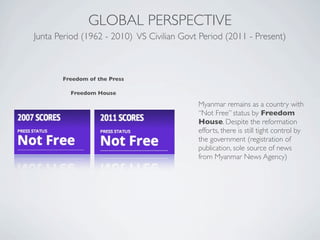
Freedom of the Press
Freedom House
Myanmar remains as a country with
“Not Free” status by Freedom
House. Despite the reformation
efforts, there is still tight control by
the government (registration of
publication, sole source of news
from Myanmar News Agency)
GLOBAL PERSPECTIVE
Junta Period (1962 - 2010) VS Civilian Govt Period (2011 - Present)
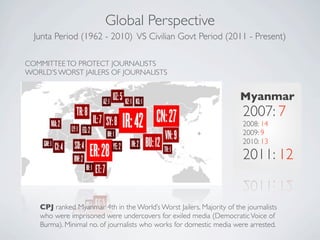
COMMITTEETO PROTECT JOURNALISTS
WORLD’S WORST JAILERS OF JOURNALISTS
Myanmar
2007: 7
2008: 14
2009: 9
2010: 13
2011: 12
Global Perspective
CPJ ranked Myanmar 4th in the World’s Worst Jailers. Majority of the journalists
who were imprisoned were undercovers for exiled media (DemocraticVoice of
Burma). Minimal no. of journalists who works for domestic media were arrested.
Junta Period (1962 - 2010) VS Civilian Govt Period (2011 - Present)
LANDSCAPE OF PRINT MEDIA
(JUNTA PERIOD)
1962 - 2010
• Strict authoritarian media system since military coup in 1962
‣ State controls main publications and privately-owned are forced to do weekly or monthly publications.
Limited no. of international publications.Thai and Indian publications may appear at times but are removed
most of the time
‣ All publications (poetry, books, journals, magazines, newspaper) must pass through the censor board at the
Press Scrutiny and Registration Division set up by the Ministry of Information
• Instrumental use of media by Junta
‣ News covers activities of the ruling generals and progress in the implementation of policies
• Readers read newspapers for advertisements, weddings and obituaries
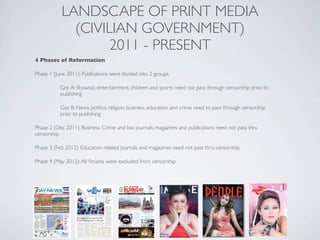
LANDSCAPE OF PRINT MEDIA
(CIVILIAN GOVERNMENT)
2011 - PRESENT
4 Phases of Reformation
Phase 1 (June 2011): Publications were divided into 2 groups
Grp A: Showbiz, entertainment, children and sports need not pass through censorship prior to
publishing
Grp B: News, politics, religion, business, education and crime need to pass through censorship
prior to publishing
Phase 2 (Dec 2011): Business, Crime and law journals, magazines and publications need not pass thru
censorship
Phase 3 (Feb 2012): Education related journals and magazines need not pass thru censorship.
Phase 4 (May 2012):All fictions were excluded from censorship
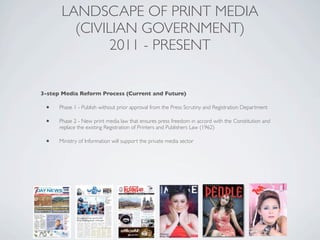
3-step Media Reform Process (Current and Future)
• Phase 1 - Publish without prior approval from the Press Scrutiny and Registration Department
• Phase 2 - New print media law that ensures press freedom in accord with the Constitution and
replace the existing Registration of Printers and Publishers Law (1962)
• Ministry of Information will support the private media sector
LANDSCAPE OF PRINT MEDIA
(CIVILIAN GOVERNMENT)
2011 - PRESENT
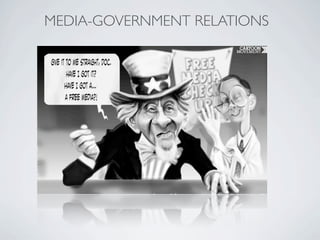
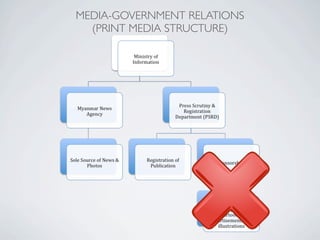
MEDIA-GOVERNMENT RELATIONS
(PRINT MEDIA STRUCTURE)
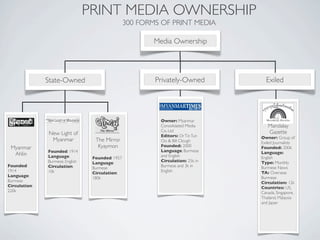
Media Ownership
State-Owned Privately-Owned Exiled
New Light of
Myanmar
Founded: 1914
Language:
Burmese, English
Circulation:
10k
The Mirror
Kyaymon
Founded: 1957
Language:
Burmese
Circulation:
180k
Myanmar
Ahlin
Founded:
1914
Language:
Burmese
Circulation:
220k
Owner: Myanmar
Consolidated Media
Co. Ltd
Editors: DrTinTun
Oo & Bill Clough
Founded: 2000
Language: Burmese
and English
Circulation: 25k in
Burmese and 3k in
English
Mandalay
Gazette
Owner: Group of
Exiled Journalists
Founded: 2006
Language:
English
Type: Monthly
Burmese News
TA: Overseas
Burmese
Circulation: 12k
Countries: US,
Canada, Singapore,
Thailand, Malaysia
and Japan
PRINT MEDIA OWNERSHIP
300 FORMS OF PRINT MEDIA
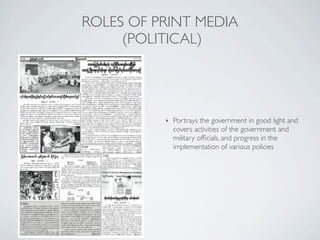
ROLES OF PRINT MEDIA
(POLITICAL)
‣ Portrays the government in good light and
covers activities of the government and
military officials, and progress in the
implementation of various policies
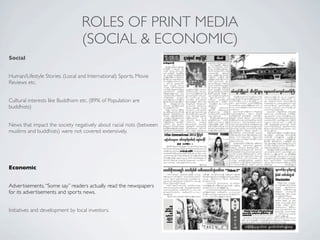
Social
Human/Lifestyle Stories. (Local and International) Sports, Movie
Reviews etc.
Cultural interests like Buddhism etc. (89% of Population are
buddhists)
News that impact the society negatively about racial riots (between
muslims and buddhists) were not covered extensively.
Economic
Advertisements.“Some say” readers actually read the newspapers
for its advertisements and sports news.
Initiatives and development by local investors.
ROLES OF PRINT MEDIA
(SOCIAL & ECONOMIC)
COMPARATIVE PRINT MEDIA
COVERAGE
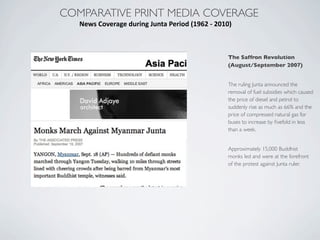
COMPARATIVE PRINT MEDIA COVERAGE
News	
  Coverage	
  during	
  Junta	
  Period	
  (1962	
  -­‐	
  2010)
The Saffron Revolution
(August/September 2007)
The ruling Junta announced the
removal of fuel subsidies which caused
the price of diesel and petrol to
suddenly rise as much as 66% and the
price of compressed natural gas for
buses to increase by fivefold in less
than a week.
Approximately 15,000 Buddhist
monks led and were at the forefront
of the protest against Junta ruler.
COMPARATIVE PRINT MEDIA COVERAGE
News	
  Coverage	
  during	
  Print	
  Media	
  Reforma?on	
  Period
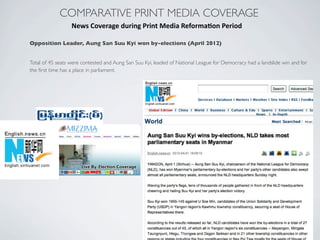
Opposition Leader, Aung San Suu Kyi won by-elections (April 2012)
Total of 45 seats were contested and Aung San Suu Kyi, leaded of National League for Democracy had a landslide win and for
the first time has a place in parliament.
COMPARATIVE PRINT MEDIA COVERAGE
News	
  Coverage	
  a@er	
  Abolish	
  of	
  Censorship	
  
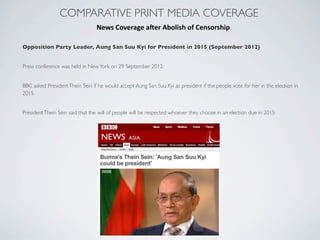
Opposition Party Leader, Aung San Suu Kyi for President in 2015 (September 2012)
Press conference was held in NewYork on 29 September 2012.
BBC asked PresidentThein Sein if he would accept Aung San Suu Kyi as president if the people vote for her in the election in
2015.
PresidentThein Sein said that the will of people will be respected whoever they choose in an election due in 2015
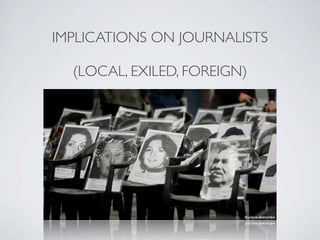
IMPLICATIONS ON JOURNALISTS
(LOCAL, EXILED, FOREIGN)
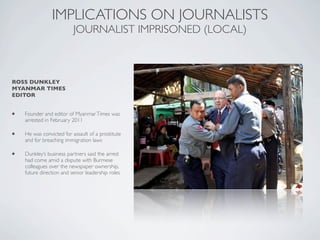
ROSS DUNKLEY
MYANMAR TIMES
EDITOR
IMPLICATIONS ON JOURNALISTS
JOURNALIST IMPRISONED (LOCAL)
• Founder and editor of MyanmarTimes was
arrested in February 2011
• He was convicted for assault of a prostitute
and for breaching immigration laws
• Dunkley’s business partners said the arrest
had come amid a dispute with Burmese
colleagues over the newspaper ownership,
future direction and senior leadership roles
IMPLICATIONS ON JOURNALISTS
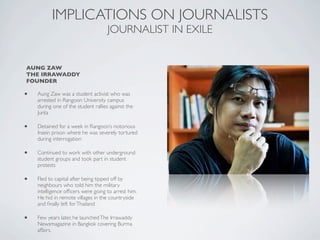
JOURNALIST IN EXILE
AUNG ZAW
THE IRRAWADDY
FOUNDER
• Aung Zaw was a student activist who was
arrested in Rangoon University campus
during one of the student rallies against the
Junta
• Detained for a week in Rangoon’s notorious
Insein prison where he was severely tortured
during interrogation
• Continued to work with other underground
student groups and took part in student
protests
• Fled to capital after being tipped off by
neighbours who told him the military
intelligence officers were going to arrest him.
He hid in remote villages in the countryside
and finally left forThailand
• Few years later, he launchedThe Irrawaddy
Newsmagazine in Bangkok covering Burma
affairs.
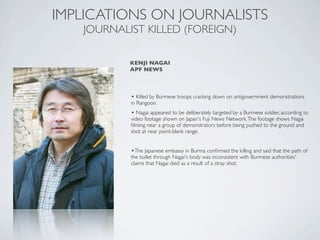
• Killed by Burmese troops cracking down on antigovernment demonstrations
in Rangoon.
• Nagai appeared to be deliberately targeted by a Burmese soldier, according to
video footage shown on Japan's Fuji News Network.The footage shows Nagai
filming near a group of demonstrators before being pushed to the ground and
shot at near point-blank range.
•The Japanese embassy in Burma confirmed the killing and said that the path of
the bullet through Nagai's body was inconsistent with Burmese authorities'
claims that Nagai died as a result of a stray shot.
IMPLICATIONS ON JOURNALISTS
JOURNALIST KILLED (FOREIGN)
KENJI NAGAI
APF NEWS
CHALLENGES &
OPPORTUNITIES
CHALLENGES
• Lack of Journalism Capacity Building Efforts
• Lack of practical skills, training and formal degree courses for journalism
• Journalists learned from older journalists and through books written by their
seniors
• One institution (University ofYangon) offers a degree in Journalism
• What is Good Ethics after 50years of Military Dictatorship
• Objectivity vs. Emotional Reporting
• Lack of examples of good ethics practiced by journalists
CHALLENGES
• Democratic Transition
• Opening up to privately owned media agencies
• Capitalistic Media Approach (Profit-driven) or Libertarian Approach (Watchdog
of Public Interests)
• Balance between media independence with accountability (Higher demand of
accountability with lax in press policies in democratic transition)
• Will Media Imperialism Take Place with Influx of Investments
from the West?
• With the influx of foreign investments and the lift of economic sanctions, will
Myanmar be influenced by western media?
• Will they be lost in finding their very own identity in the midst of transition to
democracy?
OPPORTUNITIES
• Road to Press Freedom
• Lifting of censorship system marks a positive step for print media landscape in
Myanmar, as it transits towards democracy
• It is a door to many more opportunities of making social, economic and
political change
• Myanmar may not be as free as the Philippine press, but it is optimistic in
making the big step of change towards press freedom
• Print Media for Democratic Discourse
• Reformation efforts hope to offer more diverse types of print publications.
Possibly, a more knowledgeable society with the exposure of different
publications and perspectives. Foreign investments may bring about more
international publications into Myanmar, hence, offering diverse perspectives
of the world and empowering burmese to better their lives and eventually,
make social change
OPPORTUNITIES
• Return of Exiled Journalists/Print Media
• With the return of exiled journalists, will they value-add and increase the
existing standards of print media landscape in Myanmar? With their vast
experience to less or no restriction to print media censorship from all over
the world, how will they improve the underdeveloped media landscape in
Myanmar
• Reform state media along public services lines, with full editorial
independence and a pluralism of content that reflects all sections of society,
including the weakest
OPPORTUNITIES
OPPORTUNITIES
• Will One of the Theories from Critical Media Approach Take
Place?
• Critical theory teaches that knowledge is power.To understand the ways
one is oppressed enables one to take action to change and bring about a
more equal and fairer society
• Print media for democratic discourse plays an important role in political,
economic and social change in Myanmar
• With the knowledge that the burmese may acquire from consumption of
diverse print media publications, will they want to take action and bring
about a more equal and fairer society?
CONCLUSION
• Myanmar is the land of shadows. It is caught between the transition from authoritarian to
democracy political system
• Vast opportunities for its underdeveloped media system to evolve
• Overcoming challenges that it faces will not be an easy task. However, it’s exciting to contemplate
on what the future of print media in Myanmar might be
• Will they adopt the Libertarian Model? Or will they adopt Developmental Approach if they are not
able to release sole ownership of major news outlet in Myanmar
• It’s an exciting future for Myanmar
Fun Fact: Did you know that Junta is pronounced as Hoon-Ta? :) ala Javier is pronounced as Ha-Vier
REFERENCES
UNICEF. (2012). Republic of the Union of Myanmar. Available: http://www.unicef.org/infobycountry/myanmar_statistics.html. Last accessed
5 Oct 2012.
The Myanmar Times. (2010-2012). Online Burma/Myanmar Library.Available: http://www.burmalibrary.org/show.php?cat=1687. Last
accessed 8 Oct 2012.
Jakubowicz, K, Sukosd, M (2008). Finding the Right Place on the Map: Central and Eastern European Media Change in a Global Perspective.
UK/USA: Intellect Books. p95-101.
C. Hallin, D, Mancini, P (2004). Comparing Media Systems: Three Models of Media and Politics. UK: Cambridge University Press. p66-78.
Ko Ko, Chairman, Yangon Media Group. (2012). The Fourth Pillar In Myanmar: Journey to Free Press. Available: http://www.iseas.edu.sg/
myan_forum/Ko%20Ko.pdf. Last accessed 9 Oct 2012.
Union of Myanmar, Ministry of Education. (2008). Country Report: Myanmar Education Development Strategy Focusing on Inclusive
Education. Available: http://www.ibe.unesco.org/National_Reports/ICE_2008/myanmar_NR08.pdf. Last accessed 10 Oct 2012.
D. H. Downing, J. (2011). Independent Media (Burma/Myanmar). In: John D. H. Downing Encyclopedia of Social Movement Media. USA:
Sage Publications Ltd. p242-243.
Committee to Protect Journalists (2011). Attacks on the Press in 2011: A Worldwide Survey by the Committee to Protect Journalists. USA:
United Book Press. p74-77.
Larmer, B. (2011). Land of Shadows. Available: http://ngm.nationalgeographic.com/2011/08/burma/larmer-text. Last accessed 6 Oct 2012.
Lee Arpon, Y. (2012). No media freedom yet, only self-censorship in Myanmar. Available: http://www.thejakartapost.com/news/2012/08/22/
no-media-freedom-yet-only-self-censorship-myanmar.html. Last accessed 5 Oct 2012.
Ministry of Information and Culture. (2012). Conference on Media Development in Myanmar. Available: http://www.i-m-s.dk/files/
publications/myanmar-conf-report-2012-final.pdf. Last accessed 6 Oct 2012.
REFERENCES
Phanida. (2012). Burma removes prior censorship. Available: http://www.mizzima.com/gallery/media-alert/7800-govt-removes-
prior-censorship-on-all-publications.html. Last accessed 7 Oct 2012.
Free Press. (2012). Transparency and Accountability. Available: http://www.freepress.net/transparency-and-accountability. Last
accessed 4 Oct 2012.
Al Jazeera. (2012). 'Mass graves' for Myanmar's Rohingya. Available: http://www.aljazeera.com/indepth/features/
2012/08/201288114724103607.html. Last accessed 4 Oct 2012.
Fuller, T. (2012). Myanmar lifts censorship of private publications.Available: http://www.business-standard.com/india/news/
myanmar-lifts-censorshipprivate-publications/483885/. Last accessed 8 Oct 2012.
UNICEF. (2012). A country of contrasts. Available: http://www.unicef.org/myanmar/overview_1343.html. Last accessed 8 Oct
2012.
BBC. (2012). Burma profile. Available: http://www.bbc.co.uk/news/world-asia-pacific-12990563. Last accessed 9 Oct 2012.
The New York Times. (2012). World: Myanmar. Available: http://topics.nytimes.com/top/news/international/
countriesandterritories/myanmar/index.html. Last accessed 9 Oct 2012.

Presentation Slides Template - Print Media in Myanmar

  • 1.
    L A ND S H A D O W S OF
  • 2.
    Land that iscaught between
  • 3.
    I S OL A T I O N
  • 4.
  • 5.
    I N TE G R A T I O N
  • 6.
    Land that iscaught between
  • 7.
    R E PR E S S I O N
  • 8.
  • 9.
    R E FO R M A T I O N
  • 10.
    Land that iscaught between
  • 11.
  • 12.
  • 13.
  • 14.
  • 15.
    Analysis of medialandscape in Myanmar; a country that is transiting from military rule to democracy political system. Explore the opportunities and challenges of print media that transiting countries like Myanmar will have in the near future. Research Topic
  • 16.
    Contents Part 1 [Introduction] •Brief Country Profile • Timeline of Print Media Part II [Landscape of Print Media] Comparison between Pre-media Reformation Efforts and Present • Overview • Global Perspective • Print Media Landscape • Media - Government Relations • Print Media Structure and Policies • Print Media Ownership • Roles of Print Media • Comparative Print Media Coverage • Impact on Journalists in Myanmar Part III [Road to Freedom] • Opportunities & Challenges • Conclusion • References
  • 17.
    Population of 48Million 4th Poorest Nation in SEA 135 Different Ethnic Groups 58.2% has Basic Education
  • 18.
    18th Largest Producerof Sunflower Seeds Ranked 21st out of 177 Countries as a Failed State Key industries include illegal drug trafficking, gemstones, oil and gas and tourism
  • 19.
    Nominally Civilian Government(2011) 50Years of Military Dictatorship (1962 - 2010)
  • 20.
    0.2% Internet Penetration 1%Main Line and 2 % Cell Line Penetration Poor Telecommunication Infrastructure and Unreliable Power Supply
  • 21.
    Post-colonisation Junta PeriodJunta Period Junta Period Junta Period Civilian Government 1948 - 1961 1962 - 1987 1988 - 2004 2005 - 2007 2008 2011 - Present Timeline of Print Media
  • 22.
    Print Media inPost-colonisation 1948 - 1961 ‣ Temporary period of democracy - “Free” Press ‣ No. of print publications increased steadily ‣ No strict censorship regulations were in place Post-colonisation Junta Period Junta Period Junta Period Junta Period Civilian Government 1948 - 1961 1962 - 1987 1988 - 2004 2005 - 2007 2008 2011 - Present
  • 23.
    Print Media duringJunta Period 1962 - 1987 ‣ 1969: Privately-owned newspapers were nationalized. Became state-owned papers ‣ Burma Press Council was formed (many editors were arrested during government retaliation) Post-colonisation Junta Period Junta Period Junta Period Junta Period Civilian Government 1948 - 1961 1962 - 1987 1988 - 2004 2005 - 2007 2008 2011 - Present
  • 24.
    Print Media duringJunta Period 1988 - 2004 ‣ 8888 uprising resulted in only 3 daily newspapers ‣ Tightest censorship and control of print media ‣ Licenses were issued to publications ‣ Privately owned publications had to hire/apply licenses Post-colonisation Junta Period Junta Period Junta Period Junta Period Civilian Government 1948 - 1961 1962 - 1987 1988 - 2004 2005 - 2007 2008 2011 - Present
  • 25.
    Post-colonisation Junta PeriodJunta Period Junta Period Junta Period Civilian Government 1948 - 1961 1962 - 1987 1988 - 2004 2005 - 2007 2008 2011 - Present ‣ Press Scrutiny and Registration Department (PSRD) was established and controlled by military intelligence ‣ Newspaper drafts to be submitted to PSRD prior to publishing ‣ Strict censorship rules ‣ Heavy penalties implemented: serious warning, ban, and revocation of license Print Media during Junta Period 2005 - 2007
  • 26.
    Print Media duringJunta Period 2008 (Relaxation of Censorship) ‣ Constitutional rights were brought into the picture ‣ examine existing practice of press policies and define how it should be changed Post-colonisation Junta Period Junta Period Junta Period Junta Period Civilian Government 1948 - 1961 1962 - 1987 1988 - 2004 2005 - 2007 2008 2011 - Present
  • 27.
    Print Media duringCivilian Government 2011 - Present ‣ Efforts to reform print media landscape commences ‣ Gradual removal of censorship by Ministry of Information for publications Post-colonisation Junta Period Junta Period Junta Period Junta Period Civilian Government 1948 - 1961 1962 - 1987 1988 - 2004 2005 - 2007 2008 2011 - Present
  • 28.
    OVERVIEW OF PRINT MEDIALANDSCAPE Global Perspective Print Media Landscape Media-Govt Relations Comparative Print Media Coverage Implications on Journalists
  • 29.
    GLOBAL PERSPECTIVE 2011 169. Burma 170.Sudan 171.Yemen 172.Vietnam 173. Bahrain 174. China 175. Iran 176. Syria 177.Turkmenistan 178. North Korea 179. Eritrea 2007 164. Burma 165. Cuba 166. Iran 167.Turkmenistan 168. North Korea 169. Eritrea Reporters without Borders Press Freedom Index Junta Period (1962 - 2010) VS Civilian Govt Period (2011 - Present) Reporters without Borders recognised the efforts (softening of censorship laws, release of imprisoned journalists, return of exiled journalists) to reform print media landscape in Myanmar. Hence, the increase in ranks since 2007.
  • 30.
    Freedom of thePress Freedom House Myanmar remains as a country with “Not Free” status by Freedom House. Despite the reformation efforts, there is still tight control by the government (registration of publication, sole source of news from Myanmar News Agency) GLOBAL PERSPECTIVE Junta Period (1962 - 2010) VS Civilian Govt Period (2011 - Present)
  • 31.
    COMMITTEETO PROTECT JOURNALISTS WORLD’SWORST JAILERS OF JOURNALISTS Myanmar 2007: 7 2008: 14 2009: 9 2010: 13 2011: 12 Global Perspective CPJ ranked Myanmar 4th in the World’s Worst Jailers. Majority of the journalists who were imprisoned were undercovers for exiled media (DemocraticVoice of Burma). Minimal no. of journalists who works for domestic media were arrested. Junta Period (1962 - 2010) VS Civilian Govt Period (2011 - Present)
  • 32.
  • 33.
    LANDSCAPE OF PRINTMEDIA (JUNTA PERIOD) 1962 - 2010 • Strict authoritarian media system since military coup in 1962 ‣ State controls main publications and privately-owned are forced to do weekly or monthly publications. Limited no. of international publications.Thai and Indian publications may appear at times but are removed most of the time ‣ All publications (poetry, books, journals, magazines, newspaper) must pass through the censor board at the Press Scrutiny and Registration Division set up by the Ministry of Information • Instrumental use of media by Junta ‣ News covers activities of the ruling generals and progress in the implementation of policies • Readers read newspapers for advertisements, weddings and obituaries
  • 34.
    LANDSCAPE OF PRINTMEDIA (CIVILIAN GOVERNMENT) 2011 - PRESENT 4 Phases of Reformation Phase 1 (June 2011): Publications were divided into 2 groups Grp A: Showbiz, entertainment, children and sports need not pass through censorship prior to publishing Grp B: News, politics, religion, business, education and crime need to pass through censorship prior to publishing Phase 2 (Dec 2011): Business, Crime and law journals, magazines and publications need not pass thru censorship Phase 3 (Feb 2012): Education related journals and magazines need not pass thru censorship. Phase 4 (May 2012):All fictions were excluded from censorship
  • 35.
    3-step Media ReformProcess (Current and Future) • Phase 1 - Publish without prior approval from the Press Scrutiny and Registration Department • Phase 2 - New print media law that ensures press freedom in accord with the Constitution and replace the existing Registration of Printers and Publishers Law (1962) • Ministry of Information will support the private media sector LANDSCAPE OF PRINT MEDIA (CIVILIAN GOVERNMENT) 2011 - PRESENT
  • 36.
  • 37.
  • 38.
    Media Ownership State-Owned Privately-OwnedExiled New Light of Myanmar Founded: 1914 Language: Burmese, English Circulation: 10k The Mirror Kyaymon Founded: 1957 Language: Burmese Circulation: 180k Myanmar Ahlin Founded: 1914 Language: Burmese Circulation: 220k Owner: Myanmar Consolidated Media Co. Ltd Editors: DrTinTun Oo & Bill Clough Founded: 2000 Language: Burmese and English Circulation: 25k in Burmese and 3k in English Mandalay Gazette Owner: Group of Exiled Journalists Founded: 2006 Language: English Type: Monthly Burmese News TA: Overseas Burmese Circulation: 12k Countries: US, Canada, Singapore, Thailand, Malaysia and Japan PRINT MEDIA OWNERSHIP 300 FORMS OF PRINT MEDIA
  • 39.
    ROLES OF PRINTMEDIA (POLITICAL) ‣ Portrays the government in good light and covers activities of the government and military officials, and progress in the implementation of various policies
  • 40.
    Social Human/Lifestyle Stories. (Localand International) Sports, Movie Reviews etc. Cultural interests like Buddhism etc. (89% of Population are buddhists) News that impact the society negatively about racial riots (between muslims and buddhists) were not covered extensively. Economic Advertisements.“Some say” readers actually read the newspapers for its advertisements and sports news. Initiatives and development by local investors. ROLES OF PRINT MEDIA (SOCIAL & ECONOMIC)
  • 41.
  • 42.
    COMPARATIVE PRINT MEDIACOVERAGE News  Coverage  during  Junta  Period  (1962  -­‐  2010) The Saffron Revolution (August/September 2007) The ruling Junta announced the removal of fuel subsidies which caused the price of diesel and petrol to suddenly rise as much as 66% and the price of compressed natural gas for buses to increase by fivefold in less than a week. Approximately 15,000 Buddhist monks led and were at the forefront of the protest against Junta ruler.
  • 43.
    COMPARATIVE PRINT MEDIACOVERAGE News  Coverage  during  Print  Media  Reforma?on  Period Opposition Leader, Aung San Suu Kyi won by-elections (April 2012) Total of 45 seats were contested and Aung San Suu Kyi, leaded of National League for Democracy had a landslide win and for the first time has a place in parliament.
  • 44.
    COMPARATIVE PRINT MEDIACOVERAGE News  Coverage  a@er  Abolish  of  Censorship   Opposition Party Leader, Aung San Suu Kyi for President in 2015 (September 2012) Press conference was held in NewYork on 29 September 2012. BBC asked PresidentThein Sein if he would accept Aung San Suu Kyi as president if the people vote for her in the election in 2015. PresidentThein Sein said that the will of people will be respected whoever they choose in an election due in 2015
  • 45.
  • 46.
    ROSS DUNKLEY MYANMAR TIMES EDITOR IMPLICATIONSON JOURNALISTS JOURNALIST IMPRISONED (LOCAL) • Founder and editor of MyanmarTimes was arrested in February 2011 • He was convicted for assault of a prostitute and for breaching immigration laws • Dunkley’s business partners said the arrest had come amid a dispute with Burmese colleagues over the newspaper ownership, future direction and senior leadership roles
  • 47.
    IMPLICATIONS ON JOURNALISTS JOURNALISTIN EXILE AUNG ZAW THE IRRAWADDY FOUNDER • Aung Zaw was a student activist who was arrested in Rangoon University campus during one of the student rallies against the Junta • Detained for a week in Rangoon’s notorious Insein prison where he was severely tortured during interrogation • Continued to work with other underground student groups and took part in student protests • Fled to capital after being tipped off by neighbours who told him the military intelligence officers were going to arrest him. He hid in remote villages in the countryside and finally left forThailand • Few years later, he launchedThe Irrawaddy Newsmagazine in Bangkok covering Burma affairs.
  • 48.
    • Killed byBurmese troops cracking down on antigovernment demonstrations in Rangoon. • Nagai appeared to be deliberately targeted by a Burmese soldier, according to video footage shown on Japan's Fuji News Network.The footage shows Nagai filming near a group of demonstrators before being pushed to the ground and shot at near point-blank range. •The Japanese embassy in Burma confirmed the killing and said that the path of the bullet through Nagai's body was inconsistent with Burmese authorities' claims that Nagai died as a result of a stray shot. IMPLICATIONS ON JOURNALISTS JOURNALIST KILLED (FOREIGN) KENJI NAGAI APF NEWS
  • 49.
  • 50.
    CHALLENGES • Lack ofJournalism Capacity Building Efforts • Lack of practical skills, training and formal degree courses for journalism • Journalists learned from older journalists and through books written by their seniors • One institution (University ofYangon) offers a degree in Journalism • What is Good Ethics after 50years of Military Dictatorship • Objectivity vs. Emotional Reporting • Lack of examples of good ethics practiced by journalists
  • 51.
    CHALLENGES • Democratic Transition •Opening up to privately owned media agencies • Capitalistic Media Approach (Profit-driven) or Libertarian Approach (Watchdog of Public Interests) • Balance between media independence with accountability (Higher demand of accountability with lax in press policies in democratic transition) • Will Media Imperialism Take Place with Influx of Investments from the West? • With the influx of foreign investments and the lift of economic sanctions, will Myanmar be influenced by western media? • Will they be lost in finding their very own identity in the midst of transition to democracy?
  • 52.
    OPPORTUNITIES • Road toPress Freedom • Lifting of censorship system marks a positive step for print media landscape in Myanmar, as it transits towards democracy • It is a door to many more opportunities of making social, economic and political change • Myanmar may not be as free as the Philippine press, but it is optimistic in making the big step of change towards press freedom
  • 53.
    • Print Mediafor Democratic Discourse • Reformation efforts hope to offer more diverse types of print publications. Possibly, a more knowledgeable society with the exposure of different publications and perspectives. Foreign investments may bring about more international publications into Myanmar, hence, offering diverse perspectives of the world and empowering burmese to better their lives and eventually, make social change OPPORTUNITIES
  • 54.
    • Return ofExiled Journalists/Print Media • With the return of exiled journalists, will they value-add and increase the existing standards of print media landscape in Myanmar? With their vast experience to less or no restriction to print media censorship from all over the world, how will they improve the underdeveloped media landscape in Myanmar • Reform state media along public services lines, with full editorial independence and a pluralism of content that reflects all sections of society, including the weakest OPPORTUNITIES
  • 55.
    OPPORTUNITIES • Will Oneof the Theories from Critical Media Approach Take Place? • Critical theory teaches that knowledge is power.To understand the ways one is oppressed enables one to take action to change and bring about a more equal and fairer society • Print media for democratic discourse plays an important role in political, economic and social change in Myanmar • With the knowledge that the burmese may acquire from consumption of diverse print media publications, will they want to take action and bring about a more equal and fairer society?
  • 56.
    CONCLUSION • Myanmar isthe land of shadows. It is caught between the transition from authoritarian to democracy political system • Vast opportunities for its underdeveloped media system to evolve • Overcoming challenges that it faces will not be an easy task. However, it’s exciting to contemplate on what the future of print media in Myanmar might be • Will they adopt the Libertarian Model? Or will they adopt Developmental Approach if they are not able to release sole ownership of major news outlet in Myanmar • It’s an exciting future for Myanmar Fun Fact: Did you know that Junta is pronounced as Hoon-Ta? :) ala Javier is pronounced as Ha-Vier
  • 57.
    REFERENCES UNICEF. (2012). Republicof the Union of Myanmar. Available: http://www.unicef.org/infobycountry/myanmar_statistics.html. Last accessed 5 Oct 2012. The Myanmar Times. (2010-2012). Online Burma/Myanmar Library.Available: http://www.burmalibrary.org/show.php?cat=1687. Last accessed 8 Oct 2012. Jakubowicz, K, Sukosd, M (2008). Finding the Right Place on the Map: Central and Eastern European Media Change in a Global Perspective. UK/USA: Intellect Books. p95-101. C. Hallin, D, Mancini, P (2004). Comparing Media Systems: Three Models of Media and Politics. UK: Cambridge University Press. p66-78. Ko Ko, Chairman, Yangon Media Group. (2012). The Fourth Pillar In Myanmar: Journey to Free Press. Available: http://www.iseas.edu.sg/ myan_forum/Ko%20Ko.pdf. Last accessed 9 Oct 2012. Union of Myanmar, Ministry of Education. (2008). Country Report: Myanmar Education Development Strategy Focusing on Inclusive Education. Available: http://www.ibe.unesco.org/National_Reports/ICE_2008/myanmar_NR08.pdf. Last accessed 10 Oct 2012. D. H. Downing, J. (2011). Independent Media (Burma/Myanmar). In: John D. H. Downing Encyclopedia of Social Movement Media. USA: Sage Publications Ltd. p242-243. Committee to Protect Journalists (2011). Attacks on the Press in 2011: A Worldwide Survey by the Committee to Protect Journalists. USA: United Book Press. p74-77. Larmer, B. (2011). Land of Shadows. Available: http://ngm.nationalgeographic.com/2011/08/burma/larmer-text. Last accessed 6 Oct 2012. Lee Arpon, Y. (2012). No media freedom yet, only self-censorship in Myanmar. Available: http://www.thejakartapost.com/news/2012/08/22/ no-media-freedom-yet-only-self-censorship-myanmar.html. Last accessed 5 Oct 2012. Ministry of Information and Culture. (2012). Conference on Media Development in Myanmar. Available: http://www.i-m-s.dk/files/ publications/myanmar-conf-report-2012-final.pdf. Last accessed 6 Oct 2012.
  • 58.
    REFERENCES Phanida. (2012). Burmaremoves prior censorship. Available: http://www.mizzima.com/gallery/media-alert/7800-govt-removes- prior-censorship-on-all-publications.html. Last accessed 7 Oct 2012. Free Press. (2012). Transparency and Accountability. Available: http://www.freepress.net/transparency-and-accountability. Last accessed 4 Oct 2012. Al Jazeera. (2012). 'Mass graves' for Myanmar's Rohingya. Available: http://www.aljazeera.com/indepth/features/ 2012/08/201288114724103607.html. Last accessed 4 Oct 2012. Fuller, T. (2012). Myanmar lifts censorship of private publications.Available: http://www.business-standard.com/india/news/ myanmar-lifts-censorshipprivate-publications/483885/. Last accessed 8 Oct 2012. UNICEF. (2012). A country of contrasts. Available: http://www.unicef.org/myanmar/overview_1343.html. Last accessed 8 Oct 2012. BBC. (2012). Burma profile. Available: http://www.bbc.co.uk/news/world-asia-pacific-12990563. Last accessed 9 Oct 2012. The New York Times. (2012). World: Myanmar. Available: http://topics.nytimes.com/top/news/international/ countriesandterritories/myanmar/index.html. Last accessed 9 Oct 2012.