Analysis of buffer zone for
incoming material handling
COURSE: Production development, strategy - system - technology
Members: Elina Nilsson, JacobWesslén, Andrea Parisotto, Shreyank Ramalingaiah
and Anoop Prabhulan
JÖNKÖPING December 2016
The company
The Project
The main purpose of this project is to carry out an
analysis at Inwido, which consists of three tasks:
1. Analysis of how Inwido works with production
development and manufacturing strategies;
2. Analysis of how they handle their incoming material;
3. Analysis of the material handling with simulation.
The research question:
What changes can be made to achieve a more
efficient material handling of the incoming material
in the buffer zone?
Theory
• Operations strategy
• Manufacturing strategy
• Production development
• Lean Manufacturing
• 5S
• 7 forms of waste
• Computer Simulation
Methodology
1. Interviews 2. Observations 3. Literature studies
FINDINGS!
About the company…
• Inwido’s manufacturing strategy is concerning investments and focus on quality.
• They split resources between their two factories inVetlanda.
• They are working with Lean and “Wow!” (Wow! means clean and tidy factories).
• Lead time and costs are Inwido’s main competitive factors.
• The demand of windows at Inwido changes during a year according to low and
high season.
“The role of production at Inwido is to in a safe way produce windows
with the right quality, on time and to the lowest possible cost.”
Inwido’s KPI:
1. The amount of health and safety alerts.
2. The amount of claims against delivered volume
3. OTIF - On time in full (if a product is delivered in the right time and that it
is complete)
4. Man hour/wing (the time it takes to produce one wing (window) counted
in hours per worker)
Incoming Material
• Two main types of incoming material
• Aluminum and glass.
• Two zones for incoming material.
• Main zone & small secondary zone
• All materials are handled by forklifts
• Variety on the quantity of incoming material.
• Pallets have specific markings for sorting and production order
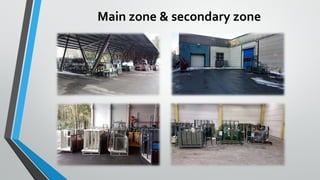
Main zone & secondary zone
Handling of material
• 3 processes for unloading material
• 2 processes for glass
• 1 process for aluminum
• 3 processes for retrieval of material
• 2 processes for glass
• 1 process for aluminum
Unloading pallets of aluminum in main incoming materials zone
# Task Description
1 Cargo truck arrives Truck arrives and park in the main incoming materials zone
2 Unload pallets Pallets are loaded off the truck with forklift
3 Place pallets in aluminum area Pallets are directly placed in unsorted rows in the area for
pallets of aluminum
4 Place empty pallets in truck Empty pallets for aluminum are loaded on to the cargo truck
5 Cargo truck leaves
Retrieve pallets of aluminum for assembly lines
1 Get order Driver gets order from an assembly line supervisor to fill the
smaller buffer zone with a number of pallets
2 Search for pallet The forklift driver searches among all aluminum pallets for the
right one
3 Move other pallets Driver needs to move other pallets blocking wanted pallet
4 Places other to side Driver places other pallets to the side
5 Retrieves correct pallet
6 Places pallet to the side Driver places correct pallet to the side
7 Move back other pallet Driver moves other pallets back to row
8 Transport pallet to buffer Pallet is transported to smaller buffer zone
9 Driver repeats steps 2 to 4 until smaller buffer is full, after that the assembly line supervisor transports
pallets to assembly lines with a smaller forklift
ANALYSIS!
7 forms of waste
In the buffer zone we found
three important types of waste:
1. Trasportation
2. Storage
3. Unnecessary movements
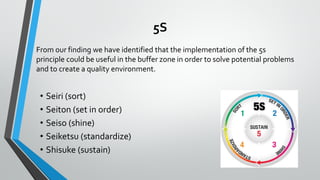
5S
From our finding we have identified that the implementation of the 5s
principle could be useful in the buffer zone in order to solve potential problems
and to create a quality environment.
• Seiri (sort)
• Seiton (set in order)
• Seiso (shine)
• Seiketsu (standardize)
• Shisuke (sustain)
Simulation of aluminum process
The Proposed Layout:
Discussion
• Expansion of the buffer zone
• Sorting documentation
• New aluminum sorting layout
Ideas & suggestions for the future of the buffer zone:
Proposed aluminum sorting layout
Truck Truck
Conclusion
Let’s see again our research question:
“What changes can be made to achieve a more efficient material handling of the
incoming material in the buffer zone?”
First thing to do is to, by using the method 5s, clean up the
incoming material zone, get rid of waste and then sort both the
glass and aluminum in a proper way according to when and where
it will be used in production.The second is to have a standardized
way of working, and finally to sustain and keep the new sorted
layout to achieve a more efficient material handling of the
incoming material in the buffer zone.
Our final answer is…
Presentation Project

Presentation Project

  • 1.
    Analysis of bufferzone for incoming material handling COURSE: Production development, strategy - system - technology Members: Elina Nilsson, JacobWesslén, Andrea Parisotto, Shreyank Ramalingaiah and Anoop Prabhulan JÖNKÖPING December 2016
  • 2.
  • 3.
    The Project The mainpurpose of this project is to carry out an analysis at Inwido, which consists of three tasks: 1. Analysis of how Inwido works with production development and manufacturing strategies; 2. Analysis of how they handle their incoming material; 3. Analysis of the material handling with simulation.
  • 4.
    The research question: Whatchanges can be made to achieve a more efficient material handling of the incoming material in the buffer zone?
  • 5.
    Theory • Operations strategy •Manufacturing strategy • Production development • Lean Manufacturing • 5S • 7 forms of waste • Computer Simulation
  • 6.
    Methodology 1. Interviews 2.Observations 3. Literature studies
  • 7.
  • 8.
    About the company… •Inwido’s manufacturing strategy is concerning investments and focus on quality. • They split resources between their two factories inVetlanda. • They are working with Lean and “Wow!” (Wow! means clean and tidy factories). • Lead time and costs are Inwido’s main competitive factors. • The demand of windows at Inwido changes during a year according to low and high season. “The role of production at Inwido is to in a safe way produce windows with the right quality, on time and to the lowest possible cost.”
  • 9.
    Inwido’s KPI: 1. Theamount of health and safety alerts. 2. The amount of claims against delivered volume 3. OTIF - On time in full (if a product is delivered in the right time and that it is complete) 4. Man hour/wing (the time it takes to produce one wing (window) counted in hours per worker)
  • 10.
    Incoming Material • Twomain types of incoming material • Aluminum and glass. • Two zones for incoming material. • Main zone & small secondary zone • All materials are handled by forklifts • Variety on the quantity of incoming material. • Pallets have specific markings for sorting and production order
  • 11.
    Main zone &secondary zone
  • 12.
    Handling of material •3 processes for unloading material • 2 processes for glass • 1 process for aluminum • 3 processes for retrieval of material • 2 processes for glass • 1 process for aluminum
  • 13.
    Unloading pallets ofaluminum in main incoming materials zone # Task Description 1 Cargo truck arrives Truck arrives and park in the main incoming materials zone 2 Unload pallets Pallets are loaded off the truck with forklift 3 Place pallets in aluminum area Pallets are directly placed in unsorted rows in the area for pallets of aluminum 4 Place empty pallets in truck Empty pallets for aluminum are loaded on to the cargo truck 5 Cargo truck leaves Retrieve pallets of aluminum for assembly lines 1 Get order Driver gets order from an assembly line supervisor to fill the smaller buffer zone with a number of pallets 2 Search for pallet The forklift driver searches among all aluminum pallets for the right one 3 Move other pallets Driver needs to move other pallets blocking wanted pallet 4 Places other to side Driver places other pallets to the side 5 Retrieves correct pallet 6 Places pallet to the side Driver places correct pallet to the side 7 Move back other pallet Driver moves other pallets back to row 8 Transport pallet to buffer Pallet is transported to smaller buffer zone 9 Driver repeats steps 2 to 4 until smaller buffer is full, after that the assembly line supervisor transports pallets to assembly lines with a smaller forklift
  • 15.
  • 16.
    7 forms ofwaste In the buffer zone we found three important types of waste: 1. Trasportation 2. Storage 3. Unnecessary movements
  • 17.
    5S From our findingwe have identified that the implementation of the 5s principle could be useful in the buffer zone in order to solve potential problems and to create a quality environment. • Seiri (sort) • Seiton (set in order) • Seiso (shine) • Seiketsu (standardize) • Shisuke (sustain)
  • 18.
  • 19.
  • 20.
  • 21.
    Discussion • Expansion ofthe buffer zone • Sorting documentation • New aluminum sorting layout Ideas & suggestions for the future of the buffer zone:
  • 22.
    Proposed aluminum sortinglayout Truck Truck
  • 23.
    Conclusion Let’s see againour research question: “What changes can be made to achieve a more efficient material handling of the incoming material in the buffer zone?” First thing to do is to, by using the method 5s, clean up the incoming material zone, get rid of waste and then sort both the glass and aluminum in a proper way according to when and where it will be used in production.The second is to have a standardized way of working, and finally to sustain and keep the new sorted layout to achieve a more efficient material handling of the incoming material in the buffer zone. Our final answer is…