PROcompetence
Challenges and possibilities in
interaction in multicultural
preschools in Sweden
–views and experiences of students
Pirjo Lahdenperä
Marja-Terttu Tryggvason
Anne Lillvist
Lahdenperä; Lillvist;Tryggvason, 2013-
09-10
Definition of client
A client is a recipient of a service who also
actively contributes to improvement of
quality and an added value. The client can
be both internal or external.
(Edvarsson, Andersson,Sandén,Waller,1998)
Lahdenperä; Lillvist;Tryggvason, 2013-
09-10
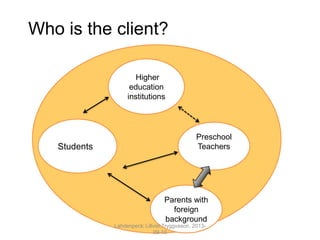
Students
Preschool
Teachers
Parents with
foreign
background
Higher
education
institutions
Who is the client?
Lahdenperä; Lillvist;Tryggvason, 2013-
09-10
Purposes
• Why we did this?
– To increase the students´ knowledge and
skills on intercultural competence.
– To increase the teacher educators´ knowledge
about how the the preschool teacher
education meets the needs and goals to work
at a multicultural preschool.
Lahdenperä; Lillvist;Tryggvason, 2013-
09-10
Fundamental values and tasks of
the Swedish preschool
The Education Act (98 rev 2010) stipulates
that the preschool should help to ensure that
children with a mother tongue other than
Swedish, receive the opportunity to develop
both their Swedish language and their
mother tongue.
Lahdenperä; Lillvist;Tryggvason, 2013-
09-10
Fundamental values and tasks of
the Swedish preschool
Increasing mobility across national borders creates
cultural diversity in the preschool, which provides
children with the opportunity to show respect and
consideration for each individual irrespective of
background.
The preschool can help to ensure that children from
national minorities and children with a foreign
background receive support in developing a
multicultural sense of identity.
Lahdenperä; Lillvist;Tryggvason, 2013-
09-10
The preschool should strive to
ensure that each child
• feel a sense of participation in their own culture and develop a
feeling and respect for other cultures,
• with a mother tongue other than Swedish develop their
cultural identity and the ability to communicate in both
Swedish and their mother tongue.
The work team should
show respect for parents and be responsible for developing good
relationships between staff of the preschool and the children’s
families,
take due account of parents viewpoints when planning and
carrying out activities.
Lahdenperä; Lillvist;Tryggvason, 2013-
09-10
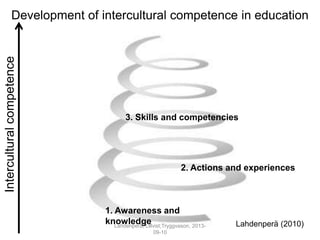
Development of intercultural competence in educationInterculturalcompetence
1. Awareness and
knowledge
2. Actions and experiences
3. Skills and competencies
Lahdenperä (2010)Lahdenperä; Lillvist;Tryggvason, 2013-
09-10
Data collection
• 3 interviews with former students from
preschool teacher education, now working
as preschool teachers.
Lahdenperä; Lillvist;Tryggvason, 2013-
09-10
Data collection cont.
• 6 theses on views and experience of
multiculturalism in Swedish preschools
• How multicultural parents experience the Swedish
preschool
• How preschool teachers experience the contacts
with multicultural parents
• How preschool teachers experience their work in
multicultural preschools
Lahdenperä; Lillvist;Tryggvason, 2013-
09-10
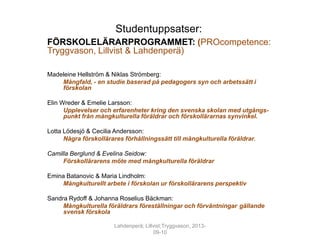
Studentuppsatser:
FÖRSKOLELÄRARPROGRAMMET: (PROcompetence:
Tryggvason, Lillvist & Lahdenperä)
Madeleine Hellström & Niklas Strömberg:
Mångfald, - en studie baserad på pedagogers syn och arbetssätt i
förskolan
Elin Wreder & Emelie Larsson:
Upplevelser och erfarenheter kring den svenska skolan med utgångs-
punkt från mångkulturella föräldrar och förskollärarnas synvinkel.
Lotta Lödesjö & Cecilia Andersson:
Några förskollärares förhållningssätt till mångkulturella föräldrar.
Camilla Berglund & Evelina Seidow:
Förskollärarens möte med mångkulturella föräldrar
Emina Batanovic & Maria Lindholm:
Mångkulturellt arbete i förskolan ur förskollärarens perspektiv
Sandra Rydoff & Johanna Roselius Bäckman:
Mångkulturella föräldrars föreställningar och förväntningar gällande
svensk förskola
Lahdenperä; Lillvist;Tryggvason, 2013-
09-10
Data collection cont.
• 9 oral and written interviews with the
teacher students who wrote the thesis on
multiculturalism
why we did this
to get to know what a student
understands with intercultural
competence
Lahdenperä; Lillvist;Tryggvason, 2013-
09-10
Results
The teacher education program is lacking
content regarding multicultural issues.
Students focused on differences and parents insufficient
knowledge of Swedish society.
Language was seen as a barrier.
” At school [teacher education programme] we talked
about gender and class inequalities mostly related to
school outcomes. Nothing really about how to
collaborate with parents from other cultural
backgrounds”
Lahdenperä; Lillvist;Tryggvason, 2013-
09-10
Results cont.
There are many multicultural preschools in the region,
however they are not being used as work placement
schools.
”My field practice school was in a very Swedish
neighborhood, so after graduation when I got a job at a
culturally very diverse preschool, it was almost a chock to
me”
“ I think that the Higher Education Institutes could
collaborate more with preschools and schools. Maybe have
preschool teachers or parents coming to give lectures”
Lahdenperä; Lillvist;Tryggvason, 2013-
09-10
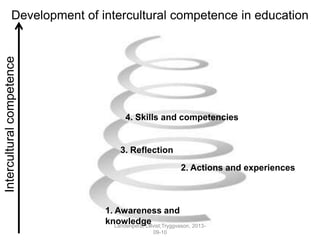
Development of intercultural competence in educationInterculturalcompetence
1. Awareness and
knowledge
2. Actions and experiences
3. Reflection
4. Skills and competencies
Lahdenperä; Lillvist;Tryggvason, 2013-
09-10
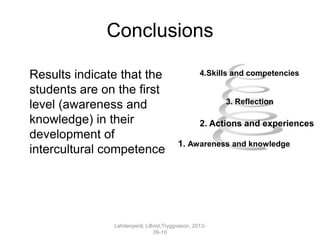
Conclusions
1. Awareness and knowledge
2. Actions and experiences
Results indicate that the
students are on the first
level (awareness and
knowledge) in their
development of
intercultural competence
3. Reflection
4.Skills and competencies
Lahdenperä; Lillvist;Tryggvason, 2013-
09-10
Future recommendations
1.Theoretical knowledge of multicultural issues in preschool
teacher education is needed.
Our teacher education needs to motivate and awaken students
interest for multicultural issues.
2.Multicultural field practice schools should be used by students to
gain experiences of interaction with children and especially with
parents with foreign background.
3. Interculturally competent staff at teacher education and field
practice school should reflect with students about their experiences
4. Skills and competencies are developed by combining theory and
experiences
Lahdenperä; Lillvist;Tryggvason, 2013-
09-10
References:
• Edvarsson, Bo; Andersson, Tobias; Sandén, Mattias; Waller Björn
(1998). Mätning av tjänstekvaliten I praktiken. Lund:
Studentlitteratur.
• Lahdenperä, Pirjo (2010). Mångfald som interkulturell utmaning, I P.
Lahdenperä & H. Lotentz (red) Möten i mångfaldens skola.
Interkulturella arbetaformer och nya pedagogiska utmaningar. Lund:
Studentlitteratur.
• Utbildningsdepartementet, Läroplan för förskolan 1998/2010.
Lahdenperä; Lillvist;Tryggvason, 2013-
09-10

Presentation pärnu, Sweden

  • 1.
    PROcompetence Challenges and possibilitiesin interaction in multicultural preschools in Sweden –views and experiences of students Pirjo Lahdenperä Marja-Terttu Tryggvason Anne Lillvist Lahdenperä; Lillvist;Tryggvason, 2013- 09-10
  • 2.
    Definition of client Aclient is a recipient of a service who also actively contributes to improvement of quality and an added value. The client can be both internal or external. (Edvarsson, Andersson,Sandén,Waller,1998) Lahdenperä; Lillvist;Tryggvason, 2013- 09-10
  • 3.
  • 4.
    Purposes • Why wedid this? – To increase the students´ knowledge and skills on intercultural competence. – To increase the teacher educators´ knowledge about how the the preschool teacher education meets the needs and goals to work at a multicultural preschool. Lahdenperä; Lillvist;Tryggvason, 2013- 09-10
  • 5.
    Fundamental values andtasks of the Swedish preschool The Education Act (98 rev 2010) stipulates that the preschool should help to ensure that children with a mother tongue other than Swedish, receive the opportunity to develop both their Swedish language and their mother tongue. Lahdenperä; Lillvist;Tryggvason, 2013- 09-10
  • 6.
    Fundamental values andtasks of the Swedish preschool Increasing mobility across national borders creates cultural diversity in the preschool, which provides children with the opportunity to show respect and consideration for each individual irrespective of background. The preschool can help to ensure that children from national minorities and children with a foreign background receive support in developing a multicultural sense of identity. Lahdenperä; Lillvist;Tryggvason, 2013- 09-10
  • 7.
    The preschool shouldstrive to ensure that each child • feel a sense of participation in their own culture and develop a feeling and respect for other cultures, • with a mother tongue other than Swedish develop their cultural identity and the ability to communicate in both Swedish and their mother tongue. The work team should show respect for parents and be responsible for developing good relationships between staff of the preschool and the children’s families, take due account of parents viewpoints when planning and carrying out activities. Lahdenperä; Lillvist;Tryggvason, 2013- 09-10
  • 8.
    Development of interculturalcompetence in educationInterculturalcompetence 1. Awareness and knowledge 2. Actions and experiences 3. Skills and competencies Lahdenperä (2010)Lahdenperä; Lillvist;Tryggvason, 2013- 09-10
  • 9.
    Data collection • 3interviews with former students from preschool teacher education, now working as preschool teachers. Lahdenperä; Lillvist;Tryggvason, 2013- 09-10
  • 10.
    Data collection cont. •6 theses on views and experience of multiculturalism in Swedish preschools • How multicultural parents experience the Swedish preschool • How preschool teachers experience the contacts with multicultural parents • How preschool teachers experience their work in multicultural preschools Lahdenperä; Lillvist;Tryggvason, 2013- 09-10
  • 11.
    Studentuppsatser: FÖRSKOLELÄRARPROGRAMMET: (PROcompetence: Tryggvason, Lillvist& Lahdenperä) Madeleine Hellström & Niklas Strömberg: Mångfald, - en studie baserad på pedagogers syn och arbetssätt i förskolan Elin Wreder & Emelie Larsson: Upplevelser och erfarenheter kring den svenska skolan med utgångs- punkt från mångkulturella föräldrar och förskollärarnas synvinkel. Lotta Lödesjö & Cecilia Andersson: Några förskollärares förhållningssätt till mångkulturella föräldrar. Camilla Berglund & Evelina Seidow: Förskollärarens möte med mångkulturella föräldrar Emina Batanovic & Maria Lindholm: Mångkulturellt arbete i förskolan ur förskollärarens perspektiv Sandra Rydoff & Johanna Roselius Bäckman: Mångkulturella föräldrars föreställningar och förväntningar gällande svensk förskola Lahdenperä; Lillvist;Tryggvason, 2013- 09-10
  • 12.
    Data collection cont. •9 oral and written interviews with the teacher students who wrote the thesis on multiculturalism why we did this to get to know what a student understands with intercultural competence Lahdenperä; Lillvist;Tryggvason, 2013- 09-10
  • 13.
    Results The teacher educationprogram is lacking content regarding multicultural issues. Students focused on differences and parents insufficient knowledge of Swedish society. Language was seen as a barrier. ” At school [teacher education programme] we talked about gender and class inequalities mostly related to school outcomes. Nothing really about how to collaborate with parents from other cultural backgrounds” Lahdenperä; Lillvist;Tryggvason, 2013- 09-10
  • 14.
    Results cont. There aremany multicultural preschools in the region, however they are not being used as work placement schools. ”My field practice school was in a very Swedish neighborhood, so after graduation when I got a job at a culturally very diverse preschool, it was almost a chock to me” “ I think that the Higher Education Institutes could collaborate more with preschools and schools. Maybe have preschool teachers or parents coming to give lectures” Lahdenperä; Lillvist;Tryggvason, 2013- 09-10
  • 15.
    Development of interculturalcompetence in educationInterculturalcompetence 1. Awareness and knowledge 2. Actions and experiences 3. Reflection 4. Skills and competencies Lahdenperä; Lillvist;Tryggvason, 2013- 09-10
  • 16.
    Conclusions 1. Awareness andknowledge 2. Actions and experiences Results indicate that the students are on the first level (awareness and knowledge) in their development of intercultural competence 3. Reflection 4.Skills and competencies Lahdenperä; Lillvist;Tryggvason, 2013- 09-10
  • 17.
    Future recommendations 1.Theoretical knowledgeof multicultural issues in preschool teacher education is needed. Our teacher education needs to motivate and awaken students interest for multicultural issues. 2.Multicultural field practice schools should be used by students to gain experiences of interaction with children and especially with parents with foreign background. 3. Interculturally competent staff at teacher education and field practice school should reflect with students about their experiences 4. Skills and competencies are developed by combining theory and experiences Lahdenperä; Lillvist;Tryggvason, 2013- 09-10
  • 18.
    References: • Edvarsson, Bo;Andersson, Tobias; Sandén, Mattias; Waller Björn (1998). Mätning av tjänstekvaliten I praktiken. Lund: Studentlitteratur. • Lahdenperä, Pirjo (2010). Mångfald som interkulturell utmaning, I P. Lahdenperä & H. Lotentz (red) Möten i mångfaldens skola. Interkulturella arbetaformer och nya pedagogiska utmaningar. Lund: Studentlitteratur. • Utbildningsdepartementet, Läroplan för förskolan 1998/2010. Lahdenperä; Lillvist;Tryggvason, 2013- 09-10