Content:
Introduction:
• Throughout a woman's life cycle, the
hormonal influences that take place
can affect the therapeutic decision
making in Periodontics.
• However at times there are various
contributing factors that exaggerate
the existing periodontal disease.
• One such is observed in female
patients where, as a result of
hormonal influences seen during
their life cycle.
• Hormones are specific regulatory molecules that modulate
reproduction, growth and development, maintenance of
the internal environment, as well as energy production,
utilization, and storage.
• Hormonal effects reflect physiological/ pathological
changes in almost all types of tissues of the body.
Puberty:
• 11 to 14 years in most women.
• Prevalence of gingivitis increases, without an increase in the amount of
plaque.
• Gram negative anaerobes, implicated in association with puberty gingivitis.
• Kornman and Loesche (1979) postulated that these anaerobic organisms
may use ovarian hormones as a substitute for vitamin K growth factor.
• Prevotella intermedia and Capnocytophaga species have been implicated in
the increased bleeding tendency observed during puberty.
Clinical Features:
• Exaggerated response to local
factors.
• Hyperplasic reaction of the gingiva
may occur.
• Inflamed tissues become
erythematous, lobulated, and
retractable.
• Easily Bleeds.
• Inflammatory hyperplasia seen.
• Chronic regurgitation of gastric
contents on intraoral tissues which
is a common complaint in the
puberty phase.
• Bulimia and anorexia nervosa.
• Perimylosis typically on the palatal
surfaces of maxillary anterior teeth
varies with duration and frequency
of eating disorder.
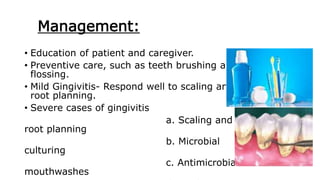
Management:
• Education of patient and caregiver.
• Preventive care, such as teeth brushing and
flossing.
• Mild Gingivitis- Respond well to scaling and
root planning.
• Severe cases of gingivitis
a. Scaling and
root planning
b. Microbial
culturing
c. Antimicrobial
mouthwashes
MENSES:
• During the reproductive years, the ovarian cycle is
controlled by the anterior pituitary gland which secretes
follicle stimulating hormone (FSH) and Luteinizing
hormone (LH) are produced from anterior pituitary
gland.
• Under the influence of FSH and LH, estrogen and
progesterone are steroid hormones produced by the
ovaries during the menstrual cycle.
• Average ovarian cycle lasts for 28 days, which is
interrupted only by pregnancy.
• During the reproductive cycle, the purpose of estrogen
and progesterone is to prepare the uterus for
Pre menstrual syndrome ( PMS):
• During the peak level of progesterone (about 7 – 10 days prior
to menstruation) PMS also occur.
• No significant differences in estrogen and progesterone levels
between women who suffer PMS and women who do not.
• Depression, irritability, mood swings, and difficulty with memory
and concentration due to reduced neuro transmitters.
• PMS women have lower of certain neuro transmitters such as:
• Enkaphalins
• Endorphins
• Amino butyric acid (GABA)
• Serotonin
The monthly reproductive cycle has two
phases monthly reproductive cycle has two phases: The monthly reproductive cycle
has two phases:
Presentation .pptx
Presentation .pptx
Presentation .pptx
Presentation .pptx
Presentation .pptx
Presentation .pptx
Presentation .pptx
Presentation .pptx
Presentation .pptx
Presentation .pptx
Presentation .pptx
Presentation .pptx
Presentation .pptx
Presentation .pptx
Presentation .pptx
Presentation .pptx
Presentation .pptx
Presentation .pptx
Presentation .pptx
Presentation .pptx
Presentation .pptx
Presentation .pptx
Presentation .pptx

Presentation .pptx

  • 2.
  • 3.
    Introduction: • Throughout awoman's life cycle, the hormonal influences that take place can affect the therapeutic decision making in Periodontics. • However at times there are various contributing factors that exaggerate the existing periodontal disease. • One such is observed in female patients where, as a result of hormonal influences seen during their life cycle.
  • 4.
    • Hormones arespecific regulatory molecules that modulate reproduction, growth and development, maintenance of the internal environment, as well as energy production, utilization, and storage. • Hormonal effects reflect physiological/ pathological changes in almost all types of tissues of the body.
  • 5.
    Puberty: • 11 to14 years in most women. • Prevalence of gingivitis increases, without an increase in the amount of plaque. • Gram negative anaerobes, implicated in association with puberty gingivitis. • Kornman and Loesche (1979) postulated that these anaerobic organisms may use ovarian hormones as a substitute for vitamin K growth factor. • Prevotella intermedia and Capnocytophaga species have been implicated in the increased bleeding tendency observed during puberty.
  • 6.
    Clinical Features: • Exaggeratedresponse to local factors. • Hyperplasic reaction of the gingiva may occur. • Inflamed tissues become erythematous, lobulated, and retractable. • Easily Bleeds. • Inflammatory hyperplasia seen.
  • 7.
    • Chronic regurgitationof gastric contents on intraoral tissues which is a common complaint in the puberty phase. • Bulimia and anorexia nervosa. • Perimylosis typically on the palatal surfaces of maxillary anterior teeth varies with duration and frequency of eating disorder.
  • 8.
    Management: • Education ofpatient and caregiver. • Preventive care, such as teeth brushing and flossing. • Mild Gingivitis- Respond well to scaling and root planning. • Severe cases of gingivitis a. Scaling and root planning b. Microbial culturing c. Antimicrobial mouthwashes
  • 9.
    MENSES: • During thereproductive years, the ovarian cycle is controlled by the anterior pituitary gland which secretes follicle stimulating hormone (FSH) and Luteinizing hormone (LH) are produced from anterior pituitary gland. • Under the influence of FSH and LH, estrogen and progesterone are steroid hormones produced by the ovaries during the menstrual cycle. • Average ovarian cycle lasts for 28 days, which is interrupted only by pregnancy. • During the reproductive cycle, the purpose of estrogen and progesterone is to prepare the uterus for
  • 11.
    Pre menstrual syndrome( PMS): • During the peak level of progesterone (about 7 – 10 days prior to menstruation) PMS also occur. • No significant differences in estrogen and progesterone levels between women who suffer PMS and women who do not. • Depression, irritability, mood swings, and difficulty with memory and concentration due to reduced neuro transmitters. • PMS women have lower of certain neuro transmitters such as: • Enkaphalins • Endorphins • Amino butyric acid (GABA) • Serotonin
  • 12.
    The monthly reproductivecycle has two phases monthly reproductive cycle has two phases: The monthly reproductive cycle has two phases: