1--4
7--
1 What is light and sound
Ans) Light is an electromagnetic radiation
electromagnetic wave that can be detected by
Human eyes. S ound is defined as an Oscillation in
pressure, stress, particle displacement, particle
velocity, etc. propagated in a medium with
internal forces.
2 What are mechanical waves
Ans) A mechanical wave is a wave that is an
oscillation of matter, and therefore transfers
energy through a medium. Mechanical waves can
be produced only in media which possess
elasticity .
Real and Virtual
images
1 V i rt ua l i ma ge s a re e re ct .
2 Concave lenses form a virtual
i m a g e .
3)Virtual images appearto be on the
l e n s es o r th e m i r r o r i t s el f .
4)Virtual images are formed by
c o n v e x m i r r o r s .
5)Virtual images are formed due
to the imaginary intersection of
l i g h t r a y s .
1 Real images are inverted.
2 Convex lenses form a real
i m a g e . .
3 Real images are formed on the
s c r e e n .
4)Real images are
formed by concave
m i r r o r s .
5 )R e a l i m a g e a r e
formed due to the actual
intersectionof light rays.
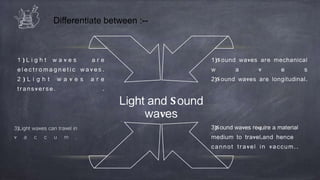
Differentiate between :--
Light and S ound
waves
1)S ound waves are mechanical
w a v e s
2)S ound waves are longitudinal.
3)S ound waves require a material
medium to travel,and hence
c a nn ot t r a vel i n vac cu m . .
1 ) L i g h t w a v e s a r e
e l e c t r o m a g n e t i c w a v e s .
2 ) L i g h t w a v e s a r e
t r a n s ve r s e . .
3)Light waves can travel in
v a c c u m .
Differentiate between :--
1)Who invented Televions and what could be the reason
behind the invention of televisions
Ans) Philo Taylor Farnsworth II (born on August 19 1906
invented televisions . Televisions were invented because
Philo Farnsworth II wanted to make an invention that could
capture moving images transform those images into code
move those images in radio waves to various devices .
Q2) Why is it celebrated ?
Ans) World Television Day is
celebrated on 21 November every
year. According to the UN, this day
highlights the major role that
television plays in daily life by
presenting different issues that
affect people. UN General
Assembly on 17 December 1996
proclaimed 21 November as World
Television Day.
Q1) How can television promote good moral values in development of a
child ?
Ans) Television has negative and positive affects on the children . The question is
about good ones . Here are a few advantages of watching TV :--
1) Watching TV can be educational and informative.
2)Gathering around the television gives families, friends, and strangers some thing to
bond over.
3)Watching a varieties of show might gives us understanding of the world we live in
and expose us to things we might never come across in our own lives.
4)Watching TV makes us laugh, which is good for health.
5)Some shows let you travel and teach you about people, cultures, ideas and and
places.
Watching TV can s
Q2) How is it useful in social, political and economical
developments and help a person to connect globally ?
Ans) TV is a source of information or communication and media
plays a very significant role in everyone's life. In today's modern
society, media has become a very big parts of our life. Its duty is to
inform, educate and entertain.TV like a bridge between the
governing bodies and general public. Because of its ability to create
powerful touchstones, TV enables young people to share cultural
experiences with others. ... News, current events and historical
programming can help make young people more aware of other
cultures and people. Documentaries can help develop critical
thinking about society and the world.
Q2) What are the adverse health affects of
watching TV?
Ans) Too much screen time can lead to obesity, sleep
problems, chronic neck and back problems, depression,
anxiety and lower test scores in children. Children
should limit screen time to 1 to 2 hours per day. Adults
should also try to limit screen time outside of work
hours.
1)https://www.britannica.com/science/light
2)https://en.wikipedia.org/wiki/Sound
3)https://en.wikipedia.org/wiki/Mechanical_wave
4)https://www.everydayhealth.com/news/ways-tv-binge-
watching-hurts-your-health/
Presentation Physics.pptx

Presentation Physics.pptx

  • 2.
  • 3.
    1 What islight and sound Ans) Light is an electromagnetic radiation electromagnetic wave that can be detected by Human eyes. S ound is defined as an Oscillation in pressure, stress, particle displacement, particle velocity, etc. propagated in a medium with internal forces.
  • 4.
    2 What aremechanical waves Ans) A mechanical wave is a wave that is an oscillation of matter, and therefore transfers energy through a medium. Mechanical waves can be produced only in media which possess elasticity .
  • 5.
    Real and Virtual images 1V i rt ua l i ma ge s a re e re ct . 2 Concave lenses form a virtual i m a g e . 3)Virtual images appearto be on the l e n s es o r th e m i r r o r i t s el f . 4)Virtual images are formed by c o n v e x m i r r o r s . 5)Virtual images are formed due to the imaginary intersection of l i g h t r a y s . 1 Real images are inverted. 2 Convex lenses form a real i m a g e . . 3 Real images are formed on the s c r e e n . 4)Real images are formed by concave m i r r o r s . 5 )R e a l i m a g e a r e formed due to the actual intersectionof light rays. Differentiate between :--
  • 6.
    Light and Sound waves 1)S ound waves are mechanical w a v e s 2)S ound waves are longitudinal. 3)S ound waves require a material medium to travel,and hence c a nn ot t r a vel i n vac cu m . . 1 ) L i g h t w a v e s a r e e l e c t r o m a g n e t i c w a v e s . 2 ) L i g h t w a v e s a r e t r a n s ve r s e . . 3)Light waves can travel in v a c c u m . Differentiate between :--
  • 7.
    1)Who invented Televionsand what could be the reason behind the invention of televisions Ans) Philo Taylor Farnsworth II (born on August 19 1906 invented televisions . Televisions were invented because Philo Farnsworth II wanted to make an invention that could capture moving images transform those images into code move those images in radio waves to various devices .
  • 8.
    Q2) Why isit celebrated ? Ans) World Television Day is celebrated on 21 November every year. According to the UN, this day highlights the major role that television plays in daily life by presenting different issues that affect people. UN General Assembly on 17 December 1996 proclaimed 21 November as World Television Day.
  • 9.
    Q1) How cantelevision promote good moral values in development of a child ? Ans) Television has negative and positive affects on the children . The question is about good ones . Here are a few advantages of watching TV :-- 1) Watching TV can be educational and informative. 2)Gathering around the television gives families, friends, and strangers some thing to bond over. 3)Watching a varieties of show might gives us understanding of the world we live in and expose us to things we might never come across in our own lives. 4)Watching TV makes us laugh, which is good for health. 5)Some shows let you travel and teach you about people, cultures, ideas and and places. Watching TV can s
  • 10.
    Q2) How isit useful in social, political and economical developments and help a person to connect globally ? Ans) TV is a source of information or communication and media plays a very significant role in everyone's life. In today's modern society, media has become a very big parts of our life. Its duty is to inform, educate and entertain.TV like a bridge between the governing bodies and general public. Because of its ability to create powerful touchstones, TV enables young people to share cultural experiences with others. ... News, current events and historical programming can help make young people more aware of other cultures and people. Documentaries can help develop critical thinking about society and the world.
  • 11.
    Q2) What arethe adverse health affects of watching TV? Ans) Too much screen time can lead to obesity, sleep problems, chronic neck and back problems, depression, anxiety and lower test scores in children. Children should limit screen time to 1 to 2 hours per day. Adults should also try to limit screen time outside of work hours.
  • 12.