ADVANCE COLLEGE OF PHARMACY
Kanpur
DEPARTMENT OF PHARMACOLOGY
Mr. ANUBHAV DUBEY
M.Pharma
pharmacology
Peptic ulcer
Presented- By
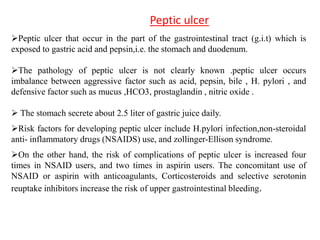
Peptic ulcer
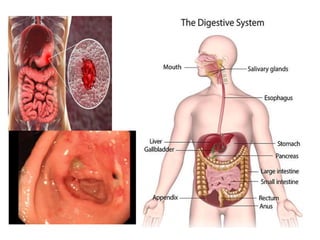
Peptic ulcer that occur in the part of the gastrointestinal tract (g.i.t) which is
exposed to gastric acid and pepsin,i.e. the stomach and duodenum.
The pathology of peptic ulcer is not clearly known .peptic ulcer occurs
imbalance between aggressive factor such as acid, pepsin, bile , H. pylori , and
defensive factor such as mucus ,HCO3, prostaglandin , nitric oxide .
 The stomach secrete about 2.5 liter of gastric juice daily.
Risk factors for developing peptic ulcer include H.pylori infection,non-steroidal
anti- inflammatory drugs (NSAIDS) use, and zollinger-Ellison syndrome.
On the other hand, the risk of complications of peptic ulcer is increased four
times in NSAID users, and two times in aspirin users. The concomitant use of
NSAID or aspirin with anticoagulants, Corticosteroids and selective serotonin
reuptake inhibitors increase the risk of upper gastrointestinal bleeding.
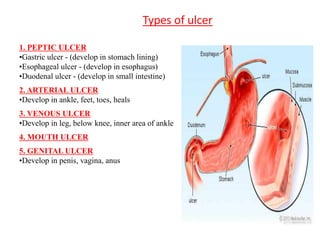
Types of ulcer
1. PEPTIC ULCER
•Gastric ulcer - (develop in stomach lining)
•Esophageal ulcer - (develop in esophagus)
•Duodenal ulcer - (develop in small intestine)
2. ARTERIAL ULCER
•Develop in ankle, feet, toes, heals
3. VENOUS ULCER
•Develop in leg, below knee, inner area of ankle
4. MOUTH ULCER
5. GENITAL ULCER
•Develop in penis, vagina, anus
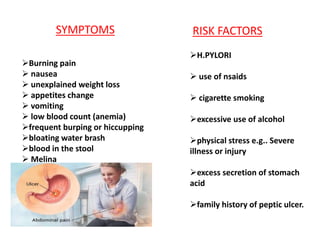
SYMPTOMS
Burning pain
 nausea
 unexplained weight loss
 appetites change
 vomiting
 low blood count (anemia)
frequent burping or hiccupping
bloating water brash
blood in the stool
 Melina
RISK FACTORS
H.PYLORI
 use of nsaids
 cigarette smoking
excessive use of alcohol
physical stress e.g.. Severe
illness or injury
excess secretion of stomach
acid
family history of peptic ulcer.
Diagnosis
1. Endoscopy
2. barium meal
3. breath test
4. blood test
5. stool test
6. rapid urease test
7. culture test
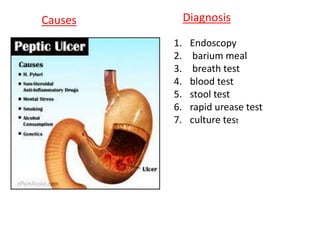
Causes
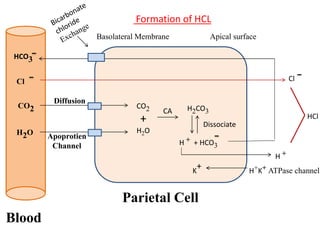
Blood
Cl
HCO3
CO2
H2O
CO2
+
H2O
CA H2CO3
H + + HCO3
K
+ H+K+ ATPase channel
Dissociate
Cl
Apoprotien
Channel
Diffusion
Parietal Cell
Basolateral Membrane Apical surface
H +
HCl
Formation of HCL
Physiology of gastric acid secretion
Gastric acid secretion in a complex ,continuous process in which
multiple central and peripheral factors contribute to a common
end point secretion of H + by parietal cell .
 Neuronal acetylcholine ,paracrine (histamine) and endocrine
(gastrine) factors all regulated acid secretion
their specific receptors (M3 ,H2 , CCK2) RECEPTORS RESPECTIVELY
ARE are on the basolateral membrane of parietal cell in the body
and fundus of the stomach.
The H2 receptor is GPCR that activates the GS – adenyl
cyclase –cyclic AMP- PKA pathway .
Ach and gastrin signal through GPCRS that couple to the Gq
–PLC-IP3- CA++pathway in parietal cells.
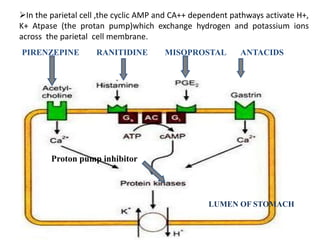
PIRENZEPINE RANITIDINE MISOPROSTAL ANTACIDS
Proton pump inhibitor
LUMEN OF STOMACH
In the parietal cell ,the cyclic AMP and CA++ dependent pathways activate H+,
K+ Atpase (the protan pump)which exchange hydrogen and potassium ions
across the parietal cell membrane.
About the organism
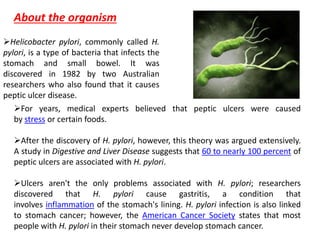
Helicobacter pylori, commonly called H.
pylori, is a type of bacteria that infects the
stomach and small bowel. It was
discovered in 1982 by two Australian
researchers who also found that it causes
peptic ulcer disease.
For years, medical experts believed that peptic ulcers were caused
by stress or certain foods.
After the discovery of H. pylori, however, this theory was argued extensively.
A study in Digestive and Liver Disease suggests that 60 to nearly 100 percent of
peptic ulcers are associated with H. pylori.
Ulcers aren't the only problems associated with H. pylori; researchers
discovered that H. pylori cause gastritis, a condition that
involves inflammation of the stomach's lining. H. pylori infection is also linked
to stomach cancer; however, the American Cancer Society states that most
people with H. pylori in their stomach never develop stomach cancer.
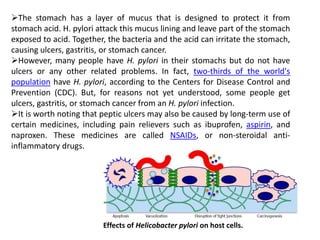
The stomach has a layer of mucus that is designed to protect it from
stomach acid. H. pylori attack this mucus lining and leave part of the stomach
exposed to acid. Together, the bacteria and the acid can irritate the stomach,
causing ulcers, gastritis, or stomach cancer.
However, many people have H. pylori in their stomachs but do not have
ulcers or any other related problems. In fact, two-thirds of the world's
population have H. pylori, according to the Centers for Disease Control and
Prevention (CDC). But, for reasons not yet understood, some people get
ulcers, gastritis, or stomach cancer from an H. pylori infection.
It is worth noting that peptic ulcers may also be caused by long-term use of
certain medicines, including pain relievers such as ibuprofen, aspirin, and
naproxen. These medicines are called NSAIDs, or non-steroidal anti-
inflammatory drugs.
Effects of Helicobacter pylori on host cells.
Treatment
1. Herbal treatment
2. medicinal treatment
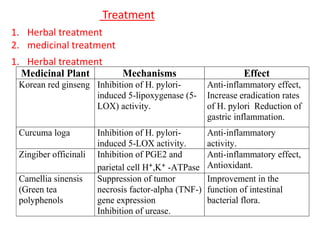
1. Herbal treatment
Medicinal Plant Mechanisms Effect
Korean red ginseng Inhibition of H. pylori-
induced 5-lipoxygenase (5-
LOX) activity.
Anti-inflammatory effect,
Increase eradication rates
of H. pylori Reduction of
gastric inflammation.
Curcuma loga Inhibition of H. pylori-
induced 5-LOX activity.
Anti-inflammatory
activity.
Zingiber officinali Inhibition of PGE2 and
parietal cell H+,K+ -ATPase
Anti-inflammatory effect,
Antioxidant.
Camellia sinensis
(Green tea
polyphenols
Suppression of tumor
necrosis factor-alpha (TNF-)
gene expression
Inhibition of urease.
Improvement in the
function of intestinal
bacterial flora.
Together with increasing use of herbal supplements worldwide, the number of
adverse eventsand drug interactions is rising.
Panax ginseng induces cytochrome P450 3A4 (CYP3A4), which decreases
the effectiveness of calcium channel blockers, certain antihypertensive and
statin medications, and some antidepressants.
Ginkgo biloba could increase bleeding risk, especially in combination with
anticoagulant drugs, due to the inhibition of platelet aggregation
.
Flavonoids in Ginkgo biloba have antiplatelet activity, but do not affect blood
coagulation or platelet function in humans [103]. In combination with NSAIDs,
it can cause severe bleeding.
Zingiberofficinalis prolongs bleeding time by the inhibition of thromboxane
synthetase, but this has not been confirmed in a clinical trial
Herb –drug –interaction
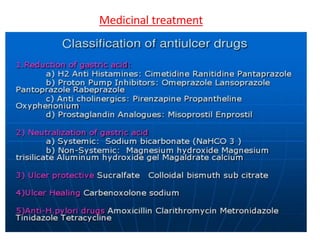
Medicinal treatment
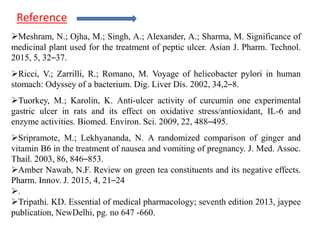
Meshram, N.; Ojha, M.; Singh, A.; Alexander, A.; Sharma, M. Significance of
medicinal plant used for the treatment of peptic ulcer. Asian J. Pharm. Technol.
2015, 5, 32–37.
Ricci, V.; Zarrilli, R.; Romano, M. Voyage of helicobacter pylori in human
stomach: Odyssey of a bacterium. Dig. Liver Dis. 2002, 34,2–8.
Tuorkey, M.; Karolin, K. Anti-ulcer activity of curcumin one experimental
gastric ulcer in rats and its effect on oxidative stress/antioxidant, IL-6 and
enzyme activities. Biomed. Environ. Sci. 2009, 22, 488–495.
Sripramote, M.; Lekhyananda, N. A randomized comparison of ginger and
vitamin B6 in the treatment of nausea and vomiting of pregnancy. J. Med. Assoc.
Thail. 2003, 86, 846–853.
Amber Nawab, N.F. Review on green tea constituents and its negative effects.
Pharm. Innov. J. 2015, 4, 21–24
.
Tripathi. KD. Essential of medical pharmacology; seventh edition 2013, jaypee
publication, NewDelhi, pg. no 647 -660.
Reference
Presentation on peptic ulcer

Presentation on peptic ulcer

  • 1.
    ADVANCE COLLEGE OFPHARMACY Kanpur DEPARTMENT OF PHARMACOLOGY Mr. ANUBHAV DUBEY M.Pharma pharmacology Peptic ulcer Presented- By
  • 2.
    Peptic ulcer Peptic ulcerthat occur in the part of the gastrointestinal tract (g.i.t) which is exposed to gastric acid and pepsin,i.e. the stomach and duodenum. The pathology of peptic ulcer is not clearly known .peptic ulcer occurs imbalance between aggressive factor such as acid, pepsin, bile , H. pylori , and defensive factor such as mucus ,HCO3, prostaglandin , nitric oxide .  The stomach secrete about 2.5 liter of gastric juice daily. Risk factors for developing peptic ulcer include H.pylori infection,non-steroidal anti- inflammatory drugs (NSAIDS) use, and zollinger-Ellison syndrome. On the other hand, the risk of complications of peptic ulcer is increased four times in NSAID users, and two times in aspirin users. The concomitant use of NSAID or aspirin with anticoagulants, Corticosteroids and selective serotonin reuptake inhibitors increase the risk of upper gastrointestinal bleeding.
  • 4.
    Types of ulcer 1.PEPTIC ULCER •Gastric ulcer - (develop in stomach lining) •Esophageal ulcer - (develop in esophagus) •Duodenal ulcer - (develop in small intestine) 2. ARTERIAL ULCER •Develop in ankle, feet, toes, heals 3. VENOUS ULCER •Develop in leg, below knee, inner area of ankle 4. MOUTH ULCER 5. GENITAL ULCER •Develop in penis, vagina, anus
  • 5.
    SYMPTOMS Burning pain  nausea unexplained weight loss  appetites change  vomiting  low blood count (anemia) frequent burping or hiccupping bloating water brash blood in the stool  Melina RISK FACTORS H.PYLORI  use of nsaids  cigarette smoking excessive use of alcohol physical stress e.g.. Severe illness or injury excess secretion of stomach acid family history of peptic ulcer.
  • 6.
    Diagnosis 1. Endoscopy 2. bariummeal 3. breath test 4. blood test 5. stool test 6. rapid urease test 7. culture test Causes
  • 7.
    Blood Cl HCO3 CO2 H2O CO2 + H2O CA H2CO3 H ++ HCO3 K + H+K+ ATPase channel Dissociate Cl Apoprotien Channel Diffusion Parietal Cell Basolateral Membrane Apical surface H + HCl Formation of HCL
  • 8.
    Physiology of gastricacid secretion Gastric acid secretion in a complex ,continuous process in which multiple central and peripheral factors contribute to a common end point secretion of H + by parietal cell .  Neuronal acetylcholine ,paracrine (histamine) and endocrine (gastrine) factors all regulated acid secretion their specific receptors (M3 ,H2 , CCK2) RECEPTORS RESPECTIVELY ARE are on the basolateral membrane of parietal cell in the body and fundus of the stomach. The H2 receptor is GPCR that activates the GS – adenyl cyclase –cyclic AMP- PKA pathway . Ach and gastrin signal through GPCRS that couple to the Gq –PLC-IP3- CA++pathway in parietal cells.
  • 9.
    PIRENZEPINE RANITIDINE MISOPROSTALANTACIDS Proton pump inhibitor LUMEN OF STOMACH In the parietal cell ,the cyclic AMP and CA++ dependent pathways activate H+, K+ Atpase (the protan pump)which exchange hydrogen and potassium ions across the parietal cell membrane.
  • 10.
    About the organism Helicobacterpylori, commonly called H. pylori, is a type of bacteria that infects the stomach and small bowel. It was discovered in 1982 by two Australian researchers who also found that it causes peptic ulcer disease. For years, medical experts believed that peptic ulcers were caused by stress or certain foods. After the discovery of H. pylori, however, this theory was argued extensively. A study in Digestive and Liver Disease suggests that 60 to nearly 100 percent of peptic ulcers are associated with H. pylori. Ulcers aren't the only problems associated with H. pylori; researchers discovered that H. pylori cause gastritis, a condition that involves inflammation of the stomach's lining. H. pylori infection is also linked to stomach cancer; however, the American Cancer Society states that most people with H. pylori in their stomach never develop stomach cancer.
  • 12.
    The stomach hasa layer of mucus that is designed to protect it from stomach acid. H. pylori attack this mucus lining and leave part of the stomach exposed to acid. Together, the bacteria and the acid can irritate the stomach, causing ulcers, gastritis, or stomach cancer. However, many people have H. pylori in their stomachs but do not have ulcers or any other related problems. In fact, two-thirds of the world's population have H. pylori, according to the Centers for Disease Control and Prevention (CDC). But, for reasons not yet understood, some people get ulcers, gastritis, or stomach cancer from an H. pylori infection. It is worth noting that peptic ulcers may also be caused by long-term use of certain medicines, including pain relievers such as ibuprofen, aspirin, and naproxen. These medicines are called NSAIDs, or non-steroidal anti- inflammatory drugs. Effects of Helicobacter pylori on host cells.
  • 13.
    Treatment 1. Herbal treatment 2.medicinal treatment 1. Herbal treatment Medicinal Plant Mechanisms Effect Korean red ginseng Inhibition of H. pylori- induced 5-lipoxygenase (5- LOX) activity. Anti-inflammatory effect, Increase eradication rates of H. pylori Reduction of gastric inflammation. Curcuma loga Inhibition of H. pylori- induced 5-LOX activity. Anti-inflammatory activity. Zingiber officinali Inhibition of PGE2 and parietal cell H+,K+ -ATPase Anti-inflammatory effect, Antioxidant. Camellia sinensis (Green tea polyphenols Suppression of tumor necrosis factor-alpha (TNF-) gene expression Inhibition of urease. Improvement in the function of intestinal bacterial flora.
  • 14.
    Together with increasinguse of herbal supplements worldwide, the number of adverse eventsand drug interactions is rising. Panax ginseng induces cytochrome P450 3A4 (CYP3A4), which decreases the effectiveness of calcium channel blockers, certain antihypertensive and statin medications, and some antidepressants. Ginkgo biloba could increase bleeding risk, especially in combination with anticoagulant drugs, due to the inhibition of platelet aggregation . Flavonoids in Ginkgo biloba have antiplatelet activity, but do not affect blood coagulation or platelet function in humans [103]. In combination with NSAIDs, it can cause severe bleeding. Zingiberofficinalis prolongs bleeding time by the inhibition of thromboxane synthetase, but this has not been confirmed in a clinical trial Herb –drug –interaction
  • 15.
  • 16.
    Meshram, N.; Ojha,M.; Singh, A.; Alexander, A.; Sharma, M. Significance of medicinal plant used for the treatment of peptic ulcer. Asian J. Pharm. Technol. 2015, 5, 32–37. Ricci, V.; Zarrilli, R.; Romano, M. Voyage of helicobacter pylori in human stomach: Odyssey of a bacterium. Dig. Liver Dis. 2002, 34,2–8. Tuorkey, M.; Karolin, K. Anti-ulcer activity of curcumin one experimental gastric ulcer in rats and its effect on oxidative stress/antioxidant, IL-6 and enzyme activities. Biomed. Environ. Sci. 2009, 22, 488–495. Sripramote, M.; Lekhyananda, N. A randomized comparison of ginger and vitamin B6 in the treatment of nausea and vomiting of pregnancy. J. Med. Assoc. Thail. 2003, 86, 846–853. Amber Nawab, N.F. Review on green tea constituents and its negative effects. Pharm. Innov. J. 2015, 4, 21–24 . Tripathi. KD. Essential of medical pharmacology; seventh edition 2013, jaypee publication, NewDelhi, pg. no 647 -660. Reference