Noting and Drafting
play a vital role in decision-
making process in the
Government.
The quality of Noting and
Drafting has deteriorated over
the years.
1
DEFINITIONS:
‘File’ : Collection & proper maintenance
of communications received & issued, in
a particular folder.
‘Receipt’ means a communication/
note/matter received for consideration.
‘Issue’ means communication/note
issued after consideration/disposal.
‘PUC’ = Paper Under Consideration.
‘DFA’ = Draft For Approval.
2
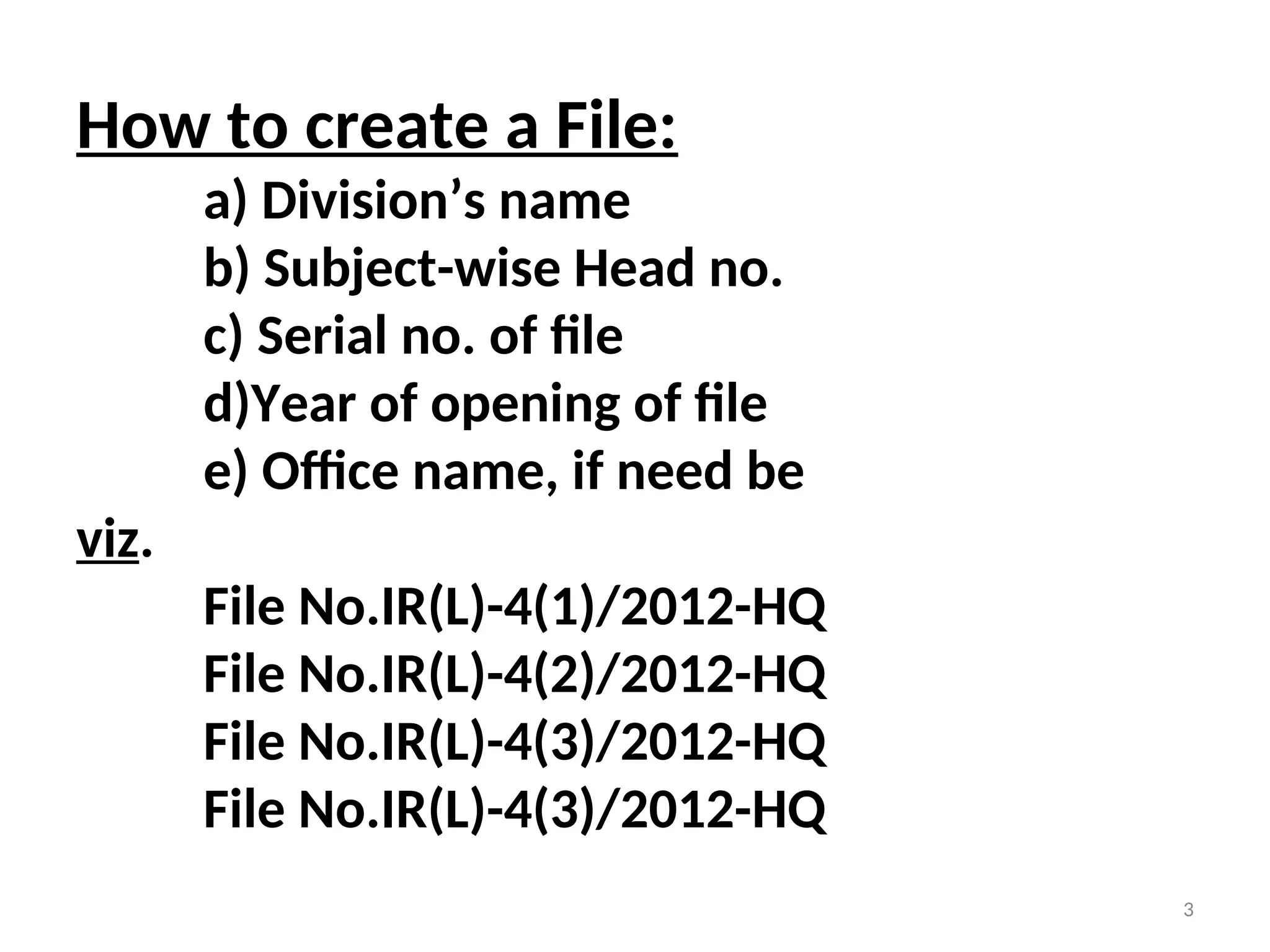
How to create a File:
a) Division’s name
b) Subject-wise Head no.
c) Serial no. of file
d)Year of opening of file
e) Office name, if need be
viz.
File No.IR(L)-4(1)/2012-HQ
File No.IR(L)-4(2)/2012-HQ
File No.IR(L)-4(3)/2012-HQ
3
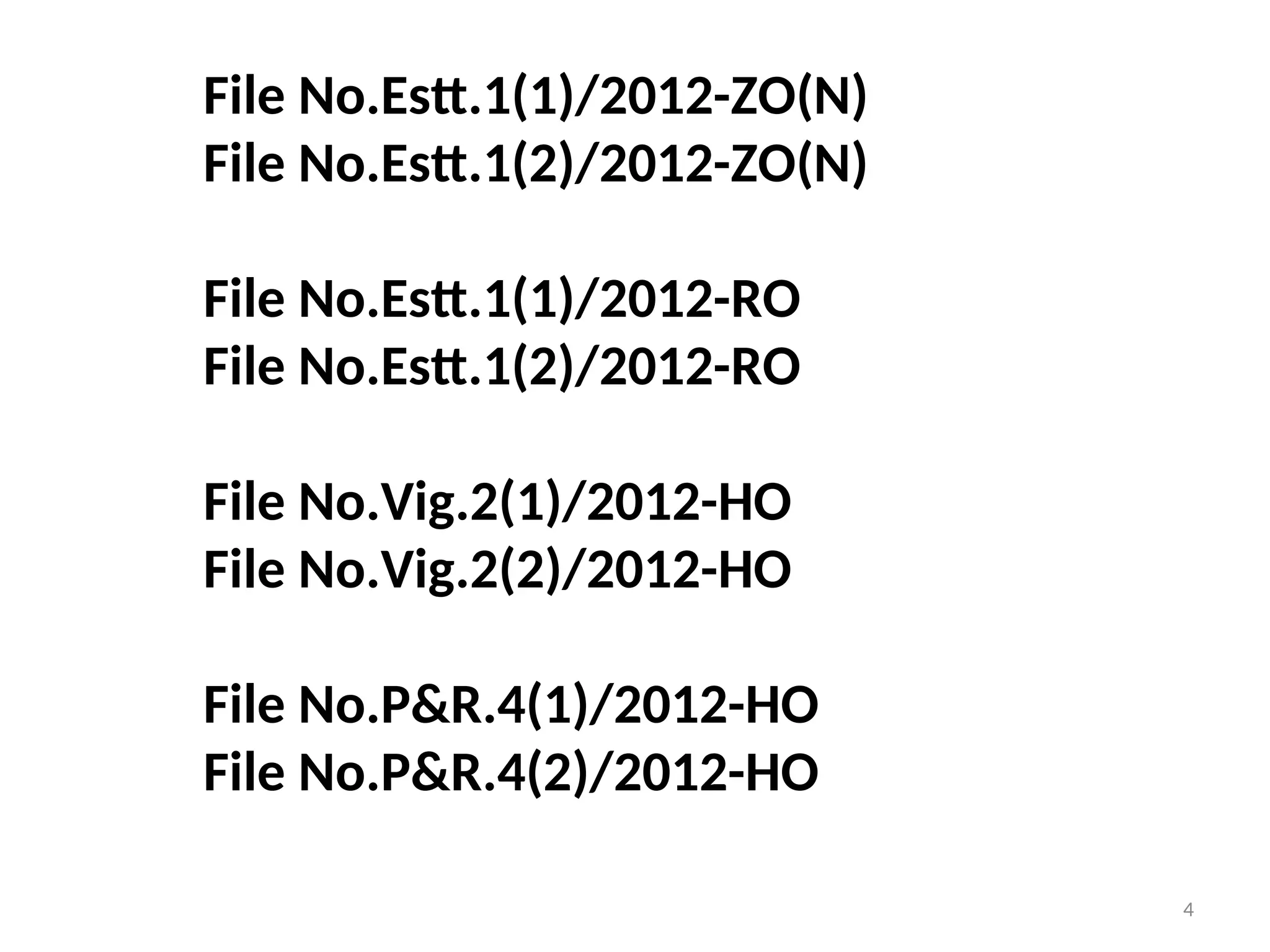
File No.Estt.1(1)/2012-ZO(N)
File No.Estt.1(2)/2012-ZO(N)
File No.Estt.1(1)/2012-RO
File No.Estt.1(2)/2012-RO
File No.Vig.2(1)/2012-HO
File No.Vig.2(2)/2012-HO
File No.P&R.4(1)/2012-HO
File No.P&R.4(2)/2012-HO
4
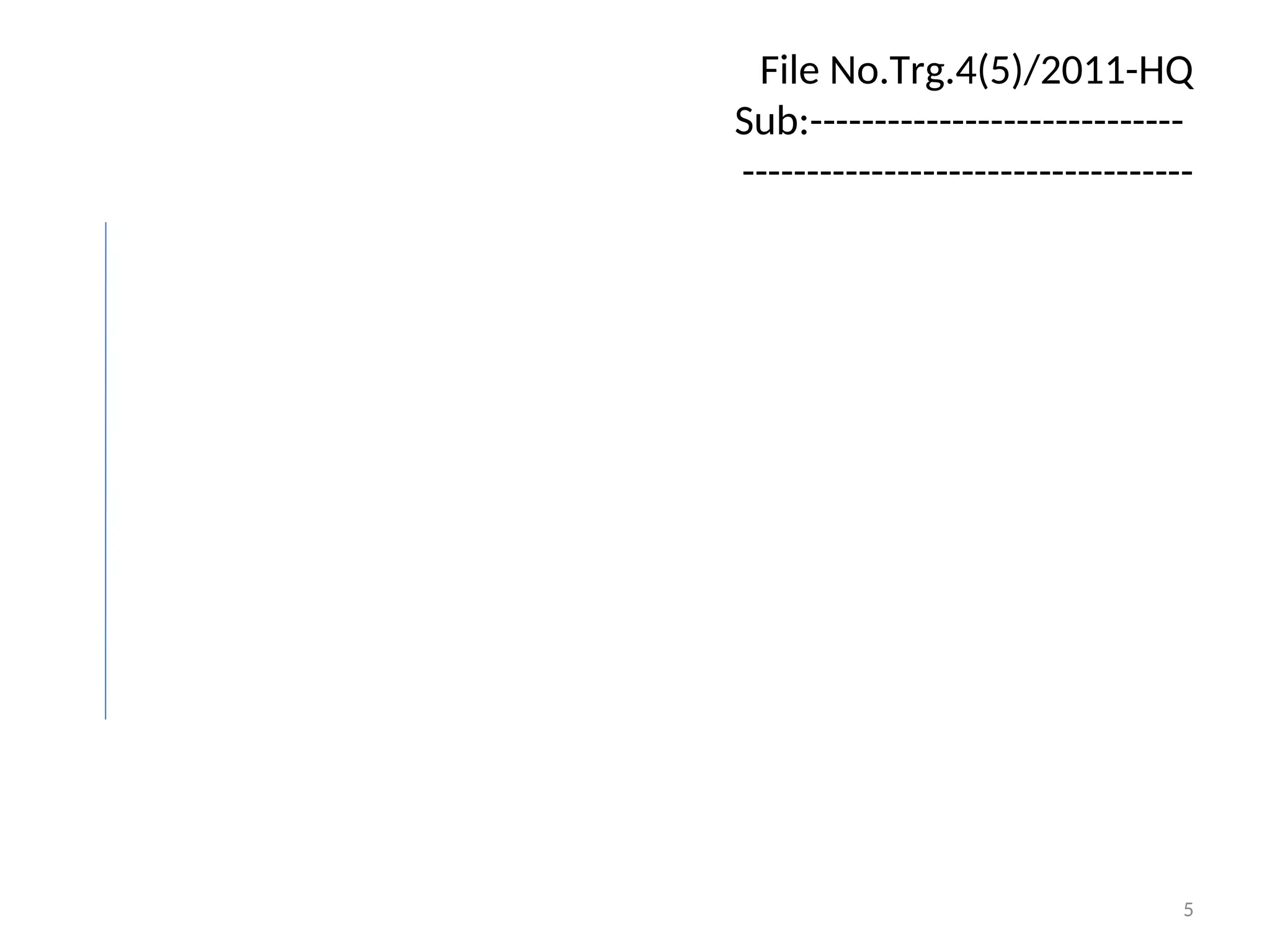
File No.Trg.4(5)/2011-HQ
Sub:-----------------------------
-----------------------------------
5
6
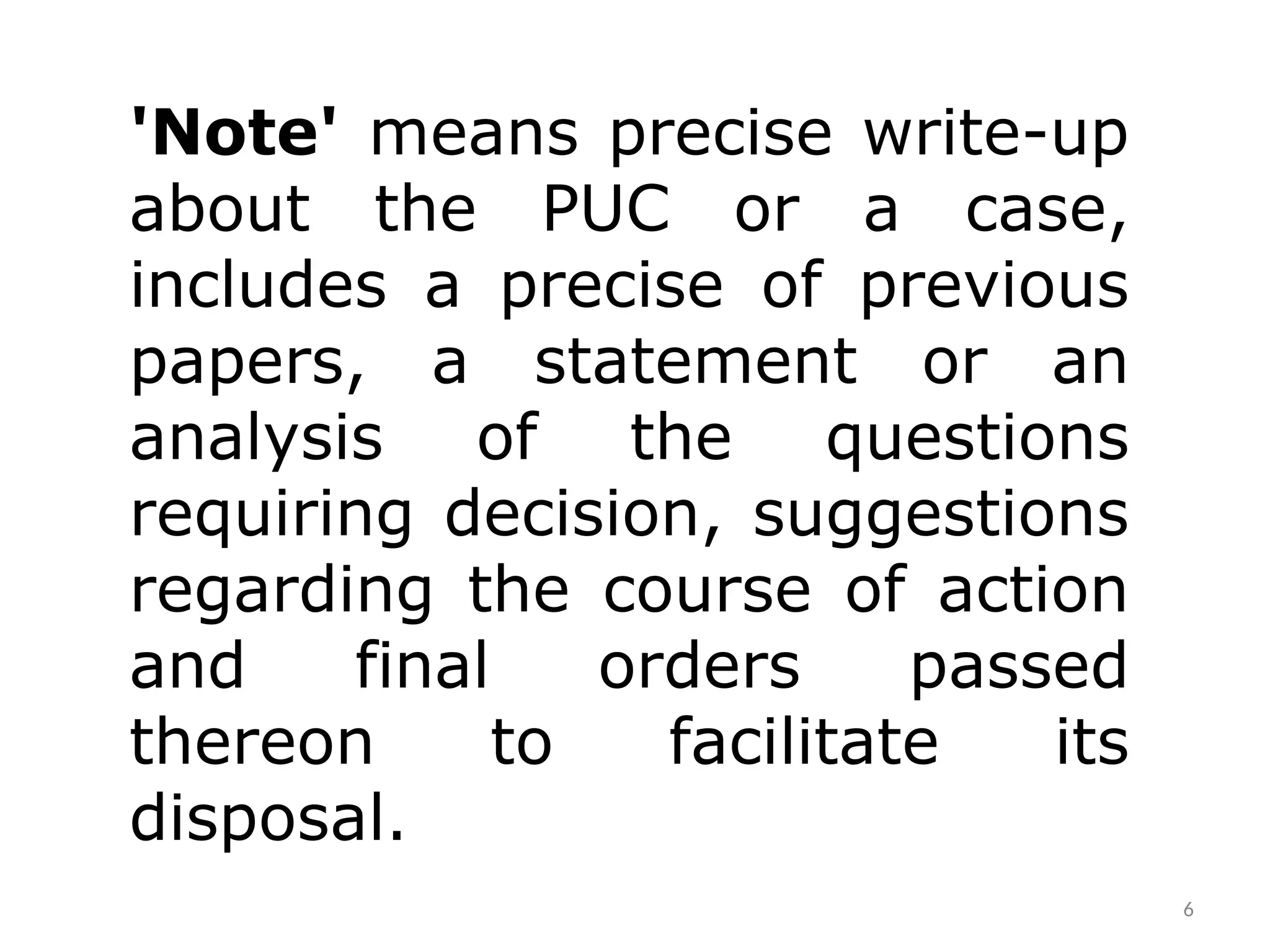
'Note' means precise write-up
about the PUC or a case,
includes a precise of previous
papers, a statement or an
analysis of the questions
requiring decision, suggestions
regarding the course of action
and final orders passed
thereon to facilitate its
disposal.
A GOOD NOTE:
A good note should properly:
-Define and analyze the problem;
-Refer to relevant rules,
regulations, policies and
precedents;
-Talk about alternative solutions;
-Discuss implications of these
various alternatives and
-then suggest a suitable solution
and a draft reply. 7
8
DETAILED NOTE
A detailed note providing maximum
information on each aspect will be
necessary. Even then, the note should be
concise and to the point, covering the
following aspects:­
(i) What is the problem?
(ii) How has it arisen? '
(iii) What is the `Rule', `Policy' or
`Precedent’?
(iv) What are the possible solutions?
(v) Which is the best solution? Why?
(vii) What will be the consequences of
the proposed solution?
9
Policy and Planning Note:
The note in such cases should be structured on
the following grounds:-
(i) Problem - How it has arisen? What
are the critical factors?
(ii) Additional Information: - Give
additional information available on the files
etc. and other papers in the Section.
(iii) Rule, policy etc: - Relevant rules,
regulations, policy, standing orders, practices
are required to be referred to with Logical
interpretation of such rules etc.
10
Courteousness in writing Note
•It should express ideas tactfully, without
hurting anybody’s feelings.
•It should emphasize positive facts.
•To point out errors or incorrect statements
or to criticize an opinion expressed therein
has to be criticized, care should be taken
to couch the observations in courteous and
temperate language free from personal
remarks.
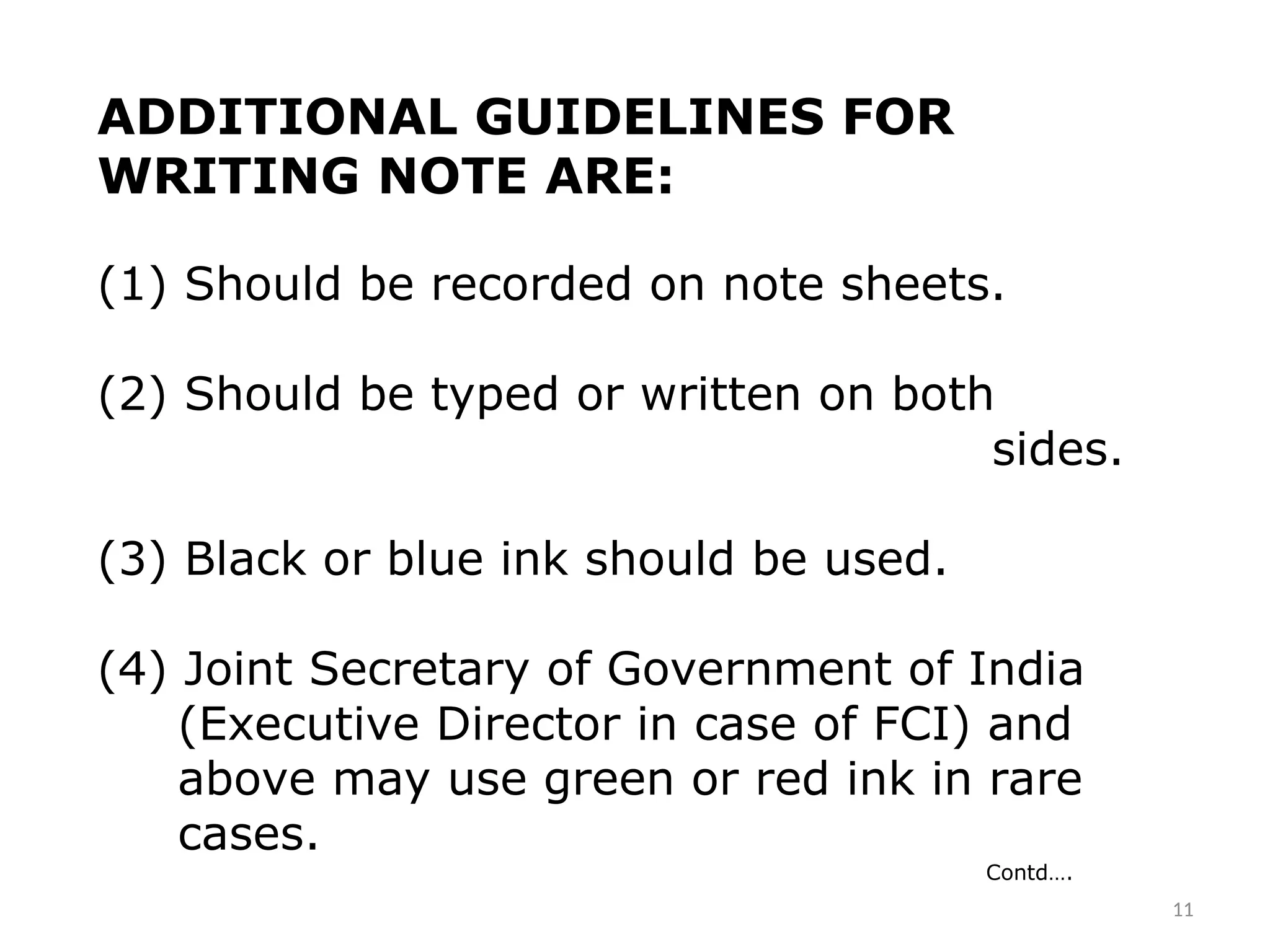
ADDITIONAL GUIDELINES FOR
WRITING NOTE ARE:
(1) Should be recorded on note sheets.
(2) Should be typed or written on both
sides.
(3) Black or blue ink should be used.
(4) Joint Secretary of Government of India
(Executive Director in case of FCI) and
above may use green or red ink in rare
cases.
Contd….
11
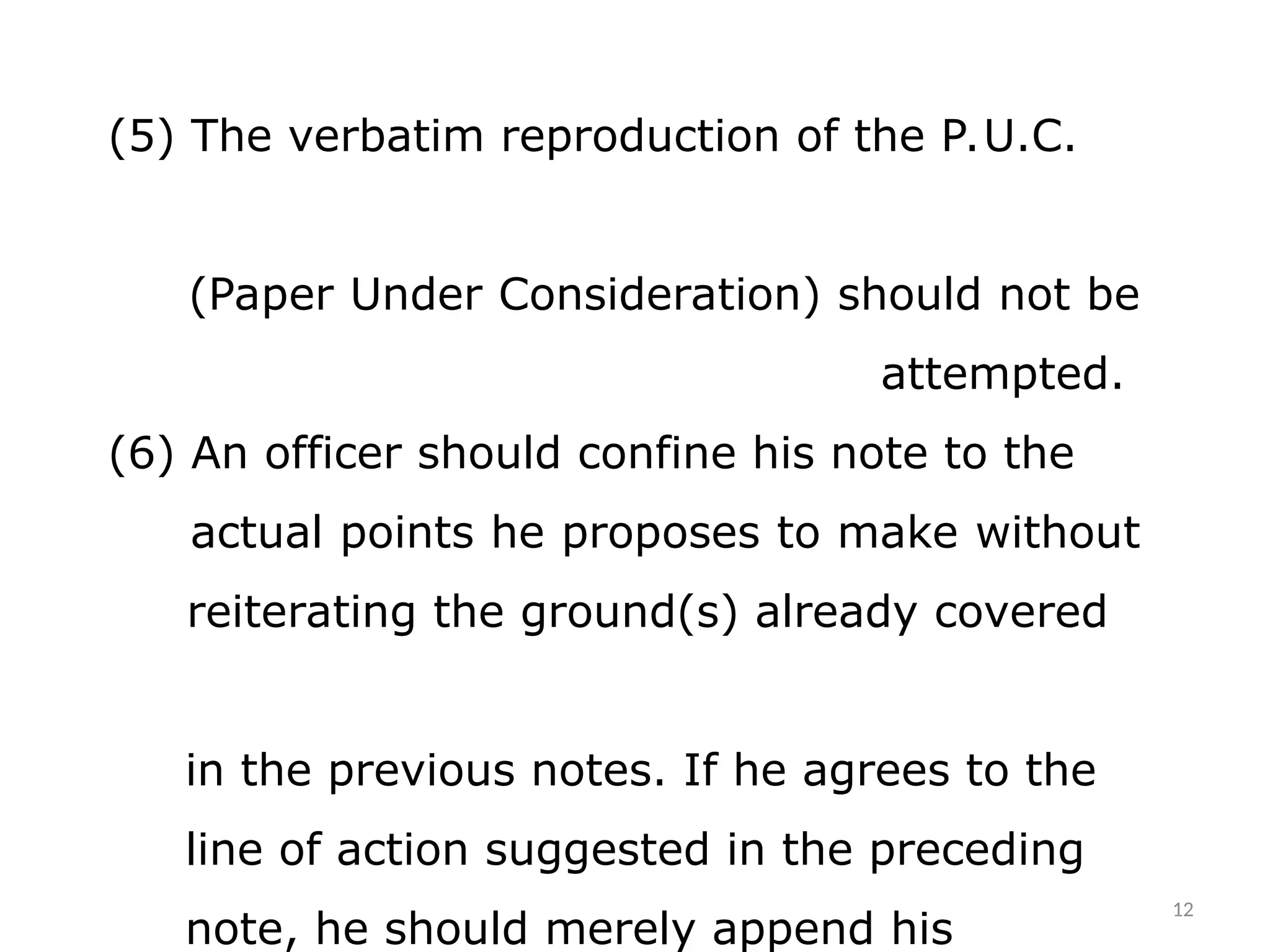
(5) The verbatim reproduction of the P.U.C.
(Paper Under Consideration) should not be
attempted.
(6) An officer should confine his note to the
actual points he proposes to make without
reiterating the ground(s) already covered
in the previous notes. If he agrees to the
line of action suggested in the preceding
note, he should merely append his
12
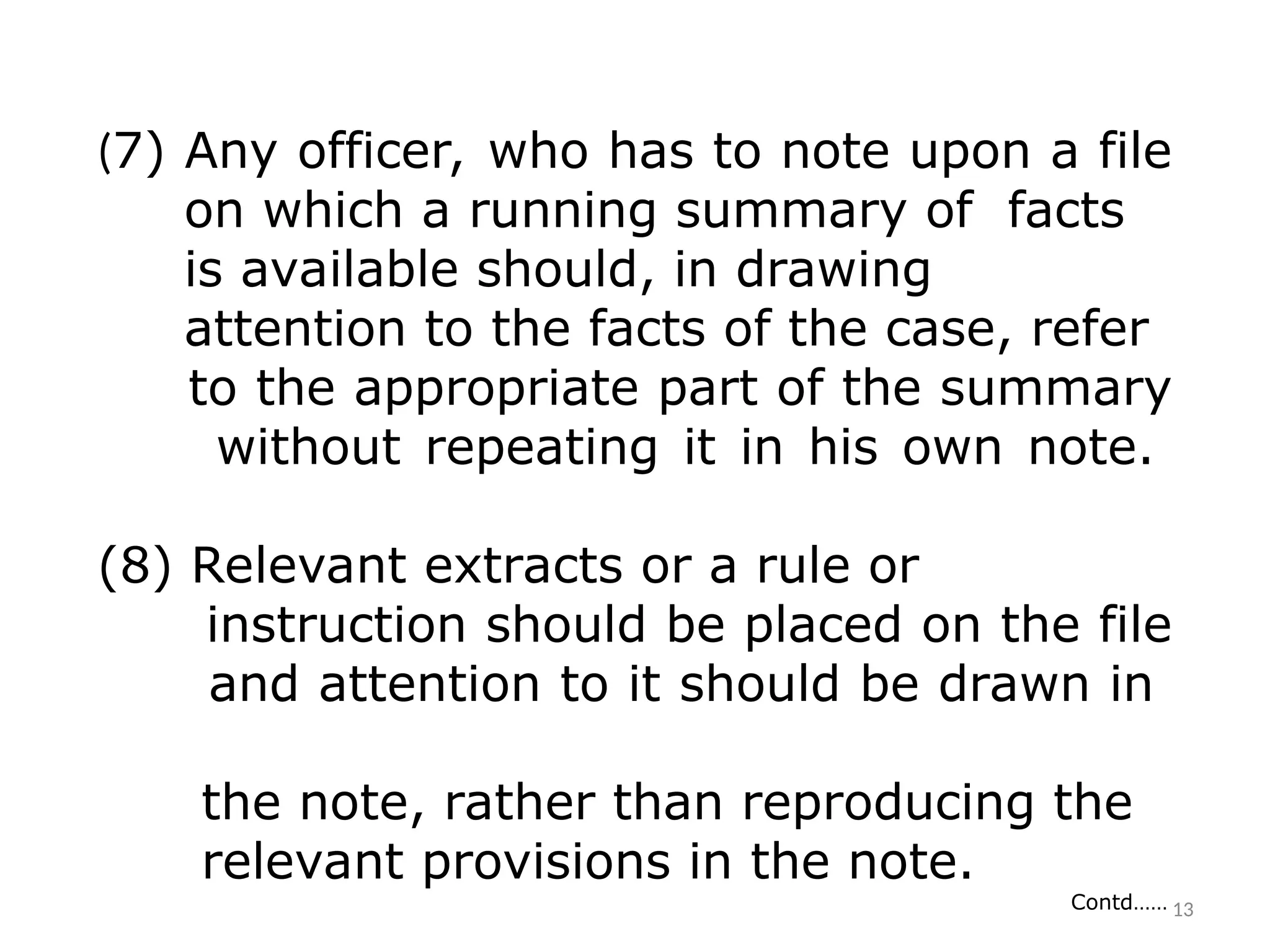
(7) Any officer, who has to note upon a file
on which a running summary of facts
is available should, in drawing
attention to the facts of the case, refer
to the appropriate part of the summary
without repeating it in his own note.
(8) Relevant extracts or a rule or
instruction should be placed on the file
and attention to it should be drawn in
the note, rather than reproducing the
relevant provisions in the note.
Contd…… 13
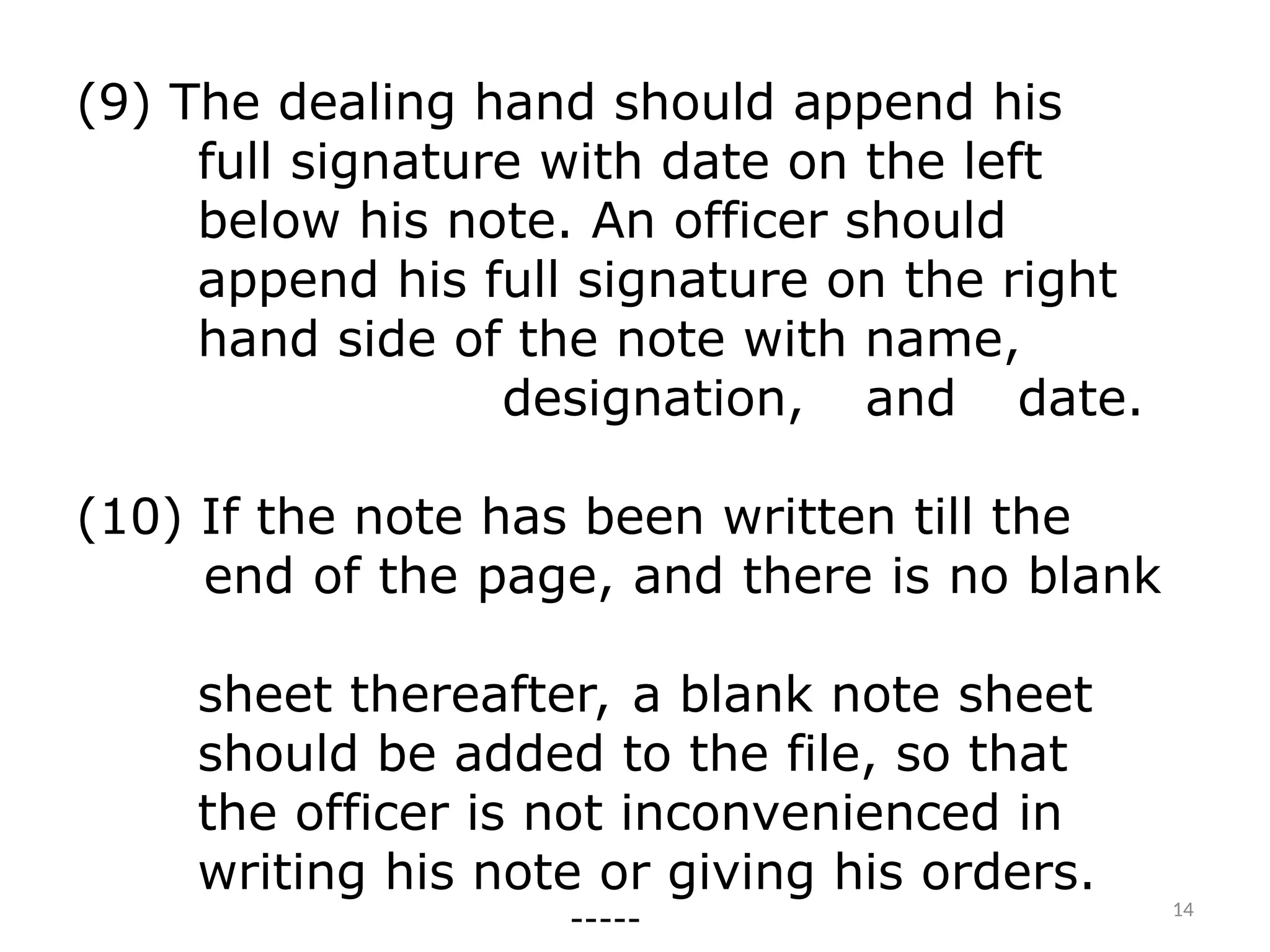
(9) The dealing hand should append his
full signature with date on the left
below his note. An officer should
append his full signature on the right
hand side of the note with name,
designation, and date.
(10) If the note has been written till the
end of the page, and there is no blank
sheet thereafter, a blank note sheet
should be added to the file, so that
the officer is not inconvenienced in
writing his note or giving his orders.
----- 14
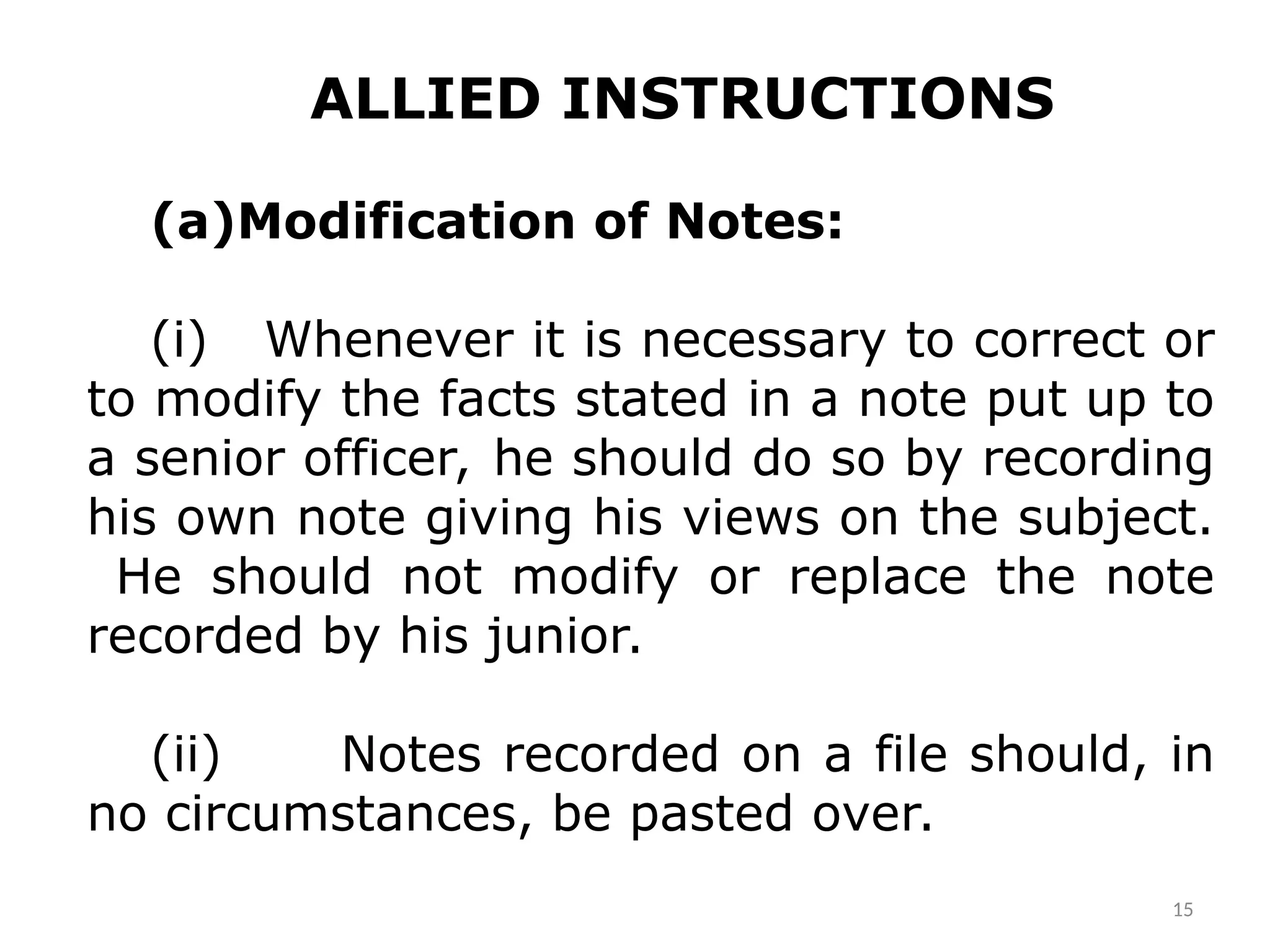
ALLIED INSTRUCTIONS
(a)Modification of Notes:­
(i) Whenever it is necessary to correct or
to modify the facts stated in a note put up to
a senior officer, he should do so by recording
his own note giving his views on the subject.
He should not modify or replace the note
recorded by his junior.
(ii) Notes recorded on a file should, in
no circumstances, be pasted over.
15
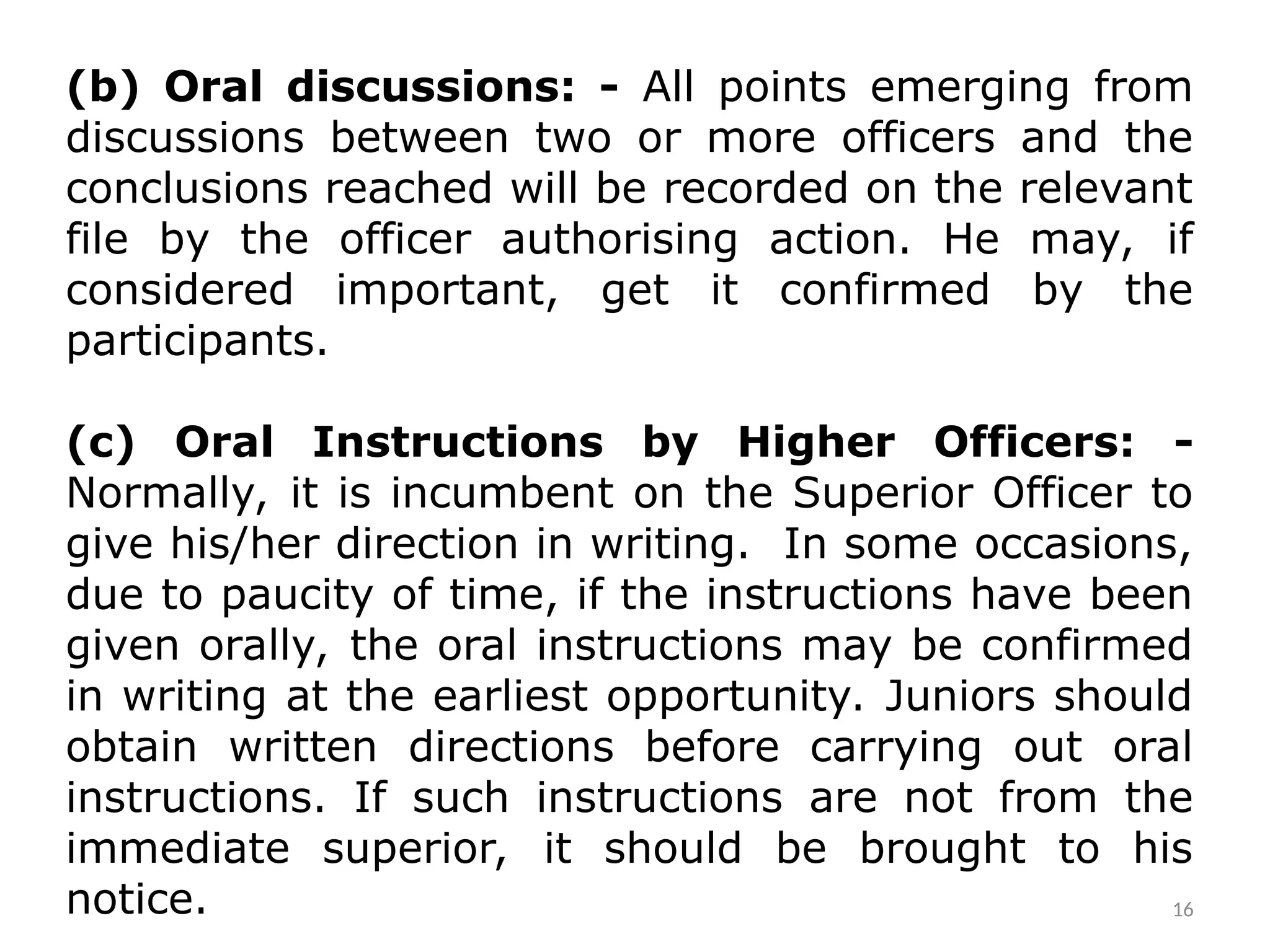
(b) Oral discussions: - All points emerging from
discussions between two or more officers and the
conclusions reached will be recorded on the relevant
file by the officer authorising action. He may, if
considered important, get it confirmed by the
participants.
(c) Oral Instructions by Higher Officers: -
Normally, it is incumbent on the Superior Officer to
give his/her direction in writing. In some occasions,
due to paucity of time, if the instructions have been
given orally, the oral instructions may be confirmed
in writing at the earliest opportunity. Juniors should
obtain written directions before carrying out oral
instructions. If such instructions are not from the
immediate superior, it should be brought to his
notice. 16
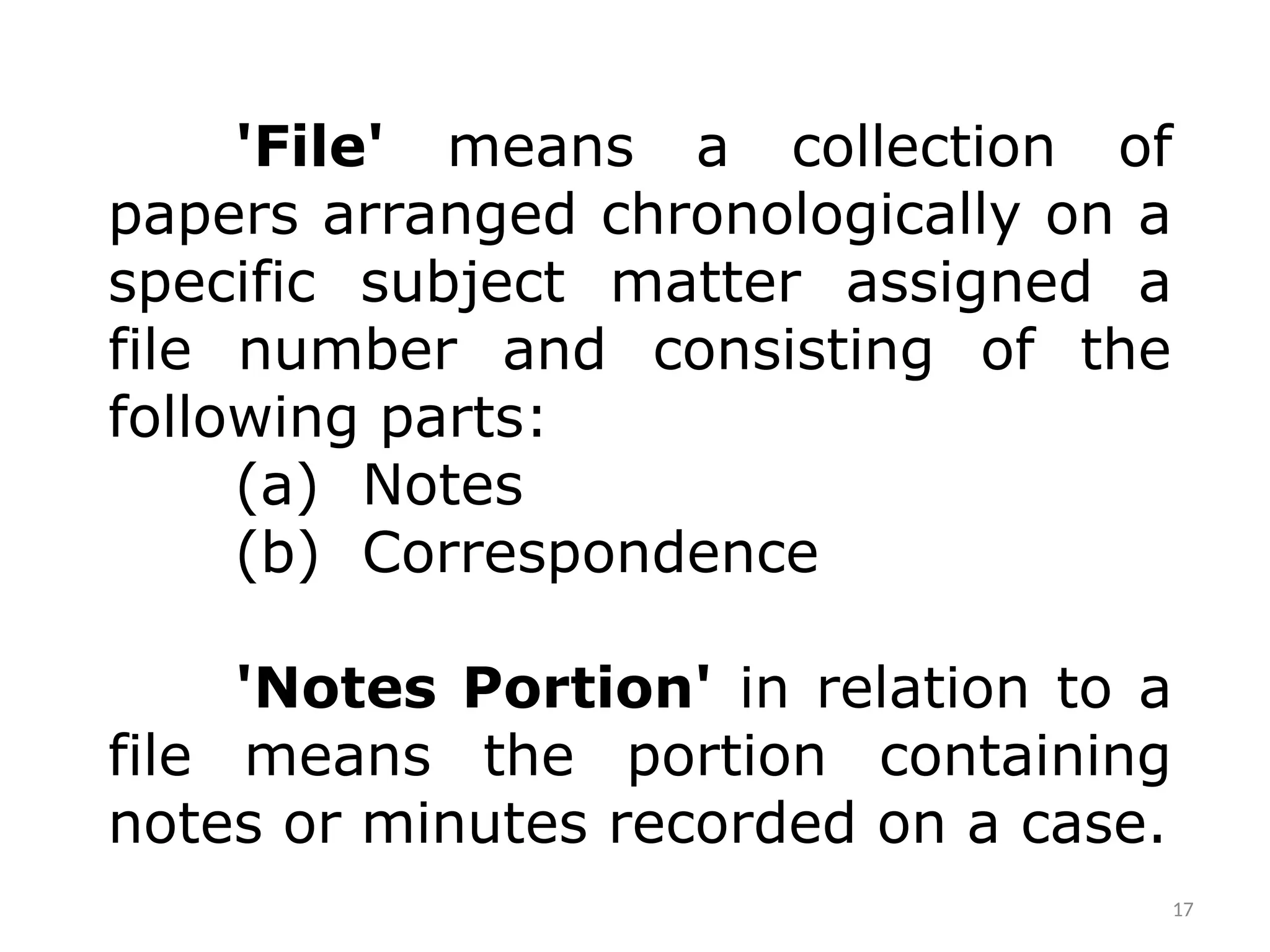
'File' means a collection of
papers arranged chronologically on a
specific subject matter assigned a
file number and consisting of the
following parts:
(a) Notes
(b) Correspondence
'Notes Portion' in relation to a
file means the portion containing
notes or minutes recorded on a case.
17
18
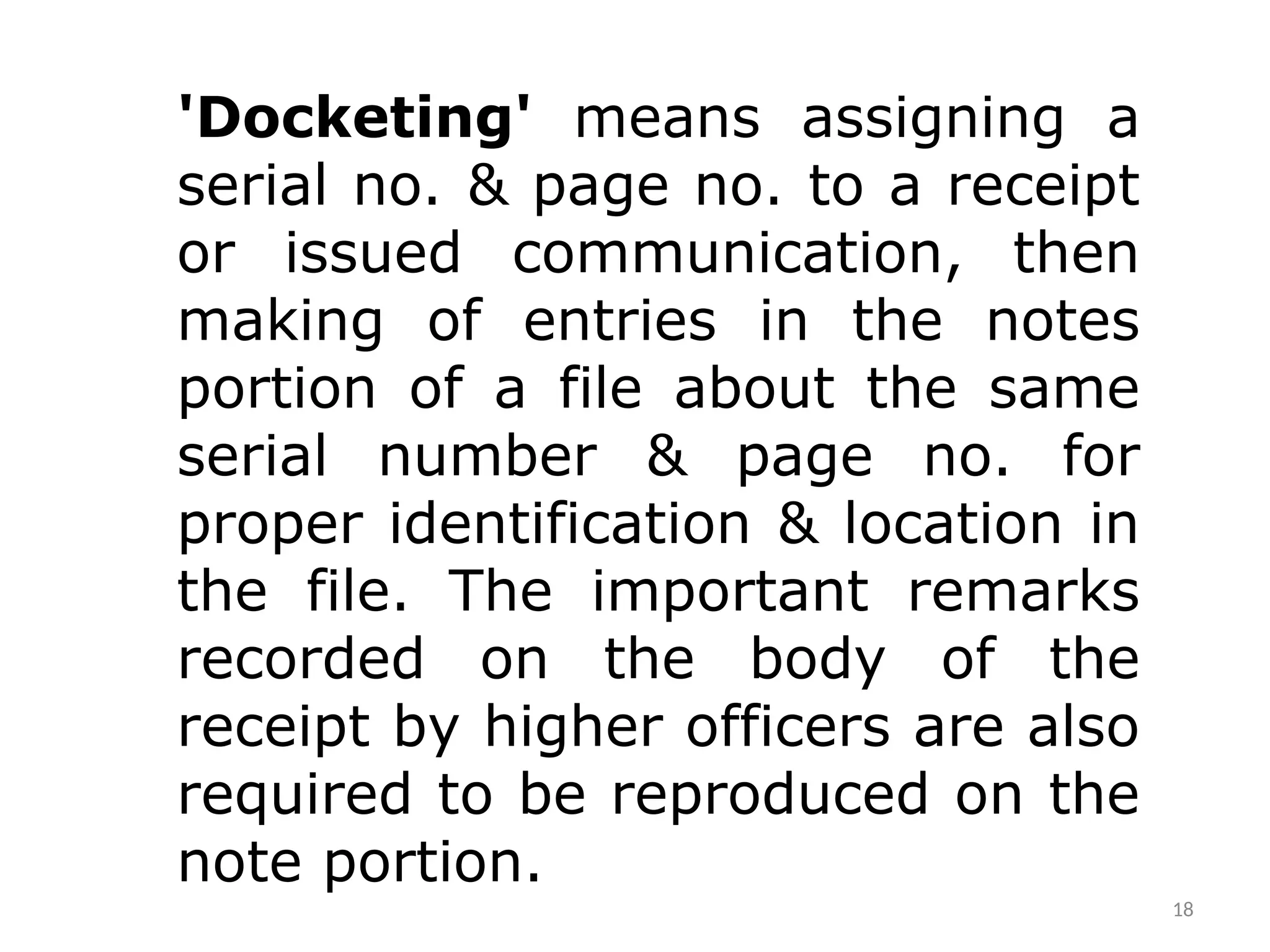
'Docketing' means assigning a
serial no. & page no. to a receipt
or issued communication, then
making of entries in the notes
portion of a file about the same
serial number & page no. for
proper identification & location in
the file. The important remarks
recorded on the body of the
receipt by higher officers are also
required to be reproduced on the
note portion.
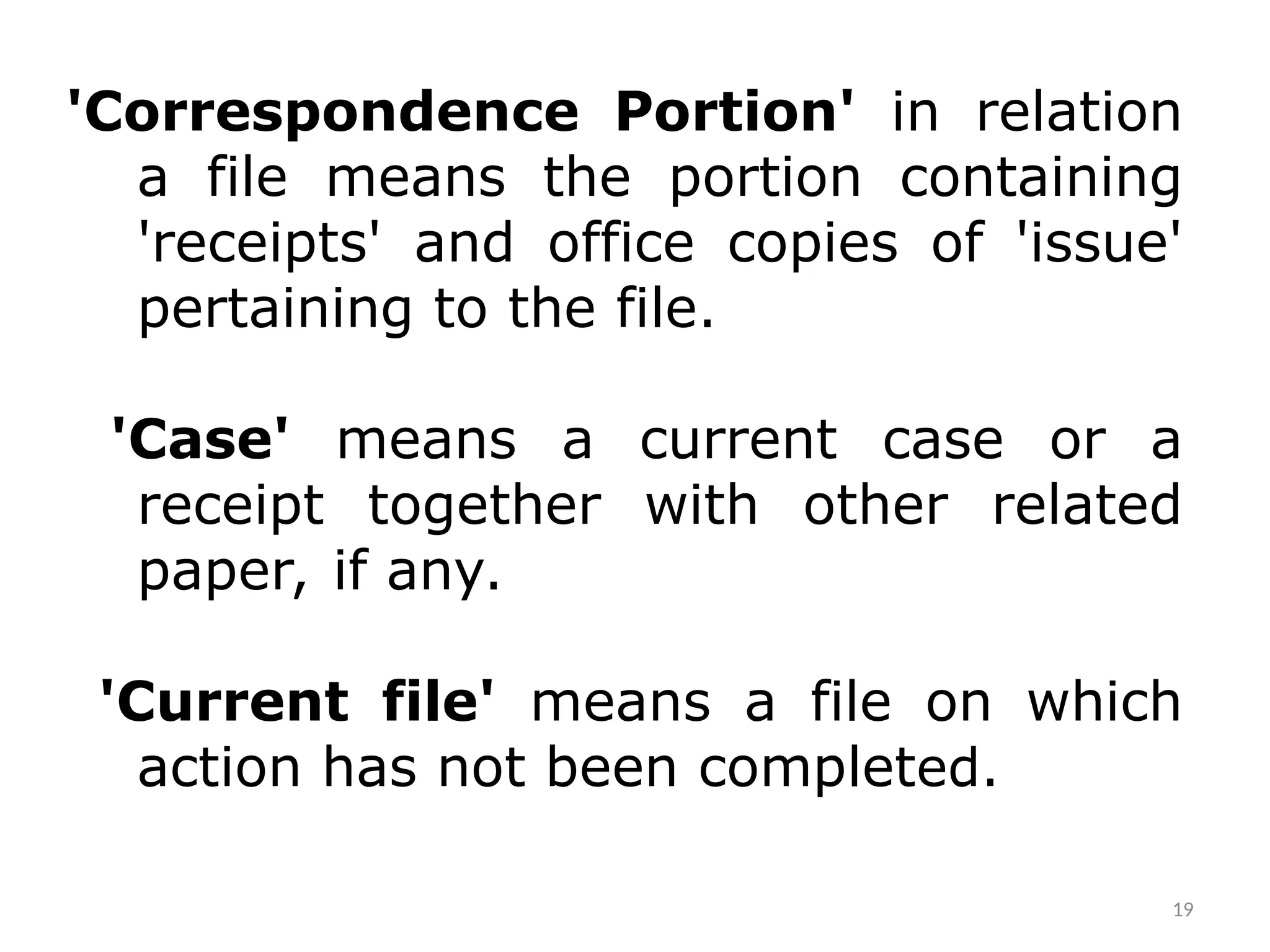
'Correspondence Portion' in relation
a file means the portion containing
'receipts' and office copies of 'issue'
pertaining to the file.
'Case' means a current case or a
receipt together with other related
paper, if any.
'Current file' means a file on which
action has not been completed.
19
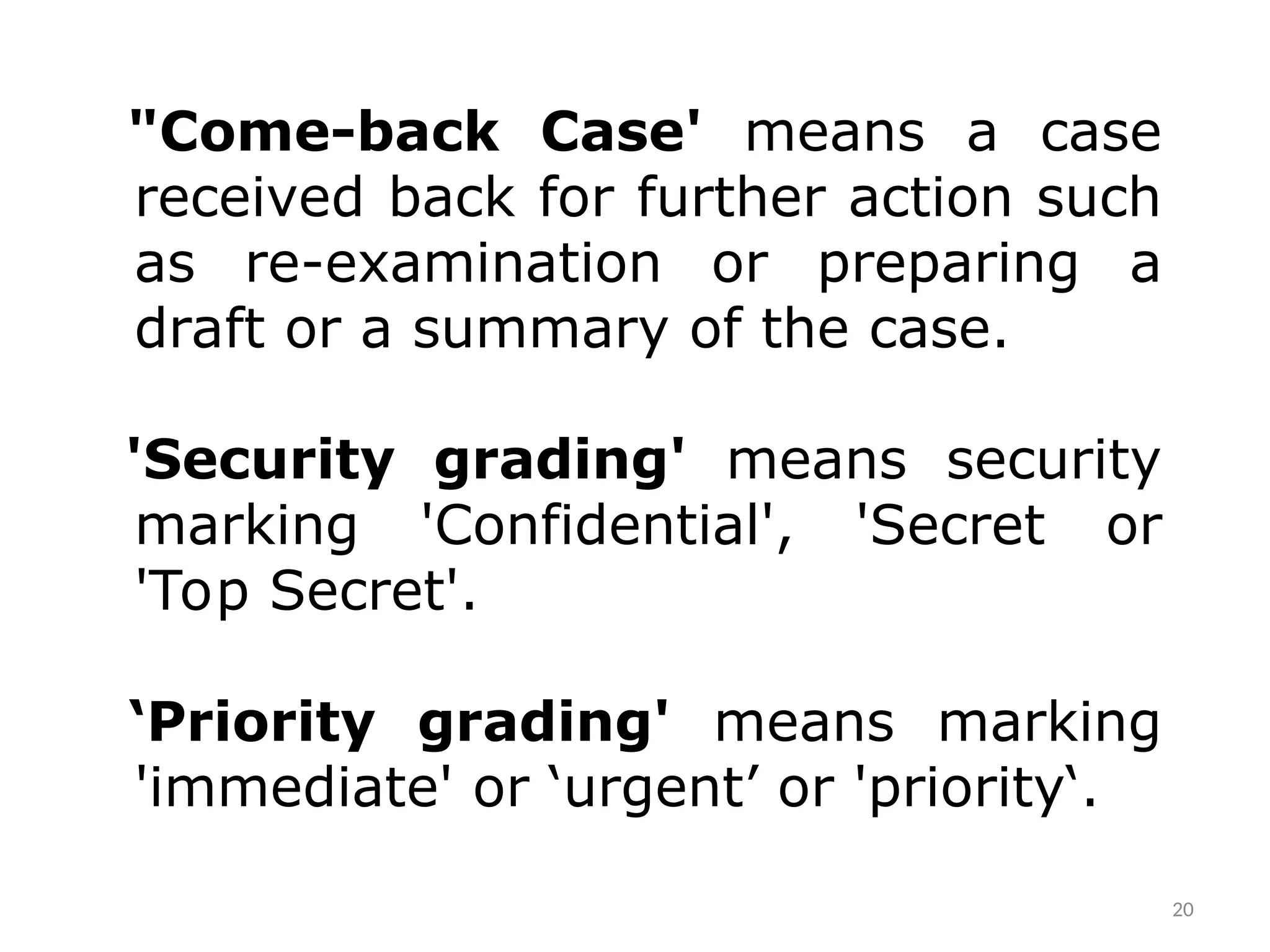
"Come-back Case' means a case
received back for further action such
as re-­
examination or preparing a
draft or a summary of the case.
'Security grading' means security
marking 'Confidential', 'Secret or
'Top Secret'.
‘Priority grading' means marking
'immediate' or ‘urgent’ or 'priority‘.
20
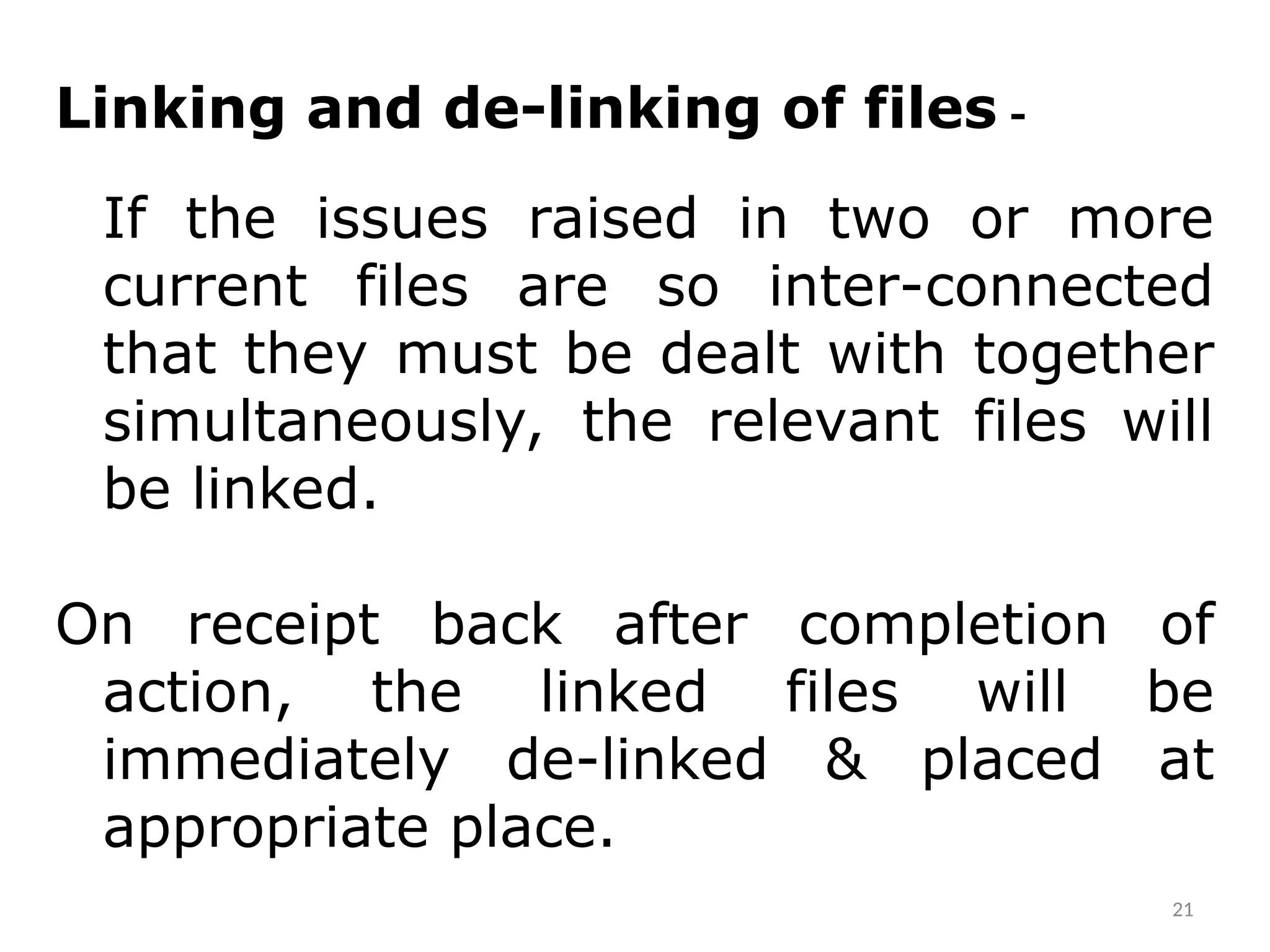
Linking and de-linking of files -
If the issues raised in two or more
current files are so inter-connected
that they must be dealt with together
simultaneously, the relevant files will
be linked.
On receipt back after completion of
action, the linked files will be
immediately de-linked & placed at
appropriate place.
21
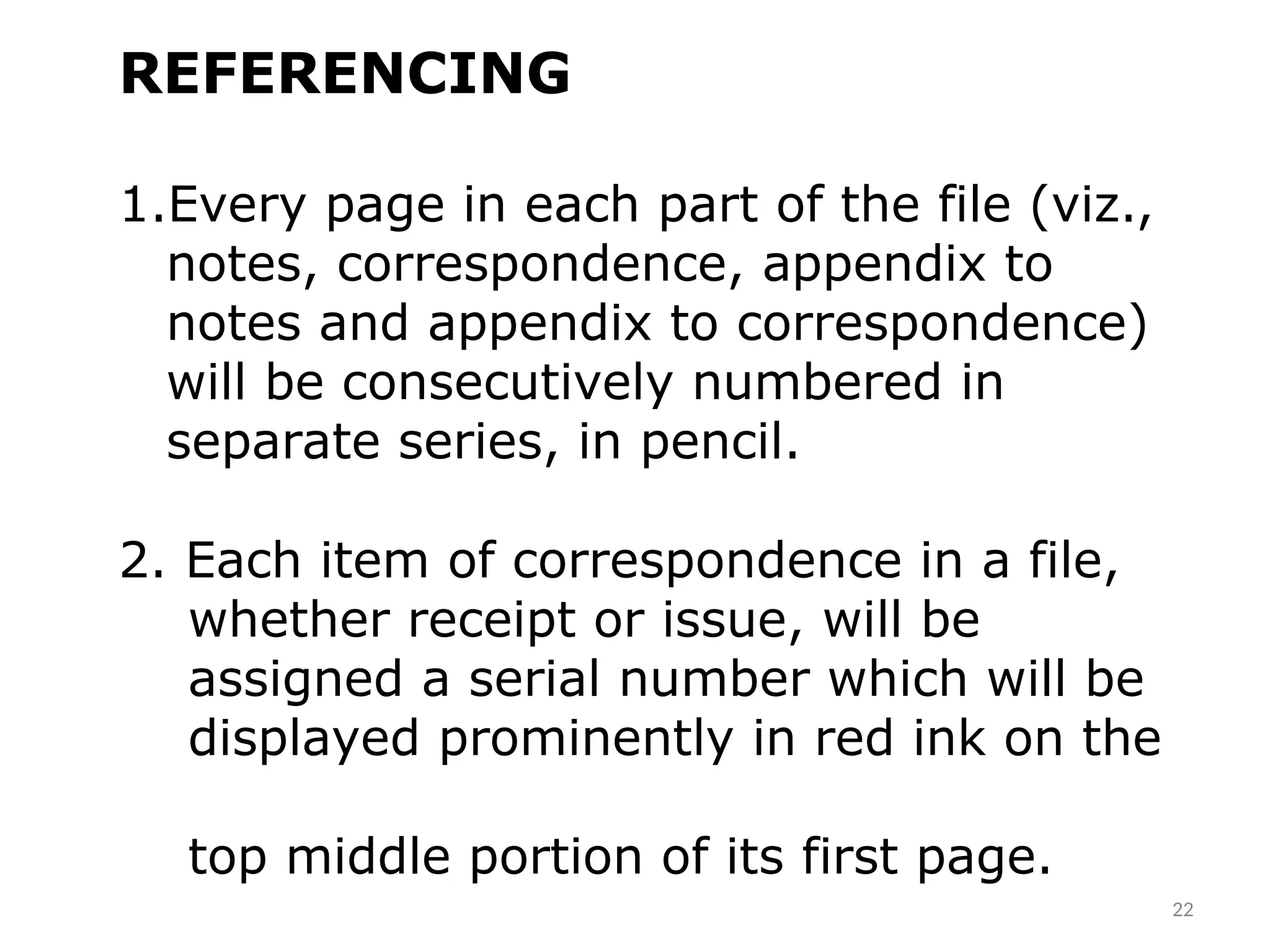
REFERENCING
1.Every page in each part of the file (viz.,
notes, correspondence, appendix to
notes and appendix to correspondence)
will be consecutively numbered in
separate series, in pencil.
2. Each item of correspondence in a file,
whether receipt or issue, will be
assigned a serial number which will be
displayed prominently in red ink on the
top middle portion of its first page.
22
3. The paper under consideration on a file
will be flagged 'PUC‘. If there are more
than one fresh receipt in a case, these
should be flagged as ‘PUC-I', ‘PUC-II and
so on.
4. In referring to the papers flagged 'PUC'
the relevant page numbers will be quoted
invariably in the margin.
5. Recorded files and other papers put up
with the current file will be flagged with
alphabetical slips for quick identification 23
FORMS OF WRITTEN COMMUNICATIONS
1. Letter
2. Demi-Official (D.O.) Letter
3. Office Memorandum (O.M.)
4. Inter-Departmental (ID) or
Inter-Office (IO) Note (U.O. Note)
5. Telegram
6. Office Order / Order
…….2
.
24
25
7. Notification
8. Resolution
9. Press Communiqué / Note
10.Endorsement
11.Circular
12.Fax And Telex
13.E-mail
DRAFTING
A draft is a rough sketch of a communication to
be issued after approval by the officer concerned.
SEARCHING Questions-
• Is a draft necessary?
• Who should be addressed and who will sign?
• What is the relationship between the sender and
receiver?
• What should be the form?
• What is the intention of the decision?
• What should be the recipient response?
• Does the language convey?
• Has the referencing been done?
• Is it logically sequenced?
• Does it have proper urgency, security grading?
26
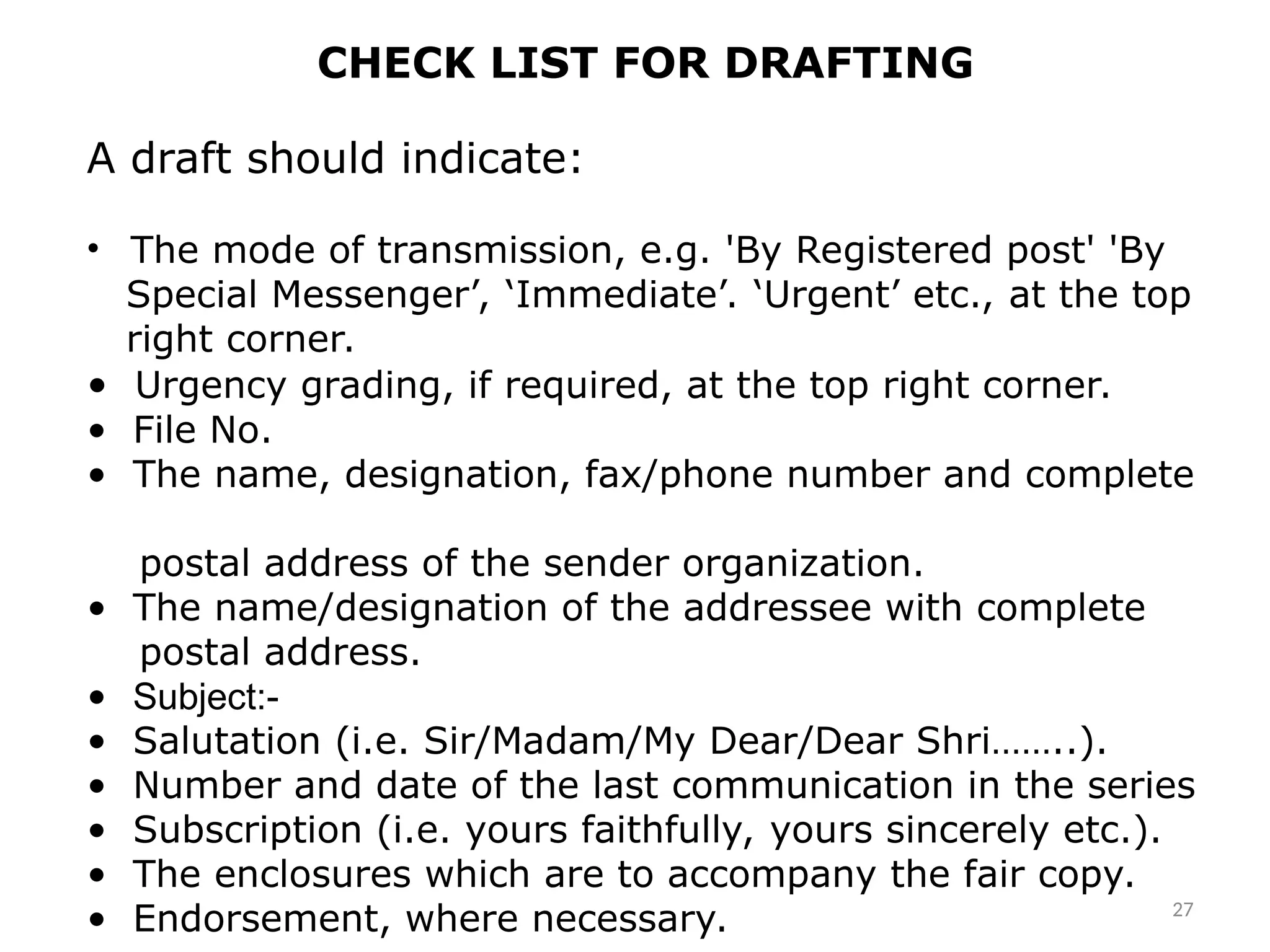
CHECK LIST FOR DRAFTING
A draft should indicate:
• The mode of transmission, e.g. 'By Registered post' 'By
Special Messenger’, ‘Immediate’. ‘Urgent’ etc., at the top
right corner.
• Urgency grading, if required, at the top right corner.
• File No.
• The name, designation, fax/phone number and complete
postal address of the sender organization.
• The name/designation of the addressee with complete
postal address.
• Subject:-
• Salutation (i.e. Sir/Madam/My Dear/Dear Shri……..).
• Number and date of the last communication in the series
• Subscription (i.e. yours faithfully, yours sincerely etc.).
• The enclosures which are to accompany the fair copy.
• Endorsement, where necessary. 27
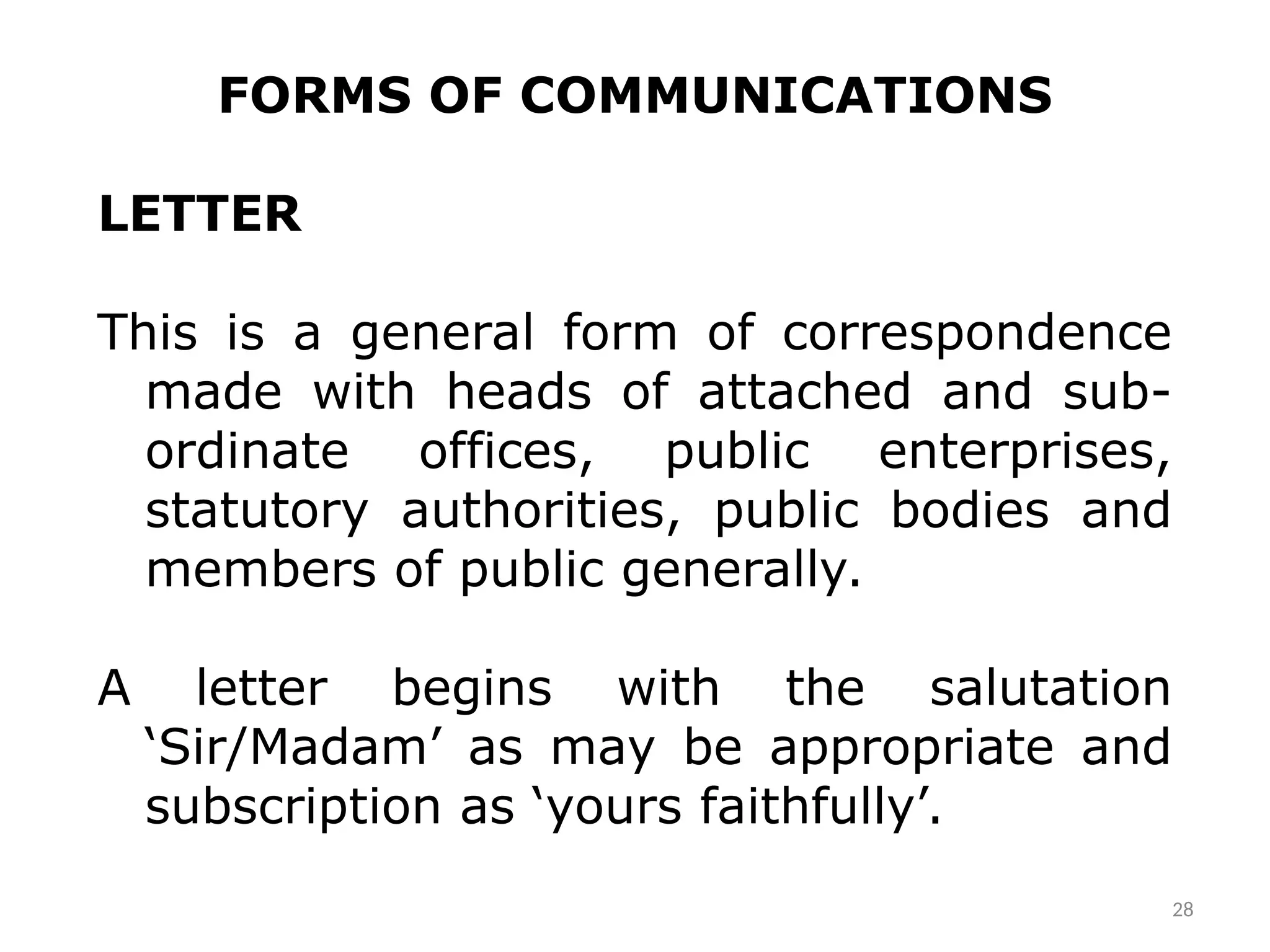
FORMS OF COMMUNICATIONS
LETTER
This is a general form of correspondence
made with heads of attached and sub-
ordinate offices, public enterprises,
statutory authorities, public bodies and
members of public generally.
A letter begins with the salutation
‘Sir/Madam’ as may be appropriate and
subscription as ‘yours faithfully’.
28
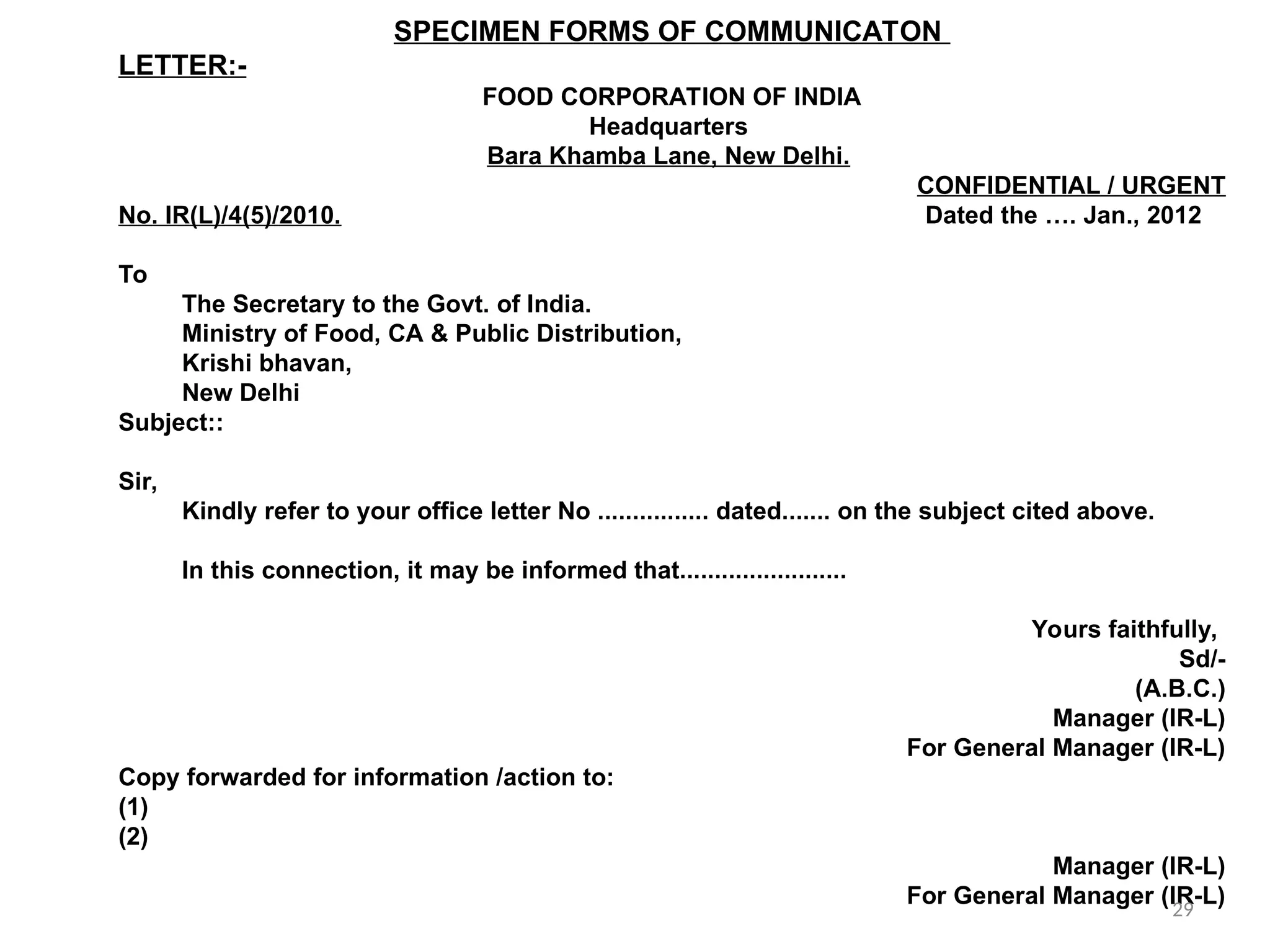
SPECIMEN FORMS OF COMMUNICATON
LETTER:-
FOOD CORPORATION OF INDIA
Headquarters
Bara Khamba Lane, New Delhi.
CONFIDENTIAL / URGENT
No. IR(L)/4(5)/2010. Dated the …. Jan., 2012
To
The Secretary to the Govt. of India.
Ministry of Food, CA & Public Distribution,
Krishi bhavan,
New Delhi
Subject::
Sir,
Kindly refer to your office letter No ................ dated....... on the subject cited above.
In this connection, it may be informed that........................
Yours faithfully,
Sd/-
(A.B.C.)
Manager (IR-L)
For General Manager (IR-L)
Copy forwarded for information /action to:
(1)
(2)
Manager (IR-L)
For General Manager (IR-L)
29
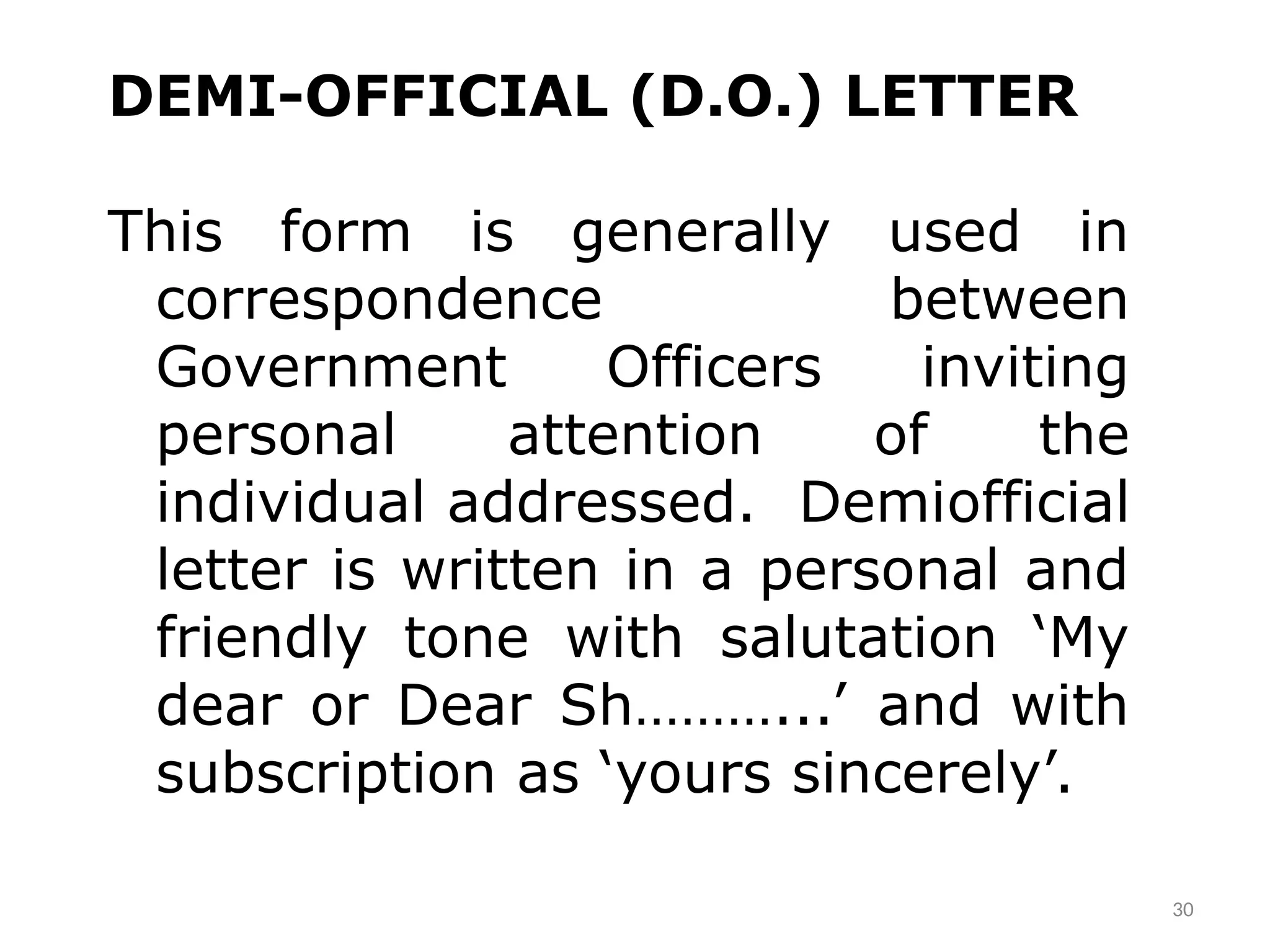
30
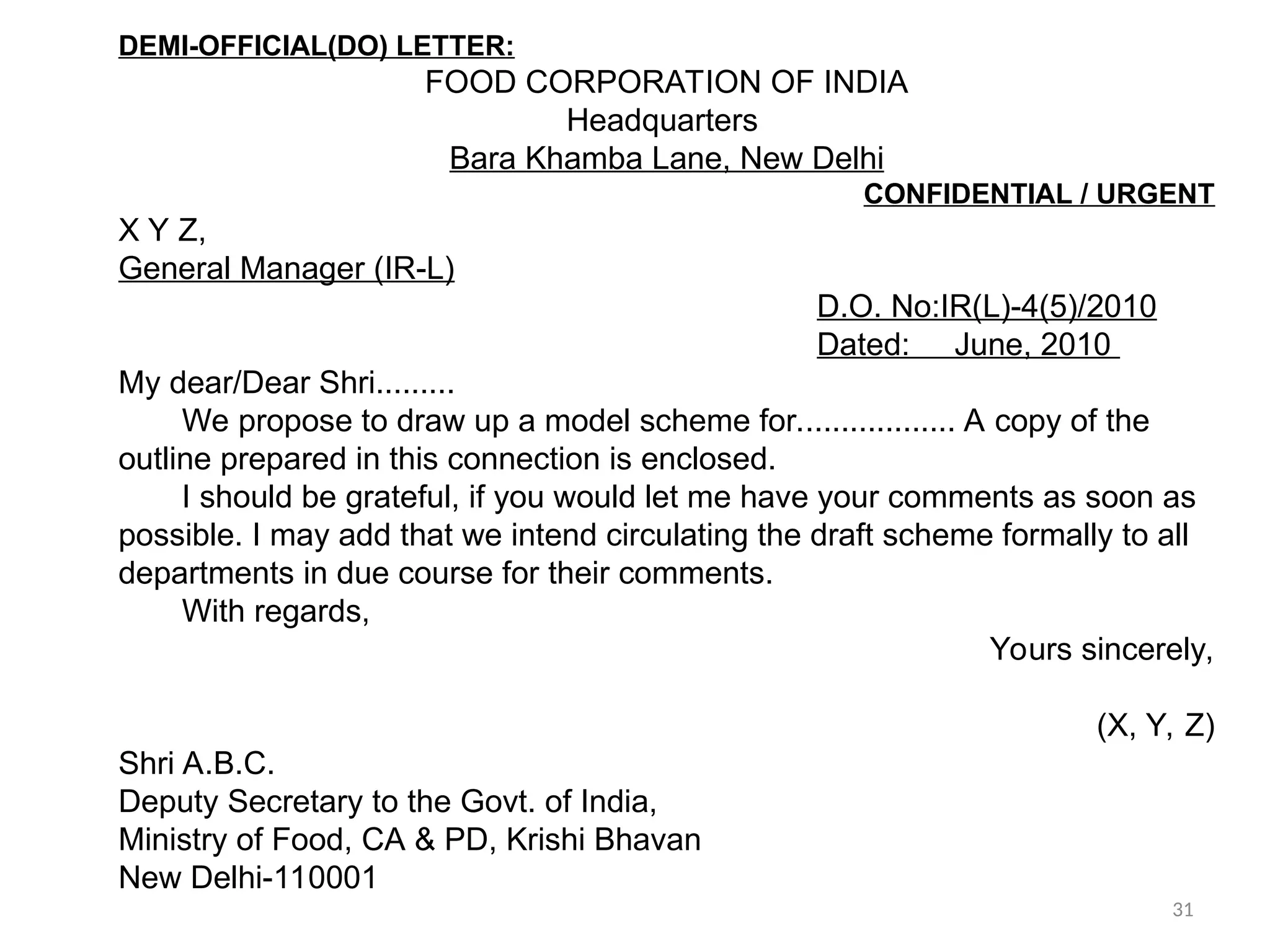
DEMI-OFFICIAL (D.O.) LETTER
This form is generally used in
correspondence between
Government Officers inviting
personal attention of the
individual addressed. Demi­
official
letter is written in a personal and
friendly tone with salutation ‘My
dear or Dear Sh………...’ and with
subscription as ‘yours sincerely’.
DEMI-OFFICIAL(DO) LETTER:
FOOD CORPORATION OF INDIA
Headquarters
Bara Khamba Lane, New Delhi
CONFIDENTIAL / URGENT
X Y Z,
General Manager (IR-L)
D.O. No:IR(L)-4(5)/2010
Dated: June, 2010
My dear/Dear Shri.........
We propose to draw up a model scheme for.................. A copy of the
outline prepared in this connection is enclosed.
I should be grateful, if you would let me have your comments as soon as
possible. I may add that we intend circulating the draft scheme formally to all
departments in due course for their comments.
With regards,
Yours sincerely,
(X, Y, Z)
Shri A.B.C.
Deputy Secretary to the Govt. of India,
Ministry of Food, CA & PD, Krishi Bhavan
New Delhi-110001
31
32
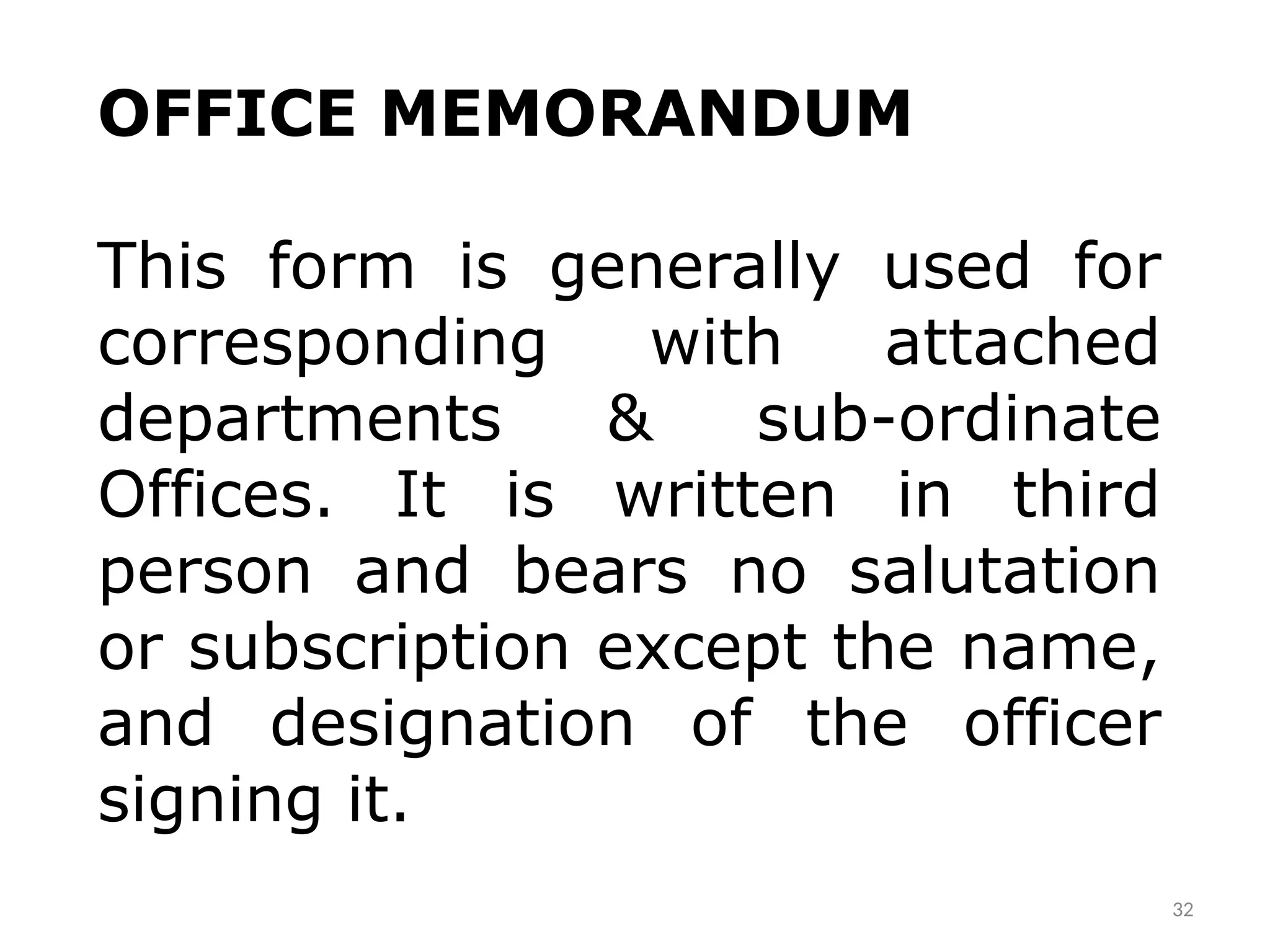
OFFICE MEMORANDUM
This form is generally used for
corresponding with attached
departments & sub-ordinate
Offices. It is written in third
person and bears no salutation
or subscription except the name,
and designation of the officer
signing it.
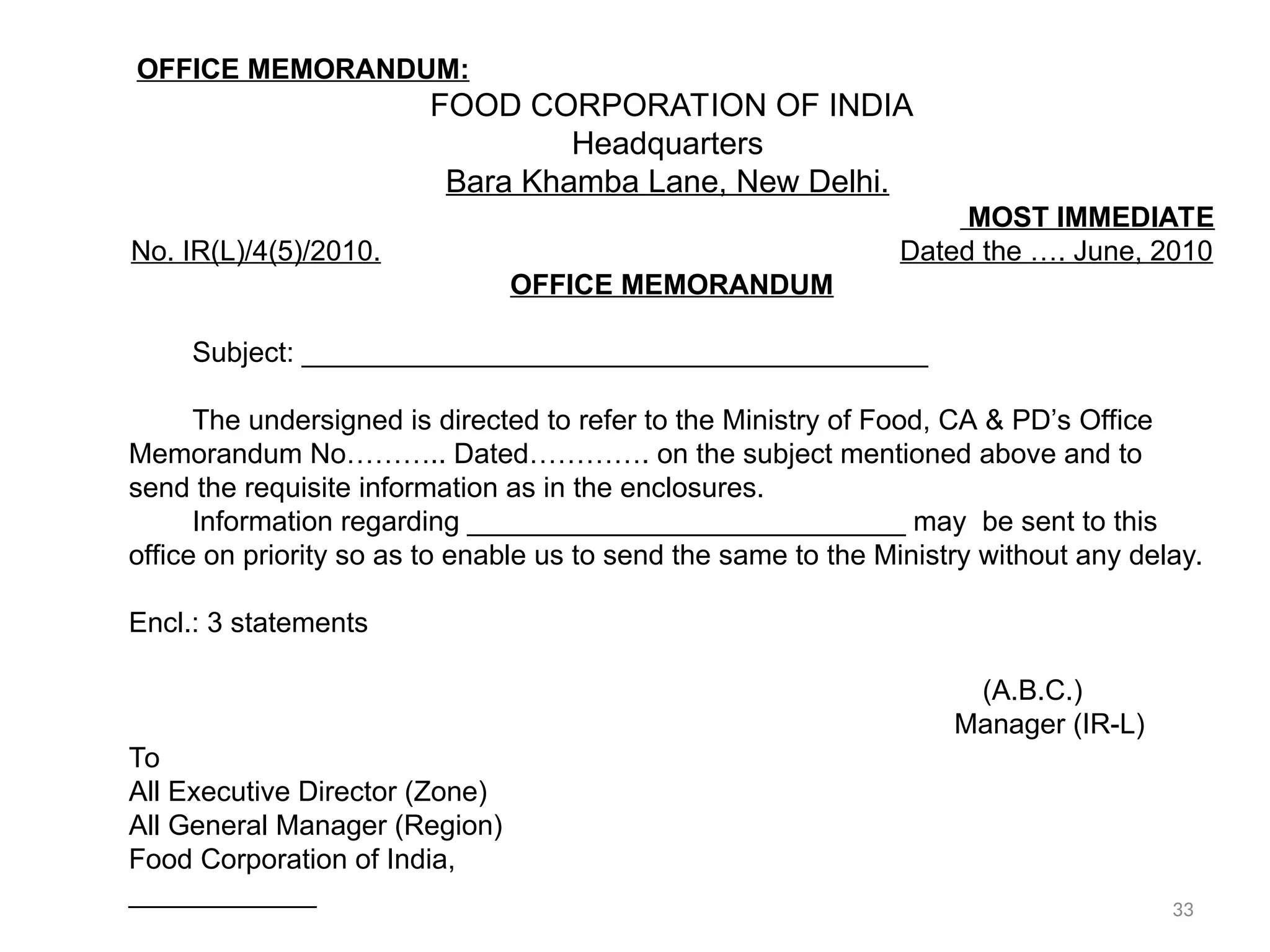
OFFICE MEMORANDUM:
FOOD CORPORATION OF INDIA
Headquarters
Bara Khamba Lane, New Delhi.
MOST IMMEDIATE
No. IR(L)/4(5)/2010. Dated the …. June, 2010
OFFICE MEMORANDUM
Subject: ________________________________________
The undersigned is directed to refer to the Ministry of Food, CA & PD’s Office
Memorandum No……….. Dated…………. on the subject mentioned above and to
send the requisite information as in the enclosures.
Information regarding ____________________________ may be sent to this
office on priority so as to enable us to send the same to the Ministry without any delay.
Encl.: 3 statements
(A.B.C.)
Manager (IR-L)
To
All Executive Director (Zone)
All General Manager (Region)
Food Corporation of India,
____________ 33
34
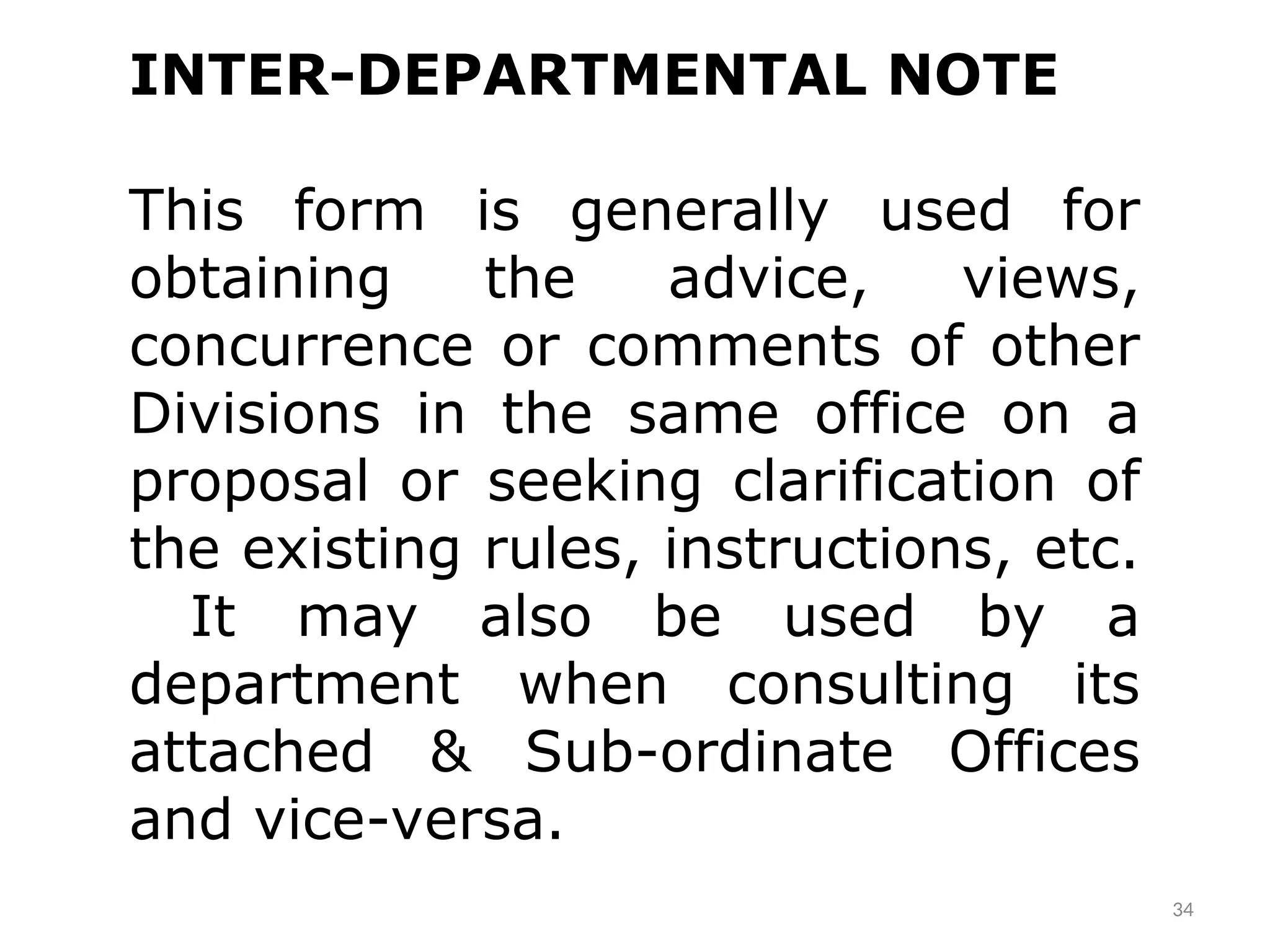
INTER-DEPARTMENTAL NOTE
This form is generally used for
obtaining the advice, views,
concurrence or comments of other
Divisions in the same office on a
proposal or seeking clarification of
the existing rules, instructions, etc.
It may also be used by a
department when consulting its
attached & Sub-ordinate Offices
and vice-versa.
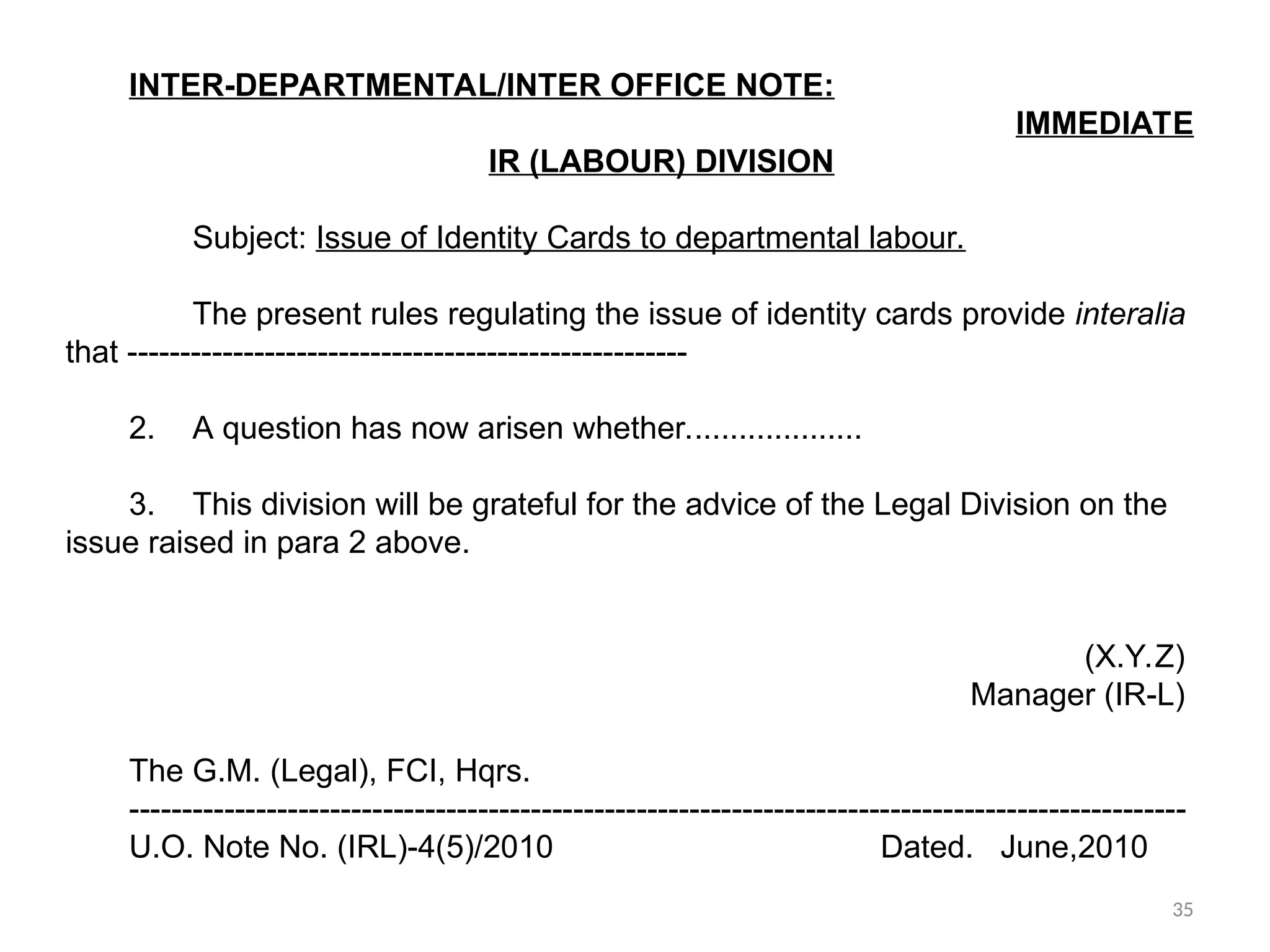
INTER-DEPARTMENTAL/INTER OFFICE NOTE:
IMMEDIATE
IR (LABOUR) DIVISION
Subject: Issue of Identity Cards to departmental labour.
The present rules regulating the issue of identity cards provide interalia
that -----------------------------------------------------
2. A question has now arisen whether....................
3. This division will be grateful for the advice of the Legal Division on the
issue raised in para 2 above.
(X.Y.Z)
Manager (IR-L)
The G.M. (Legal), FCI, Hqrs.
----------------------------------------------------------------------------------------------------
U.O. Note No. (IRL)-4(5)/2010 Dated. June,2010
35
36
OFFICE ORDER
This form is normally used
for issuing instructions meant
for internal administration, e.g.
grant of regular leave,
distribution of work among
officers and sections,
promotions and transfers, etc.
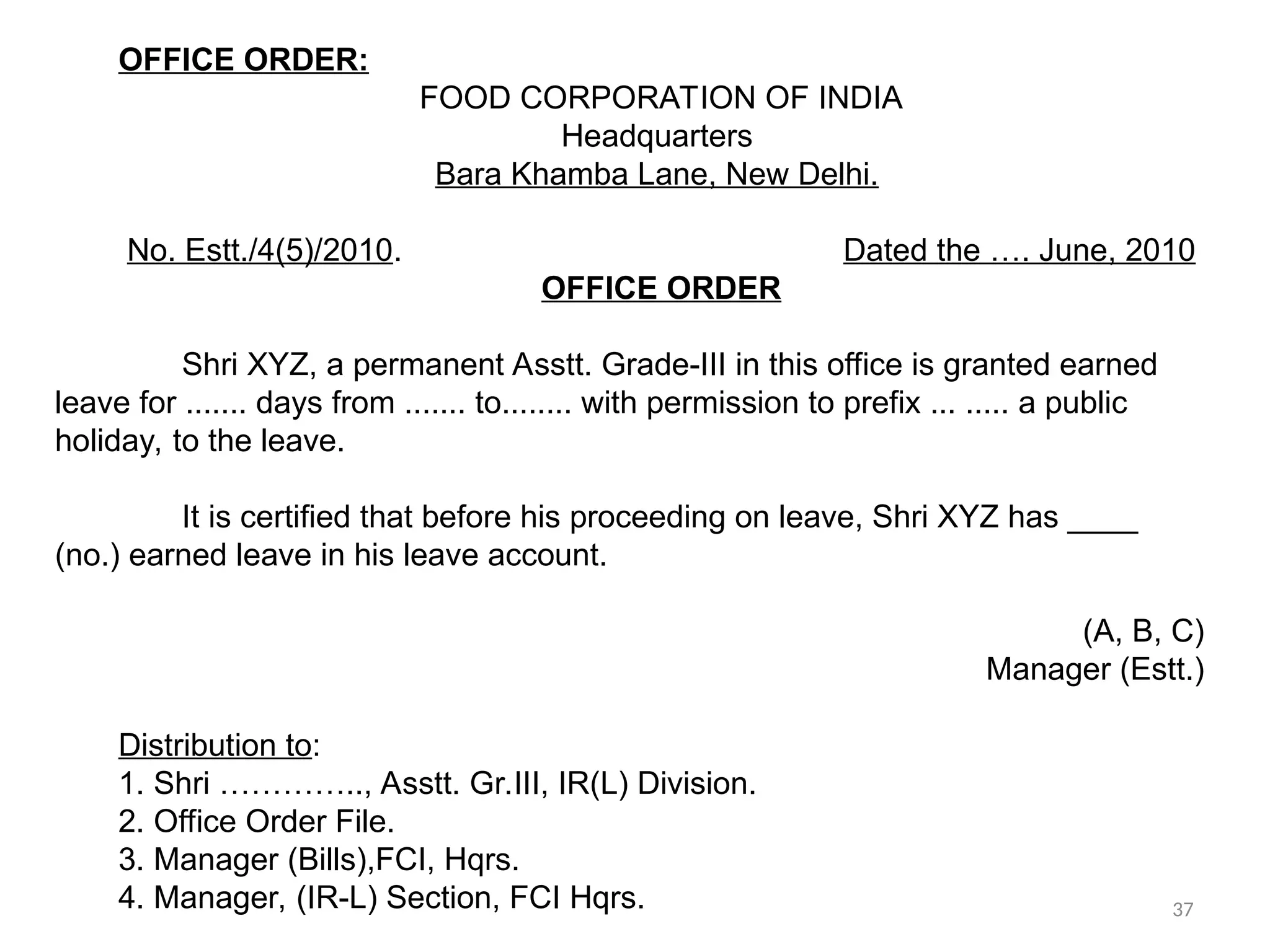
OFFICE ORDER:
FOOD CORPORATION OF INDIA
Headquarters
Bara Khamba Lane, New Delhi.
No. Estt./4(5)/2010. Dated the …. June, 2010
OFFICE ORDER
Shri XYZ, a permanent Asstt. Grade-III in this office is granted earned
leave for ....... days from ....... to........ with permission to prefix ... ..... a public
holiday, to the leave.
It is certified that before his proceeding on leave, Shri XYZ has ____
(no.) earned leave in his leave account.
(A, B, C)
Manager (Estt.)
Distribution to:
1. Shri ………….., Asstt. Gr.III, IR(L) Division.
2. Office Order File.
3. Manager (Bills),FCI, Hqrs.
4. Manager, (IR-L) Section, FCI Hqrs. 37
ORDER
This form is generally used
for issuing certain types of
financial sanctions and for
communicating government
orders in disciplinary cases,
etc., to the officials concerned.
38
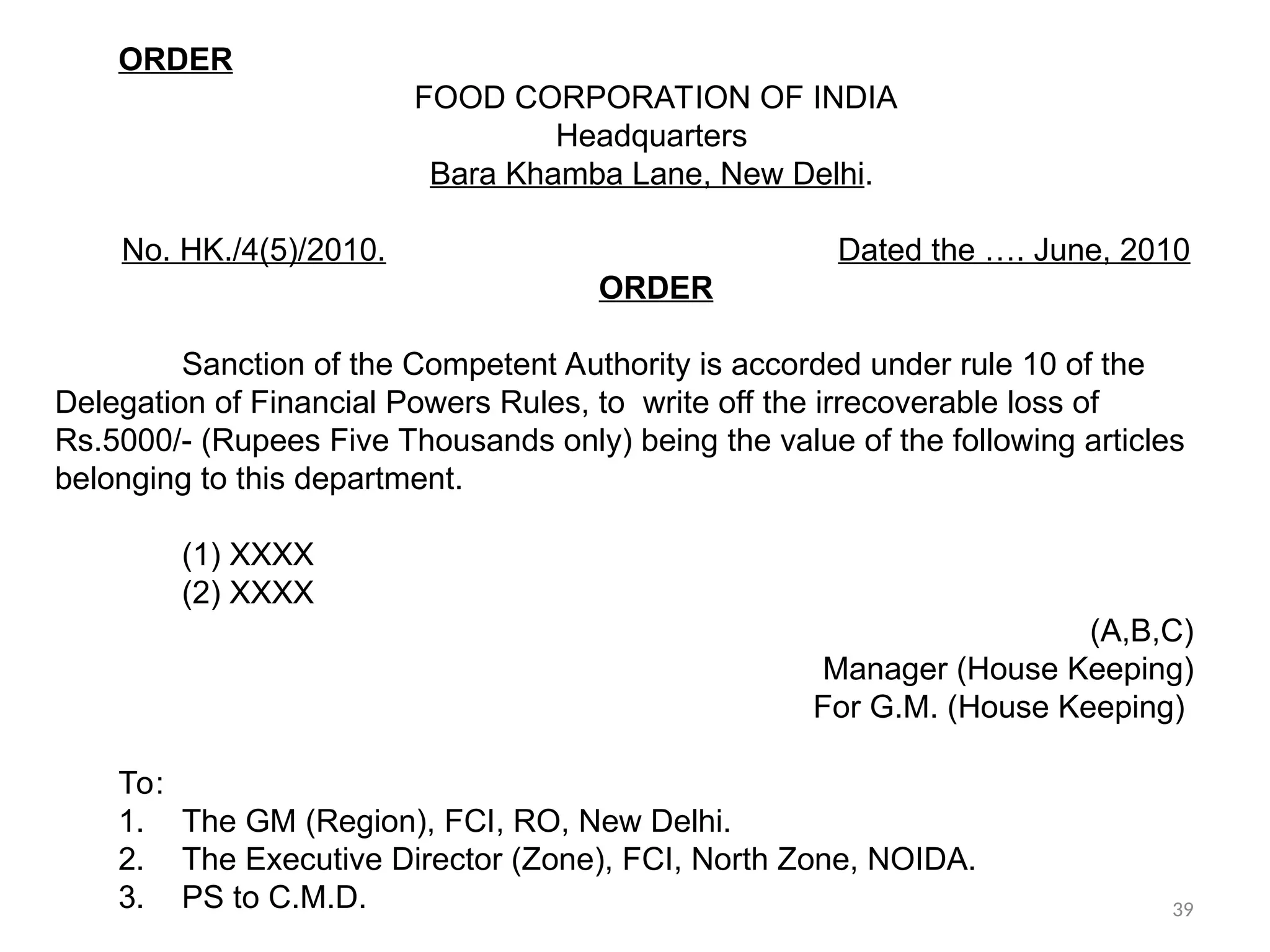
ORDER
FOOD CORPORATION OF INDIA
Headquarters
Bara Khamba Lane, New Delhi.
No. HK./4(5)/2010. Dated the …. June, 2010
ORDER
Sanction of the Competent Authority is accorded under rule 10 of the
Delegation of Financial Powers Rules, to write off the irrecoverable loss of
Rs.5000/- (Rupees Five Thousands only) being the value of the following articles
belonging to this department.
(1) XXXX
(2) XXXX
(A,B,C)
Manager (House Keeping)
For G.M. (House Keeping)
To:
1. The GM (Region), FCI, RO, New Delhi.
2. The Executive Director (Zone), FCI, North Zone, NOIDA.
3. PS to C.M.D. 39
40
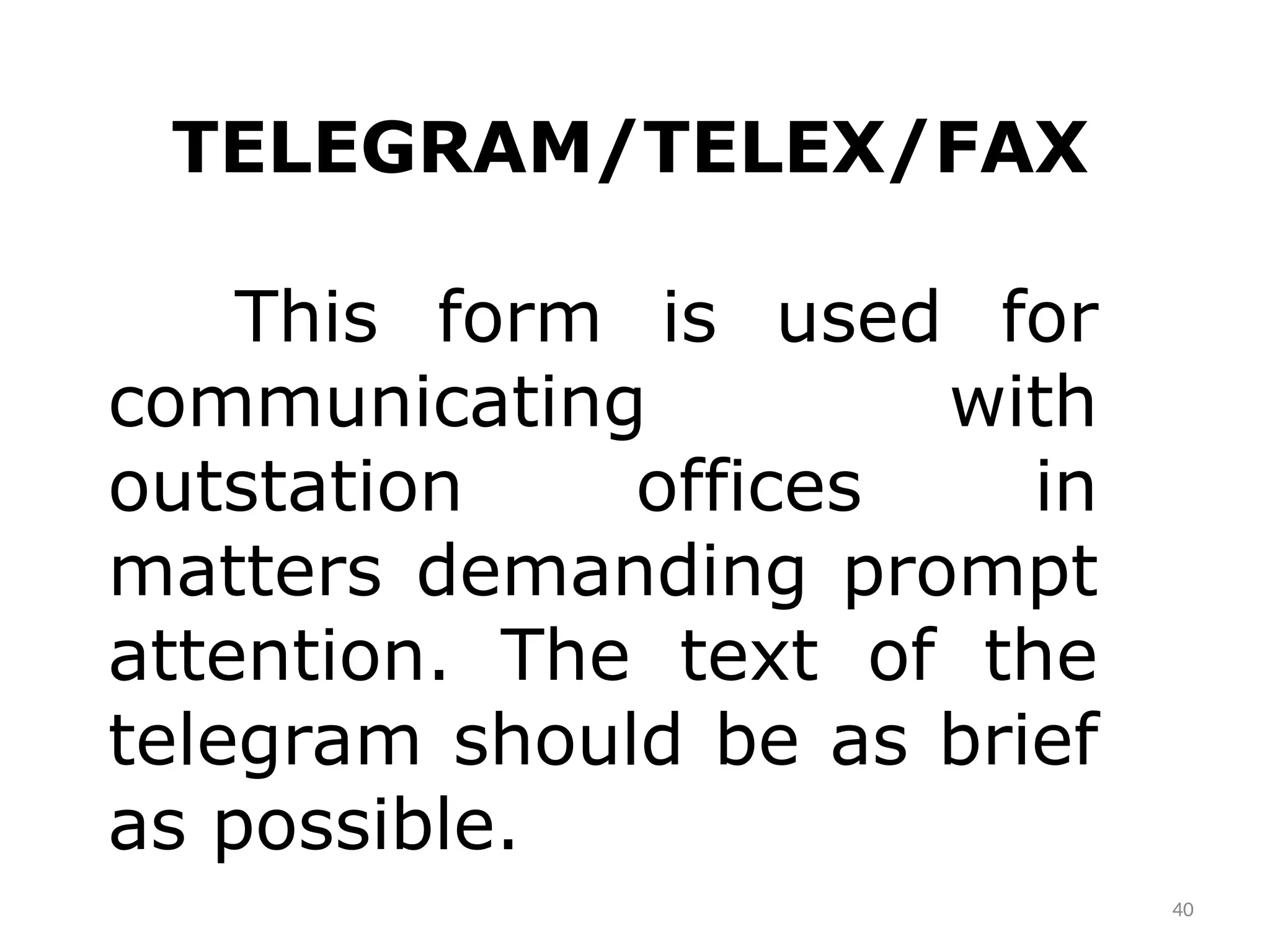
TELEGRAM/TELEX/FAX
This form is used for
communicating with
outstation offices in
matters demanding prompt
attention. The text of the
telegram should be as brief
as possible.
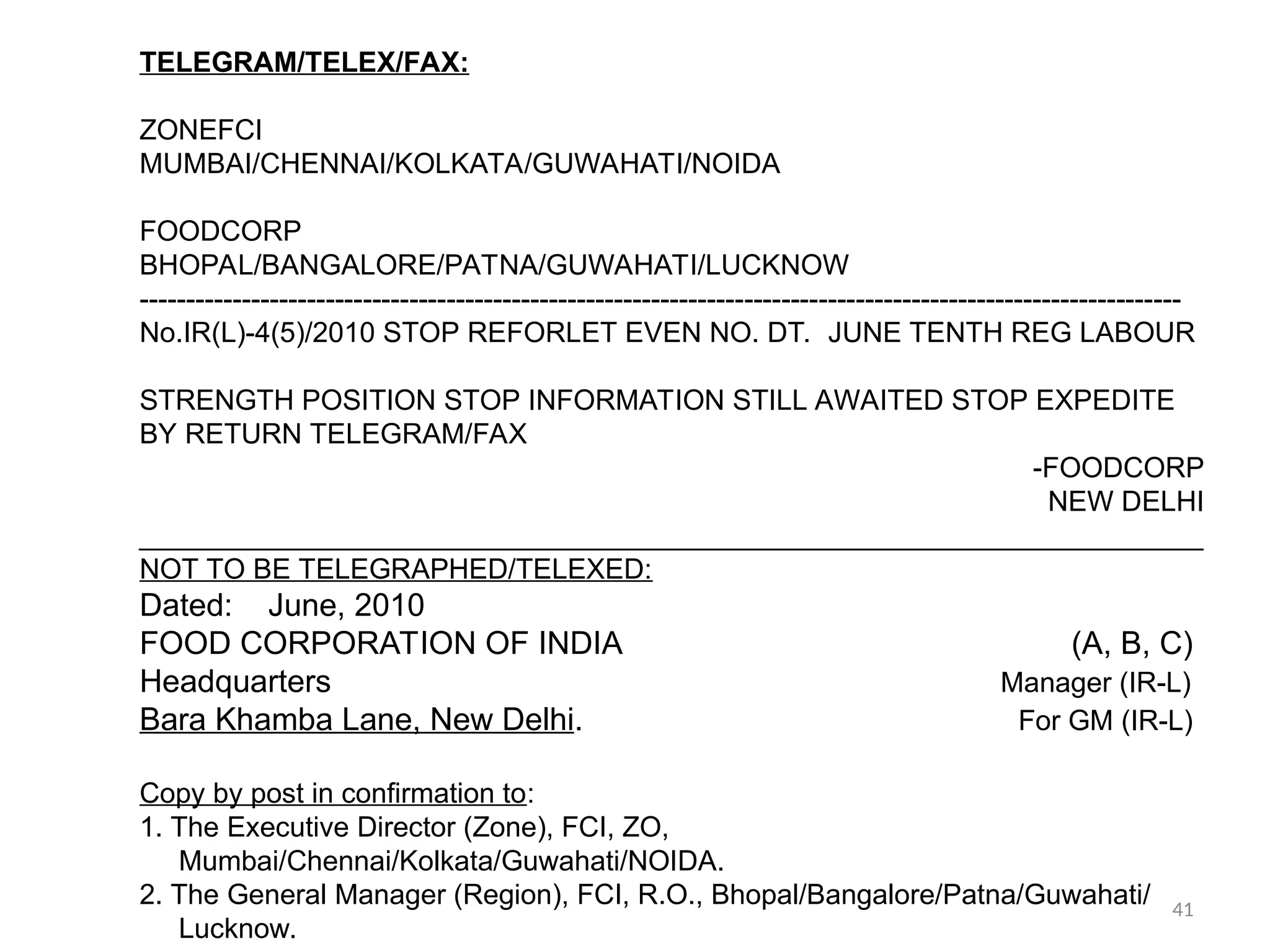
TELEGRAM/TELEX/FAX:
ZONEFCI
MUMBAI/CHENNAI/KOLKATA/GUWAHATI/NOIDA
FOODCORP
BHOPAL/BANGALORE/PATNA/GUWAHATI/LUCKNOW
----------------------------------------------------------------------------------------------------------------
No.IR(L)-4(5)/2010 STOP REFORLET EVEN NO. DT. JUNE TENTH REG LABOUR
STRENGTH POSITION STOP INFORMATION STILL AWAITED STOP EXPEDITE
BY RETURN TELEGRAM/FAX
-FOODCORP
NEW DELHI
____________________________________________________________________
NOT TO BE TELEGRAPHED/TELEXED:
Dated: June, 2010
FOOD CORPORATION OF INDIA (A, B, C)
Headquarters Manager (IR-L)
Bara Khamba Lane, New Delhi. For GM (IR-L)
Copy by post in confirmation to:
1. The Executive Director (Zone), FCI, ZO,
Mumbai/Chennai/Kolkata/Guwahati/NOIDA.
2. The General Manager (Region), FCI, R.O., Bhopal/Bangalore/Patna/Guwahati/
Lucknow.
41
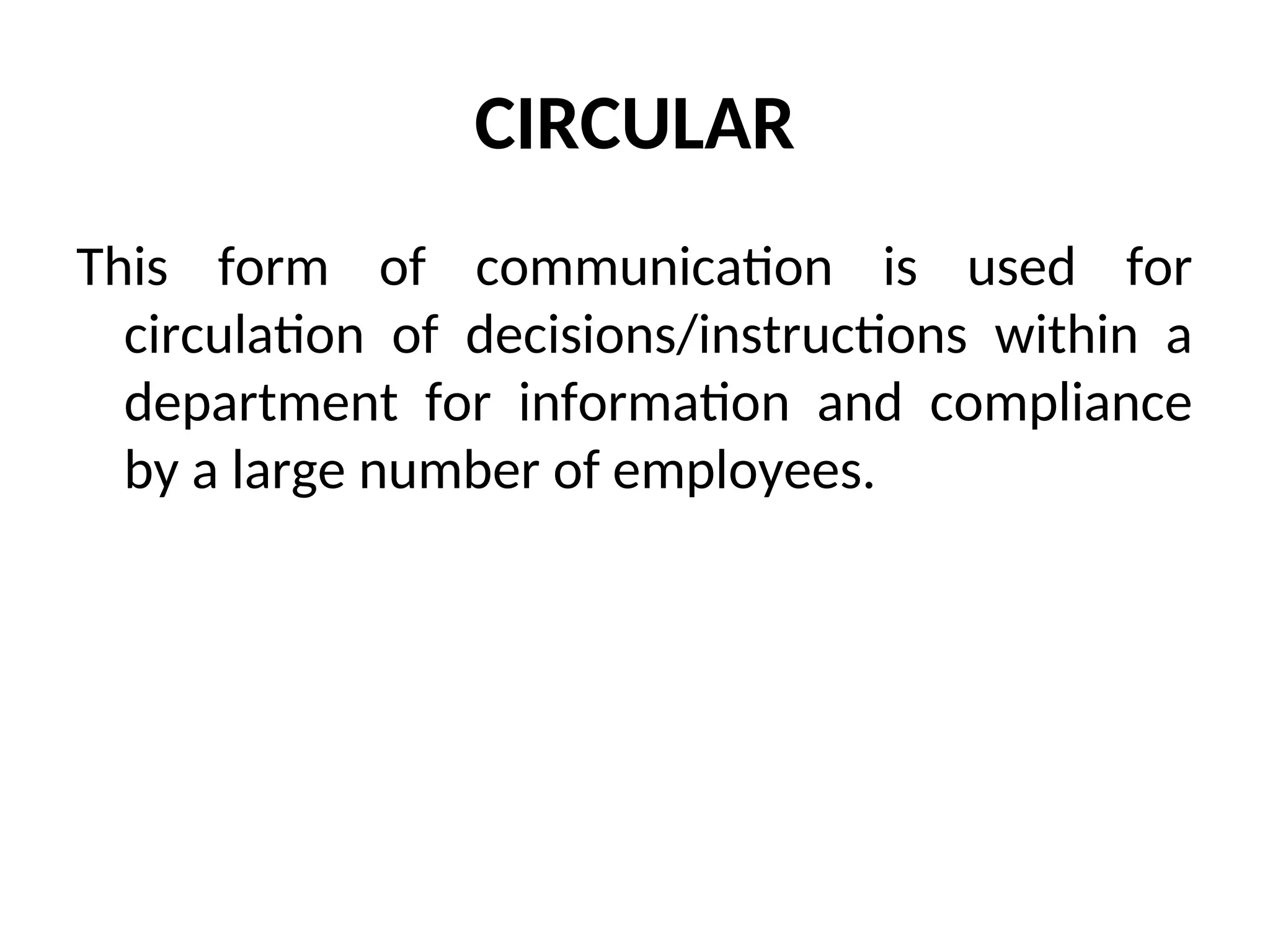
CIRCULAR
This form of communication is used for
circulation of decisions/instructions within a
department for information and compliance
by a large number of employees.
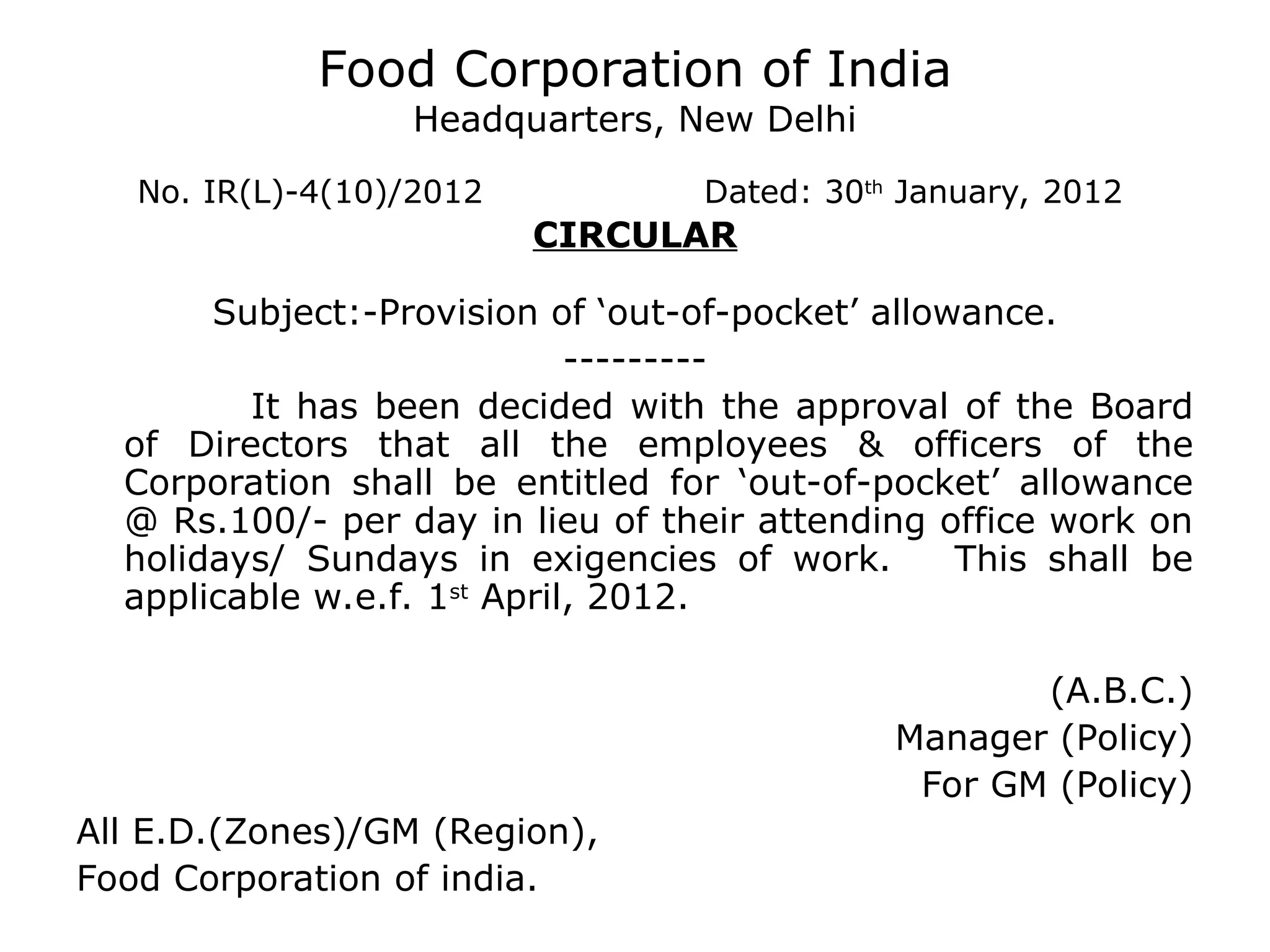
Food Corporation of India
Headquarters, New Delhi
No. IR(L)-4(10)/2012 Dated: 30th
January, 2012
CIRCULAR
Subject:-Provision of ‘out-of-pocket’ allowance.
---------
It has been decided with the approval of the Board
of Directors that all the employees & officers of the
Corporation shall be entitled for ‘out-of-pocket’ allowance
@ Rs.100/- per day in lieu of their attending office work on
holidays/ Sundays in exigencies of work. This shall be
applicable w.e.f. 1st
April, 2012.
(A.B.C.)
Manager (Policy)
For GM (Policy)
All E.D.(Zones)/GM (Region),
Food Corporation of india.
NOTIFICATION
This form is mostly used in
notifying the promulgation of
statutory rules and orders,
appointments and promotions of
Gazetted Officers, etc. through
publications in the Gazette of
India.
44
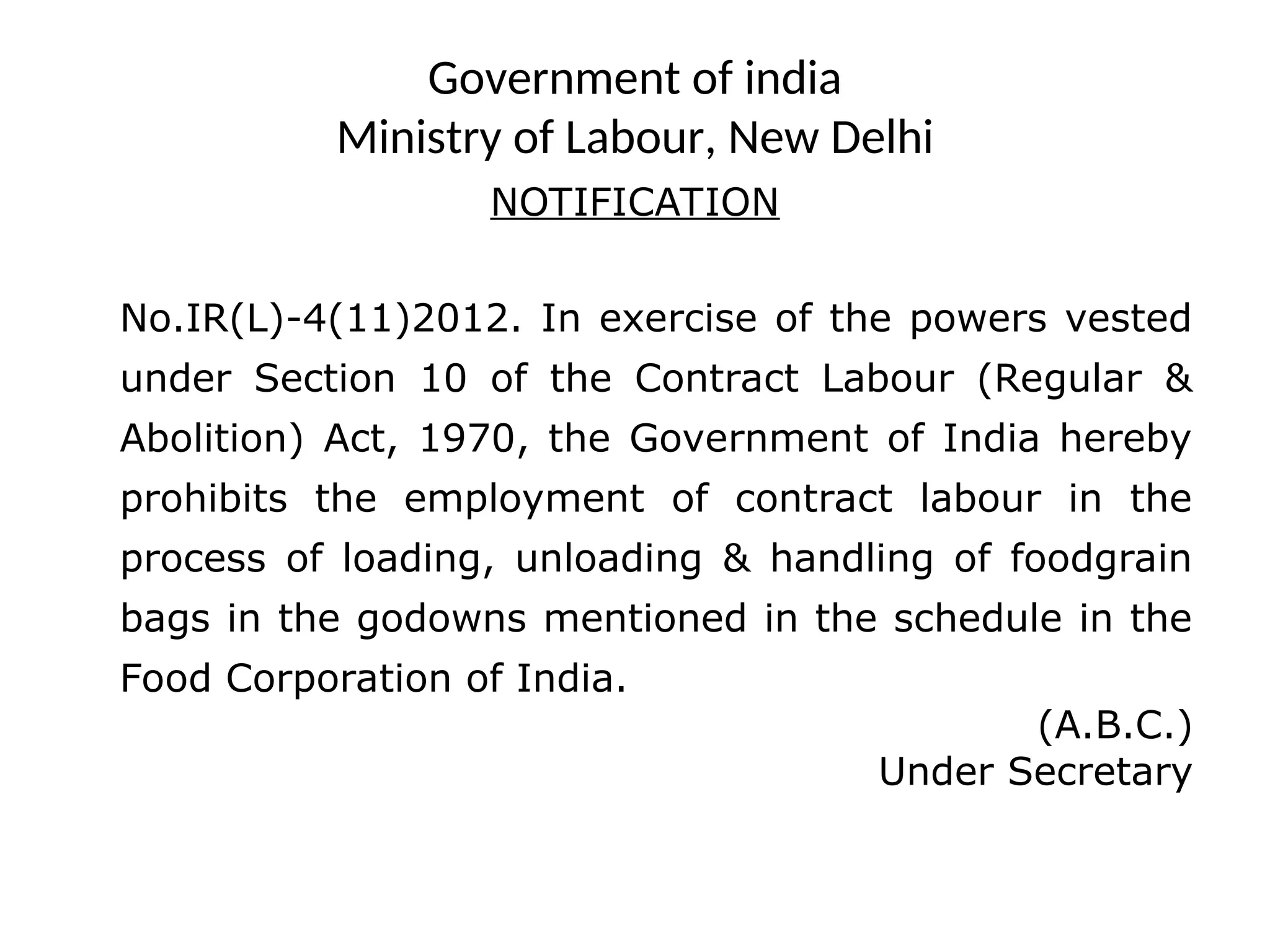
Government of india
Ministry of Labour, New Delhi
NOTIFICATION
No.IR(L)-4(11)2012. In exercise of the powers vested
under Section 10 of the Contract Labour (Regular &
Abolition) Act, 1970, the Government of India hereby
prohibits the employment of contract labour in the
process of loading, unloading & handling of foodgrain
bags in the godowns mentioned in the schedule in the
Food Corporation of India.
(A.B.C.)
Under Secretary
RESOLUTION
This form of communication is used for
making public announcement of decisions of
Government in important matters of
policy, e.g., the policy of industrial
licensing, appointment of committees or
commissions of enquiry.
Resolutions are also published in
the Gazette of India.
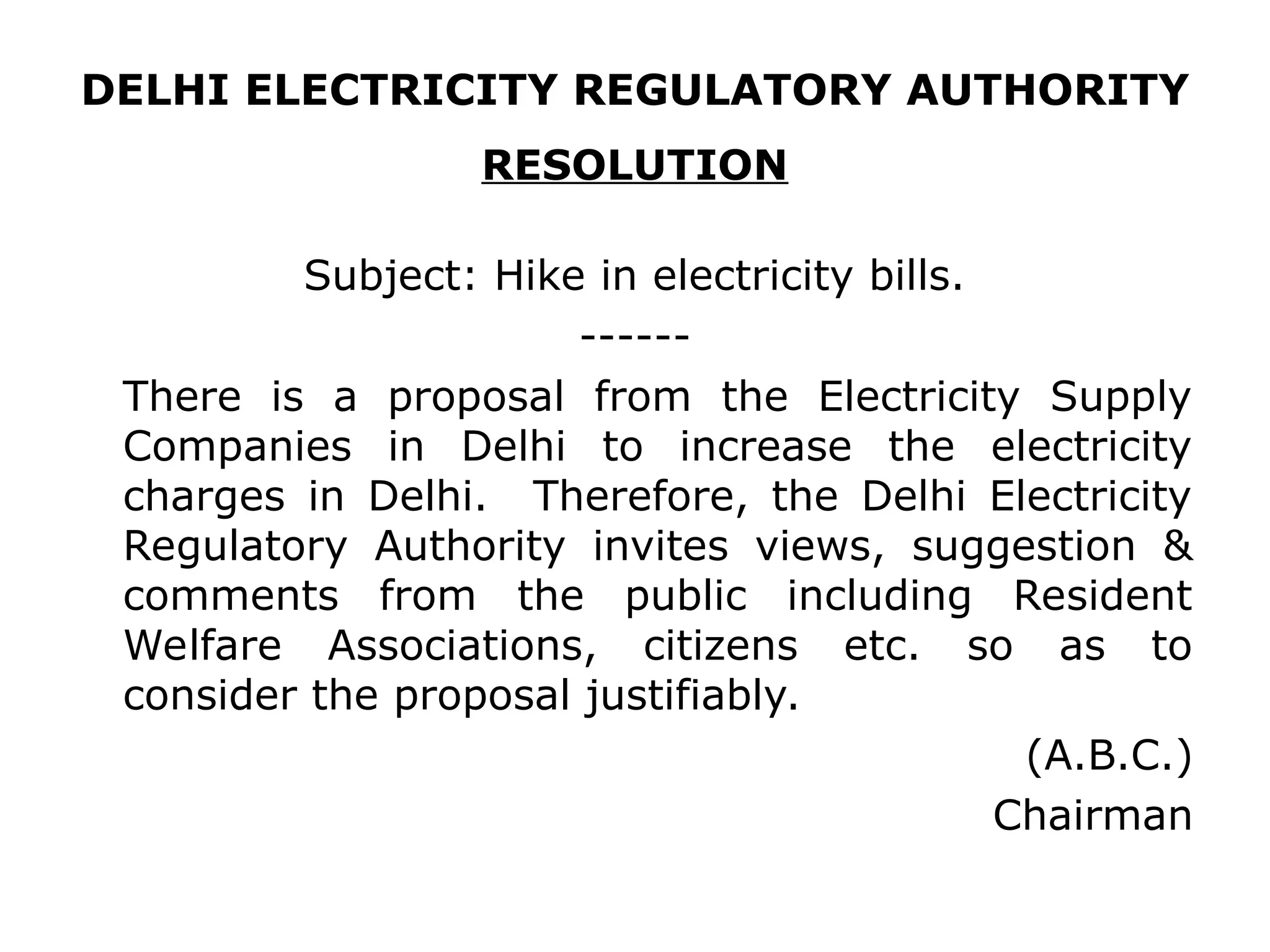
DELHI ELECTRICITY REGULATORY AUTHORITY
RESOLUTION
Subject: Hike in electricity bills.
------
There is a proposal from the Electricity Supply
Companies in Delhi to increase the electricity
charges in Delhi. Therefore, the Delhi Electricity
Regulatory Authority invites views, suggestion &
comments from the public including Resident
Welfare Associations, citizens etc. so as to
consider the proposal justifiably.
(A.B.C.)
Chairman
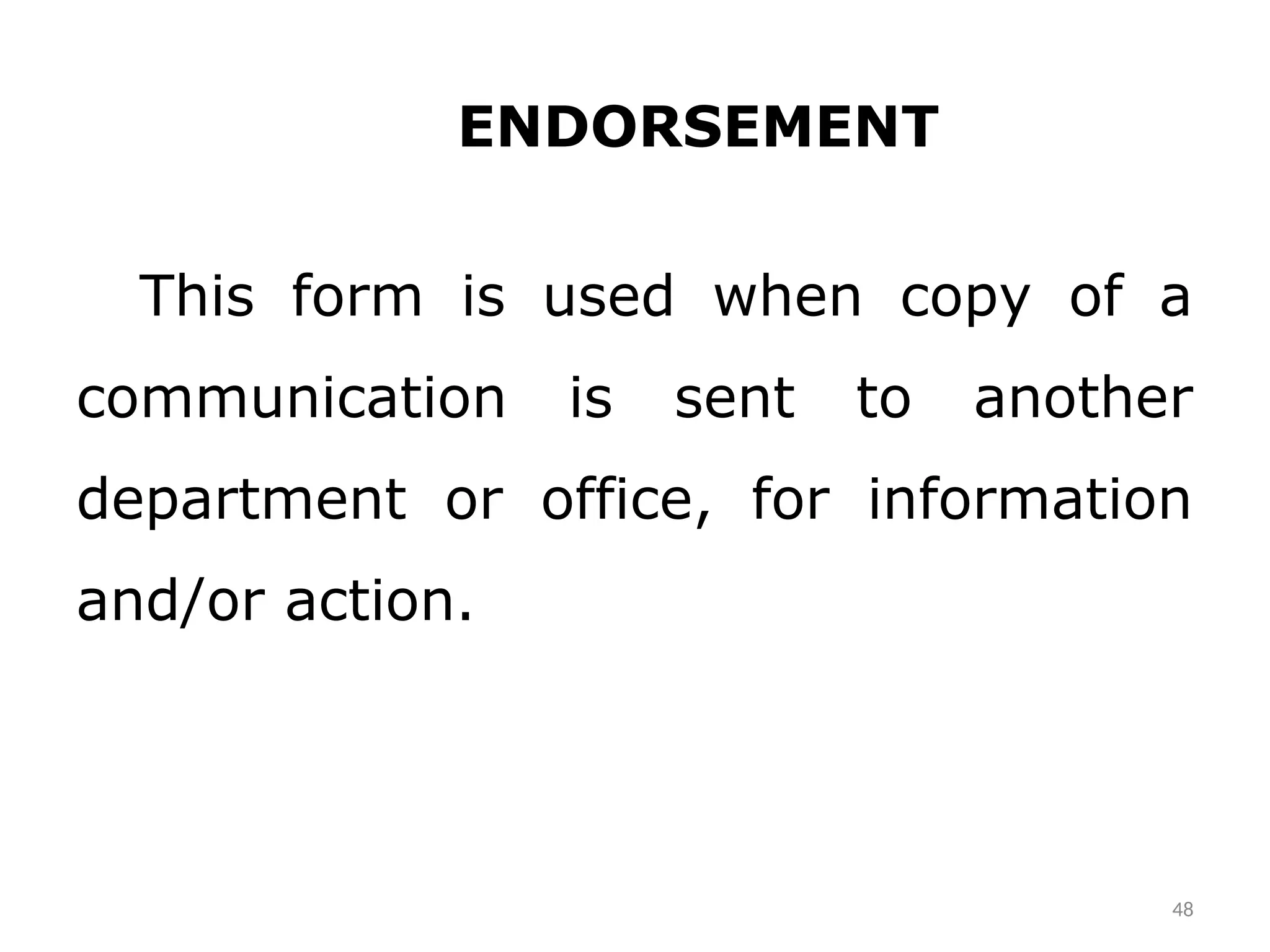
ENDORSEMENT
This form is used when copy of a
communication is sent to another
department or office, for information
and/or action.
48
THANK
YOU

Presentation on Noting & Drafting in government offices

  • 1.
    Noting and Drafting playa vital role in decision- making process in the Government. The quality of Noting and Drafting has deteriorated over the years. 1
  • 2.
    DEFINITIONS: ‘File’ : Collection& proper maintenance of communications received & issued, in a particular folder. ‘Receipt’ means a communication/ note/matter received for consideration. ‘Issue’ means communication/note issued after consideration/disposal. ‘PUC’ = Paper Under Consideration. ‘DFA’ = Draft For Approval. 2
  • 3.
    How to createa File: a) Division’s name b) Subject-wise Head no. c) Serial no. of file d)Year of opening of file e) Office name, if need be viz. File No.IR(L)-4(1)/2012-HQ File No.IR(L)-4(2)/2012-HQ File No.IR(L)-4(3)/2012-HQ File No.IR(L)-4(3)/2012-HQ 3
  • 4.
    File No.Estt.1(1)/2012-ZO(N) File No.Estt.1(2)/2012-ZO(N) FileNo.Estt.1(1)/2012-RO File No.Estt.1(2)/2012-RO File No.Vig.2(1)/2012-HO File No.Vig.2(2)/2012-HO File No.P&R.4(1)/2012-HO File No.P&R.4(2)/2012-HO 4
  • 5.
  • 6.
    6 'Note' means precisewrite-up about the PUC or a case, includes a precise of previous papers, a statement or an analysis of the questions requiring decision, suggestions regarding the course of action and final orders passed thereon to facilitate its disposal.
  • 7.
    A GOOD NOTE: Agood note should properly: -Define and analyze the problem; -Refer to relevant rules, regulations, policies and precedents; -Talk about alternative solutions; -Discuss implications of these various alternatives and -then suggest a suitable solution and a draft reply. 7
  • 8.
    8 DETAILED NOTE A detailednote providing maximum information on each aspect will be necessary. Even then, the note should be concise and to the point, covering the following aspects:­ (i) What is the problem? (ii) How has it arisen? ' (iii) What is the `Rule', `Policy' or `Precedent’? (iv) What are the possible solutions? (v) Which is the best solution? Why? (vii) What will be the consequences of the proposed solution?
  • 9.
    9 Policy and PlanningNote: The note in such cases should be structured on the following grounds:- (i) Problem - How it has arisen? What are the critical factors? (ii) Additional Information: - Give additional information available on the files etc. and other papers in the Section. (iii) Rule, policy etc: - Relevant rules, regulations, policy, standing orders, practices are required to be referred to with Logical interpretation of such rules etc.
  • 10.
    10 Courteousness in writingNote •It should express ideas tactfully, without hurting anybody’s feelings. •It should emphasize positive facts. •To point out errors or incorrect statements or to criticize an opinion expressed therein has to be criticized, care should be taken to couch the observations in courteous and temperate language free from personal remarks.
  • 11.
    ADDITIONAL GUIDELINES FOR WRITINGNOTE ARE: (1) Should be recorded on note sheets. (2) Should be typed or written on both sides. (3) Black or blue ink should be used. (4) Joint Secretary of Government of India (Executive Director in case of FCI) and above may use green or red ink in rare cases. Contd…. 11
  • 12.
    (5) The verbatimreproduction of the P.U.C. (Paper Under Consideration) should not be attempted. (6) An officer should confine his note to the actual points he proposes to make without reiterating the ground(s) already covered in the previous notes. If he agrees to the line of action suggested in the preceding note, he should merely append his 12
  • 13.
    (7) Any officer,who has to note upon a file on which a running summary of facts is available should, in drawing attention to the facts of the case, refer to the appropriate part of the summary without repeating it in his own note. (8) Relevant extracts or a rule or instruction should be placed on the file and attention to it should be drawn in the note, rather than reproducing the relevant provisions in the note. Contd…… 13
  • 14.
    (9) The dealinghand should append his full signature with date on the left below his note. An officer should append his full signature on the right hand side of the note with name, designation, and date. (10) If the note has been written till the end of the page, and there is no blank sheet thereafter, a blank note sheet should be added to the file, so that the officer is not inconvenienced in writing his note or giving his orders. ----- 14
  • 15.
    ALLIED INSTRUCTIONS (a)Modification ofNotes:­ (i) Whenever it is necessary to correct or to modify the facts stated in a note put up to a senior officer, he should do so by recording his own note giving his views on the subject. He should not modify or replace the note recorded by his junior. (ii) Notes recorded on a file should, in no circumstances, be pasted over. 15
  • 16.
    (b) Oral discussions:- All points emerging from discussions between two or more officers and the conclusions reached will be recorded on the relevant file by the officer authorising action. He may, if considered important, get it confirmed by the participants. (c) Oral Instructions by Higher Officers: - Normally, it is incumbent on the Superior Officer to give his/her direction in writing. In some occasions, due to paucity of time, if the instructions have been given orally, the oral instructions may be confirmed in writing at the earliest opportunity. Juniors should obtain written directions before carrying out oral instructions. If such instructions are not from the immediate superior, it should be brought to his notice. 16
  • 17.
    'File' means acollection of papers arranged chronologically on a specific subject matter assigned a file number and consisting of the following parts: (a) Notes (b) Correspondence 'Notes Portion' in relation to a file means the portion containing notes or minutes recorded on a case. 17
  • 18.
    18 'Docketing' means assigninga serial no. & page no. to a receipt or issued communication, then making of entries in the notes portion of a file about the same serial number & page no. for proper identification & location in the file. The important remarks recorded on the body of the receipt by higher officers are also required to be reproduced on the note portion.
  • 19.
    'Correspondence Portion' inrelation a file means the portion containing 'receipts' and office copies of 'issue' pertaining to the file. 'Case' means a current case or a receipt together with other related paper, if any. 'Current file' means a file on which action has not been completed. 19
  • 20.
    "Come-back Case' meansa case received back for further action such as re-­ examination or preparing a draft or a summary of the case. 'Security grading' means security marking 'Confidential', 'Secret or 'Top Secret'. ‘Priority grading' means marking 'immediate' or ‘urgent’ or 'priority‘. 20
  • 21.
    Linking and de-linkingof files - If the issues raised in two or more current files are so inter-connected that they must be dealt with together simultaneously, the relevant files will be linked. On receipt back after completion of action, the linked files will be immediately de-linked & placed at appropriate place. 21
  • 22.
    REFERENCING 1.Every page ineach part of the file (viz., notes, correspondence, appendix to notes and appendix to correspondence) will be consecutively numbered in separate series, in pencil. 2. Each item of correspondence in a file, whether receipt or issue, will be assigned a serial number which will be displayed prominently in red ink on the top middle portion of its first page. 22
  • 23.
    3. The paperunder consideration on a file will be flagged 'PUC‘. If there are more than one fresh receipt in a case, these should be flagged as ‘PUC-I', ‘PUC-II and so on. 4. In referring to the papers flagged 'PUC' the relevant page numbers will be quoted invariably in the margin. 5. Recorded files and other papers put up with the current file will be flagged with alphabetical slips for quick identification 23
  • 24.
    FORMS OF WRITTENCOMMUNICATIONS 1. Letter 2. Demi-Official (D.O.) Letter 3. Office Memorandum (O.M.) 4. Inter-Departmental (ID) or Inter-Office (IO) Note (U.O. Note) 5. Telegram 6. Office Order / Order …….2 . 24
  • 25.
    25 7. Notification 8. Resolution 9.Press Communiqué / Note 10.Endorsement 11.Circular 12.Fax And Telex 13.E-mail
  • 26.
    DRAFTING A draft isa rough sketch of a communication to be issued after approval by the officer concerned. SEARCHING Questions- • Is a draft necessary? • Who should be addressed and who will sign? • What is the relationship between the sender and receiver? • What should be the form? • What is the intention of the decision? • What should be the recipient response? • Does the language convey? • Has the referencing been done? • Is it logically sequenced? • Does it have proper urgency, security grading? 26
  • 27.
    CHECK LIST FORDRAFTING A draft should indicate: • The mode of transmission, e.g. 'By Registered post' 'By Special Messenger’, ‘Immediate’. ‘Urgent’ etc., at the top right corner. • Urgency grading, if required, at the top right corner. • File No. • The name, designation, fax/phone number and complete postal address of the sender organization. • The name/designation of the addressee with complete postal address. • Subject:- • Salutation (i.e. Sir/Madam/My Dear/Dear Shri……..). • Number and date of the last communication in the series • Subscription (i.e. yours faithfully, yours sincerely etc.). • The enclosures which are to accompany the fair copy. • Endorsement, where necessary. 27
  • 28.
    FORMS OF COMMUNICATIONS LETTER Thisis a general form of correspondence made with heads of attached and sub- ordinate offices, public enterprises, statutory authorities, public bodies and members of public generally. A letter begins with the salutation ‘Sir/Madam’ as may be appropriate and subscription as ‘yours faithfully’. 28
  • 29.
    SPECIMEN FORMS OFCOMMUNICATON LETTER:- FOOD CORPORATION OF INDIA Headquarters Bara Khamba Lane, New Delhi. CONFIDENTIAL / URGENT No. IR(L)/4(5)/2010. Dated the …. Jan., 2012 To The Secretary to the Govt. of India. Ministry of Food, CA & Public Distribution, Krishi bhavan, New Delhi Subject:: Sir, Kindly refer to your office letter No ................ dated....... on the subject cited above. In this connection, it may be informed that........................ Yours faithfully, Sd/- (A.B.C.) Manager (IR-L) For General Manager (IR-L) Copy forwarded for information /action to: (1) (2) Manager (IR-L) For General Manager (IR-L) 29
  • 30.
    30 DEMI-OFFICIAL (D.O.) LETTER Thisform is generally used in correspondence between Government Officers inviting personal attention of the individual addressed. Demi­ official letter is written in a personal and friendly tone with salutation ‘My dear or Dear Sh………...’ and with subscription as ‘yours sincerely’.
  • 31.
    DEMI-OFFICIAL(DO) LETTER: FOOD CORPORATIONOF INDIA Headquarters Bara Khamba Lane, New Delhi CONFIDENTIAL / URGENT X Y Z, General Manager (IR-L) D.O. No:IR(L)-4(5)/2010 Dated: June, 2010 My dear/Dear Shri......... We propose to draw up a model scheme for.................. A copy of the outline prepared in this connection is enclosed. I should be grateful, if you would let me have your comments as soon as possible. I may add that we intend circulating the draft scheme formally to all departments in due course for their comments. With regards, Yours sincerely, (X, Y, Z) Shri A.B.C. Deputy Secretary to the Govt. of India, Ministry of Food, CA & PD, Krishi Bhavan New Delhi-110001 31
  • 32.
    32 OFFICE MEMORANDUM This formis generally used for corresponding with attached departments & sub-ordinate Offices. It is written in third person and bears no salutation or subscription except the name, and designation of the officer signing it.
  • 33.
    OFFICE MEMORANDUM: FOOD CORPORATIONOF INDIA Headquarters Bara Khamba Lane, New Delhi. MOST IMMEDIATE No. IR(L)/4(5)/2010. Dated the …. June, 2010 OFFICE MEMORANDUM Subject: ________________________________________ The undersigned is directed to refer to the Ministry of Food, CA & PD’s Office Memorandum No……….. Dated…………. on the subject mentioned above and to send the requisite information as in the enclosures. Information regarding ____________________________ may be sent to this office on priority so as to enable us to send the same to the Ministry without any delay. Encl.: 3 statements (A.B.C.) Manager (IR-L) To All Executive Director (Zone) All General Manager (Region) Food Corporation of India, ____________ 33
  • 34.
    34 INTER-DEPARTMENTAL NOTE This formis generally used for obtaining the advice, views, concurrence or comments of other Divisions in the same office on a proposal or seeking clarification of the existing rules, instructions, etc. It may also be used by a department when consulting its attached & Sub-ordinate Offices and vice-versa.
  • 35.
    INTER-DEPARTMENTAL/INTER OFFICE NOTE: IMMEDIATE IR(LABOUR) DIVISION Subject: Issue of Identity Cards to departmental labour. The present rules regulating the issue of identity cards provide interalia that ----------------------------------------------------- 2. A question has now arisen whether.................... 3. This division will be grateful for the advice of the Legal Division on the issue raised in para 2 above. (X.Y.Z) Manager (IR-L) The G.M. (Legal), FCI, Hqrs. ---------------------------------------------------------------------------------------------------- U.O. Note No. (IRL)-4(5)/2010 Dated. June,2010 35
  • 36.
    36 OFFICE ORDER This formis normally used for issuing instructions meant for internal administration, e.g. grant of regular leave, distribution of work among officers and sections, promotions and transfers, etc.
  • 37.
    OFFICE ORDER: FOOD CORPORATIONOF INDIA Headquarters Bara Khamba Lane, New Delhi. No. Estt./4(5)/2010. Dated the …. June, 2010 OFFICE ORDER Shri XYZ, a permanent Asstt. Grade-III in this office is granted earned leave for ....... days from ....... to........ with permission to prefix ... ..... a public holiday, to the leave. It is certified that before his proceeding on leave, Shri XYZ has ____ (no.) earned leave in his leave account. (A, B, C) Manager (Estt.) Distribution to: 1. Shri ………….., Asstt. Gr.III, IR(L) Division. 2. Office Order File. 3. Manager (Bills),FCI, Hqrs. 4. Manager, (IR-L) Section, FCI Hqrs. 37
  • 38.
    ORDER This form isgenerally used for issuing certain types of financial sanctions and for communicating government orders in disciplinary cases, etc., to the officials concerned. 38
  • 39.
    ORDER FOOD CORPORATION OFINDIA Headquarters Bara Khamba Lane, New Delhi. No. HK./4(5)/2010. Dated the …. June, 2010 ORDER Sanction of the Competent Authority is accorded under rule 10 of the Delegation of Financial Powers Rules, to write off the irrecoverable loss of Rs.5000/- (Rupees Five Thousands only) being the value of the following articles belonging to this department. (1) XXXX (2) XXXX (A,B,C) Manager (House Keeping) For G.M. (House Keeping) To: 1. The GM (Region), FCI, RO, New Delhi. 2. The Executive Director (Zone), FCI, North Zone, NOIDA. 3. PS to C.M.D. 39
  • 40.
    40 TELEGRAM/TELEX/FAX This form isused for communicating with outstation offices in matters demanding prompt attention. The text of the telegram should be as brief as possible.
  • 41.
    TELEGRAM/TELEX/FAX: ZONEFCI MUMBAI/CHENNAI/KOLKATA/GUWAHATI/NOIDA FOODCORP BHOPAL/BANGALORE/PATNA/GUWAHATI/LUCKNOW ---------------------------------------------------------------------------------------------------------------- No.IR(L)-4(5)/2010 STOP REFORLETEVEN NO. DT. JUNE TENTH REG LABOUR STRENGTH POSITION STOP INFORMATION STILL AWAITED STOP EXPEDITE BY RETURN TELEGRAM/FAX -FOODCORP NEW DELHI ____________________________________________________________________ NOT TO BE TELEGRAPHED/TELEXED: Dated: June, 2010 FOOD CORPORATION OF INDIA (A, B, C) Headquarters Manager (IR-L) Bara Khamba Lane, New Delhi. For GM (IR-L) Copy by post in confirmation to: 1. The Executive Director (Zone), FCI, ZO, Mumbai/Chennai/Kolkata/Guwahati/NOIDA. 2. The General Manager (Region), FCI, R.O., Bhopal/Bangalore/Patna/Guwahati/ Lucknow. 41
  • 42.
    CIRCULAR This form ofcommunication is used for circulation of decisions/instructions within a department for information and compliance by a large number of employees.
  • 43.
    Food Corporation ofIndia Headquarters, New Delhi No. IR(L)-4(10)/2012 Dated: 30th January, 2012 CIRCULAR Subject:-Provision of ‘out-of-pocket’ allowance. --------- It has been decided with the approval of the Board of Directors that all the employees & officers of the Corporation shall be entitled for ‘out-of-pocket’ allowance @ Rs.100/- per day in lieu of their attending office work on holidays/ Sundays in exigencies of work. This shall be applicable w.e.f. 1st April, 2012. (A.B.C.) Manager (Policy) For GM (Policy) All E.D.(Zones)/GM (Region), Food Corporation of india.
  • 44.
    NOTIFICATION This form ismostly used in notifying the promulgation of statutory rules and orders, appointments and promotions of Gazetted Officers, etc. through publications in the Gazette of India. 44
  • 45.
    Government of india Ministryof Labour, New Delhi NOTIFICATION No.IR(L)-4(11)2012. In exercise of the powers vested under Section 10 of the Contract Labour (Regular & Abolition) Act, 1970, the Government of India hereby prohibits the employment of contract labour in the process of loading, unloading & handling of foodgrain bags in the godowns mentioned in the schedule in the Food Corporation of India. (A.B.C.) Under Secretary
  • 46.
    RESOLUTION This form ofcommunication is used for making public announcement of decisions of Government in important matters of policy, e.g., the policy of industrial licensing, appointment of committees or commissions of enquiry. Resolutions are also published in the Gazette of India.
  • 47.
    DELHI ELECTRICITY REGULATORYAUTHORITY RESOLUTION Subject: Hike in electricity bills. ------ There is a proposal from the Electricity Supply Companies in Delhi to increase the electricity charges in Delhi. Therefore, the Delhi Electricity Regulatory Authority invites views, suggestion & comments from the public including Resident Welfare Associations, citizens etc. so as to consider the proposal justifiably. (A.B.C.) Chairman
  • 48.
    ENDORSEMENT This form isused when copy of a communication is sent to another department or office, for information and/or action. 48
  • 49.