Presented by
Aditi Patni
Bachelors of Computer Applications – Second Year
Dezyne E’Cole College, Ajmer
Project report on
Network Security
Submitted To
Dezyne E’Cole College
Towards
The Partial Fulfillment
Of 2019 Year, Bachelor of Computer Application
By
Aditi Patni
Dezyne E’Cole College
106/10, Civil Line, Ajmer
www.dezyneecole.com
Acknowledgement
I am Aditi patni, Student of Bachelor of Computer Application,
Dezyne E’Cole College. I would like express my gratitude to
each and every person who has contributed in encouraging
me and helping me to coordinate my project.
I also thank Dezyne E’Cole College who provided insight and
expertise that greatly assisted the project. A special thanks to
my teachers, parents and colleagues who have supported me
at every step. Not to forget, the almighty who blessed me
with good health because of which I worked more efficiently
and better.
CONTENTS
 What is a network?
 Network security
 Why do we need network security?
 Controls of network security
 Types of network security
 Network security concept
 Principles of network security
 Conclusion
WHAT IS A NETWORK?
 In simple language, a computer
network is a collection of
computers/devices also known as
nodes which are connected to each
other in a certain pattern and can
communicate with each other using
some protocol.
NETWORK SECURITY
 Network security consists of the policies and practices
adopted to prevent and monitor unauthorized access,
misuse, modification, or denial of a computer network
and network accessible resources.
 It secures the network, as well as protecting a network
and overseeing operations has been done.
 Network security covers a variety of computer
networks, both public and private that are used in
everyday jobs: conducting transactions and
communications among business, government
agencies and individuals.
 It involves the authorization of access to data in a
network which is controlled by the network
administrator.
 The most common and simple way of protecting a
network resource is by assigning it a unique name
and a corresponding password.
WHY DO WE NEED SECURITY?
 To protect vital information like trade secrets, medical
records etc.
 Security against hackers and attackers.
 To protect the information from loss and make it to be
delivered to its destination properly.
CONTROLS OF NETWORK SECURITY
 PHYSICAL NETWORK SECURITY: These are
designed to prevent unauthorized personnel, from
gaining physical access to network components such
as routers.
 TECHNICAL NETWORK SECURITY: It protects data
that is stored on the network or which is in transit
across, into or out of the network.
 ADMINISTRATIVE NETWORK SECURITY: It
controls consist of security policies and processes that
control user behaviour, including how users are
authenticated their level of access.
TYPES OF NETWORK SECURITY
 NETWORK ACCESS CONTROL: It refers to security
features that control who can access resources in an
operating system. For example, you could grant
administrators full access to the network but deny
access to confidential folders or prevent their personal
devices from joining the network.
 ANTIVIRUS & ANTMALWARE SOFTWARE: They
protect an organization from a range of malicious
software, including viruses, worms and trojans.
 FIREWALL PROTECTION: Firewall, as their name
suggests act as a barrier between the untrusted
external networks and your trusted internal networks.
Example of Firewall protection:
NETWORK SECURITY CONCEPT
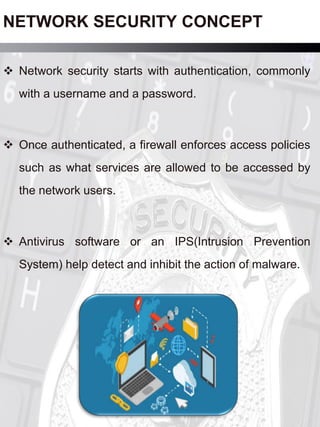
 Network security starts with authentication, commonly
with a username and a password.
 Once authenticated, a firewall enforces access policies
such as what services are allowed to be accessed by
the network users.
 Antivirus software or an IPS(Intrusion Prevention
System) help detect and inhibit the action of malware.
PRINCIPLES OF NETWORK SECURITY
 Confidentiality
 Authentication
 Integrity
 Non-repudiation
 Access Control
 Availability
CONFIDENTIALITY
 The principle of confidentiality specifies that only the sender
and the intended recipient be able to access the contents of
the message.
 Confidentiality gets compromised if and unauthorized person
is able to access the message.
 Interception attack causes loss of confidentiality.
 Only sender, intended receiver should understand message
contents.
AUTHENTICATION
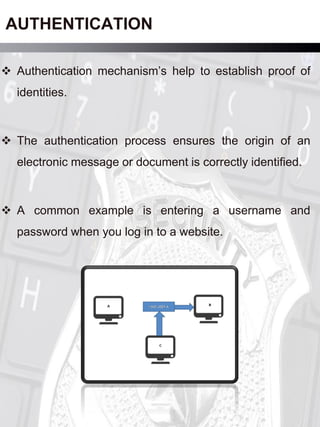
 Authentication mechanism’s help to establish proof of
identities.
 The authentication process ensures the origin of an
electronic message or document is correctly identified.
 A common example is entering a username and
password when you log in to a website.
INTEGRITY
 Integrity refers to methods of ensuring that data is real,
accurate and safeguard from unauthorized user
modification.
 When the contents of the message are changed after
the sender sends it, but before it reaches the intended
recipient, we say that the integrity of the message is
lost.
 Modification causes loss of integrity.
NON-REPUDIATION
 There are situations where a user sends a message
and later on refuses that she has sent the message.
 The principle of non-repudiation defeats such
possibilities of denying something, having done it.
 Non-repudiation does not allow the sender of a
message to refuse the claim of not sending that
message.
ACCESS CONTROL
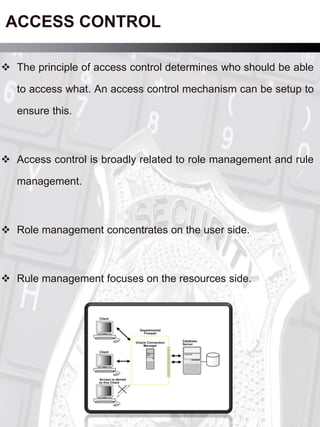
 The principle of access control determines who should be able
to access what. An access control mechanism can be setup to
ensure this.
 Access control is broadly related to role management and rule
management.
 Role management concentrates on the user side.
 Rule management focuses on the resources side.
AVAILABILITY
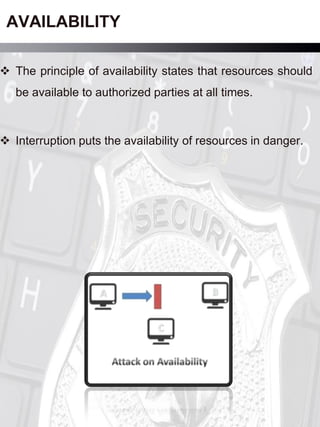
 The principle of availability states that resources should
be available to authorized parties at all times.
 Interruption puts the availability of resources in danger.
CONCLUSION
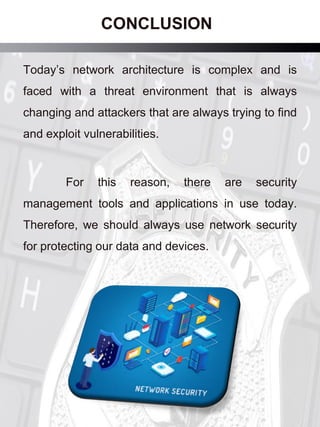
Today’s network architecture is complex and is
faced with a threat environment that is always
changing and attackers that are always trying to find
and exploit vulnerabilities.
For this reason, there are security
management tools and applications in use today.
Therefore, we should always use network security
for protecting our data and devices.
Thank You
Presented by
Aditi Patni
Bachelors Of Computer Application
Dezyne E’Cole College
WWW.dezyneecole.com

Presentation on Network Security

  • 1.
    Presented by Aditi Patni Bachelorsof Computer Applications – Second Year Dezyne E’Cole College, Ajmer
  • 2.
    Project report on NetworkSecurity Submitted To Dezyne E’Cole College Towards The Partial Fulfillment Of 2019 Year, Bachelor of Computer Application By Aditi Patni Dezyne E’Cole College 106/10, Civil Line, Ajmer www.dezyneecole.com
  • 3.
    Acknowledgement I am Aditipatni, Student of Bachelor of Computer Application, Dezyne E’Cole College. I would like express my gratitude to each and every person who has contributed in encouraging me and helping me to coordinate my project. I also thank Dezyne E’Cole College who provided insight and expertise that greatly assisted the project. A special thanks to my teachers, parents and colleagues who have supported me at every step. Not to forget, the almighty who blessed me with good health because of which I worked more efficiently and better.
  • 5.
    CONTENTS  What isa network?  Network security  Why do we need network security?  Controls of network security  Types of network security  Network security concept  Principles of network security  Conclusion
  • 6.
    WHAT IS ANETWORK?  In simple language, a computer network is a collection of computers/devices also known as nodes which are connected to each other in a certain pattern and can communicate with each other using some protocol.
  • 7.
    NETWORK SECURITY  Networksecurity consists of the policies and practices adopted to prevent and monitor unauthorized access, misuse, modification, or denial of a computer network and network accessible resources.  It secures the network, as well as protecting a network and overseeing operations has been done.  Network security covers a variety of computer networks, both public and private that are used in everyday jobs: conducting transactions and communications among business, government agencies and individuals.  It involves the authorization of access to data in a network which is controlled by the network administrator.  The most common and simple way of protecting a network resource is by assigning it a unique name and a corresponding password.
  • 8.
    WHY DO WENEED SECURITY?  To protect vital information like trade secrets, medical records etc.  Security against hackers and attackers.  To protect the information from loss and make it to be delivered to its destination properly.
  • 9.
    CONTROLS OF NETWORKSECURITY  PHYSICAL NETWORK SECURITY: These are designed to prevent unauthorized personnel, from gaining physical access to network components such as routers.  TECHNICAL NETWORK SECURITY: It protects data that is stored on the network or which is in transit across, into or out of the network.  ADMINISTRATIVE NETWORK SECURITY: It controls consist of security policies and processes that control user behaviour, including how users are authenticated their level of access.
  • 10.
    TYPES OF NETWORKSECURITY  NETWORK ACCESS CONTROL: It refers to security features that control who can access resources in an operating system. For example, you could grant administrators full access to the network but deny access to confidential folders or prevent their personal devices from joining the network.  ANTIVIRUS & ANTMALWARE SOFTWARE: They protect an organization from a range of malicious software, including viruses, worms and trojans.  FIREWALL PROTECTION: Firewall, as their name suggests act as a barrier between the untrusted external networks and your trusted internal networks.
  • 11.
  • 12.
    NETWORK SECURITY CONCEPT Network security starts with authentication, commonly with a username and a password.  Once authenticated, a firewall enforces access policies such as what services are allowed to be accessed by the network users.  Antivirus software or an IPS(Intrusion Prevention System) help detect and inhibit the action of malware.
  • 13.
    PRINCIPLES OF NETWORKSECURITY  Confidentiality  Authentication  Integrity  Non-repudiation  Access Control  Availability
  • 14.
    CONFIDENTIALITY  The principleof confidentiality specifies that only the sender and the intended recipient be able to access the contents of the message.  Confidentiality gets compromised if and unauthorized person is able to access the message.  Interception attack causes loss of confidentiality.  Only sender, intended receiver should understand message contents.
  • 15.
    AUTHENTICATION  Authentication mechanism’shelp to establish proof of identities.  The authentication process ensures the origin of an electronic message or document is correctly identified.  A common example is entering a username and password when you log in to a website.
  • 16.
    INTEGRITY  Integrity refersto methods of ensuring that data is real, accurate and safeguard from unauthorized user modification.  When the contents of the message are changed after the sender sends it, but before it reaches the intended recipient, we say that the integrity of the message is lost.  Modification causes loss of integrity.
  • 17.
    NON-REPUDIATION  There aresituations where a user sends a message and later on refuses that she has sent the message.  The principle of non-repudiation defeats such possibilities of denying something, having done it.  Non-repudiation does not allow the sender of a message to refuse the claim of not sending that message.
  • 18.
    ACCESS CONTROL  Theprinciple of access control determines who should be able to access what. An access control mechanism can be setup to ensure this.  Access control is broadly related to role management and rule management.  Role management concentrates on the user side.  Rule management focuses on the resources side.
  • 19.
    AVAILABILITY  The principleof availability states that resources should be available to authorized parties at all times.  Interruption puts the availability of resources in danger.
  • 20.
    CONCLUSION Today’s network architectureis complex and is faced with a threat environment that is always changing and attackers that are always trying to find and exploit vulnerabilities. For this reason, there are security management tools and applications in use today. Therefore, we should always use network security for protecting our data and devices.
  • 21.
    Thank You Presented by AditiPatni Bachelors Of Computer Application Dezyne E’Cole College WWW.dezyneecole.com