 GUTTEN MORGEN 
A Presentation on 3S module line
machines and there working in
brief….
By Krishnashis Banerjee
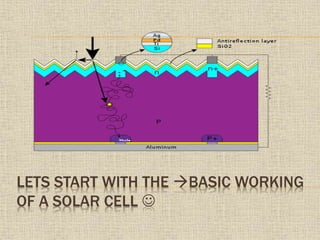
LETS START WITH THE BASIC WORKING
OF A SOLAR CELL 
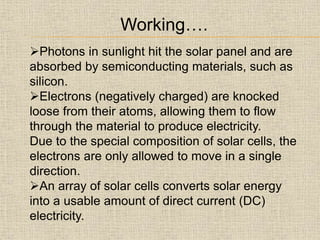
Photons in sunlight hit the solar panel and are
absorbed by semiconducting materials, such as
silicon.
Electrons (negatively charged) are knocked
loose from their atoms, allowing them to flow
through the material to produce electricity.
Due to the special composition of solar cells, the
electrons are only allowed to move in a single
direction.
An array of solar cells converts solar energy
into a usable amount of direct current (DC)
electricity.
Working….
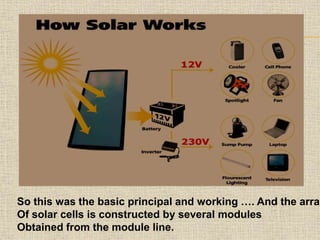
So this was the basic principal and working …. And the array
Of solar cells is constructed by several modules
Obtained from the module line.
SO WHAT DOES A MODULE LINE CONSISTS
OF????
STRINGER
LAY UP
LAMINATOR
MODULE TESTER
THIS IS THE LINE WE TERM AS MODULE
LINE SINCE WE OBTAIN A COMPLETE
MODULE FROM SILICON CELLS AS BASIC
RAW MATERIAL.
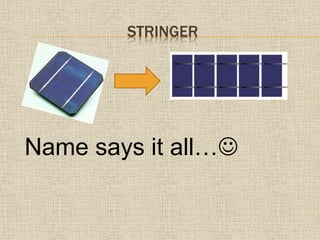
STRINGER
Name says it all…
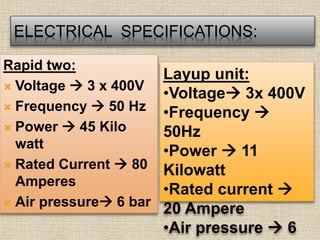
ELECTRICAL SPECIFICATIONS:
Rapid two:
 Voltage  3 x 400V
 Frequency  50 Hz
 Power  45 Kilo
watt
 Rated Current  80
Amperes
 Air pressure 6 bar
Layup unit:
•Voltage 3x 400V
•Frequency 
50Hz
•Power  11
Kilowatt
•Rated current 
20 Ampere
•Air pressure  6
TO BE MORE SPECIFIC ABOUT
STRINGER…..
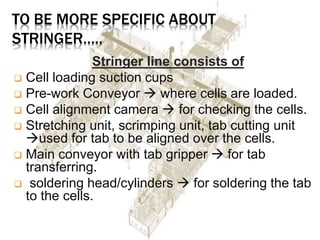
Stringer line consists of
 Cell loading suction cups
 Pre-work Conveyor  where cells are loaded.
 Cell alignment camera  for checking the cells.
 Stretching unit, scrimping unit, tab cutting unit
used for tab to be aligned over the cells.
 Main conveyor with tab gripper  for tab
transferring.
 soldering head/cylinders  for soldering the tab
to the cells.
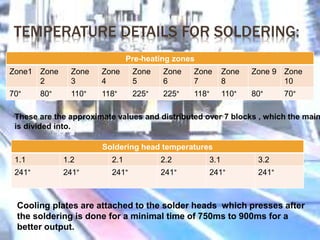
TEMPERATURE DETAILS FOR SOLDERING:
Pre-heating zones
Zone1 Zone
2
Zone
3
Zone
4
Zone
5
Zone
6
Zone
7
Zone
8
Zone 9 Zone
10
70° 80° 110° 118° 225° 225° 118° 110° 80° 70°
These are the approximate values and distributed over 7 blocks , which the main
is divided into.
Soldering head temperatures
1.1 1.2 2.1 2.2 3.1 3.2
241° 241° 241° 241° 241° 241°
Cooling plates are attached to the solder heads which presses after
the soldering is done for a minimal time of 750ms to 900ms for a
better output.
LAY UP
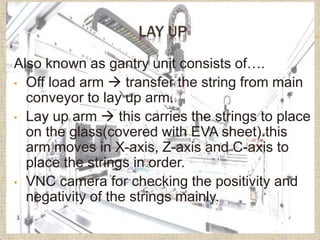
Also known as gantry unit consists of….
• Off load arm  transfer the string from main
conveyor to lay up arm.
• Lay up arm  this carries the strings to place
on the glass(covered with EVA sheet).this
arm moves in X-axis, Z-axis and C-axis to
place the strings in order.
• VNC camera for checking the positivity and
negativity of the strings mainly.
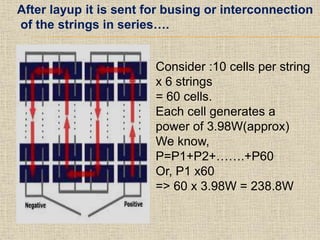
After layup it is sent for busing or interconnection
of the strings in series….
Consider :10 cells per string
x 6 strings
= 60 cells.
Each cell generates a
power of 3.98W(approx)
We know,
P=P1+P2+…….+P60
Or, P1 x60
=> 60 x 3.98W = 238.8W
LAMINATOR
Once the panel comes out from stringer, layup
line and inter-connection of the strings are
done, it’s sent for lamination.
Which is making a compact module toughened
to last longer and hence increases life.
ELECTRICAL SPECIFICATIONS:
Voltage  3 x 400V
Frequency  50 Hz
Power  175 Kilo watt
Rated Current  180 Amperes
Max- pre fuse current  200 Amperes
WHAT DOES IT BASICALLY INCLUDES????
Heating
chamber
Oil pump
chamber
Heating
chamber
Oil pump
chamber
Cooling
chamber
Laminator line
And What makes it unique is----- the medium of
heating the chambers is oil….which gives a uniform
heating and less chances of problems .
RECIPE:
So for running modules with different glass type
we need to prepare recipe, where the following
parameters are required to be set accordingly
 Temperature
 Pin up and pin down time
 Pressing time
 Pressure
 Venting rate
After feeding the recipe the process is started
 once the set temperature is reached the
modules are released from the transport
conveyor.
LAMINATOR CHAMBER’S WORKING….
Heating chamber 1:
 The modules settles on the heating plate ---
at this point upper chamber pressure is 0 bar
and lower chamber pressure is 1 bar.
 The glass sits on pins (pin up)--- at the same
time the lower chamber starts evacuating.
 Suction starts from both upper as well as
lower chamber.
 This continues for 360 seconds(on the basis
of raw material) as per recipe.
CONTINUES…. FOR HEATING CHAMBER 1:
 Next pins are down but suction is on for
lower chamber, for upper chamber
pressure starts increasing to 1bar and
pressing takes place.
 This continues for 120seconds(on the
basis of raw mat.)
LAMINATOR CHAMBER’S WORKING….
CONTINUED…
Heating chamber 2:
 Once the above process is over module moves on
from 1st heating chamber to 2nd.
 Here the only difference is that, no pin-up position
is there.
 In this chamber, the complete 480 seconds(pin up+
pressing time + sync. time) the upper chamber
presses and the suction takes place in lower
chamber.
 After this the module moves into the cooling
chamber.
[note: the pressure is applied by the membrane fixed
to the upper chamber]
LAMINATOR CHAMBER’S WORKING….
CONTINUED…
Cooling chamber:
 In this chamber the modules in hot state are
passed in.
 Water acts as coolant and atmospheric air and
ventilator fans enhance in keeping the water cooler.
 Hence the coolant is circulated through grids in
both upper and lower section which presses the
module thereby absorbs the temperature by the
process of convection.
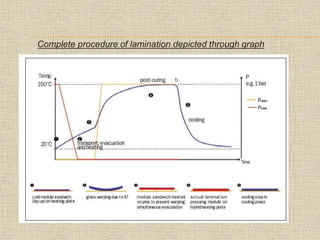
Complete procedure of lamination depicted through graph
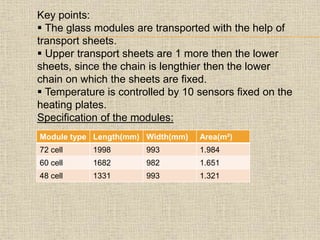
Key points:
 The glass modules are transported with the help of
transport sheets.
 Upper transport sheets are 1 more then the lower
sheets, since the chain is lengthier then the lower
chain on which the sheets are fixed.
 Temperature is controlled by 10 sensors fixed on the
heating plates.
Specification of the modules:
Module type Length(mm) Width(mm) Area(m²)
72 cell 1998 993 1.984
60 cell 1682 982 1.651
48 cell 1331 993 1.321
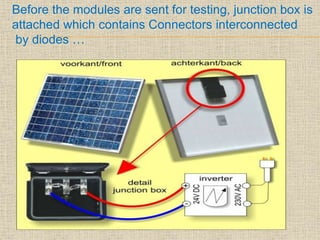
Before the modules are sent for testing, junction box is
attached which contains Connectors interconnected
by diodes …
WHAT IS MODULE TESTER??
The testing unit for the
solar modules…
It collects the feedback
about the module and help
us analyze the state of it…
ELECTRICAL SPECIFICATIONS:
Voltage  1Ф 230V
Frequency  50Hz
Power  3.68 kilo watt
Rated Current  16 Amperes
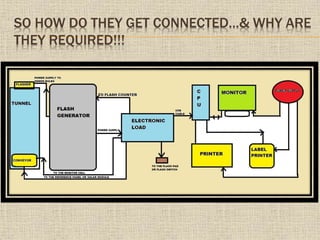
WHAT DOES THE PASAN MODULE TESTER
CONSISTS OF!!!
 A Tunnel.
 Two xenon bulbs of 50LM/ watt .
 A monitor cell.
 Computer system.
 Electronic load.
 Flash generator .
 Printer.
 Label printer .
SO HOW DO THEY GET CONNECTED…& WHY ARE
THEY REQUIRED!!!
FUNCTIONS FOR EACH CAN BE STATED AS
BELOW
A monitor cell fixed for collecting the data and transferring
the same to the electronic load.(defined below)
Computer system for storing the data and providing the
visual output.
Electronic load collects the measurement data from the
module or rather from the monitor cell and does the
calculation for various parameters to further feed it to the
system.
Printer for obtaining printout of the performance
measurement values for each solar module tested.
Label printer for providing a brief quotation about the
measurements obtained (especially for the customers
purchasing the modules.)
Flash generator this supplies power for the xenon bulb and
signal to the electronic load.
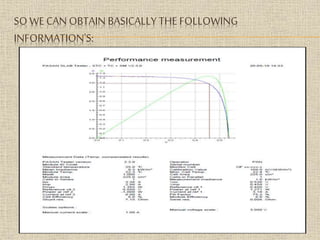
SO WE CAN OBTAIN BASICALLY THE FOLLOWING
INFORMATION'S:
ANDHENCETHISISOURMAIN AIM….
GUIDINGOURCOUNTRYTOWARDSABRIGHT
FUTURE..
FREQUENTLY ASKED QUESTIONS:
Q. Area required for the module line?
A: basically 2000m² for 25MW line and 3500m² for 65MW line.
Q. What is the average cell breakage rate per day?
A: for 180micron cells the breakage rate is 0.2 to 0.3/day. When
using cells of less thickness breakage rate is around 0.5/per
day.
Q. What is the Laminator heating plate area?
A: 2200 x 3600 mm².
Q. Calculation procedure for 25MW line?
A: 22.5Hrs/day x 16 modules/hr (960 cells) x 4watts/cell average
x 293 days(excluding Sundays and 20 national holidays) =
25.31 MW.
Q. Why are diodes used in junction box?
A: For creating bypass routes for the flow of power in case one
Q. How many modules of 60 cells , 72 cells and 48 cells
can be sent into the laminator for one cycle?
A: For 60 cells & 48 cells = 4 modules ; For 72 cells = 3
modules .
Can be calculated from the size of the glass and
laminator heating plate accordingly.
Q. Cell capacity for rapid two stringer per hour?
A: for rapid two cell loading per hour is 1200cells, for
rapid four it is 2400 cells per hour.
Q. Is it possible to install air condition inside PASAN
tunnel?
A: No obstacles can be installed in the tunnel.
Q. Will RFID data software be provided by PASAN?
A: currently a feature they do support.
Frequentlyasked questions continued…
A WARM THANKS FOR ALL YOUR ATTENTION…
any questions…..please!

Presentation on module line

  • 1.
     GUTTEN MORGEN A Presentation on 3S module line machines and there working in brief…. By Krishnashis Banerjee
  • 2.
    LETS START WITHTHE BASIC WORKING OF A SOLAR CELL 
  • 3.
    Photons in sunlighthit the solar panel and are absorbed by semiconducting materials, such as silicon. Electrons (negatively charged) are knocked loose from their atoms, allowing them to flow through the material to produce electricity. Due to the special composition of solar cells, the electrons are only allowed to move in a single direction. An array of solar cells converts solar energy into a usable amount of direct current (DC) electricity. Working….
  • 4.
    So this wasthe basic principal and working …. And the array Of solar cells is constructed by several modules Obtained from the module line.
  • 5.
    SO WHAT DOESA MODULE LINE CONSISTS OF???? STRINGER LAY UP LAMINATOR MODULE TESTER THIS IS THE LINE WE TERM AS MODULE LINE SINCE WE OBTAIN A COMPLETE MODULE FROM SILICON CELLS AS BASIC RAW MATERIAL.
  • 6.
  • 7.
    ELECTRICAL SPECIFICATIONS: Rapid two: Voltage  3 x 400V  Frequency  50 Hz  Power  45 Kilo watt  Rated Current  80 Amperes  Air pressure 6 bar Layup unit: •Voltage 3x 400V •Frequency  50Hz •Power  11 Kilowatt •Rated current  20 Ampere •Air pressure  6
  • 8.
    TO BE MORESPECIFIC ABOUT STRINGER….. Stringer line consists of  Cell loading suction cups  Pre-work Conveyor  where cells are loaded.  Cell alignment camera  for checking the cells.  Stretching unit, scrimping unit, tab cutting unit used for tab to be aligned over the cells.  Main conveyor with tab gripper  for tab transferring.  soldering head/cylinders  for soldering the tab to the cells.
  • 9.
    TEMPERATURE DETAILS FORSOLDERING: Pre-heating zones Zone1 Zone 2 Zone 3 Zone 4 Zone 5 Zone 6 Zone 7 Zone 8 Zone 9 Zone 10 70° 80° 110° 118° 225° 225° 118° 110° 80° 70° These are the approximate values and distributed over 7 blocks , which the main is divided into. Soldering head temperatures 1.1 1.2 2.1 2.2 3.1 3.2 241° 241° 241° 241° 241° 241° Cooling plates are attached to the solder heads which presses after the soldering is done for a minimal time of 750ms to 900ms for a better output.
  • 10.
    LAY UP Also knownas gantry unit consists of…. • Off load arm  transfer the string from main conveyor to lay up arm. • Lay up arm  this carries the strings to place on the glass(covered with EVA sheet).this arm moves in X-axis, Z-axis and C-axis to place the strings in order. • VNC camera for checking the positivity and negativity of the strings mainly.
  • 11.
    After layup itis sent for busing or interconnection of the strings in series…. Consider :10 cells per string x 6 strings = 60 cells. Each cell generates a power of 3.98W(approx) We know, P=P1+P2+…….+P60 Or, P1 x60 => 60 x 3.98W = 238.8W
  • 12.
    LAMINATOR Once the panelcomes out from stringer, layup line and inter-connection of the strings are done, it’s sent for lamination. Which is making a compact module toughened to last longer and hence increases life.
  • 13.
    ELECTRICAL SPECIFICATIONS: Voltage 3 x 400V Frequency  50 Hz Power  175 Kilo watt Rated Current  180 Amperes Max- pre fuse current  200 Amperes
  • 14.
    WHAT DOES ITBASICALLY INCLUDES???? Heating chamber Oil pump chamber Heating chamber Oil pump chamber Cooling chamber Laminator line And What makes it unique is----- the medium of heating the chambers is oil….which gives a uniform heating and less chances of problems .
  • 15.
    RECIPE: So for runningmodules with different glass type we need to prepare recipe, where the following parameters are required to be set accordingly  Temperature  Pin up and pin down time  Pressing time  Pressure  Venting rate After feeding the recipe the process is started  once the set temperature is reached the modules are released from the transport conveyor.
  • 16.
    LAMINATOR CHAMBER’S WORKING…. Heatingchamber 1:  The modules settles on the heating plate --- at this point upper chamber pressure is 0 bar and lower chamber pressure is 1 bar.  The glass sits on pins (pin up)--- at the same time the lower chamber starts evacuating.  Suction starts from both upper as well as lower chamber.  This continues for 360 seconds(on the basis of raw material) as per recipe.
  • 17.
    CONTINUES…. FOR HEATINGCHAMBER 1:  Next pins are down but suction is on for lower chamber, for upper chamber pressure starts increasing to 1bar and pressing takes place.  This continues for 120seconds(on the basis of raw mat.)
  • 18.
    LAMINATOR CHAMBER’S WORKING…. CONTINUED… Heatingchamber 2:  Once the above process is over module moves on from 1st heating chamber to 2nd.  Here the only difference is that, no pin-up position is there.  In this chamber, the complete 480 seconds(pin up+ pressing time + sync. time) the upper chamber presses and the suction takes place in lower chamber.  After this the module moves into the cooling chamber. [note: the pressure is applied by the membrane fixed to the upper chamber]
  • 19.
    LAMINATOR CHAMBER’S WORKING…. CONTINUED… Coolingchamber:  In this chamber the modules in hot state are passed in.  Water acts as coolant and atmospheric air and ventilator fans enhance in keeping the water cooler.  Hence the coolant is circulated through grids in both upper and lower section which presses the module thereby absorbs the temperature by the process of convection.
  • 20.
    Complete procedure oflamination depicted through graph
  • 21.
    Key points:  Theglass modules are transported with the help of transport sheets.  Upper transport sheets are 1 more then the lower sheets, since the chain is lengthier then the lower chain on which the sheets are fixed.  Temperature is controlled by 10 sensors fixed on the heating plates. Specification of the modules: Module type Length(mm) Width(mm) Area(m²) 72 cell 1998 993 1.984 60 cell 1682 982 1.651 48 cell 1331 993 1.321
  • 22.
    Before the modulesare sent for testing, junction box is attached which contains Connectors interconnected by diodes …
  • 23.
    WHAT IS MODULETESTER?? The testing unit for the solar modules… It collects the feedback about the module and help us analyze the state of it…
  • 24.
    ELECTRICAL SPECIFICATIONS: Voltage 1Ф 230V Frequency  50Hz Power  3.68 kilo watt Rated Current  16 Amperes
  • 25.
    WHAT DOES THEPASAN MODULE TESTER CONSISTS OF!!!  A Tunnel.  Two xenon bulbs of 50LM/ watt .  A monitor cell.  Computer system.  Electronic load.  Flash generator .  Printer.  Label printer .
  • 26.
    SO HOW DOTHEY GET CONNECTED…& WHY ARE THEY REQUIRED!!!
  • 27.
    FUNCTIONS FOR EACHCAN BE STATED AS BELOW A monitor cell fixed for collecting the data and transferring the same to the electronic load.(defined below) Computer system for storing the data and providing the visual output. Electronic load collects the measurement data from the module or rather from the monitor cell and does the calculation for various parameters to further feed it to the system. Printer for obtaining printout of the performance measurement values for each solar module tested. Label printer for providing a brief quotation about the measurements obtained (especially for the customers purchasing the modules.) Flash generator this supplies power for the xenon bulb and signal to the electronic load.
  • 28.
    SO WE CANOBTAIN BASICALLY THE FOLLOWING INFORMATION'S:
  • 29.
  • 30.
    FREQUENTLY ASKED QUESTIONS: Q.Area required for the module line? A: basically 2000m² for 25MW line and 3500m² for 65MW line. Q. What is the average cell breakage rate per day? A: for 180micron cells the breakage rate is 0.2 to 0.3/day. When using cells of less thickness breakage rate is around 0.5/per day. Q. What is the Laminator heating plate area? A: 2200 x 3600 mm². Q. Calculation procedure for 25MW line? A: 22.5Hrs/day x 16 modules/hr (960 cells) x 4watts/cell average x 293 days(excluding Sundays and 20 national holidays) = 25.31 MW. Q. Why are diodes used in junction box? A: For creating bypass routes for the flow of power in case one
  • 31.
    Q. How manymodules of 60 cells , 72 cells and 48 cells can be sent into the laminator for one cycle? A: For 60 cells & 48 cells = 4 modules ; For 72 cells = 3 modules . Can be calculated from the size of the glass and laminator heating plate accordingly. Q. Cell capacity for rapid two stringer per hour? A: for rapid two cell loading per hour is 1200cells, for rapid four it is 2400 cells per hour. Q. Is it possible to install air condition inside PASAN tunnel? A: No obstacles can be installed in the tunnel. Q. Will RFID data software be provided by PASAN? A: currently a feature they do support. Frequentlyasked questions continued…
  • 32.
    A WARM THANKSFOR ALL YOUR ATTENTION… any questions…..please!