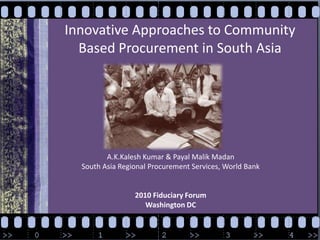
Innovative Approaches to Community  Based Procurement in South AsiaA.K.Kalesh Kumar & Payal Malik MadanSouth Asia Regional Procurement Services, World Bank2010 Fiduciary ForumWashington DC
BackgroundBased on a  2009 study sponsoredBy WB-Norwegian GovernanceTrust Fund in 3 CDD Projects and one Local Self Government System in India, and Outcomes of a South Asia Regional Workshop on “ Community Based Procurement: Learning from Field” organised  in New Delhi, India in October 2009
Structure of PresentationPart I-  Findings on Procurement Performance     and Enabling FactorsPart II- Innovations in Community Based     Procurement identified by the studyPart III- Panel shares experiences and     open session for questions
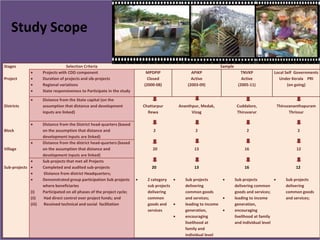
Study Scope
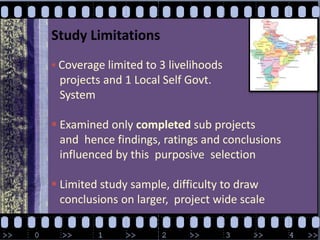
Study LimitationsCoverage limited to 3 livelihoods    projects and 1 Local Self Govt.    System Examined only completed sub projects    and  hence findings, ratings and conclusions    influenced by this  purposive  selection  Limited study sample, difficulty to draw    conclusions on larger,  project wide scale
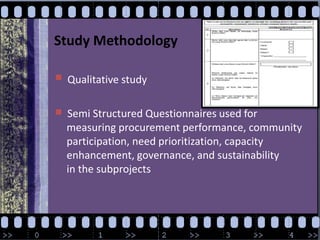
Study MethodologyQualitative studySemi Structured Questionnaires used for              measuring procurement performance, community              participation, need prioritization, capacity              enhancement, governance, and sustainability      in the subprojects
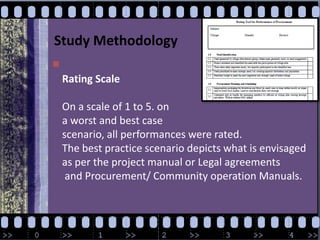
Study MethodologyRating Scale On a scale of 1 to 5. on a worst and best case scenario, all performances were rated. The best practice scenario depicts what is envisaged as per the project manual or Legal agreementsand Procurement/ Community operation Manuals.
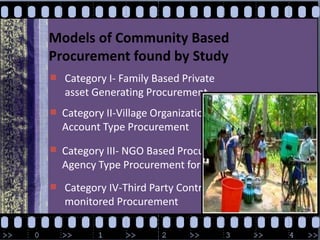
Models of Community Based Procurement found by StudyCategory I- Family Based Private asset Generating ProcurementCategory II-Village Organization Based Force Account Type ProcurementCategory III- NGO Based Procurement Support Agency Type Procurement for CDD ImplementationCategory IV-Third Party Contracted but community monitored Procurementwww.CDD detailswww.CBP details
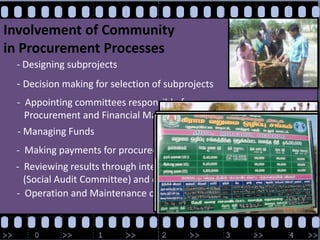
Involvement of Community in Procurement Processes- Designing subprojects  - Decision making for selection of subprojects   Appointing committees responsible for    Procurement and Financial Management- Managing Funds -  Making payments for procured items Reviewing results through internal    (Social Audit Committee) and external audits. -  Operation and Maintenance of Subproject
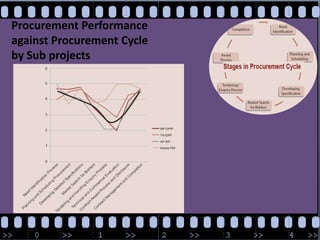
Procurement Performance against Procurement Cycle by Sub projects
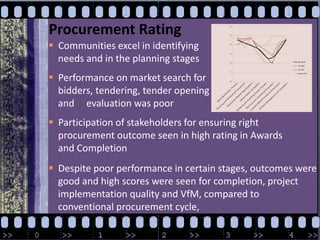
Procurement RatingCommunities excel in identifying  needs and in the planning stages  Performance on market search for     bidders, tendering, tender opening     and     evaluation was poor  Participation of stakeholders for ensuring right     procurement outcome seen in high rating in Awards     and Completion   Despite poor performance in certain stages, outcomes were     good and high scores were seen for completion, project      implementation quality and VfM, compared to     conventional procurement cycle,
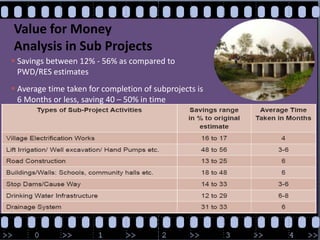
Value for Money Analysis in Sub ProjectsSavings between 12% - 56% as compared to  PWD/RES estimates Average time taken for completion of subprojects is    6 Months or less, saving 40 – 50% in time
How CBP Delivers VfM and Successful OutcomesFor the most part, no contractors were involved-  resulted in savings of profits and some of the taxes   Savings in costs generated through efficient use of     raw material  through timely delivery, reducing     waste and saving on storage costs, volunteer    community labor and labor at lower than market     rates Practice of Relationship Based Procurement  lead to further saving and post implementation support
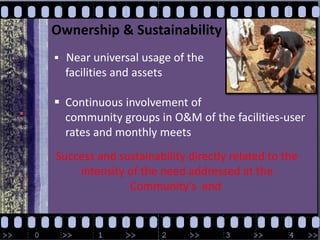
Ownership & SustainabilityNear universal usage of the     facilities and assets   Continuous involvement of     community groups in O&M of the facilities-user     rates and monthly meetsSuccess and sustainability directly related to the  intensity of the need addressed at the Community’s  end
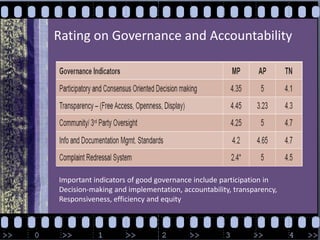
Rating on Governance and Accountability Important indicators of good governance include participation in Decision-making and implementation, accountability, transparency,Responsiveness, efficiency and equity
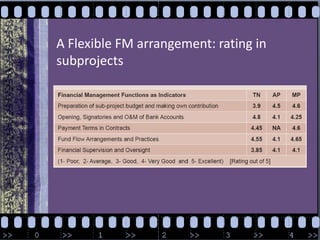
A Flexible FM arrangement: rating in subprojects
Findings on Financial Management ArrangementFunds were directly channeled into the hands of     communities with a strong emphasis on information     disclosure and transparency especially for project     budgets, contracting and procurement  Broad categories of funds were made available and     communities could use their discretion to make     consensual investments   To generate cost savings, improve ownership and     accountability communities were expected to contribute     a fixed share of the project cost.
Findings onFinancial Management ArrangementFunds were disbursed in multiple tranches upon     completion of milestones.  Other than external audits, local level finance and audit     committees constituting community beneficiaries     verified utilization. These arrangements have instilled confidence and     built Community  capacity to regulate fund flow, plan,     budget and procure to manage Sound credit management     and access to credit from banks
Enabling Factorsan effective entry point activity  for gaining confidence of the target poor
use of participatory tools in target group identification - use of positive discrimination measures like mandated membership of women in decision making bodiesensuring most strategic need for the group as a whole is prioritized
 choosing a good facilitation team
 intensive capacity building of the beneficiaries
 ensuring consensual decision making in procurement and financial management - free access to information, documentation and record keeping for the group, families and village
20PART IIInnovations in Community Based Procurement
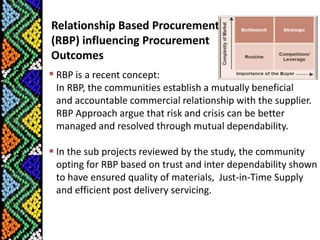
Relationship Based Procurement (RBP) influencing Procurement Outcomes RBP is a recent concept: In RBP, the communities establish a mutually beneficial   and accountable commercial relationship with the supplier. RBP Approach argue that risk and crisis can be better   managed and resolved through mutual dependability.   In the sub projects reviewed by the study, the community   opting for RBP based on trust and inter dependability shown   to have ensured quality of materials,  Just-in-Time Supply   and efficient post delivery servicing.
RBP in Action…Working with Suppliers to Achieve Innovative and Cost Effective SolutionsSome 100 kms. away from district head quarters, the only available resources available in Obari are  the natural resources: the river, land and forestAs part MPDPIP, the income generation activity for SHG planned was:using the river water for irrigation of the surrounding lands. However, the challenges were, fields were at a height of 6 meters and 1.5 km away from the river.SHG approached vendors with this unique requirement. Among 3 Suppliers approached,  Sanjay Agrico, the villagers took the challenge of assembling pump manufactured by Greaves and rail pipes manufactured by Reliance.
RBP in Action… Working with Suppliers to Achieve Innovative and Cost Effective SolutionsThe pump failed on the day of 	inauguration! Supplier through in-house 	R&D came up with another solution which was a modified 	auto rickshaw engine which had the capacity to pump the 	water up to the needed height. Surprisingly, this unconventional 	solution worked!	The SHG had successfully implemented the work with nearly 	a 50% cost savings, passed on by Supplier (RBP working!) and 	the Supplier had created a credible market where private 	individuals are opting for their innovative solution, not a 	registered trade mark (again RBP at work!)
RBP in Action… A Buy Back Arrangement Delivering VfM for Silk WeaversMahan Laxmi SHG started the livelihoods initiative by extending $100 loans to 15 poor women members of the village depended on their household loomsThe next big step was SHG deciding to join Silk Federation Group. “…there was resource mapping done in the village and we decided to federate as group to work for ourselves and not for theMuddalali (Moneylender)…”who first loaned money to the poor to buy raw material  from him and then bought back their produce for servicing the interest on the original loan!As some members wanted the traditional machines, and others the Jacobean ones, SHG did a market survey to get rate estimates to guide the members for these individual purchases. A manufacturer of machinesand yarn was identified through this process.
in Action… A Buy Back Arrangement Delivering VfM for Silk WeaversRBPOffer to procure yarn in bulk and directing new members for machines  were the negotiation points for SHGA weekly run of service mechanic, free oil and servicing and delivery of yarn at door step were the counter offers from the supplierA 30% savings on cost of yarn and the good manners of the supplier and service mechanic resulted in an instant establishment of Relationship Based ProcurementSHG has proudly announced that they supply to 2 leading Silk Saree Show Rooms in Chennai- Chennai Silks and Mudra Sons- another spin off from the good business SHG had offered the Supplier…And the Procurement Committee still travels to the city- Trichy every month to verify the rates!!
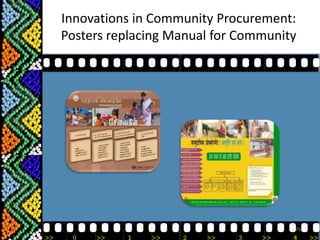
26Innovations in Community Procurement:Posters replacing Manual for Community
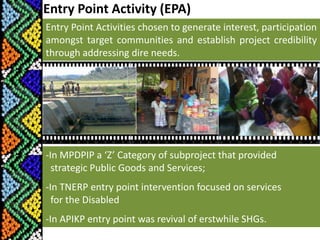
Entry Point Activity (EPA)Entry Point Activities chosen to generate interest, participation amongst target communities and establish project credibility through addressing dire needs.-In MPDPIP a ‘Z’ Category of subproject that provided   strategic Public Goods and Services;-In TNERP entry point intervention focused on services   for the Disabled-In APIKP entry point was revival of erstwhile SHGs.
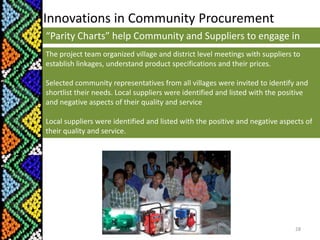
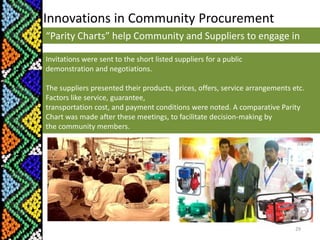
Innovations in Community Procurement“Parity Charts” help Community and Suppliers to engage in28The project team organized village and district level meetings with suppliers to establish linkages, understand product specifications and their prices.Selected community representatives from all villages were invited to identify and shortlist their needs. Local suppliers were identified and listed with the positive and negative aspects of their quality and serviceLocal suppliers were identified and listed with the positive and negative aspects of their quality and service.

Presentation on Innovations in Community Based Procurement

  • 1.
    Innovative Approaches toCommunity Based Procurement in South AsiaA.K.Kalesh Kumar & Payal Malik MadanSouth Asia Regional Procurement Services, World Bank2010 Fiduciary ForumWashington DC
  • 2.
    BackgroundBased on a 2009 study sponsoredBy WB-Norwegian GovernanceTrust Fund in 3 CDD Projects and one Local Self Government System in India, and Outcomes of a South Asia Regional Workshop on “ Community Based Procurement: Learning from Field” organised in New Delhi, India in October 2009
  • 3.
    Structure of PresentationPartI- Findings on Procurement Performance and Enabling FactorsPart II- Innovations in Community Based Procurement identified by the studyPart III- Panel shares experiences and open session for questions
  • 4.
  • 5.
    Study LimitationsCoverage limitedto 3 livelihoods projects and 1 Local Self Govt. System Examined only completed sub projects and hence findings, ratings and conclusions influenced by this purposive selection Limited study sample, difficulty to draw conclusions on larger, project wide scale
  • 6.
    Study MethodologyQualitative studySemiStructured Questionnaires used for measuring procurement performance, community participation, need prioritization, capacity enhancement, governance, and sustainability in the subprojects
  • 7.
    Study MethodologyRating ScaleOn a scale of 1 to 5. on a worst and best case scenario, all performances were rated. The best practice scenario depicts what is envisaged as per the project manual or Legal agreementsand Procurement/ Community operation Manuals.
  • 8.
    Models of CommunityBased Procurement found by StudyCategory I- Family Based Private asset Generating ProcurementCategory II-Village Organization Based Force Account Type ProcurementCategory III- NGO Based Procurement Support Agency Type Procurement for CDD ImplementationCategory IV-Third Party Contracted but community monitored Procurementwww.CDD detailswww.CBP details
  • 9.
    Involvement of Communityin Procurement Processes- Designing subprojects - Decision making for selection of subprojects Appointing committees responsible for Procurement and Financial Management- Managing Funds - Making payments for procured items Reviewing results through internal (Social Audit Committee) and external audits. - Operation and Maintenance of Subproject
  • 10.
    Procurement Performance againstProcurement Cycle by Sub projects
  • 11.
    Procurement RatingCommunities excelin identifying needs and in the planning stages Performance on market search for bidders, tendering, tender opening and evaluation was poor Participation of stakeholders for ensuring right procurement outcome seen in high rating in Awards and Completion Despite poor performance in certain stages, outcomes were good and high scores were seen for completion, project implementation quality and VfM, compared to conventional procurement cycle,
  • 12.
    Value for MoneyAnalysis in Sub ProjectsSavings between 12% - 56% as compared to PWD/RES estimates Average time taken for completion of subprojects is 6 Months or less, saving 40 – 50% in time
  • 13.
    How CBP DeliversVfM and Successful OutcomesFor the most part, no contractors were involved- resulted in savings of profits and some of the taxes Savings in costs generated through efficient use of raw material through timely delivery, reducing waste and saving on storage costs, volunteer community labor and labor at lower than market rates Practice of Relationship Based Procurement lead to further saving and post implementation support
  • 14.
    Ownership & SustainabilityNearuniversal usage of the facilities and assets Continuous involvement of community groups in O&M of the facilities-user rates and monthly meetsSuccess and sustainability directly related to the intensity of the need addressed at the Community’s end
  • 15.
    Rating on Governanceand Accountability Important indicators of good governance include participation in Decision-making and implementation, accountability, transparency,Responsiveness, efficiency and equity
  • 16.
    A Flexible FMarrangement: rating in subprojects
  • 17.
    Findings on FinancialManagement ArrangementFunds were directly channeled into the hands of communities with a strong emphasis on information disclosure and transparency especially for project budgets, contracting and procurement Broad categories of funds were made available and communities could use their discretion to make consensual investments To generate cost savings, improve ownership and accountability communities were expected to contribute a fixed share of the project cost.
  • 18.
    Findings onFinancial ManagementArrangementFunds were disbursed in multiple tranches upon completion of milestones. Other than external audits, local level finance and audit committees constituting community beneficiaries verified utilization. These arrangements have instilled confidence and built Community capacity to regulate fund flow, plan, budget and procure to manage Sound credit management and access to credit from banks
  • 19.
    Enabling Factorsan effectiveentry point activity for gaining confidence of the target poor
  • 20.
    use of participatorytools in target group identification - use of positive discrimination measures like mandated membership of women in decision making bodiesensuring most strategic need for the group as a whole is prioritized
  • 21.
    choosing agood facilitation team
  • 22.
    intensive capacitybuilding of the beneficiaries
  • 23.
    ensuring consensualdecision making in procurement and financial management - free access to information, documentation and record keeping for the group, families and village
  • 24.
    20PART IIInnovations inCommunity Based Procurement
  • 25.
    Relationship Based Procurement(RBP) influencing Procurement Outcomes RBP is a recent concept: In RBP, the communities establish a mutually beneficial and accountable commercial relationship with the supplier. RBP Approach argue that risk and crisis can be better managed and resolved through mutual dependability. In the sub projects reviewed by the study, the community opting for RBP based on trust and inter dependability shown to have ensured quality of materials, Just-in-Time Supply and efficient post delivery servicing.
  • 26.
    RBP in Action…Workingwith Suppliers to Achieve Innovative and Cost Effective SolutionsSome 100 kms. away from district head quarters, the only available resources available in Obari are the natural resources: the river, land and forestAs part MPDPIP, the income generation activity for SHG planned was:using the river water for irrigation of the surrounding lands. However, the challenges were, fields were at a height of 6 meters and 1.5 km away from the river.SHG approached vendors with this unique requirement. Among 3 Suppliers approached, Sanjay Agrico, the villagers took the challenge of assembling pump manufactured by Greaves and rail pipes manufactured by Reliance.
  • 27.
    RBP in Action…Working with Suppliers to Achieve Innovative and Cost Effective SolutionsThe pump failed on the day of inauguration! Supplier through in-house R&D came up with another solution which was a modified auto rickshaw engine which had the capacity to pump the water up to the needed height. Surprisingly, this unconventional solution worked! The SHG had successfully implemented the work with nearly a 50% cost savings, passed on by Supplier (RBP working!) and the Supplier had created a credible market where private individuals are opting for their innovative solution, not a registered trade mark (again RBP at work!)
  • 28.
    RBP in Action…A Buy Back Arrangement Delivering VfM for Silk WeaversMahan Laxmi SHG started the livelihoods initiative by extending $100 loans to 15 poor women members of the village depended on their household loomsThe next big step was SHG deciding to join Silk Federation Group. “…there was resource mapping done in the village and we decided to federate as group to work for ourselves and not for theMuddalali (Moneylender)…”who first loaned money to the poor to buy raw material from him and then bought back their produce for servicing the interest on the original loan!As some members wanted the traditional machines, and others the Jacobean ones, SHG did a market survey to get rate estimates to guide the members for these individual purchases. A manufacturer of machinesand yarn was identified through this process.
  • 29.
    in Action… ABuy Back Arrangement Delivering VfM for Silk WeaversRBPOffer to procure yarn in bulk and directing new members for machines were the negotiation points for SHGA weekly run of service mechanic, free oil and servicing and delivery of yarn at door step were the counter offers from the supplierA 30% savings on cost of yarn and the good manners of the supplier and service mechanic resulted in an instant establishment of Relationship Based ProcurementSHG has proudly announced that they supply to 2 leading Silk Saree Show Rooms in Chennai- Chennai Silks and Mudra Sons- another spin off from the good business SHG had offered the Supplier…And the Procurement Committee still travels to the city- Trichy every month to verify the rates!!
  • 30.
    26Innovations in CommunityProcurement:Posters replacing Manual for Community
  • 31.
    Entry Point Activity(EPA)Entry Point Activities chosen to generate interest, participation amongst target communities and establish project credibility through addressing dire needs.-In MPDPIP a ‘Z’ Category of subproject that provided strategic Public Goods and Services;-In TNERP entry point intervention focused on services for the Disabled-In APIKP entry point was revival of erstwhile SHGs.
  • 32.
    Innovations in CommunityProcurement“Parity Charts” help Community and Suppliers to engage in28The project team organized village and district level meetings with suppliers to establish linkages, understand product specifications and their prices.Selected community representatives from all villages were invited to identify and shortlist their needs. Local suppliers were identified and listed with the positive and negative aspects of their quality and serviceLocal suppliers were identified and listed with the positive and negative aspects of their quality and service.