 Economic activity concerned with the processing of raw
materials and manufacture of goods in factories.
 The process by which an economy is transformed from
primarily agricultural to one based on the manufacturing of
goods.
 Individual manual labor replaced by machine
 Craftsmen replaced by assembly lines
 Economic growth
 More efficient division of labor
 The use of technological innovation to solve problems
 Reduce dependency human control.
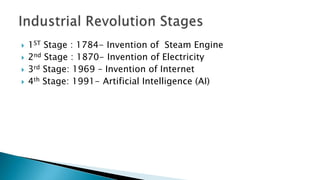
 1ST Stage : 1784- Invention of Steam Engine
 2nd Stage : 1870- Invention of Electricity
 3rd Stage: 1969 – Invention of Internet
 4th Stage: 1991- Artificial Intelligence (AI)
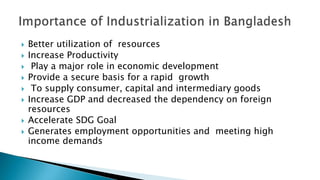
 Better utilization of resources
 Increase Productivity
 Play a major role in economic development
 Provide a secure basis for a rapid growth
 To supply consumer, capital and intermediary goods
 Increase GDP and decreased the dependency on foreign
resources
 Accelerate SDG Goal
 Generates employment opportunities and meeting high
income demands
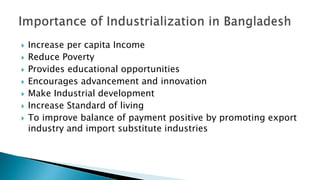
 Increase per capita Income
 Reduce Poverty
 Provides educational opportunities
 Encourages advancement and innovation
 Make Industrial development
 Increase Standard of living
 To improve balance of payment positive by promoting export
industry and import substitute industries
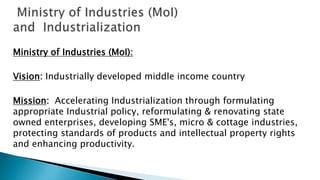
Ministry of Industries (MoI):
Vision: Industrially developed middle income country
Mission: Accelerating Industrialization through formulating
appropriate Industrial policy, reformulating & renovating state
owned enterprises, developing SME's, micro & cottage industries,
protecting standards of products and intellectual property rights
and enhancing productivity.
The Ministry of Industries carries out (performs) its functions
through Six wings:
(1) Administration & Co-ordination
(2) Autonomous Bodies
(3) Audit & Department
(4) Privatization (Disinvestment) Laws & International Co-
operation
(5) Research & Development
(6) Planning.
 Formulating, implementing, monitoring and updating of
appropriate industrial policy.
 Providing services for registering patent , design and
trademarks and strengthening activities in protecting
intellectual property.
 Developing small, micro & cottage industries.
 Determining and harmonizing national standards in
consistent with the international standards of commodities
and services.
 Standardization, examination and certification of products.
 Establishing, developing and regulating Eco-friendly and safe
industrial infrastructure.
 Keep continuing production of salt ,sugar, fertilizer and other
commodities.
 Fortifying edible oil with vitamin A.
 Providing policy support and other assistance to the
development of ship building and ship recycling industries.
 Enhancing productivity through providing training support to
entrepreneurs on industrial management and technical know
how.
 Generating employment opportunities through accelerating
industrialization in public and private sector and joint
ventures.
 Inquiring into the reason of non-profitability of state owned
enterprises and conduct research on the unsuccessful
ventures both in public and private sector.
 Improving overall management of state owned enterprises
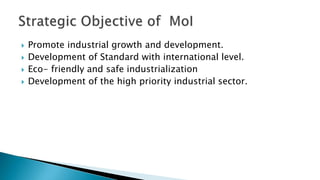
 Promote industrial growth and development.
 Development of Standard with international level.
 Eco- friendly and safe industrialization
 Development of the high priority industrial sector.
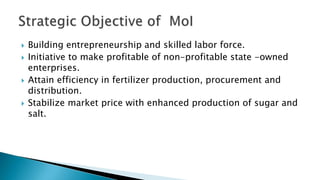
 Building entrepreneurship and skilled labor force.
 Initiative to make profitable of non-profitable state -owned
enterprises.
 Attain efficiency in fertilizer production, procurement and
distribution.
 Stabilize market price with enhanced production of sugar and
salt.
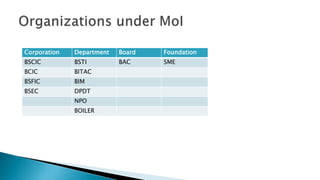
Corporation Department Board Foundation
BSCIC BSTI BAC SME
BCIC BITAC
BSFIC BIM
BSEC DPDT
NPO
BOILER
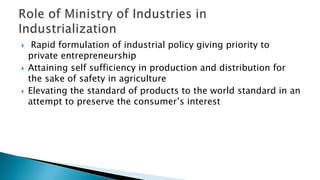
 Rapid formulation of industrial policy giving priority to
private entrepreneurship
 Attaining self sufficiency in production and distribution for
the sake of safety in agriculture
 Elevating the standard of products to the world standard in an
attempt to preserve the consumer’s interest
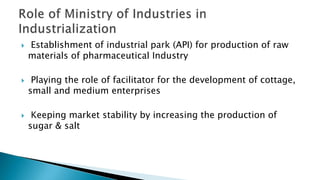
 Establishment of industrial park (API) for production of raw
materials of pharmaceutical Industry
 Playing the role of facilitator for the development of cottage,
small and medium enterprises
 Keeping market stability by increasing the production of
sugar & salt
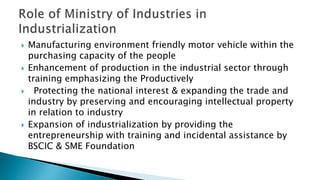
 Manufacturing environment friendly motor vehicle within the
purchasing capacity of the people
 Enhancement of production in the industrial sector through
training emphasizing the Productively
 Protecting the national interest & expanding the trade and
industry by preserving and encouraging intellectual property
in relation to industry
 Expansion of industrialization by providing the
entrepreneurship with training and incidental assistance by
BSCIC & SME Foundation
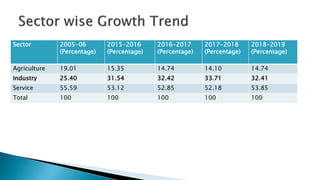
Sector 2005-06
(Percentage)
2015-2016
(Percentage)
2016-2017
(Percentage)
2017-2018
(Percentage)
2018-2019
(Percentage)
Agriculture 19.01 15.35 14.74 14.10 14.74
Industry 25.40 31.54 32.42 33.71 32.41
Service 55.59 53.12 52.85 52.18 53.85
Total 100 100 100 100 100
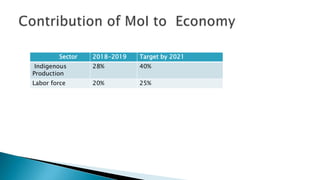
Sector 2018-2019 Target by 2021
Indigenous
Production
28% 40%
Labor force 20% 25%
 Vision 2021- a charter for moving towards a prosperous future , the first
stage of a middle-income economy
 Perspective Plan (2010-2021)- laid down goals and strategies together
with a framework for mobilising natural and human resources to achieve
goals
 The Seventh Five Year Plan (2016-2020): To achieve GDP 8%
 The Second Perspective Plan 2022 to 2041: To address the global
commitment of achieving the Sustainable Development Goals (SDG)
 VISION 2041:
1. To eliminate extreme poverty and reach Upper Middle-Income Country
(UMIC) status by 2030
2. High-Income Country (HIC) status around 2041 with poverty becoming
non-existent
3. Bangladesh will be a developed country by 2041, with per capita income of
over $12,500
•
• Bangladesh Delta Plan (BDP) 2100:
1. Achieving Safe, Climate Resilient and Prosperous Delta
2. BDP -2100 is the plan for moving Bangladesh forward for the
next 100 years towards the 21st Century.
 Cheap labor
 Positive development
 Opened new market
 Growth of trade
 Rise of living standard
 Achievement of foreign currency
 Stable economy
 Creation skill labor force.
 Reduce unemployment.
 Historical background
 Agro-base economy
 Lack of entrepreneurship
 Unskilled manpower
 Small size in market
 Lack of instrument
 Lack of capital
 Weakness banking system
 Labor dissatisfaction .
 Shortage of Energy ( gas, electricity)
 Child labor.
 Lack of wage.
 Lack of job security.
 Lack of training facilities.
 Lack of proper management.

Presentation on industrialization M.pptx

  • 2.
     Economic activityconcerned with the processing of raw materials and manufacture of goods in factories.
  • 3.
     The processby which an economy is transformed from primarily agricultural to one based on the manufacturing of goods.  Individual manual labor replaced by machine  Craftsmen replaced by assembly lines
  • 4.
     Economic growth More efficient division of labor  The use of technological innovation to solve problems  Reduce dependency human control.
  • 5.
     1ST Stage: 1784- Invention of Steam Engine  2nd Stage : 1870- Invention of Electricity  3rd Stage: 1969 – Invention of Internet  4th Stage: 1991- Artificial Intelligence (AI)
  • 6.
     Better utilizationof resources  Increase Productivity  Play a major role in economic development  Provide a secure basis for a rapid growth  To supply consumer, capital and intermediary goods  Increase GDP and decreased the dependency on foreign resources  Accelerate SDG Goal  Generates employment opportunities and meeting high income demands
  • 7.
     Increase percapita Income  Reduce Poverty  Provides educational opportunities  Encourages advancement and innovation  Make Industrial development  Increase Standard of living  To improve balance of payment positive by promoting export industry and import substitute industries
  • 8.
    Ministry of Industries(MoI): Vision: Industrially developed middle income country Mission: Accelerating Industrialization through formulating appropriate Industrial policy, reformulating & renovating state owned enterprises, developing SME's, micro & cottage industries, protecting standards of products and intellectual property rights and enhancing productivity.
  • 9.
    The Ministry ofIndustries carries out (performs) its functions through Six wings: (1) Administration & Co-ordination (2) Autonomous Bodies (3) Audit & Department (4) Privatization (Disinvestment) Laws & International Co- operation (5) Research & Development (6) Planning.
  • 10.
     Formulating, implementing,monitoring and updating of appropriate industrial policy.  Providing services for registering patent , design and trademarks and strengthening activities in protecting intellectual property.  Developing small, micro & cottage industries.  Determining and harmonizing national standards in consistent with the international standards of commodities and services.
  • 11.
     Standardization, examinationand certification of products.  Establishing, developing and regulating Eco-friendly and safe industrial infrastructure.  Keep continuing production of salt ,sugar, fertilizer and other commodities.  Fortifying edible oil with vitamin A.  Providing policy support and other assistance to the development of ship building and ship recycling industries.
  • 12.
     Enhancing productivitythrough providing training support to entrepreneurs on industrial management and technical know how.  Generating employment opportunities through accelerating industrialization in public and private sector and joint ventures.  Inquiring into the reason of non-profitability of state owned enterprises and conduct research on the unsuccessful ventures both in public and private sector.  Improving overall management of state owned enterprises
  • 13.
     Promote industrialgrowth and development.  Development of Standard with international level.  Eco- friendly and safe industrialization  Development of the high priority industrial sector.
  • 14.
     Building entrepreneurshipand skilled labor force.  Initiative to make profitable of non-profitable state -owned enterprises.  Attain efficiency in fertilizer production, procurement and distribution.  Stabilize market price with enhanced production of sugar and salt.
  • 15.
    Corporation Department BoardFoundation BSCIC BSTI BAC SME BCIC BITAC BSFIC BIM BSEC DPDT NPO BOILER
  • 16.
     Rapid formulationof industrial policy giving priority to private entrepreneurship  Attaining self sufficiency in production and distribution for the sake of safety in agriculture  Elevating the standard of products to the world standard in an attempt to preserve the consumer’s interest
  • 17.
     Establishment ofindustrial park (API) for production of raw materials of pharmaceutical Industry  Playing the role of facilitator for the development of cottage, small and medium enterprises  Keeping market stability by increasing the production of sugar & salt
  • 18.
     Manufacturing environmentfriendly motor vehicle within the purchasing capacity of the people  Enhancement of production in the industrial sector through training emphasizing the Productively  Protecting the national interest & expanding the trade and industry by preserving and encouraging intellectual property in relation to industry  Expansion of industrialization by providing the entrepreneurship with training and incidental assistance by BSCIC & SME Foundation
  • 19.
    Sector 2005-06 (Percentage) 2015-2016 (Percentage) 2016-2017 (Percentage) 2017-2018 (Percentage) 2018-2019 (Percentage) Agriculture 19.0115.35 14.74 14.10 14.74 Industry 25.40 31.54 32.42 33.71 32.41 Service 55.59 53.12 52.85 52.18 53.85 Total 100 100 100 100 100
  • 20.
    Sector 2018-2019 Targetby 2021 Indigenous Production 28% 40% Labor force 20% 25%
  • 21.
     Vision 2021-a charter for moving towards a prosperous future , the first stage of a middle-income economy  Perspective Plan (2010-2021)- laid down goals and strategies together with a framework for mobilising natural and human resources to achieve goals  The Seventh Five Year Plan (2016-2020): To achieve GDP 8%  The Second Perspective Plan 2022 to 2041: To address the global commitment of achieving the Sustainable Development Goals (SDG)
  • 22.
     VISION 2041: 1.To eliminate extreme poverty and reach Upper Middle-Income Country (UMIC) status by 2030 2. High-Income Country (HIC) status around 2041 with poverty becoming non-existent 3. Bangladesh will be a developed country by 2041, with per capita income of over $12,500 •
  • 23.
    • Bangladesh DeltaPlan (BDP) 2100: 1. Achieving Safe, Climate Resilient and Prosperous Delta 2. BDP -2100 is the plan for moving Bangladesh forward for the next 100 years towards the 21st Century.
  • 24.
     Cheap labor Positive development  Opened new market  Growth of trade  Rise of living standard  Achievement of foreign currency  Stable economy  Creation skill labor force.  Reduce unemployment.
  • 25.
     Historical background Agro-base economy  Lack of entrepreneurship  Unskilled manpower  Small size in market  Lack of instrument  Lack of capital  Weakness banking system
  • 26.
     Labor dissatisfaction.  Shortage of Energy ( gas, electricity)  Child labor.  Lack of wage.  Lack of job security.  Lack of training facilities.  Lack of proper management.