Presentation on fault detection in power transmission lines.pdf
1.
FAULT DETECTION, CLASSIFICATIONAND
LOCATION IN POWER TRANSMISSION
NETWORK
D1 Presentation (State of Art)
SAMA Promise AWA
Laboratory of Computer Science Engineering and Automation,
ENSET Douala
President : Pr. BOUM Alexandre Teplaira,
Professor, University of Douala
Telephone No: 675014572 / 655037902
Email Address : boumat2002@yahoo.fr
Rapporteur : Pr. DZONDE NAOUSSI,
Professor, University of Douala
Member : Dr. MBEY CAMILLE Franklein
Lecturer, University of Douala
January 12, 2023
2.
CONTENTS
1 GENERAL INTRODUCTION
•Institutional and Partnership Frameworks
• Scientific Motivations of the Thesis
• Statement of Problem and Research Objectives
2 CALENDAR OF ACTIVITIES
• D1 Activities
• D2 Activities
• D3 Activities
3 STATE OF ART
3.
GENERAL INTRODUCTION I
InstitutionalFramework
This thesis is founded in the Framework of acquiring a Doctorate Degree (PhD) in
Engineering Science (Eng.Sc.) at the Higher Technical Teacher Training College (ENSET)
Douala, affiliated through the Post Graduate School of Fundamental and Applied Sciences
(POSPAS) of the University of Douala (UD), more particularly in the Doctorate Training unit
of Engineering Sciences (UFD-SCI), in the field of Electrical, Electronic Engineering and
Industrial Computing (EEII) of the Laboratory of Computer Science and Automation
Engineering (CAE).
Partnership Framework
This work was carried out solely in the Laboratory of Computer Science and Automation
Engineering (CAE) of the Higher Technical Teacher Training College (ENSET) Douala: -
affiliated to the Post Graduate School of Pure and Applied Sciences (POSPAS) of the
University of Douala. Sponsorship was mainly solicited from the collaboration of
supervision, parents and Individual finances.
4.
GENERAL INTRODUCTION II
NationalContext
At the national level, though a few researches related to power systems have been attempted
and preliminary studies have been studied at both undergraduate and post graduate levels,
one is still to find out if there exist any internationally accepted article on fault detection,
classification and location in PTNs published by a Cameroonian. Thus, based on intensive
survey and availability of literature on the subject under study, no work has been reported or
published in Cameroon in relation to fault detection or classification or location in PTNs.
This is a call for concern in the science and engineering community of Cameroon.
International Context
At the international level, tens of articles have been written on fault detection, location and
classification in power transmission lines. The most recent one that directly fits into the
framework of our study is that of Le Van Dai et al., published in 2022. However, most of the
works published online are based on Machine Learning and the technology of Deep learning
are still under-explored in this domain if not for publishers like Le Van Dai et al., who have
recently delved into the glimpse of this Deep learning approach.
5.
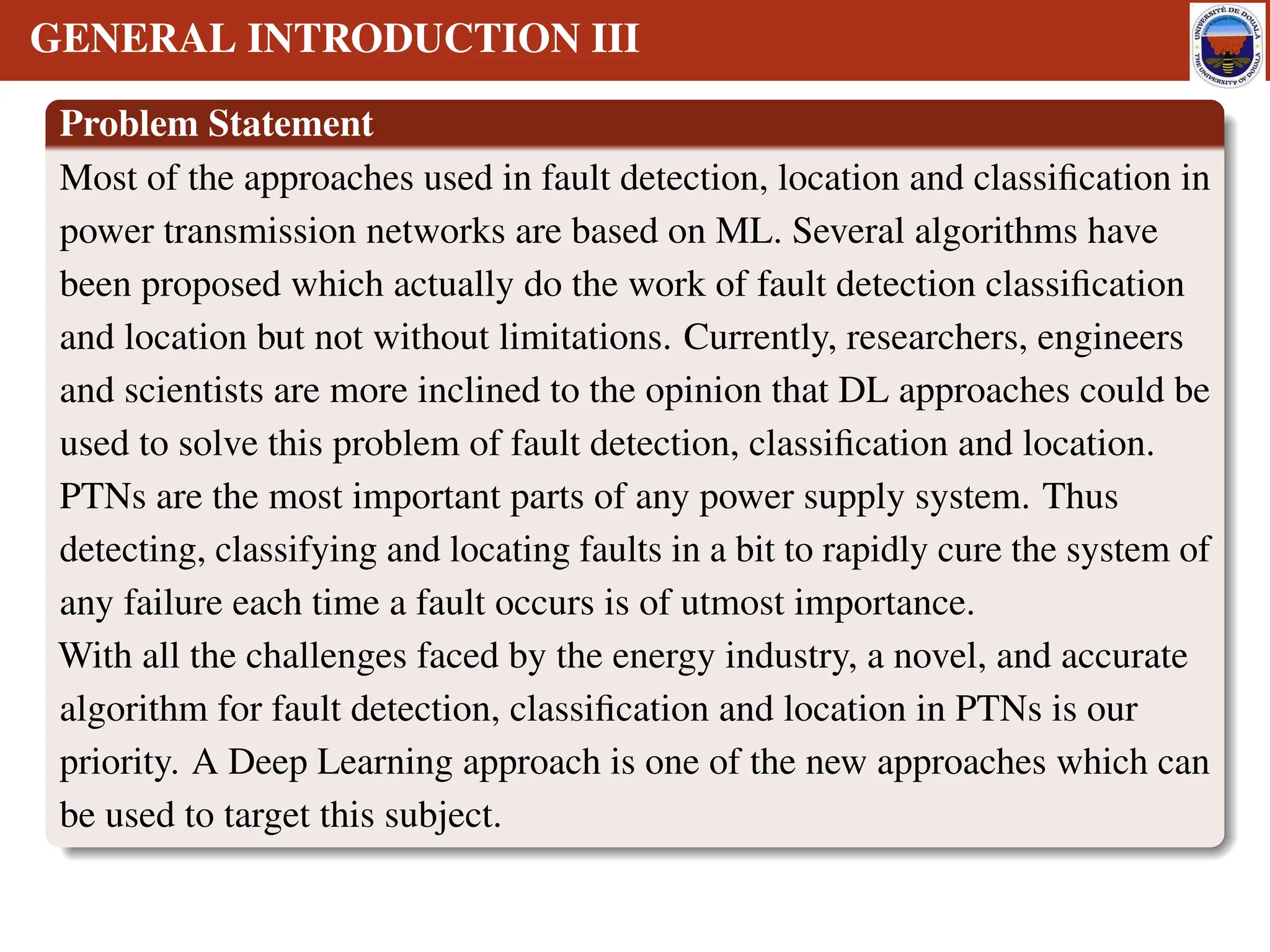
GENERAL INTRODUCTION III
ProblemStatement
Most of the approaches used in fault detection, location and classification in
power transmission networks are based on ML. Several algorithms have
been proposed which actually do the work of fault detection classification
and location but not without limitations. Currently, researchers, engineers
and scientists are more inclined to the opinion that DL approaches could be
used to solve this problem of fault detection, classification and location.
PTNs are the most important parts of any power supply system. Thus
detecting, classifying and locating faults in a bit to rapidly cure the system of
any failure each time a fault occurs is of utmost importance.
With all the challenges faced by the energy industry, a novel, and accurate
algorithm for fault detection, classification and location in PTNs is our
priority. A Deep Learning approach is one of the new approaches which can
be used to target this subject.
6.
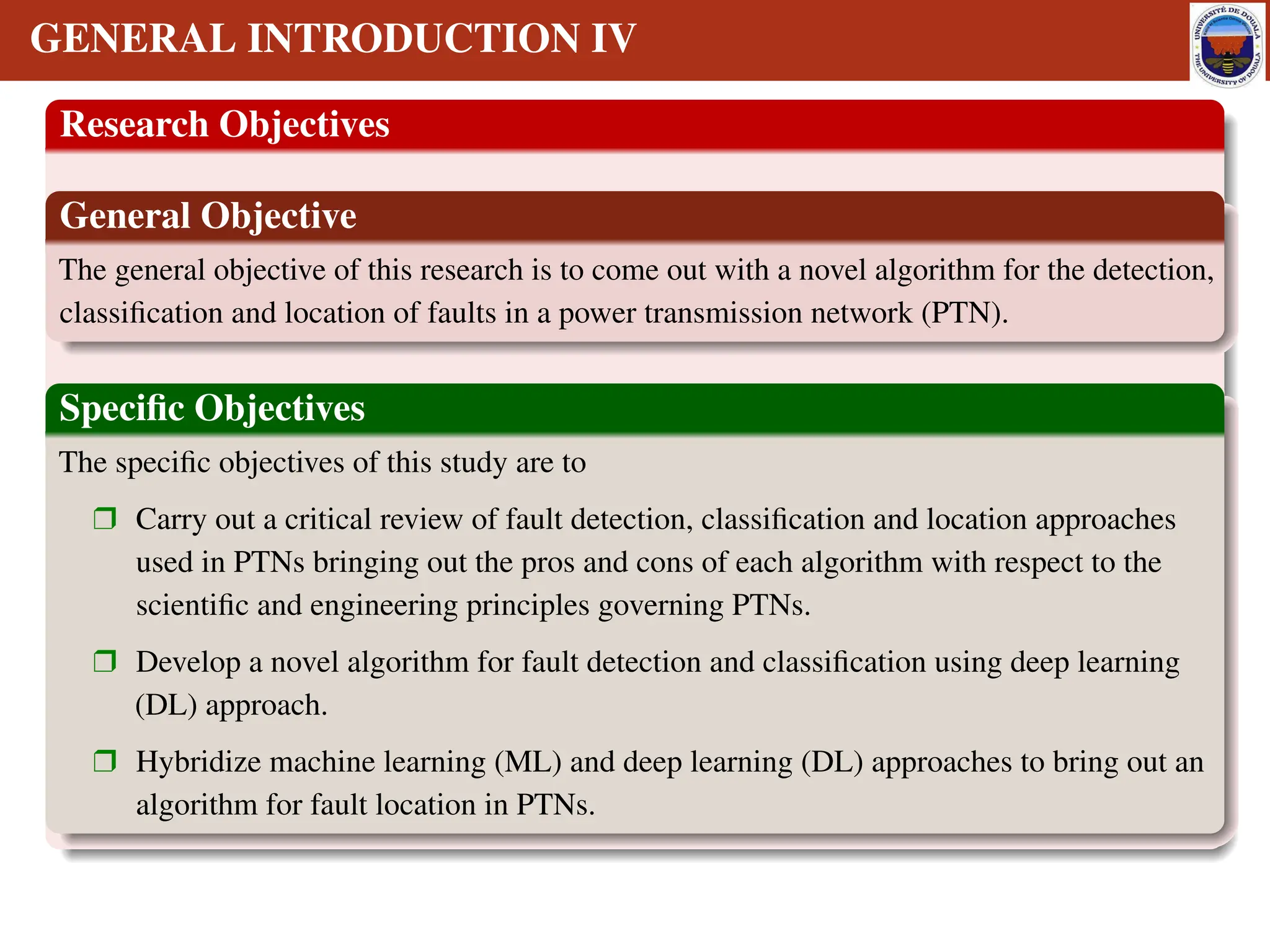
GENERAL INTRODUCTION IV
ResearchObjectives
General Objective
The general objective of this research is to come out with a novel algorithm for the detection,
classification and location of faults in a power transmission network (PTN).
Specific Objectives
The specific objectives of this study are to
r Carry out a critical review of fault detection, classification and location approaches
used in PTNs bringing out the pros and cons of each algorithm with respect to the
scientific and engineering principles governing PTNs.
r Develop a novel algorithm for fault detection and classification using deep learning
(DL) approach.
r Hybridize machine learning (ML) and deep learning (DL) approaches to bring out an
algorithm for fault location in PTNs.
7.
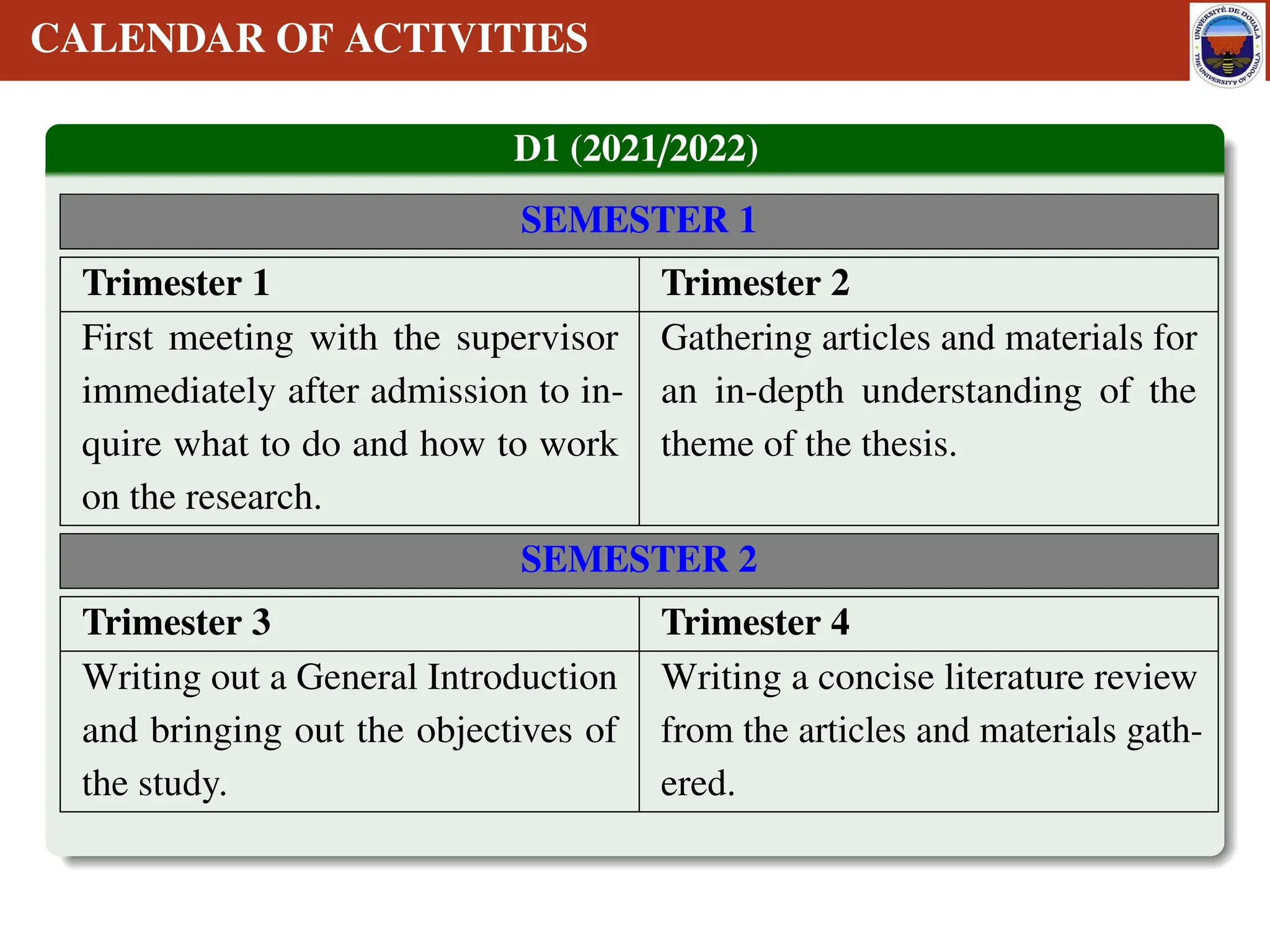
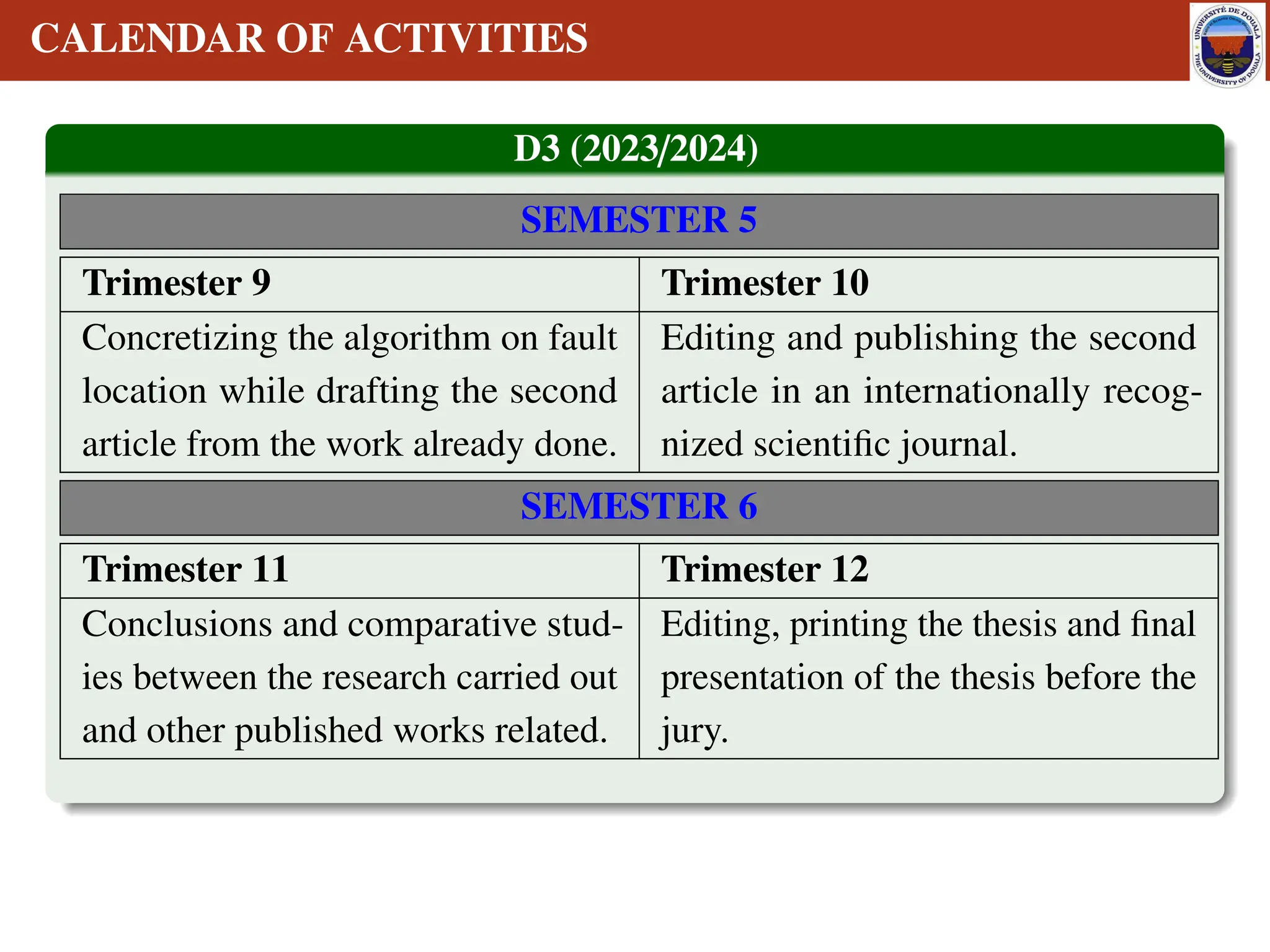
CALENDAR OF ACTIVITIES
D1(2021/2022)
SEMESTER 1
Trimester 1 Trimester 2
First meeting with the supervisor
immediately after admission to in-
quire what to do and how to work
on the research.
Gathering articles and materials for
an in-depth understanding of the
theme of the thesis.
SEMESTER 2
Trimester 3 Trimester 4
Writing out a General Introduction
and bringing out the objectives of
the study.
Writing a concise literature review
from the articles and materials gath-
ered.
8.
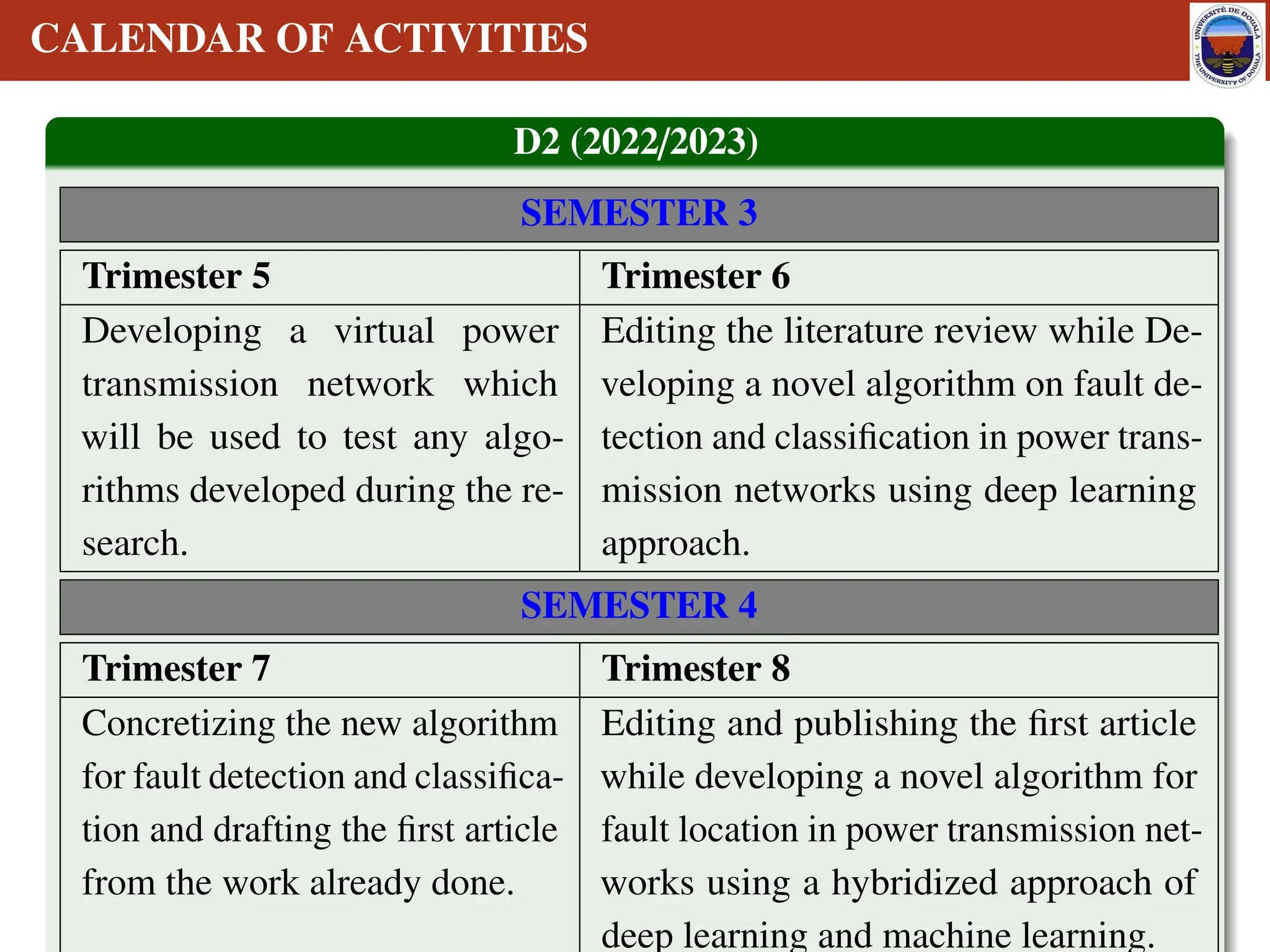
CALENDAR OF ACTIVITIES
D2(2022/2023)
SEMESTER 3
Trimester 5 Trimester 6
Developing a virtual power
transmission network which
will be used to test any algo-
rithms developed during the re-
search.
Editing the literature review while De-
veloping a novel algorithm on fault de-
tection and classification in power trans-
mission networks using deep learning
approach.
SEMESTER 4
Trimester 7 Trimester 8
Concretizing the new algorithm
for fault detection and classifica-
tion and drafting the first article
from the work already done.
Editing and publishing the first article
while developing a novel algorithm for
fault location in power transmission net-
works using a hybridized approach of
deep learning and machine learning.
9.
CALENDAR OF ACTIVITIES
D3(2023/2024)
SEMESTER 5
Trimester 9 Trimester 10
Concretizing the algorithm on fault
location while drafting the second
article from the work already done.
Editing and publishing the second
article in an internationally recog-
nized scientific journal.
SEMESTER 6
Trimester 11 Trimester 12
Conclusions and comparative stud-
ies between the research carried out
and other published works related.
Editing, printing the thesis and final
presentation of the thesis before the
jury.
10.
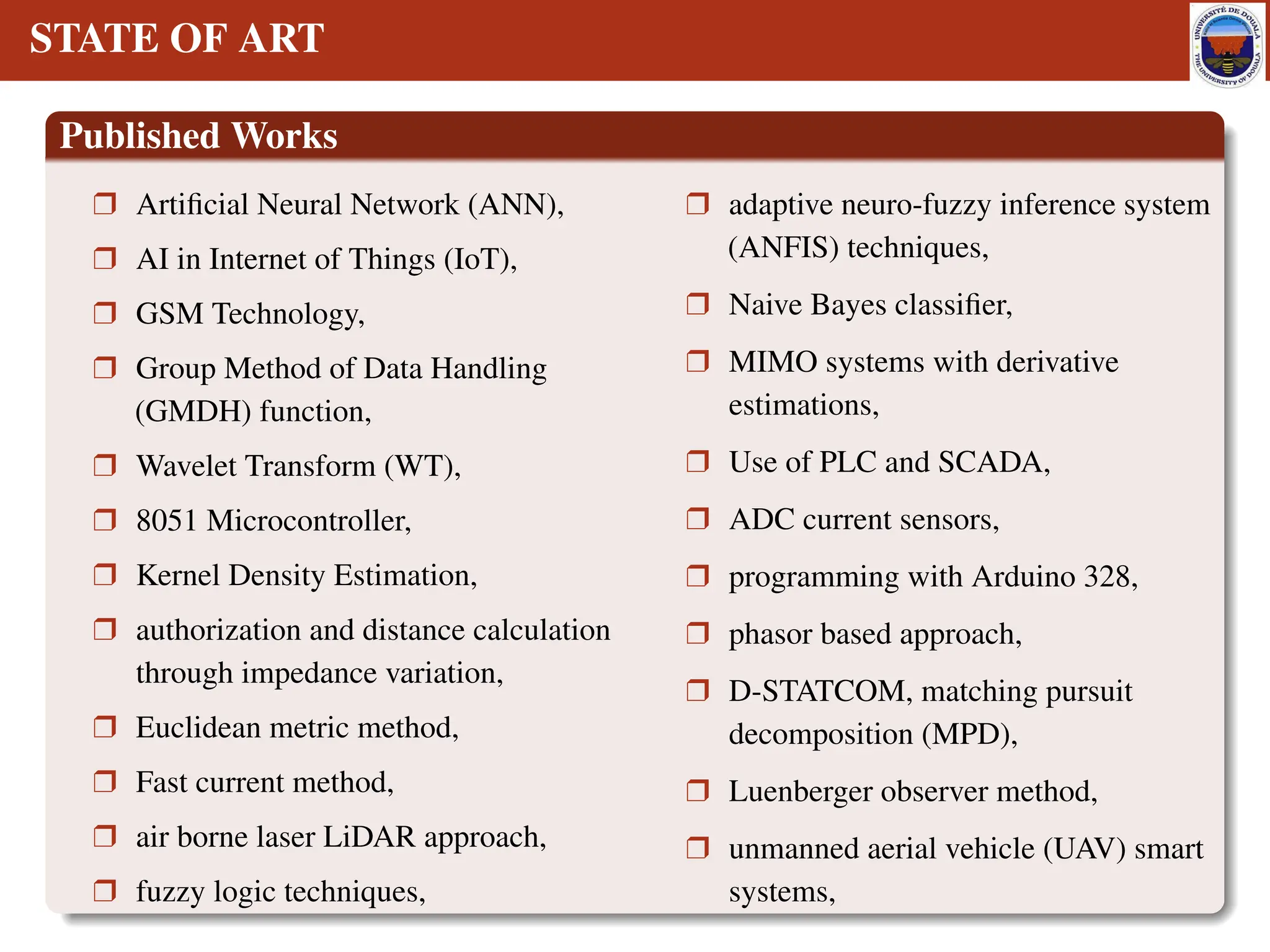
STATE OF ART
PublishedWorks
r Artificial Neural Network (ANN),
r AI in Internet of Things (IoT),
r GSM Technology,
r Group Method of Data Handling
(GMDH) function,
r Wavelet Transform (WT),
r 8051 Microcontroller,
r Kernel Density Estimation,
r authorization and distance calculation
through impedance variation,
r Euclidean metric method,
r Fast current method,
r air borne laser LiDAR approach,
r fuzzy logic techniques,
r adaptive neuro-fuzzy inference system
(ANFIS) techniques,
r Naive Bayes classifier,
r MIMO systems with derivative
estimations,
r Use of PLC and SCADA,
r ADC current sensors,
r programming with Arduino 328,
r phasor based approach,
r D-STATCOM, matching pursuit
decomposition (MPD),
r Luenberger observer method,
r unmanned aerial vehicle (UAV) smart
systems,
11.
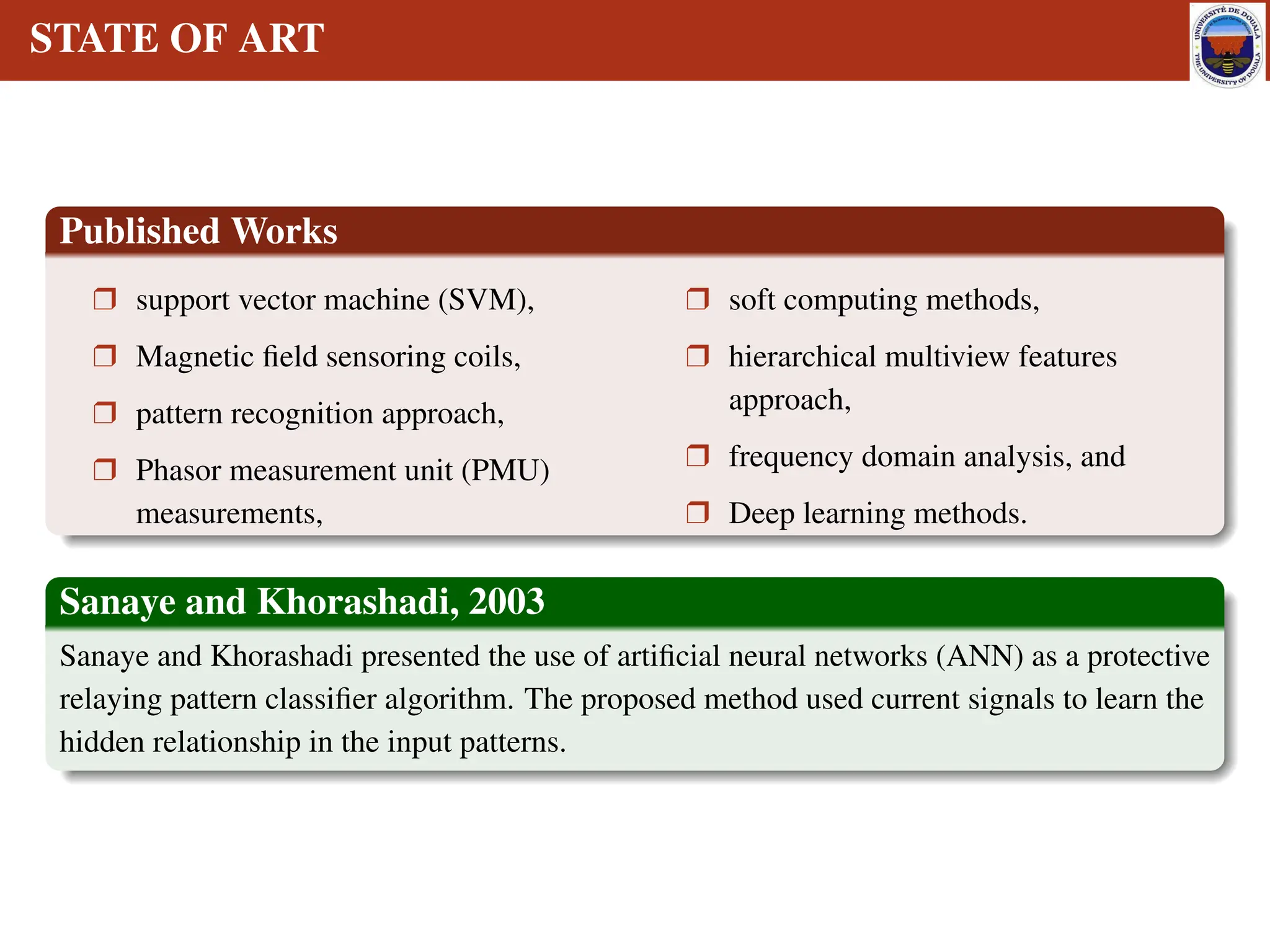
STATE OF ART
PublishedWorks
r support vector machine (SVM),
r Magnetic field sensoring coils,
r pattern recognition approach,
r Phasor measurement unit (PMU)
measurements,
r soft computing methods,
r hierarchical multiview features
approach,
r frequency domain analysis, and
r Deep learning methods.
Sanaye and Khorashadi, 2003
Sanaye and Khorashadi presented the use of artificial neural networks (ANN) as a protective
relaying pattern classifier algorithm. The proposed method used current signals to learn the
hidden relationship in the input patterns.
12.
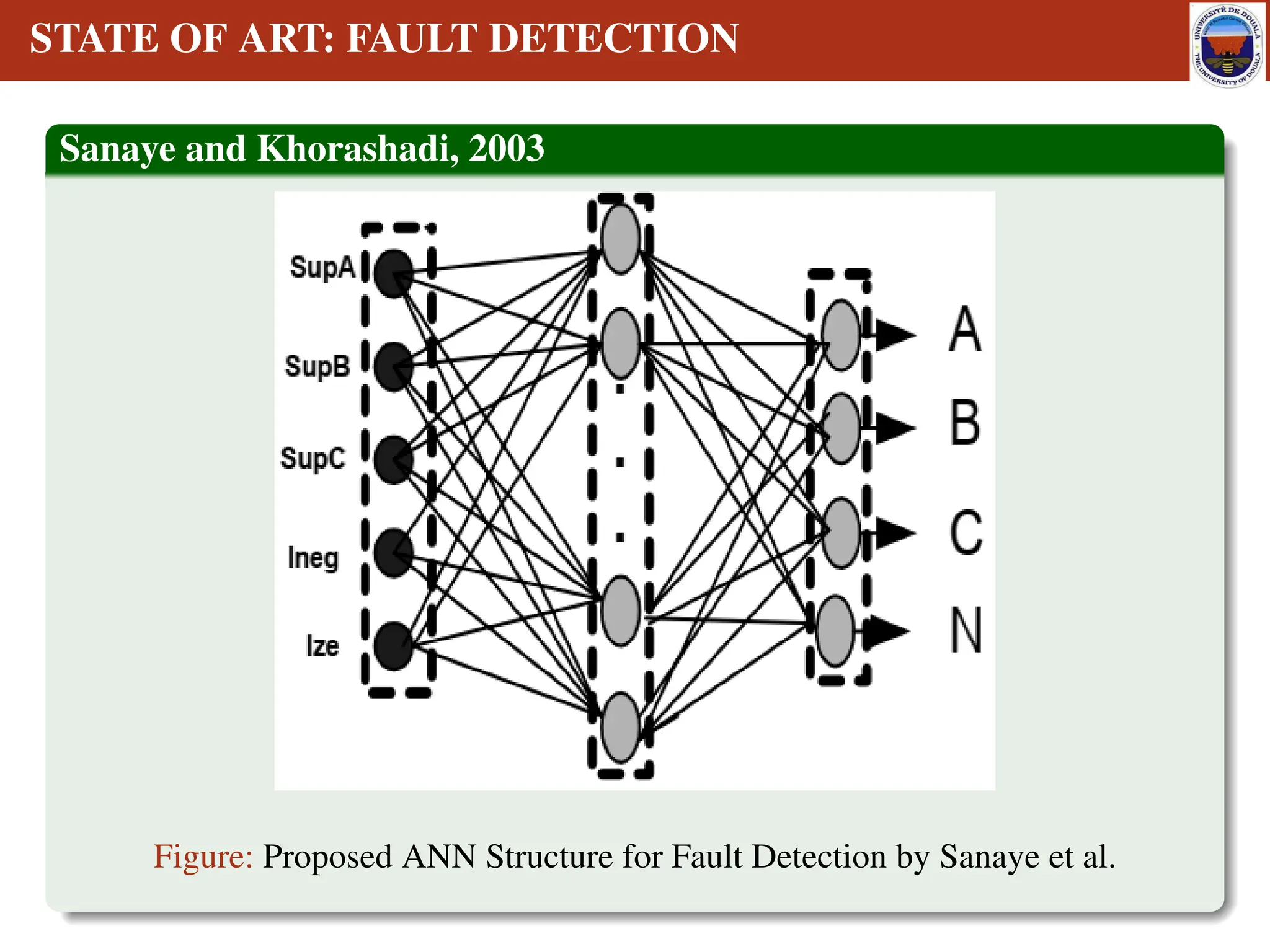
STATE OF ART:FAULT DETECTION
Sanaye and Khorashadi, 2003
Figure: Proposed ANN Structure for Fault Detection by Sanaye et al.
13.
STATE OF ART:FAULT DETECTION
Tahar Bouthiba, 2004
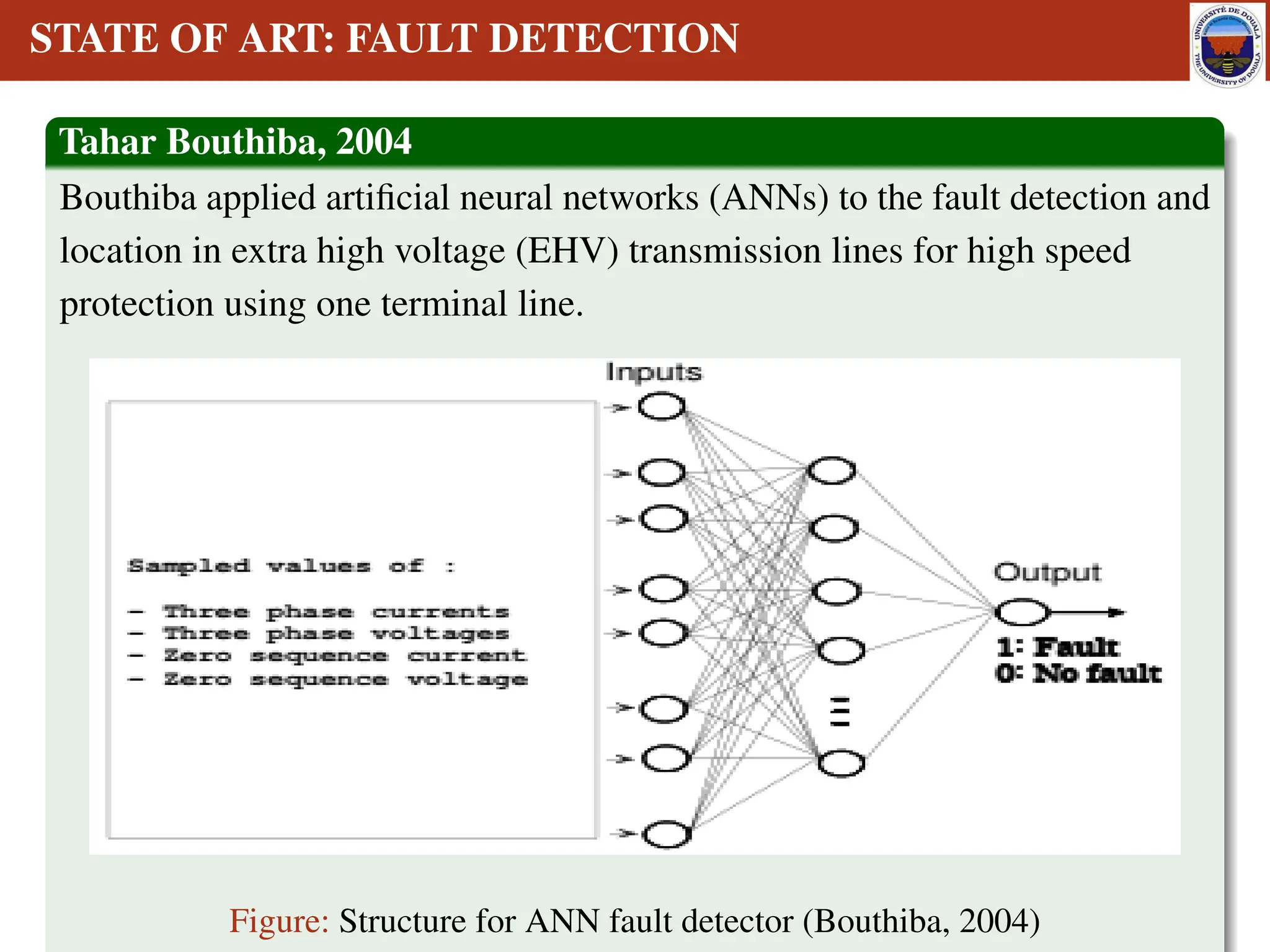
Bouthiba applied artificial neural networks (ANNs) to the fault detection and
location in extra high voltage (EHV) transmission lines for high speed
protection using one terminal line.
Figure: Structure for ANN fault detector (Bouthiba, 2004)
14.
STATE OF ART:FAULT LOCATION
Tahar Bouthiba, 2004
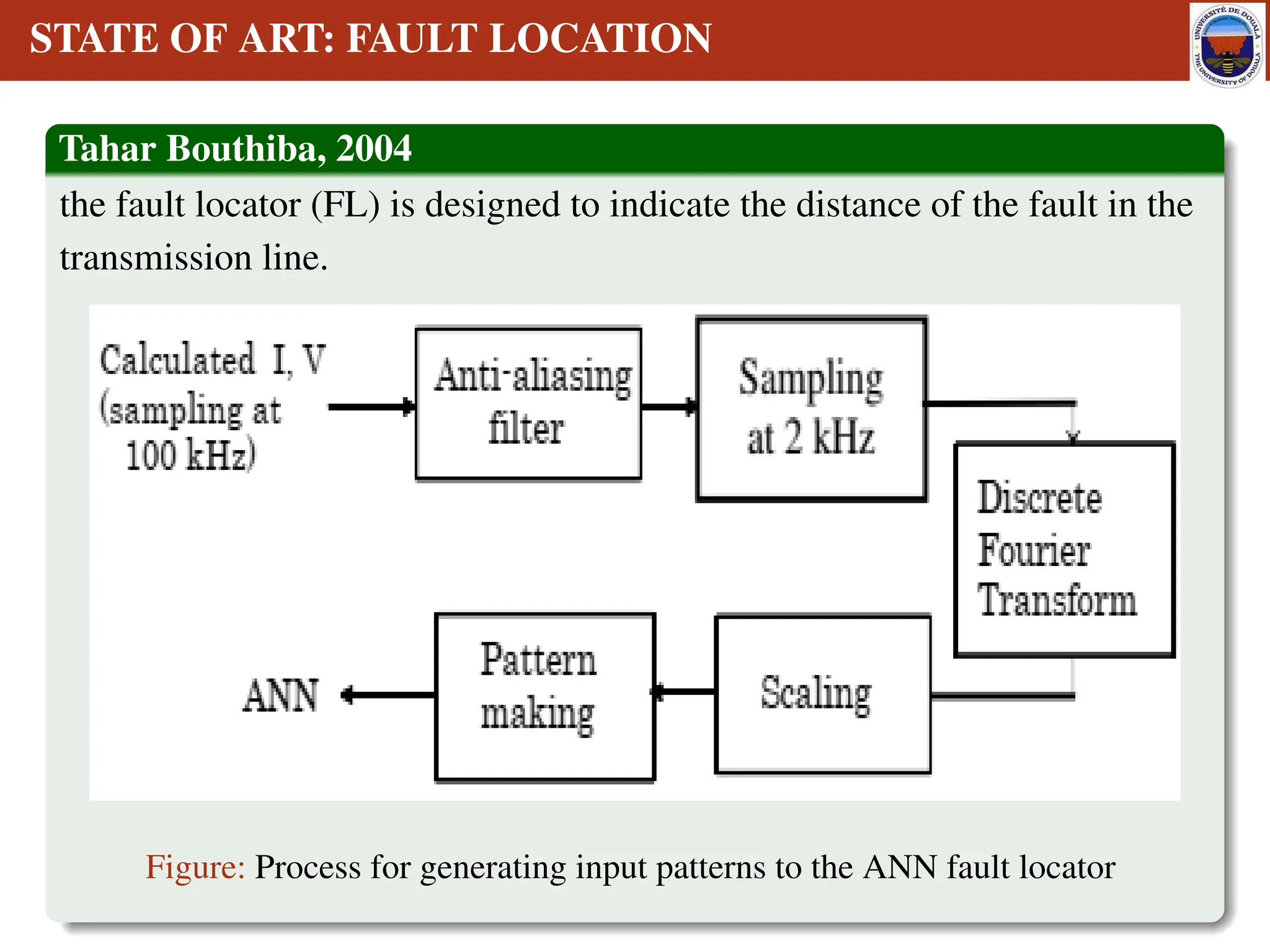
the fault locator (FL) is designed to indicate the distance of the fault in the
transmission line.
Figure: Process for generating input patterns to the ANN fault locator
15.
STATE OF ART:FAULT LOCATION
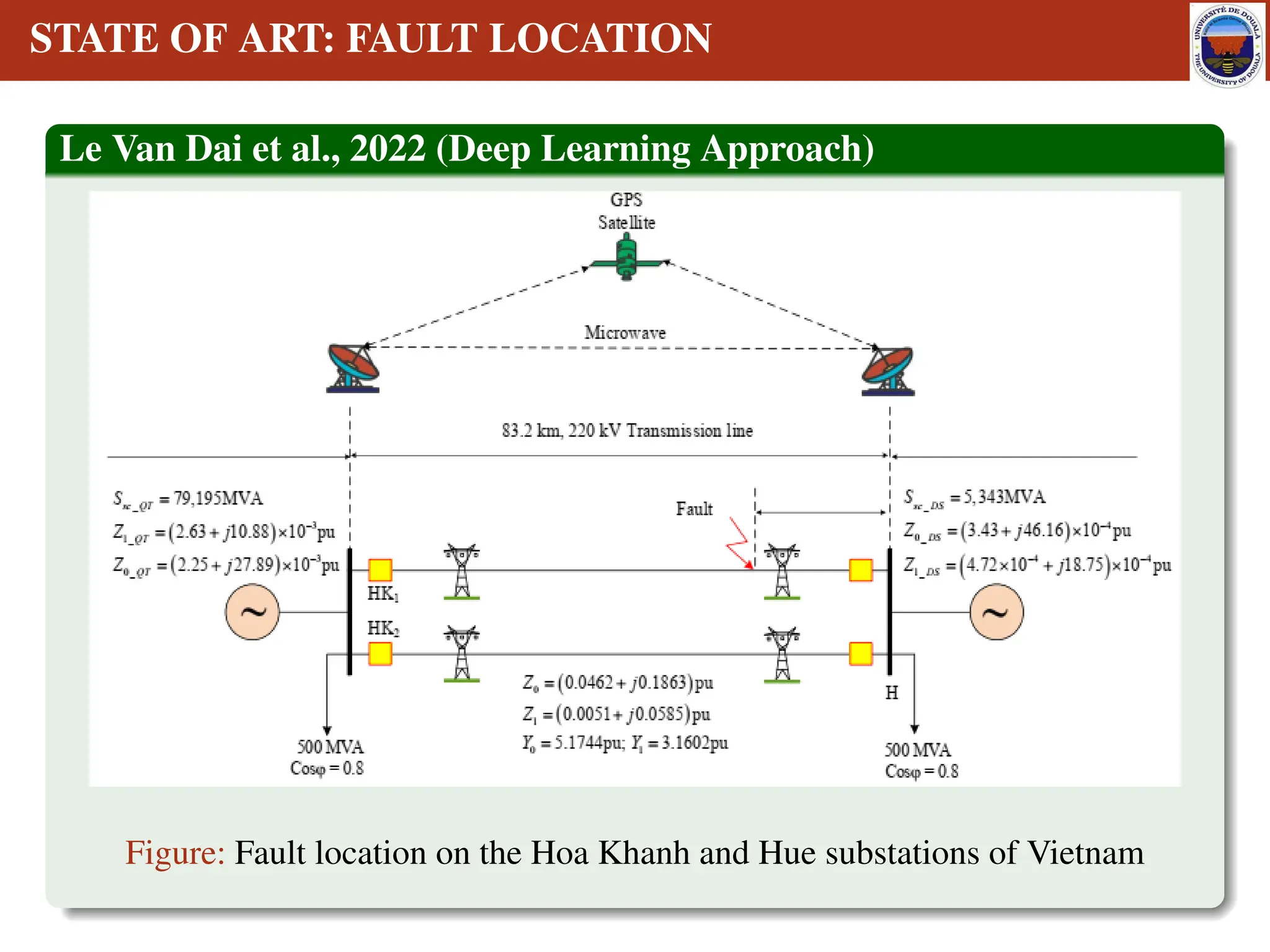
Le Van Dai et al., 2022 (Deep Learning Approach)
Figure: Fault location on the Hoa Khanh and Hue substations of Vietnam
16.
STATE OF ART:FAULT CLASSIFICATION
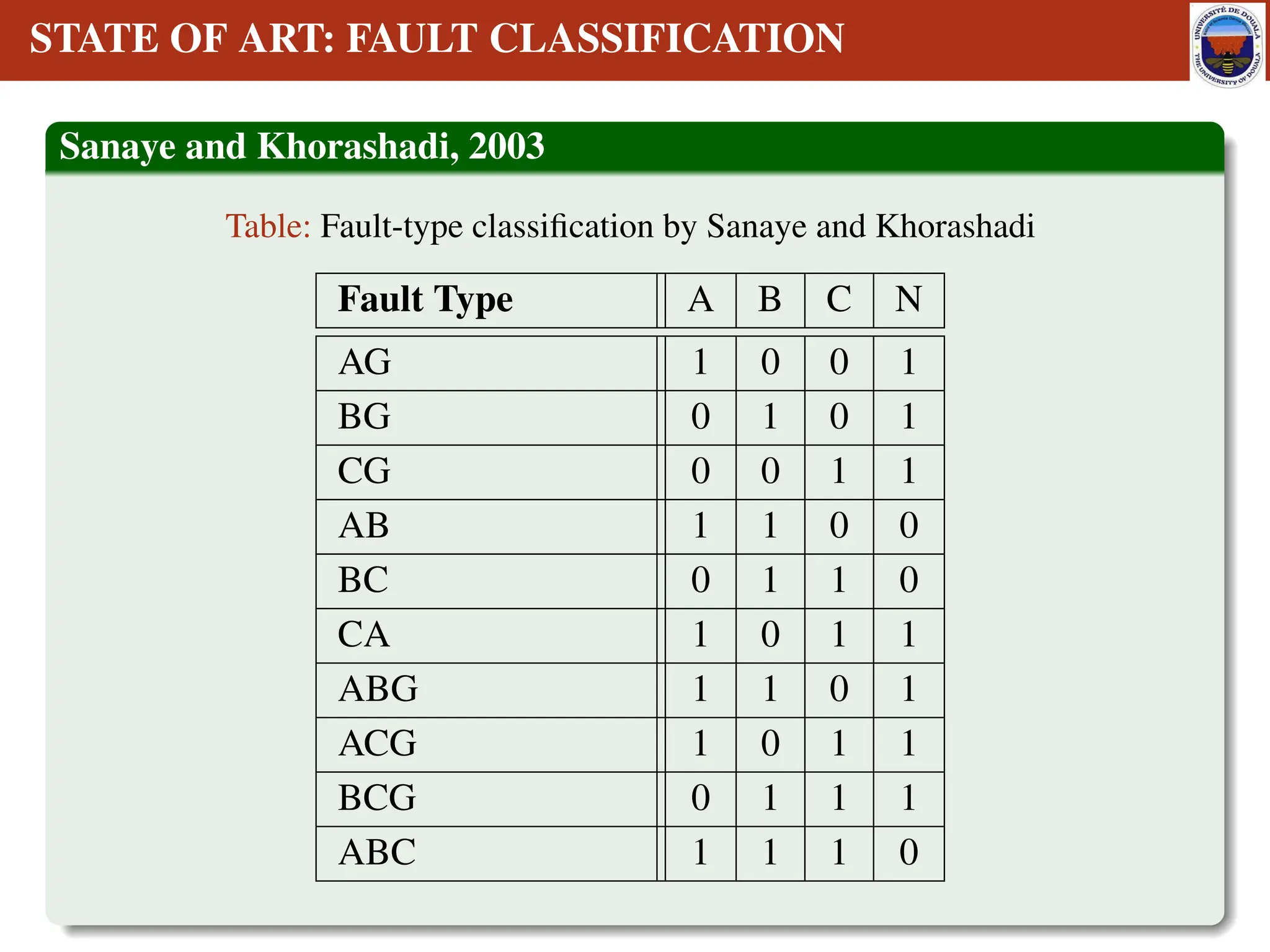
Sanaye and Khorashadi, 2003
Table: Fault-type classification by Sanaye and Khorashadi
Fault Type A B C N
AG 1 0 0 1
BG 0 1 0 1
CG 0 0 1 1
AB 1 1 0 0
BC 0 1 1 0
CA 1 0 1 1
ABG 1 1 0 1
ACG 1 0 1 1
BCG 0 1 1 1
ABC 1 1 1 0
17.
STATE OF ART:FAULT CLASSIFICATION
Le Van Dai et al., 2022
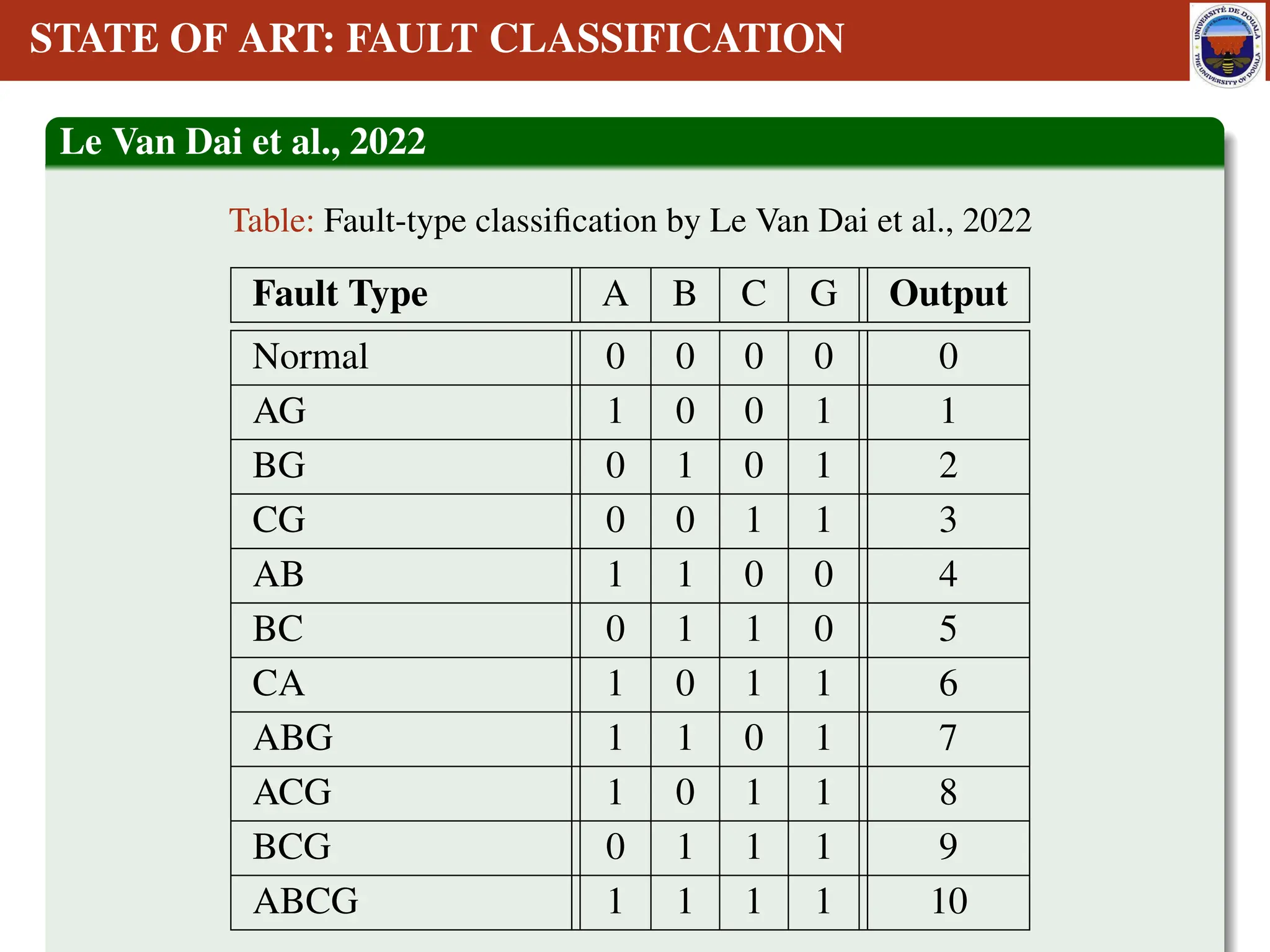
Table: Fault-type classification by Le Van Dai et al., 2022
Fault Type A B C G Output
Normal 0 0 0 0 0
AG 1 0 0 1 1
BG 0 1 0 1 2
CG 0 0 1 1 3
AB 1 1 0 0 4
BC 0 1 1 0 5
CA 1 0 1 1 6
ABG 1 1 0 1 7
ACG 1 0 1 1 8
BCG 0 1 1 1 9
ABCG 1 1 1 1 10
18.
STATE OF ART:DEEP LEARNING ALGORITHM
Le Van Dai et al., 2022
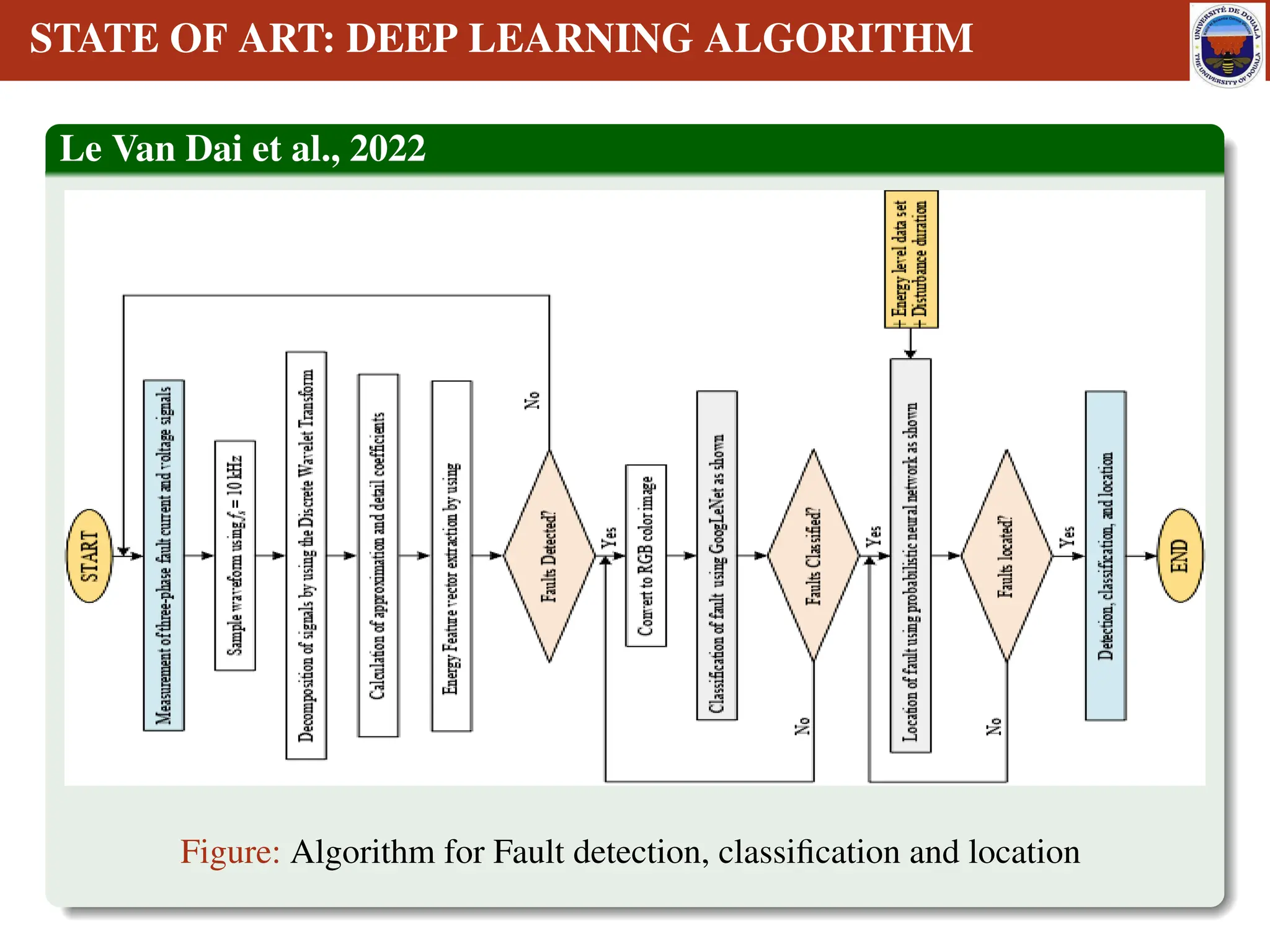
Figure: Algorithm for Fault detection, classification and location
19.
PROSPECTIVE
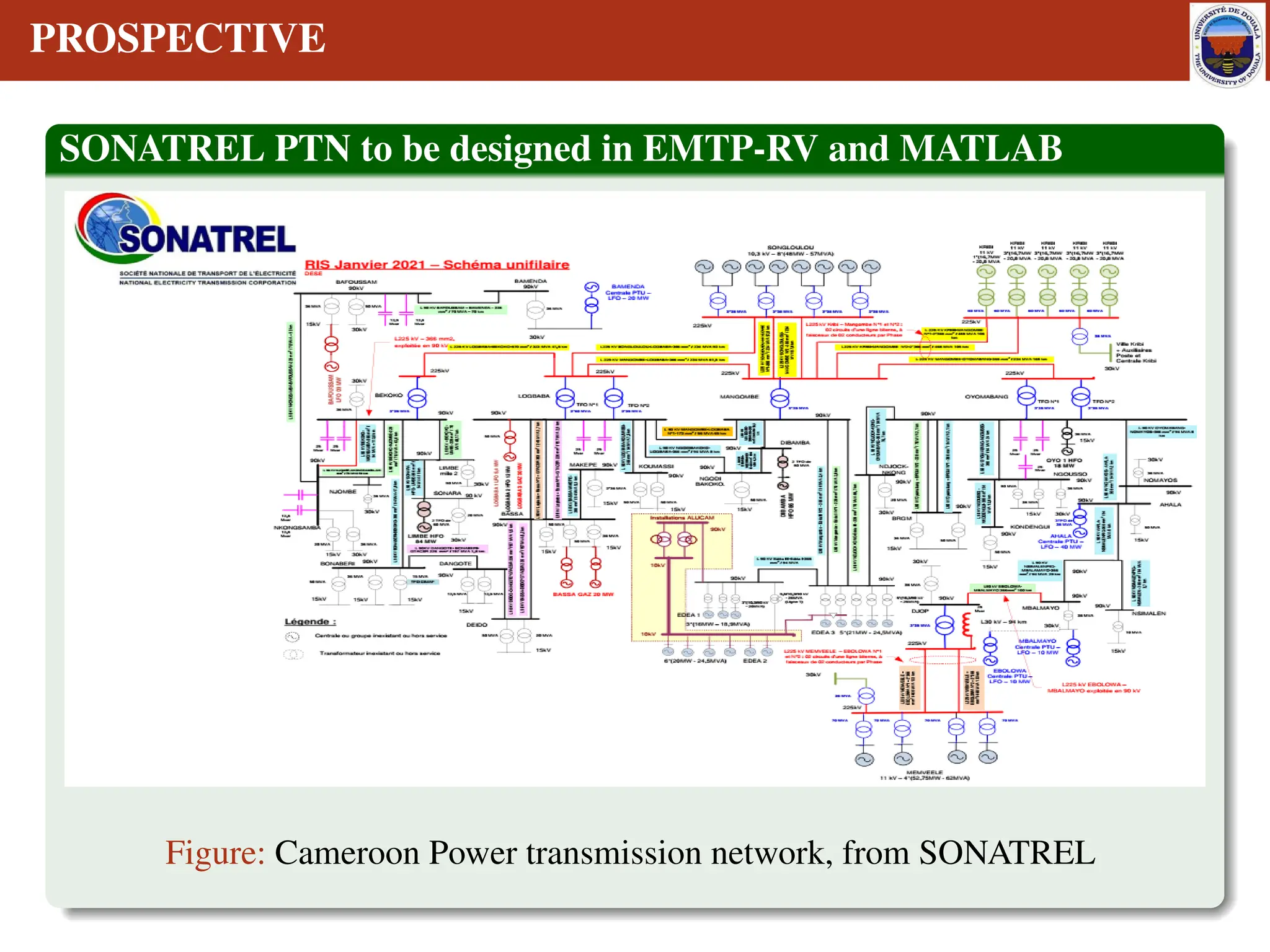
SONATREL PTN tobe designed in EMTP-RV and MATLAB
Figure: Cameroon Power transmission network, from SONATREL
20.
Thank you foryour keen attention . . .
SAMA Promise Awa
‰ +237 674 605 217
R samapromiseawa@gmail.com