


Welcome
To
Our Presentation
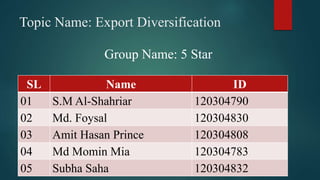
Topic Name: Export Diversification
Group Name: 5 Star
SL Name ID
01 S.M Al-Shahriar 120304790
02 Md. Foysal 120304830
03 Amit Hasan Prince 120304808
04 Md Momin Mia 120304783
05 Subha Saha 120304832
Export:
The term export means shipping the goods and
services out of the port of a country. The seller of
such goods and services is referred to as an
"exporter" and is based in the country of export
whereas the overseas based buyer is referred to as
an "importer". In International Trade, "exports" refers
to selling goods and services produced in the home
country to other markets.
Export diversification:
Export diversification, by definition is the changing of a country's
export structure. This can be attained by changing the existing
basket of commodities or by embellishing them through
innovation and technology. Dennis and Shepherd (2007) define
export diversification as widening the range of products that a
country exports. As a matter of fact, export diversification can
take two forms, namely, horizontal and vertical. Export
diversification has different dimensions and can be analysed at
different levels (Ali et al., 1991). Herzer and Nowak-Lehnmann
(2006) explain that export diversification can occur either
horizontally or vertically.
Introduction:
The acceleration of global trade in the latter half of the 20th century has
seen patterns of trade vastly differing from those predicted by classical
trade theories built around perfect competition, comparative
advantage and constant returns to scale (Krugman, 1980). Based on
Adam Smith’s concept of division of labor and specialization for
economic growth and development, and the Heckscher-Ohlin
Samuelson (HOS) model of international trade, countries should
specialize in producing those goods in which they have a comparative
advantage. Recent literature, instead, has found that countries appear
to diversify in terms of production and exports as they grow.
Export diversification and
Bangladesh
The need for different eggs and baskets Bangladesh has
come a long way in terms of its exports. With an export of
only $0.36 billion in fiscal 1973, the country has managed to
increase it to $30.2 billion by the end of fiscal 2014.
Comprising a share of 20 percent in the GDP, the
importance of exports remains critical to the overall
economic growth of the country.
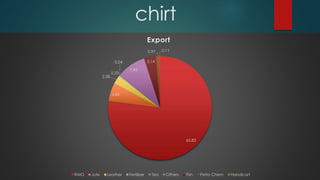
chirt
65.83
4.88
2.38
0.23
0.04
7.85
3.14
0.97 0.11
Export
RMG Jute Leather Fertilizer Tea Others Fish Petro Chem Handicart
Export diversification and
Bangladesh
Firstly, let us take a quick look at some of the facts regarding exports
of Bangladesh. The exports are largely dominated by readymade
garments, whose share was 81.2 percent in FY2014. Around 96
percent of all exported goods are manufactured commodities. If
we look at the table of top five manufactured goods, what we can
perceive is that Bangladesh's export basket is heavily concentrated
on one product that is the readymade garments.
Export diversification and
Bangladesh
With about four million workers and 81.2 percent of total export
earnings, a lot of the country's fate depends on a single sector. High
export concentration on the garment sector can make the economy
vulnerable to shocks. Shocks stemming from international financial
crises, however, are likely to have minimal effects on Bangladeshi
exports. This is because the share of Bangladeshi exports in world
trade is extremely small. To put this in perspective, let us take a look at
our largest export partner -- the USA. Total import of goods and
services into the USA was $2,766 billion in 2013 and the share of
Bangladesh is only a meager 0.2 percent of total US imports.
Export diversification and
Bangladesh
This depicts that Bangladesh has a vast world market for selling its
products. However, possible threats that Bangladesh's garment
exports may face mostly stem from domestic inadequacies and rival
countries. Currently, our garment industry has a comparative
advantage in two areas namely high capacity and low wages. With
5,600 factories, Bangladesh's apparel industry is ahead of countries
like Indonesia (2,450 factories), Vietnam (2,000 factories) and
Cambodia (260 factories) in terms of capacity.
Export diversification and
Bangladesh
However, the other prime factor, low wage, may not be a sustainable
comparative advantage for Bangladesh. The minimum wage in the
industry has already increased by 77 percent to $66.25 since December
2013. Though it is lower than in countries like India, Pakistan, Indonesia
and Vietnam, an increase in Bangladeshi wages will lead to a change
in its comparative advantage. Not only can a wage hike in the
domestic industry create a problem but countries emerging with lower
wages may pose threats to our industry as well. For instance in the case
of African nations such as Ethiopia, minimum wages can be as low as
$23 a month. In addition, African countries receive a zero duty benefit
for their exports to the US under the African Growth and Opportunity
Act,
Export diversification and
Bangladesh
whereas Bangladesh has to pay duty of 15.6 percent. African
garment exports to the US were $0.9 billion in contrast to Bangladesh's
$5 billion in 2013. It should not come as a big surprise if African
garment exports to the US gallop in the next few years. Nevertheless,
the effects of rising wages can be negated with the help of higher
productivity. But in terms of Standard Allowed Minutes (SAM),
Bangladesh has a productivity score of 40 percent in contrast to its
competitors Vietnam, India and Pakistan with a score of 80 percent in
garment production.
How to increase Export:
The question remains as to what can be done to increase
Bangladesh's exports? One way to do this is by diversification of
products. Along with introducing new products to the export basket,
the country can also focus on increasing exports from the existing
industries that can prove to be lucrative. For instance, if we look at
the exports of leather and footwear industry, we will see that they
have been growing at an average annual rate of 31 percent and 25
percent respectively during the last five years. Scope exists for these
industries to increase their exports further with the help of correct
policies.
How to increase Export:
Another way to increase exports is through diversification of markets.
In fiscal 2009, 93 percent of Bangladeshi garment exports went to the
traditional markets, namely the USA, the EU and Canada. This has
declined to 85 percent in fiscal 2014. The government gave cash
incentives to the garment industry (5 percent, 4 percent and 2
percent for 2009-10, 2010-11 and 2011-12, respectively) for exporting
to new destinations. This has increased exports and helped trigger the
process of market diversification.
Conclusion:
Food and Agriculture Organization of the United Nations (FAO) (2004)
maintains that, due to the absence of export diversification in
developing countries, decline and fluctuations in export earnings
have negatively influenced income, investment and employment.
With diversification, investment risks are spread over a broader
portfolio of economic sectors, which eventually increases income
(Acemoglu and Zilibotti, 1997). Romer (1990) believes that
diversification can be seen as an input factor that has an effect in
improving the efficiency of other factors of production.
Any
Question
???
!!Good Bye!!

Presentation on Export Diversification

  • 1.
  • 2.
    Topic Name: ExportDiversification Group Name: 5 Star SL Name ID 01 S.M Al-Shahriar 120304790 02 Md. Foysal 120304830 03 Amit Hasan Prince 120304808 04 Md Momin Mia 120304783 05 Subha Saha 120304832
  • 3.
    Export: The term exportmeans shipping the goods and services out of the port of a country. The seller of such goods and services is referred to as an "exporter" and is based in the country of export whereas the overseas based buyer is referred to as an "importer". In International Trade, "exports" refers to selling goods and services produced in the home country to other markets.
  • 4.
    Export diversification: Export diversification,by definition is the changing of a country's export structure. This can be attained by changing the existing basket of commodities or by embellishing them through innovation and technology. Dennis and Shepherd (2007) define export diversification as widening the range of products that a country exports. As a matter of fact, export diversification can take two forms, namely, horizontal and vertical. Export diversification has different dimensions and can be analysed at different levels (Ali et al., 1991). Herzer and Nowak-Lehnmann (2006) explain that export diversification can occur either horizontally or vertically.
  • 5.
    Introduction: The acceleration ofglobal trade in the latter half of the 20th century has seen patterns of trade vastly differing from those predicted by classical trade theories built around perfect competition, comparative advantage and constant returns to scale (Krugman, 1980). Based on Adam Smith’s concept of division of labor and specialization for economic growth and development, and the Heckscher-Ohlin Samuelson (HOS) model of international trade, countries should specialize in producing those goods in which they have a comparative advantage. Recent literature, instead, has found that countries appear to diversify in terms of production and exports as they grow.
  • 6.
    Export diversification and Bangladesh Theneed for different eggs and baskets Bangladesh has come a long way in terms of its exports. With an export of only $0.36 billion in fiscal 1973, the country has managed to increase it to $30.2 billion by the end of fiscal 2014. Comprising a share of 20 percent in the GDP, the importance of exports remains critical to the overall economic growth of the country.
  • 7.
    chirt 65.83 4.88 2.38 0.23 0.04 7.85 3.14 0.97 0.11 Export RMG JuteLeather Fertilizer Tea Others Fish Petro Chem Handicart
  • 8.
    Export diversification and Bangladesh Firstly,let us take a quick look at some of the facts regarding exports of Bangladesh. The exports are largely dominated by readymade garments, whose share was 81.2 percent in FY2014. Around 96 percent of all exported goods are manufactured commodities. If we look at the table of top five manufactured goods, what we can perceive is that Bangladesh's export basket is heavily concentrated on one product that is the readymade garments.
  • 9.
    Export diversification and Bangladesh Withabout four million workers and 81.2 percent of total export earnings, a lot of the country's fate depends on a single sector. High export concentration on the garment sector can make the economy vulnerable to shocks. Shocks stemming from international financial crises, however, are likely to have minimal effects on Bangladeshi exports. This is because the share of Bangladeshi exports in world trade is extremely small. To put this in perspective, let us take a look at our largest export partner -- the USA. Total import of goods and services into the USA was $2,766 billion in 2013 and the share of Bangladesh is only a meager 0.2 percent of total US imports.
  • 10.
    Export diversification and Bangladesh Thisdepicts that Bangladesh has a vast world market for selling its products. However, possible threats that Bangladesh's garment exports may face mostly stem from domestic inadequacies and rival countries. Currently, our garment industry has a comparative advantage in two areas namely high capacity and low wages. With 5,600 factories, Bangladesh's apparel industry is ahead of countries like Indonesia (2,450 factories), Vietnam (2,000 factories) and Cambodia (260 factories) in terms of capacity.
  • 11.
    Export diversification and Bangladesh However,the other prime factor, low wage, may not be a sustainable comparative advantage for Bangladesh. The minimum wage in the industry has already increased by 77 percent to $66.25 since December 2013. Though it is lower than in countries like India, Pakistan, Indonesia and Vietnam, an increase in Bangladeshi wages will lead to a change in its comparative advantage. Not only can a wage hike in the domestic industry create a problem but countries emerging with lower wages may pose threats to our industry as well. For instance in the case of African nations such as Ethiopia, minimum wages can be as low as $23 a month. In addition, African countries receive a zero duty benefit for their exports to the US under the African Growth and Opportunity Act,
  • 12.
    Export diversification and Bangladesh whereasBangladesh has to pay duty of 15.6 percent. African garment exports to the US were $0.9 billion in contrast to Bangladesh's $5 billion in 2013. It should not come as a big surprise if African garment exports to the US gallop in the next few years. Nevertheless, the effects of rising wages can be negated with the help of higher productivity. But in terms of Standard Allowed Minutes (SAM), Bangladesh has a productivity score of 40 percent in contrast to its competitors Vietnam, India and Pakistan with a score of 80 percent in garment production.
  • 13.
    How to increaseExport: The question remains as to what can be done to increase Bangladesh's exports? One way to do this is by diversification of products. Along with introducing new products to the export basket, the country can also focus on increasing exports from the existing industries that can prove to be lucrative. For instance, if we look at the exports of leather and footwear industry, we will see that they have been growing at an average annual rate of 31 percent and 25 percent respectively during the last five years. Scope exists for these industries to increase their exports further with the help of correct policies.
  • 14.
    How to increaseExport: Another way to increase exports is through diversification of markets. In fiscal 2009, 93 percent of Bangladeshi garment exports went to the traditional markets, namely the USA, the EU and Canada. This has declined to 85 percent in fiscal 2014. The government gave cash incentives to the garment industry (5 percent, 4 percent and 2 percent for 2009-10, 2010-11 and 2011-12, respectively) for exporting to new destinations. This has increased exports and helped trigger the process of market diversification.
  • 15.
    Conclusion: Food and AgricultureOrganization of the United Nations (FAO) (2004) maintains that, due to the absence of export diversification in developing countries, decline and fluctuations in export earnings have negatively influenced income, investment and employment. With diversification, investment risks are spread over a broader portfolio of economic sectors, which eventually increases income (Acemoglu and Zilibotti, 1997). Romer (1990) believes that diversification can be seen as an input factor that has an effect in improving the efficiency of other factors of production.
  • 16.
  • 17.