M
M
Merrimack
Energy
Competitive Procurement Process
Development and Implementation
Merrimack Energy Group, Inc.
M
M
Merrimack
Energy 2
Outline of Discussion
 Process for Developing and Implementing an Effective
Competitive Procurement Process
 Recent Trends in Competitive Procurement/Competitive Bidding
Processes
 Lessons Learned Based on Recent Experiences
 Characteristics of an Effective Competitive Procurement Process
M
M
Merrimack
Energy
Objectives of Presentation
 Provide a template on competitive procurement processes to
guide a utility or buying entity to develop and implement a
competitive procurement process for securing electric power
resources to meet system requirements
 Discuss recent trends in competitive procurement and lessons
learned with power procurement processes
 Identify the characteristics of an effective procurement process
from the perspective of an Independent Evaluator overseeing the
process
3
M
M
Merrimack
Energy
Process for Developing and
Implementing a Competitive
Procurement Program
M
M
Merrimack
Energy 5
Process for Developing and Implementing a
Competitive Procurement Process by Process Stage
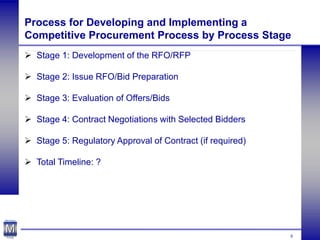
 Stage 1: Development of the RFO/RFP
 Stage 2: Issue RFO/Bid Preparation
 Stage 3: Evaluation of Offers/Bids
 Stage 4: Contract Negotiations with Selected Bidders
 Stage 5: Regulatory Approval of Contract (if required)
 Total Timeline: ?
M
M
Merrimack
Energy 6
Stage 1: Development of RFO/RFP
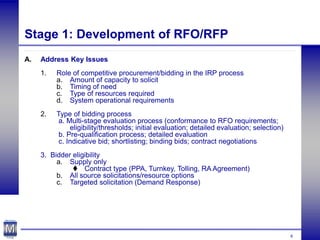
A. Address Key Issues
1. Role of competitive procurement/bidding in the IRP process
a. Amount of capacity to solicit
b. Timing of need
c. Type of resources required
d. System operational requirements
2. Type of bidding process
a. Multi-stage evaluation process (conformance to RFO requirements;
eligibility/thresholds; initial evaluation; detailed evaluation; selection)
b. Pre-qualification process; detailed evaluation
c. Indicative bid; shortlisting; binding bids; contract negotiations
3. Bidder eligibility
a. Supply only
 Contract type (PPA, Turnkey, Tolling, RA Agreement)
b. All source solicitations/resource options
c. Targeted solicitation (Demand Response)
M
M
Merrimack
Energy
Stage 1: Development of RFO/RFP
4. Project eligibility/threshold criteria
a. Project eligibility characteristics (size, resource type, COD date, location,
operational characteristics)
b. Site control
c. Interconnection status
5. Decisions regarding eligibility/threshold criteria
a. New, emerging market – utilize more lenient thresholds to encourage
competition
b. Mature market – stricter thresholds/more mature projects compete
6. Price Evaluation Methodology
a. Models/methodologies
b. Data requirements
c. Term of the evaluation
d. Evaluation of proposals with different term lengths
e. Development of input assumptions
f. Development of offer forms
g. Research assessments
– Capacity value
– Generation profiles/characteristics
– Load profile
– Transmission assessments
7
M
M
Merrimack
Energy 8
Stage 1: Development of RFO/RFP
A. Address Key Issues (cont.)
7. Role of price and non-price factors - options
a. Specific weights (i.e. 60% price/40% non-price) – objective process
b. Primarily price with non-price considered in evaluation as a risk factor or
subjective criteria
8. Non-price or qualitative factors
a. Project development feasibility/viability
b. Project operational viability
c. Operating profile
d. Flexibility provisions
9. Credit Issues/Security Requirements/Amount of Security Required
a. Development period security
b. Operational period security
M
M
Merrimack
Energy
Stage 1: Development of RFO/RFP
A. Address key issues (cont.)
10. Contract Issues
a. Development milestones
b. Events of default; Cure rights
c. Liquidated damages
d. Conditions precedent
e. Pricing provisions
f. Change in law risk
g. Force majeure
h. Operational performance standards
j. Termination rights
9
M
M
Merrimack
Energy 10
Stage 1: Develop RFP
A. Address Key Issues (cont)
11. Operational Requirements by resource type (renewable, storage, hybrid, etc.)
a. Dispatchability/Scheduling
b. Other requirements (ramp rates, quick start capability)
12. Transmission considerations
a. Timing of interconnection application
b. Completion of interconnection studies for each bid
c. CAISO transmission tariff
d. Cost of transmission upgrades to deliver power to load
13. Flexibility requirements
a. Contract flexibility to delay or accelerate in-service date
b. Contract buyout or acquisition option
M
M
Merrimack
Energy 11
Stage 1: Develop the RFO/RFP
B. Identification of Tasks/Schedule for Implementation
– 3-6 month timeframe from start to finish
– Develop schedule of tasks
C. Develop Evaluation Criteria and Weighting System
1. Threshold or minimum criteria
a. Lenient vs stringent threshold criteria
b. Price/non-price weights
c. Eligibility requirements
d. Overall evaluation process/methodology
D. Develop Internal Procedures Documentation
1. Organizational Structure
2. Documentation of decisions
3. Process for communications with Bidders and others
4. Reporting
5. Project Teams
6. Governance
M
M
Merrimack
Energy 12
Stage 1: Develop RFO/RFP
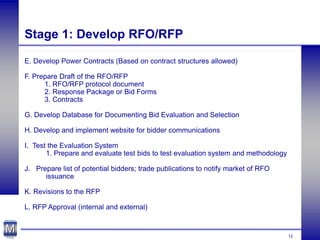
E. Develop Power Contracts (Based on contract structures allowed)
F. Prepare Draft of the RFO/RFP
1. RFO/RFP protocol document
2. Response Package or Bid Forms
3. Contracts
G. Develop Database for Documenting Bid Evaluation and Selection
H. Develop and implement website for bidder communications
I. Test the Evaluation System
1. Prepare and evaluate test bids to test evaluation system and methodology
J. Prepare list of potential bidders; trade publications to notify market of RFO
issuance
K. Revisions to the RFP
L. RFP Approval (internal and external)
M
M
Merrimack
Energy 13
Stage 2: Issue RFO/RFP/Bid Preparation
 Issue RFO/RFP
– To bidder list and trade publications and other outlets
 Organize and hold Bidders Conference or Bidders Webinar
– Decide on in-person conference or webinar only
 Notice of Intent to bid form submitted (if first RFO or unique RFO may provide
value for assessing potential offers)
 Respond to bidders questions
– Establish procedures and process for responding to bidder questions
– Hand-offs from RFO team to subject matter experts for responses if required
 Finalize evaluation process and methodology
 Complete preparation of input assumptions for evaluation
 Finalize process for including transmission costs in offer evaluation
M
M
Merrimack
Energy 14
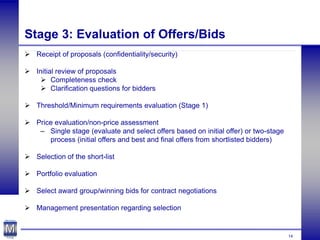
Stage 3: Evaluation of Offers/Bids
 Receipt of proposals (confidentiality/security)
 Initial review of proposals
 Completeness check
 Clarification questions for bidders
 Threshold/Minimum requirements evaluation (Stage 1)
 Price evaluation/non-price assessment
– Single stage (evaluate and select offers based on initial offer) or two-stage
process (initial offers and best and final offers from shortlisted bidders)
 Selection of the short-list
 Portfolio evaluation
 Select award group/winning bids for contract negotiations
 Management presentation regarding selection
M
M
Merrimack
Energy 15
Stage 4: Contract Negotiations
 Review exceptions to power contracts
 Organize contract negotiations team
 Legal
 Credit
 Commercial expertise
 Negotiate commercial terms
 Negotiate credit terms
 Finalize contracts
M
M
Merrimack
Energy 16
Stage 5: Regulatory Approvals (Utility
requirements)
 Advice Letter/application for contract approval
 Cost recovery issues
 Final approval
M
M
Merrimack
Energy
Recent Trends in Competitive Bidding
Lessons Learned
M
M
Merrimack
Energy 18
Recent Trends in Competitive
Procurement Processes
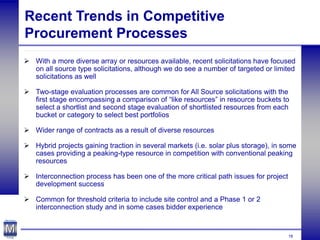
 With a more diverse array or resources available, recent solicitations have focused
on all source type solicitations, although we do see a number of targeted or limited
solicitations as well
 Two-stage evaluation processes are common for All Source solicitations with the
first stage encompassing a comparison of “like resources” in resource buckets to
select a shortlist and second stage evaluation of shortlisted resources from each
bucket or category to select best portfolios
 Wider range of contracts as a result of diverse resources
 Hybrid projects gaining traction in several markets (i.e. solar plus storage), in some
cases providing a peaking-type resource in competition with conventional peaking
resources
 Interconnection process has been one of the more critical path issues for project
development success
 Common for threshold criteria to include site control and a Phase 1 or 2
interconnection study and in some cases bidder experience
M
M
Merrimack
Energy 19
Recent Trends in Competitive Bidding
Processes
 Bidder response to power procurement solicitations has generally been robust with
a large number of bidders competing for most products
 Transmission costs and access are having an important impact for distinguishing
viable projects
 Price-related criteria are generally the predominant selection criteria
 Non-price used to ensure projects are viable
 Utilities utilize a range of processes that treat price and non-price criteria
differently
M
M
Merrimack
Energy 20
Lessons Learned
 It is important to establish the procurement rules, evaluation and selection criteria, and buyer
requirements for the solicitation process before issuing the RFO
 Preparation up-front is necessary, fair and consistent for all bidders
 Assume that not all bidders will be satisfied with the process
 Documentation of decisions regarding bid compliance and selection is very important
 Try to maintain the schedule included in the Protocol document. Deviations from schedule can
frustrate bidders
 While transparency in the solicitation process is important, open and transparent evaluation
systems can lead to gaming of bids and limit true competition. Process should be reasonably
transparent without providing evaluation models or input assumptions to bidders
 It is important in undertaking a competitive procurement process that the RFP, Contract, and
information required of bidders (i.e. Response Package or Offer Forms) are integrated and
linked. Ensure information requested from bidders is used in the evaluation
 Power contracting has become more complex and time consuming with new products and
resource options, including combinations of several resources in a portfolio
 All reasonable costs (bid prices and utility system costs) should be included in the evaluation
process
M
M
Merrimack
Energy
Characteristics of an Effective
Competitive Procurement Process
M
M
Merrimack
Energy 22
Characteristics of an Effective Competitive
Procurement Process
 The solicitation process should be fair and equitable, comprehensive, unbiased to
all bidders and reasonably transparent
 The solicitation process should ensure that competitive benefits for customers can
result from the process (enhance competition and provide clear and timely
directives to bidders)
 The solicitation process should be designed to encourage broad participation from
potential bidders via outreach initiatives to prospective bidders
 The RFP documents (i.e. RFO Protocol, Offer Forms or Response Package, and
Contracts) should describe the bidding guidelines, the bidding requirements to
guide bidders in preparing and submitting their proposals, the bid evaluation and
selection criteria, and the risk factors important to the utility issuing the RFO
 The Protocol documents should clearly identify the products solicited, the
procurement targets, define the characteristics of the products, the evaluation
criteria and process, utility’s principles and objectives for the solicitation, and the
information that bidders should provide to ensure the buyer can effectively conduct
the evaluation
M
M
Merrimack
Energy 23
Characteristics of an Effective Competitive
Bidding Process
 The price evaluation methodology should allow for consistent evaluation of offers
of different sizes, in-service dates and offer terms
– The Least Cost Best Fit methodology used by California IOUs is effective in
meeting these provisions
 The solicitation process should include thorough, consistent and accurate
information on which to evaluate bids, a consistent and equitable evaluation
process, documentation of decisions, and guidelines for undertaking the solicitation
process
 The solicitation process should ensure that the power purchase agreements are
designed to provide a reasonable balance between the objectives of the counter-
parties, seeking to minimize risk to utility customers, and shareholders while
ensuring that projects can be reasonably financed and constructed
 The solicitation process should incorporate the unique aspects of the utility system
and the preferences and requirements of the utility and its customers
 The solicitation process should be undertaken in a manner consistent with
pertinent statutory and regulatory requirements and objectives

Presentation on Competitive Procurement_Jan2020.ppt

  • 1.
    M M Merrimack Energy Competitive Procurement Process Developmentand Implementation Merrimack Energy Group, Inc.
  • 2.
    M M Merrimack Energy 2 Outline ofDiscussion  Process for Developing and Implementing an Effective Competitive Procurement Process  Recent Trends in Competitive Procurement/Competitive Bidding Processes  Lessons Learned Based on Recent Experiences  Characteristics of an Effective Competitive Procurement Process
  • 3.
    M M Merrimack Energy Objectives of Presentation Provide a template on competitive procurement processes to guide a utility or buying entity to develop and implement a competitive procurement process for securing electric power resources to meet system requirements  Discuss recent trends in competitive procurement and lessons learned with power procurement processes  Identify the characteristics of an effective procurement process from the perspective of an Independent Evaluator overseeing the process 3
  • 4.
    M M Merrimack Energy Process for Developingand Implementing a Competitive Procurement Program
  • 5.
    M M Merrimack Energy 5 Process forDeveloping and Implementing a Competitive Procurement Process by Process Stage  Stage 1: Development of the RFO/RFP  Stage 2: Issue RFO/Bid Preparation  Stage 3: Evaluation of Offers/Bids  Stage 4: Contract Negotiations with Selected Bidders  Stage 5: Regulatory Approval of Contract (if required)  Total Timeline: ?
  • 6.
    M M Merrimack Energy 6 Stage 1:Development of RFO/RFP A. Address Key Issues 1. Role of competitive procurement/bidding in the IRP process a. Amount of capacity to solicit b. Timing of need c. Type of resources required d. System operational requirements 2. Type of bidding process a. Multi-stage evaluation process (conformance to RFO requirements; eligibility/thresholds; initial evaluation; detailed evaluation; selection) b. Pre-qualification process; detailed evaluation c. Indicative bid; shortlisting; binding bids; contract negotiations 3. Bidder eligibility a. Supply only  Contract type (PPA, Turnkey, Tolling, RA Agreement) b. All source solicitations/resource options c. Targeted solicitation (Demand Response)
  • 7.
    M M Merrimack Energy Stage 1: Developmentof RFO/RFP 4. Project eligibility/threshold criteria a. Project eligibility characteristics (size, resource type, COD date, location, operational characteristics) b. Site control c. Interconnection status 5. Decisions regarding eligibility/threshold criteria a. New, emerging market – utilize more lenient thresholds to encourage competition b. Mature market – stricter thresholds/more mature projects compete 6. Price Evaluation Methodology a. Models/methodologies b. Data requirements c. Term of the evaluation d. Evaluation of proposals with different term lengths e. Development of input assumptions f. Development of offer forms g. Research assessments – Capacity value – Generation profiles/characteristics – Load profile – Transmission assessments 7
  • 8.
    M M Merrimack Energy 8 Stage 1:Development of RFO/RFP A. Address Key Issues (cont.) 7. Role of price and non-price factors - options a. Specific weights (i.e. 60% price/40% non-price) – objective process b. Primarily price with non-price considered in evaluation as a risk factor or subjective criteria 8. Non-price or qualitative factors a. Project development feasibility/viability b. Project operational viability c. Operating profile d. Flexibility provisions 9. Credit Issues/Security Requirements/Amount of Security Required a. Development period security b. Operational period security
  • 9.
    M M Merrimack Energy Stage 1: Developmentof RFO/RFP A. Address key issues (cont.) 10. Contract Issues a. Development milestones b. Events of default; Cure rights c. Liquidated damages d. Conditions precedent e. Pricing provisions f. Change in law risk g. Force majeure h. Operational performance standards j. Termination rights 9
  • 10.
    M M Merrimack Energy 10 Stage 1:Develop RFP A. Address Key Issues (cont) 11. Operational Requirements by resource type (renewable, storage, hybrid, etc.) a. Dispatchability/Scheduling b. Other requirements (ramp rates, quick start capability) 12. Transmission considerations a. Timing of interconnection application b. Completion of interconnection studies for each bid c. CAISO transmission tariff d. Cost of transmission upgrades to deliver power to load 13. Flexibility requirements a. Contract flexibility to delay or accelerate in-service date b. Contract buyout or acquisition option
  • 11.
    M M Merrimack Energy 11 Stage 1:Develop the RFO/RFP B. Identification of Tasks/Schedule for Implementation – 3-6 month timeframe from start to finish – Develop schedule of tasks C. Develop Evaluation Criteria and Weighting System 1. Threshold or minimum criteria a. Lenient vs stringent threshold criteria b. Price/non-price weights c. Eligibility requirements d. Overall evaluation process/methodology D. Develop Internal Procedures Documentation 1. Organizational Structure 2. Documentation of decisions 3. Process for communications with Bidders and others 4. Reporting 5. Project Teams 6. Governance
  • 12.
    M M Merrimack Energy 12 Stage 1:Develop RFO/RFP E. Develop Power Contracts (Based on contract structures allowed) F. Prepare Draft of the RFO/RFP 1. RFO/RFP protocol document 2. Response Package or Bid Forms 3. Contracts G. Develop Database for Documenting Bid Evaluation and Selection H. Develop and implement website for bidder communications I. Test the Evaluation System 1. Prepare and evaluate test bids to test evaluation system and methodology J. Prepare list of potential bidders; trade publications to notify market of RFO issuance K. Revisions to the RFP L. RFP Approval (internal and external)
  • 13.
    M M Merrimack Energy 13 Stage 2:Issue RFO/RFP/Bid Preparation  Issue RFO/RFP – To bidder list and trade publications and other outlets  Organize and hold Bidders Conference or Bidders Webinar – Decide on in-person conference or webinar only  Notice of Intent to bid form submitted (if first RFO or unique RFO may provide value for assessing potential offers)  Respond to bidders questions – Establish procedures and process for responding to bidder questions – Hand-offs from RFO team to subject matter experts for responses if required  Finalize evaluation process and methodology  Complete preparation of input assumptions for evaluation  Finalize process for including transmission costs in offer evaluation
  • 14.
    M M Merrimack Energy 14 Stage 3:Evaluation of Offers/Bids  Receipt of proposals (confidentiality/security)  Initial review of proposals  Completeness check  Clarification questions for bidders  Threshold/Minimum requirements evaluation (Stage 1)  Price evaluation/non-price assessment – Single stage (evaluate and select offers based on initial offer) or two-stage process (initial offers and best and final offers from shortlisted bidders)  Selection of the short-list  Portfolio evaluation  Select award group/winning bids for contract negotiations  Management presentation regarding selection
  • 15.
    M M Merrimack Energy 15 Stage 4:Contract Negotiations  Review exceptions to power contracts  Organize contract negotiations team  Legal  Credit  Commercial expertise  Negotiate commercial terms  Negotiate credit terms  Finalize contracts
  • 16.
    M M Merrimack Energy 16 Stage 5:Regulatory Approvals (Utility requirements)  Advice Letter/application for contract approval  Cost recovery issues  Final approval
  • 17.
    M M Merrimack Energy Recent Trends inCompetitive Bidding Lessons Learned
  • 18.
    M M Merrimack Energy 18 Recent Trendsin Competitive Procurement Processes  With a more diverse array or resources available, recent solicitations have focused on all source type solicitations, although we do see a number of targeted or limited solicitations as well  Two-stage evaluation processes are common for All Source solicitations with the first stage encompassing a comparison of “like resources” in resource buckets to select a shortlist and second stage evaluation of shortlisted resources from each bucket or category to select best portfolios  Wider range of contracts as a result of diverse resources  Hybrid projects gaining traction in several markets (i.e. solar plus storage), in some cases providing a peaking-type resource in competition with conventional peaking resources  Interconnection process has been one of the more critical path issues for project development success  Common for threshold criteria to include site control and a Phase 1 or 2 interconnection study and in some cases bidder experience
  • 19.
    M M Merrimack Energy 19 Recent Trendsin Competitive Bidding Processes  Bidder response to power procurement solicitations has generally been robust with a large number of bidders competing for most products  Transmission costs and access are having an important impact for distinguishing viable projects  Price-related criteria are generally the predominant selection criteria  Non-price used to ensure projects are viable  Utilities utilize a range of processes that treat price and non-price criteria differently
  • 20.
    M M Merrimack Energy 20 Lessons Learned It is important to establish the procurement rules, evaluation and selection criteria, and buyer requirements for the solicitation process before issuing the RFO  Preparation up-front is necessary, fair and consistent for all bidders  Assume that not all bidders will be satisfied with the process  Documentation of decisions regarding bid compliance and selection is very important  Try to maintain the schedule included in the Protocol document. Deviations from schedule can frustrate bidders  While transparency in the solicitation process is important, open and transparent evaluation systems can lead to gaming of bids and limit true competition. Process should be reasonably transparent without providing evaluation models or input assumptions to bidders  It is important in undertaking a competitive procurement process that the RFP, Contract, and information required of bidders (i.e. Response Package or Offer Forms) are integrated and linked. Ensure information requested from bidders is used in the evaluation  Power contracting has become more complex and time consuming with new products and resource options, including combinations of several resources in a portfolio  All reasonable costs (bid prices and utility system costs) should be included in the evaluation process
  • 21.
    M M Merrimack Energy Characteristics of anEffective Competitive Procurement Process
  • 22.
    M M Merrimack Energy 22 Characteristics ofan Effective Competitive Procurement Process  The solicitation process should be fair and equitable, comprehensive, unbiased to all bidders and reasonably transparent  The solicitation process should ensure that competitive benefits for customers can result from the process (enhance competition and provide clear and timely directives to bidders)  The solicitation process should be designed to encourage broad participation from potential bidders via outreach initiatives to prospective bidders  The RFP documents (i.e. RFO Protocol, Offer Forms or Response Package, and Contracts) should describe the bidding guidelines, the bidding requirements to guide bidders in preparing and submitting their proposals, the bid evaluation and selection criteria, and the risk factors important to the utility issuing the RFO  The Protocol documents should clearly identify the products solicited, the procurement targets, define the characteristics of the products, the evaluation criteria and process, utility’s principles and objectives for the solicitation, and the information that bidders should provide to ensure the buyer can effectively conduct the evaluation
  • 23.
    M M Merrimack Energy 23 Characteristics ofan Effective Competitive Bidding Process  The price evaluation methodology should allow for consistent evaluation of offers of different sizes, in-service dates and offer terms – The Least Cost Best Fit methodology used by California IOUs is effective in meeting these provisions  The solicitation process should include thorough, consistent and accurate information on which to evaluate bids, a consistent and equitable evaluation process, documentation of decisions, and guidelines for undertaking the solicitation process  The solicitation process should ensure that the power purchase agreements are designed to provide a reasonable balance between the objectives of the counter- parties, seeking to minimize risk to utility customers, and shareholders while ensuring that projects can be reasonably financed and constructed  The solicitation process should incorporate the unique aspects of the utility system and the preferences and requirements of the utility and its customers  The solicitation process should be undertaken in a manner consistent with pertinent statutory and regulatory requirements and objectives