CAN HOSTILE INTENT BE
DETECTED BY MEANS OF
     SIGNALING?
        M.R. Stekkinger
      28th of August 2012
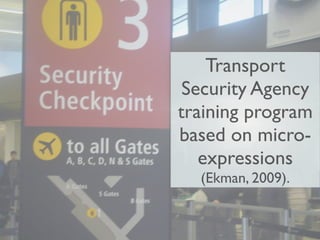
Transport
 Security Agency
training program
based on micro-
   expressions
  (Ekman, 2009).
Micro-expressions are also visible in
      genuine statements
       (Porter & ten Brinke, 2008)
More than 150 deviant behaviors!

  Can you detect all of them?
Limits of current methodology


• Forced   to interact with suspicious person
Limits of current methodology


• Forced   to interact with suspicious person
• Primary   focus is on visceral expressions
Limits of current methodology


• Forced   to interact with suspicious person
• Primary   focus is on visceral expressions
•A  lot of information is needed to make a
 judgment!
A signal used at greater than interpersonal
           distance by a police officer,

    which can magnify the behavioral
               differences,

    between individuals with and without
              hostile intent.
Why would individuals with hostile
intent differ from normal individuals?
Why would individuals with hostile
intent differ from normal individuals?
Why would individuals with hostile
intent differ from normal individuals?


 It is hard and stressful to hide
intent (Burgoon, et al., 2009; Eachus, Stedmon, & Baillie, In
                           press).
Compare it with hiding a stigma
            (Pachankis, 2007).


 Hiding non-visible secrets makes a
person vigilant towards his or her
           surroundings.
Am I doing
 enough to
   hide my
 intentions?

Who suspects
 my secret?
Self-conscious thoughts

Vigilance towards behavior in one’s
          direct surroundings
Self-conscious thoughts

Vigilance towards behavior in one’s
          direct surroundings

 Seeing yourself as the target of
      social information
 (Mendoza-Denton, Downey, Darvis, Purdie, & Pietrzak, 2002;
 Galbraith, Manktelow, & Morris, 2008; Riggio & Kwong, 2009;
                  Santuzzi & Ruscher, 2002)
Activation of the cognitive ‘self ’

 Seeing yourself as the cause of
(hypothetical) situations (Fenigstein, 1984).
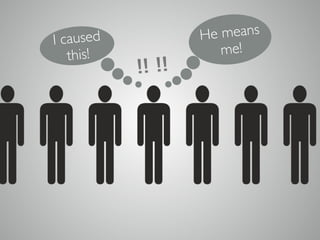
!! !!
I caused           He means
   this!              me!
           !! !!
Amplified by the accessibility of the
concepts of ‘Threat’ and ‘Danger’
            (Srull & Wyer, 1979).
Amplified by the accessibility of the
concepts of ‘Threat’ and ‘Danger’
                (Srull & Wyer, 1979).


Alert towards stimuli that can be
interpreted as such (Moskowitz & Skurnik, 1999;
             Pilkington & Woods, 1999).
Cognitive pressure; resulting
    in rigid behavior.
(cf., Lane & Wegner, 1995; Vrij, Granhag, Mann, & Leal, 2011)
Hypotheses Hostile Intent

Individuals with hostile intent will show:
Hypotheses Hostile Intent

 Individuals with hostile intent will show:
• Less   arm, head, hand movements;
•A heightened perception of (public)
 self-awareness;
•A heightened perception of the self as
 target of social interaction,
 as compared to individuals without hostile intent.
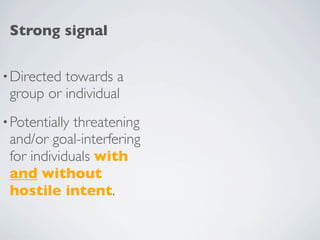
Strong signal


• Directedtowards a
 group or individual
• Potentiallythreatening
 and/or goal-interfering
 for individuals with
 and without
 hostile intent.
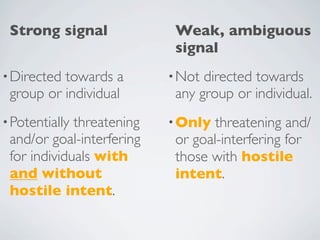
Strong signal              Weak, ambiguous
                            signal
• Directedtowards a        • Not directed towards
 group or individual        any group or individual.
• Potentiallythreatening   • Only  threatening and/
 and/or goal-interfering    or goal-interfering for
 for individuals with       those with hostile
 and without                intent.
 hostile intent.
Hypothesis Signal

Individuals with hostile intent will show
fewer gestures, but more orientating
reflexes towards the source of the signal, than
individuals without hostile intent, but these
differences between individuals will
particularly be visible when they are
confronted with a weak, ambiguous signal
and will be absent when confronted with a
strong signal.
EXPERIMENT I
Hostile intent Manipulation

          Hostile intent:
Hostile intent Manipulation

          Hostile intent:
          If stopped by police officer:
          - Longer experiment;
          interrogation and no
          compensation for time lost.
          - Lose ticket for iPod.
Hostile intent Manipulation

          Hostile intent:
          If stopped by police officer:
          - Longer experiment;
          interrogation and no
          compensation for time lost.
          - Lose ticket for iPod.
          In case of success:
          - Extra ticket for iPod.
Hostile intent Manipulation


          Non-Hostile Intent:
          Receives an extra ticket
          regardless if the police officer
          stops them.
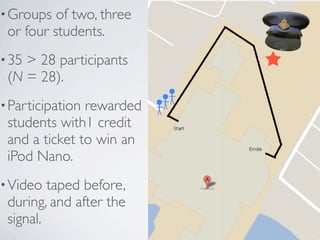
• Groups  of two, three
 or four students.
• 35> 28 participants
 (N = 28).
• Participationrewarded
 students with1 credit
 and a ticket to win an
 iPod Nano.
• Video  taped before,
 during, and after the
 signal.
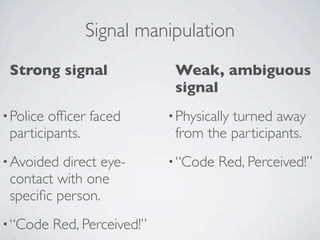
Signal manipulation
Signal manipulation
 Strong signal


• Policeofficer faced
 participants.
• Avoided direct eye-
 contact with one
 specific person.
• “Code    Red, Perceived!”
Signal manipulation
 Strong signal                 Weak, ambiguous
                               signal
• Policeofficer faced          • Physically
                                        turned away
 participants.                 from the participants.
• Avoided direct eye-         • “Code   Red, Perceived!”
 contact with one
 specific person.
• “Code    Red, Perceived!”
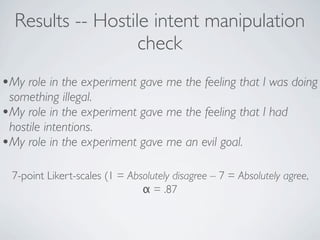
Results -- Hostile intent manipulation
                   check
•My role in the experiment gave me the feeling that I was doing
 something illegal.
•My role in the experiment gave me the feeling that I had
 hostile intentions.
•My role in the experiment gave me an evil goal.
  7-point Likert-scales (1 = Absolutely disagree – 7 = Absolutely agree,
                                α = .87
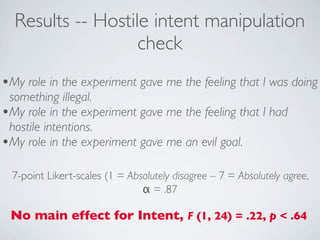
Results -- Hostile intent manipulation
                   check
•My role in the experiment gave me the feeling that I was doing
 something illegal.
•My role in the experiment gave me the feeling that I had
 hostile intentions.
•My role in the experiment gave me an evil goal.
  7-point Likert-scales (1 = Absolutely disagree – 7 = Absolutely agree,
                                α = .87

 No main effect for Intent, F (1, 24) = .22, p < .64
Results -- Hostile intent manipulation
                 check
Results -- Hostile intent manipulation
                   check

•Activation of cognitive themes of danger and
 threat (Srull & Weyer, 1979).
Results -- Hostile intent manipulation
                   check

•Activation of cognitive themes of danger and
 threat (Srull & Weyer, 1979).

•Positive feelings after completing a devious
 mission (cf. duping delight, Vrij, 2008).
Results -- Signal manipulation check


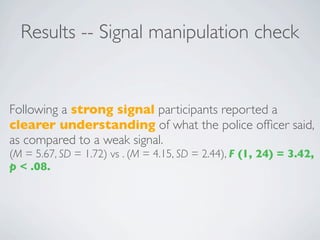
Following a strong signal participants reported a
clearer understanding of what the police officer said,
as compared to a weak signal.
(M = 5.67, SD = 1.72) vs . (M = 4.15, SD = 2.44), F (1, 24) = 3.42,
p < .08.
Results -- Signal manipulation check


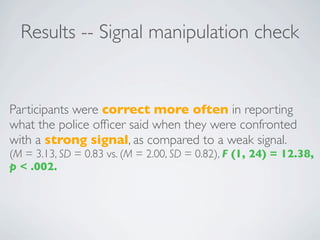
Participants were correct more often in reporting
what the police officer said when they were confronted
with a strong signal, as compared to a weak signal.
(M = 3.13, SD = 0.83 vs. (M = 2.00, SD = 0.82), F (1, 24) = 12.38,
p < .002.
Results -- Self as target scale

•Main effect Intent, F (1, 24) = 5.37, p < .03.
•Interaction effect Intent x Signal, F (1, 24) = 6.68, p < .02.
•No main effect for signal, F (1, 24) < 1.
Results -- Self as target scale

    Individuals with hostile intent confronted with a
strong signal experienced a significantly stronger
feeling of being the target of interaction, as opposed
  to individuals without hostile intent confronted with the
                         same signal!

              Simple contrast strong signal:
           Hostile Intent (M = 4.78, SD = 1.23) vs.
          Non-Hostile Intent (M = 2.86, SD = 1.07),
                F (1, 24) = 12.95, p < .001
Results -- Self as target scale


No differences reported between Intent when looking
       at those confronted with a weak signal.

               Simple contrast weak signal:
         Hostile intent (M = 4.07, SD = 0.73) vs
   Non-hostile intent (M = 4.17, SD = 0.93), F (1, 24) < 1.
Results -- Public self-awareness scale


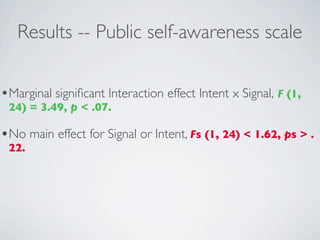
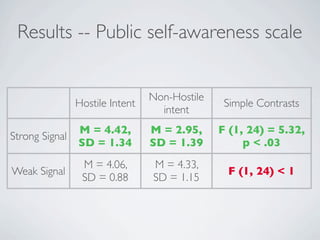
•Marginal significant Interaction effect Intent x Signal, F (1,
 24) = 3.49, p < .07.

•No main effect for Signal or Intent, Fs (1, 24) < 1.62, ps > .
 22.
Results -- Public self-awareness scale


                                 Non-Hostile
                Hostile Intent                  Simple Contrasts
                                   intent
                M = 4.42,        M = 2.95,     F (1, 24) = 5.32,
Strong Signal
                SD = 1.34        SD = 1.39          p < .03
                 M = 4.06,       M = 4.33,
Weak Signal                                     F (1, 24) < 1
                 SD = 0.88       SD = 1.15
Results -- Video coding

•Videos were broken down in three segments: Before the
 signal, at the moment of the signal, and after the signal.
Results -- Video coding

•Videos were broken down in three segments: Before the
 signal, at the moment of the signal, and after the signal.

•Just one participant exhibited clear non-verbal
 behavior!
Results -- Video coding

•Videos were broken down in three segments: Before the
 signal, at the moment of the signal, and after the signal.

•Just one participant exhibited clear non-verbal
 behavior!

•The Orientating reflex (M = .64, SD = 0.49) revealed no
 significant effects, Fs (1,24) < 1.29, ps > .27.
Discussion - Experiment 1


 Effects most pronounced when a strong
           signal was present?


Police officer = unexpected stimulus in
                  itself?
Discussion - Experiment 1


Strong signal becomes a weaker signal?
     Weak signal becomes trivial?
Discussion - Experiment 1

Mental shift in attention, but no physical
           behavior changes?

 Coding separate parts and separate
 behaviors of the videos vs. analyzing the
          complete video?
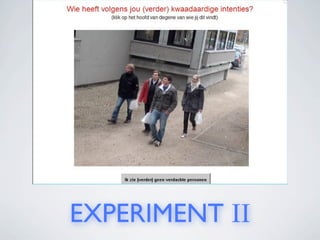
EXPERIMENT II
Experiment 2: Hypotheses


Experts will achieve higher accuracy
  scores, as compared to laypeople.
Experiment 2: Hypotheses


Experts will achieve higher accuracy
  scores, as compared to laypeople.

  Experts will give more elaborate
statements, as compared to laypersons.
Experiment 2: Hypotheses


 Experts will achieve higher accuracy
  scores on strong signal videos, as
compared to laypersons. These differences will
 be absent when judging weak signal videos.
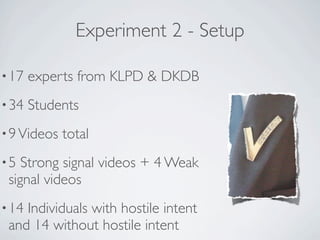
Experiment 2 - Setup

• 17   experts from KLPD & DKDB
• 34   Students
• 9 Videos   total
•5  Strong signal videos + 4 Weak
 signal videos
• 14Individuals with hostile intent
 and 14 without hostile intent
Experiment 2 - Setup

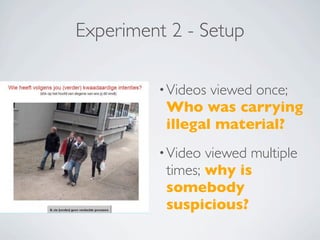
         • Videosviewed once;
          Who was carrying
          illegal material?
         • Video viewed multiple
          times; why is
          somebody
          suspicious?
Experiment 2 - Results

  Experts are more accurate than laypersons,
                 F (1, 49) = 6.44, p < .01.

    Experts (M = 54.26% [95% CI = 49.93 – 58.60%] ± 2.16%),
vs. laypersons (M = 47.56% [95% CI = 44.49 – 50.62%] ± 1.53%)
Experiment 2 - Results

    A strong signal revealed more accurate
        scores, as compared to a weak signal,
                F (1, 49) = 10.95, p < .002.

 Strong signal (M = 56.05% [95% CI = 51.84 – 60.27%] ± 2.10%),
vs. Weak signal (M = 45.77% [95% CI = 41.79 - 49.75%] ± 1.98%)
Experiment 2 - Results

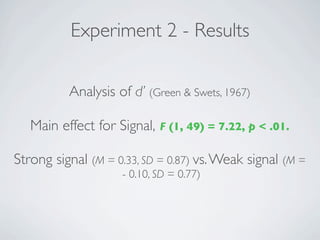
          Analysis of d’ (Green & Swets, 1967)

   Main effect for Signal, F (1, 49) = 7.22, p < .01.

Strong signal (M = 0.33, SD = 0.87) vs. Weak signal (M =
                    - 0.10, SD = 0.77)
Experiment 2 - Results

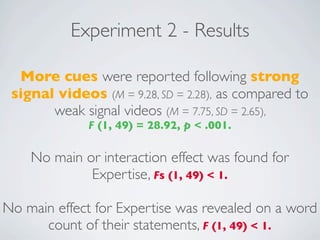
  More cues were reported following strong
 signal videos (M = 9.28, SD = 2.28), as compared to
       weak signal videos (M = 7.75, SD = 2.65),
              F (1, 49) = 28.92, p < .001.

    No main or interaction effect was found for
             Expertise, Fs (1, 49) < 1.

No main effect for Expertise was revealed on a word
      count of their statements, F (1, 49) < 1.
General Discussion
General discussion
General discussion


Is a strong signal better than a
          weak signal?
Is a strong signal better than a
             weak signal?


• Higher   accuracy, more behavioral cues.
Is a strong signal better than a
              weak signal?


• Higher   accuracy, more behavioral cues.
• Result
       of the length of the video? and not the
 response to the signal?
Is a strong signal better than a
              weak signal?


• Higher   accuracy, more behavioral cues.
• Result
       of the length of the video? and not the
 response to the signal?
• Expertise?
CAN A SIGNAL AID
THE DETECTION OF
 HOSTILE INTENT?
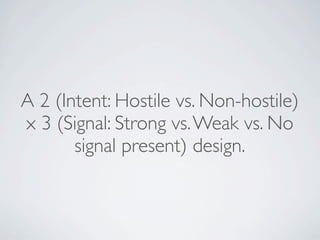
A 2 (Intent: Hostile vs. Non-hostile)
x 3 (Signal: Strong vs. Weak vs. No
       signal present) design.
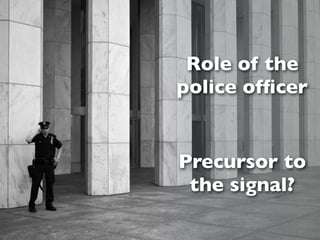
Role of the
police officer


Precursor to
 the signal?
Limitations and Recommendations


      Small sample size experiment one.

Experts recommended more naturalistic setting
            for experiment one.

   No reaction times from experiment two.
CONCLUSIONS

    Detecting intent is hard! (cf. Eachus, et al., In Press)

         Make it difficult for suspicious persons
             - build cognitive load!!

No judgment can be made from just one indicator!
PICTURE CREDITS
•   Twin Towers: Jeff Mock (jeff@mock.com)

•   Security Gate: Unknown

•   Ssst photo: http://zoom.nl/foto/187163/portret/ssst---.html

•   Experiment 1 + bag + screenshots + sunset: M.R. Stekkinger (m.stekkinger@gmail.com)

•   Black figures: jayofboy at stock.xchng

•   Spider: TheOrangeTiger on deviantART

•   Police hat: Politie Arnhem (http://bit.ly/NtzkyZ)

•   Police officer: 85mm.ch Thomas Leuthard

Presentation Masterthesis

  • 2.
    CAN HOSTILE INTENTBE DETECTED BY MEANS OF SIGNALING? M.R. Stekkinger 28th of August 2012
  • 4.
    Transport Security Agency trainingprogram based on micro- expressions (Ekman, 2009).
  • 5.
    Micro-expressions are alsovisible in genuine statements (Porter & ten Brinke, 2008)
  • 6.
    More than 150deviant behaviors! Can you detect all of them?
  • 7.
    Limits of currentmethodology
  • 8.
    Limits of currentmethodology • Forced to interact with suspicious person
  • 9.
    Limits of currentmethodology • Forced to interact with suspicious person • Primary focus is on visceral expressions
  • 10.
    Limits of currentmethodology • Forced to interact with suspicious person • Primary focus is on visceral expressions •A lot of information is needed to make a judgment!
  • 11.
    A signal usedat greater than interpersonal distance by a police officer, which can magnify the behavioral differences, between individuals with and without hostile intent.
  • 12.
    Why would individualswith hostile intent differ from normal individuals?
  • 13.
    Why would individualswith hostile intent differ from normal individuals?
  • 14.
    Why would individualswith hostile intent differ from normal individuals? It is hard and stressful to hide intent (Burgoon, et al., 2009; Eachus, Stedmon, & Baillie, In press).
  • 16.
    Compare it withhiding a stigma (Pachankis, 2007). Hiding non-visible secrets makes a person vigilant towards his or her surroundings.
  • 18.
    Am I doing enough to hide my intentions? Who suspects my secret?
  • 20.
  • 21.
    Self-conscious thoughts Vigilance towardsbehavior in one’s direct surroundings
  • 22.
    Self-conscious thoughts Vigilance towardsbehavior in one’s direct surroundings Seeing yourself as the target of social information (Mendoza-Denton, Downey, Darvis, Purdie, & Pietrzak, 2002; Galbraith, Manktelow, & Morris, 2008; Riggio & Kwong, 2009; Santuzzi & Ruscher, 2002)
  • 24.
    Activation of thecognitive ‘self ’
  • 25.
    Activation of thecognitive ‘self ’ Seeing yourself as the cause of (hypothetical) situations (Fenigstein, 1984).
  • 26.
  • 27.
    I caused He means this! me! !! !!
  • 29.
    Amplified by theaccessibility of the concepts of ‘Threat’ and ‘Danger’ (Srull & Wyer, 1979).
  • 30.
    Amplified by theaccessibility of the concepts of ‘Threat’ and ‘Danger’ (Srull & Wyer, 1979). Alert towards stimuli that can be interpreted as such (Moskowitz & Skurnik, 1999; Pilkington & Woods, 1999).
  • 31.
    Cognitive pressure; resulting in rigid behavior. (cf., Lane & Wegner, 1995; Vrij, Granhag, Mann, & Leal, 2011)
  • 32.
  • 33.
    Hypotheses Hostile Intent Individualswith hostile intent will show:
  • 34.
    Hypotheses Hostile Intent Individuals with hostile intent will show: • Less arm, head, hand movements; •A heightened perception of (public) self-awareness; •A heightened perception of the self as target of social interaction, as compared to individuals without hostile intent.
  • 37.
    Strong signal • Directedtowardsa group or individual • Potentiallythreatening and/or goal-interfering for individuals with and without hostile intent.
  • 38.
    Strong signal Weak, ambiguous signal • Directedtowards a • Not directed towards group or individual any group or individual. • Potentiallythreatening • Only threatening and/ and/or goal-interfering or goal-interfering for for individuals with those with hostile and without intent. hostile intent.
  • 39.
    Hypothesis Signal Individuals withhostile intent will show fewer gestures, but more orientating reflexes towards the source of the signal, than individuals without hostile intent, but these differences between individuals will particularly be visible when they are confronted with a weak, ambiguous signal and will be absent when confronted with a strong signal.
  • 41.
  • 42.
  • 43.
  • 44.
    Hostile intent Manipulation Hostile intent: If stopped by police officer: - Longer experiment; interrogation and no compensation for time lost. - Lose ticket for iPod.
  • 45.
    Hostile intent Manipulation Hostile intent: If stopped by police officer: - Longer experiment; interrogation and no compensation for time lost. - Lose ticket for iPod. In case of success: - Extra ticket for iPod.
  • 46.
  • 47.
    Hostile intent Manipulation Non-Hostile Intent: Receives an extra ticket regardless if the police officer stops them.
  • 48.
    • Groups of two, three or four students. • 35> 28 participants (N = 28). • Participationrewarded students with1 credit and a ticket to win an iPod Nano. • Video taped before, during, and after the signal.
  • 49.
  • 50.
    Signal manipulation Strongsignal • Policeofficer faced participants. • Avoided direct eye- contact with one specific person. • “Code Red, Perceived!”
  • 51.
    Signal manipulation Strongsignal Weak, ambiguous signal • Policeofficer faced • Physically turned away participants. from the participants. • Avoided direct eye- • “Code Red, Perceived!” contact with one specific person. • “Code Red, Perceived!”
  • 52.
    Results -- Hostileintent manipulation check •My role in the experiment gave me the feeling that I was doing something illegal. •My role in the experiment gave me the feeling that I had hostile intentions. •My role in the experiment gave me an evil goal. 7-point Likert-scales (1 = Absolutely disagree – 7 = Absolutely agree, α = .87
  • 53.
    Results -- Hostileintent manipulation check •My role in the experiment gave me the feeling that I was doing something illegal. •My role in the experiment gave me the feeling that I had hostile intentions. •My role in the experiment gave me an evil goal. 7-point Likert-scales (1 = Absolutely disagree – 7 = Absolutely agree, α = .87 No main effect for Intent, F (1, 24) = .22, p < .64
  • 54.
    Results -- Hostileintent manipulation check
  • 55.
    Results -- Hostileintent manipulation check •Activation of cognitive themes of danger and threat (Srull & Weyer, 1979).
  • 56.
    Results -- Hostileintent manipulation check •Activation of cognitive themes of danger and threat (Srull & Weyer, 1979). •Positive feelings after completing a devious mission (cf. duping delight, Vrij, 2008).
  • 57.
    Results -- Signalmanipulation check
  • 58.
    Results -- Signalmanipulation check Following a strong signal participants reported a clearer understanding of what the police officer said, as compared to a weak signal. (M = 5.67, SD = 1.72) vs . (M = 4.15, SD = 2.44), F (1, 24) = 3.42, p < .08.
  • 59.
    Results -- Signalmanipulation check Participants were correct more often in reporting what the police officer said when they were confronted with a strong signal, as compared to a weak signal. (M = 3.13, SD = 0.83 vs. (M = 2.00, SD = 0.82), F (1, 24) = 12.38, p < .002.
  • 60.
    Results -- Selfas target scale •Main effect Intent, F (1, 24) = 5.37, p < .03. •Interaction effect Intent x Signal, F (1, 24) = 6.68, p < .02. •No main effect for signal, F (1, 24) < 1.
  • 61.
    Results -- Selfas target scale Individuals with hostile intent confronted with a strong signal experienced a significantly stronger feeling of being the target of interaction, as opposed to individuals without hostile intent confronted with the same signal! Simple contrast strong signal: Hostile Intent (M = 4.78, SD = 1.23) vs. Non-Hostile Intent (M = 2.86, SD = 1.07), F (1, 24) = 12.95, p < .001
  • 62.
    Results -- Selfas target scale No differences reported between Intent when looking at those confronted with a weak signal. Simple contrast weak signal: Hostile intent (M = 4.07, SD = 0.73) vs Non-hostile intent (M = 4.17, SD = 0.93), F (1, 24) < 1.
  • 63.
    Results -- Publicself-awareness scale
  • 64.
    Results -- Publicself-awareness scale •Marginal significant Interaction effect Intent x Signal, F (1, 24) = 3.49, p < .07. •No main effect for Signal or Intent, Fs (1, 24) < 1.62, ps > . 22.
  • 65.
    Results -- Publicself-awareness scale Non-Hostile Hostile Intent Simple Contrasts intent M = 4.42, M = 2.95, F (1, 24) = 5.32, Strong Signal SD = 1.34 SD = 1.39 p < .03 M = 4.06, M = 4.33, Weak Signal F (1, 24) < 1 SD = 0.88 SD = 1.15
  • 66.
  • 67.
    Results -- Videocoding •Videos were broken down in three segments: Before the signal, at the moment of the signal, and after the signal.
  • 68.
    Results -- Videocoding •Videos were broken down in three segments: Before the signal, at the moment of the signal, and after the signal. •Just one participant exhibited clear non-verbal behavior!
  • 69.
    Results -- Videocoding •Videos were broken down in three segments: Before the signal, at the moment of the signal, and after the signal. •Just one participant exhibited clear non-verbal behavior! •The Orientating reflex (M = .64, SD = 0.49) revealed no significant effects, Fs (1,24) < 1.29, ps > .27.
  • 70.
    Discussion - Experiment1 Effects most pronounced when a strong signal was present? Police officer = unexpected stimulus in itself?
  • 71.
    Discussion - Experiment1 Strong signal becomes a weaker signal? Weak signal becomes trivial?
  • 72.
    Discussion - Experiment1 Mental shift in attention, but no physical behavior changes? Coding separate parts and separate behaviors of the videos vs. analyzing the complete video?
  • 74.
  • 75.
  • 76.
    Experiment 2: Hypotheses Expertswill achieve higher accuracy scores, as compared to laypeople.
  • 77.
    Experiment 2: Hypotheses Expertswill achieve higher accuracy scores, as compared to laypeople. Experts will give more elaborate statements, as compared to laypersons.
  • 78.
  • 79.
    Experiment 2: Hypotheses Experts will achieve higher accuracy scores on strong signal videos, as compared to laypersons. These differences will be absent when judging weak signal videos.
  • 80.
    Experiment 2 -Setup • 17 experts from KLPD & DKDB • 34 Students • 9 Videos total •5 Strong signal videos + 4 Weak signal videos • 14Individuals with hostile intent and 14 without hostile intent
  • 81.
    Experiment 2 -Setup • Videosviewed once; Who was carrying illegal material? • Video viewed multiple times; why is somebody suspicious?
  • 82.
  • 83.
    Experiment 2 -Results Experts are more accurate than laypersons, F (1, 49) = 6.44, p < .01. Experts (M = 54.26% [95% CI = 49.93 – 58.60%] ± 2.16%), vs. laypersons (M = 47.56% [95% CI = 44.49 – 50.62%] ± 1.53%)
  • 84.
    Experiment 2 -Results A strong signal revealed more accurate scores, as compared to a weak signal, F (1, 49) = 10.95, p < .002. Strong signal (M = 56.05% [95% CI = 51.84 – 60.27%] ± 2.10%), vs. Weak signal (M = 45.77% [95% CI = 41.79 - 49.75%] ± 1.98%)
  • 85.
    Experiment 2 -Results Analysis of d’ (Green & Swets, 1967) Main effect for Signal, F (1, 49) = 7.22, p < .01. Strong signal (M = 0.33, SD = 0.87) vs. Weak signal (M = - 0.10, SD = 0.77)
  • 86.
    Experiment 2 -Results More cues were reported following strong signal videos (M = 9.28, SD = 2.28), as compared to weak signal videos (M = 7.75, SD = 2.65), F (1, 49) = 28.92, p < .001. No main or interaction effect was found for Expertise, Fs (1, 49) < 1. No main effect for Expertise was revealed on a word count of their statements, F (1, 49) < 1.
  • 87.
  • 88.
  • 89.
    General discussion Is astrong signal better than a weak signal?
  • 90.
    Is a strongsignal better than a weak signal? • Higher accuracy, more behavioral cues.
  • 91.
    Is a strongsignal better than a weak signal? • Higher accuracy, more behavioral cues. • Result of the length of the video? and not the response to the signal?
  • 92.
    Is a strongsignal better than a weak signal? • Higher accuracy, more behavioral cues. • Result of the length of the video? and not the response to the signal? • Expertise?
  • 93.
    CAN A SIGNALAID THE DETECTION OF HOSTILE INTENT?
  • 94.
    A 2 (Intent:Hostile vs. Non-hostile) x 3 (Signal: Strong vs. Weak vs. No signal present) design.
  • 95.
    Role of the policeofficer Precursor to the signal?
  • 96.
    Limitations and Recommendations Small sample size experiment one. Experts recommended more naturalistic setting for experiment one. No reaction times from experiment two.
  • 97.
    CONCLUSIONS Detecting intent is hard! (cf. Eachus, et al., In Press) Make it difficult for suspicious persons - build cognitive load!! No judgment can be made from just one indicator!
  • 98.
    PICTURE CREDITS • Twin Towers: Jeff Mock (jeff@mock.com) • Security Gate: Unknown • Ssst photo: http://zoom.nl/foto/187163/portret/ssst---.html • Experiment 1 + bag + screenshots + sunset: M.R. Stekkinger (m.stekkinger@gmail.com) • Black figures: jayofboy at stock.xchng • Spider: TheOrangeTiger on deviantART • Police hat: Politie Arnhem (http://bit.ly/NtzkyZ) • Police officer: 85mm.ch Thomas Leuthard

Editor's Notes

  • #2 Terrorists &gt; Twin Towers ---- changed security around the world -&gt; focus on preventing the next terrorist attack, finding the next person with hostile intentions\n\n
  • #3 Title of the research project\n
  • #4 How does one detect suspicious behavior? The Transport secuirty agency train security officer to look for suspicious facial expressions - the so called micro-expressions, when talking to travelers. Several drawbacks can be identified from using this method!\n

  • #5 How does one detect suspicious behavior? The Transport secuirty agency train security officer to look for suspicious facial expressions - the so called micro-expressions, when talking to travelers. Several drawbacks can be identified from using this method!\n
  • #6 For one micro-expressions are not limited to deceptive statements!\n
  • #7 There are over 150 deviant behaviors which cannot be detected when talking to a person.\n
  • #8 Problem current method:\n
  • #9 Problem current method:\n
  • #10 Problem current method:\n
  • #11 What we propose is simple:\n
  • #12 But why should a person with hostile intentions differ from you and me?\n
  • #13 But why should a person with hostile intentions differ from you and me?\n
  • #14 A stigma is a non-visible characteristic on which a taboo is held by society \nA person who is HIV positive does not say: Hi I am HIV positive when at a party -- Feel free to talk about me! ---&gt; High costs associated with discovery.\n= same as hiding intentions: non visible secret and high costs (dark hole in the ground)\n
  • #15 A person hiding his intentions will constantly be aware and thinking about it.\n
  • #16 A person hiding his intentions will constantly be aware and thinking about it.\n
  • #17 It is also paired with:\n
  • #18 It is also paired with:\n
  • #19 It is also paired with:\n
  • #20 It is also paired with:\n
  • #21 These phenemenon show people hiding their intentions to be very aware of who they are, and how they are interacting with their surroundings!\n
  • #22 These phenemenon show people hiding their intentions to be very aware of who they are, and how they are interacting with their surroundings!\n
  • #23 To clarify, Imagine a pickpocket; this could happen.\n
  • #24 To clarify, Imagine a pickpocket; this could happen.\n
  • #25 To clarify, Imagine a pickpocket; this could happen.\n
  • #26 To clarify, Imagine a pickpocket; this could happen.\n
  • #27 To clarify, Imagine a pickpocket; this could happen.\n
  • #28 To clarify, Imagine a pickpocket; this could happen.\n
  • #29 To clarify, Imagine a pickpocket; this could happen.\n
  • #30 To clarify, Imagine a pickpocket; this could happen.\n
  • #31 To clarify, Imagine a pickpocket; this could happen.\n
  • #32 To clarify, Imagine a pickpocket; this could happen.\n
  • #33 These effects are amplified by the accessability of cognitive themes (thinking about what happens when you blow up a train station)!\nPeople are therefore very alert to anything that can be interpreted as threatening!\n
  • #34 These effects are amplified by the accessability of cognitive themes (thinking about what happens when you blow up a train station)!\nPeople are therefore very alert to anything that can be interpreted as threatening!\n
  • #35 These effects are amplified by the accessability of cognitive themes (thinking about what happens when you blow up a train station)!\nPeople are therefore very alert to anything that can be interpreted as threatening!\n
  • #36 All these effects result in increased cognitive pressure, increased pressure on your mental resources. \n
  • #37 We expect the following: \n
  • #38 We expect the following: \n
  • #39 We expect the following: \n
  • #40 We expect the following: \n
  • #41 We expect the following: \n
  • #42 Thankfully all people pay great attention to stimuli that are considered threatening! (dangerous or goal-interferring)\n
  • #43 This allows us to explore two different possibilities: A strong signal that evokes responses from everybody, and a weak, ambiguous signal, which should only evoke responses from people who interpret this as threatening.\n
  • #44 This allows us to explore two different possibilities: A strong signal that evokes responses from everybody, and a weak, ambiguous signal, which should only evoke responses from people who interpret this as threatening.\n
  • #45 This allows us to explore two different possibilities: A strong signal that evokes responses from everybody, and a weak, ambiguous signal, which should only evoke responses from people who interpret this as threatening.\n
  • #46 This allows us to explore two different possibilities: A strong signal that evokes responses from everybody, and a weak, ambiguous signal, which should only evoke responses from people who interpret this as threatening.\n
  • #47 This allows us to explore two different possibilities: A strong signal that evokes responses from everybody, and a weak, ambiguous signal, which should only evoke responses from people who interpret this as threatening.\n
  • #48 This allows us to explore two different possibilities: A strong signal that evokes responses from everybody, and a weak, ambiguous signal, which should only evoke responses from people who interpret this as threatening.\n
  • #49 To conclude on our signal we expect: \n
  • #50 So how did we test this? Students were given a video briefing and asked to carry a package with or without illegal material along a route.\n\n
  • #51 In this video briefing we manipulated Hostile Intent. We created two different scenarios. Those in the Hostile Intent condition were in the high stakes situation -- Significant losses when apprehended and a bonus when they succesfully complete the mission of carrying illegal material.\n
  • #52 In this video briefing we manipulated Hostile Intent. We created two different scenarios. Those in the Hostile Intent condition were in the high stakes situation -- Significant losses when apprehended and a bonus when they succesfully complete the mission of carrying illegal material.\n
  • #53 In this video briefing we manipulated Hostile Intent. We created two different scenarios. Those in the Hostile Intent condition were in the high stakes situation -- Significant losses when apprehended and a bonus when they succesfully complete the mission of carrying illegal material.\n
  • #54 In the Non-Hostile intent condition had they had nothing to worry about and received an extra ticket regardless if they were apprehended.\n
  • #55 Participants walked this route around a building on campus. A confederate was placed alongside this route in a police uniform. He or she utilized the signal at a predetermined marker. After participants completed this route they were given a short questionnaire and a debriefing.\n
  • #56 So what did we do with the signal? \n\n
  • #57 So what did we do with the signal? \n\n
  • #58 So what did we do with the signal? \n\n
  • #59 So what did we do with the signal? \n\n
  • #60 So what did we do with the signal? \n\n
  • #61 So what did we do with the signal? \n\n
  • #62 So what did we do with the signal? \n\n
  • #63 This brings us to the results: Participants answered these questions. We did not find our expected main effect on the hostile intent check.\n
  • #64 Participants only answered these questions after the experiment. This is important because we believe our manipulation of hostile intent was succesful. Participants without hostile intent.......\n
  • #65 Participants only answered these questions after the experiment. This is important because we believe our manipulation of hostile intent was succesful. Participants without hostile intent.......\n
  • #66 Our signal check did reveal that the strong signal was much clearer for participants, as compared to a weak signal.\n
  • #67 Our signal check did reveal that the strong signal was much clearer for participants, as compared to a weak signal.\n
  • #68 Our signal check did reveal that the strong signal was much clearer for participants, as compared to a weak signal.\n
  • #69 As expected participants with hostile intent thought they were the target of social information more often, as compared to those without hostile intent. What is more interesting is the significant interaction effect.\n
  • #70 VOORLEZEN\n
  • #71 No differences between groups when a weak signal was present.\n
  • #72 A similair result was present for the public self-awareness scale. Very aware of their public presentation\n
  • #73 A similair result was present for the public self-awareness scale. Very aware of their public presentation\n
  • #74 A similair result was present for the public self-awareness scale. Very aware of their public presentation\n
  • #75 Contrary to our expected effects\n
  • #76 Contrary to our expected effects\n
  • #77 Contrary to our expected effects\n
  • #78 Police officer was visible after participants turned first corner --&gt; predetermined marker = signal participants prepare themselves for actions of police officer\n
  • #79 Police officer was visible after participants turned first corner --&gt; predetermined marker = signal participants prepare themselves for actions of police officer\n
  • #80 Alternatively - Mental shift in attention (Attention was grabbed by police officer, but not nessecarily accompanied with physical behavior)\nIs looking at seperate parts and seperate behaviors usefull for detecting intent? \n
  • #81 Experts vs laypeople judging the complete video - which person or persons in the videos is carrying illegal material\n
  • #82 Expertise aids in the detection of multiple critical cues to infer the best solution to a problem - to accurate discern which individual is bearing hostile intentions.\n
  • #83 Expertise aids in the detection of multiple critical cues to infer the best solution to a problem - to accurate discern which individual is bearing hostile intentions.\n
  • #84 Contrast = stronger when weak signal --&gt; experts + laypersons better\nStrong signal = everybody reactions --&gt; only experts --&gt; handeling multiple cues of information.\n
  • #85 Experts in detecting deviant behavior\nJudge material from our first experiment\n
  • #86 still-image mark persons with hostile intent/carrying illegal material\n
  • #87 As expected Experts &gt; Students, but Strong signal &gt; Weak signal videos!!!\n
  • #88 As expected Experts &gt; Students, but Strong signal &gt; Weak signal videos!!!\n
  • #89 As expected Experts &gt; Students, but Strong signal &gt; Weak signal videos!!!\n
  • #90 Supported by discrimination accuracy --&gt; contrast between those with and without hostile intent!\n
  • #91 Contrary to what we expected --&gt; Experts not better than students in statements.\n
  • #92 That brings us to the general discussion, our limitations and recommendations, and a few concluding remarks.\n
  • #93 Higher accuracy + more behavioral cuesresult of length?? both could identify multiple cues!\nAnd were experts aided by the signal or drawing from their expertise?\n\n
  • #94 Higher accuracy + more behavioral cuesresult of length?? both could identify multiple cues!\nAnd were experts aided by the signal or drawing from their expertise?\n\n
  • #95 Higher accuracy + more behavioral cuesresult of length?? both could identify multiple cues!\nAnd were experts aided by the signal or drawing from their expertise?\n\n
  • #96 Higher accuracy + more behavioral cuesresult of length?? both could identify multiple cues!\nAnd were experts aided by the signal or drawing from their expertise?\n\n
  • #97 Higher accuracy + more behavioral cuesresult of length?? both could identify multiple cues!\nAnd were experts aided by the signal or drawing from their expertise?\n\n
  • #98 Higher accuracy + more behavioral cuesresult of length?? both could identify multiple cues!\nAnd were experts aided by the signal or drawing from their expertise?\n\n
  • #99 So did the signal work? Additional cues = always usefull to correct infer intent!\nAbsence of orientating reflex =/= no behavior visible during or after the signal, possible not coded.\n
  • #100 An elaborate experimental design could provide us with clear and definitive answers! Are people aided by a signal could be clearly shown by including a non-signal condition.\n
  • #101 Our last discussion point pertains to the role of the police officer.\nImportant for inferring intent (not included in preso!)\nParticipants might have anticipated his or her behavior\n
  • #102 \n
  • #103 \n
  • #104 \n