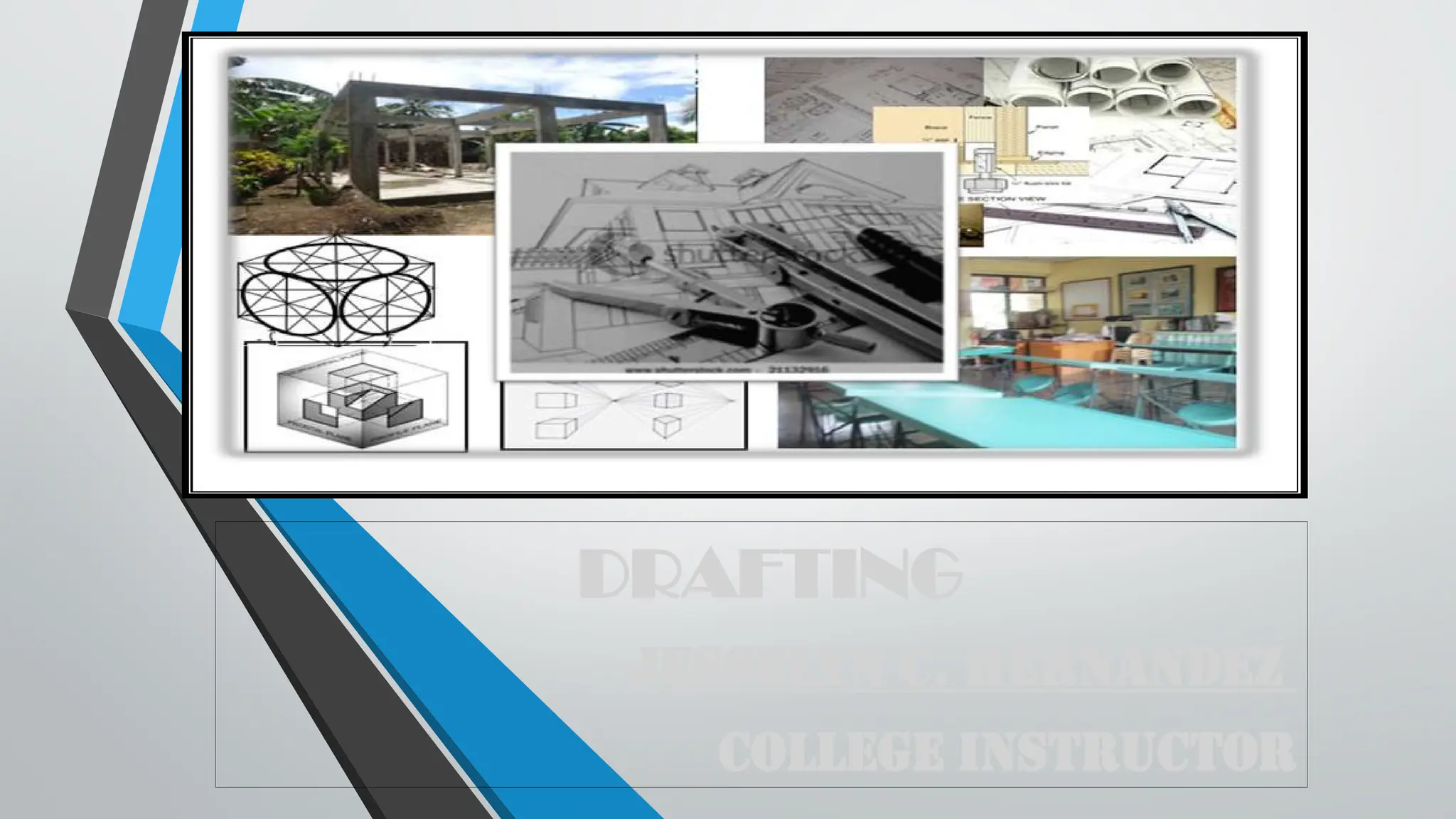
DRAFTING
Jesselyn C. Hernandez
College Instructor
Prepare Drafting Materials and
Tools/Drawing Instrument
• LO 1. identify drafting materials and tools/drawing
instruments applicable to a specific job
• LO 2. Determine the different Alphabet of lines
• LO3 Perform freehand drawing
What is Drafting?
• -A n essential method of communication between designers and
clients, architects and builders, engineers and production personnel
and between advertisers and customers.
Difference of
Drafter and Architect?
Difference of
Drafter and Architect?
-A DRAFTER can be working with different
companies with different specialization.
-An ARCHITECT is a person who oversees the entire
building project and may have an architectural
drafter as his assistant.
Kinds of drafting
The major kinds of drafting are furniture drafting, architectural drafting,
and mechanical or machine drafting, electrical and electronics drafting,
topographical drafting, airplane drafting, ship or naval drafting, structural
drafting and sheet-metal drafting.
Furniture drafting includes not only the making of working drawings of
the various types of furniture but also the designing of them.
​
Architectural drafting pertains to the making of working plans for
buildings for residential, business, manufacturing, religious, recreational
and storage purposes.
​
Machine drafting is the preparation of detail and assembly working
drawings of machines and their parts.
Electrical and electronics drafting produces schematic wiring diagrams for either
house wiring connections and radio and television receivers and transmitters or
the installation of electrically-operated machines.
​
Topographical drafting is the making of plots or maps for various purposes.
Airplane drafting concerns the preparation of working drawings of aircraft,
including helicopters, planes, rockets and spaceships. Ship drafting is the making
of working plans for all types of ship and for either commercial or naval purposes.
Structural drafting refers to the making of working drawings of steel buildings,
bridges, towers, dams and so forth. Sheet-metal drafting is the development of
surfaces of various objects made of galvanized iron, steel aluminum or copper
sheets. It includes pattern development for chimneys, downspouts, water tanks
and air-conditioning ducts, among many others.
Definition of Terms in
Mechanical Drafting
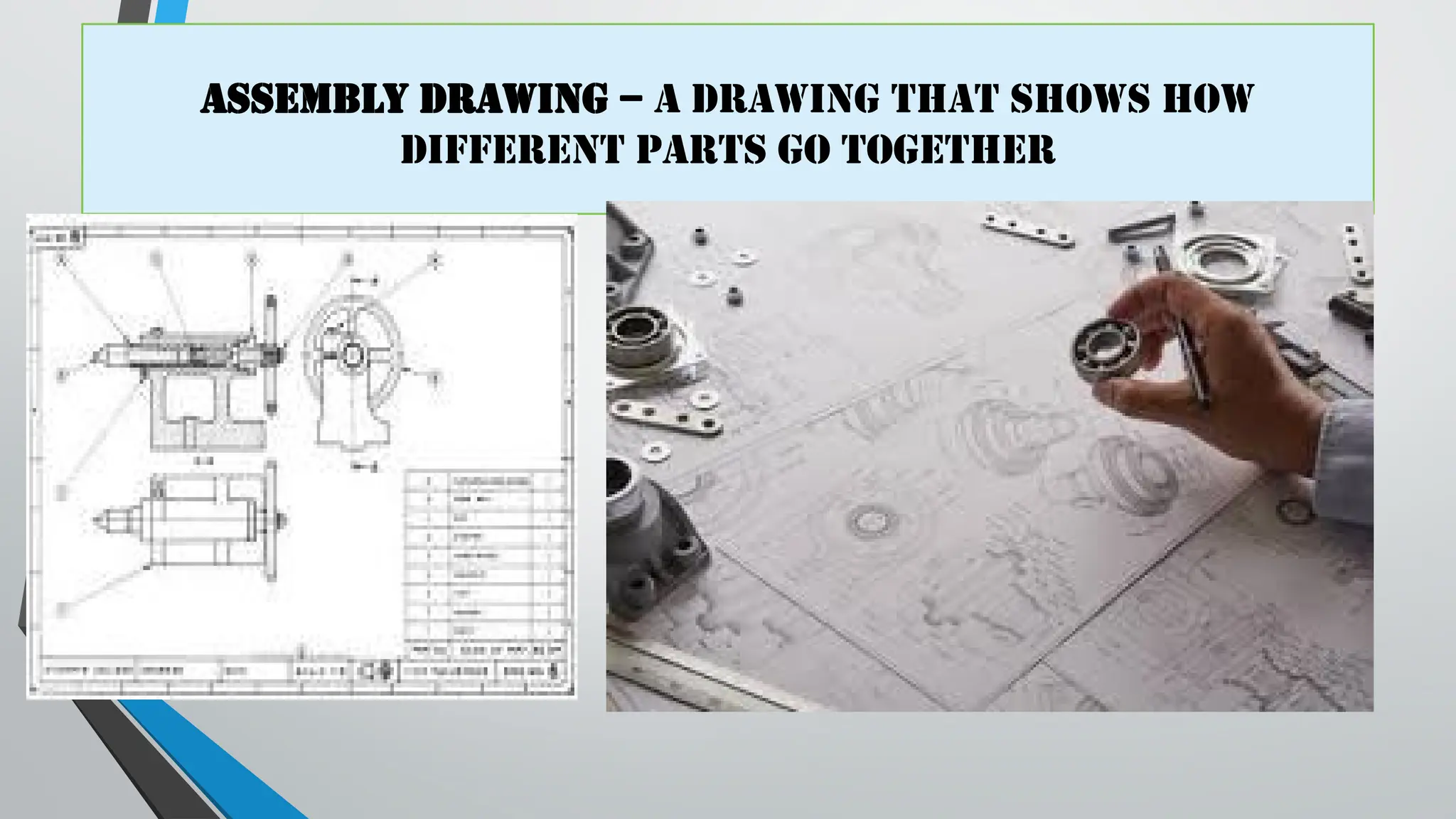
Assembly drawing – a drawing that shows how
different parts go together
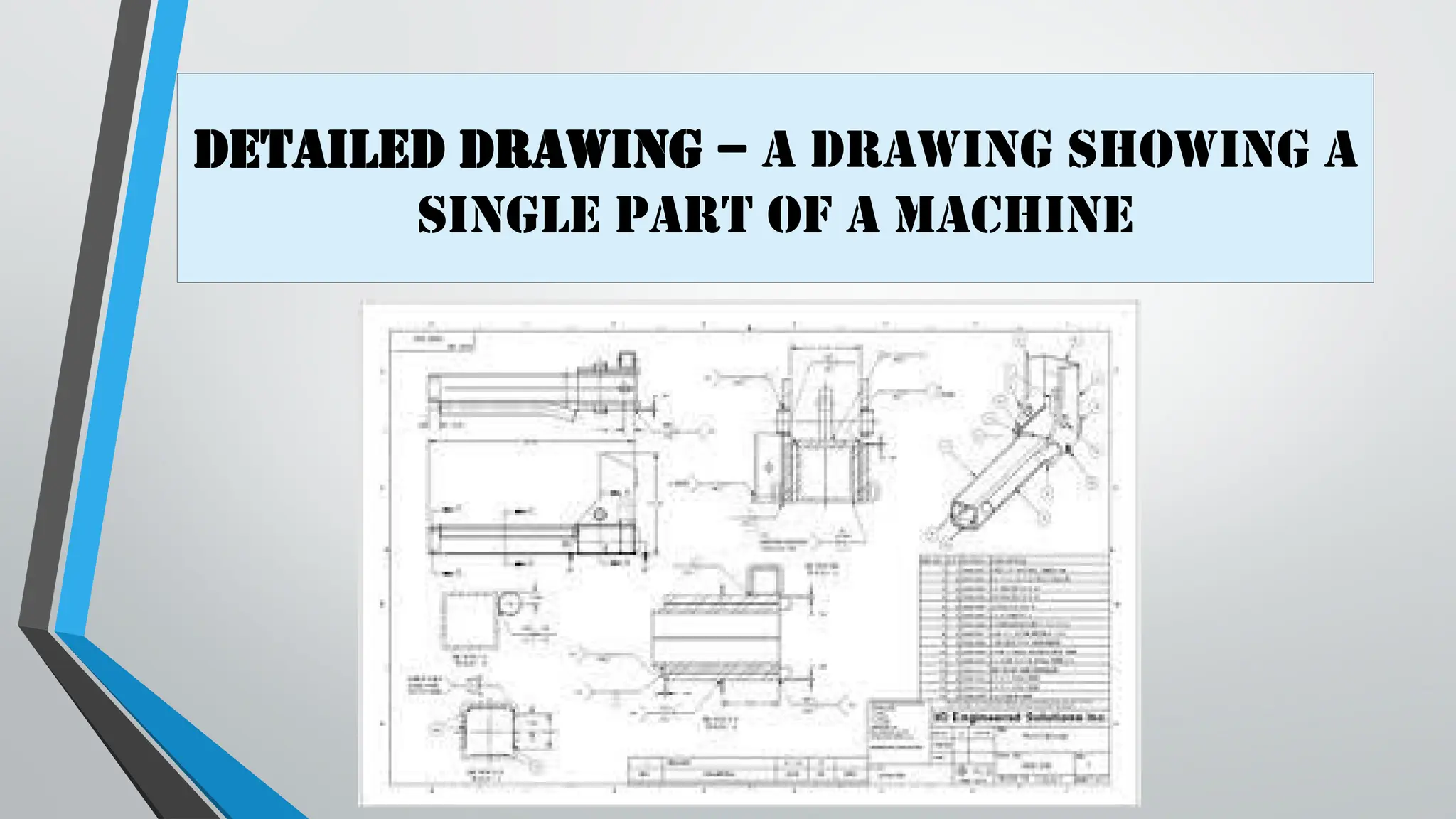
Detailed drawing – a drawing showing a
single part of a machine
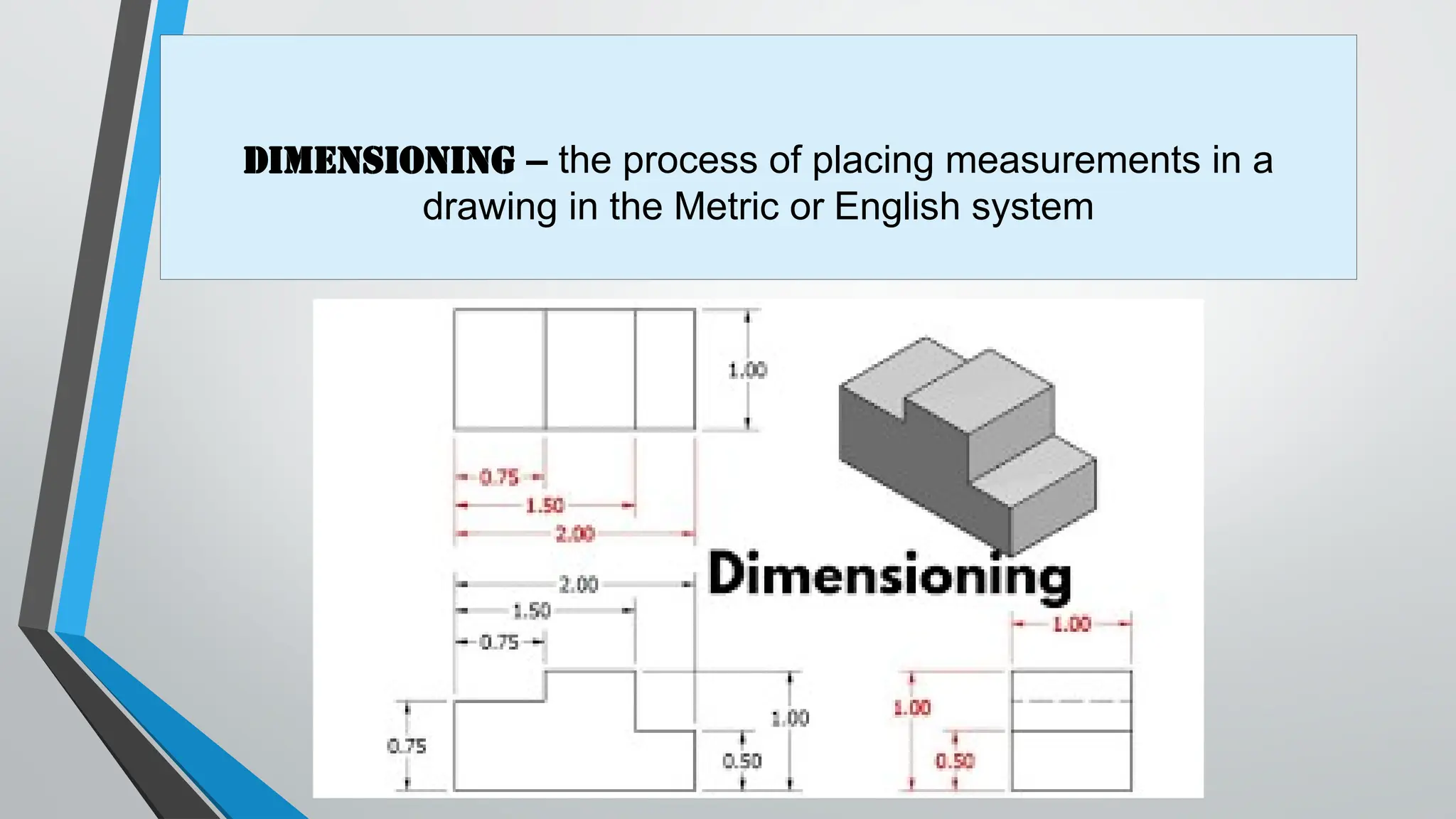
Dimensioning – the process of placing measurements in a
drawing in the Metric or English system
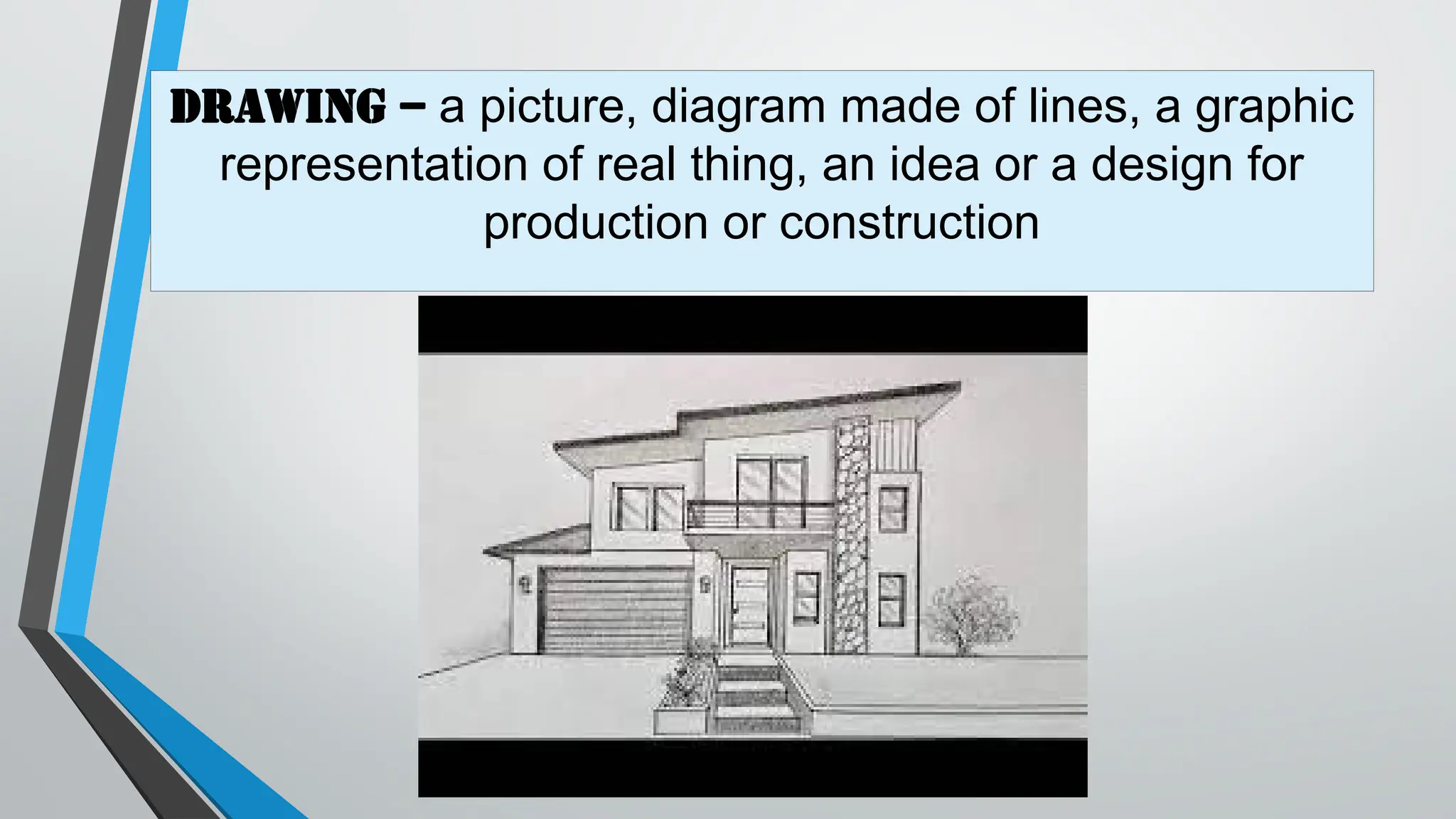
Drawing – a picture, diagram made of lines, a graphic
representation of real thing, an idea or a design for
production or construction
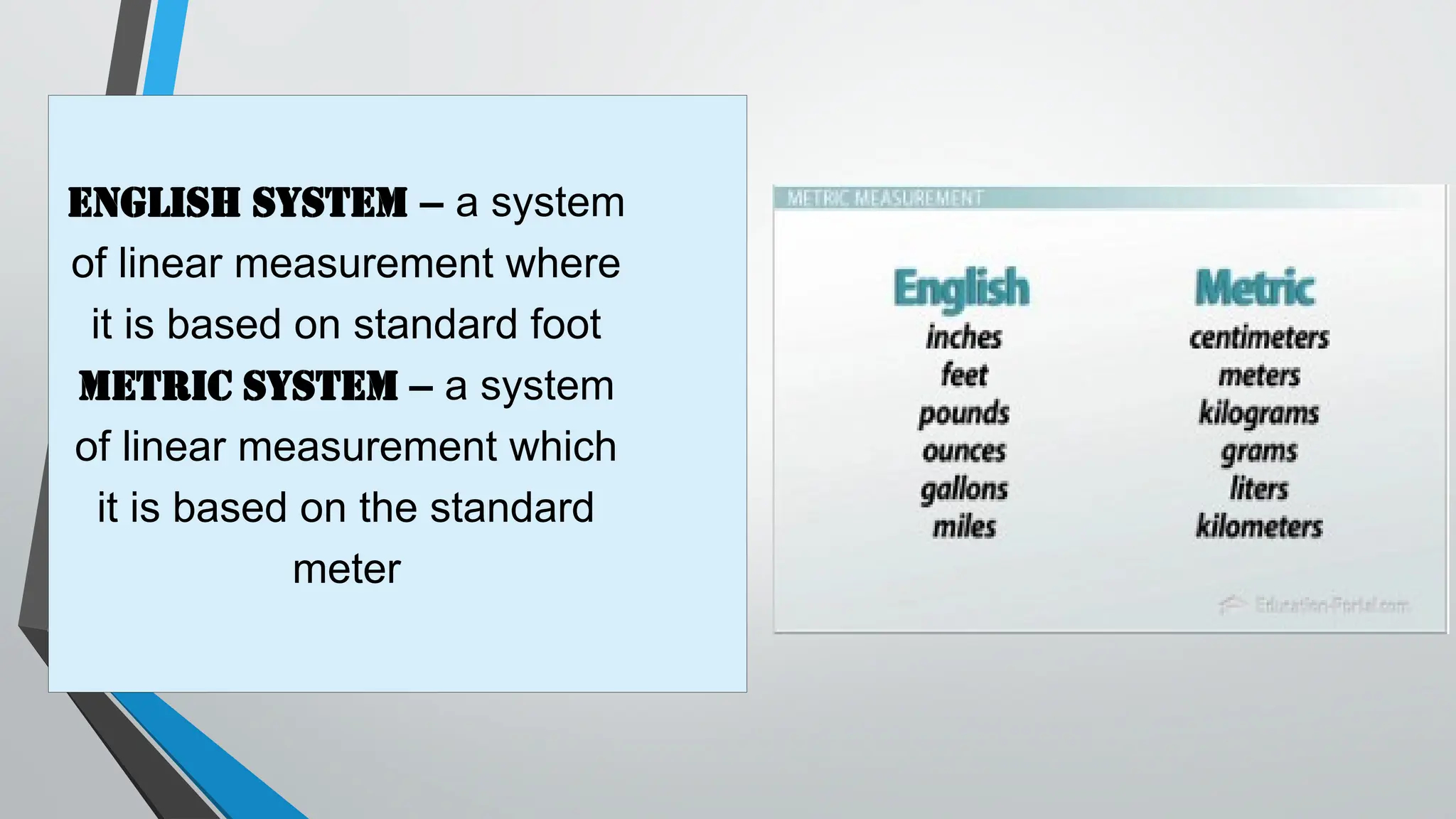
English system – a system
of linear measurement where
it is based on standard foot
Metric system – a system
of linear measurement which
it is based on the standard
meter
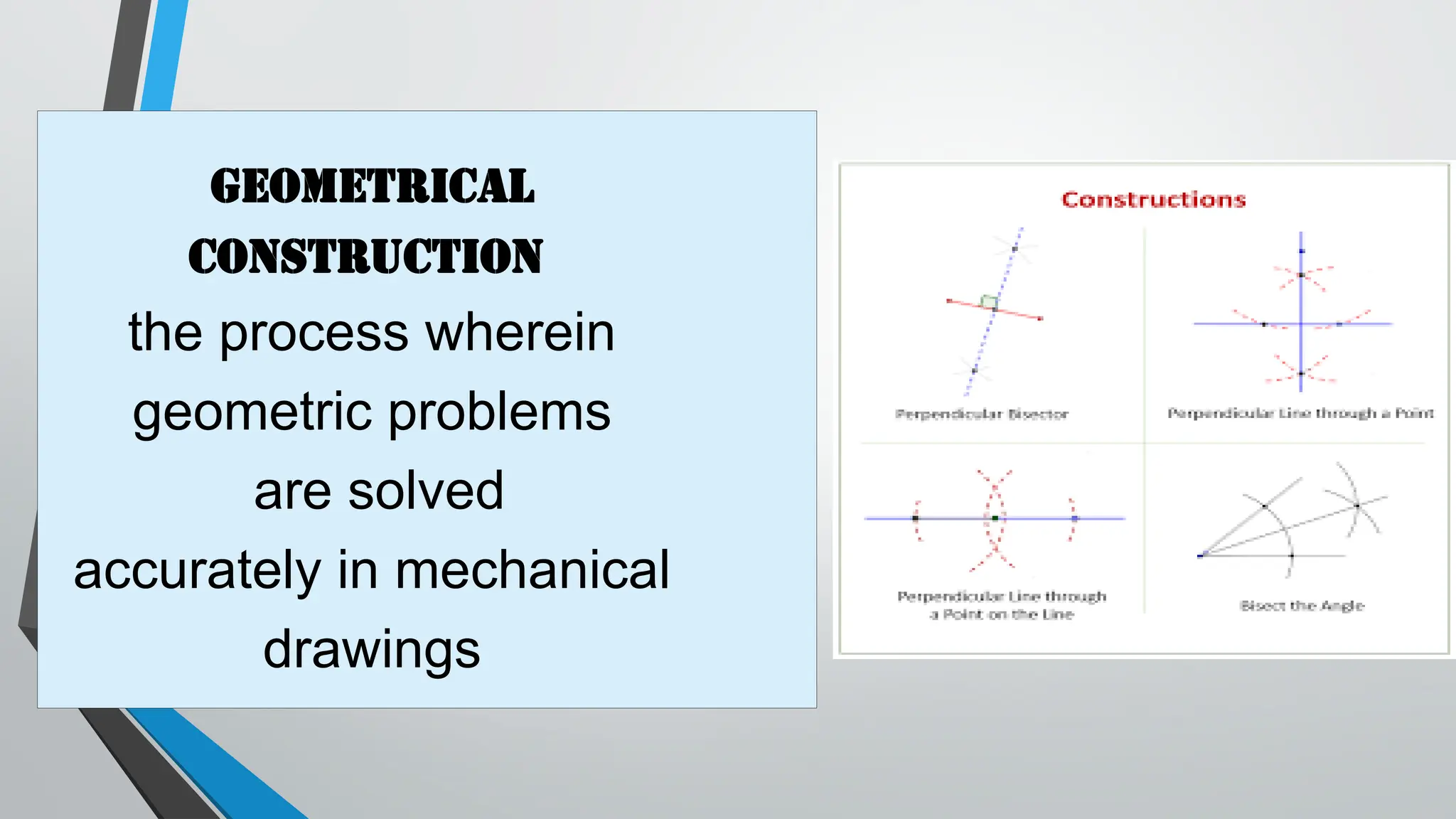
Geometrical
construction
the process wherein
geometric problems
are solved
accurately in mechanical
drawings
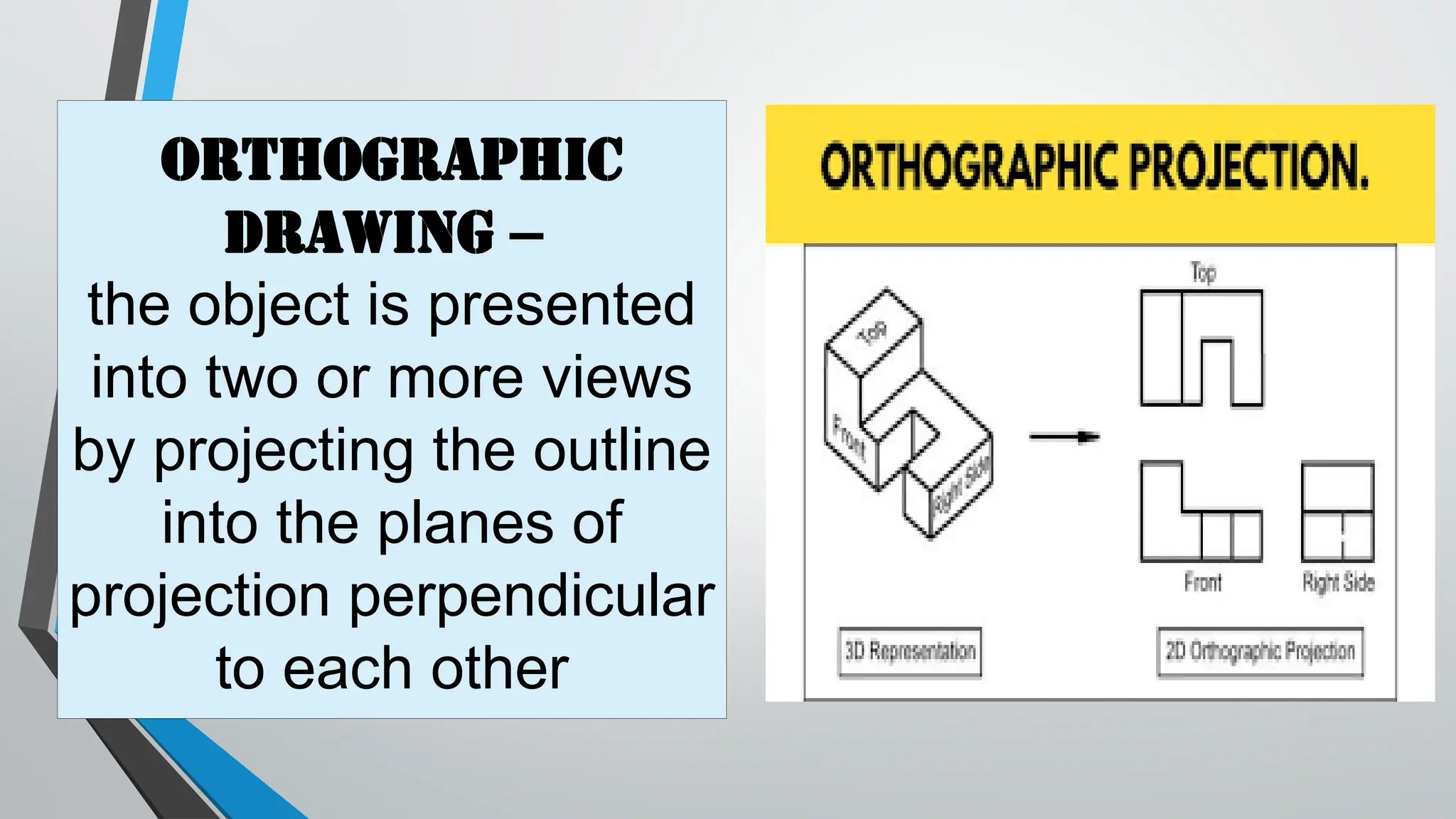
Orthographic
drawing –
the object is presented
into two or more views
by projecting the outline
into the planes of
projection perpendicular
to each other
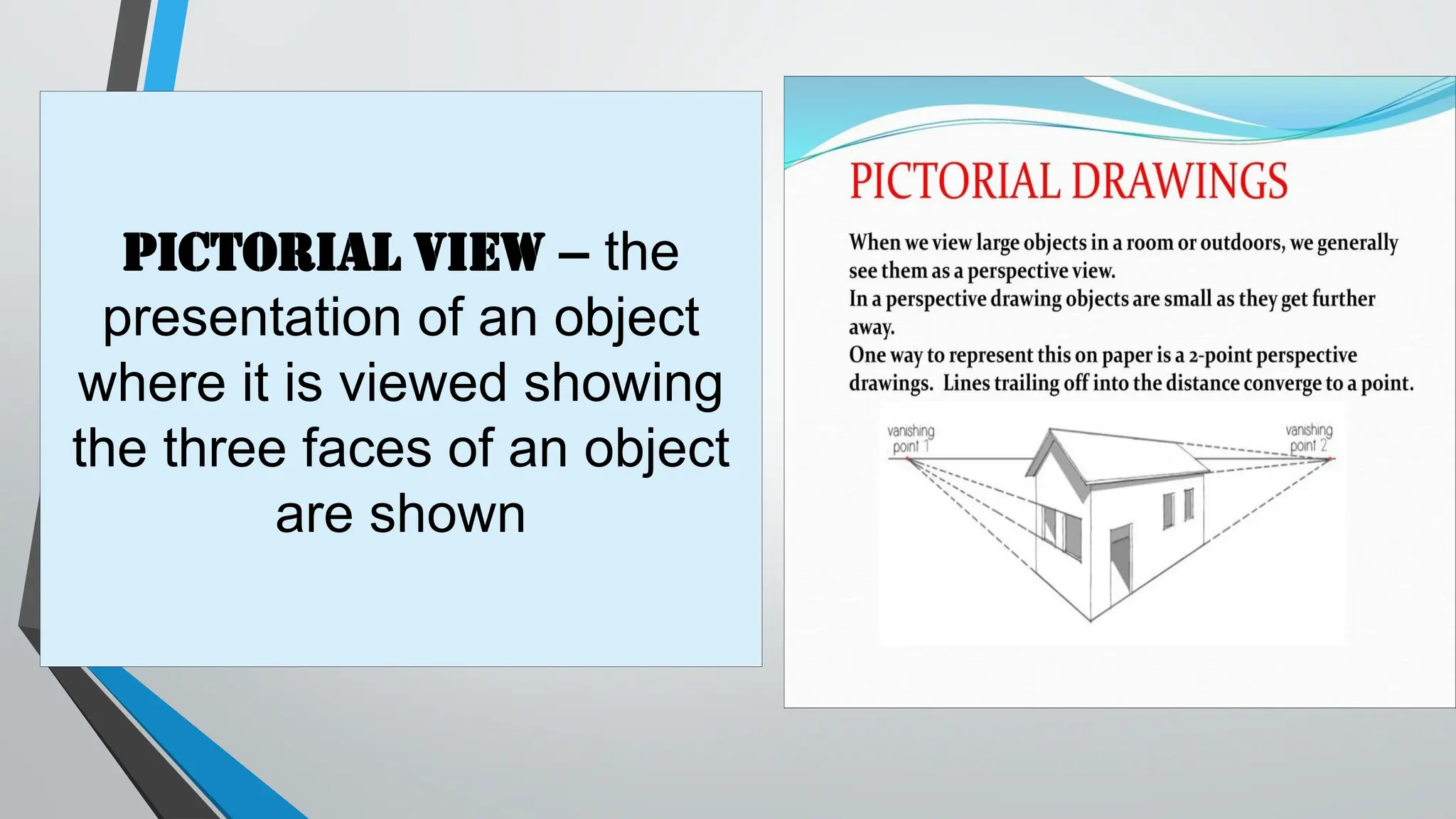
Pictorial view – the
presentation of an object
where it is viewed showing
the three faces of an object
are shown
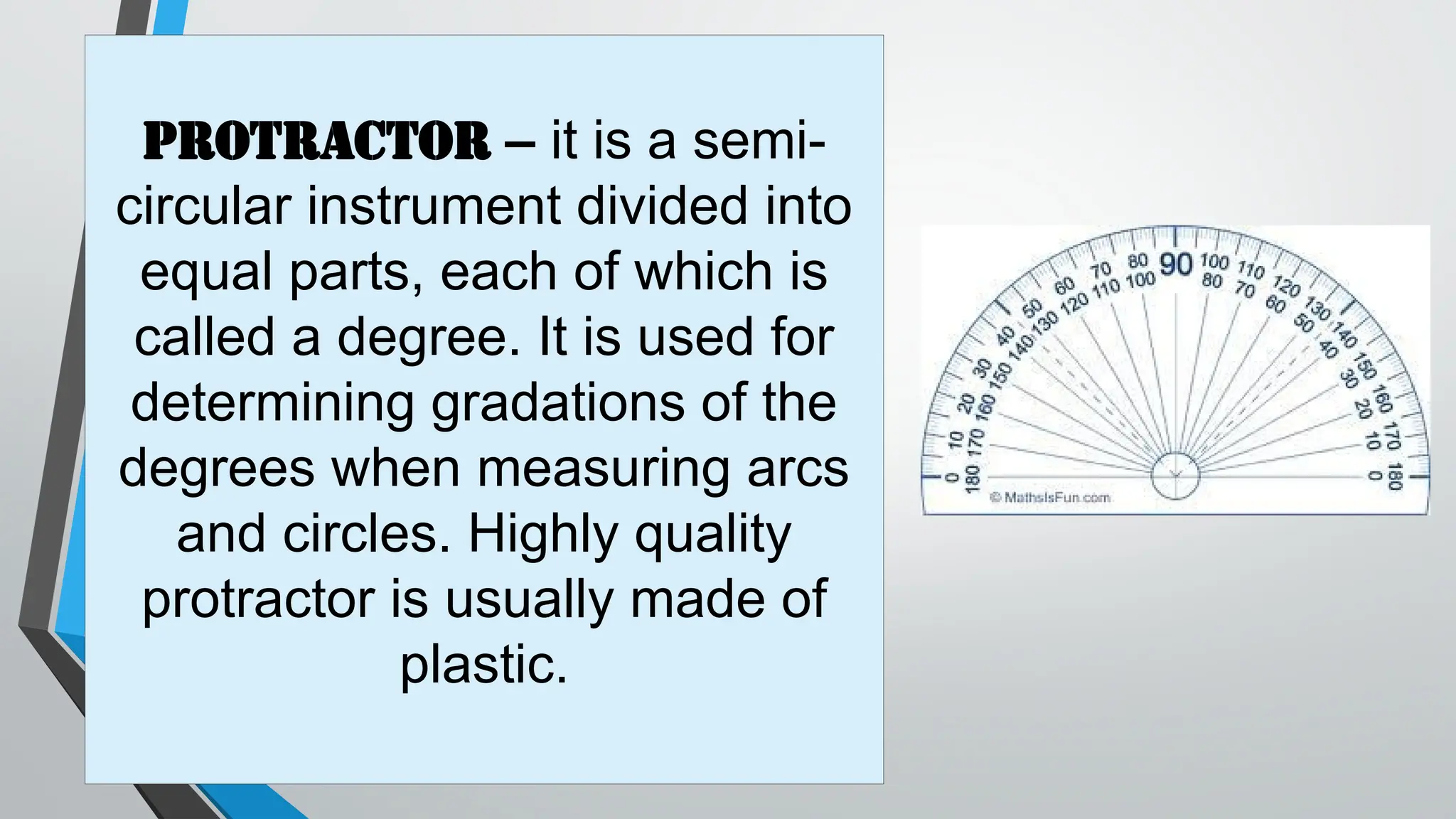
Protractor – it is a semi-
circular instrument divided into
equal parts, each of which is
called a degree. It is used for
determining gradations of the
degrees when measuring arcs
and circles. Highly quality
protractor is usually made of
plastic.
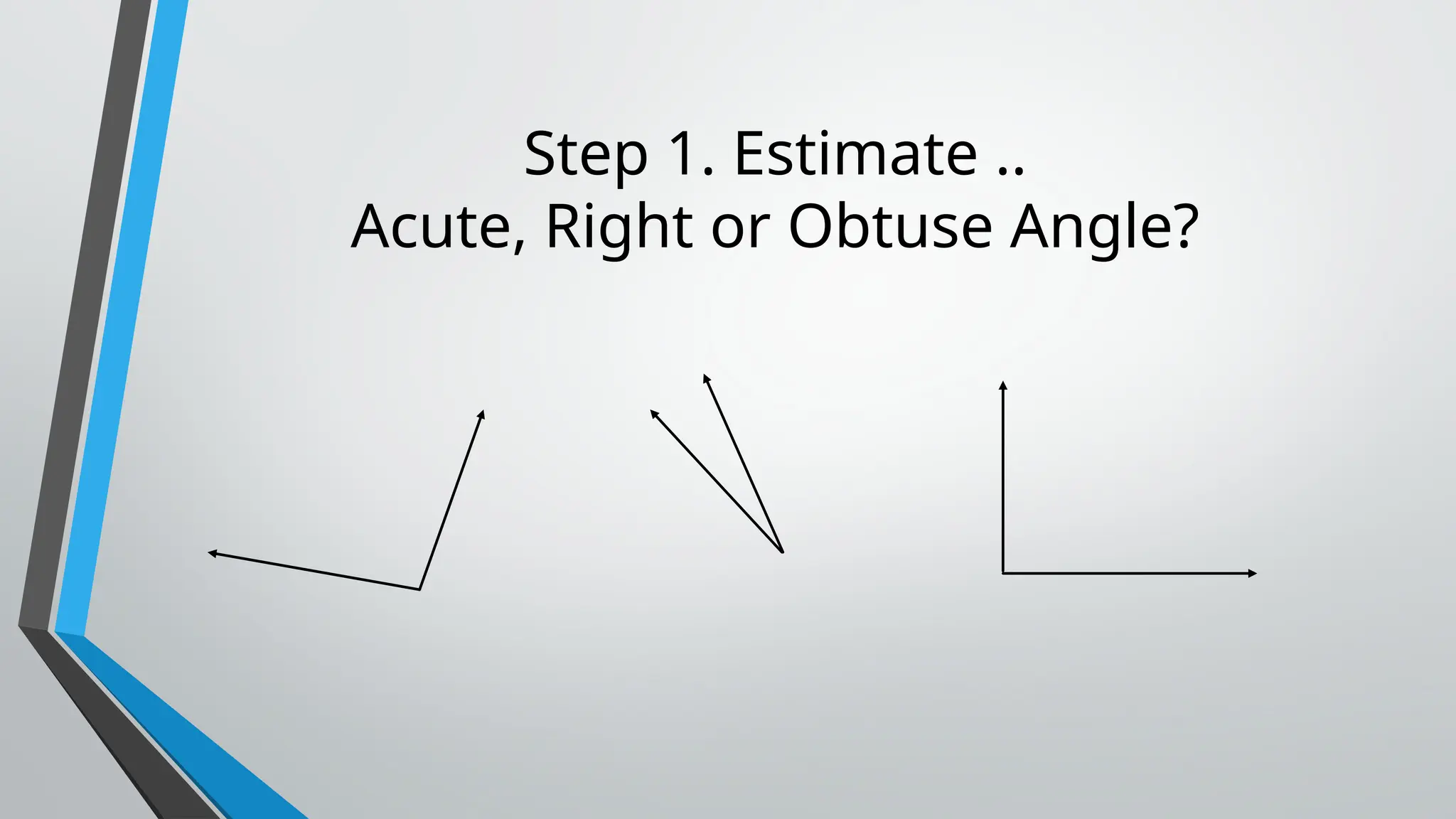
Step 1. Estimate ..
Acute, Right or Obtuse Angle?
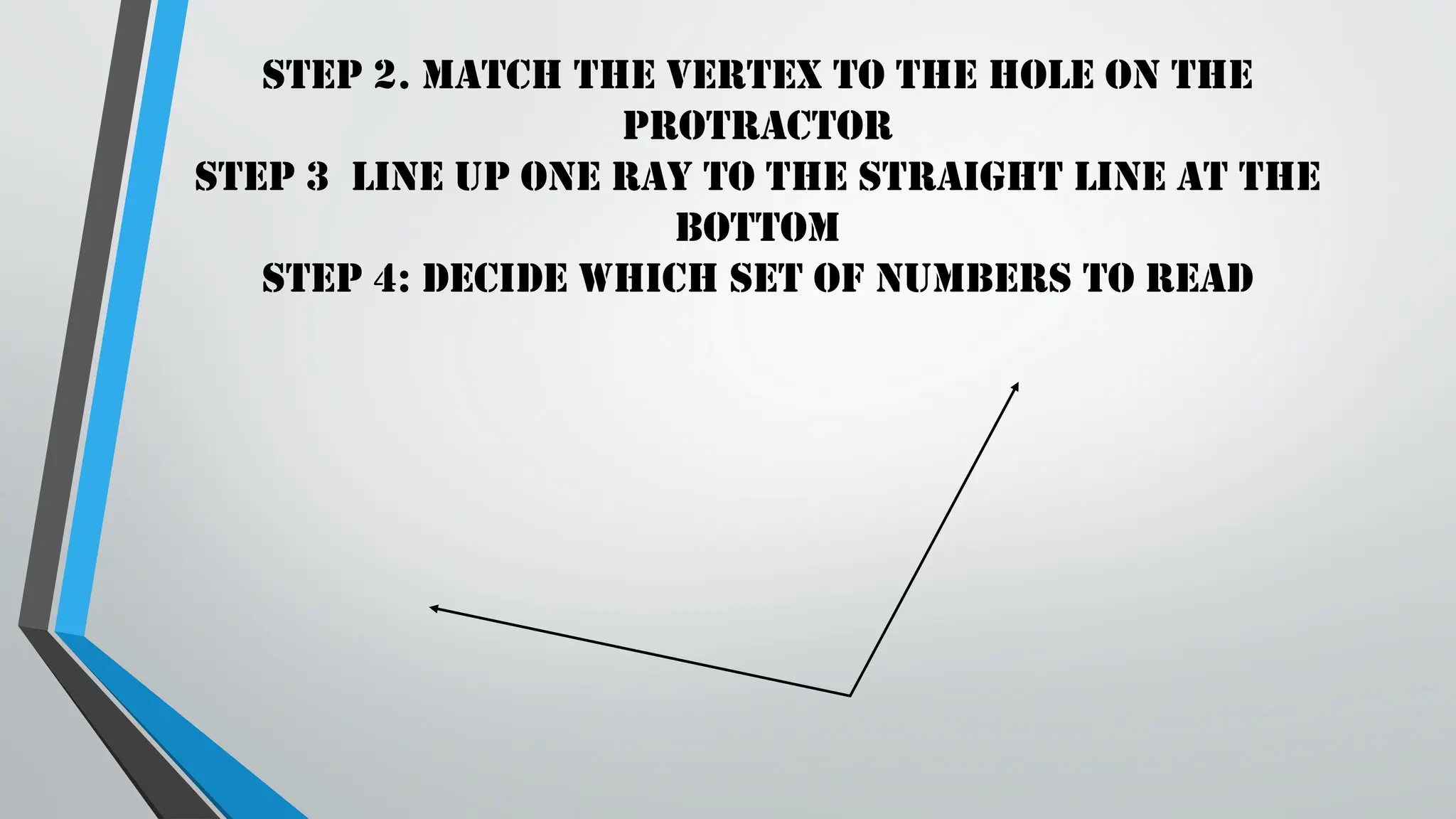
Step 2. Match the vertex to the hole on the
protractor
Step 3 Line up one ray to the straight line at the
bottom
Step 4: Decide which set of numbers to read
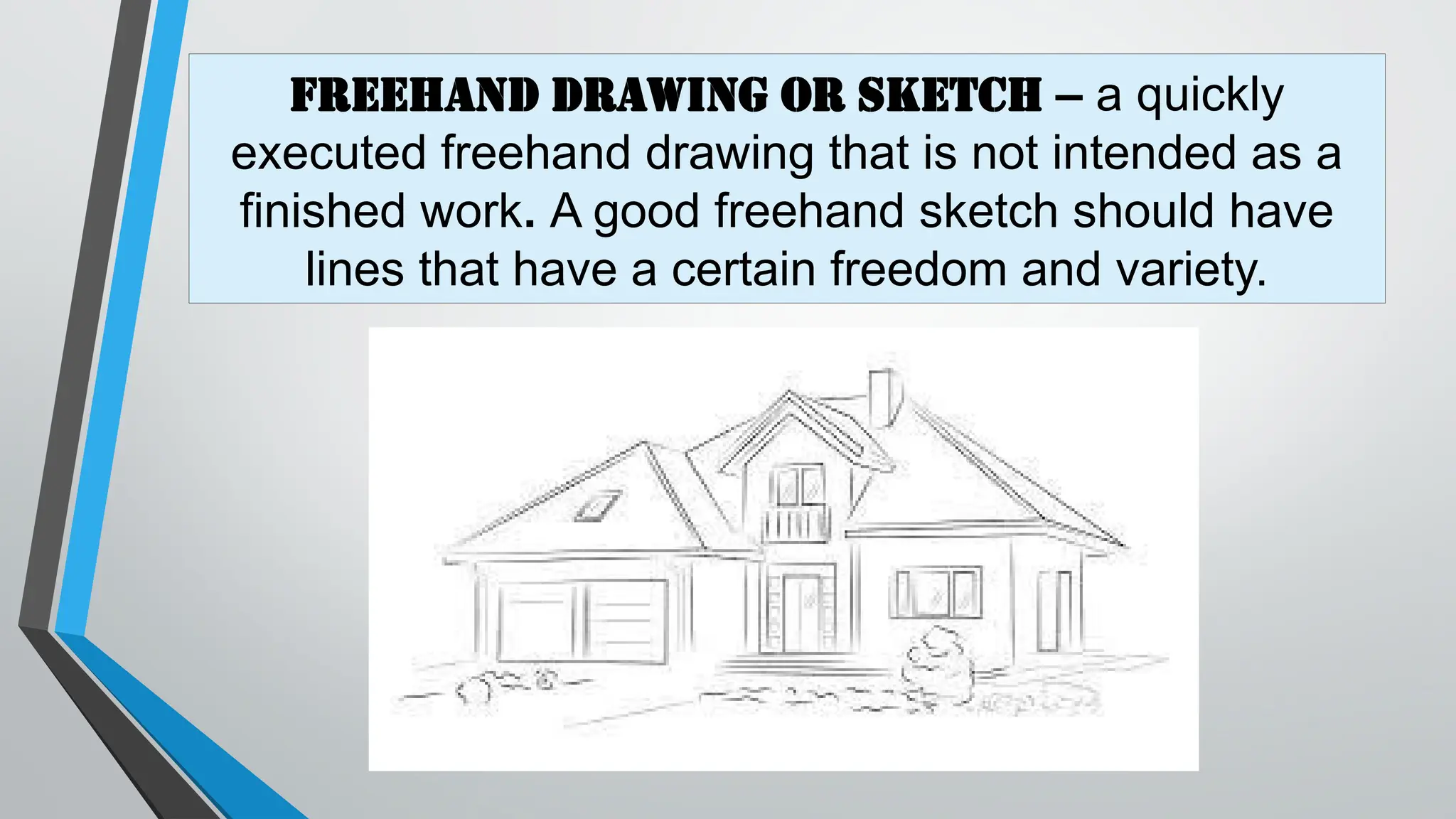
FREEHAND DRAWING OR Sketch – a quickly
executed freehand drawing that is not intended as a
finished work. A good freehand sketch should have
lines that have a certain freedom and variety.
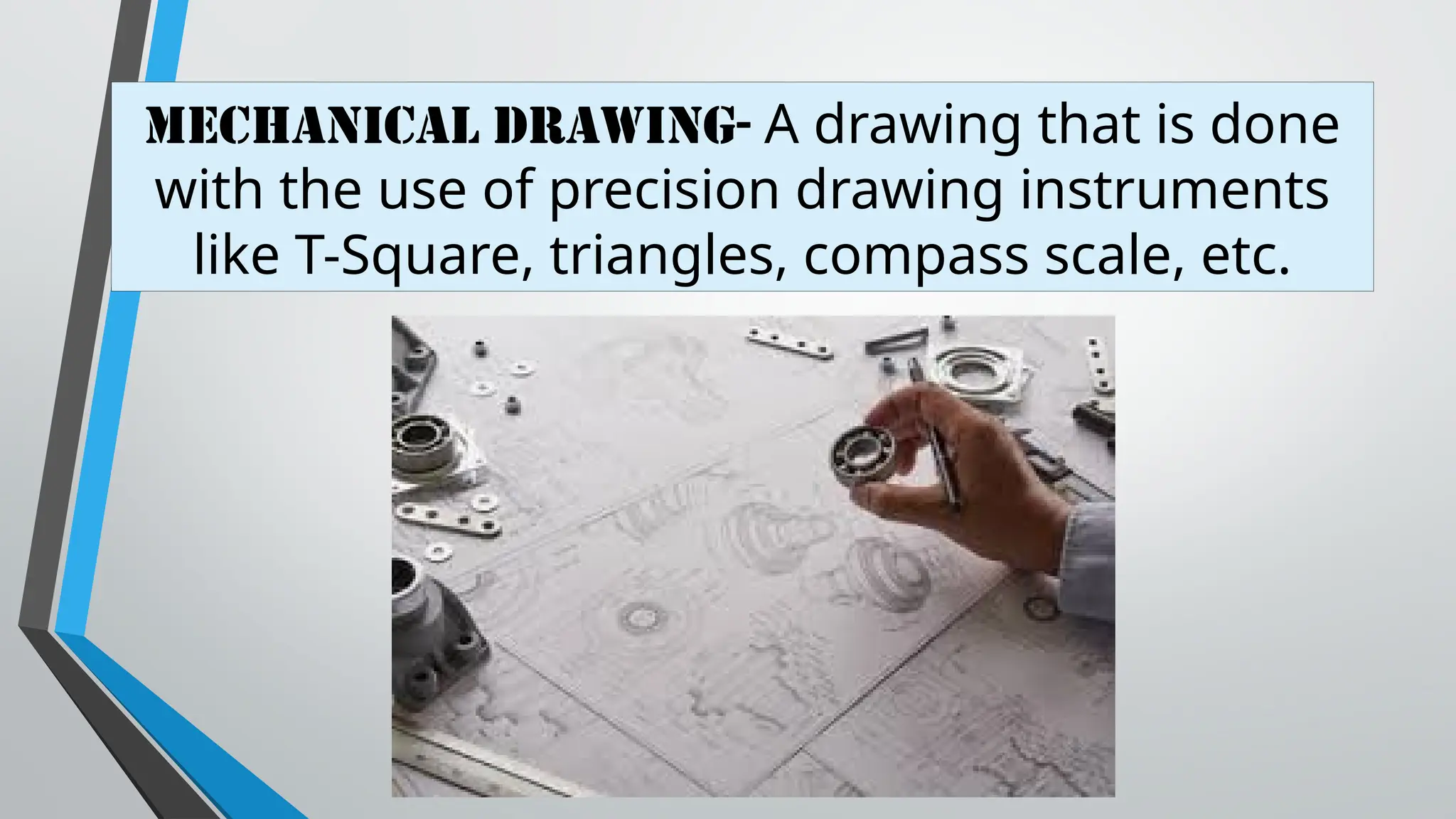
MECHANICAL DRAWING- A drawing that is done
with the use of precision drawing instruments
like T-Square, triangles, compass scale, etc.
DRAFTING TOOLS AND
EQUIPMENT
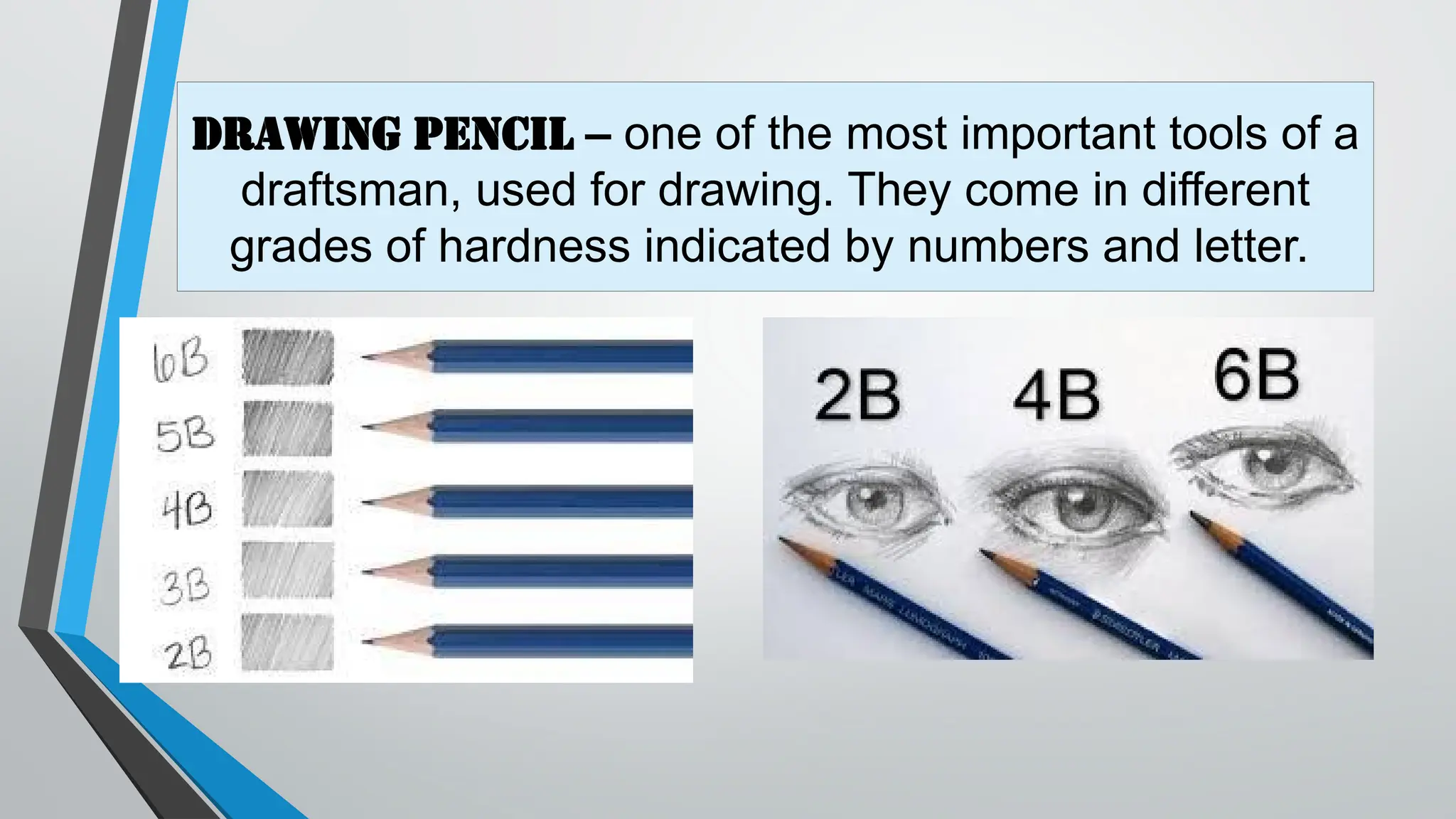
Drawing pencil – one of the most important tools of a
draftsman, used for drawing. They come in different
grades of hardness indicated by numbers and letter.
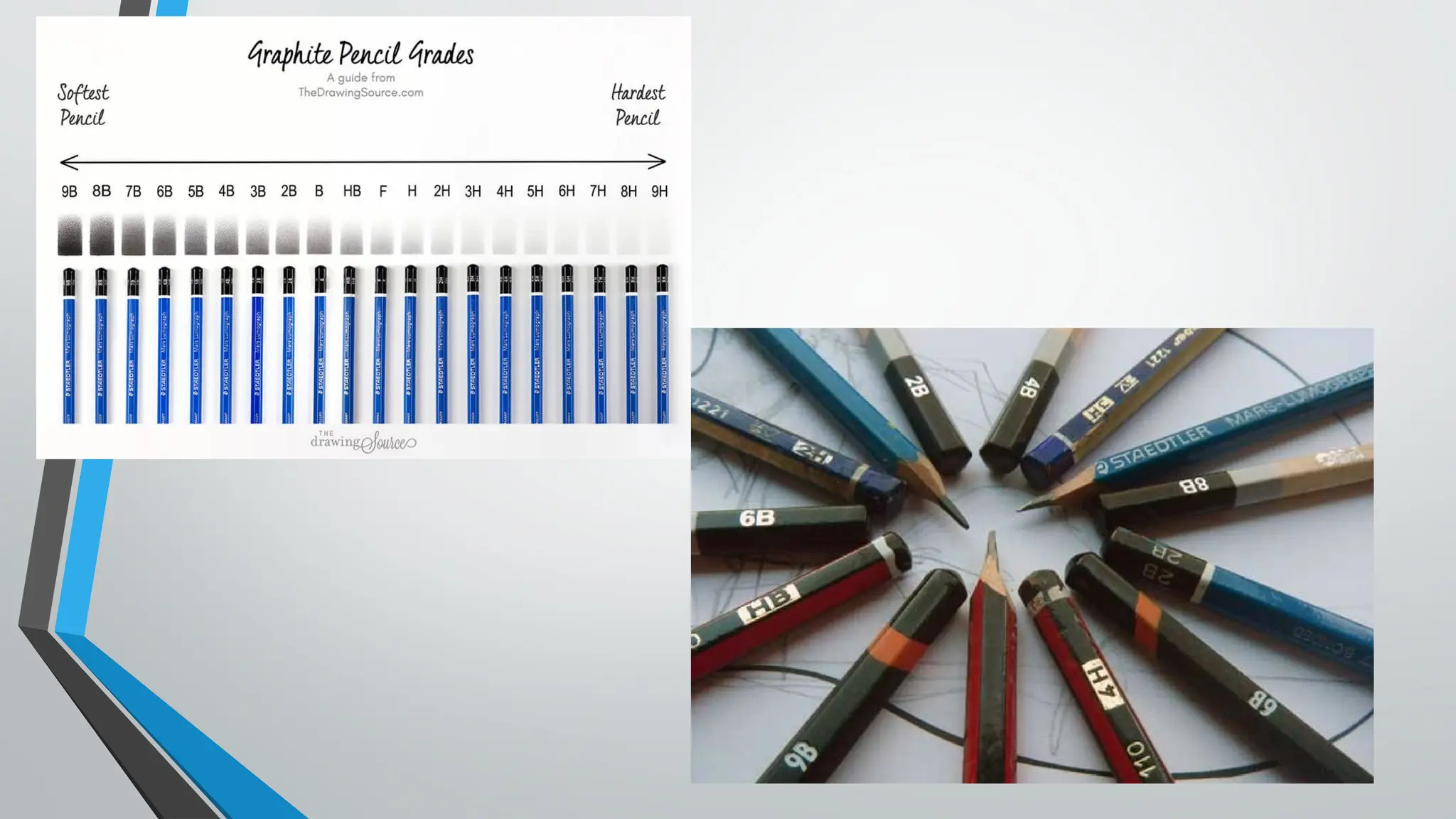
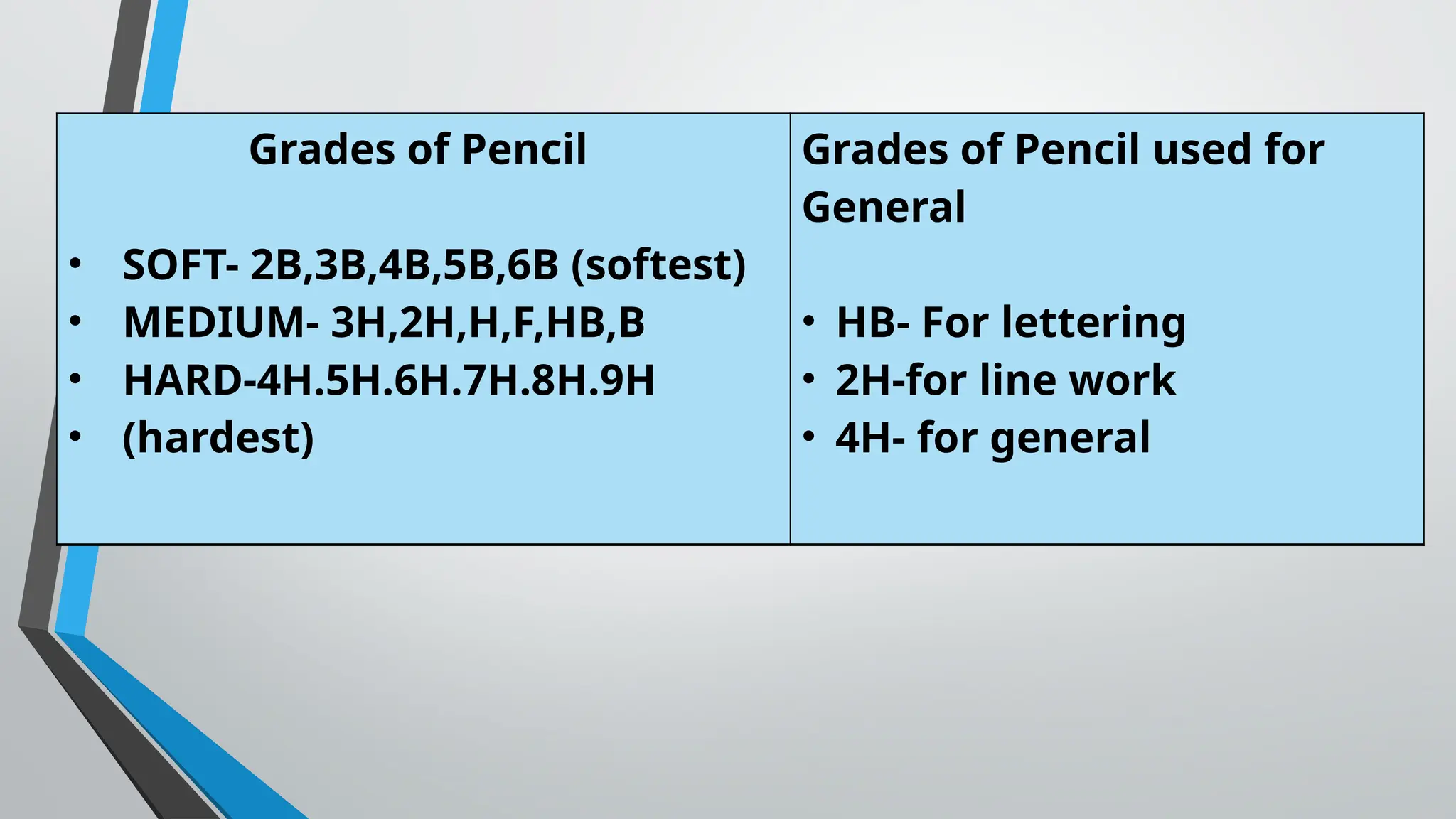
Grades of Pencil
• SOFT- 2B,3B,4B,5B,6B (softest)
• MEDIUM- 3H,2H,H,F,HB,B
• HARD-4H.5H.6H.7H.8H.9H
• (hardest)
Grades of Pencil used for
General
• HB- For lettering
• 2H-for line work
• 4H- for general
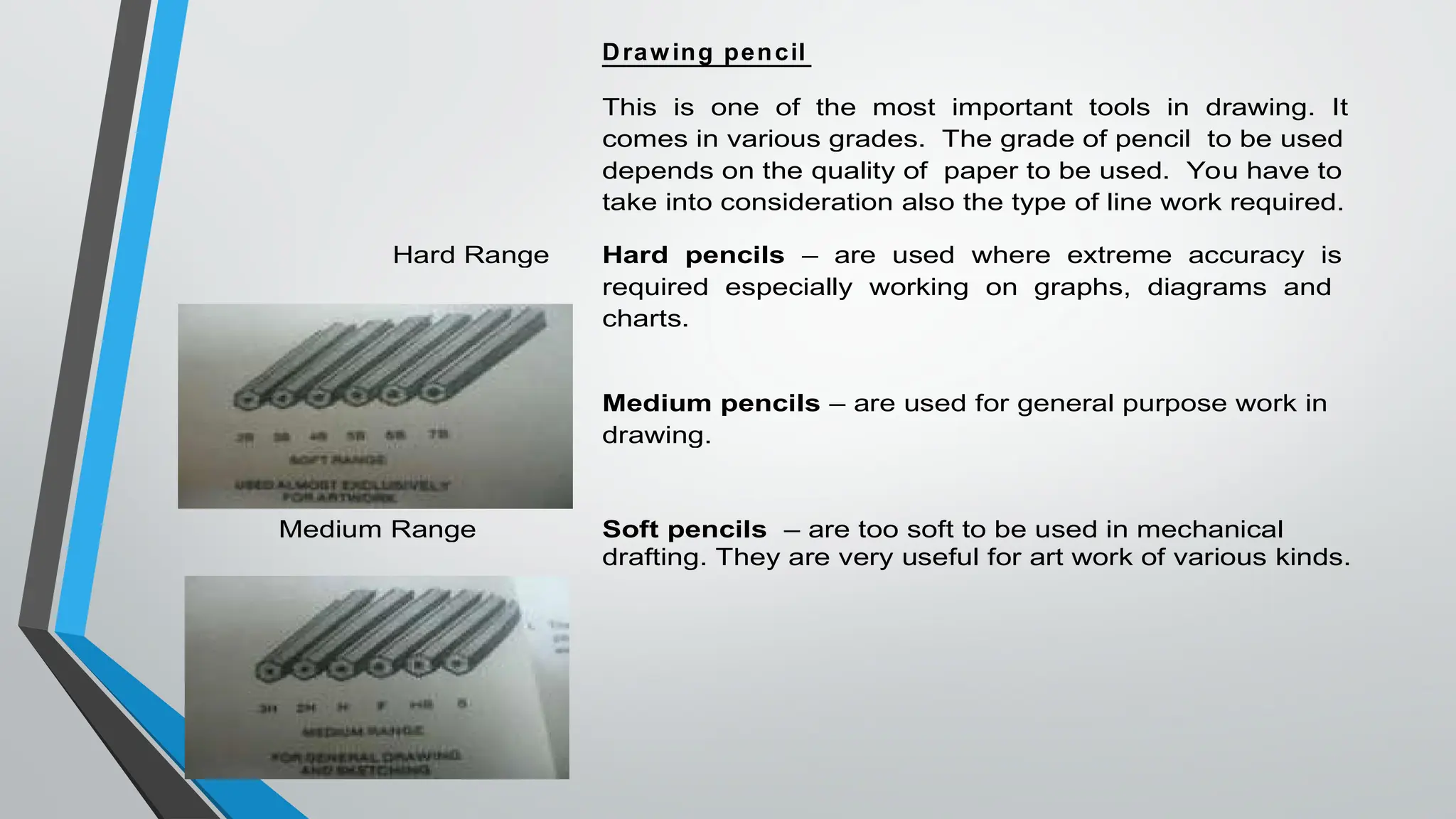
Drawing pencil
This is one of the most important tools in drawing. It
comes in various grades. The grade of pencil to be used
depends on the quality of paper to be used. You have to
take into consideration also the type of line work required.
Hard Range Hard pencils – are used where extreme accuracy is
required especially working on graphs, diagrams and
charts.
Medium pencils – are used for general purpose work in
drawing.
Medium Range Soft pencils – are too soft to be used in mechanical
drafting. They are very useful for art work of various kinds.
Minimum requirement for a Drafting
students
4H- For re-penciling light finished lines such as center lines,
Dimension lines, and visible object line
F or H- for all lettering and freehand work
6H- for light construction lines in layout work where accuracy is
required.
2H- for visible object lines
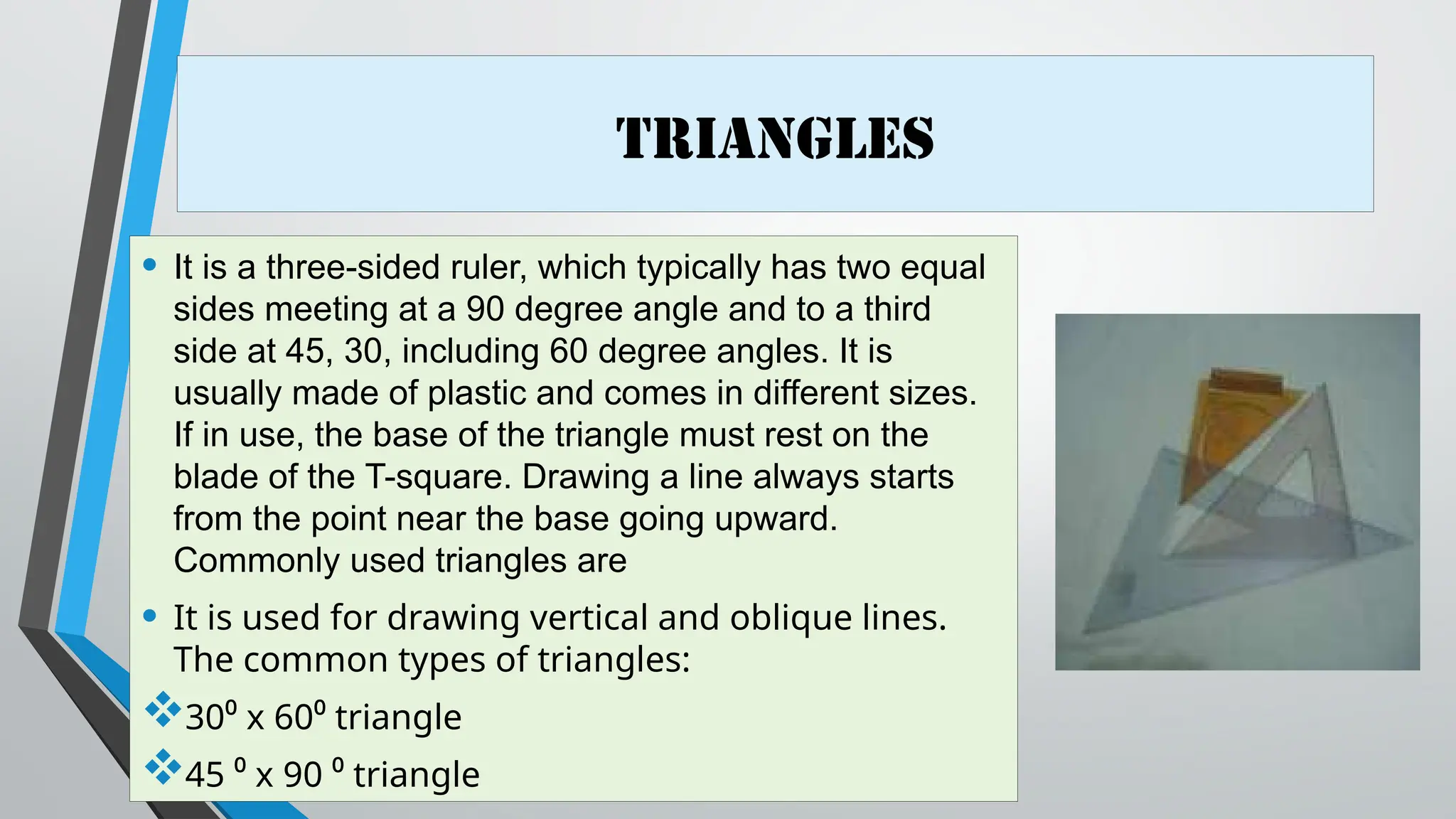
Triangles
• It is a three-sided ruler, which typically has two equal
sides meeting at a 90 degree angle and to a third
side at 45, 30, including 60 degree angles. It is
usually made of plastic and comes in different sizes.
If in use, the base of the triangle must rest on the
blade of the T-square. Drawing a line always starts
from the point near the base going upward.
Commonly used triangles are
• It is used for drawing vertical and oblique lines.
The common types of triangles:
30⁰ x 60⁰ triangle
45 ⁰ x 90 ⁰ triangle
Drawing Paper
•Various types of drawing papers are
available for use but hard and soft
surface drawing papers are highly
recommended to be the best. This
type does not groove easily when
pressure is applied to the pencil.
Oslo paper is commonly used but
bond paper is also recommended.
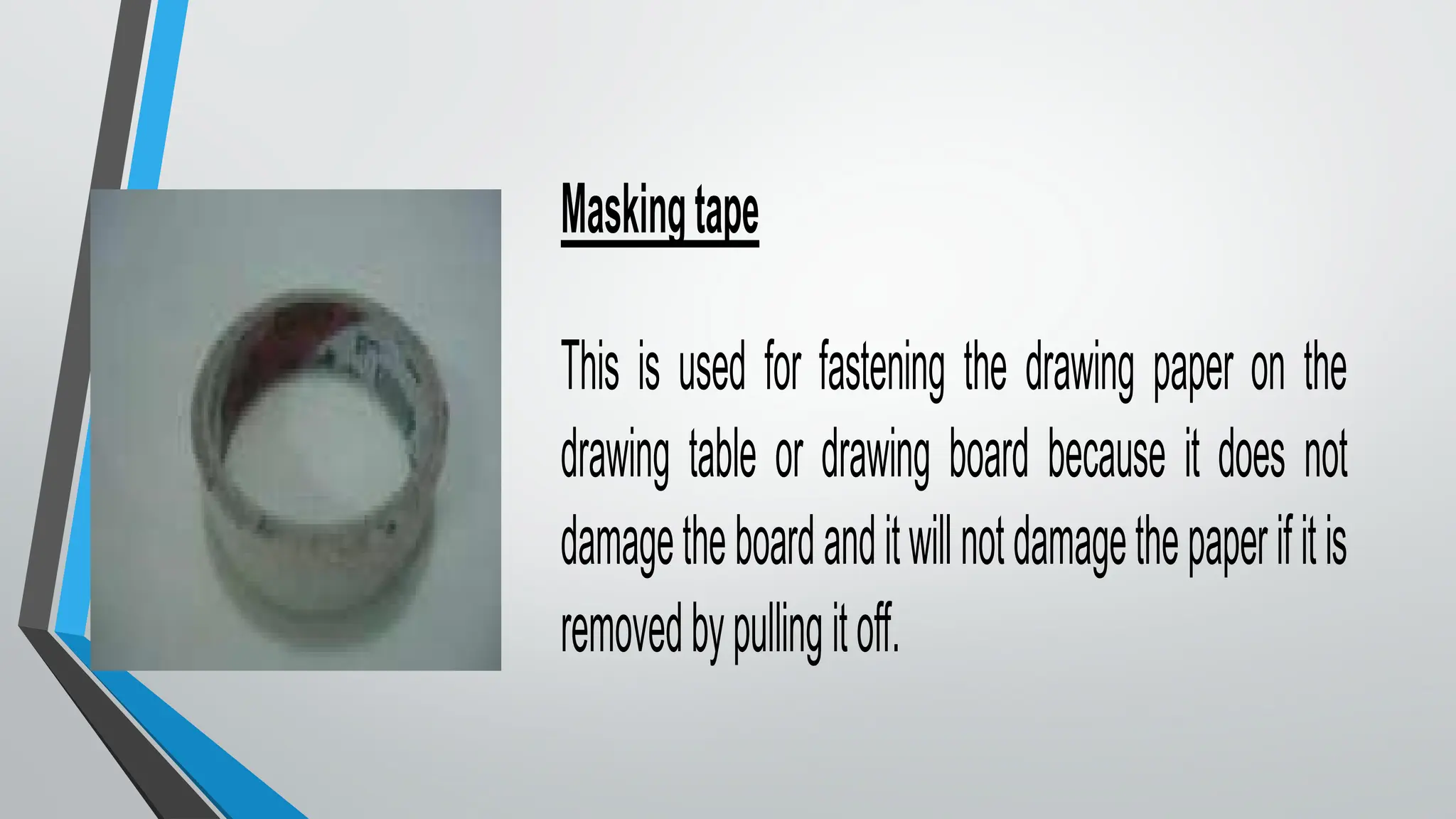
Maskingtape
This is used for fastening the drawing paper on the
drawing table or drawing board because it does not
damagetheboardanditwillnotdamagethepaperifitis
removedbypullingitoff.
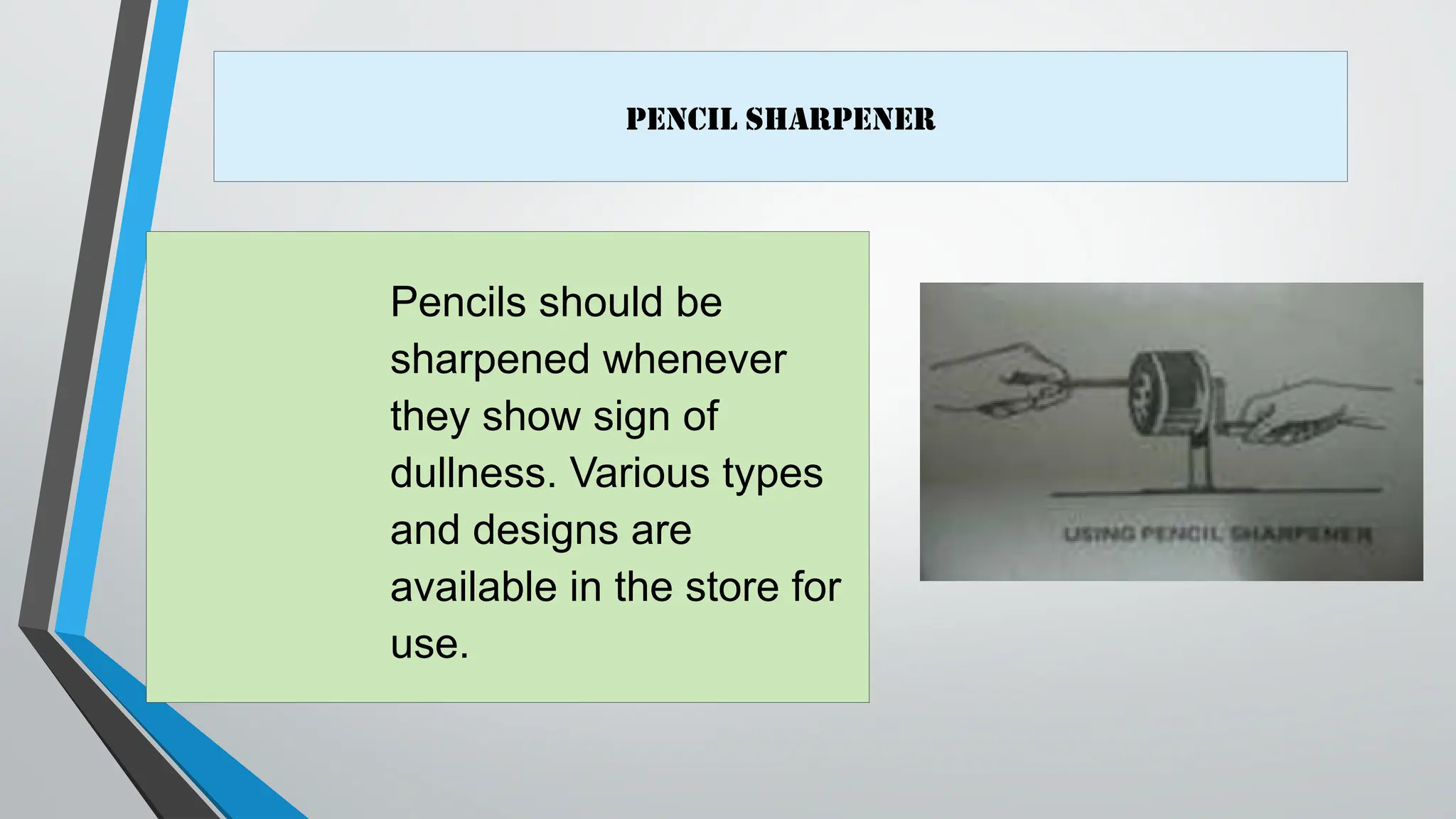
Pencil sharpener
Pencils should be
sharpened whenever
they show sign of
dullness. Various types
and designs are
available in the store for
use.
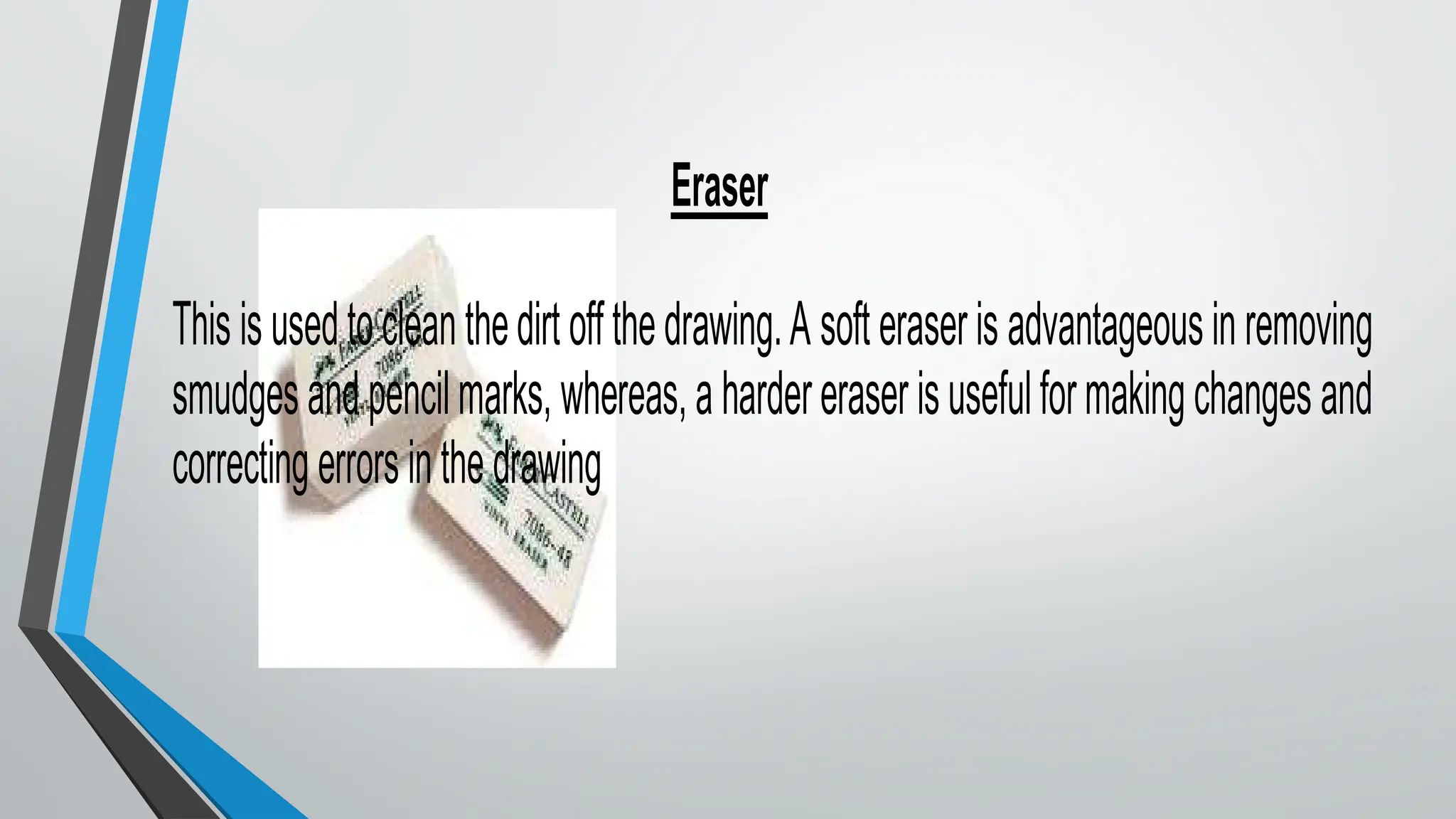
Eraser
Thisisusedtocleanthedirtoffthedrawing.A softeraseris advantageousinremoving
smudgesandpencilmarks,whereas,ahardereraserisusefulformakingchangesand
correctingerrorsinthedrawing
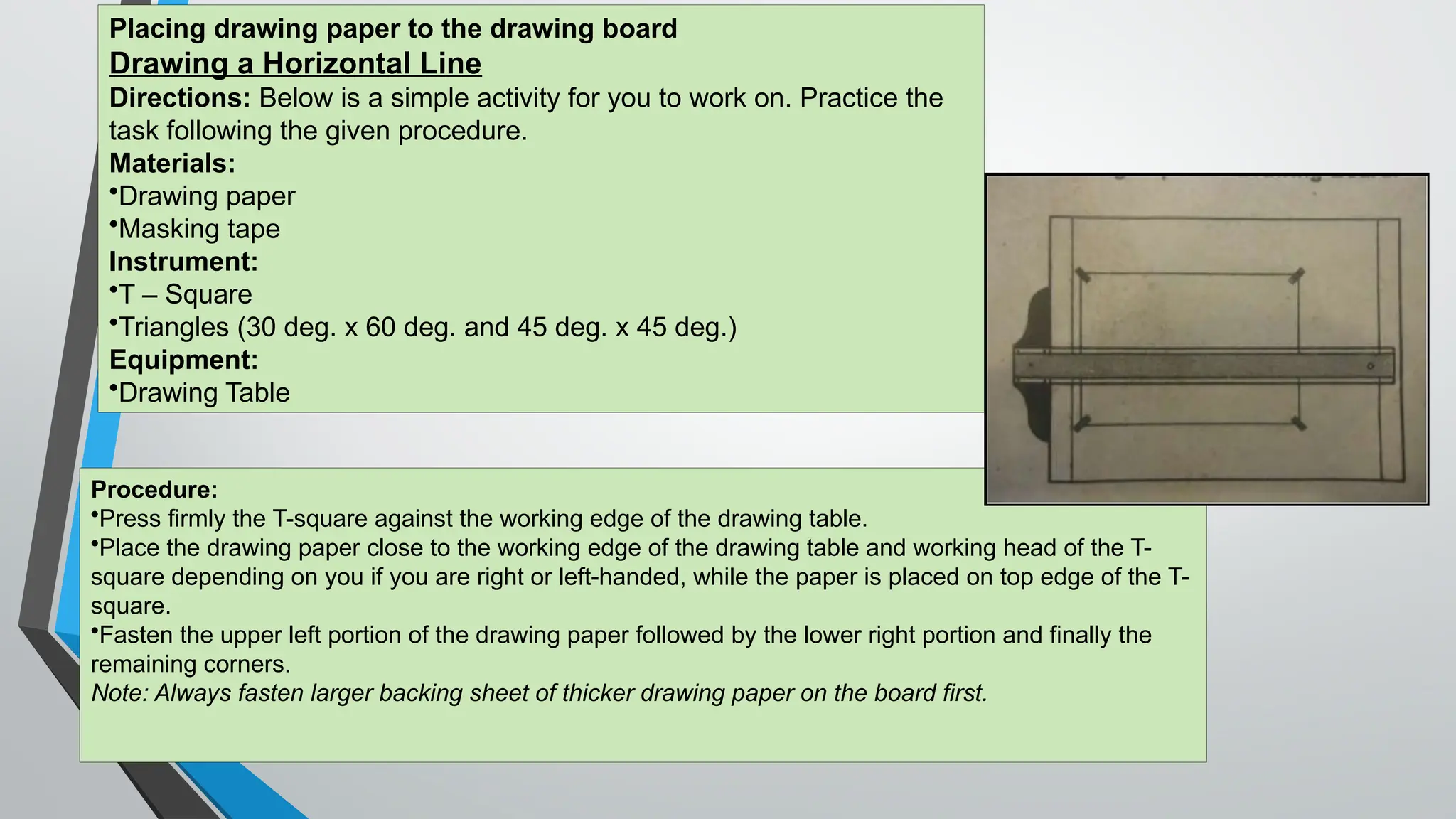
Procedure:
•Press firmly the T-square against the working edge of the drawing table.
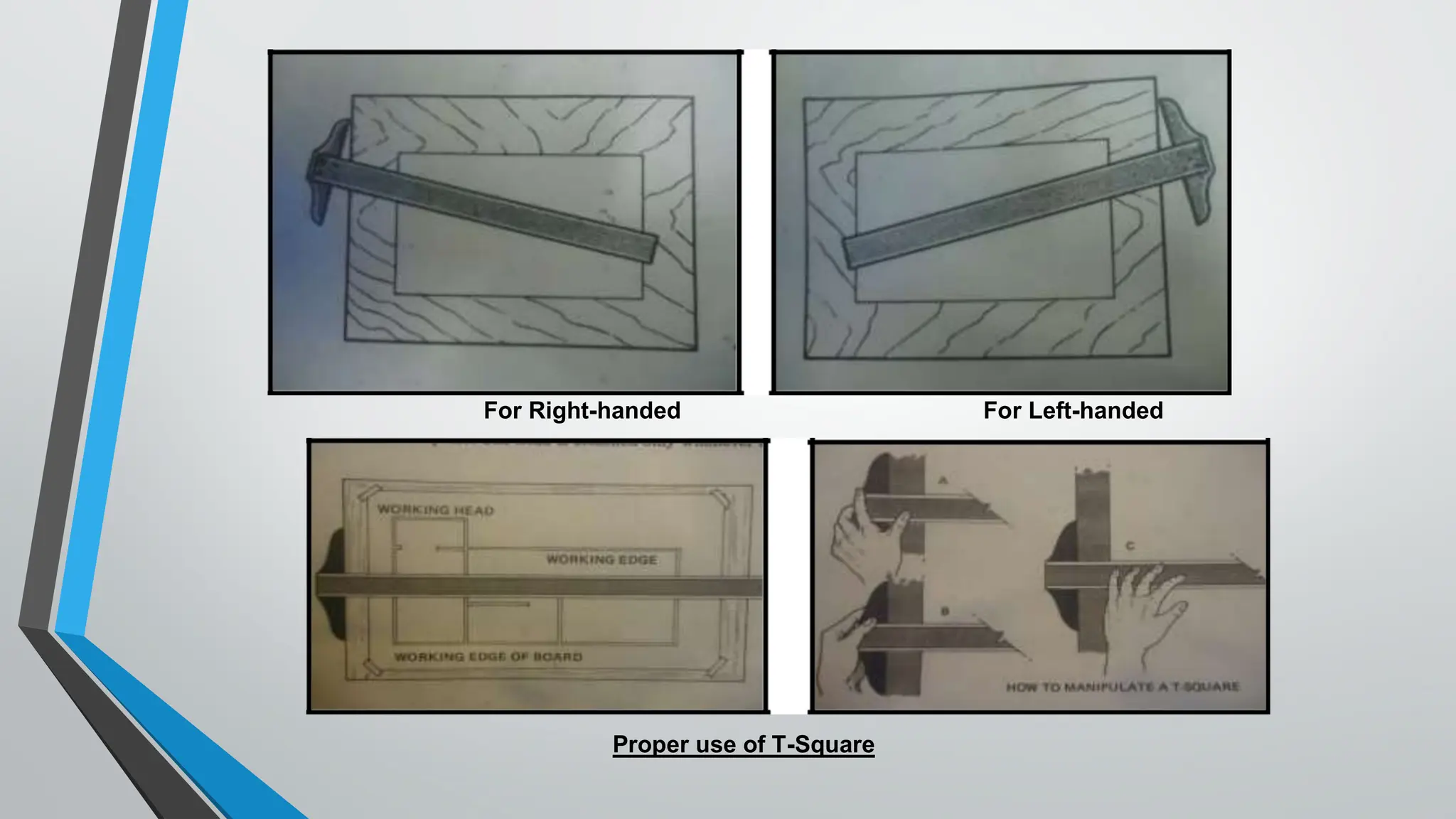
•Place the drawing paper close to the working edge of the drawing table and working head of the T-
square depending on you if you are right or left-handed, while the paper is placed on top edge of the T-
square.
•Fasten the upper left portion of the drawing paper followed by the lower right portion and finally the
remaining corners.
Note: Always fasten larger backing sheet of thicker drawing paper on the board first.
Placing drawing paper to the drawing board
Drawing a Horizontal Line
Directions: Below is a simple activity for you to work on. Practice the
task following the given procedure.
Materials:
•Drawing paper
•Masking tape
Instrument:
•T – Square
•Triangles (30 deg. x 60 deg. and 45 deg. x 45 deg.)
Equipment:
•Drawing Table
Procedure:
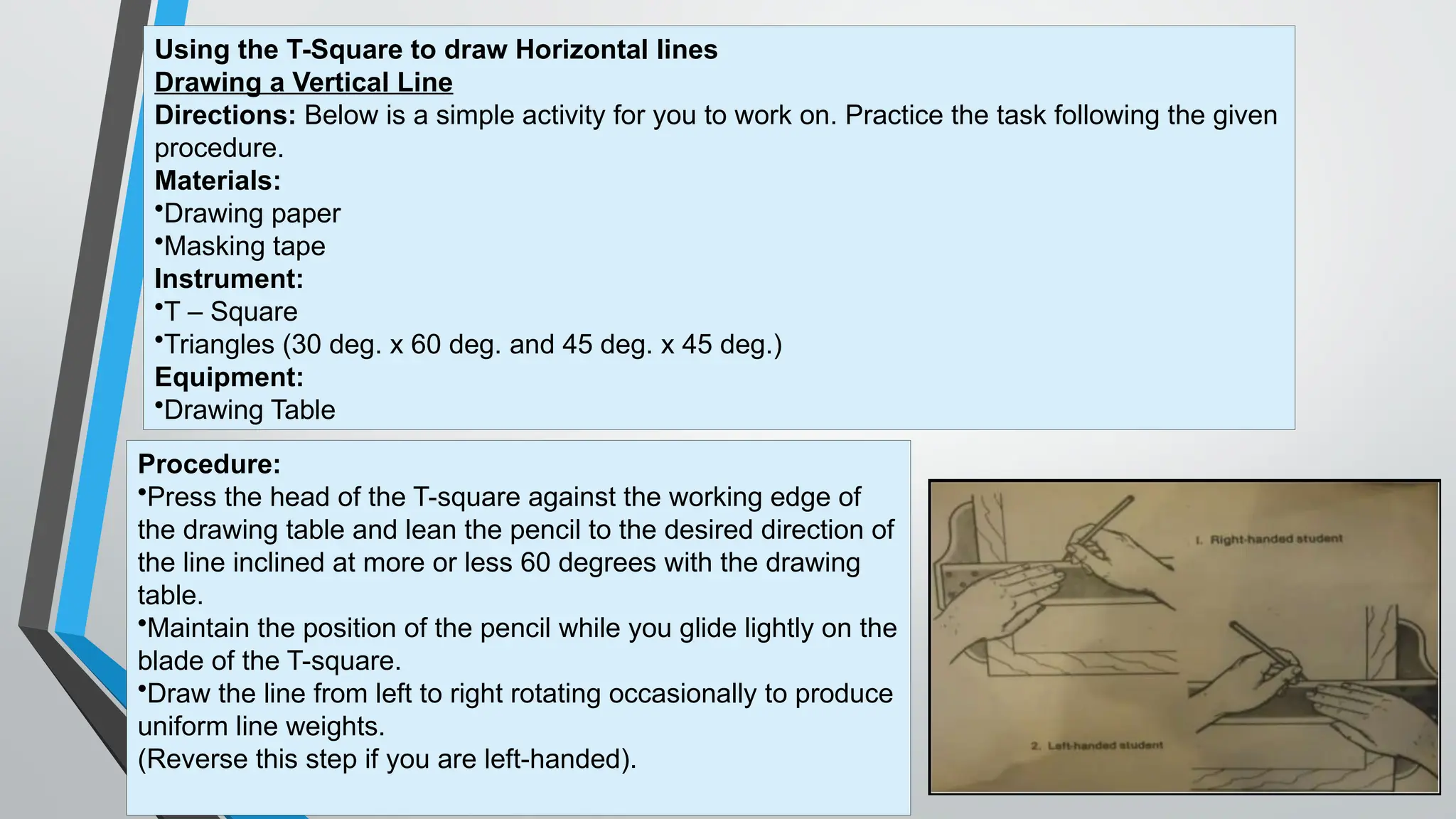
•Press the head of the T-square against the working edge of
the drawing table and lean the pencil to the desired direction of
the line inclined at more or less 60 degrees with the drawing
table.
•Maintain the position of the pencil while you glide lightly on the
blade of the T-square.
•Draw the line from left to right rotating occasionally to produce
uniform line weights.
(Reverse this step if you are left-handed).
Using the T-Square to draw Horizontal lines
Drawing a Vertical Line
Directions: Below is a simple activity for you to work on. Practice the task following the given
procedure.
Materials:
•Drawing paper
•Masking tape
Instrument:
•T – Square
•Triangles (30 deg. x 60 deg. and 45 deg. x 45 deg.)
Equipment:
•Drawing Table
Procedure:
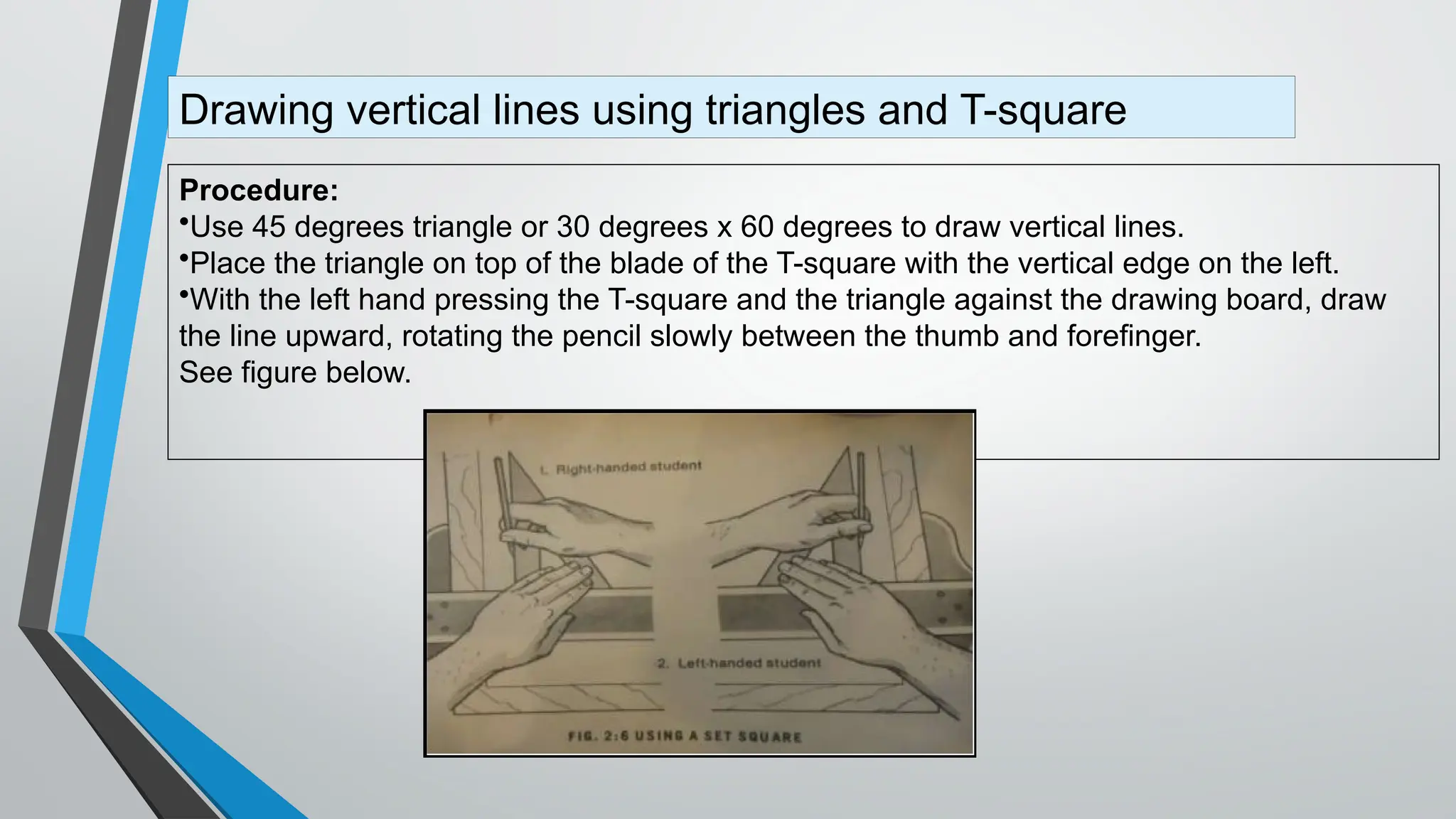
•Use 45 degrees triangle or 30 degrees x 60 degrees to draw vertical lines.
•Place the triangle on top of the blade of the T-square with the vertical edge on the left.
•With the left hand pressing the T-square and the triangle against the drawing board, draw
the line upward, rotating the pencil slowly between the thumb and forefinger.
See figure below.
Drawing vertical lines using triangles and T-square
For Right-handed For Left-handed
Proper use of T-Square
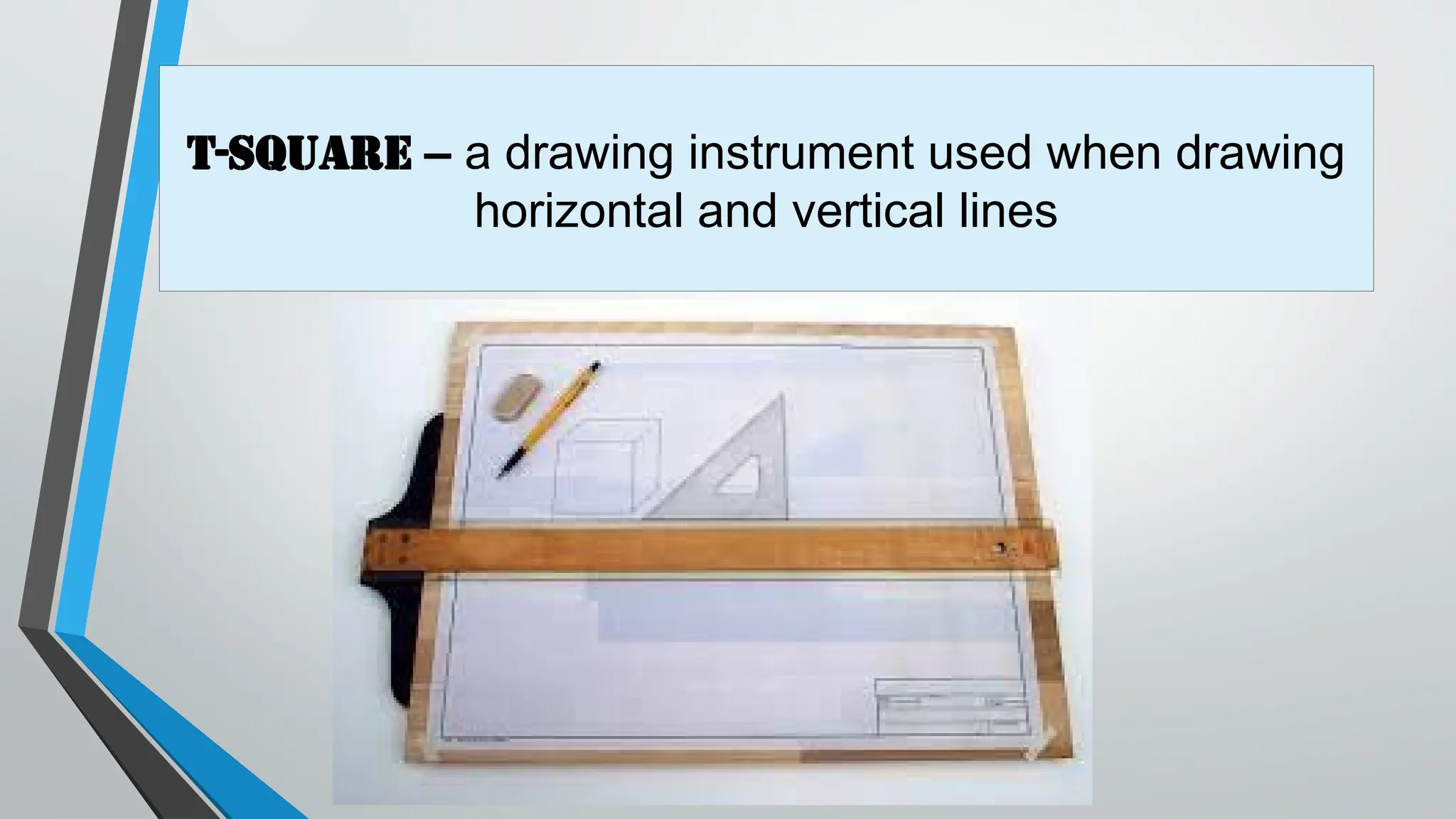
T-Square – a drawing instrument used when drawing
horizontal and vertical lines
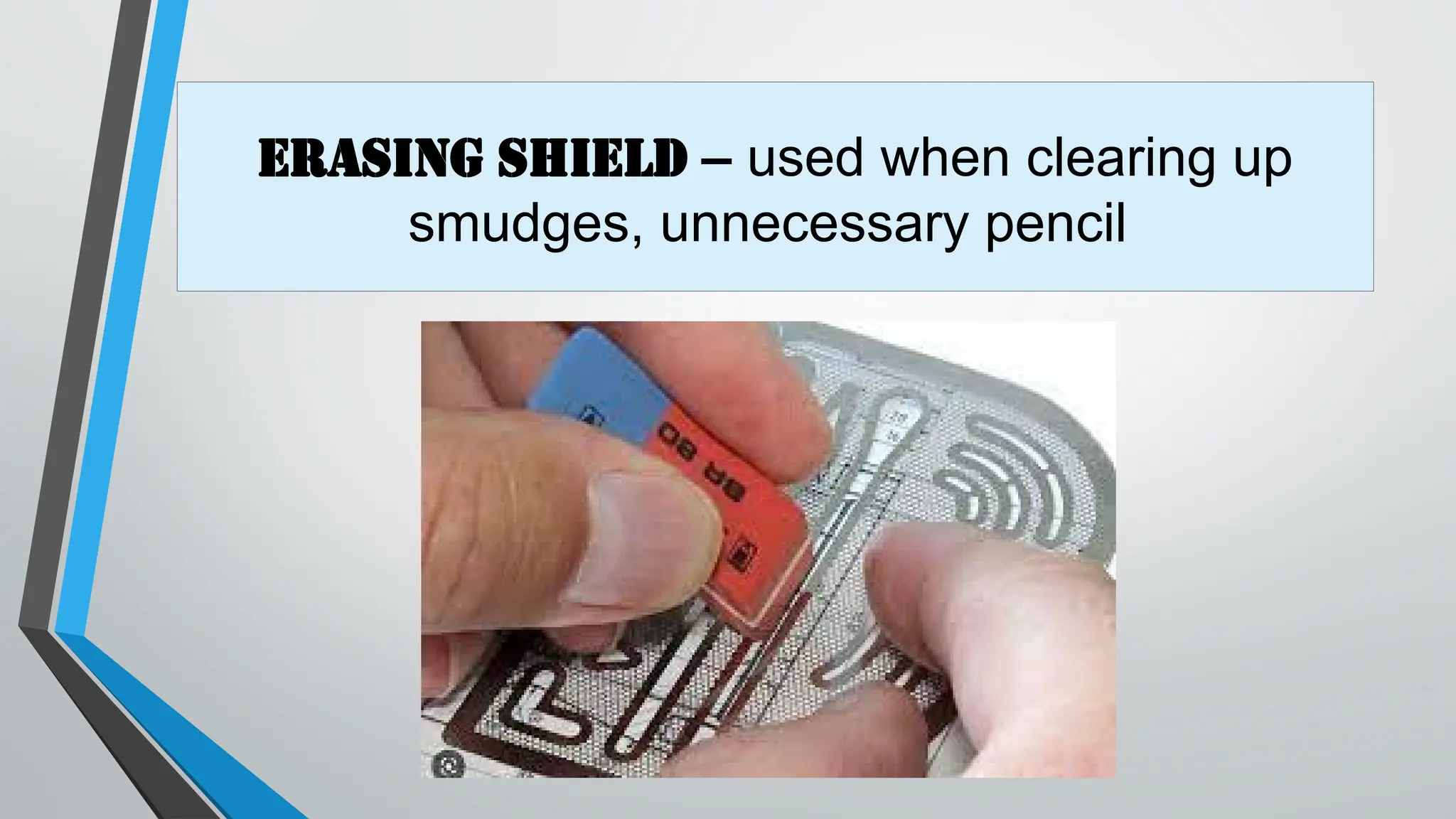
Erasing shield – used when clearing up
smudges, unnecessary pencil
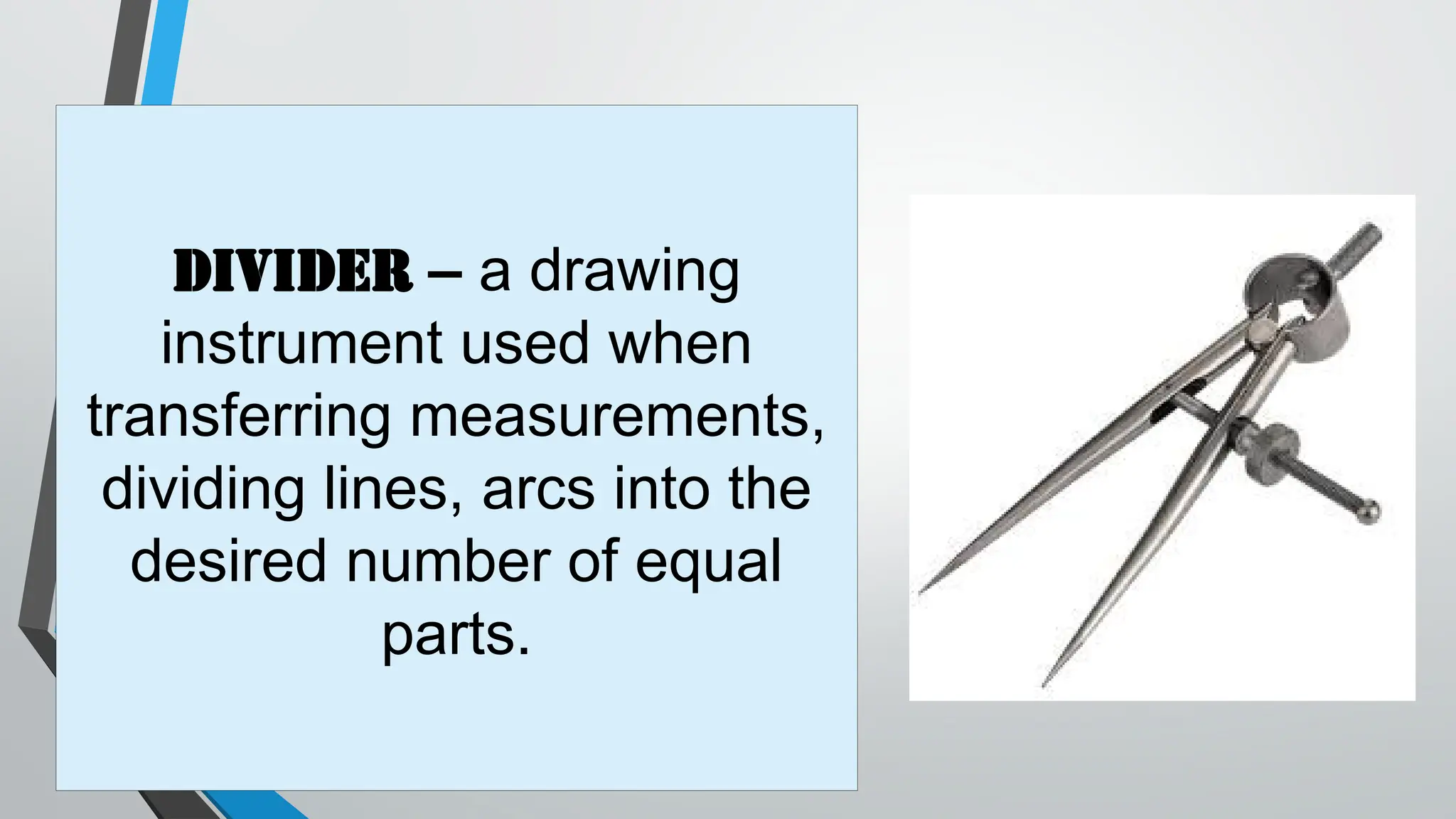
Divider – a drawing
instrument used when
transferring measurements,
dividing lines, arcs into the
desired number of equal
parts.
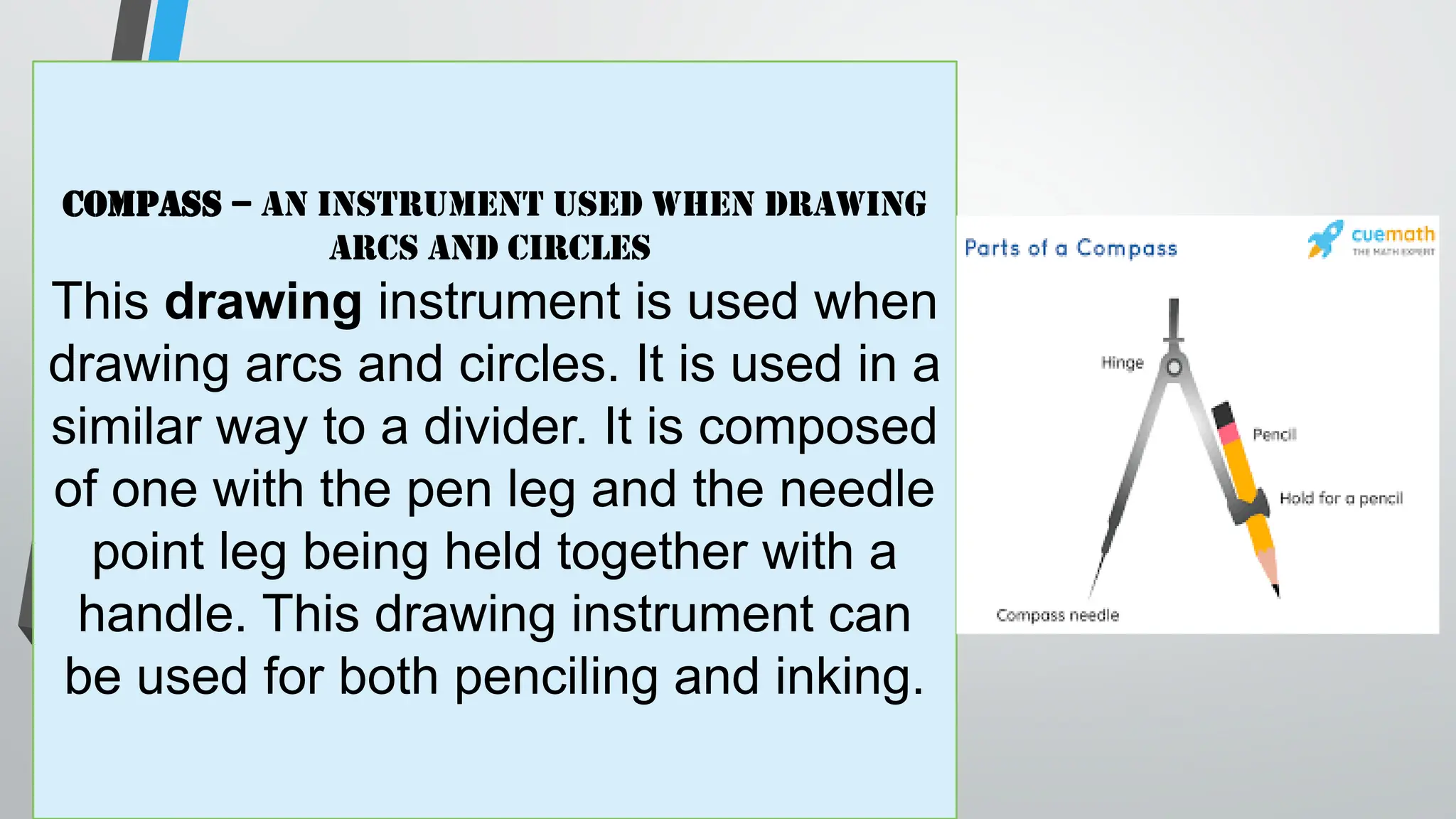
Compass – an instrument used when drawing
arcs and circles
This drawing instrument is used when
drawing arcs and circles. It is used in a
similar way to a divider. It is composed
of one with the pen leg and the needle
point leg being held together with a
handle. This drawing instrument can
be used for both penciling and inking.
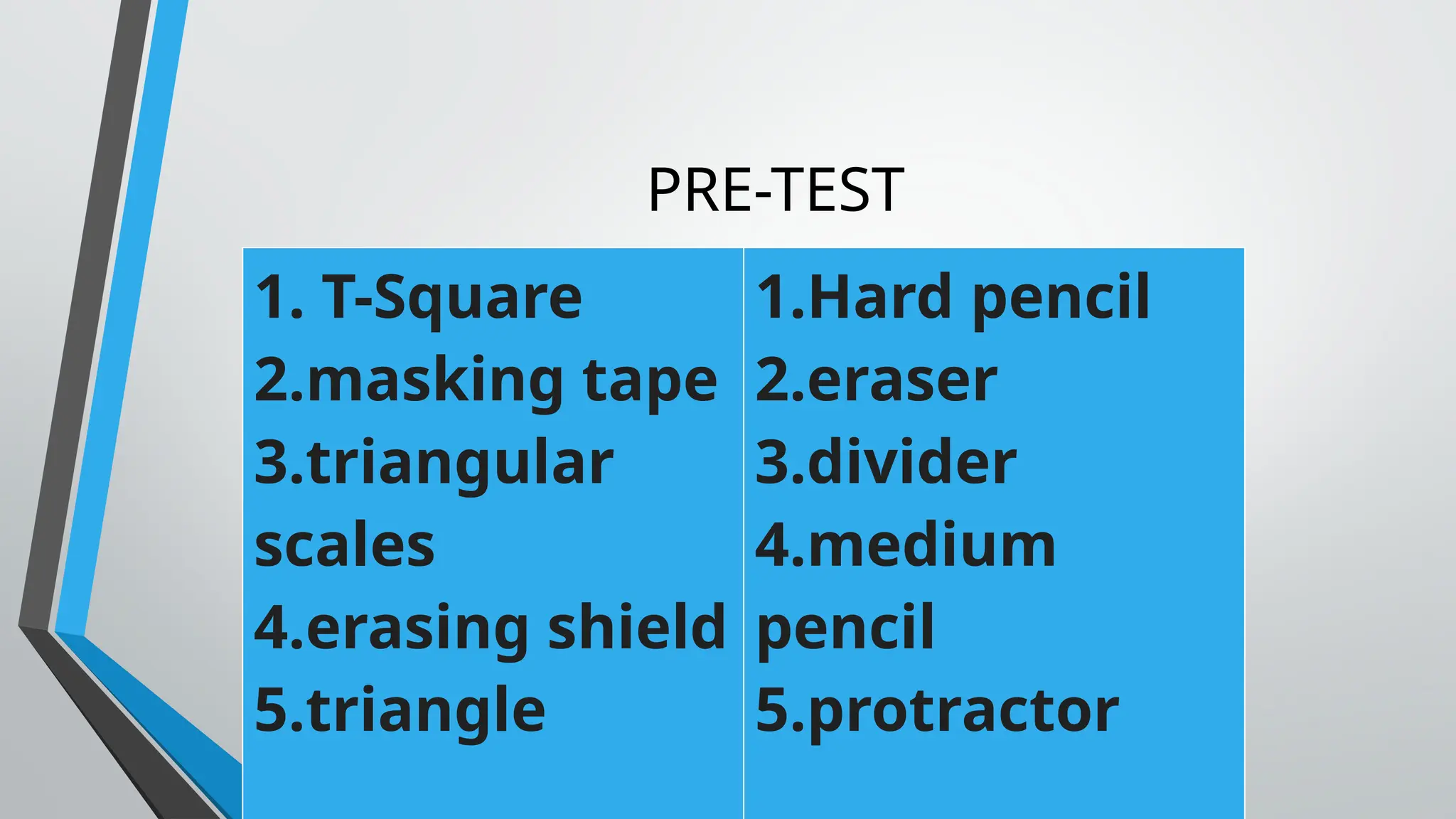
PRE-TEST
1. T-Square
2.masking tape
3.triangular
scales
4.erasing shield
5.triangle
1.Hard pencil
2.eraser
3.divider
4.medium
pencil
5.protractor
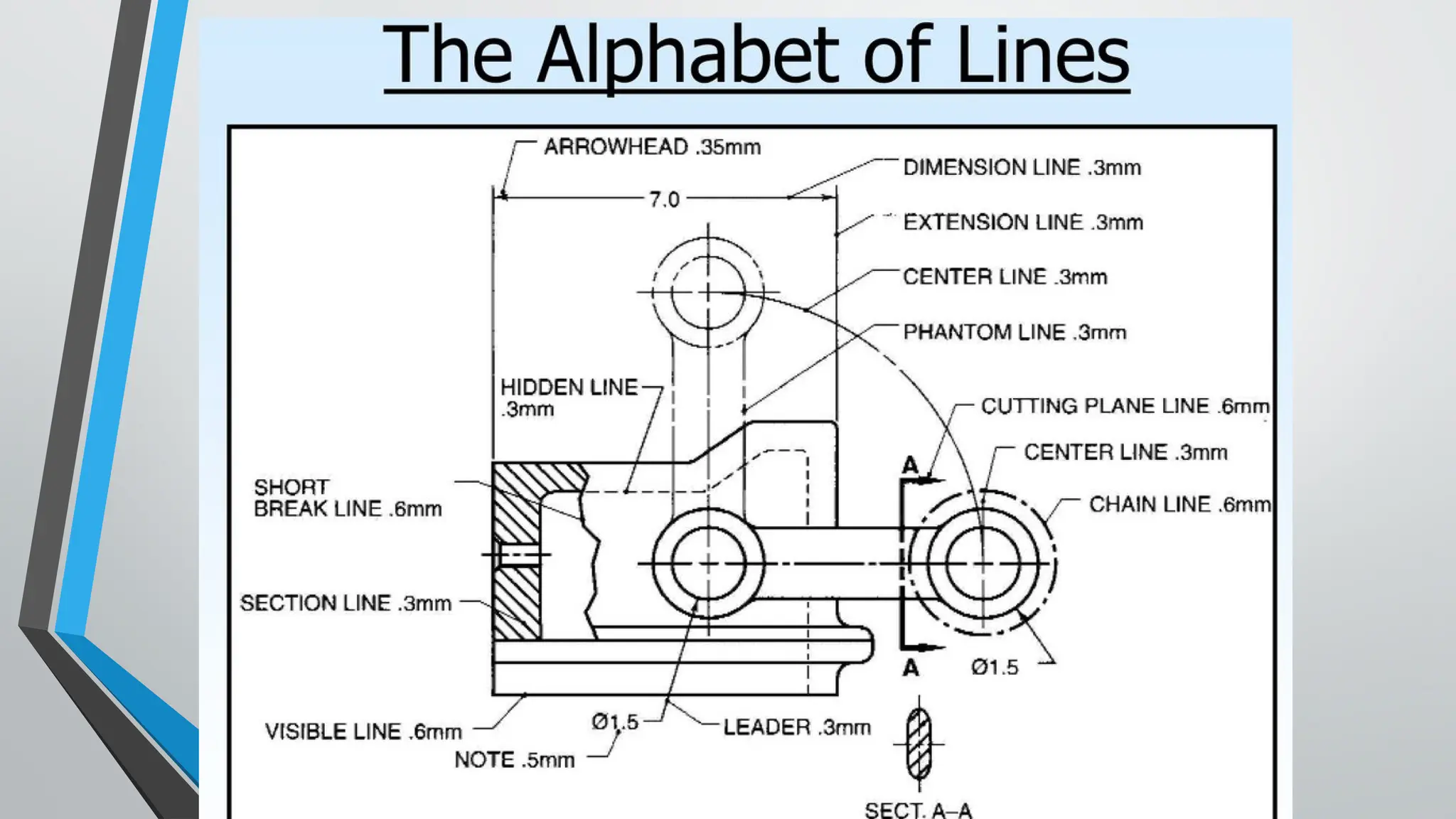
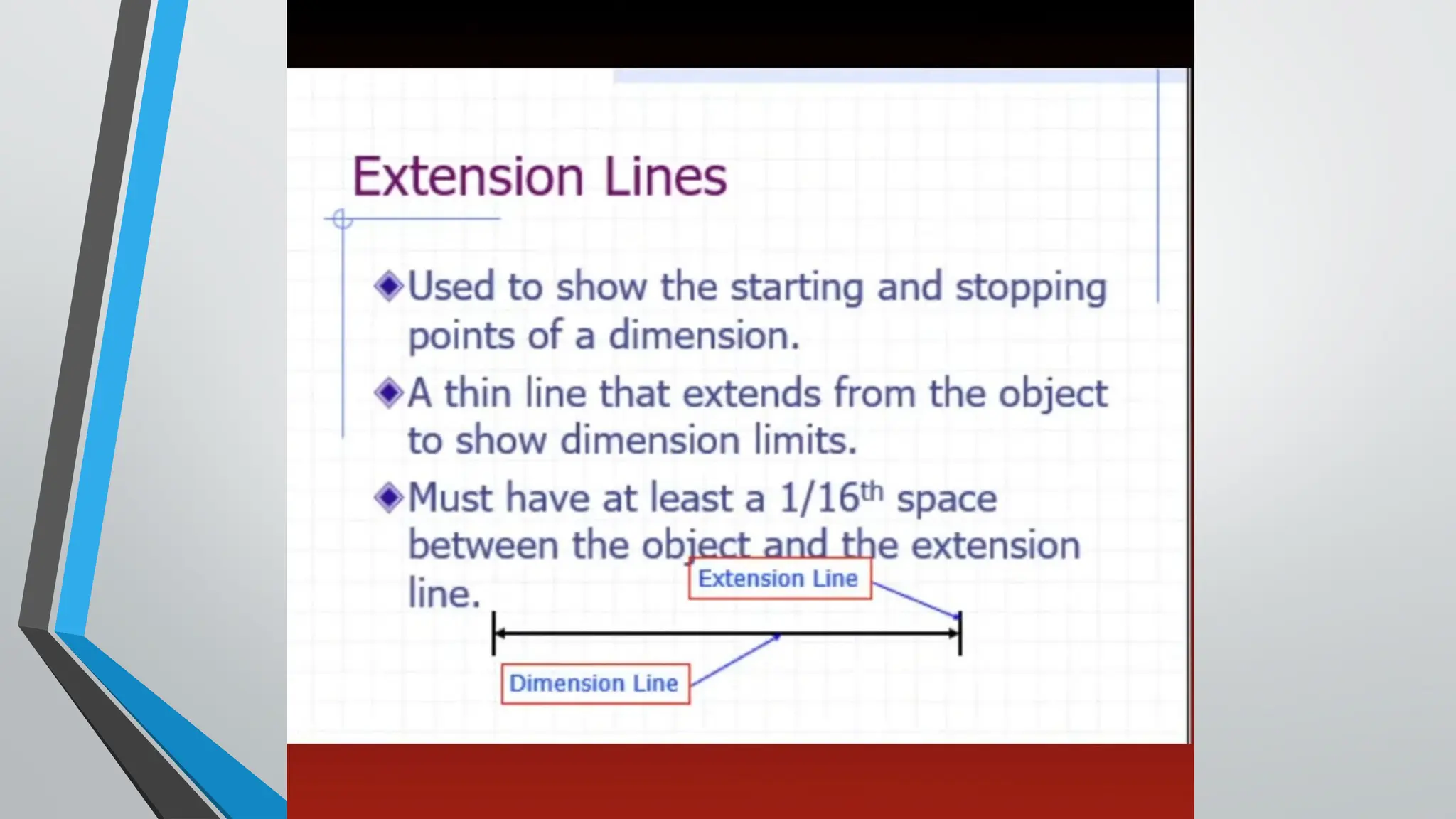
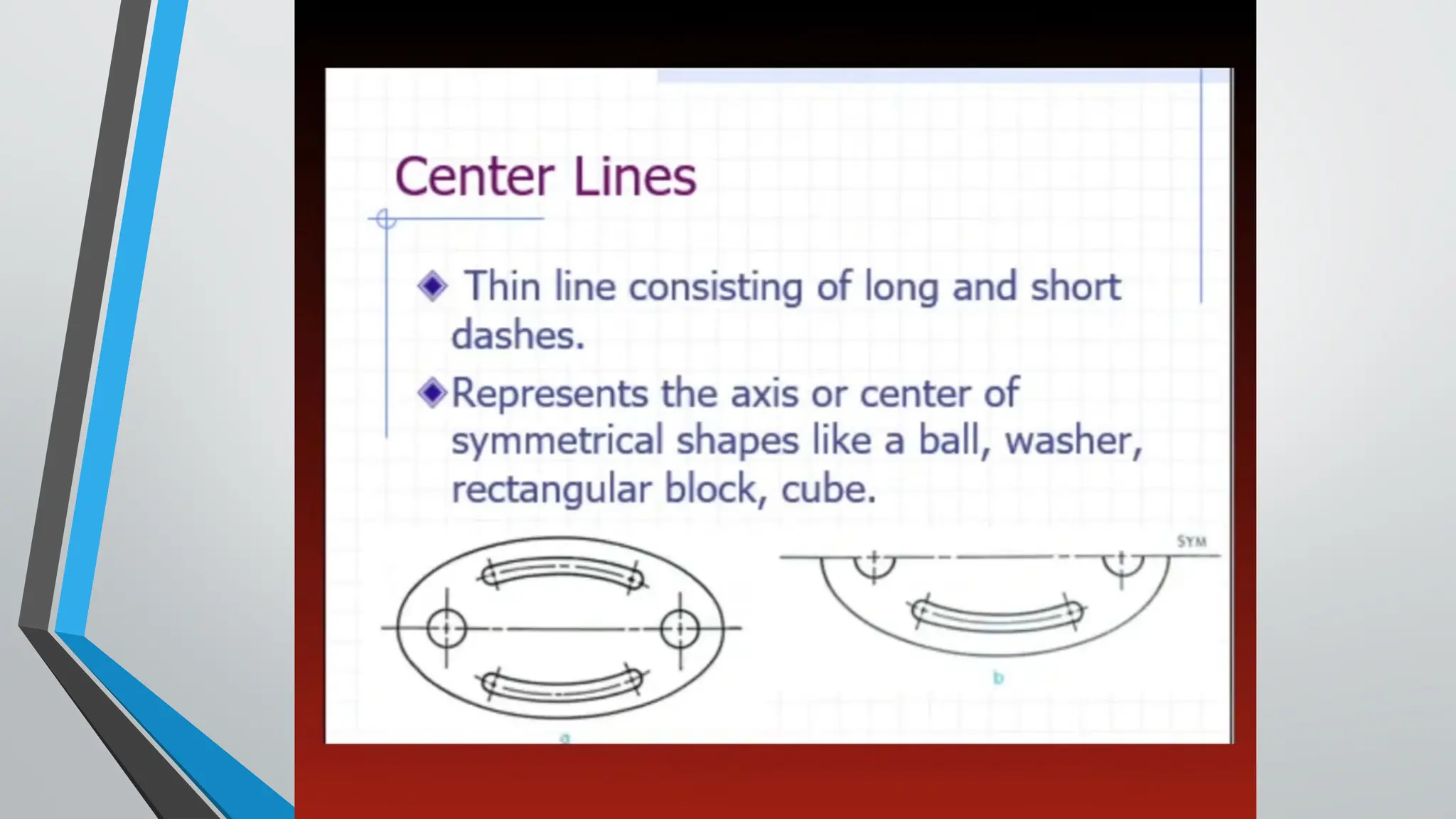
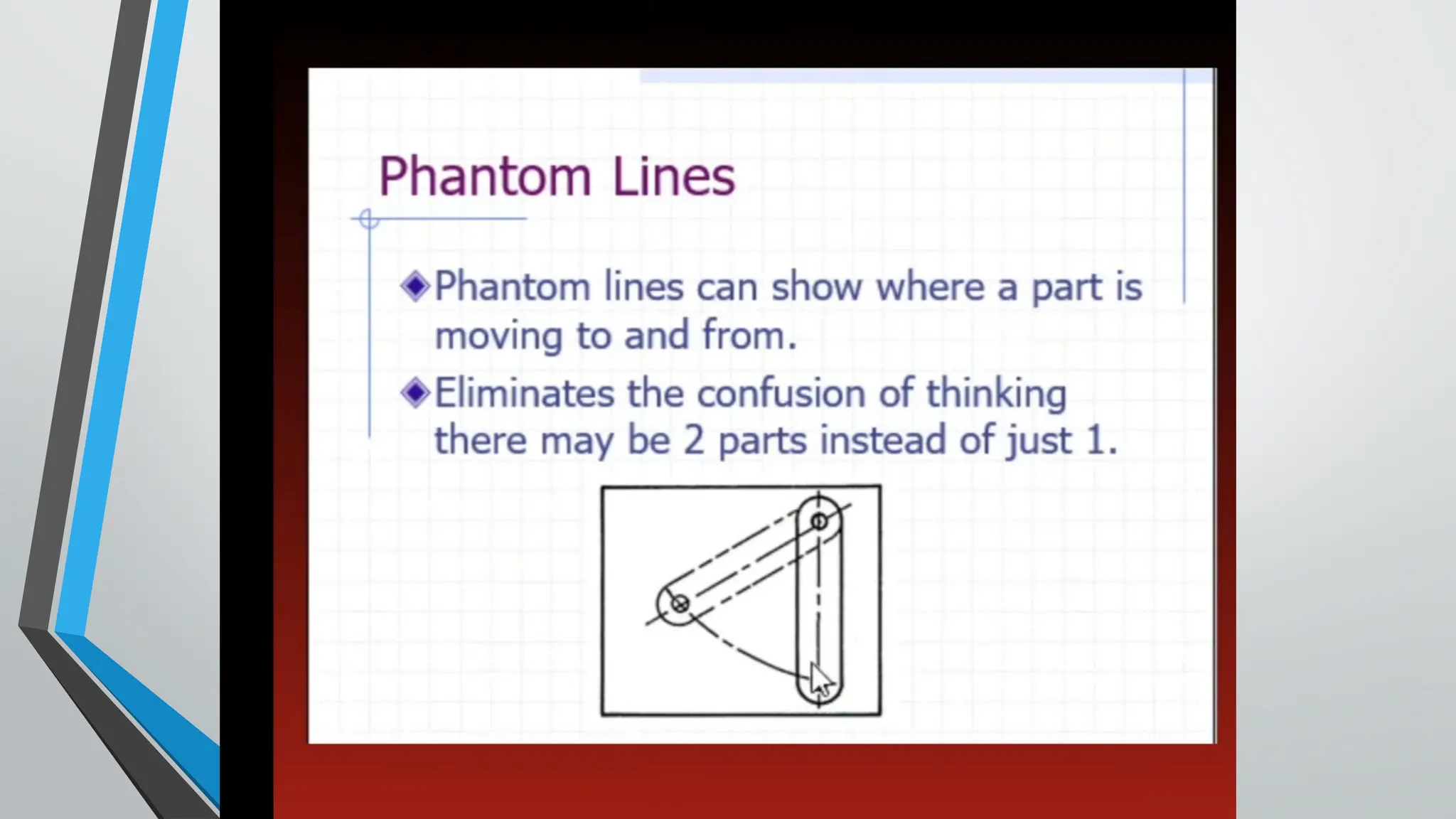
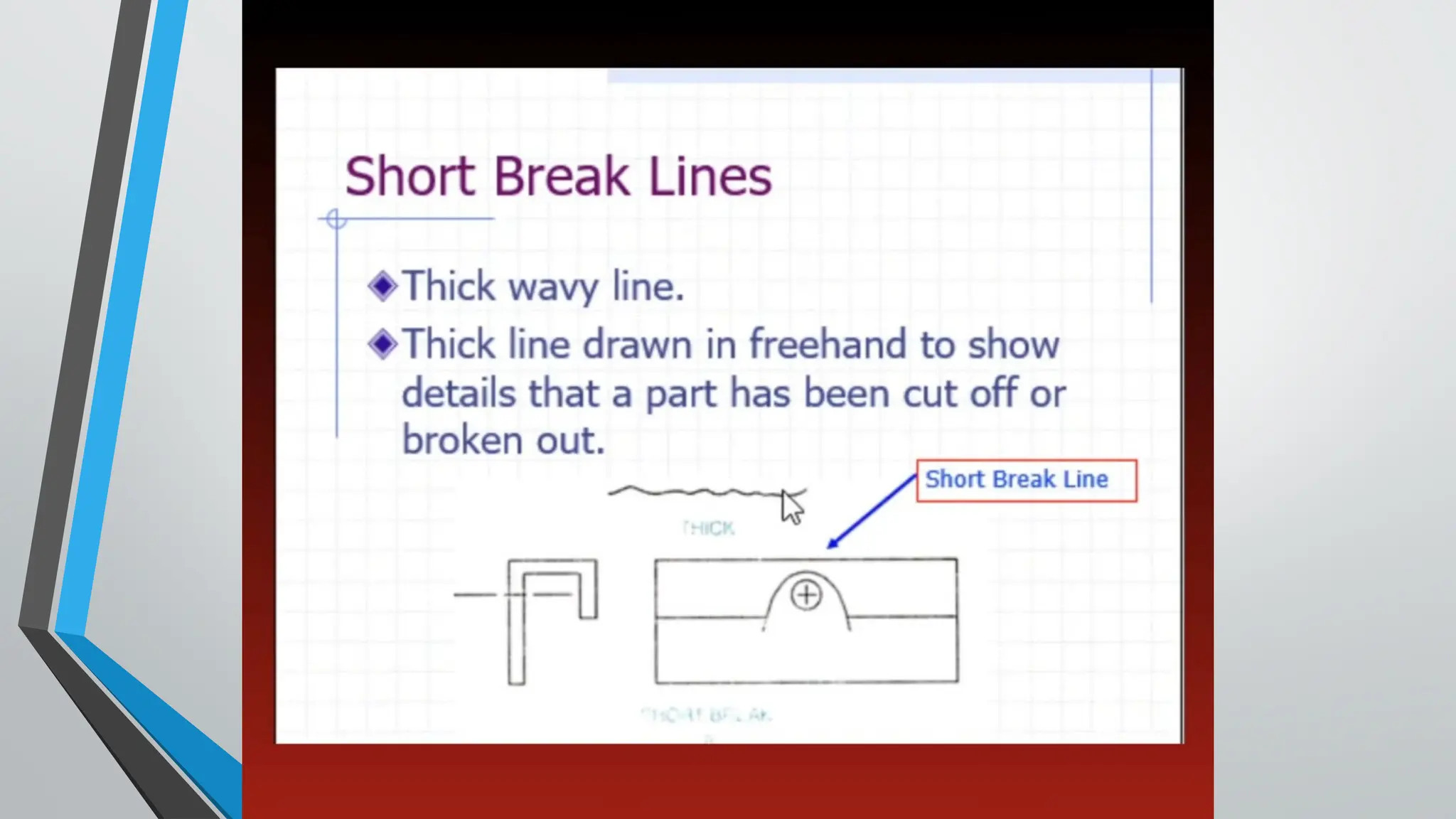
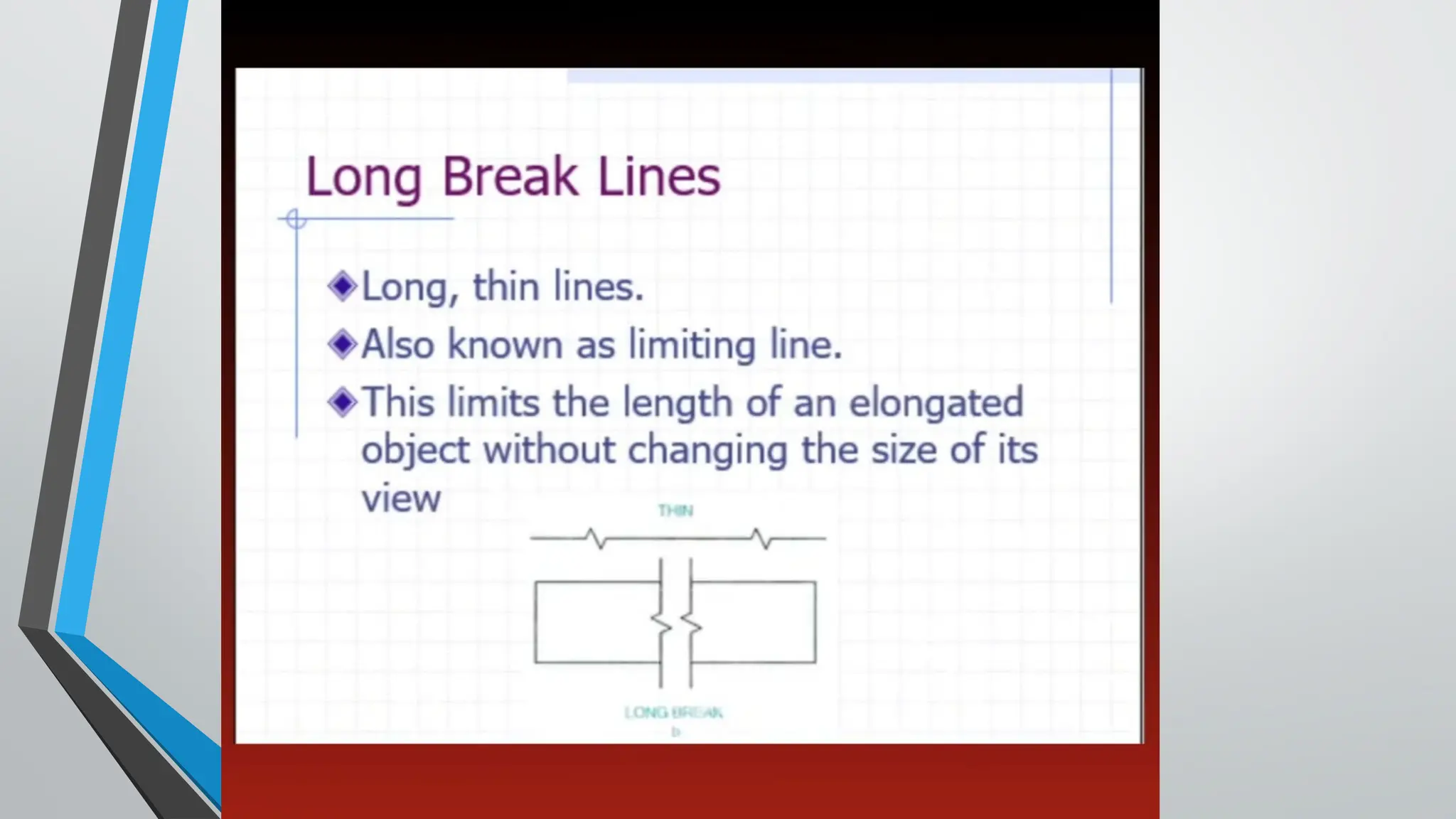
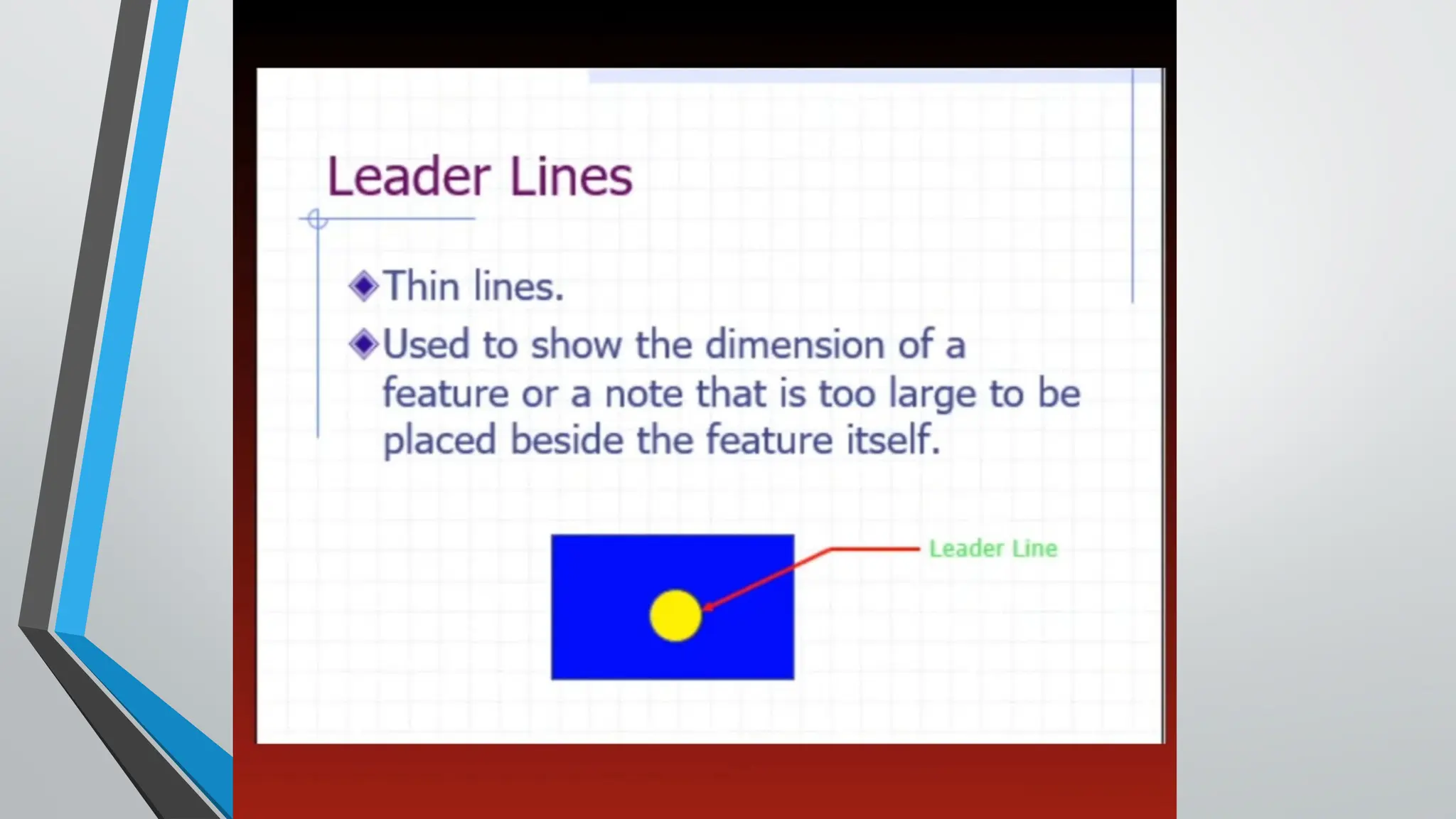
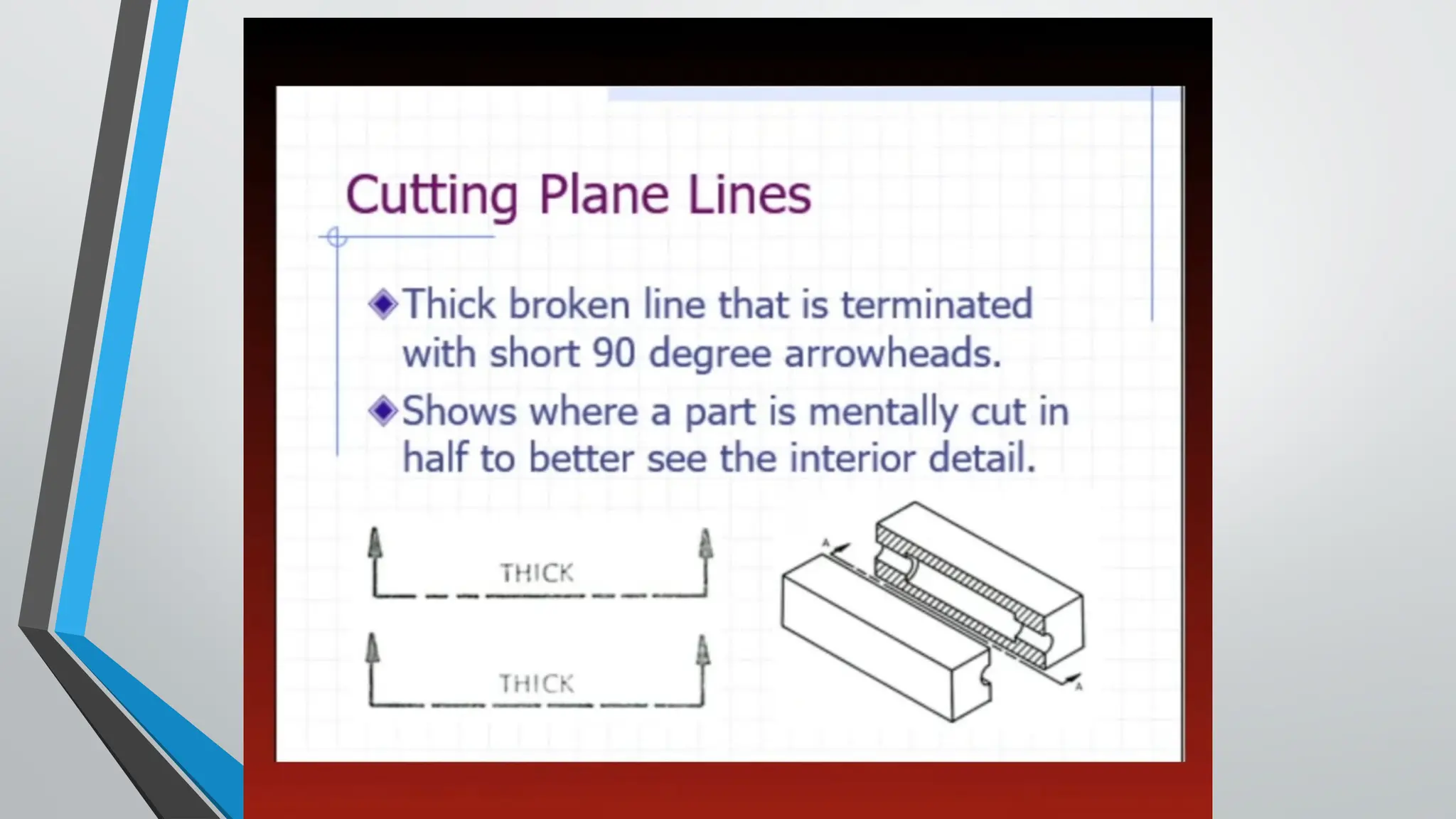
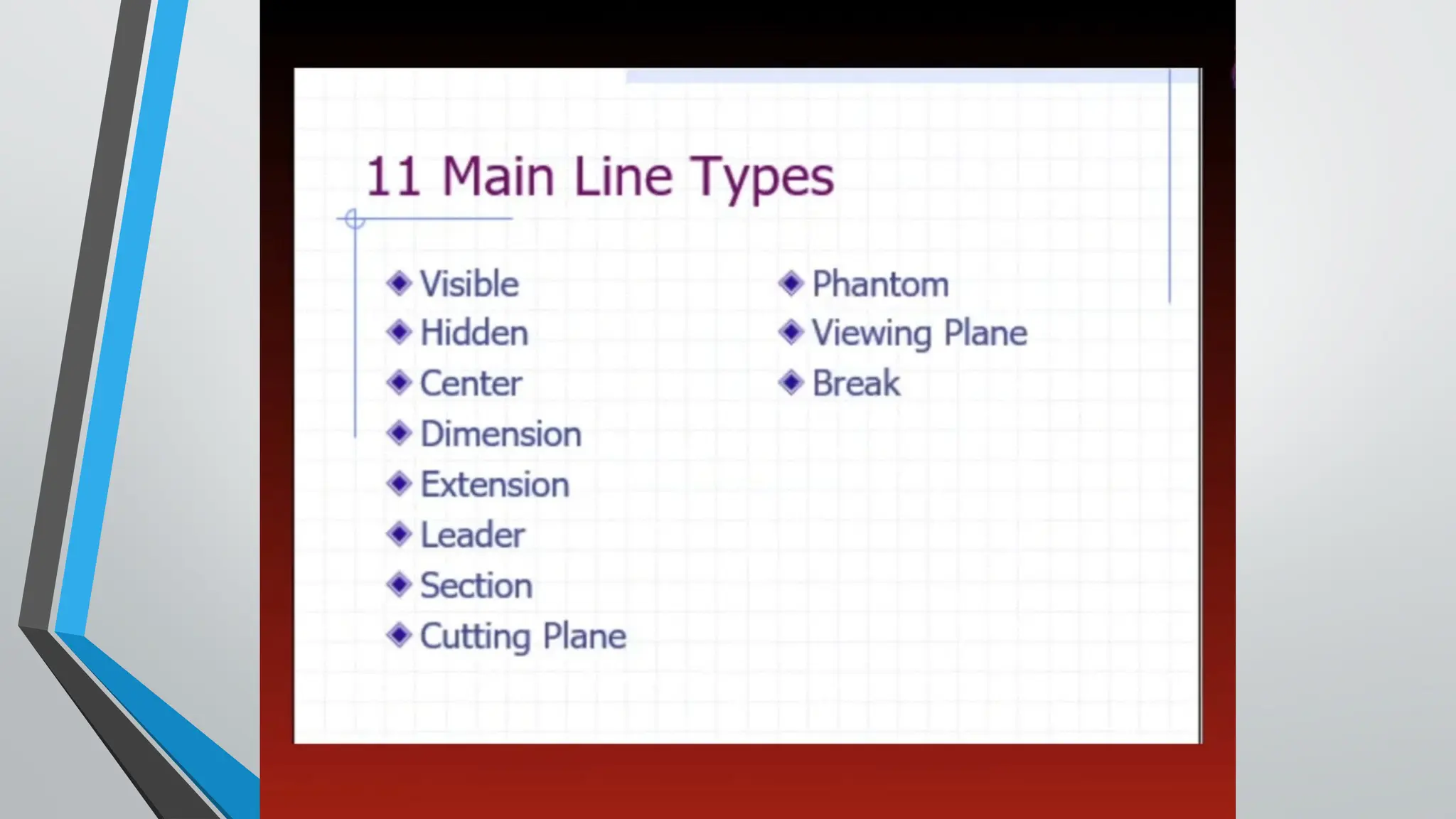
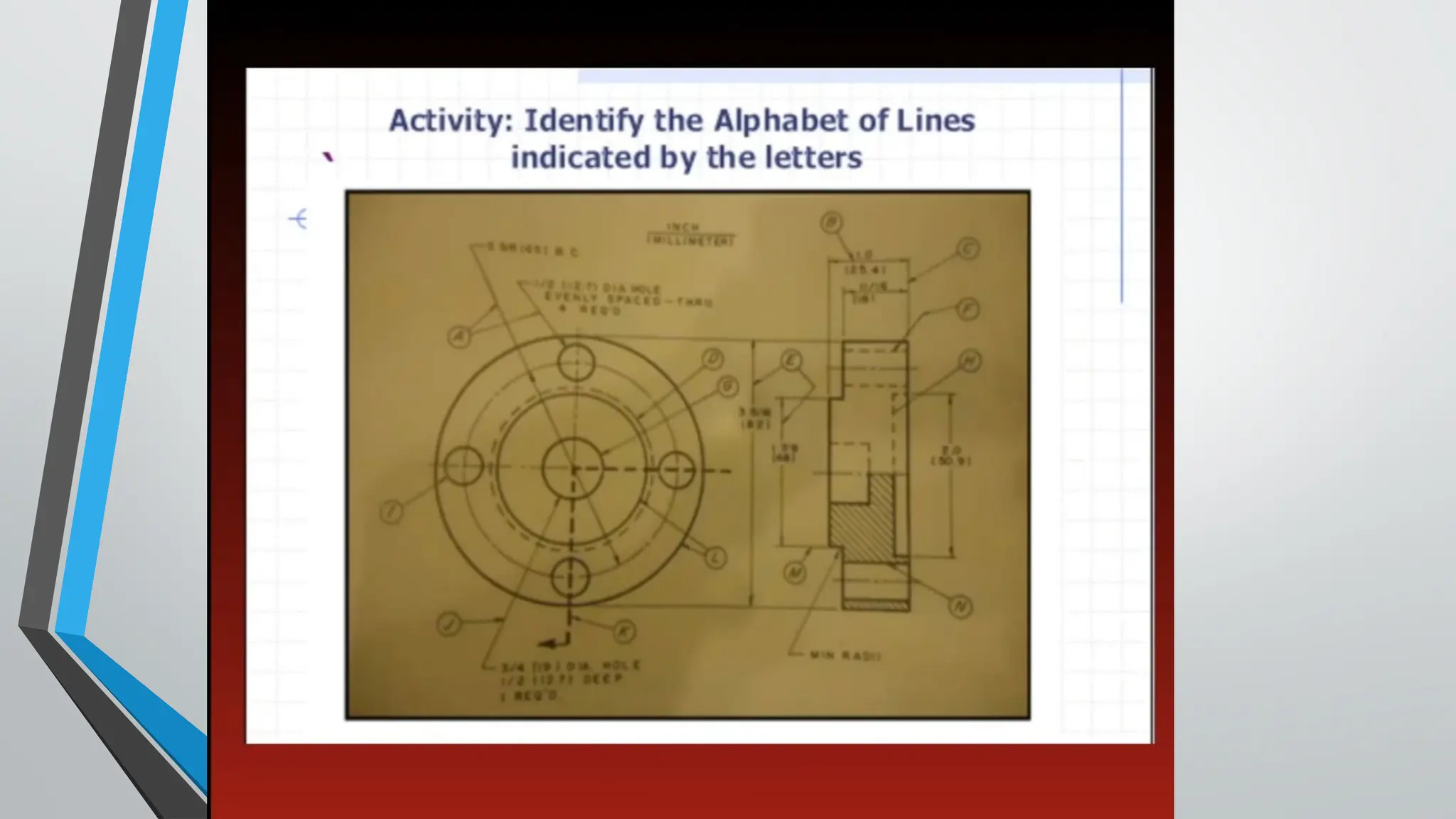
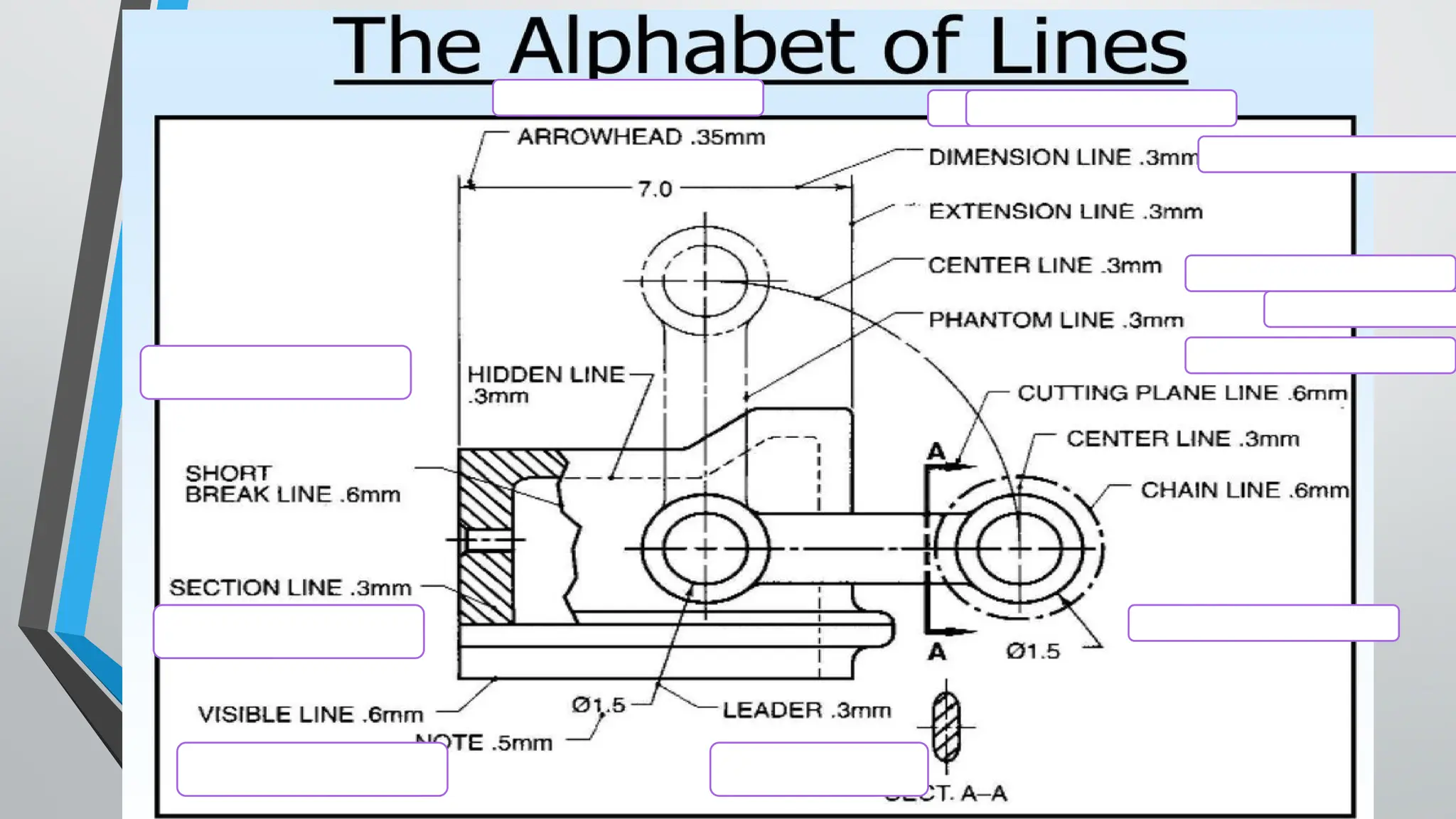
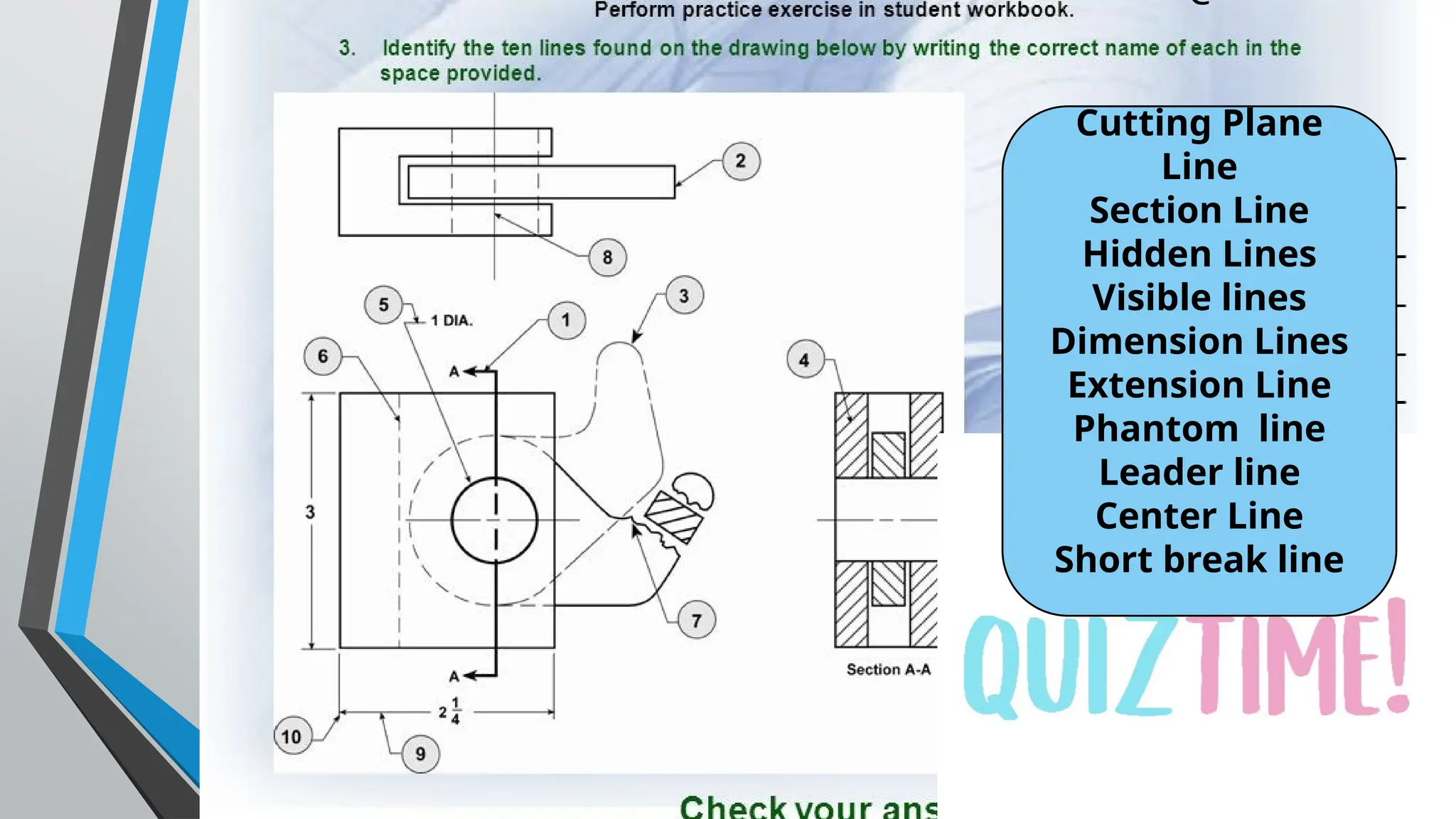
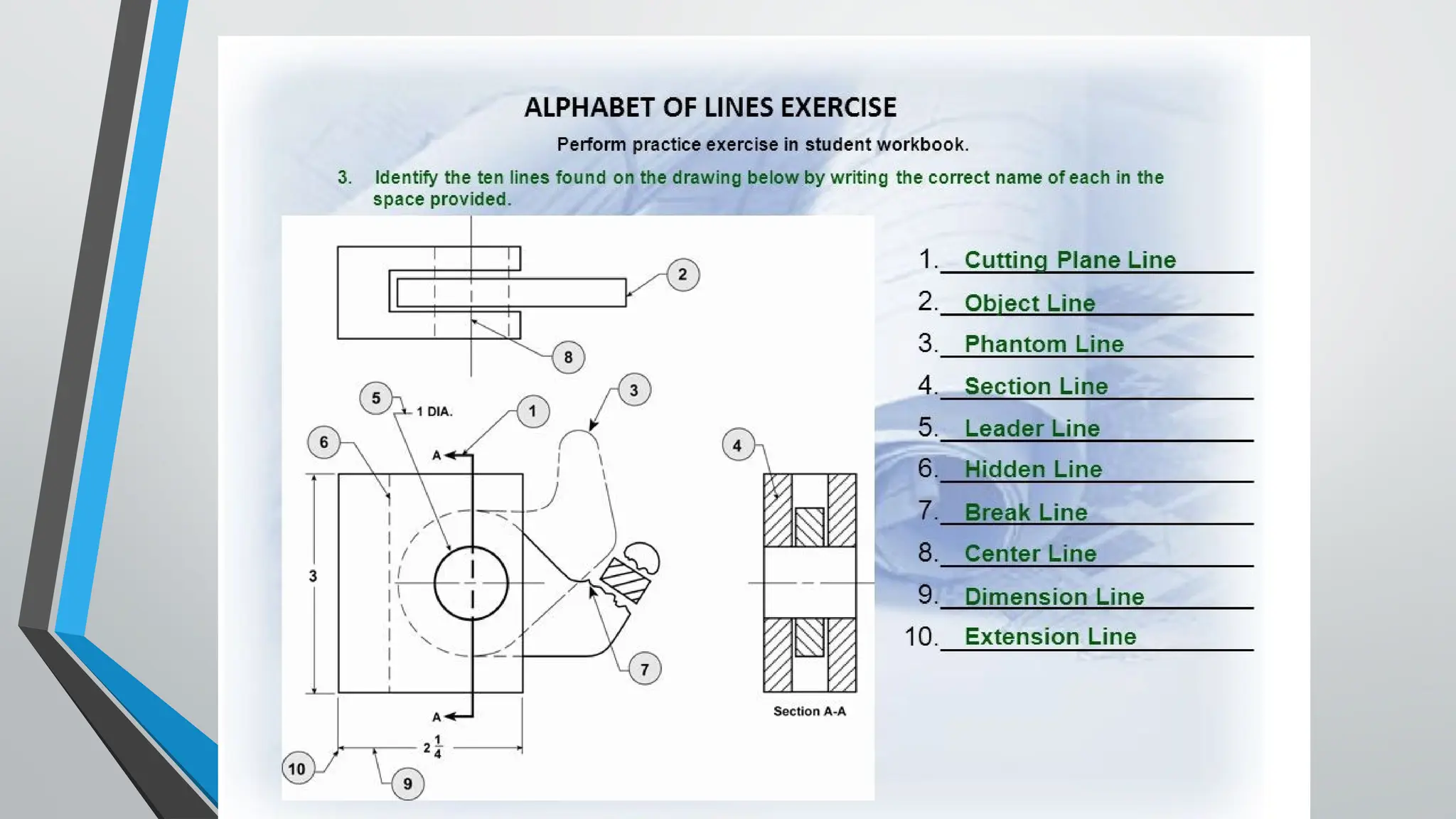
•ALPHABET OF LINES
C
Cutting Plane
Line
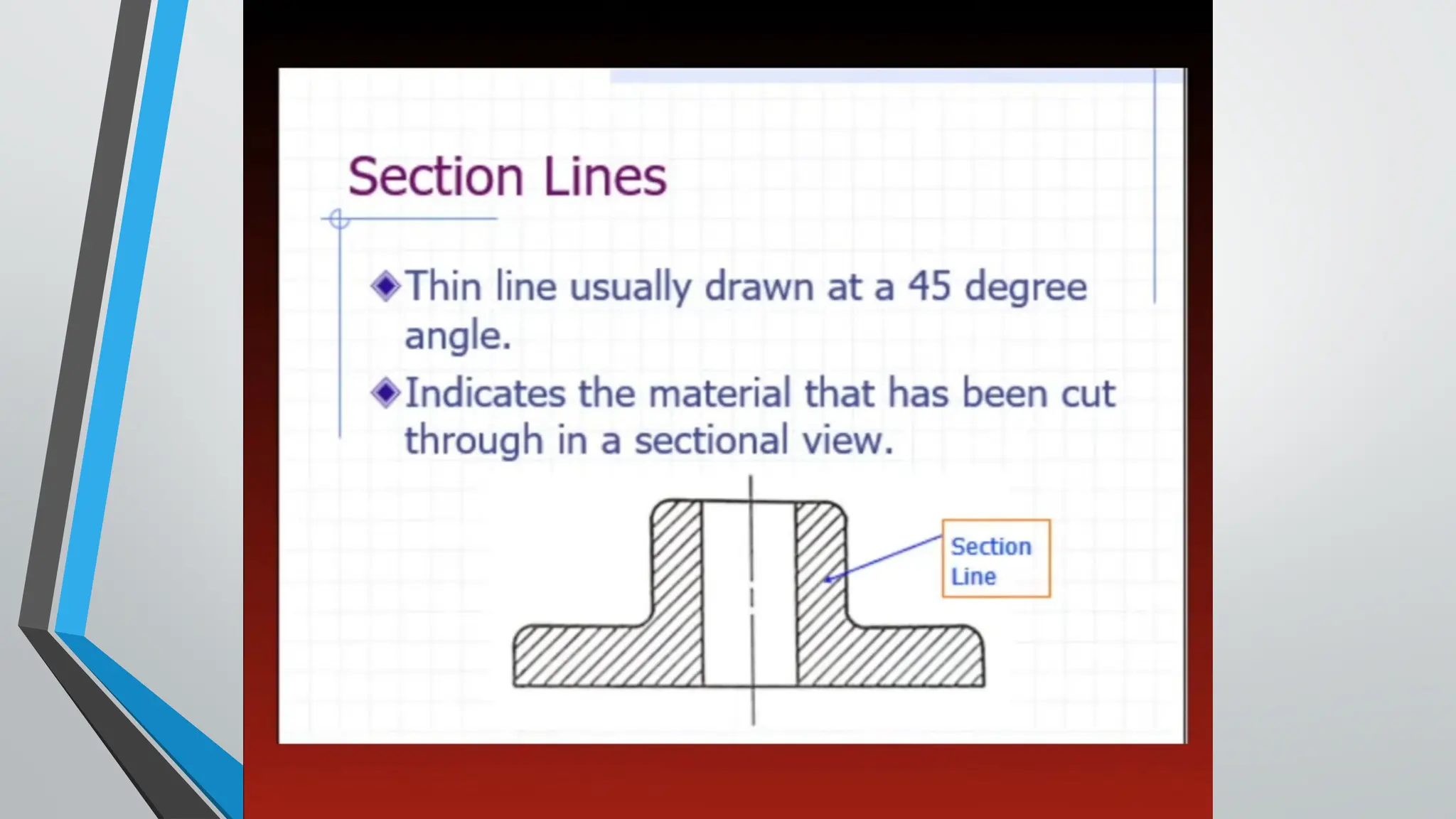
Section Line
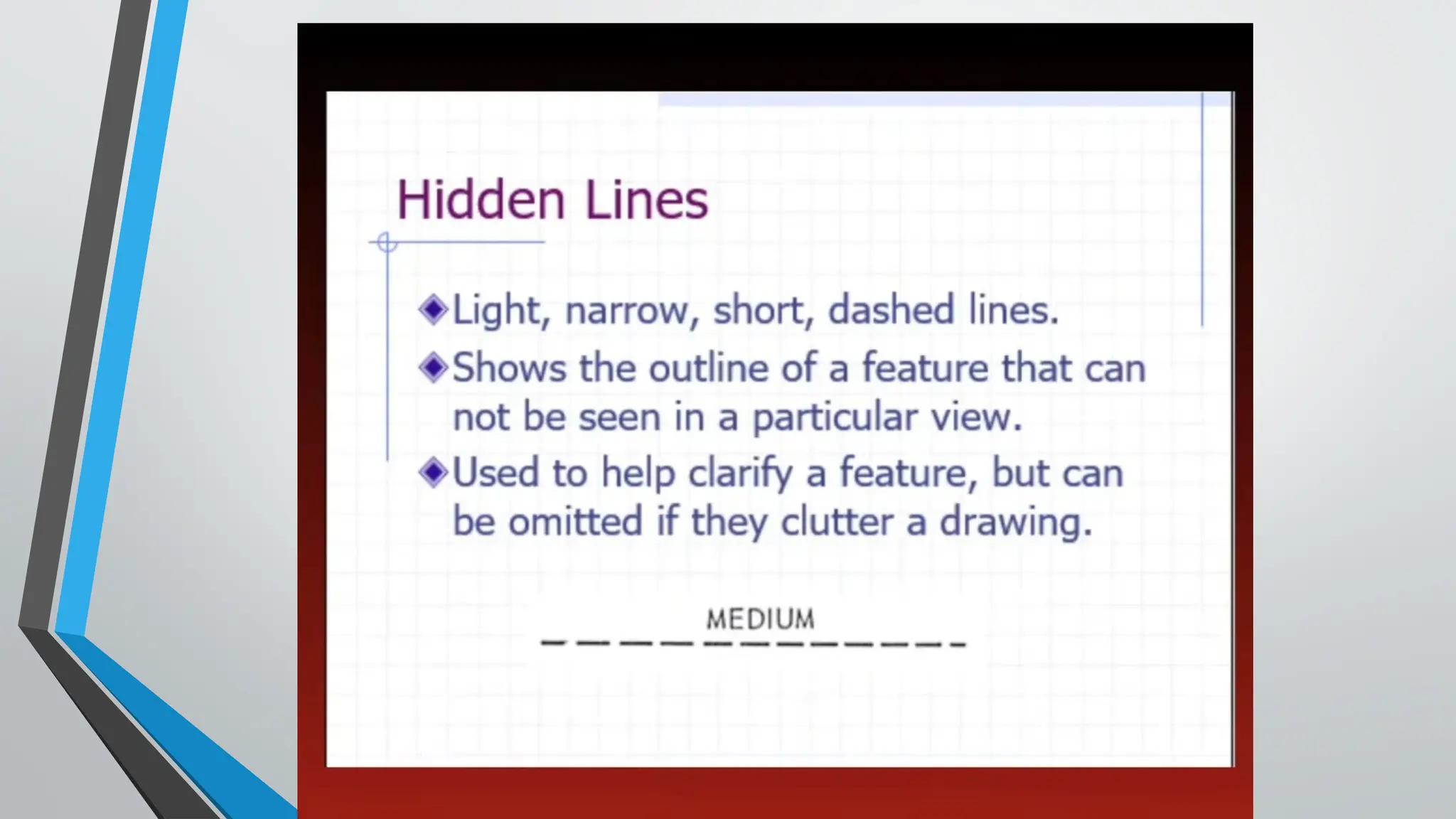
Hidden Lines
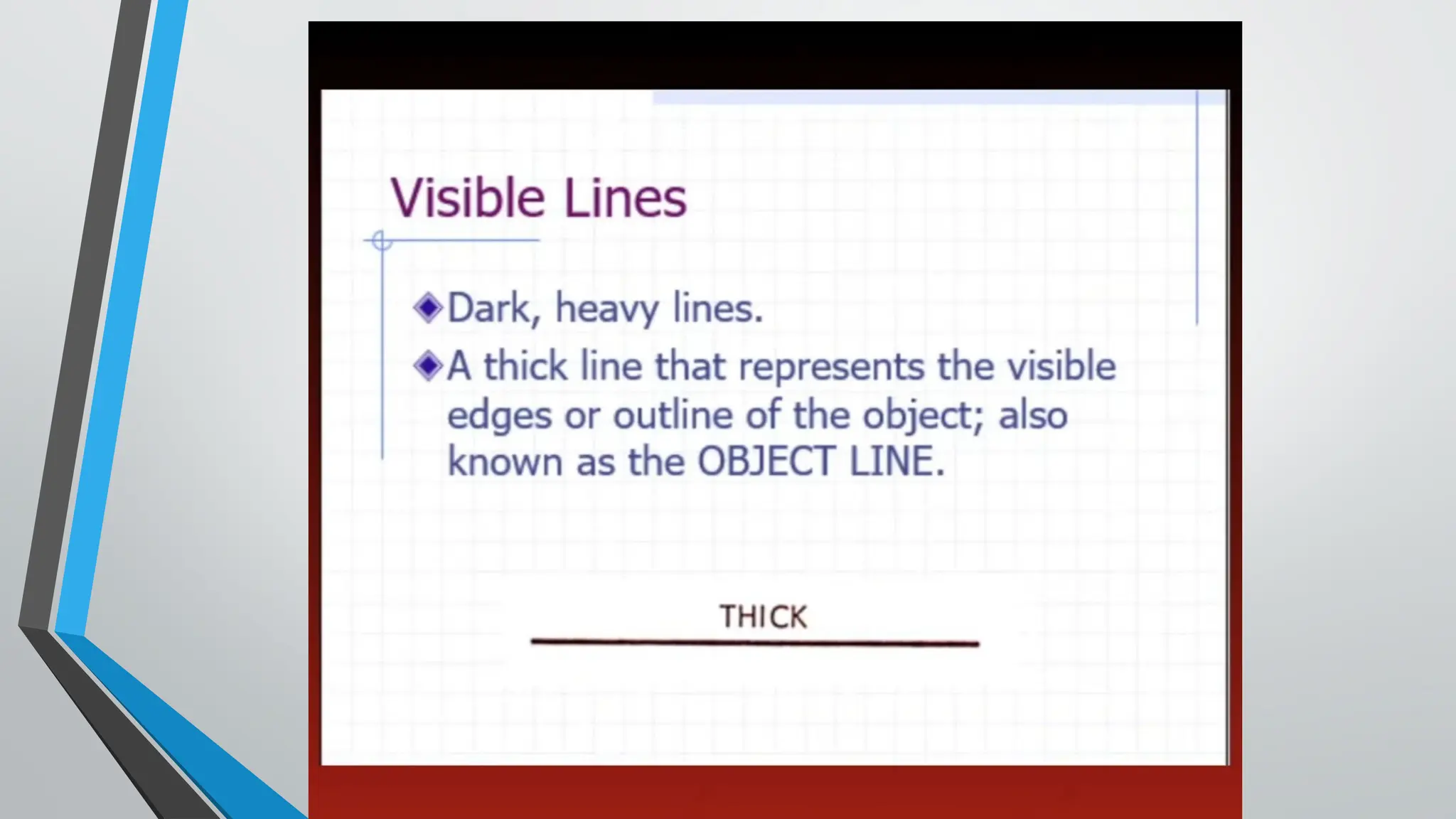
Visible lines
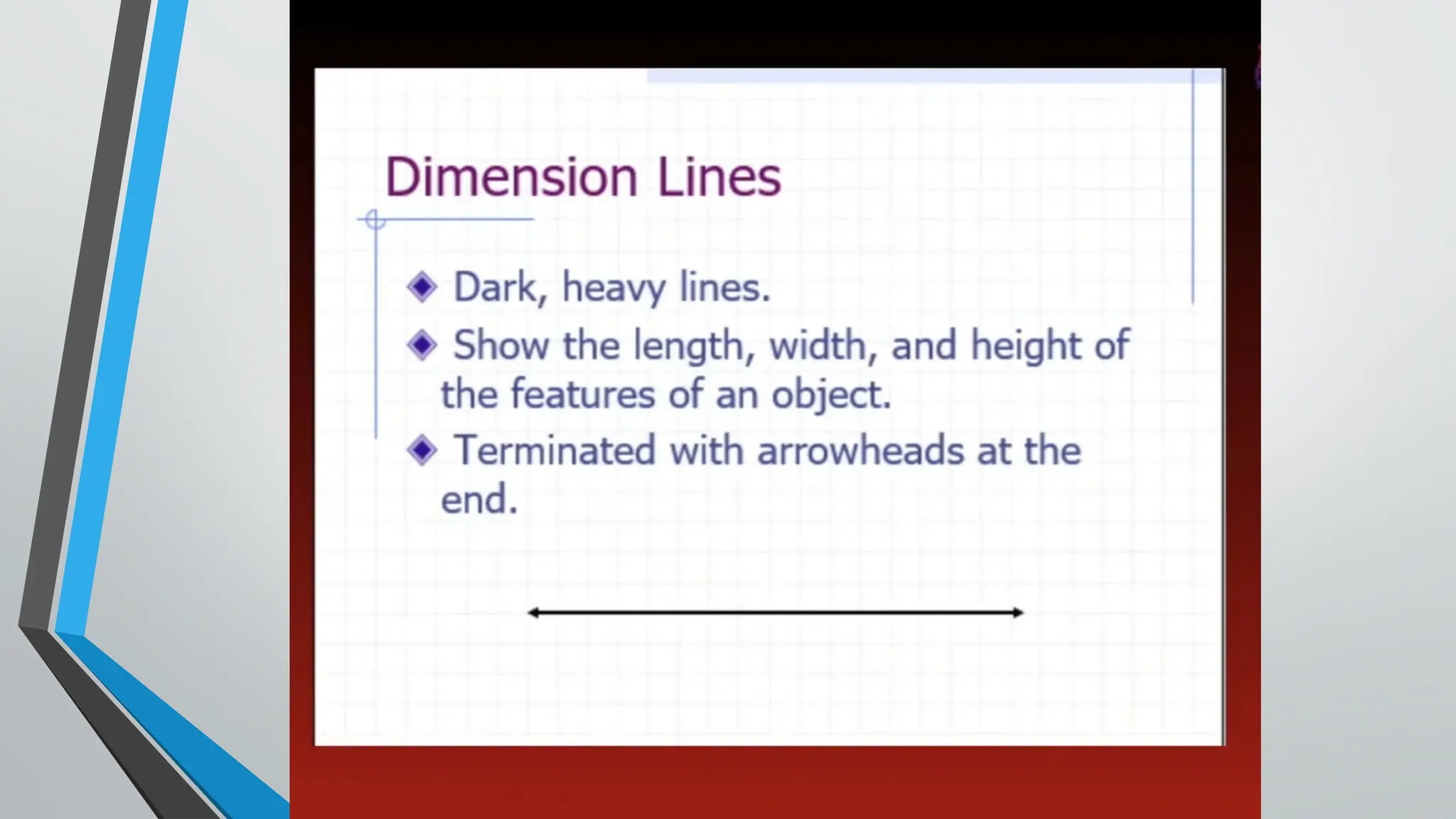
Dimension Lines
Extension Line
Phantom line
Leader line
Center Line
Short break line
PLATE NO. 1
Boarder Line
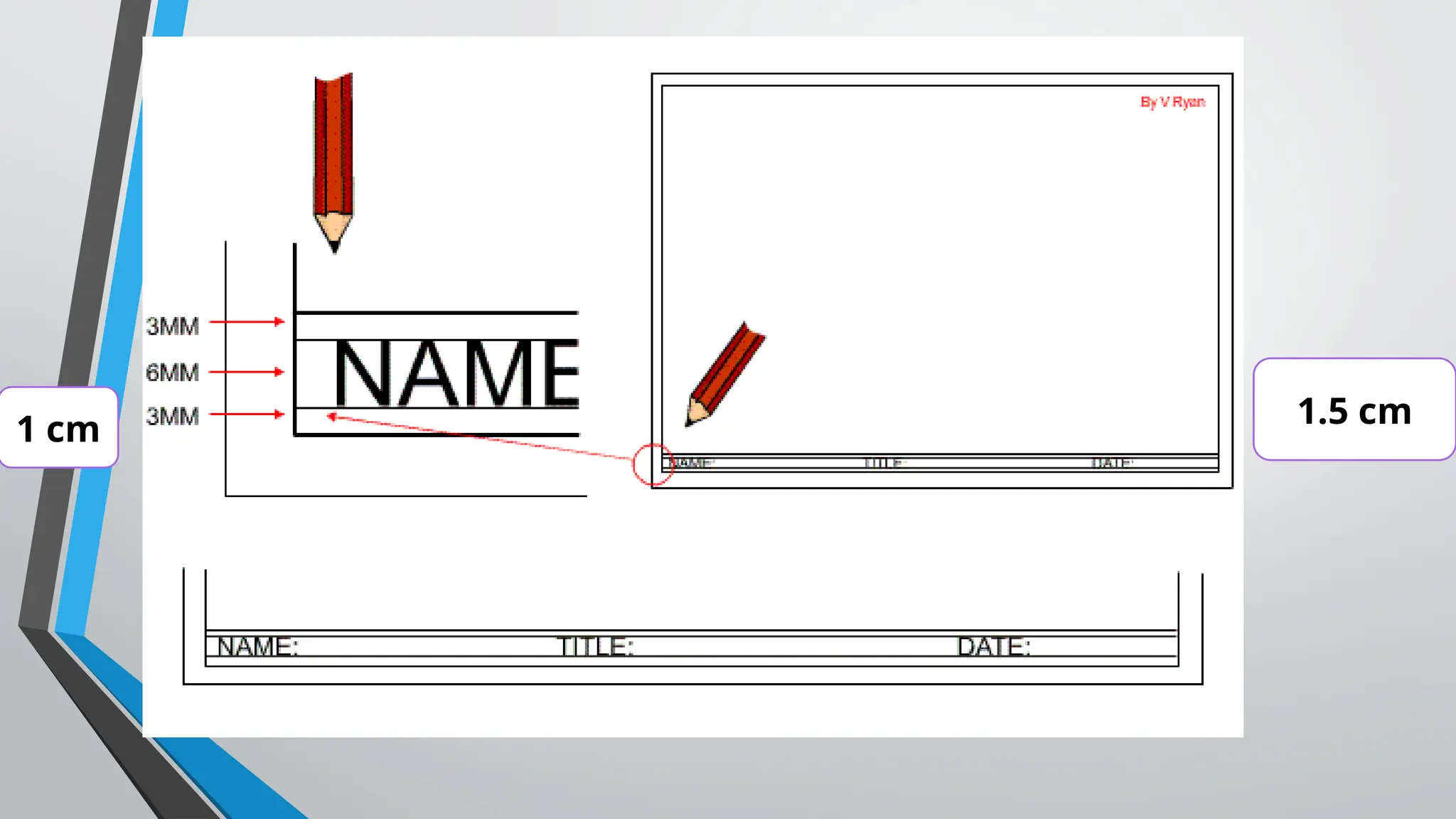
1 cm 1.5 cm
PLATE NO. 2
Freehand drawing
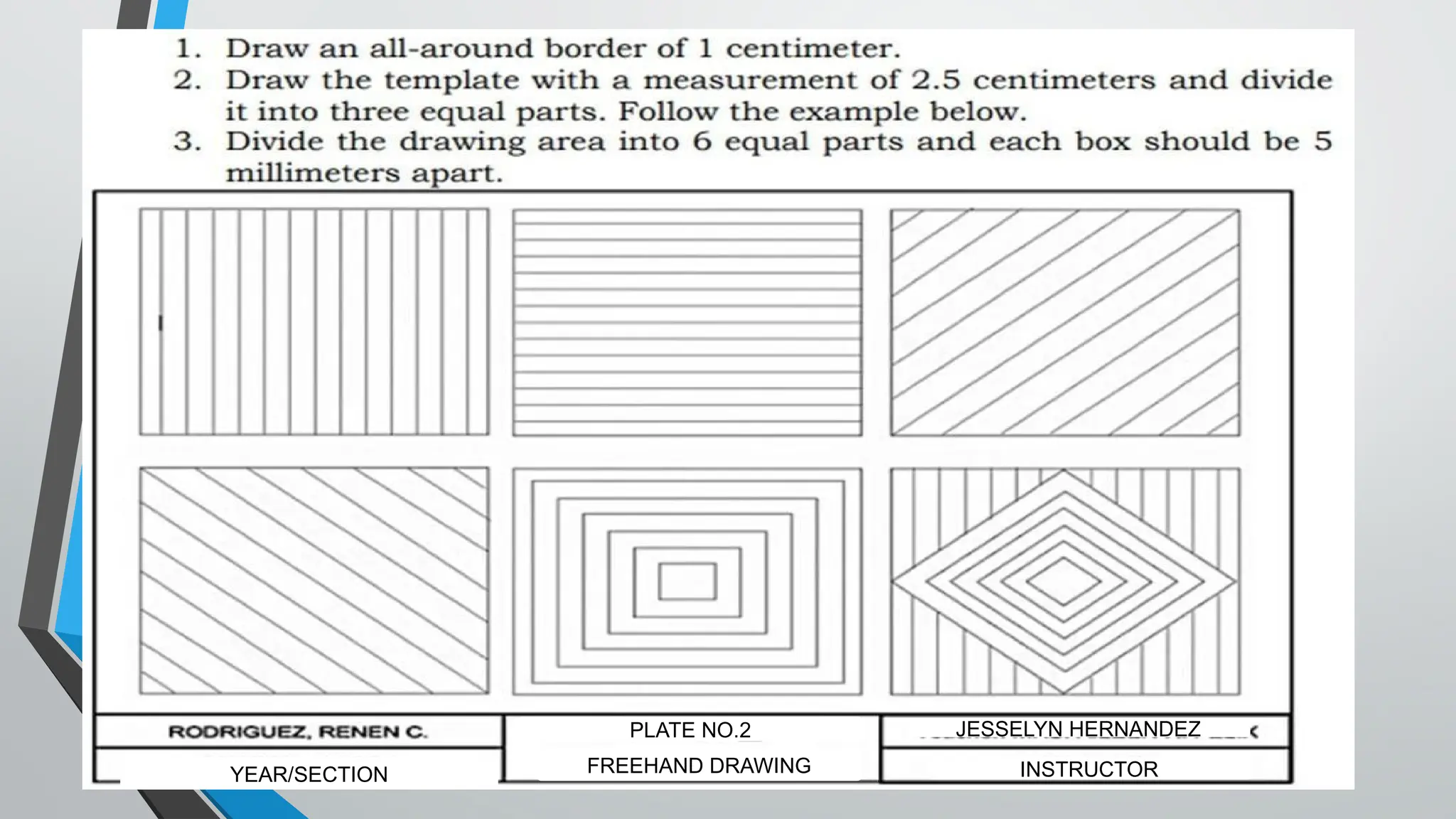
YEAR/SECTION FREEHAND DRAWING
PLATE NO.2 JESSELYN HERNANDEZ
INSTRUCTOR
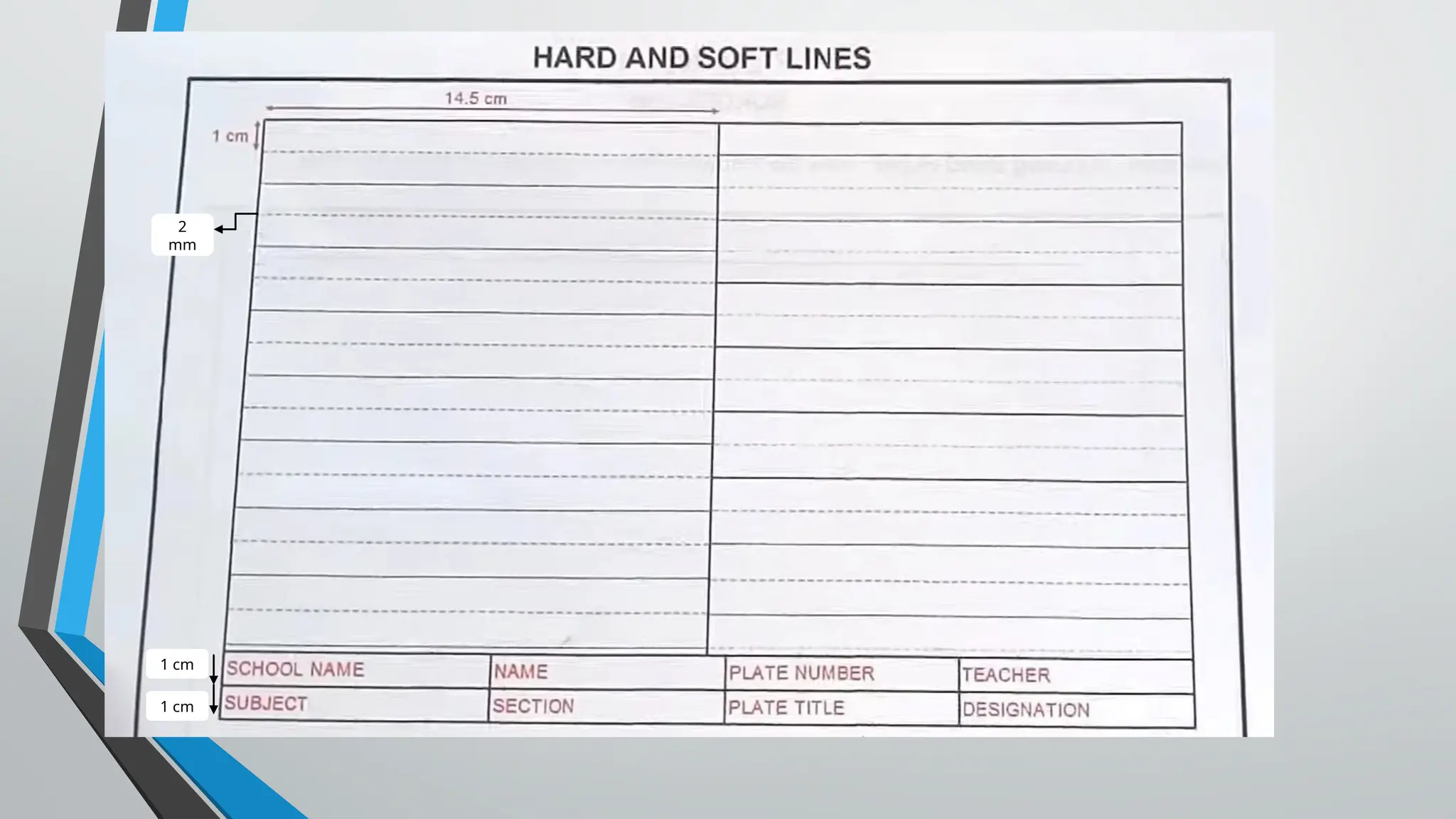
PLATE NO. 3
Hard and soft lines
2
mm
1 cm
1 cm
Geometrical Figures
• A set of points. A portion of the line between two distinct points
Perform Basic Mensuration and
Calculation
Different Measuring Tools
• 1. T-Square is used as guide in drawing horizontal lines and in
measuring up to 48” straight line.
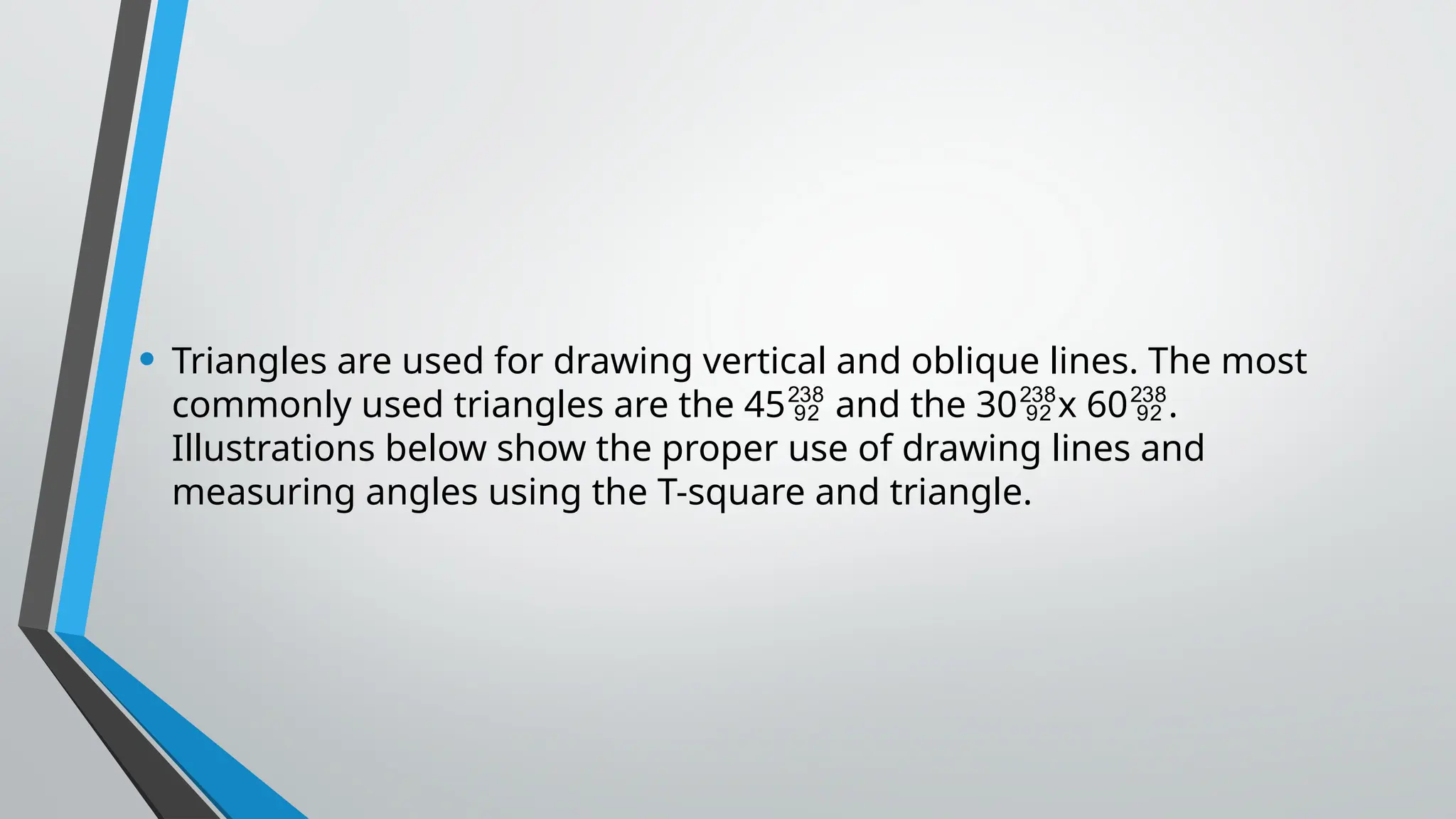
• Triangles are used for drawing vertical and oblique lines. The most
commonly used triangles are the 45 and the 30 x 60 .
  
Illustrations below show the proper use of drawing lines and
measuring angles using the T-square and triangle.
Ruler is the most popular type of measuring tool. It is
usually 6 or 12 inches in length. It is needed for measuring
sizes and distances.
• Triangular Scale is used in general drawing. Its main purpose is to
reproduce the dimension in full size or to reduce or enlarge them
on a drawing. Scales help a drafter keep the proportions accurate.

Presentation lesson 1.pptx TLE Industrial Education

  • 1.
  • 2.
    Prepare Drafting Materialsand Tools/Drawing Instrument • LO 1. identify drafting materials and tools/drawing instruments applicable to a specific job • LO 2. Determine the different Alphabet of lines • LO3 Perform freehand drawing
  • 3.
    What is Drafting? •-A n essential method of communication between designers and clients, architects and builders, engineers and production personnel and between advertisers and customers.
  • 4.
  • 5.
    Difference of Drafter andArchitect? -A DRAFTER can be working with different companies with different specialization. -An ARCHITECT is a person who oversees the entire building project and may have an architectural drafter as his assistant.
  • 6.
    Kinds of drafting Themajor kinds of drafting are furniture drafting, architectural drafting, and mechanical or machine drafting, electrical and electronics drafting, topographical drafting, airplane drafting, ship or naval drafting, structural drafting and sheet-metal drafting. Furniture drafting includes not only the making of working drawings of the various types of furniture but also the designing of them. ​ Architectural drafting pertains to the making of working plans for buildings for residential, business, manufacturing, religious, recreational and storage purposes. ​ Machine drafting is the preparation of detail and assembly working drawings of machines and their parts.
  • 7.
    Electrical and electronicsdrafting produces schematic wiring diagrams for either house wiring connections and radio and television receivers and transmitters or the installation of electrically-operated machines. ​ Topographical drafting is the making of plots or maps for various purposes. Airplane drafting concerns the preparation of working drawings of aircraft, including helicopters, planes, rockets and spaceships. Ship drafting is the making of working plans for all types of ship and for either commercial or naval purposes. Structural drafting refers to the making of working drawings of steel buildings, bridges, towers, dams and so forth. Sheet-metal drafting is the development of surfaces of various objects made of galvanized iron, steel aluminum or copper sheets. It includes pattern development for chimneys, downspouts, water tanks and air-conditioning ducts, among many others.
  • 8.
    Definition of Termsin Mechanical Drafting
  • 9.
    Assembly drawing –a drawing that shows how different parts go together
  • 10.
    Detailed drawing –a drawing showing a single part of a machine
  • 11.
    Dimensioning – theprocess of placing measurements in a drawing in the Metric or English system
  • 12.
    Drawing – apicture, diagram made of lines, a graphic representation of real thing, an idea or a design for production or construction
  • 13.
    English system –a system of linear measurement where it is based on standard foot Metric system – a system of linear measurement which it is based on the standard meter
  • 14.
    Geometrical construction the process wherein geometricproblems are solved accurately in mechanical drawings
  • 15.
    Orthographic drawing – the objectis presented into two or more views by projecting the outline into the planes of projection perpendicular to each other
  • 16.
    Pictorial view –the presentation of an object where it is viewed showing the three faces of an object are shown
  • 17.
    Protractor – itis a semi- circular instrument divided into equal parts, each of which is called a degree. It is used for determining gradations of the degrees when measuring arcs and circles. Highly quality protractor is usually made of plastic.
  • 18.
    Step 1. Estimate.. Acute, Right or Obtuse Angle?
  • 19.
    Step 2. Matchthe vertex to the hole on the protractor Step 3 Line up one ray to the straight line at the bottom Step 4: Decide which set of numbers to read
  • 21.
    FREEHAND DRAWING ORSketch – a quickly executed freehand drawing that is not intended as a finished work. A good freehand sketch should have lines that have a certain freedom and variety.
  • 22.
    MECHANICAL DRAWING- Adrawing that is done with the use of precision drawing instruments like T-Square, triangles, compass scale, etc.
  • 23.
  • 24.
    Drawing pencil –one of the most important tools of a draftsman, used for drawing. They come in different grades of hardness indicated by numbers and letter.
  • 26.
    Grades of Pencil •SOFT- 2B,3B,4B,5B,6B (softest) • MEDIUM- 3H,2H,H,F,HB,B • HARD-4H.5H.6H.7H.8H.9H • (hardest) Grades of Pencil used for General • HB- For lettering • 2H-for line work • 4H- for general
  • 27.
    Drawing pencil This isone of the most important tools in drawing. It comes in various grades. The grade of pencil to be used depends on the quality of paper to be used. You have to take into consideration also the type of line work required. Hard Range Hard pencils – are used where extreme accuracy is required especially working on graphs, diagrams and charts. Medium pencils – are used for general purpose work in drawing. Medium Range Soft pencils – are too soft to be used in mechanical drafting. They are very useful for art work of various kinds.
  • 28.
    Minimum requirement fora Drafting students 4H- For re-penciling light finished lines such as center lines, Dimension lines, and visible object line F or H- for all lettering and freehand work 6H- for light construction lines in layout work where accuracy is required. 2H- for visible object lines
  • 29.
    Triangles • It isa three-sided ruler, which typically has two equal sides meeting at a 90 degree angle and to a third side at 45, 30, including 60 degree angles. It is usually made of plastic and comes in different sizes. If in use, the base of the triangle must rest on the blade of the T-square. Drawing a line always starts from the point near the base going upward. Commonly used triangles are • It is used for drawing vertical and oblique lines. The common types of triangles: 30⁰ x 60⁰ triangle 45 ⁰ x 90 ⁰ triangle
  • 30.
    Drawing Paper •Various typesof drawing papers are available for use but hard and soft surface drawing papers are highly recommended to be the best. This type does not groove easily when pressure is applied to the pencil. Oslo paper is commonly used but bond paper is also recommended.
  • 31.
    Maskingtape This is usedfor fastening the drawing paper on the drawing table or drawing board because it does not damagetheboardanditwillnotdamagethepaperifitis removedbypullingitoff.
  • 32.
    Pencil sharpener Pencils shouldbe sharpened whenever they show sign of dullness. Various types and designs are available in the store for use.
  • 33.
  • 34.
    Procedure: •Press firmly theT-square against the working edge of the drawing table. •Place the drawing paper close to the working edge of the drawing table and working head of the T- square depending on you if you are right or left-handed, while the paper is placed on top edge of the T- square. •Fasten the upper left portion of the drawing paper followed by the lower right portion and finally the remaining corners. Note: Always fasten larger backing sheet of thicker drawing paper on the board first. Placing drawing paper to the drawing board Drawing a Horizontal Line Directions: Below is a simple activity for you to work on. Practice the task following the given procedure. Materials: •Drawing paper •Masking tape Instrument: •T – Square •Triangles (30 deg. x 60 deg. and 45 deg. x 45 deg.) Equipment: •Drawing Table
  • 35.
    Procedure: •Press the headof the T-square against the working edge of the drawing table and lean the pencil to the desired direction of the line inclined at more or less 60 degrees with the drawing table. •Maintain the position of the pencil while you glide lightly on the blade of the T-square. •Draw the line from left to right rotating occasionally to produce uniform line weights. (Reverse this step if you are left-handed). Using the T-Square to draw Horizontal lines Drawing a Vertical Line Directions: Below is a simple activity for you to work on. Practice the task following the given procedure. Materials: •Drawing paper •Masking tape Instrument: •T – Square •Triangles (30 deg. x 60 deg. and 45 deg. x 45 deg.) Equipment: •Drawing Table
  • 36.
    Procedure: •Use 45 degreestriangle or 30 degrees x 60 degrees to draw vertical lines. •Place the triangle on top of the blade of the T-square with the vertical edge on the left. •With the left hand pressing the T-square and the triangle against the drawing board, draw the line upward, rotating the pencil slowly between the thumb and forefinger. See figure below. Drawing vertical lines using triangles and T-square
  • 37.
    For Right-handed ForLeft-handed Proper use of T-Square
  • 38.
    T-Square – adrawing instrument used when drawing horizontal and vertical lines
  • 39.
    Erasing shield –used when clearing up smudges, unnecessary pencil
  • 40.
    Divider – adrawing instrument used when transferring measurements, dividing lines, arcs into the desired number of equal parts.
  • 41.
    Compass – aninstrument used when drawing arcs and circles This drawing instrument is used when drawing arcs and circles. It is used in a similar way to a divider. It is composed of one with the pen leg and the needle point leg being held together with a handle. This drawing instrument can be used for both penciling and inking.
  • 42.
    PRE-TEST 1. T-Square 2.masking tape 3.triangular scales 4.erasingshield 5.triangle 1.Hard pencil 2.eraser 3.divider 4.medium pencil 5.protractor
  • 43.
  • 60.
    C Cutting Plane Line Section Line HiddenLines Visible lines Dimension Lines Extension Line Phantom line Leader line Center Line Short break line
  • 62.
  • 63.
  • 64.
  • 65.
    YEAR/SECTION FREEHAND DRAWING PLATENO.2 JESSELYN HERNANDEZ INSTRUCTOR
  • 66.
    PLATE NO. 3 Hardand soft lines
  • 67.
  • 69.
    Geometrical Figures • Aset of points. A portion of the line between two distinct points
  • 70.
  • 71.
    Different Measuring Tools •1. T-Square is used as guide in drawing horizontal lines and in measuring up to 48” straight line.
  • 72.
    • Triangles areused for drawing vertical and oblique lines. The most commonly used triangles are the 45 and the 30 x 60 .    Illustrations below show the proper use of drawing lines and measuring angles using the T-square and triangle.
  • 73.
    Ruler is themost popular type of measuring tool. It is usually 6 or 12 inches in length. It is needed for measuring sizes and distances.
  • 74.
    • Triangular Scaleis used in general drawing. Its main purpose is to reproduce the dimension in full size or to reduce or enlarge them on a drawing. Scales help a drafter keep the proportions accurate.

Editor's Notes

  • #14 Geometry is the branch of mathematics that deals with shapes, angles, dimensions and sizes of a variety of things we see in everyday life.
  • #18 Remember that Acute- less 90 degrees (smaller) Right-90 degrees Obtuse-more than 90 degrees I have a tool here 1st. Bigger than the 90 degrees so this is Obtuse angle 2nd this is less 90 degrees so this is acute angle
  • #19 Vertex is the point on the angle There are pairs of number in the protractor We can measure the angle that open ups this way or that way Choose the bigger number in measuring the angle
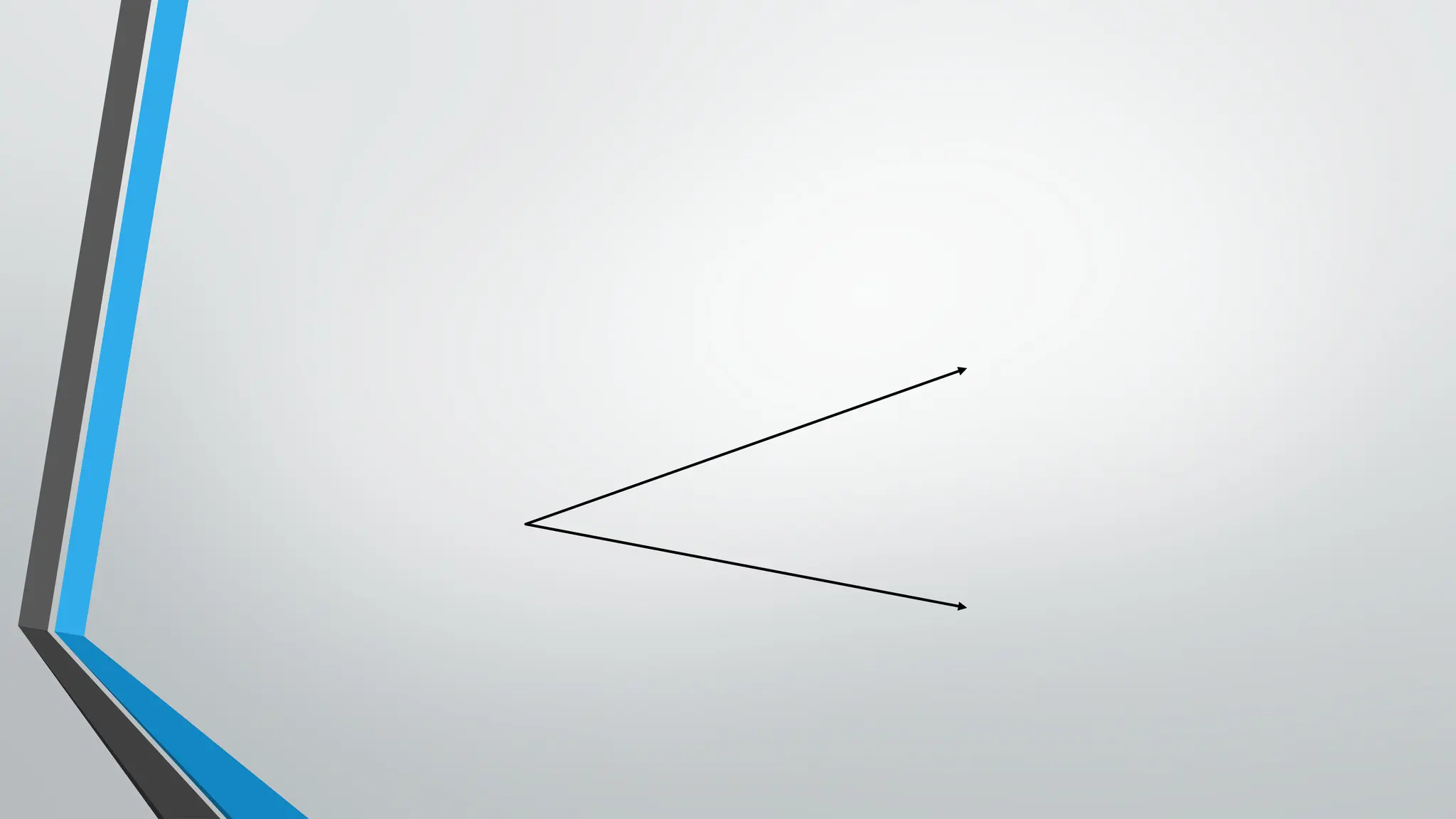
  • #20 Acute angle This one opens at the opposite angle
  • #40 This is a drawing instrument used when transferring measurements, dividing lines and arcs into the desired number of equal parts. It can easily transfer accurate measurements by adjusting the divider points. Constant correct practice is necessary before doing an actual work for a quick and easy control when use.