Low Head Wind Farm
Ankit Grover
Byoungmo Kang
Cecilia M. Ferreira
Liang Zhao
Feasibility study
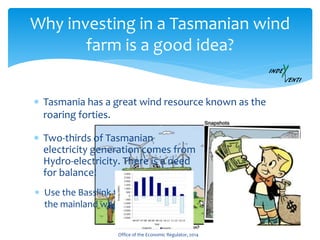
 Tasmania has a great wind resource known as the
roaring forties.
Why investing in a Tasmanian wind
farm is a good idea?
 Two-thirds of Tasmanian
electricity generation comes from
Hydro-electricity. There is a need
for balance!
 Use the Basslink to sell electricity to
the mainland when demand is high.
Office of the Economic Regulator, 2014
Site characterization
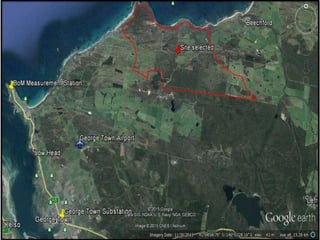
• Area: 15.7 km
2
• 6 km to George Town
Airport
• 7.2 km to BoM Weather
Station
• 10 km to George Town
Substation (220 kV)
• Wind speed: 8.68 m/s ( at
hub - 94 m)
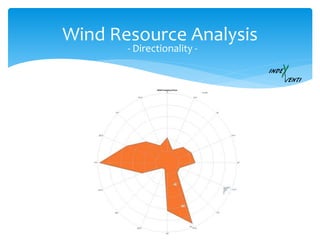
• Wind Direction: Southly and
Westly
• Terrain slope: 2.3% and 1.2%
• Land usage: Crown land and
freehold land
(SFM Environmental Solutions Pty Ltd, 2005)(Transend Networks, 2014)
Wind Resource Analysis
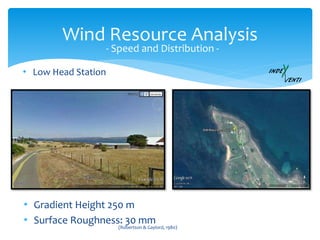
• Low Head Station
- Speed and Distribution -
• Gradient Height 250 m
• Surface Roughness: 30 mm
(Robertson & Gaylord, 1980)
Wind Resource Analysis
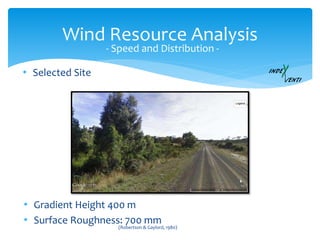
• Selected Site
- Speed and Distribution -
• Gradient Height 400 m
• Surface Roughness: 700 mm
(Robertson & Gaylord, 1980)
Wind Resource Analysis
- Speed and Distribution -
Height
[m]
Surface
roughness
[m]
Gradient
height
[m]
Mean
wind
speed
[m/s]
Standard
deviation
BoM
Station
10 0.03 250 7.24 3.036
Wind farm
site
94 0.70 400 8.68 3.642
• IEC 61400 – 1 : Wind class II
Wind Resource Analysis
- Speed and Distribution -
0%
2%
4%
6%
8%
10%
12%
14%
0 1 2 3 4 5 6 7 8 9 10 11 12 13 14 15 16 17 18 19 20 21 22 23 24 25 26 27 28 29 30
Probability[m/s]
Wind speed [m/s]
Weibull PDF
Actual data
Wind Resource Analysis
- Speed and Distribution -
0
5
10
15
20
25
30
0 1000 2000 3000 4000 5000 6000 7000 8000 9000
Windspeed[m/s]
Duration [hours]
Velocity-duration chart
Wind Resource Analysis
- Directionality -
Wind Resource Analysis
- Correlation with demand -
0
10
20
30
40
50
60
0
200
400
600
800
1000
1200
1400
0:00 4:48 9:36 14:24 19:12 0:00
Electricitygenerated[MWh]
Demand[MWh]
Time of day
Daily summer profile
TAS Demand Wind farm output
0
10
20
30
40
50
60
0
200
400
600
800
1000
1200
1400
1600
0:00 4:48 9:36 14:24 19:12 0:00
Electricitygenerated[MWh]
Demand[MWh]
Time of day
Daily winter profile
TAS Demand Wind farm output
• Demand data from AEMO
(Australian Energy Market Operator, 2015)
𝑉𝑜𝑙𝑢𝑚𝑒 𝑤𝑒𝑖𝑔ℎ𝑡𝑒𝑑 𝑝𝑟𝑖𝑐𝑒 = $ 29.14/𝑀𝑊ℎ
Wind Turbine Selection
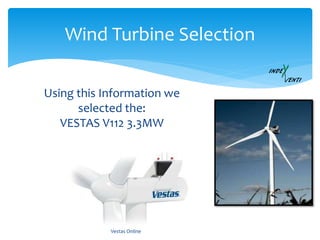
Using this Information we
selected the:
VESTAS V112 3.3MW
Vestas Online
Turbine Placement
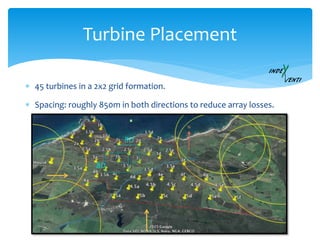
8D
8D
 Spacing: roughly 850m in both directions to reduce array losses.
 45 turbines in a 2x2 grid formation.
Energy Output
 Energy output
 Farm output – 743GWh
 Ideal output – 1300GWh
 Capacity Factorbefore losses – 57%
 Losses – 20.6%
 Capacity Factorafter losses – 45%
 Farm outputafter losses – 590GWh
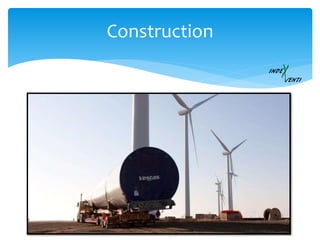
Construction
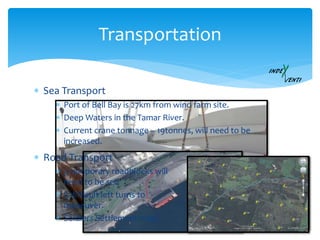
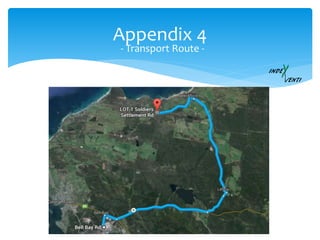
 Sea Transport
Transportation
Vestas V112 - Macarthur wind farm
 Port of Bell Bay is 27km from wind farm site.
 Deep Waters in the Tamar River.
 Current crane tonnage – 19tonnes, will need to be
increased.
 Road Transport
 3 temporary roadblocks will
need to be set.
 3 difficult left turns to
maneuver.
 Soldiers Settlement road.
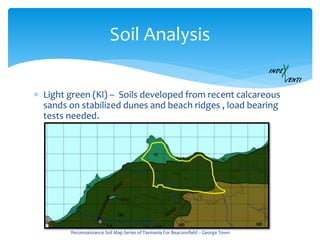
Soil Analysis
 Light green (Kl) – Soils developed from recent calcareous
sands on stabilized dunes and beach ridges , load bearing
tests needed.
Reconnaissance Soil Map Series of Tasmania For Beaconsfield – George Town
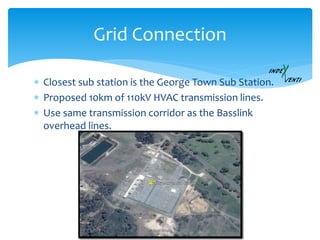
 Closest sub station is the George Town Sub Station.
 Proposed 10km of 110kV HVAC transmission lines.
 Use same transmission corridor as the Basslink
overhead lines.
Grid Connection
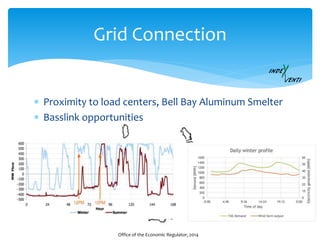
 Proximity to load centers, Bell Bay Aluminum Smelter
 Basslink opportunities
Grid Connection
Office of the Economic Regulator, 2014
Avian Fauna
Land clearance
Waste management
Environmental impact
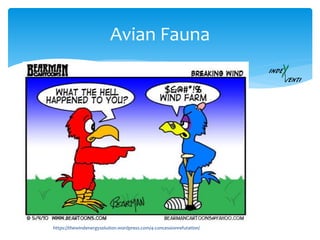
Avian Fauna
https://thewindenergysolution.wordpress.com/4-concessionrefutation/
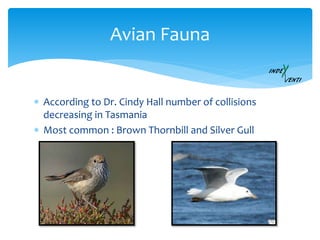
 According to Dr. Cindy Hall number of collisions
decreasing in Tasmania
 Most common : Brown Thornbill and Silver Gull
Avian Fauna
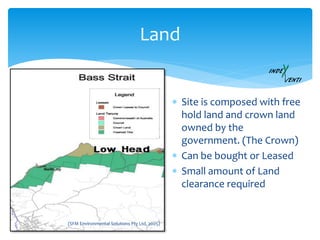
 Site is composed with free
hold land and crown land
owned by the
government. (The Crown)
 Can be bought or Leased
 Small amount of Land
clearance required
Land
(SFM Environmental Solutions Pty Ltd, 2005)
 Possible waste
produced from
construction
 No harmful or
hazardous waste during
operation
 Cleanest energy source
 Disposal of wind turbine
after lifespan
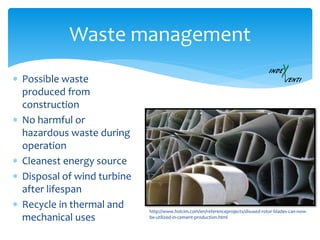
 Recycle in thermal and
mechanical uses
Waste management
http://www.holcim.com/en/referenceprojects/disused-rotor-blades-can-now-
be-utilized-in-cement-production.html
 Visual Impact
 Noise Impact
 Local and government opinions
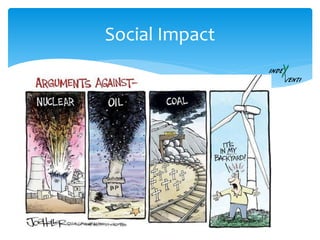
Social Impact
Social Impact
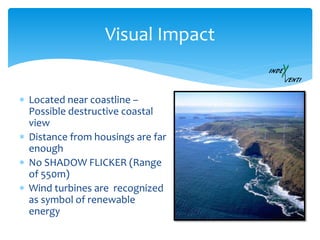
 Located near coastline –
Possible destructive coastal
view
 Distance from housings are far
enough
 No SHADOW FLICKER (Range
of 550m)
 Wind turbines are recognized
as symbol of renewable
energy
Visual Impact
 Wind farm noise – the biggest problem for local
residents
 Noise level of wind farm 103 dB
 Allowed noise level 35 dB at housing
 Presence of trees and direction of wind blowing away
from the housing
Noise Impact
 Tasmanian government-the premier Will Hodgman
"Tasmania as a renewable energy state has
tremendous capacity, I believe, into the future”
 Previous wind farms in TAS were supported by local
communities
 Employment and local business development
 Possible opposition group (NIMBY)
Opinions
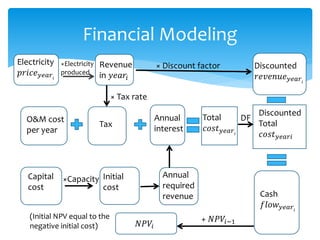
Financial Modeling
Electricity
𝑝𝑟𝑖𝑐𝑒 𝑦𝑒𝑎𝑟𝑖
Revenue
in 𝑦𝑒𝑎𝑟𝑖
Discounted
𝑟𝑒𝑣𝑒𝑛𝑢𝑒 𝑦𝑒𝑎𝑟𝑖
O&M cost
per year
Annual
interest
Total
𝑐𝑜𝑠𝑡 𝑦𝑒𝑎𝑟𝑖
Discounted
Total
𝑐𝑜𝑠𝑡 𝑦𝑒𝑎𝑟𝑖
Initial
cost
Tax
Capital
cost
Annual
required
revenue
×Electricity
produced
× Discount factor
× Tax rate
DF
×Capacity
Cash
𝑓𝑙𝑜𝑤 𝑦𝑒𝑎𝑟𝑖
𝑁𝑃𝑉𝑖
+ 𝑁𝑃𝑉𝑖−1
(Initial NPV equal to the
negative initial cost)
High revenue
scenario
Medium revenue
scenario
Low revenue
scenario
Capital costs (million
AU$/MV)
1.7 2.35 2.53
Life time (years) 20 20 20
Discount rate 10% 10% 10%
Inflation rate 0.024 0.024 0.024
Construction time
(years)
1 1 2
Total O&M per year
($/MW)
10297682.74 10297682.74 10297682.74
Electricity price
(AU$/MWh)
110.00 90.00 39.056(in 2017)
Capacity factor 45.38% 45.38% 45.38%
O&M Cost $10297682.74 $10297682.74 $10297682.74
Tax rate 0.03 0.03 0.03
NPV of project $308002166.50 $61451272.20 -$97643477.50
IRR 25.34% 12.95% 7.58%
LCE(AU$/MWh) 60.81288773 77.0976962 81.60733547
-3E+08
-2E+08
-1E+08
0
100000000
200000000
300000000
400000000
1 2 3 4 5 6 7 8 9 10 11 12 13 14 15 16 17 18 19 20 21
High Revenue Scenario
NPV in high revenue scenario Cashflow in high revenue scenario
-7E+08
-6E+08
-5E+08
-4E+08
-3E+08
-2E+08
-1E+08
0
100000000
1 2 3 4 5 6 7 8 9 10 11 12 13 14 15 16 17 18 19 20 21 22
Low Revenue Scenario
Cashflow in low revenue scenario" NPV in low revenue scenario
-8E+08
-7E+08
-6E+08
-5E+08
-4E+08
-3E+08
-2E+08
-1E+08
0
100000000
200000000
1 2 3 4 5 6 7 8 9 10 11 12 13 14 15 16 17 18 19 20 21
Medium Revenue Scenario
Cashflow in medium revenue scenario NPV in medium revenue scenario
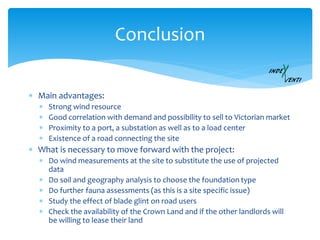
Conclusion
 Main advantages:
 Strong wind resource
 Good correlation with demand and possibility to sell to Victorian market
 Proximity to a port, a substation as well as to a load center
 Existence of a road connecting the site
 What is necessary to move forward with the project:
 Do wind measurements at the site to substitute the use of projected
data
 Do soil and geography analysis to choose the foundation type
 Do further fauna assessments (as this is a site specific issue)
 Study the effect of blade glint on road users
 Check the availability of the Crown Land and if the other landlords will
be willing to lease their land
Conclusion
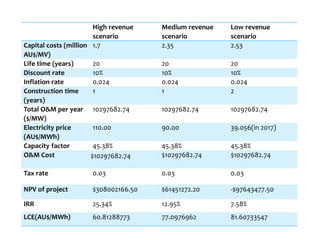
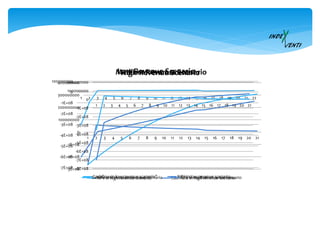
The construction of a 148.5 MW wind farm will be able to generate
590 [GWh] per year.
However, It will be necessary to do a Power Purchase Agreement to
make the project financially viable. Therefore it became an interesting
investment with:
Medium revenue ($90/MWh)
 NPV: $ 61,451,272.20
 IRR: 12.95%
 SPB: 12 years
High revenue ($110/MWh)
 NPV: $ 308,002,166.50
 IRR: 25.34%
 SPB: 7 years
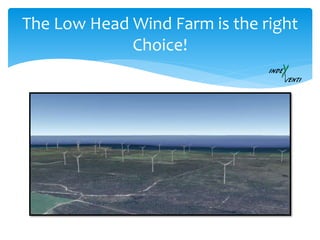
The Low Head Wind Farm is the right
Choice!
References
Australian Energy Market Operator. (2015). Aggregated Price and Demand Data Files. Retrieved April 25, 2015, from
http://www.aemo.com.au/Electricity/Data/Price-and-Demand/Aggregated-Price-and-Demand-Data-Files
Economic Regulator. (2014, February). Energy in Tasmania - Performance Report 2012-13. Retrieved April 30, 2015, from
http://www.economicregulator.tas.gov.au/domino/otter.nsf/LookupFiles/Energy_in_Tasmania_Performance_Report_2012-
13_FINAL_140212.pdf/$file/ Energy_in_Tasmania_Performance_Report_2012-13_FINAL_140212.pdf
Robertson, L. E., & Gaylord, E. H. (1980). Section 3.3.2 - Properties of the Mean Wind. In Tall building: criteria and loading (pp.
161 - 162). New York: American Society of Civil Engineers.
SFM Environmental Solutions Pty Ltd. (2005, October). George Town Coastal Management Plan. Retrieved April 7, 2015, from
http://georgetown.tas.gov.au/coastal-reserve-management-lan?fd=pP%25F8%25F0%252F%25B5%25E7%25D
D%25A3%25EDJ%2588%25B4r%25FC%25F6d%25DC%25CEO%252FI%253A%253FN5D%25CD%25F3%252FMA26%253F
Transend Networks. (2014, June 30). Annual Planning Report: 2014. Retrieved April 1, 2015, from
http://www.tasnetworks.com.au/TasNetworks/media/pdf/Transend-Annual-Planning-Report-2014.pdf
Office of the Tasmanian Economic Regulator. (2014). Energy in Tasmania - Performance Report 2012/13.
Department of Primary Industries, Parks, Water and Environment. RECONNAISSANCE SOIL MAP SERIES OF TASMANIA
BEACONSFIELD-GEORGE TOWN.
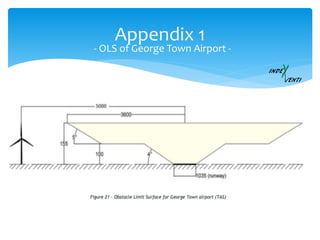
Appendix 1
- OLS of George Town Airport -
Appendix 2
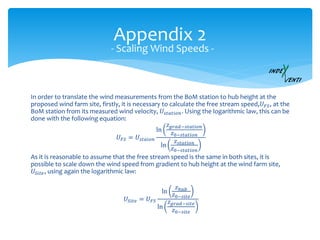
In order to translate the wind measurements from the BoM station to hub height at the
proposed wind farm site, firstly, it is necessary to calculate the free stream speed,𝑈 𝐹𝑆, at the
BoM station from its measured wind velocity, 𝑈𝑠𝑡𝑎𝑡𝑖𝑜𝑛. Using the logarithmic law, this can be
done with the following equation:
𝑈 𝐹𝑆 = 𝑈𝑠𝑡𝑎𝑖𝑜𝑛
ln
𝑧 𝑔𝑟𝑎𝑑−𝑠𝑡𝑎𝑡𝑖𝑜𝑛
𝑧0−𝑠𝑡𝑎𝑡𝑖𝑜𝑛
ln
𝑧𝑠𝑡𝑎𝑡𝑖𝑜𝑛
𝑧0−𝑠𝑡𝑎𝑡𝑖𝑜𝑛
As it is reasonable to assume that the free stream speed is the same in both sites, it is
possible to scale down the wind speed from gradient to hub height at the wind farm site,
𝑈𝑆𝑖𝑡𝑒, using again the logarithmic law:
𝑈𝑆𝑖𝑡𝑒 = 𝑈 𝐹𝑆
ln
𝑧ℎ𝑢𝑏
𝑧0−𝑠𝑖𝑡𝑒
ln
𝑧 𝑔𝑟𝑎𝑑−𝑠𝑖𝑡𝑒
𝑧0−𝑠𝑖𝑡𝑒
- Scaling Wind Speeds -
Appendix 3
The Weibull distribution is used to approximate the distribution of wind speeds for a certain location. It uses two
parameters: k, called shape factor, and c, called scale factor. Which can be calculated using the mean wind speed, 𝑈,
and the standard deviation, σ, of a dataset with the following equations:
𝑘 =
σ
𝑈
−1.086
𝑐 = 𝑈 0.568 +
0.433
𝑘
−1/𝑘
With this parameters, it is possible to calculate the Weibull Probability Density Function (PDF) which is
the relative likelihood in [m/s] of having wind at speeds of U [m/s]:
𝑃𝐷𝐹 𝑈 =
𝑘
𝑐
𝑈
𝑐
𝑘−1
𝑒
−
𝑈
𝑐
𝑘
And the Weibull Cumulative Distribution Fuction (CDF) which is the probability of having wind speeds
below U [m/s]:
𝐶𝐷𝐹 𝑈 = 1 − 𝑒
−
𝑈
𝑐
𝑘
Therefore, it is possible to calculate the probability of finding wind speed within a range of velocities
by:
𝑈1 < 𝑈 < 𝑈2 = 𝐶𝐷𝐹 𝑈2 − 𝐶𝐷𝐹 𝑈1
This can be used to calculate the number of hours per year that the wind blows within that range of
speeds and the energy output. (Manwell, McGowan, & Rogers, 2004)
- Weilbul Distribution -
Appendix 4
- Transport Route -
Appendix 5
- Wind Turbine Selection -
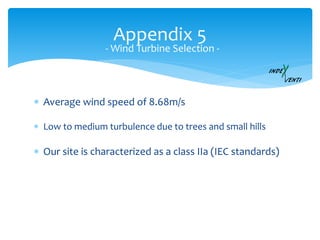
 Our site is characterized as a class IIa (IEC standards)
 Low to medium turbulence due to trees and small hills
 Average wind speed of 8.68m/s
Appendix 6
- Losses -
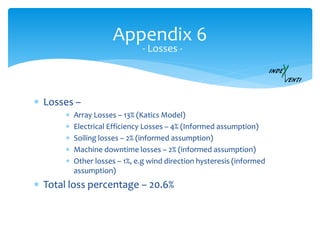
 Losses –
 Array Losses – 13% (Katics Model)
 Electrical Efficiency Losses – 4% (Informed assumption)
 Soiling losses – 2% (informed assumption)
 Machine downtime losses – 2% (informed assumption)
 Other losses – 1%, e.g wind direction hysteresis (informed
assumption)
 Total loss percentage – 20.6%
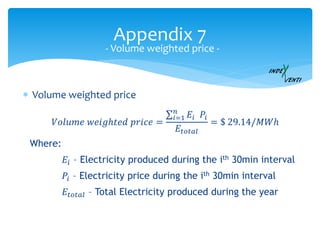
Appendix 7
 Volume weighted price
- Volume weighted price -
𝑉𝑜𝑙𝑢𝑚𝑒 𝑤𝑒𝑖𝑔ℎ𝑡𝑒𝑑 𝑝𝑟𝑖𝑐𝑒 =
𝑖=1
𝑛
𝐸𝑖 𝑃𝑖
𝐸𝑡𝑜𝑡𝑎𝑙
= $ 29.14/𝑀𝑊ℎ
Where:
𝐸𝑖 – Electricity produced during the ith 30min interval
𝑃𝑖 – Electricity price during the ith 30min interval
𝐸𝑡𝑜𝑡𝑎𝑙 – Total Electricity produced during the year
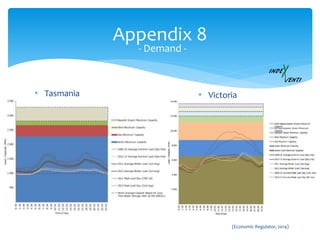
Appendix 8
- Demand -
• Tasmania • Victoria
(Economic Regulator, 2014)
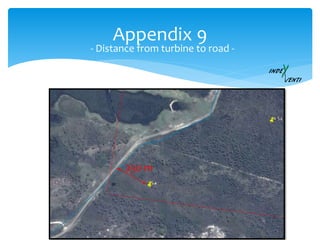
Appendix 9
- Distance from turbine to road -
250 m
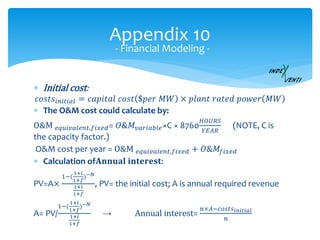
Appendix 10
 Initial cost:
𝑐𝑜𝑠𝑡𝑠𝑖𝑛𝑖𝑡𝑖𝑎𝑙 = 𝑐𝑎𝑝𝑖𝑡𝑎𝑙 𝑐𝑜𝑠𝑡 $𝑝𝑒𝑟 𝑀𝑊 × 𝑝𝑙𝑎𝑛𝑡 𝑟𝑎𝑡𝑒𝑑 𝑝𝑜𝑤𝑒𝑟 𝑀𝑊
 The O&M cost could calculate by:
O&M 𝑒𝑞𝑢𝑖𝑣𝑎𝑙𝑒𝑛𝑡,𝑓𝑖𝑥𝑒𝑑= 𝑂&𝑀𝑣𝑎𝑟𝑖𝑎𝑏𝑙𝑒×C × 8760
𝐻𝑂𝑈𝑅𝑆
𝑌𝐸𝐴𝑅
(NOTE, C is
the capacity factor.)
O&M cost per year = O&M 𝑒𝑞𝑢𝑖𝑣𝑎𝑙𝑒𝑛𝑡,𝑓𝑖𝑥𝑒𝑑 + 𝑂&𝑀𝑓𝑖𝑥𝑒𝑑
 Calculation of𝐀𝐧𝐧𝐮𝐚𝐥 𝐢𝐧𝐭𝐞𝐫𝐞𝐬𝐭:
PV=A×
1−(
1+𝑖
1+𝑓
)−𝑁
1+𝑖
1+𝑓
, PV= the initial cost; A is annual required revenue
A= PV/
1−(
1+𝑖
1+𝑓
)−𝑁
1+𝑖
1+𝑓
→ Annual interest=
n×𝐴−𝑐𝑜𝑠𝑡𝑠 𝑖𝑛𝑖𝑡𝑖𝑎𝑙
𝑛
- Financial Modeling -
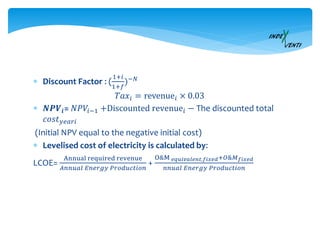
 Discount Factor : (
1+𝑖
1+𝑓
)−𝑁
𝑇𝑎𝑥𝑖 = revenue𝑖 × 0.03
 𝑵𝑷𝑽𝒊= 𝑁𝑃𝑉𝑖−1 +Discounted revenue𝑖 − The discounted total
𝑐𝑜𝑠𝑡 𝑦𝑒𝑎𝑟𝑖
(Initial NPV equal to the negative initial cost)
 Levelised cost of electricity is calculated by:
LCOE=
Annual required revenue
𝐴𝑛𝑛𝑢𝑎𝑙 𝐸𝑛𝑒𝑟𝑔𝑦 𝑃𝑟𝑜𝑑𝑢𝑐𝑡𝑖𝑜𝑛
+
O&M 𝑒𝑞𝑢𝑖𝑣𝑎𝑙𝑒𝑛𝑡,𝑓𝑖𝑥𝑒𝑑+𝑂&𝑀 𝑓𝑖𝑥𝑒𝑑
𝑛𝑛𝑢𝑎𝑙 𝐸𝑛𝑒𝑟𝑔𝑦 𝑃𝑟𝑜𝑑𝑢𝑐𝑡𝑖𝑜𝑛
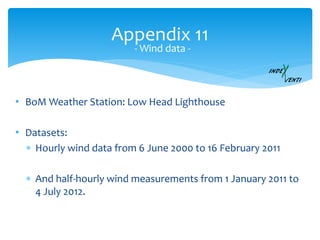
• BoM Weather Station: Low Head Lighthouse
• Datasets:
 Hourly wind data from 6 June 2000 to 16 February 2011
 And half-hourly wind measurements from 1 January 2011 to
4 July 2012.
Appendix 11
- Wind data -

Presentation (group)

  • 1.
    Low Head WindFarm Ankit Grover Byoungmo Kang Cecilia M. Ferreira Liang Zhao Feasibility study
  • 2.
     Tasmania hasa great wind resource known as the roaring forties. Why investing in a Tasmanian wind farm is a good idea?  Two-thirds of Tasmanian electricity generation comes from Hydro-electricity. There is a need for balance!  Use the Basslink to sell electricity to the mainland when demand is high. Office of the Economic Regulator, 2014
  • 4.
    Site characterization • Area:15.7 km 2 • 6 km to George Town Airport • 7.2 km to BoM Weather Station • 10 km to George Town Substation (220 kV) • Wind speed: 8.68 m/s ( at hub - 94 m) • Wind Direction: Southly and Westly • Terrain slope: 2.3% and 1.2% • Land usage: Crown land and freehold land (SFM Environmental Solutions Pty Ltd, 2005)(Transend Networks, 2014)
  • 5.
    Wind Resource Analysis •Low Head Station - Speed and Distribution - • Gradient Height 250 m • Surface Roughness: 30 mm (Robertson & Gaylord, 1980)
  • 6.
    Wind Resource Analysis •Selected Site - Speed and Distribution - • Gradient Height 400 m • Surface Roughness: 700 mm (Robertson & Gaylord, 1980)
  • 7.
    Wind Resource Analysis -Speed and Distribution - Height [m] Surface roughness [m] Gradient height [m] Mean wind speed [m/s] Standard deviation BoM Station 10 0.03 250 7.24 3.036 Wind farm site 94 0.70 400 8.68 3.642 • IEC 61400 – 1 : Wind class II
  • 8.
    Wind Resource Analysis -Speed and Distribution - 0% 2% 4% 6% 8% 10% 12% 14% 0 1 2 3 4 5 6 7 8 9 10 11 12 13 14 15 16 17 18 19 20 21 22 23 24 25 26 27 28 29 30 Probability[m/s] Wind speed [m/s] Weibull PDF Actual data
  • 9.
    Wind Resource Analysis -Speed and Distribution - 0 5 10 15 20 25 30 0 1000 2000 3000 4000 5000 6000 7000 8000 9000 Windspeed[m/s] Duration [hours] Velocity-duration chart
  • 10.
    Wind Resource Analysis -Directionality -
  • 11.
    Wind Resource Analysis -Correlation with demand - 0 10 20 30 40 50 60 0 200 400 600 800 1000 1200 1400 0:00 4:48 9:36 14:24 19:12 0:00 Electricitygenerated[MWh] Demand[MWh] Time of day Daily summer profile TAS Demand Wind farm output 0 10 20 30 40 50 60 0 200 400 600 800 1000 1200 1400 1600 0:00 4:48 9:36 14:24 19:12 0:00 Electricitygenerated[MWh] Demand[MWh] Time of day Daily winter profile TAS Demand Wind farm output • Demand data from AEMO (Australian Energy Market Operator, 2015) 𝑉𝑜𝑙𝑢𝑚𝑒 𝑤𝑒𝑖𝑔ℎ𝑡𝑒𝑑 𝑝𝑟𝑖𝑐𝑒 = $ 29.14/𝑀𝑊ℎ
  • 12.
    Wind Turbine Selection Usingthis Information we selected the: VESTAS V112 3.3MW Vestas Online
  • 13.
    Turbine Placement 8D 8D  Spacing:roughly 850m in both directions to reduce array losses.  45 turbines in a 2x2 grid formation.
  • 14.
    Energy Output  Energyoutput  Farm output – 743GWh  Ideal output – 1300GWh  Capacity Factorbefore losses – 57%  Losses – 20.6%  Capacity Factorafter losses – 45%  Farm outputafter losses – 590GWh
  • 15.
  • 16.
     Sea Transport Transportation VestasV112 - Macarthur wind farm  Port of Bell Bay is 27km from wind farm site.  Deep Waters in the Tamar River.  Current crane tonnage – 19tonnes, will need to be increased.  Road Transport  3 temporary roadblocks will need to be set.  3 difficult left turns to maneuver.  Soldiers Settlement road.
  • 17.
    Soil Analysis  Lightgreen (Kl) – Soils developed from recent calcareous sands on stabilized dunes and beach ridges , load bearing tests needed. Reconnaissance Soil Map Series of Tasmania For Beaconsfield – George Town
  • 18.
     Closest substation is the George Town Sub Station.  Proposed 10km of 110kV HVAC transmission lines.  Use same transmission corridor as the Basslink overhead lines. Grid Connection
  • 19.
     Proximity toload centers, Bell Bay Aluminum Smelter  Basslink opportunities Grid Connection Office of the Economic Regulator, 2014
  • 20.
    Avian Fauna Land clearance Wastemanagement Environmental impact
  • 21.
  • 22.
     According toDr. Cindy Hall number of collisions decreasing in Tasmania  Most common : Brown Thornbill and Silver Gull Avian Fauna
  • 23.
     Site iscomposed with free hold land and crown land owned by the government. (The Crown)  Can be bought or Leased  Small amount of Land clearance required Land (SFM Environmental Solutions Pty Ltd, 2005)
  • 24.
     Possible waste producedfrom construction  No harmful or hazardous waste during operation  Cleanest energy source  Disposal of wind turbine after lifespan  Recycle in thermal and mechanical uses Waste management http://www.holcim.com/en/referenceprojects/disused-rotor-blades-can-now- be-utilized-in-cement-production.html
  • 25.
     Visual Impact Noise Impact  Local and government opinions Social Impact
  • 26.
  • 27.
     Located nearcoastline – Possible destructive coastal view  Distance from housings are far enough  No SHADOW FLICKER (Range of 550m)  Wind turbines are recognized as symbol of renewable energy Visual Impact
  • 28.
     Wind farmnoise – the biggest problem for local residents  Noise level of wind farm 103 dB  Allowed noise level 35 dB at housing  Presence of trees and direction of wind blowing away from the housing Noise Impact
  • 29.
     Tasmanian government-thepremier Will Hodgman "Tasmania as a renewable energy state has tremendous capacity, I believe, into the future”  Previous wind farms in TAS were supported by local communities  Employment and local business development  Possible opposition group (NIMBY) Opinions
  • 30.
    Financial Modeling Electricity 𝑝𝑟𝑖𝑐𝑒 𝑦𝑒𝑎𝑟𝑖 Revenue in𝑦𝑒𝑎𝑟𝑖 Discounted 𝑟𝑒𝑣𝑒𝑛𝑢𝑒 𝑦𝑒𝑎𝑟𝑖 O&M cost per year Annual interest Total 𝑐𝑜𝑠𝑡 𝑦𝑒𝑎𝑟𝑖 Discounted Total 𝑐𝑜𝑠𝑡 𝑦𝑒𝑎𝑟𝑖 Initial cost Tax Capital cost Annual required revenue ×Electricity produced × Discount factor × Tax rate DF ×Capacity Cash 𝑓𝑙𝑜𝑤 𝑦𝑒𝑎𝑟𝑖 𝑁𝑃𝑉𝑖 + 𝑁𝑃𝑉𝑖−1 (Initial NPV equal to the negative initial cost)
  • 31.
    High revenue scenario Medium revenue scenario Lowrevenue scenario Capital costs (million AU$/MV) 1.7 2.35 2.53 Life time (years) 20 20 20 Discount rate 10% 10% 10% Inflation rate 0.024 0.024 0.024 Construction time (years) 1 1 2 Total O&M per year ($/MW) 10297682.74 10297682.74 10297682.74 Electricity price (AU$/MWh) 110.00 90.00 39.056(in 2017) Capacity factor 45.38% 45.38% 45.38% O&M Cost $10297682.74 $10297682.74 $10297682.74 Tax rate 0.03 0.03 0.03 NPV of project $308002166.50 $61451272.20 -$97643477.50 IRR 25.34% 12.95% 7.58% LCE(AU$/MWh) 60.81288773 77.0976962 81.60733547
  • 32.
    -3E+08 -2E+08 -1E+08 0 100000000 200000000 300000000 400000000 1 2 34 5 6 7 8 9 10 11 12 13 14 15 16 17 18 19 20 21 High Revenue Scenario NPV in high revenue scenario Cashflow in high revenue scenario -7E+08 -6E+08 -5E+08 -4E+08 -3E+08 -2E+08 -1E+08 0 100000000 1 2 3 4 5 6 7 8 9 10 11 12 13 14 15 16 17 18 19 20 21 22 Low Revenue Scenario Cashflow in low revenue scenario" NPV in low revenue scenario -8E+08 -7E+08 -6E+08 -5E+08 -4E+08 -3E+08 -2E+08 -1E+08 0 100000000 200000000 1 2 3 4 5 6 7 8 9 10 11 12 13 14 15 16 17 18 19 20 21 Medium Revenue Scenario Cashflow in medium revenue scenario NPV in medium revenue scenario
  • 33.
    Conclusion  Main advantages: Strong wind resource  Good correlation with demand and possibility to sell to Victorian market  Proximity to a port, a substation as well as to a load center  Existence of a road connecting the site  What is necessary to move forward with the project:  Do wind measurements at the site to substitute the use of projected data  Do soil and geography analysis to choose the foundation type  Do further fauna assessments (as this is a site specific issue)  Study the effect of blade glint on road users  Check the availability of the Crown Land and if the other landlords will be willing to lease their land
  • 34.
    Conclusion The construction ofa 148.5 MW wind farm will be able to generate 590 [GWh] per year. However, It will be necessary to do a Power Purchase Agreement to make the project financially viable. Therefore it became an interesting investment with: Medium revenue ($90/MWh)  NPV: $ 61,451,272.20  IRR: 12.95%  SPB: 12 years High revenue ($110/MWh)  NPV: $ 308,002,166.50  IRR: 25.34%  SPB: 7 years
  • 35.
    The Low HeadWind Farm is the right Choice!
  • 36.
    References Australian Energy MarketOperator. (2015). Aggregated Price and Demand Data Files. Retrieved April 25, 2015, from http://www.aemo.com.au/Electricity/Data/Price-and-Demand/Aggregated-Price-and-Demand-Data-Files Economic Regulator. (2014, February). Energy in Tasmania - Performance Report 2012-13. Retrieved April 30, 2015, from http://www.economicregulator.tas.gov.au/domino/otter.nsf/LookupFiles/Energy_in_Tasmania_Performance_Report_2012- 13_FINAL_140212.pdf/$file/ Energy_in_Tasmania_Performance_Report_2012-13_FINAL_140212.pdf Robertson, L. E., & Gaylord, E. H. (1980). Section 3.3.2 - Properties of the Mean Wind. In Tall building: criteria and loading (pp. 161 - 162). New York: American Society of Civil Engineers. SFM Environmental Solutions Pty Ltd. (2005, October). George Town Coastal Management Plan. Retrieved April 7, 2015, from http://georgetown.tas.gov.au/coastal-reserve-management-lan?fd=pP%25F8%25F0%252F%25B5%25E7%25D D%25A3%25EDJ%2588%25B4r%25FC%25F6d%25DC%25CEO%252FI%253A%253FN5D%25CD%25F3%252FMA26%253F Transend Networks. (2014, June 30). Annual Planning Report: 2014. Retrieved April 1, 2015, from http://www.tasnetworks.com.au/TasNetworks/media/pdf/Transend-Annual-Planning-Report-2014.pdf Office of the Tasmanian Economic Regulator. (2014). Energy in Tasmania - Performance Report 2012/13. Department of Primary Industries, Parks, Water and Environment. RECONNAISSANCE SOIL MAP SERIES OF TASMANIA BEACONSFIELD-GEORGE TOWN.
  • 37.
    Appendix 1 - OLSof George Town Airport -
  • 38.
    Appendix 2 In orderto translate the wind measurements from the BoM station to hub height at the proposed wind farm site, firstly, it is necessary to calculate the free stream speed,𝑈 𝐹𝑆, at the BoM station from its measured wind velocity, 𝑈𝑠𝑡𝑎𝑡𝑖𝑜𝑛. Using the logarithmic law, this can be done with the following equation: 𝑈 𝐹𝑆 = 𝑈𝑠𝑡𝑎𝑖𝑜𝑛 ln 𝑧 𝑔𝑟𝑎𝑑−𝑠𝑡𝑎𝑡𝑖𝑜𝑛 𝑧0−𝑠𝑡𝑎𝑡𝑖𝑜𝑛 ln 𝑧𝑠𝑡𝑎𝑡𝑖𝑜𝑛 𝑧0−𝑠𝑡𝑎𝑡𝑖𝑜𝑛 As it is reasonable to assume that the free stream speed is the same in both sites, it is possible to scale down the wind speed from gradient to hub height at the wind farm site, 𝑈𝑆𝑖𝑡𝑒, using again the logarithmic law: 𝑈𝑆𝑖𝑡𝑒 = 𝑈 𝐹𝑆 ln 𝑧ℎ𝑢𝑏 𝑧0−𝑠𝑖𝑡𝑒 ln 𝑧 𝑔𝑟𝑎𝑑−𝑠𝑖𝑡𝑒 𝑧0−𝑠𝑖𝑡𝑒 - Scaling Wind Speeds -
  • 39.
    Appendix 3 The Weibulldistribution is used to approximate the distribution of wind speeds for a certain location. It uses two parameters: k, called shape factor, and c, called scale factor. Which can be calculated using the mean wind speed, 𝑈, and the standard deviation, σ, of a dataset with the following equations: 𝑘 = σ 𝑈 −1.086 𝑐 = 𝑈 0.568 + 0.433 𝑘 −1/𝑘 With this parameters, it is possible to calculate the Weibull Probability Density Function (PDF) which is the relative likelihood in [m/s] of having wind at speeds of U [m/s]: 𝑃𝐷𝐹 𝑈 = 𝑘 𝑐 𝑈 𝑐 𝑘−1 𝑒 − 𝑈 𝑐 𝑘 And the Weibull Cumulative Distribution Fuction (CDF) which is the probability of having wind speeds below U [m/s]: 𝐶𝐷𝐹 𝑈 = 1 − 𝑒 − 𝑈 𝑐 𝑘 Therefore, it is possible to calculate the probability of finding wind speed within a range of velocities by: 𝑈1 < 𝑈 < 𝑈2 = 𝐶𝐷𝐹 𝑈2 − 𝐶𝐷𝐹 𝑈1 This can be used to calculate the number of hours per year that the wind blows within that range of speeds and the energy output. (Manwell, McGowan, & Rogers, 2004) - Weilbul Distribution -
  • 40.
  • 41.
    Appendix 5 - WindTurbine Selection -  Our site is characterized as a class IIa (IEC standards)  Low to medium turbulence due to trees and small hills  Average wind speed of 8.68m/s
  • 42.
    Appendix 6 - Losses-  Losses –  Array Losses – 13% (Katics Model)  Electrical Efficiency Losses – 4% (Informed assumption)  Soiling losses – 2% (informed assumption)  Machine downtime losses – 2% (informed assumption)  Other losses – 1%, e.g wind direction hysteresis (informed assumption)  Total loss percentage – 20.6%
  • 43.
    Appendix 7  Volumeweighted price - Volume weighted price - 𝑉𝑜𝑙𝑢𝑚𝑒 𝑤𝑒𝑖𝑔ℎ𝑡𝑒𝑑 𝑝𝑟𝑖𝑐𝑒 = 𝑖=1 𝑛 𝐸𝑖 𝑃𝑖 𝐸𝑡𝑜𝑡𝑎𝑙 = $ 29.14/𝑀𝑊ℎ Where: 𝐸𝑖 – Electricity produced during the ith 30min interval 𝑃𝑖 – Electricity price during the ith 30min interval 𝐸𝑡𝑜𝑡𝑎𝑙 – Total Electricity produced during the year
  • 44.
    Appendix 8 - Demand- • Tasmania • Victoria (Economic Regulator, 2014)
  • 45.
    Appendix 9 - Distancefrom turbine to road - 250 m
  • 46.
    Appendix 10  Initialcost: 𝑐𝑜𝑠𝑡𝑠𝑖𝑛𝑖𝑡𝑖𝑎𝑙 = 𝑐𝑎𝑝𝑖𝑡𝑎𝑙 𝑐𝑜𝑠𝑡 $𝑝𝑒𝑟 𝑀𝑊 × 𝑝𝑙𝑎𝑛𝑡 𝑟𝑎𝑡𝑒𝑑 𝑝𝑜𝑤𝑒𝑟 𝑀𝑊  The O&M cost could calculate by: O&M 𝑒𝑞𝑢𝑖𝑣𝑎𝑙𝑒𝑛𝑡,𝑓𝑖𝑥𝑒𝑑= 𝑂&𝑀𝑣𝑎𝑟𝑖𝑎𝑏𝑙𝑒×C × 8760 𝐻𝑂𝑈𝑅𝑆 𝑌𝐸𝐴𝑅 (NOTE, C is the capacity factor.) O&M cost per year = O&M 𝑒𝑞𝑢𝑖𝑣𝑎𝑙𝑒𝑛𝑡,𝑓𝑖𝑥𝑒𝑑 + 𝑂&𝑀𝑓𝑖𝑥𝑒𝑑  Calculation of𝐀𝐧𝐧𝐮𝐚𝐥 𝐢𝐧𝐭𝐞𝐫𝐞𝐬𝐭: PV=A× 1−( 1+𝑖 1+𝑓 )−𝑁 1+𝑖 1+𝑓 , PV= the initial cost; A is annual required revenue A= PV/ 1−( 1+𝑖 1+𝑓 )−𝑁 1+𝑖 1+𝑓 → Annual interest= n×𝐴−𝑐𝑜𝑠𝑡𝑠 𝑖𝑛𝑖𝑡𝑖𝑎𝑙 𝑛 - Financial Modeling -
  • 47.
     Discount Factor: ( 1+𝑖 1+𝑓 )−𝑁 𝑇𝑎𝑥𝑖 = revenue𝑖 × 0.03  𝑵𝑷𝑽𝒊= 𝑁𝑃𝑉𝑖−1 +Discounted revenue𝑖 − The discounted total 𝑐𝑜𝑠𝑡 𝑦𝑒𝑎𝑟𝑖 (Initial NPV equal to the negative initial cost)  Levelised cost of electricity is calculated by: LCOE= Annual required revenue 𝐴𝑛𝑛𝑢𝑎𝑙 𝐸𝑛𝑒𝑟𝑔𝑦 𝑃𝑟𝑜𝑑𝑢𝑐𝑡𝑖𝑜𝑛 + O&M 𝑒𝑞𝑢𝑖𝑣𝑎𝑙𝑒𝑛𝑡,𝑓𝑖𝑥𝑒𝑑+𝑂&𝑀 𝑓𝑖𝑥𝑒𝑑 𝑛𝑛𝑢𝑎𝑙 𝐸𝑛𝑒𝑟𝑔𝑦 𝑃𝑟𝑜𝑑𝑢𝑐𝑡𝑖𝑜𝑛
  • 48.
    • BoM WeatherStation: Low Head Lighthouse • Datasets:  Hourly wind data from 6 June 2000 to 16 February 2011  And half-hourly wind measurements from 1 January 2011 to 4 July 2012. Appendix 11 - Wind data -