GAME
BASED
FOR
TEACHING
IN PE
LOOKING INTO THE APPROACHES OF GAME SENSE
AND TEACHING GAMES FOR UNDERSTANDING
Traditional coaching indicates as a “directive, coach-centered
instruction and focuses primarily on the refinement and development
of technique” (Light, 2006, p. 10). Students are forced to practice a
specific skill in isolation, before playing the game at the end of the
lesson. Unlike traditional coaching, the game sense (GS) model
created by Bunker & Thorpe (1982), focuses on allowing children to
discover skills, strategies, and tactical aspects throughout playing
games. Dewey (1916/1997; cited in Light 2006) states that meaningful
learning occurs through immediate reflection upon overt experience
(Light, 2006, p. 9). GS enables students to adapt and make better
decisions as self progress is developed through an engaging and
pressuring context. Furthermore, the inquiry approach of teaching
games for understanding attempts to build children’s “tactical
awareness and decision-making within modified games utilising
constructivists learning principles” (Griffin and Patton, 2005; cited in
O'Leary, 2016, p. 4). Undertaking this tactical approach conveys a
guided-discovery of students developing greater game performance
TYPES OF GAME SENSE CATEGORIES
The pedagogical approach consists of:
• Small sided games
• Modification of games in relation to full rules
games
• Modification of games to endure tactical skill
learning
• Learning discovery facilitated and guided by
questioning from a teacher
• Game played before lesson organization and
planning
(Pill, 2016)
“The approaches sets the environment for the
players to learn, challenges the players to meet
the demands of the game and guides them
through appropriate questioning rather than
telling them what to do” (Light, 2006, p. 16).
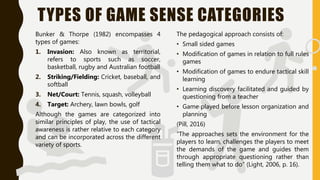
Bunker & Thorpe (1982) encompasses 4
types of games:
1. Invasion: Also known as territorial,
refers to sports such as soccer,
basketball, rugby and Australian football
2. Striking/Fielding: Cricket, baseball, and
softball
3. Net/Court: Tennis, squash, volleyball
4. Target: Archery, lawn bowls, golf
Although the games are categorized into
similar principles of play, the use of tactical
awareness is rather relative to each category
and can be incorporated across the different
variety of sports.
FUNDAMENTAL
MOVEMENT SKILLS
New South Wales, Education Standards
Authority [NESA] (2018) presents the
following building blocks to consolidate
children when playing games:
• Non-locomotor skills: The positioning and
control of the body and recognizing spatial
awareness. Examples such as bending,
twisting, turning, and balancing
• Locomotor skills: Travelling to a different
space and coordinating other parts of the
body together. Examples such as running,
rolling, skipping, jogging, hopping and
sliding
• Object control: The positioning of the body
in relation to rotation, precision and force.
Examples such as catching, bouncing,
kicking, throwing and dribbling a certain
object
• Sequencing/combination skill: The
transition from a skill to another, in order to
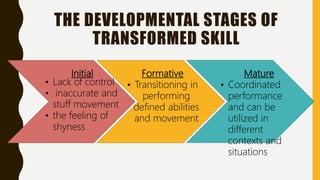
THE DEVELOPMENTAL STAGES OF
TRANSFORMED SKILL
Initial
• Lack of control
• inaccurate and
stuff movement
• the feeling of
shyness
Formative
• Transitioning in
performing
defined abilities
and movement
Mature
• Coordinated
performance
and can be
utilized in
different
contexts and
situations
WHERE DOES IT FIT IN THE
SYLLABUS?
• The pedagogical approach incorporates the ideology of general capabilities in
regard to critical and creative thinking. NESA (2018) states that by learning through
movement, students develop and “refine movement concepts and strategies that
enable them to think both critically and creatively to improve performance, solve
movement challenges and persist in achieving set goals” (p. 33). Students have the
possibility to challenge the norms of the traditional approach, and are able to
manipulate the process in order to effectively achieve at their own ability.
Additionally, the sub strand of ‘learning through movement’ relates as students
develop the skill and performance of competence and engagement. Students convey
specific movement skills which enables the development of “self-management and
interpersonal skills to support them to strive for enhanced performance and
participation in a lifetime of physical activity”. (NESA, 2018, p. 26). It is critical that
students commit towards developing skills at an early stage to prevent lack of
achievement and basic movement during physical sports in the future.
STRENGTHS AS A TEACHING
APPROACH
The game sense approach has not been fully endorsed within Australian physical
education, as the traditional approach of technique-based learning is still being
appropriated within schools. But is that an outdated pedagogy in today's society?
Allowing modification in games and encouraging students to own responsibility in
decision-making of skill, improves “self- esteem and confidence in performing
fundamental movement skills has a flow-on effect to other areas of a child’s education”
(NSW Department of Education and Training 2000, p. 12). On the other hand, teachers
are also benefitted; as “games sense coach can modify the game further in ways that
reduce the stress on technical proficiency” (Light 2006, p. 14). Teachers who are not
confident in physical education due to lack of skills and knowledge does not significantly
affect students, as teachers can in turn focus discretely on a specific category of game
sense. This as a result allows teachers to guide students into developing knowledge and
understanding through games, without the aspect of learning a technique.
STRENGTHS AS A
TEACHING APPROACH
The game sense pedagogy repositions the teacher
in a way where it is a context of student-centered
learning. The teachers are fostered as a guide, to
modify games in order to suit the child’s needs
and physical abilities. Rather than demonstrating
lessons to learn a specific technicality and
introducing the game as the very last outcome;
teachers can introduce smaller games throughout
each lesson in order for students to take
responsibility in gradually building the necessary
skills. Moreover, students increase intellectual
understanding, as students freely discover and
explore tactics and strategies that are essential to
their own learning without direct instruction of
skills. As a result, teachers and students are able
to create a physical sporting lesson that is
engaging, inclusive and adaptive for all students
REFERENCES
Curriculum Renewal- Online Course (NESA Accredited) [Image]. (2019, October 5). Retrieved from
https://janiceatkin.com/product/curriculum-renewal-online-course-nesa-accredited/
Light, R. (2006). Game Sense: Innovation or just good coaching? Journal of Physical Education New
Zealand, 39(1), 8. ProQuest Nursing & Allied Health Source
NSW Department of Education and Training. (2000). A K-6 resource to support the teaching of
fundamental movement skills. Curriculum Support Directorate, Ryde NSW.
NSW Education Standards Authority. (2018). PDHPE K-6 Syllabus. Sydney, Australia: Board of Studies
Teaching and Educational Standards NSW
O’Leary, N. (2016). Learning informally to use the ‘full version’ of teaching games for understanding.
European Physical Education Review, 22(1), 3-22. doi: 10.1177/1356336X15586177
Pill, S. (2016). An appreciative inquiry exploring game sense teaching in physical education. Sport,
Education and Society, 21(2), 279-297. doi: 10.1080/13573322.2014.912624
When people think that Inclusion Doesn’t Work [Image]. (2019, October 5). Retrieved from
http://www.theinclusiveclass.com

Presentation for weebly

  • 1.
  • 2.
    LOOKING INTO THEAPPROACHES OF GAME SENSE AND TEACHING GAMES FOR UNDERSTANDING Traditional coaching indicates as a “directive, coach-centered instruction and focuses primarily on the refinement and development of technique” (Light, 2006, p. 10). Students are forced to practice a specific skill in isolation, before playing the game at the end of the lesson. Unlike traditional coaching, the game sense (GS) model created by Bunker & Thorpe (1982), focuses on allowing children to discover skills, strategies, and tactical aspects throughout playing games. Dewey (1916/1997; cited in Light 2006) states that meaningful learning occurs through immediate reflection upon overt experience (Light, 2006, p. 9). GS enables students to adapt and make better decisions as self progress is developed through an engaging and pressuring context. Furthermore, the inquiry approach of teaching games for understanding attempts to build children’s “tactical awareness and decision-making within modified games utilising constructivists learning principles” (Griffin and Patton, 2005; cited in O'Leary, 2016, p. 4). Undertaking this tactical approach conveys a guided-discovery of students developing greater game performance
  • 3.
    TYPES OF GAMESENSE CATEGORIES The pedagogical approach consists of: • Small sided games • Modification of games in relation to full rules games • Modification of games to endure tactical skill learning • Learning discovery facilitated and guided by questioning from a teacher • Game played before lesson organization and planning (Pill, 2016) “The approaches sets the environment for the players to learn, challenges the players to meet the demands of the game and guides them through appropriate questioning rather than telling them what to do” (Light, 2006, p. 16). Bunker & Thorpe (1982) encompasses 4 types of games: 1. Invasion: Also known as territorial, refers to sports such as soccer, basketball, rugby and Australian football 2. Striking/Fielding: Cricket, baseball, and softball 3. Net/Court: Tennis, squash, volleyball 4. Target: Archery, lawn bowls, golf Although the games are categorized into similar principles of play, the use of tactical awareness is rather relative to each category and can be incorporated across the different variety of sports.
  • 4.
    FUNDAMENTAL MOVEMENT SKILLS New SouthWales, Education Standards Authority [NESA] (2018) presents the following building blocks to consolidate children when playing games: • Non-locomotor skills: The positioning and control of the body and recognizing spatial awareness. Examples such as bending, twisting, turning, and balancing • Locomotor skills: Travelling to a different space and coordinating other parts of the body together. Examples such as running, rolling, skipping, jogging, hopping and sliding • Object control: The positioning of the body in relation to rotation, precision and force. Examples such as catching, bouncing, kicking, throwing and dribbling a certain object • Sequencing/combination skill: The transition from a skill to another, in order to
  • 5.
    THE DEVELOPMENTAL STAGESOF TRANSFORMED SKILL Initial • Lack of control • inaccurate and stuff movement • the feeling of shyness Formative • Transitioning in performing defined abilities and movement Mature • Coordinated performance and can be utilized in different contexts and situations
  • 6.
    WHERE DOES ITFIT IN THE SYLLABUS? • The pedagogical approach incorporates the ideology of general capabilities in regard to critical and creative thinking. NESA (2018) states that by learning through movement, students develop and “refine movement concepts and strategies that enable them to think both critically and creatively to improve performance, solve movement challenges and persist in achieving set goals” (p. 33). Students have the possibility to challenge the norms of the traditional approach, and are able to manipulate the process in order to effectively achieve at their own ability. Additionally, the sub strand of ‘learning through movement’ relates as students develop the skill and performance of competence and engagement. Students convey specific movement skills which enables the development of “self-management and interpersonal skills to support them to strive for enhanced performance and participation in a lifetime of physical activity”. (NESA, 2018, p. 26). It is critical that students commit towards developing skills at an early stage to prevent lack of achievement and basic movement during physical sports in the future.
  • 7.
    STRENGTHS AS ATEACHING APPROACH The game sense approach has not been fully endorsed within Australian physical education, as the traditional approach of technique-based learning is still being appropriated within schools. But is that an outdated pedagogy in today's society? Allowing modification in games and encouraging students to own responsibility in decision-making of skill, improves “self- esteem and confidence in performing fundamental movement skills has a flow-on effect to other areas of a child’s education” (NSW Department of Education and Training 2000, p. 12). On the other hand, teachers are also benefitted; as “games sense coach can modify the game further in ways that reduce the stress on technical proficiency” (Light 2006, p. 14). Teachers who are not confident in physical education due to lack of skills and knowledge does not significantly affect students, as teachers can in turn focus discretely on a specific category of game sense. This as a result allows teachers to guide students into developing knowledge and understanding through games, without the aspect of learning a technique.
  • 8.
    STRENGTHS AS A TEACHINGAPPROACH The game sense pedagogy repositions the teacher in a way where it is a context of student-centered learning. The teachers are fostered as a guide, to modify games in order to suit the child’s needs and physical abilities. Rather than demonstrating lessons to learn a specific technicality and introducing the game as the very last outcome; teachers can introduce smaller games throughout each lesson in order for students to take responsibility in gradually building the necessary skills. Moreover, students increase intellectual understanding, as students freely discover and explore tactics and strategies that are essential to their own learning without direct instruction of skills. As a result, teachers and students are able to create a physical sporting lesson that is engaging, inclusive and adaptive for all students
  • 9.
    REFERENCES Curriculum Renewal- OnlineCourse (NESA Accredited) [Image]. (2019, October 5). Retrieved from https://janiceatkin.com/product/curriculum-renewal-online-course-nesa-accredited/ Light, R. (2006). Game Sense: Innovation or just good coaching? Journal of Physical Education New Zealand, 39(1), 8. ProQuest Nursing & Allied Health Source NSW Department of Education and Training. (2000). A K-6 resource to support the teaching of fundamental movement skills. Curriculum Support Directorate, Ryde NSW. NSW Education Standards Authority. (2018). PDHPE K-6 Syllabus. Sydney, Australia: Board of Studies Teaching and Educational Standards NSW O’Leary, N. (2016). Learning informally to use the ‘full version’ of teaching games for understanding. European Physical Education Review, 22(1), 3-22. doi: 10.1177/1356336X15586177 Pill, S. (2016). An appreciative inquiry exploring game sense teaching in physical education. Sport, Education and Society, 21(2), 279-297. doi: 10.1080/13573322.2014.912624 When people think that Inclusion Doesn’t Work [Image]. (2019, October 5). Retrieved from http://www.theinclusiveclass.com