… Barcelona, March 2015
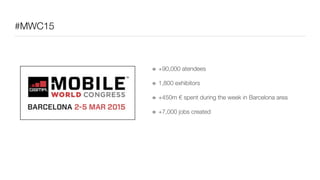
#MWC15
+90,000 atendees
1,800 exhibitors
+450m € spent during the week in Barcelona area
+7,000 jobs created
Agenda
1. Personal intro

2. Kazam and mobile industry

3. Impact of technology in our lives

4. What’s next? Trends on 21st century workplace

5. Summary of takeaways
Javier Martinez Esparza
VP, Iberia & LATAM, KAZAM Mobile
javier.esparza@kazam.mobi

@javimesparza

es.linkedin.com/in/javiermartinezesparza

alwaysblamethemessenger.wordpress.com

about.me/javiermartinezesparza

BBA 1995 class
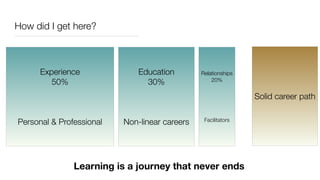
How did I get here?
Experience
50%
Personal & Professional
Education
30%
Non-linear careers
Relationships
20%
Facilitators
Solid career path
Learning is a journey that never ends
Account Manager
Key Account Manager
Sales Manager
Business Dev. Manager
Country Business Manager
Regional Sales & Operations Manager
Regional VP South Europe
Regional VP LATAM
Sales Director
Country Manager
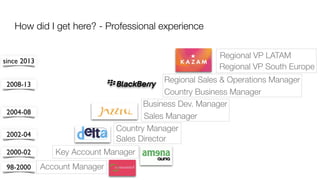
How did I get here? - Professional experience
98-2000
2000-02
2002-04
2004-08
2008-13
since 2013
Account Manager
Key Account Manager
Sales Manager
Business Dev. Manager
Country Business Manager
Regional Sales & Operations Manager
Regional VP South Europe
Regional VP LATAM
Sales Director
Country Manager
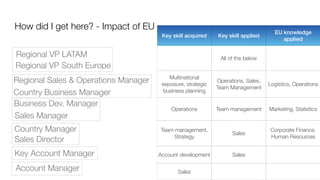
Key skill acquired Key skill applied
EU knowledge
applied
All of the below
Multinational
exposure, strategic
business planning
Operations, Sales,
Team Management
Logistics, Operations
Operations Team management Marketing, Statistics
Team management,
Strategy
Sales
Corporate Finance,
Human Resources
Account development Sales
Sales
How did I get here? - Impact of EU
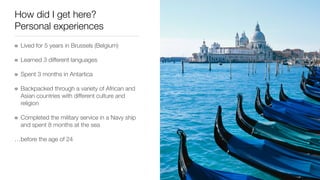
How did I get here?
Personal experiences
Lived for 5 years in Brussels (Belgium)
Learned 3 different languages
Spent 3 months in Antartica
Backpacked through a variety of African and
Asian countries with different culture and
religion
Completed the military service in a Navy ship
and spent 8 months at the sea
…before the age of 24
Kazam and the mobile industry
Current situation and Global trends
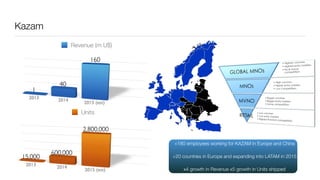
Kazam
Revenue (m U$)
Units
+180 employees working for KAZAM in Europe and China
+20 countries in Europe and expanding into LATAM in 2015
x4 growth in Revenue x5 growth in Units shipped
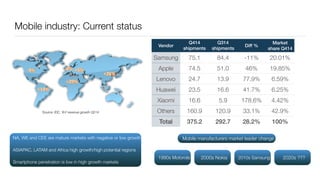
Mobile industry: Current status
Source: IDC, YoY revenue growth Q214
NA, WE and CEE are mature markets with negative or low growth
ASIAPAC, LATAM and Africa high growth/high potential regions
Smartphone penetration is low in high growth markets
Vendor
Q414
shipments
Q314
shipments
Diff %
Market
share Q414
Samsung 75.1 84.4 -11% 20.01%
Apple 74.5 51.0 46% 19.85%
Lenovo 24.7 13.9 77.9% 6.59%
Huawei 23.5 16.6 41.7% 6.25%
Xiaomi 16.6 5.9 178.6% 4.42%
Others 160.9 120.9 33.1% 42.9%
Total 375.2 292.7 28.2% 100%
1990s Motorola
Mobile manufacturers market leader change
2000s Nokia 2010s Samsung 2020s ???
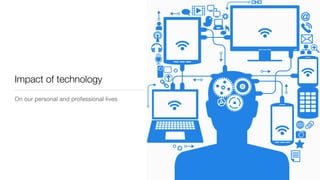
Impact of technology
On our personal and professional lives
Headlines for discussion
1. Top 10 in-demand jobs in 2010 did not exist in 2004
2. We are currently preparing students for jobs that don’t exist yet, using
technologies that haven’t been invented, in order to solve problems we haven’t
even faced yet
3. Today’s students will have 10-14 different jobs by the age of 38
Embrace change and be ready to drive those changes
Headlines for discussion (II)
1. Radio took 38 yrs to reach a market audience of 50m. TV took 13 yrs.
Internet 4 yrs. iPod 3 yrs. Facebook 2 yrs.
2. We generate the same amount of information in 1 year than in the previous
5,000 years.
3. Technical information doubles every year, so for students starting a 4 year
technical degree this means that by the end of their studies, HALF of what
they learned will be outdated
We live in exponential times
What’s next?
Trends in 21st century workplace
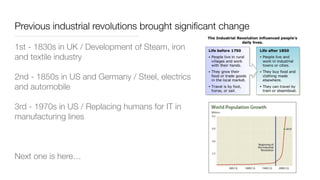
Previous industrial revolutions brought significant change
1st - 1830s in UK / Development of Steam, iron
and textile industry
2nd - 1850s in US and Germany / Steel, electrics
and automobile
3rd - 1970s in US / Replacing humans for IT in
manufacturing lines
Next one is here…
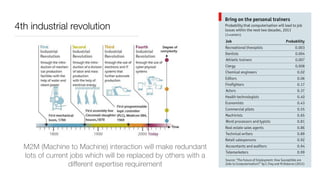
4th industrial revolution
M2M (Machine to Machine) interaction will make redundant
lots of current jobs which will be replaced by others with a
different expertise requirement
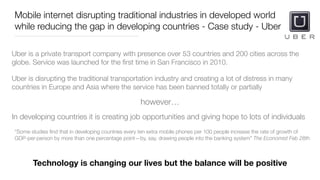
Mobile internet disrupting traditional industries in developed world
while reducing the gap in developing countries - Case study - Uber
“Some studies find that in developing countries every ten extra mobile phones per 100 people increase the rate of growth of
GDP-per-person by more than one percentage point—by, say, drawing people into the banking system” The Economist Feb 28th
Uber is disrupting the traditional transportation industry and creating a lot of distress in many
countries in Europe and Asia where the service has been banned totally or partially
Uber is a private transport company with presence over 53 countries and 200 cities across the
globe. Service was launched for the first time in San Francisco in 2010.
Technology is changing our lives but the balance will be positive
In developing countries it is creating job opportunities and giving hope to lots of individuals
however…
Summary of takeaways
Learning is a journey that never ends
We live in exponential times
Embrace change and be ready to drive that change
Technology is changing our lives but the balance will be positive
Thank you.

Presentation EU BCN March 2015

  • 1.
  • 2.
    #MWC15 +90,000 atendees 1,800 exhibitors +450m€ spent during the week in Barcelona area +7,000 jobs created
  • 3.
    Agenda 1. Personal intro 2.Kazam and mobile industry 3. Impact of technology in our lives 4. What’s next? Trends on 21st century workplace 5. Summary of takeaways
  • 4.
    Javier Martinez Esparza VP,Iberia & LATAM, KAZAM Mobile javier.esparza@kazam.mobi @javimesparza es.linkedin.com/in/javiermartinezesparza alwaysblamethemessenger.wordpress.com about.me/javiermartinezesparza BBA 1995 class
  • 5.
    How did Iget here? Experience 50% Personal & Professional Education 30% Non-linear careers Relationships 20% Facilitators Solid career path Learning is a journey that never ends
  • 6.
    Account Manager Key AccountManager Sales Manager Business Dev. Manager Country Business Manager Regional Sales & Operations Manager Regional VP South Europe Regional VP LATAM Sales Director Country Manager How did I get here? - Professional experience 98-2000 2000-02 2002-04 2004-08 2008-13 since 2013
  • 7.
    Account Manager Key AccountManager Sales Manager Business Dev. Manager Country Business Manager Regional Sales & Operations Manager Regional VP South Europe Regional VP LATAM Sales Director Country Manager Key skill acquired Key skill applied EU knowledge applied All of the below Multinational exposure, strategic business planning Operations, Sales, Team Management Logistics, Operations Operations Team management Marketing, Statistics Team management, Strategy Sales Corporate Finance, Human Resources Account development Sales Sales How did I get here? - Impact of EU
  • 8.
    How did Iget here? Personal experiences Lived for 5 years in Brussels (Belgium) Learned 3 different languages Spent 3 months in Antartica Backpacked through a variety of African and Asian countries with different culture and religion Completed the military service in a Navy ship and spent 8 months at the sea …before the age of 24
  • 9.
    Kazam and themobile industry Current situation and Global trends
  • 10.
    Kazam Revenue (m U$) Units +180employees working for KAZAM in Europe and China +20 countries in Europe and expanding into LATAM in 2015 x4 growth in Revenue x5 growth in Units shipped
  • 11.
    Mobile industry: Currentstatus Source: IDC, YoY revenue growth Q214 NA, WE and CEE are mature markets with negative or low growth ASIAPAC, LATAM and Africa high growth/high potential regions Smartphone penetration is low in high growth markets Vendor Q414 shipments Q314 shipments Diff % Market share Q414 Samsung 75.1 84.4 -11% 20.01% Apple 74.5 51.0 46% 19.85% Lenovo 24.7 13.9 77.9% 6.59% Huawei 23.5 16.6 41.7% 6.25% Xiaomi 16.6 5.9 178.6% 4.42% Others 160.9 120.9 33.1% 42.9% Total 375.2 292.7 28.2% 100% 1990s Motorola Mobile manufacturers market leader change 2000s Nokia 2010s Samsung 2020s ???
  • 12.
    Impact of technology Onour personal and professional lives
  • 15.
    Headlines for discussion 1.Top 10 in-demand jobs in 2010 did not exist in 2004 2. We are currently preparing students for jobs that don’t exist yet, using technologies that haven’t been invented, in order to solve problems we haven’t even faced yet 3. Today’s students will have 10-14 different jobs by the age of 38 Embrace change and be ready to drive those changes
  • 16.
    Headlines for discussion(II) 1. Radio took 38 yrs to reach a market audience of 50m. TV took 13 yrs. Internet 4 yrs. iPod 3 yrs. Facebook 2 yrs. 2. We generate the same amount of information in 1 year than in the previous 5,000 years. 3. Technical information doubles every year, so for students starting a 4 year technical degree this means that by the end of their studies, HALF of what they learned will be outdated We live in exponential times
  • 17.
    What’s next? Trends in21st century workplace
  • 18.
    Previous industrial revolutionsbrought significant change 1st - 1830s in UK / Development of Steam, iron and textile industry 2nd - 1850s in US and Germany / Steel, electrics and automobile 3rd - 1970s in US / Replacing humans for IT in manufacturing lines Next one is here…
  • 19.
    4th industrial revolution M2M(Machine to Machine) interaction will make redundant lots of current jobs which will be replaced by others with a different expertise requirement
  • 20.
    Mobile internet disruptingtraditional industries in developed world while reducing the gap in developing countries - Case study - Uber “Some studies find that in developing countries every ten extra mobile phones per 100 people increase the rate of growth of GDP-per-person by more than one percentage point—by, say, drawing people into the banking system” The Economist Feb 28th Uber is disrupting the traditional transportation industry and creating a lot of distress in many countries in Europe and Asia where the service has been banned totally or partially Uber is a private transport company with presence over 53 countries and 200 cities across the globe. Service was launched for the first time in San Francisco in 2010. Technology is changing our lives but the balance will be positive In developing countries it is creating job opportunities and giving hope to lots of individuals however…
  • 21.
    Summary of takeaways Learningis a journey that never ends We live in exponential times Embrace change and be ready to drive that change Technology is changing our lives but the balance will be positive
  • 22.