1
Application of Urban Harvest Approach on
water and resource cycles
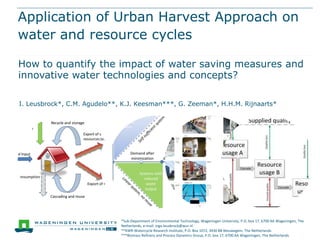
How to quantify the impact of water saving measures and
innovative water technologies and concepts?
I. Leusbrock*, C.M. Agudelo**, K.J. Keesman***, G. Zeeman*, H.H.M. Rijnaarts*
*Sub-Department of Environmental Technology, Wageningen University, P.O. box 17, 6700 AA Wageningen, The
Netherlands, e-mail: ingo.leusbrock@wur.nl
**KWR-Watercycle Research Institute, P.O. Box 1072, 3430 BB Nieuwegein, The Netherlands
***Biomass Refinery and Process Dynamics Group, P.O. box 17, 6700 AA Wageningen, The Netherlands
2
Content
 Motivation
 What is Urban Harvest?
● Steps
● Indicators
● Demand patterns
 Results of UHA on block scale and city scale
 What can you do with the results?
 What are our next steps?
3
Motivation and steps
 We develop technologies and concepts around them and
would like to apply them
 We want to improve our water cycles and make them
“better”
● Resource scarcity, population growth etc.
 Yet we do not have the tools to quantify and evaluate
technologies, improvement options and their impact on
water cycles
 So, we had to develop something new
● “Urban Harvest”
4
What is Urban Harvest?
 A framework to organize your ideas to improve water
cycles
 A tool to quantify and compare your different ideas for
water cycles
 A tool to quantify urban water flows in high temporal and
spatial resolution
5
The starting point of UHA: Baseline
External Input
Consumption
Export of waste
6
Step I: Demand Minimization
External Input
Consumption
Export of waste
7
Step II: Output minimization
External Input
Consumption
Cascading and reuse
Recycle and storage
Export of waste
8
Step III: Multisourcing
External Input
Multisource
(e.g. rain)
Consumption
Cascading and reuse
Recycle and storage
Export of waste
Export of secondary
resources (e.g. nutrients)
9
The three steps of the Urban Harvest
Approach (UHA)
I. minimizing water demand
● water saving measures
II.maximizing water re-use and minimizing outputs
● cascading and recycling of used water streams
III.multi-sourcing of alternative water sources
● Rain
● Brackish and salt water, atmospheric water
 Baseline assessment as starting point
Agudelo, C. M.; Mels, A. R.; Keesman, K. J.; Rijnaarts, H. H. M., The
urban harvest approach as an aid for sustainable urban resource
planning. Journal of Industrial Ecology 2012, 16, (6), 839-850.
10
Baseline assessment
 All inputs and outputs quantified
● Consumption, infiltration, external input, run-
off, evapotranspiration, precipitation
● qualities next to quantities
 All streams in a high temporal resolution from minutely
upwards
● diurnal and seasonal patterns
● Water consumption of households is calculated by
SIMDEUM1
1 Blokker, E.; Vreeburg, J.; van Dijk, J., Simulating residential water
demand with a stochastic end-use model. Journal of Water Resources
Planning and Management 2009, 136, (1), 19-26.
11
Water cycle at building / household scale
Building unit (bu)
Household (hh) Subsystem (ss)
Daily consumption
pattern
Building
type
Occupancy
Number of
households
Water
appliances
Garden
Roof: type and
area
Climate Rainfall
Other local
sources
Temporal
variations
Socio-economic
parameters
2) Recycling
3) Multisourcing
1) Minimizing
Treatment and
storage capacity
Yield/overflow
0 6 12 18 24
Demand
Time
0 6 12 18 24
Demand
Time
Urban Harvest strategies Variables studied
in this research
Variables not studied
in this research
Relationships not
studied in this research
Different spatial scales
Building unit Household Subsystem
Note: If there is one household per building unit, bu=hh, also note
that subsystem can be at household level or at building unit
Agudelo, C. M., Dynamic water resource management for achieving
self-sufficiency of cities of tomorrow. PhD thesis, Wageningen
University, Wageningen, 2012.
12
Water cycle at block scale
Block level
Building units
Building
type
Occupancy
Number of
households
Water
appliances
Roof:
Type and area
1) Minimizing
Urban Harvest
strategies
Urban Harvest
strategies
Variables studied
in this research
Variables studied
in this research
Variables not studied
in this research
Variables not studied
in this research
Relationships not
studied in this research
Relationships not
studied in this research
Treatment and
storage
capacity
Yield/overflow
3) Multisourcing
2) Recycling
Impermeable
areas
Permeable areas
Daily
consumption
pattern
Climate
Precipitation
Potential ET
Runoff
sewer
Irrigation
Infiltration Actual ET
ConsumptionConsumption
Domestic
wastewater
Storm
wastewater
Waste outputWaste output
External
input
Agudelo, C. M., Dynamic water resource management for achieving
self-sufficiency of cities of tomorrow. PhD thesis, Wageningen
University, Wageningen, 2012.
ET = Evapotranspiration
13
Urban Metabolic Profile
Systems
with
reduced
waste
output
Demand / DMI
Waste / unused resource exported / WOI
Water harvested
on-site / SSI
Initial
demand
Exporting
system
Demand after
minimization
Agudelo, C. M.; Mels, A. R.; Keesman, K. J.; Rijnaarts, H. H. M., The
urban harvest approach as an aid for sustainable urban resource
planning. Journal of Industrial Ecology 2012, 16, (6), 839-850.
14
Scenario study with UHA
Scenarios Action
Demand minimization step
(included in all scenarios)
shower, toilet and laundry water
Scenario 1 recycling of light grey water from
shower and sinks
Scenario 2 rainwater harvesting
Scenario 3 Scenario 1 + Scenario 2
Scenario 4 Scenario 3 + green roofs as additional
storage step and run-off reduction
15
Urban Metabolic Profile for scenarios (I)
0
1
3
2
4
0
1
4
2
3
-500
-400
-300
-200
-100
0
100
200
300
400
500
0 100 200 300 400 500
-We(m³/y)Rh(m³/y)
D
(m³/y)
-2100
-1400
-700
0
700
1400
2100
0 7
-We(m³/y)Rh(m³/y)
Baseline
Baseline
Arrows indicate the direction of inc
a) Low-density block b) Hig
0
1
3
2
4
0
1
4
2
3
-500
-400
-300
-200
-100
0
100
200
300
400
500
0 100 200 300 400 500
-We(m³/y)Rh(m³/y)
D
(m³/y)
0
1 3
2
4
0
1
4
2
3
-2100
-1400
-700
0
700
1400
2100
0 700 1400 2100
-We(m³/y)Rh(m³/y)
D
(m
Baseline
Baseline
Baseline Baseline
Arrows indicate the direction of increasing system efficiency
a) Low-density block b) High-density block
Systems
with
reduced
waste
output
Demand / DMI
Waste / unused resource exported / WOI
Water harvested
on-site / SSI
Initial
demand
Exporting
system
Demand after
minimization
16
Urban Metabolic Profile for scenarios (II)
0
1
3
2
4
0
1
4
2
3
-500
-400
-300
-200
-100
0
100
200
300
400
500
0 100 200 300 400 500
-We(m³/y)Rh(m³/y)
D
(m³/y)
0
1 3
2
4
0
1
4
2
3
-2100
-1400
-700
0
700
1400
2100
0 700 1400 2100
-We(m³/y)Rh(m³/y)
D
(m³/y)
Baseline
Baseline
Baseline Baseline
Arrows indicate the direction of increasing system efficiency
a) Low-density block b) High-density block
Agudelo, C. M., Dynamic water resource management for achieving
self-sufficiency of cities of tomorrow. PhD thesis, Wageningen
University, Wageningen, 2012.
17
Evaluation of the water cycle on city scale:
Baseline
Agudelo, C. M., Dynamic water resource management for achieving
self-sufficiency of cities of tomorrow. PhD thesis, Wageningen
University, Wageningen, 2012.
18
Evaluation of the water cycle on city scale:
after water saving measures
Agudelo, C. M., Dynamic water resource management for achieving
self-sufficiency of cities of tomorrow. PhD thesis, Wageningen
University, Wageningen, 2012.
19
Where and how to use UHA?
 Decision-support tool for technology, infrastructure and
management choices
 In-depth analysis of water cycles
 Possible fields of application
● Water scarcity prevention and self-sufficiency
concepts
● Infrastructure and Planning
● Integration of technologies on different scales
● Decentralized or centralized?
20
Future challenges
 Energy and material (e.g., chemicals) demand of applied
measures
 Extension to other climates and other settings
 Inclusion of nutrients, heat recovery, energy production
● Heat recovery from sewage
● New Sanitation
21
Conclusions
 Urban Harvest Approach can be used for quantification of
water saving measures and recycle und reuse options
● Indicator set and Urban Metabolic Profile
● Decision support
 Dynamic modelling of water cycles in high temporal
resolution possible and leads to more insights
 Further extensions of the UHA are still necessary
● nutrients and energy demand
● economics
22
Urban Harvest
• Demand
Minimization
• Output
minimization
• Multisourcing
• Dynamic Modelling
e-mail: ingo.leusbrock@wur.nl
Twitter: @leusbrocki
Slideshare: http://www.slideshare.net/IngoLeusbrock

Presentation at 3rd YWP IWA Conference 2013 in Luxembourg

  • 1.
    1 Application of UrbanHarvest Approach on water and resource cycles How to quantify the impact of water saving measures and innovative water technologies and concepts? I. Leusbrock*, C.M. Agudelo**, K.J. Keesman***, G. Zeeman*, H.H.M. Rijnaarts* *Sub-Department of Environmental Technology, Wageningen University, P.O. box 17, 6700 AA Wageningen, The Netherlands, e-mail: ingo.leusbrock@wur.nl **KWR-Watercycle Research Institute, P.O. Box 1072, 3430 BB Nieuwegein, The Netherlands ***Biomass Refinery and Process Dynamics Group, P.O. box 17, 6700 AA Wageningen, The Netherlands
  • 2.
    2 Content  Motivation  Whatis Urban Harvest? ● Steps ● Indicators ● Demand patterns  Results of UHA on block scale and city scale  What can you do with the results?  What are our next steps?
  • 3.
    3 Motivation and steps We develop technologies and concepts around them and would like to apply them  We want to improve our water cycles and make them “better” ● Resource scarcity, population growth etc.  Yet we do not have the tools to quantify and evaluate technologies, improvement options and their impact on water cycles  So, we had to develop something new ● “Urban Harvest”
  • 4.
    4 What is UrbanHarvest?  A framework to organize your ideas to improve water cycles  A tool to quantify and compare your different ideas for water cycles  A tool to quantify urban water flows in high temporal and spatial resolution
  • 5.
    5 The starting pointof UHA: Baseline External Input Consumption Export of waste
  • 6.
    6 Step I: DemandMinimization External Input Consumption Export of waste
  • 7.
    7 Step II: Outputminimization External Input Consumption Cascading and reuse Recycle and storage Export of waste
  • 8.
    8 Step III: Multisourcing ExternalInput Multisource (e.g. rain) Consumption Cascading and reuse Recycle and storage Export of waste Export of secondary resources (e.g. nutrients)
  • 9.
    9 The three stepsof the Urban Harvest Approach (UHA) I. minimizing water demand ● water saving measures II.maximizing water re-use and minimizing outputs ● cascading and recycling of used water streams III.multi-sourcing of alternative water sources ● Rain ● Brackish and salt water, atmospheric water  Baseline assessment as starting point Agudelo, C. M.; Mels, A. R.; Keesman, K. J.; Rijnaarts, H. H. M., The urban harvest approach as an aid for sustainable urban resource planning. Journal of Industrial Ecology 2012, 16, (6), 839-850.
  • 10.
    10 Baseline assessment  Allinputs and outputs quantified ● Consumption, infiltration, external input, run- off, evapotranspiration, precipitation ● qualities next to quantities  All streams in a high temporal resolution from minutely upwards ● diurnal and seasonal patterns ● Water consumption of households is calculated by SIMDEUM1 1 Blokker, E.; Vreeburg, J.; van Dijk, J., Simulating residential water demand with a stochastic end-use model. Journal of Water Resources Planning and Management 2009, 136, (1), 19-26.
  • 11.
    11 Water cycle atbuilding / household scale Building unit (bu) Household (hh) Subsystem (ss) Daily consumption pattern Building type Occupancy Number of households Water appliances Garden Roof: type and area Climate Rainfall Other local sources Temporal variations Socio-economic parameters 2) Recycling 3) Multisourcing 1) Minimizing Treatment and storage capacity Yield/overflow 0 6 12 18 24 Demand Time 0 6 12 18 24 Demand Time Urban Harvest strategies Variables studied in this research Variables not studied in this research Relationships not studied in this research Different spatial scales Building unit Household Subsystem Note: If there is one household per building unit, bu=hh, also note that subsystem can be at household level or at building unit Agudelo, C. M., Dynamic water resource management for achieving self-sufficiency of cities of tomorrow. PhD thesis, Wageningen University, Wageningen, 2012.
  • 12.
    12 Water cycle atblock scale Block level Building units Building type Occupancy Number of households Water appliances Roof: Type and area 1) Minimizing Urban Harvest strategies Urban Harvest strategies Variables studied in this research Variables studied in this research Variables not studied in this research Variables not studied in this research Relationships not studied in this research Relationships not studied in this research Treatment and storage capacity Yield/overflow 3) Multisourcing 2) Recycling Impermeable areas Permeable areas Daily consumption pattern Climate Precipitation Potential ET Runoff sewer Irrigation Infiltration Actual ET ConsumptionConsumption Domestic wastewater Storm wastewater Waste outputWaste output External input Agudelo, C. M., Dynamic water resource management for achieving self-sufficiency of cities of tomorrow. PhD thesis, Wageningen University, Wageningen, 2012. ET = Evapotranspiration
  • 13.
    13 Urban Metabolic Profile Systems with reduced waste output Demand/ DMI Waste / unused resource exported / WOI Water harvested on-site / SSI Initial demand Exporting system Demand after minimization Agudelo, C. M.; Mels, A. R.; Keesman, K. J.; Rijnaarts, H. H. M., The urban harvest approach as an aid for sustainable urban resource planning. Journal of Industrial Ecology 2012, 16, (6), 839-850.
  • 14.
    14 Scenario study withUHA Scenarios Action Demand minimization step (included in all scenarios) shower, toilet and laundry water Scenario 1 recycling of light grey water from shower and sinks Scenario 2 rainwater harvesting Scenario 3 Scenario 1 + Scenario 2 Scenario 4 Scenario 3 + green roofs as additional storage step and run-off reduction
  • 15.
    15 Urban Metabolic Profilefor scenarios (I) 0 1 3 2 4 0 1 4 2 3 -500 -400 -300 -200 -100 0 100 200 300 400 500 0 100 200 300 400 500 -We(m³/y)Rh(m³/y) D (m³/y) -2100 -1400 -700 0 700 1400 2100 0 7 -We(m³/y)Rh(m³/y) Baseline Baseline Arrows indicate the direction of inc a) Low-density block b) Hig 0 1 3 2 4 0 1 4 2 3 -500 -400 -300 -200 -100 0 100 200 300 400 500 0 100 200 300 400 500 -We(m³/y)Rh(m³/y) D (m³/y) 0 1 3 2 4 0 1 4 2 3 -2100 -1400 -700 0 700 1400 2100 0 700 1400 2100 -We(m³/y)Rh(m³/y) D (m Baseline Baseline Baseline Baseline Arrows indicate the direction of increasing system efficiency a) Low-density block b) High-density block Systems with reduced waste output Demand / DMI Waste / unused resource exported / WOI Water harvested on-site / SSI Initial demand Exporting system Demand after minimization
  • 16.
    16 Urban Metabolic Profilefor scenarios (II) 0 1 3 2 4 0 1 4 2 3 -500 -400 -300 -200 -100 0 100 200 300 400 500 0 100 200 300 400 500 -We(m³/y)Rh(m³/y) D (m³/y) 0 1 3 2 4 0 1 4 2 3 -2100 -1400 -700 0 700 1400 2100 0 700 1400 2100 -We(m³/y)Rh(m³/y) D (m³/y) Baseline Baseline Baseline Baseline Arrows indicate the direction of increasing system efficiency a) Low-density block b) High-density block Agudelo, C. M., Dynamic water resource management for achieving self-sufficiency of cities of tomorrow. PhD thesis, Wageningen University, Wageningen, 2012.
  • 17.
    17 Evaluation of thewater cycle on city scale: Baseline Agudelo, C. M., Dynamic water resource management for achieving self-sufficiency of cities of tomorrow. PhD thesis, Wageningen University, Wageningen, 2012.
  • 18.
    18 Evaluation of thewater cycle on city scale: after water saving measures Agudelo, C. M., Dynamic water resource management for achieving self-sufficiency of cities of tomorrow. PhD thesis, Wageningen University, Wageningen, 2012.
  • 19.
    19 Where and howto use UHA?  Decision-support tool for technology, infrastructure and management choices  In-depth analysis of water cycles  Possible fields of application ● Water scarcity prevention and self-sufficiency concepts ● Infrastructure and Planning ● Integration of technologies on different scales ● Decentralized or centralized?
  • 20.
    20 Future challenges  Energyand material (e.g., chemicals) demand of applied measures  Extension to other climates and other settings  Inclusion of nutrients, heat recovery, energy production ● Heat recovery from sewage ● New Sanitation
  • 21.
    21 Conclusions  Urban HarvestApproach can be used for quantification of water saving measures and recycle und reuse options ● Indicator set and Urban Metabolic Profile ● Decision support  Dynamic modelling of water cycles in high temporal resolution possible and leads to more insights  Further extensions of the UHA are still necessary ● nutrients and energy demand ● economics
  • 22.
    22 Urban Harvest • Demand Minimization •Output minimization • Multisourcing • Dynamic Modelling e-mail: ingo.leusbrock@wur.nl Twitter: @leusbrocki Slideshare: http://www.slideshare.net/IngoLeusbrock