No. Project 2020-1-RO01-KA229-080194_1
Romania
Romania is a country at the confluence of
Central, Eastern amd Southeastern Europe.
It borders Bulgaria to the south, Ukraine to
the north, Hungary to the west, Serbia to the
southwest, Moldova and to the east and the
Black Sea to the southest.
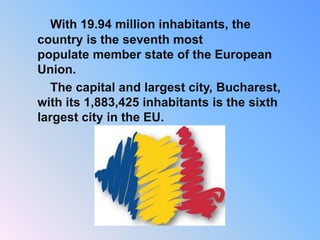
With 19.94 million inhabitants, the
country is the seventh most
populate member state of the European
Union.
The capital and largest city, Bucharest,
with its 1,883,425 inhabitants is the sixth
largest city in the EU.
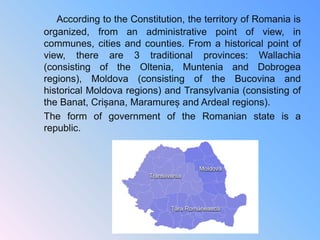
According to the Constitution, the territory of Romania is
organized, from an administrative point of view, in
communes, cities and counties. From a historical point of
view, there are 3 traditional provinces: Wallachia
(consisting of the Oltenia, Muntenia and Dobrogea
regions), Moldova (consisting of the Bucovina and
historical Moldova regions) and Transylvania (consisting of
the Banat, Crișana, Maramureș and Ardeal regions).
The form of government of the Romanian state is a
republic.
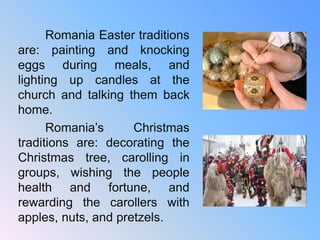
Romania Easter traditions
are: painting and knocking
eggs during meals, and
lighting up candles at the
church and talking them back
home.
Romania’s Christmas
traditions are: decorating the
Christmas tree, carolling in
groups, wishing the people
health and fortune, and
rewarding the carollers with
apples, nuts, and pretzels.
Romanian folklore
represents all
Romanian spiritual
and cultural
creations.
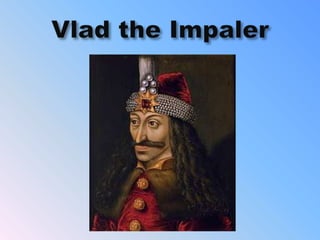
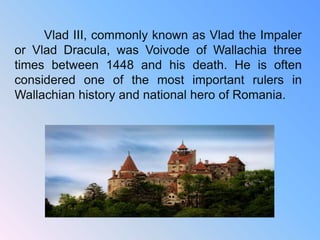
Vlad III, commonly known as Vlad the Impaler
or Vlad Dracula, was Voivode of Wallachia three
times between 1448 and his death. He is often
considered one of the most important rulers in
Wallachian history and national hero of Romania.
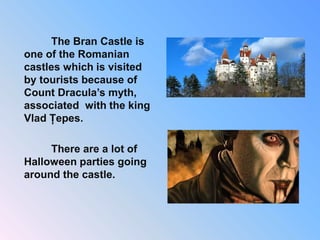
The Bran Castle is
one of the Romanian
castles which is visited
by tourists because of
Count Dracula’s myth,
associated with the king
Vlad Țepes.
There are a lot of
Halloween parties going
around the castle.
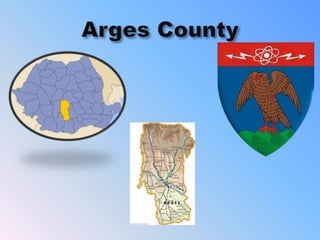
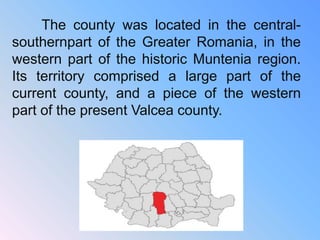
The county was located in the central-
southernpart of the Greater Romania, in the
western part of the historic Muntenia region.
Its territory comprised a large part of the
current county, and a piece of the western
part of the present Valcea county.
One of our proudest creations
The best road in the world.
TRANSFAGARASAN
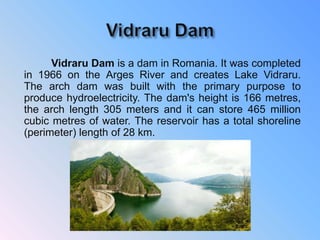
Vidraru Dam is a dam in Romania. It was completed
in 1966 on the Arges River and creates Lake Vidraru.
The arch dam was built with the primary purpose to
produce hydroelectricity. The dam's height is 166 metres,
the arch length 305 meters and it can store 465 million
cubic metres of water. The reservoir has a total shoreline
(perimeter) length of 28 km.
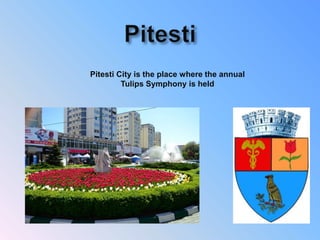
Pitesti City is the place where the annual
Tulips Symphony is held
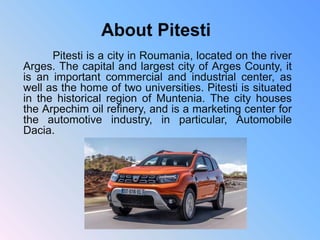
Pitesti is a city in Roumania, located on the river
Arges. The capital and largest city of Arges County, it
is an important commercial and industrial center, as
well as the home of two universities. Pitesti is situated
in the historical region of Muntenia. The city houses
the Arpechim oil refinery, and is a marketing center for
the automotive industry, in particular, Automobile
Dacia.
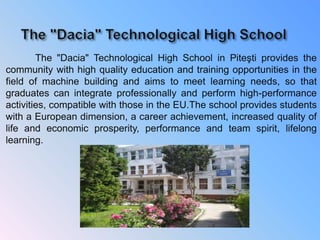
The "Dacia" Technological High School in Piteşti provides the
community with high quality education and training opportunities in the
field of machine building and aims to meet learning needs, so that
graduates can integrate professionally and perform high-performance
activities, compatible with those in the EU.The school provides students
with a European dimension, a career achievement, increased quality of
life and economic prosperity, performance and team spirit, lifelong
learning.
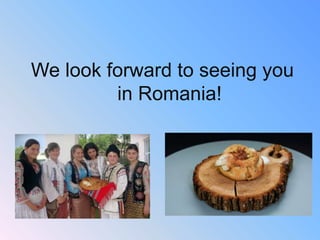
We look forward to seeing you
in Romania!
 "The European Commission support for the production of this publication
does not constitute an endorsement of the contents which reflects the views
only of the authors, and the Commission cannot be held responsi¬ble for
any use which may be made of the information contained therein."

Presentation about Romania

  • 1.
  • 3.
    Romania is acountry at the confluence of Central, Eastern amd Southeastern Europe. It borders Bulgaria to the south, Ukraine to the north, Hungary to the west, Serbia to the southwest, Moldova and to the east and the Black Sea to the southest.
  • 4.
    With 19.94 millioninhabitants, the country is the seventh most populate member state of the European Union. The capital and largest city, Bucharest, with its 1,883,425 inhabitants is the sixth largest city in the EU.
  • 5.
    According to theConstitution, the territory of Romania is organized, from an administrative point of view, in communes, cities and counties. From a historical point of view, there are 3 traditional provinces: Wallachia (consisting of the Oltenia, Muntenia and Dobrogea regions), Moldova (consisting of the Bucovina and historical Moldova regions) and Transylvania (consisting of the Banat, Crișana, Maramureș and Ardeal regions). The form of government of the Romanian state is a republic.
  • 6.
    Romania Easter traditions are:painting and knocking eggs during meals, and lighting up candles at the church and talking them back home. Romania’s Christmas traditions are: decorating the Christmas tree, carolling in groups, wishing the people health and fortune, and rewarding the carollers with apples, nuts, and pretzels.
  • 7.
    Romanian folklore represents all Romanianspiritual and cultural creations.
  • 9.
    Vlad III, commonlyknown as Vlad the Impaler or Vlad Dracula, was Voivode of Wallachia three times between 1448 and his death. He is often considered one of the most important rulers in Wallachian history and national hero of Romania.
  • 10.
    The Bran Castleis one of the Romanian castles which is visited by tourists because of Count Dracula’s myth, associated with the king Vlad Țepes. There are a lot of Halloween parties going around the castle.
  • 12.
    The county waslocated in the central- southernpart of the Greater Romania, in the western part of the historic Muntenia region. Its territory comprised a large part of the current county, and a piece of the western part of the present Valcea county.
  • 13.
    One of ourproudest creations The best road in the world. TRANSFAGARASAN
  • 14.
    Vidraru Dam isa dam in Romania. It was completed in 1966 on the Arges River and creates Lake Vidraru. The arch dam was built with the primary purpose to produce hydroelectricity. The dam's height is 166 metres, the arch length 305 meters and it can store 465 million cubic metres of water. The reservoir has a total shoreline (perimeter) length of 28 km.
  • 15.
    Pitesti City isthe place where the annual Tulips Symphony is held
  • 16.
    Pitesti is acity in Roumania, located on the river Arges. The capital and largest city of Arges County, it is an important commercial and industrial center, as well as the home of two universities. Pitesti is situated in the historical region of Muntenia. The city houses the Arpechim oil refinery, and is a marketing center for the automotive industry, in particular, Automobile Dacia.
  • 17.
    The "Dacia" TechnologicalHigh School in Piteşti provides the community with high quality education and training opportunities in the field of machine building and aims to meet learning needs, so that graduates can integrate professionally and perform high-performance activities, compatible with those in the EU.The school provides students with a European dimension, a career achievement, increased quality of life and economic prosperity, performance and team spirit, lifelong learning.
  • 18.
    We look forwardto seeing you in Romania!
  • 19.
     "The EuropeanCommission support for the production of this publication does not constitute an endorsement of the contents which reflects the views only of the authors, and the Commission cannot be held responsi¬ble for any use which may be made of the information contained therein."