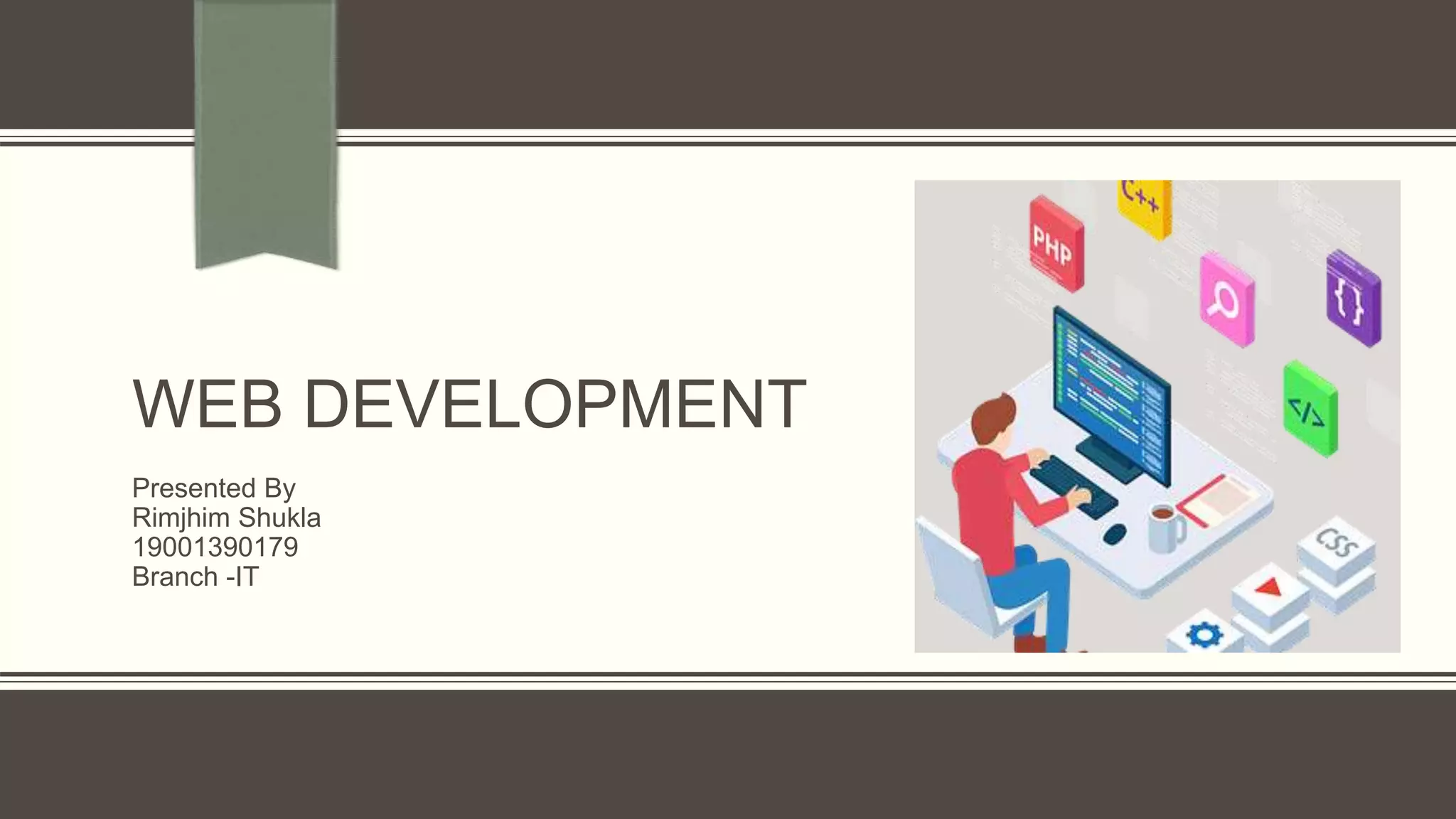
WEB DEVELOPMENT
Presented By
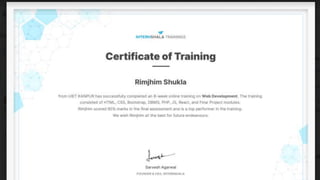
Rimjhim Shukla
19001390179
Branch -IT
ABOUT TRAINING
 Mode of training : Online from Internshala
 Start date :14 May 2022
 End date:14 July 2022
 Duration : eight weeks
CONTENT
 What is web development
 Front end development
 Front end development Technology
 Back end development
 Back end development technology
 Project
 Conclusion
What is web development
 Web development refers to the creating, building, and maintaining of websites. It
includes aspects such as web design, web publishing, web programming, and
database management. It is the creation of an application that works over the internet.
 Web: It refers to websites, web pages or anything that works over the internet.
 Development: It refers to building the application from scratch.
 Example of web applications are social networking sites like facebook or
e commerce sites like amazon.
 There are two broad division of web development – front-end development and back-
end development .
Front end development technology
 HTML :stands for Hyper Text Markup Language. It is used to design web pages using a markup
language. HTML is the combination of Hypertext and Markup language. Hypertext defines the link
between web pages. A markup language is used to define the text document within the tag which
defines the structure of web pages. This language is used to annotate (make notes for the computer)
text so that a machine can understand it and manipulate text accordingly. Most markup languages
(e.g. HTML) are human-readable. The language uses tags to define what manipulation has to be
done on the text.
 CSS: Cascading Style Sheets, fondly referred to as CSS, is a simply designed language intended to
simplify the process of making web pages presentable. CSS allows you to apply styles to web pages.
More importantly, CSS enables you to do this independent of the HTML that makes up each web
page. It describes how a webpage should look: it prescribes colors, fonts, spacing, and much more. In
short, you can make your website look however you want. CSS lets developers and designers define
how it behaves, including how elements are positioned in the browser.
 BOOTSTRAP: Bootstrap is a free and open-source tool collection for creating responsive websites
and web applications. It is the most popular HTML, CSS, and JavaScript framework for developing
responsive, mobile-first websites. It solves many problems which we had once, one of which is the
cross-browser compatibility issue. Nowadays, the websites are perfect for all the browsers (IE,
Firefox, and Chrome) and for all sizes of screens (Desktop, Tablets, Phablets, and Phones).
Back end development
 Back-end development means working on server-side software, which focuses on
everything you can’t see on a website. Back-end developers ensure the website
performs correctly, focusing on databases, back-end logic, application programming
interface (APIs), architecture, and servers. They use code that helps browsers
communicate with databases, store, understand, and delete data.
 Back end development technology : SQL and PHP
Back end development technologies
 SQL
 SQL stands for Structured Query
Language. It is used for storing and
managing data in relational database
management system (RDMS).
 It is a standard language for Relational
Database System. It enables a user to
create, read, update and delete relational
databases and tables.
 All the RDBMS like MySQL, Informix,
Oracle, MS Access and SQL Server use
SQL as their standard database
language.
 PHP
 PHP stands for Hypertext Preprocessor.
 PHP is an interpreted language, i.e.,
there is no need for compilation.
 PHP is faster than other scripting
languages, for example, ASP and JSP.
 PHP is a server-side scripting language,
which is used to manage the dynamic
content of the website.
 PHP can be embedded into HTML.
 PHP is an object-oriented language.
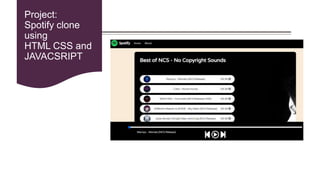
Project:
Spotify clone
using
HTML CSS and
JAVACSRIPT
CONCLUSION
 In conclusion, I can say that this training was a great experience. Thanks to this
training, I acquired deeper knowledge concerning my technical skills, but I also
personally benefited.
 There are huge opportunities available for the students who want to work in this field.
Many private and public organizations hire web designer for their online work and
website development. With the rapid advent of online industry, the demand of web
development professionals is increasing, and this has created a huge job opportunity
for the aspirants in the upcoming days

Presentation 5 (1).pptx

  • 1.
    WEB DEVELOPMENT Presented By RimjhimShukla 19001390179 Branch -IT
  • 2.
    ABOUT TRAINING  Modeof training : Online from Internshala  Start date :14 May 2022  End date:14 July 2022  Duration : eight weeks
  • 4.
    CONTENT  What isweb development  Front end development  Front end development Technology  Back end development  Back end development technology  Project  Conclusion
  • 5.
    What is webdevelopment  Web development refers to the creating, building, and maintaining of websites. It includes aspects such as web design, web publishing, web programming, and database management. It is the creation of an application that works over the internet.  Web: It refers to websites, web pages or anything that works over the internet.  Development: It refers to building the application from scratch.  Example of web applications are social networking sites like facebook or e commerce sites like amazon.  There are two broad division of web development – front-end development and back- end development .
  • 6.
    Front end developmenttechnology  HTML :stands for Hyper Text Markup Language. It is used to design web pages using a markup language. HTML is the combination of Hypertext and Markup language. Hypertext defines the link between web pages. A markup language is used to define the text document within the tag which defines the structure of web pages. This language is used to annotate (make notes for the computer) text so that a machine can understand it and manipulate text accordingly. Most markup languages (e.g. HTML) are human-readable. The language uses tags to define what manipulation has to be done on the text.  CSS: Cascading Style Sheets, fondly referred to as CSS, is a simply designed language intended to simplify the process of making web pages presentable. CSS allows you to apply styles to web pages. More importantly, CSS enables you to do this independent of the HTML that makes up each web page. It describes how a webpage should look: it prescribes colors, fonts, spacing, and much more. In short, you can make your website look however you want. CSS lets developers and designers define how it behaves, including how elements are positioned in the browser.  BOOTSTRAP: Bootstrap is a free and open-source tool collection for creating responsive websites and web applications. It is the most popular HTML, CSS, and JavaScript framework for developing responsive, mobile-first websites. It solves many problems which we had once, one of which is the cross-browser compatibility issue. Nowadays, the websites are perfect for all the browsers (IE, Firefox, and Chrome) and for all sizes of screens (Desktop, Tablets, Phablets, and Phones).
  • 7.
    Back end development Back-end development means working on server-side software, which focuses on everything you can’t see on a website. Back-end developers ensure the website performs correctly, focusing on databases, back-end logic, application programming interface (APIs), architecture, and servers. They use code that helps browsers communicate with databases, store, understand, and delete data.  Back end development technology : SQL and PHP
  • 8.
    Back end developmenttechnologies  SQL  SQL stands for Structured Query Language. It is used for storing and managing data in relational database management system (RDMS).  It is a standard language for Relational Database System. It enables a user to create, read, update and delete relational databases and tables.  All the RDBMS like MySQL, Informix, Oracle, MS Access and SQL Server use SQL as their standard database language.  PHP  PHP stands for Hypertext Preprocessor.  PHP is an interpreted language, i.e., there is no need for compilation.  PHP is faster than other scripting languages, for example, ASP and JSP.  PHP is a server-side scripting language, which is used to manage the dynamic content of the website.  PHP can be embedded into HTML.  PHP is an object-oriented language.
  • 9.
  • 10.
    CONCLUSION  In conclusion,I can say that this training was a great experience. Thanks to this training, I acquired deeper knowledge concerning my technical skills, but I also personally benefited.  There are huge opportunities available for the students who want to work in this field. Many private and public organizations hire web designer for their online work and website development. With the rapid advent of online industry, the demand of web development professionals is increasing, and this has created a huge job opportunity for the aspirants in the upcoming days

Editor's Notes

  • #2 NOTE: Want a different image on this slide? Select the picture and delete it. Now click the Pictures icon in the placeholder to insert your own image.