VACCINE DEVELOPMENT
• Vaccination has improved the quality of life for many, and serious diseases like
smallpox have been eliminated. As vaccine technology advances, researchers can
develop better and safer vaccines.
• Vaccine development is the process of creating a vaccine that can help protect
individuals from a particular infectious disease, this process is often long and
cumbersome, spanning over 10-15 years of laboratory research.
• It involves several stages of research, testing, and regulatory approval before the
vaccine can be made available for widespread use.
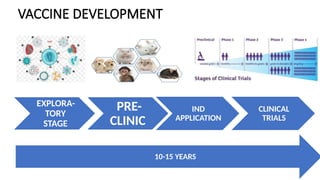
VACCINE DEVELOPMENT
EXPLORA-
TORY
STAGE
PRE-
CLINIC
IND
APPLICATION
CLINICAL
TRIALS
10-15 YEARS
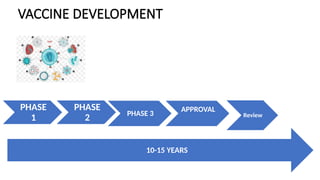
VACCINE DEVELOPMENT
PHASE 3
APPROVAL
10-15 YEARS
PHASE
1
PHASE
2 Review
VACCINE DEVELOPMENT CONT....
• Vaccine development process usually starts with laboratory research also known as the
exploratory Stage to identify potential vaccine candidates that can elicit an immune response
against the targeted pathogen.
• Such as the usage of the initially mentioned types of vaccines. This stage involves basic
laboratory research and often lasts 2-4 years.
• (B). Preclinical Evaluation : In preclinical evaluation, the safety and efficacy of a vaccine
candidate are tested using in vitro and animal models before moving on to human clinical trials.
• Animal models such as mice, rats, rabbits, and non-human primates are commonly used to
test the immunogenicity, efficacy, and safety of vaccines.
IDN APPLICATION
• IND stands for Investigational New Drug, and an IND application is a request to the
regulatory authority (such as the FDA in the United States) to allow the testing of a
new drug or vaccine in humans.
• A sponsor, usually a private company, submits an application for an Investigational
New Drug (IND) to the U.S. Food and Drug Administration.
• The IND application includes detailed information on the drug or vaccine, such as its
composition, manufacturing process, proposed clinical trials, and preclinical studies
conducted to assess its safety and efficacy. The FDA has 30 days to approve the
application. Once the IND application has been approved, the vaccine is subject to
three phases of testing.
CLINICAL EVALUATION
• Involves testing the vaccine candidate in human volunteers through a series of
clinical trials, namely Phase I, II, and III trials, to assess its safety and efficacy.
• During these trials, study designs or techniques can be employed within any of
the phases mentioned. Study designs includes (Double-blind and single-blind
randomized controlled trials )
• Phase I: trials involve a small number of healthy volunteers and primarily focuses
on evaluating the safety and immunogenicity of the vaccine candidate.
• Phase II :trials involve a larger group of volunteers and assess the optimal dose,
schedule, and formulation of the vaccine candidate, as well as its safety and
immunogenicity.
CLINICAL EVALUATION CONT....
• Phase III: trials involve a large-scale clinical trial with thousands of
volunteers and aim to evaluate the efficacy and safety of the vaccine
candidate in preventing the disease it is designed to protect against.
C. Manufacturing and Regulatory Review.
• After successful completion of clinical trials, the vaccine candidate moves into
the manufacturing and regulatory review phase
• Good Manufacturing Practices (GMP) are followed to ensure the safety, quality,
and consistency of the vaccine product during the manufacturing process.
CLINICAL EVALUATION CONT....
• Regulatory review is conducted by government agencies such as the
US (FDA) or SAHPRA to evaluate the safety, efficacy, and quality of the
vaccine product before it can be approved for use.
• If the vaccine product meets regulatory standards and is approved for
use, it can then be distributed to the public through vaccination
campaigns or immunization programs.
VACCINE EVALUATION CONT....
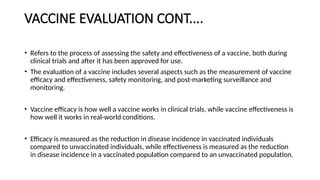
• Refers to the process of assessing the safety and effectiveness of a vaccine, both during
clinical trials and after it has been approved for use.
• The evaluation of a vaccine includes several aspects such as the measurement of vaccine
efficacy and effectiveness, safety monitoring, and post-marketing surveillance and
monitoring.
• Vaccine efficacy is how well a vaccine works in clinical trials, while vaccine effectiveness is
how well it works in real-world conditions.
• Efficacy is measured as the reduction in disease incidence in vaccinated individuals
compared to unvaccinated individuals, while effectiveness is measured as the reduction
in disease incidence in a vaccinated population compared to an unvaccinated population.
VACCINE EVALUATION CONT...
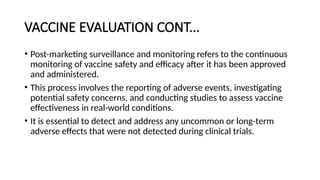
• Post-marketing surveillance and monitoring refers to the continuous
monitoring of vaccine safety and efficacy after it has been approved
and administered.
• This process involves the reporting of adverse events, investigating
potential safety concerns, and conducting studies to assess vaccine
effectiveness in real-world conditions.
• It is essential to detect and address any uncommon or long-term
adverse effects that were not detected during clinical trials.

Presentation (2).pptx....................

  • 1.
    VACCINE DEVELOPMENT • Vaccinationhas improved the quality of life for many, and serious diseases like smallpox have been eliminated. As vaccine technology advances, researchers can develop better and safer vaccines. • Vaccine development is the process of creating a vaccine that can help protect individuals from a particular infectious disease, this process is often long and cumbersome, spanning over 10-15 years of laboratory research. • It involves several stages of research, testing, and regulatory approval before the vaccine can be made available for widespread use.
  • 2.
  • 3.
    VACCINE DEVELOPMENT PHASE 3 APPROVAL 10-15YEARS PHASE 1 PHASE 2 Review
  • 4.
    VACCINE DEVELOPMENT CONT.... •Vaccine development process usually starts with laboratory research also known as the exploratory Stage to identify potential vaccine candidates that can elicit an immune response against the targeted pathogen. • Such as the usage of the initially mentioned types of vaccines. This stage involves basic laboratory research and often lasts 2-4 years. • (B). Preclinical Evaluation : In preclinical evaluation, the safety and efficacy of a vaccine candidate are tested using in vitro and animal models before moving on to human clinical trials. • Animal models such as mice, rats, rabbits, and non-human primates are commonly used to test the immunogenicity, efficacy, and safety of vaccines.
  • 5.
    IDN APPLICATION • INDstands for Investigational New Drug, and an IND application is a request to the regulatory authority (such as the FDA in the United States) to allow the testing of a new drug or vaccine in humans. • A sponsor, usually a private company, submits an application for an Investigational New Drug (IND) to the U.S. Food and Drug Administration. • The IND application includes detailed information on the drug or vaccine, such as its composition, manufacturing process, proposed clinical trials, and preclinical studies conducted to assess its safety and efficacy. The FDA has 30 days to approve the application. Once the IND application has been approved, the vaccine is subject to three phases of testing.
  • 6.
    CLINICAL EVALUATION • Involvestesting the vaccine candidate in human volunteers through a series of clinical trials, namely Phase I, II, and III trials, to assess its safety and efficacy. • During these trials, study designs or techniques can be employed within any of the phases mentioned. Study designs includes (Double-blind and single-blind randomized controlled trials ) • Phase I: trials involve a small number of healthy volunteers and primarily focuses on evaluating the safety and immunogenicity of the vaccine candidate. • Phase II :trials involve a larger group of volunteers and assess the optimal dose, schedule, and formulation of the vaccine candidate, as well as its safety and immunogenicity.
  • 7.
    CLINICAL EVALUATION CONT.... •Phase III: trials involve a large-scale clinical trial with thousands of volunteers and aim to evaluate the efficacy and safety of the vaccine candidate in preventing the disease it is designed to protect against. C. Manufacturing and Regulatory Review. • After successful completion of clinical trials, the vaccine candidate moves into the manufacturing and regulatory review phase • Good Manufacturing Practices (GMP) are followed to ensure the safety, quality, and consistency of the vaccine product during the manufacturing process.
  • 8.
    CLINICAL EVALUATION CONT.... •Regulatory review is conducted by government agencies such as the US (FDA) or SAHPRA to evaluate the safety, efficacy, and quality of the vaccine product before it can be approved for use. • If the vaccine product meets regulatory standards and is approved for use, it can then be distributed to the public through vaccination campaigns or immunization programs.
  • 9.
    VACCINE EVALUATION CONT.... •Refers to the process of assessing the safety and effectiveness of a vaccine, both during clinical trials and after it has been approved for use. • The evaluation of a vaccine includes several aspects such as the measurement of vaccine efficacy and effectiveness, safety monitoring, and post-marketing surveillance and monitoring. • Vaccine efficacy is how well a vaccine works in clinical trials, while vaccine effectiveness is how well it works in real-world conditions. • Efficacy is measured as the reduction in disease incidence in vaccinated individuals compared to unvaccinated individuals, while effectiveness is measured as the reduction in disease incidence in a vaccinated population compared to an unvaccinated population.
  • 10.
    VACCINE EVALUATION CONT... •Post-marketing surveillance and monitoring refers to the continuous monitoring of vaccine safety and efficacy after it has been approved and administered. • This process involves the reporting of adverse events, investigating potential safety concerns, and conducting studies to assess vaccine effectiveness in real-world conditions. • It is essential to detect and address any uncommon or long-term adverse effects that were not detected during clinical trials.