LATE SHRI PUNARAM NISHAD COLLEGE
OF FISHERIES, KAWARDHA (C.G.)
An Assignment On
CCRF :- Code of Conduct for
Responsible Fisheries
Course Title :- Fish Population Dynamics and Stock
Assessment
Course Code :- FRM 321 3(2+1)
Submitted By :-
Khemkumari Sonwani
B.F.Sc. 3 Year 2 Semester
Roll No. :- 202003040
Submitted To :-
Miss Deepika Korram
Department of Fisheries
Resource Management
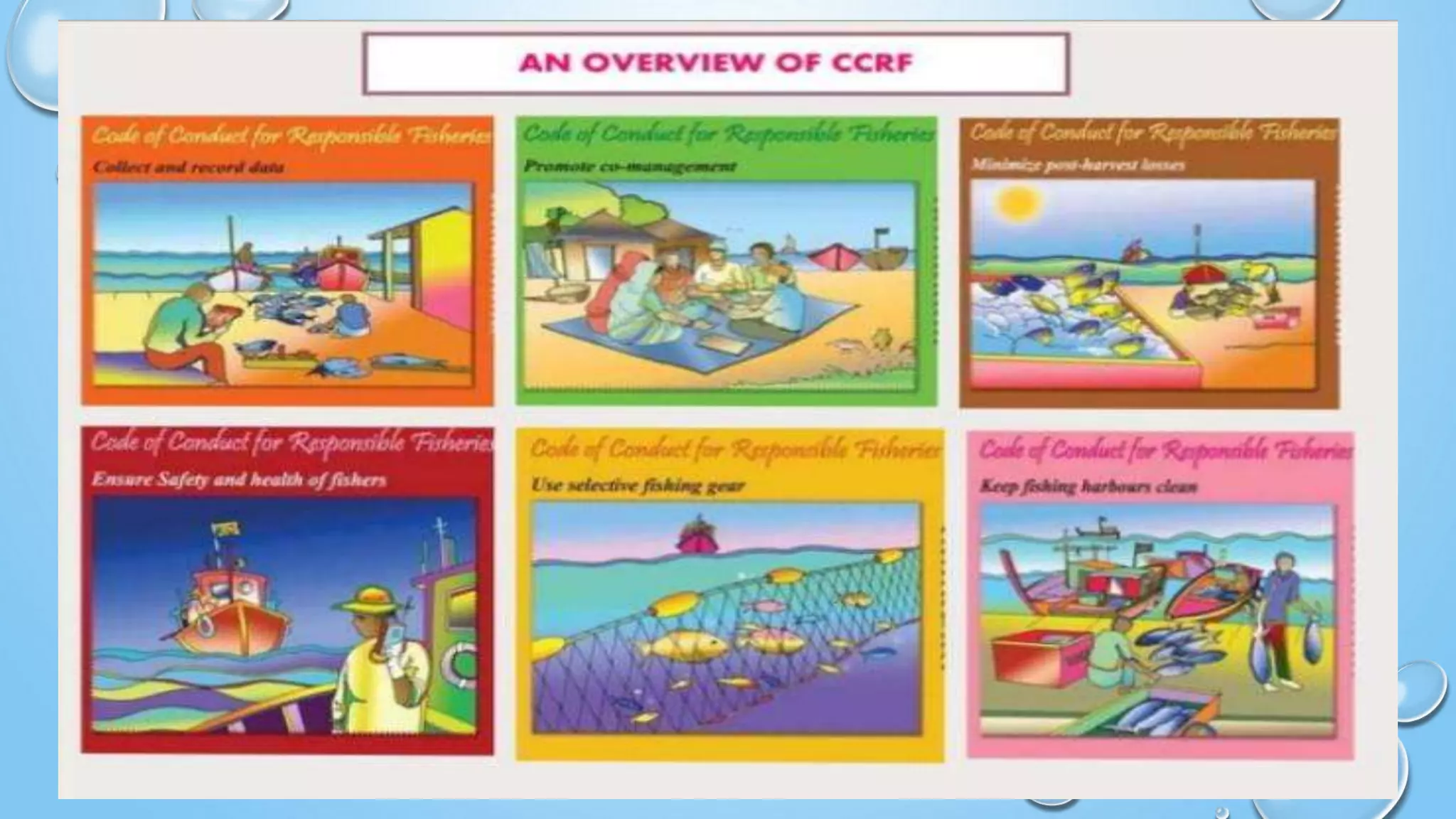
CCRF :- Code of Conduct
for Responsible Fisheries
CODE OF CONDUCT
Introduction
A code of conduct is a set of rules
outlining the norms, rules, and
responsibilities of, and or proper practices
for, an individual.
Code of Conduct :-
The Code describes :-
• How fisheries should be managed
responsibly
• Importance of countries cooperating with
one another in all aspects of fisheries
• How fishing operations themselves should
be conducted
Origin
• FAO Committee of Fisheries meeting 1991: call for
more responsible practice, better management
• 1992 Cancun Conference on Responsible Fishing called
on FAO to prepare a Code of Conduct
• Technical Consultations 1992-1995 lead to adoption
of CCRF by FAO Conference Member Governments
• The Code, which was unanimously adopted on 31
October 1995 by the FAO Conference, provides a
necessary framework for national and international
efforts to ensure sustainable exploitation of aquatic
living resources in harmony with the environment.
CCRF: CODE
The code is a set of guidelines (do's and
don'ts) to be voluntarily implemented for
conducting fishing, processing and trade
activities in a responsible manner so as to
make them sustainable in accordance with
relevant international laws for the benefit of
present & future generations.
Goals
• sustainable benefits from fisheries in terms of
food, employment, trade and economic well-
being for people throughout the world
• establish principles and standards applicable to
the conservation, management and development
of all fisheries
Structure
Art. 1: Nature and scope
Art. 2: Objectives of the
Code
Art. 3: Relationship with
other International
Instruments
Art. 4: Implementation,
Monitoring and Updating
Art. 5: Special Requirements
of Developing Countries
Art. 7: Fisheries management
Art. 8: Fishing Operations
Art. 9: Aquaculture
Development
Art. 10: Integration of
Fisheries into Coastal Area
Management
Art. 11: Post-Harvest
Practices and Trade
Art. 12: Fisheries Research
Article-1. Nature and scope of the Code
• Code is voluntary.
• Code is global in scope.
• The Code provides principles and standards
applicable to the conservation, management and
development of all fisheries.
• It also covers the capture, processing and trade of
fish and fishery products, fishing operations,
aquaculture, fisheries research and the integration
of fisheries into coastal area management.
• The term fisheries applies equally to capture
ARTICLE 2 – OBJECTIVES OF THE CODE
• Provide guidance which may be used where
appropriate in the formulation and
implementation of international agreements.
• Facilitate and promote technical, financial and
other cooperation in conservation of fisheries.
• Promote the contribution of fisheries to food
security and food quality.
• Promote protection of living aquatic resources
and their environments.
• Promote the trade of fish and fishery
products.
• Promote research on fisheries.
• Provide standards of conduct for all persons
involved in the fisheries sector.
Article-3: Relationship with other
international instruments
• The Code is to be interpreted and applied in
conformity with the relevant rules of international
law, as reflected in the United Nations Convention
on the Law of the Sea(UNCLOS) 1982
• Cancun Conference 1992
• Agreement to Promote Compliance with
International Conservation and Management
Measures by Fishing Vessels on the High Seas.
• International Parties
Article-4: Implementation, monitoring
and updating
• All members and non-members of FAO, fishing
entities and relevant sub-regional, regional and
global organizations, whether governmental or
non-governmental, should collaborate in the
fulfillment and implementation of the objectives
and principles contained in this Code.
• FAO, will monitor the application and
implementation of the Code and its effects on
fisheries and the Secretariat will report
Article-5:
Special requirements of developing
countries
• States, intergovernmental and non-governmental
organizations and financial institutions should
work for the adoption of measures to address the
needs of developing countries, especially in the
areas of financial and technical assistance,
technology transfer, training and scientific
cooperation and in enhancing their ability to
develop their own fisheries as well as to
participate in high seas fisheries, including access
Article-6: General principles
• States and users of living aquatic resources
should conserve aquatic ecosystems
• food security, poverty alleviation and
sustainable development.
• prevent overfishing and excess fishing
capacity
• reduce waste and minimize negative impacts
on the environment.
Article-7: Fisheries management
• Conservation and sustainable use of fisheries
resources.
• prevent or eliminate excess fishing
capacity.
• Promote international cooperation
• Biodiversity of aquatic habitats and ecosystems
is conserved and endangered species are
protected;
• Studies should be promoted which provide an
understanding of the costs, benefits and effects
of alternative management.
Article8: Fishing operations
• Fishing activities
• Fishing gear selectivity
• Energy optimization
• Protection of the
atmosphere
• Protection of the aquatic environment
Article- 9 :Aquaculture development
• establish, maintain and develop an appropriate legal
and administrative framework which facilitates the
development of responsible aquaculture.
• Use of aquatic genetic resources for the purposes
of aquaculture including culture-based fisheries:
• States should protect transboundary aquatic
ecosystems by supporting responsible
aquaculture practices
Article-10:Integration of fisheries into
coastal area management
• States should ensure an appropriate policy, legal
and institutional framework is adopted to achieve
the sustainable and integrated use of the
resources,
• Institutional framework
• Policy measures
• Regional cooperation
• Implementation of Coastal Area
Management
Article-11: Post-harvest practices and
trade
• Responsible fish utilization
-(FAO/WHO Codex Alimentarius
Commission and other relevant organizations or
arrangements)
• Responsible international trade
-(WTO Agreements)
• Laws and regulations relating to fish
trade
Article-12: Fisheries research
• States should establish an appropriate institutional
framework to determine the applied research which
is required and its proper use.
• States should support and strengthen national
research capabilities.
• States, as appropriate in cooperation with relevant
international organisations, should encourage
research.
• States should investigate and document
traditional fisheries knowledge and
technologies.
Thank you

Presentation (17).pptx

  • 1.
    LATE SHRI PUNARAMNISHAD COLLEGE OF FISHERIES, KAWARDHA (C.G.) An Assignment On CCRF :- Code of Conduct for Responsible Fisheries Course Title :- Fish Population Dynamics and Stock Assessment Course Code :- FRM 321 3(2+1) Submitted By :- Khemkumari Sonwani B.F.Sc. 3 Year 2 Semester Roll No. :- 202003040 Submitted To :- Miss Deepika Korram Department of Fisheries Resource Management
  • 2.
    CCRF :- Codeof Conduct for Responsible Fisheries
  • 3.
    CODE OF CONDUCT Introduction Acode of conduct is a set of rules outlining the norms, rules, and responsibilities of, and or proper practices for, an individual. Code of Conduct :-
  • 4.
    The Code describes:- • How fisheries should be managed responsibly • Importance of countries cooperating with one another in all aspects of fisheries • How fishing operations themselves should be conducted
  • 5.
    Origin • FAO Committeeof Fisheries meeting 1991: call for more responsible practice, better management • 1992 Cancun Conference on Responsible Fishing called on FAO to prepare a Code of Conduct • Technical Consultations 1992-1995 lead to adoption of CCRF by FAO Conference Member Governments • The Code, which was unanimously adopted on 31 October 1995 by the FAO Conference, provides a necessary framework for national and international efforts to ensure sustainable exploitation of aquatic living resources in harmony with the environment.
  • 6.
    CCRF: CODE The codeis a set of guidelines (do's and don'ts) to be voluntarily implemented for conducting fishing, processing and trade activities in a responsible manner so as to make them sustainable in accordance with relevant international laws for the benefit of present & future generations.
  • 7.
    Goals • sustainable benefitsfrom fisheries in terms of food, employment, trade and economic well- being for people throughout the world • establish principles and standards applicable to the conservation, management and development of all fisheries
  • 8.
    Structure Art. 1: Natureand scope Art. 2: Objectives of the Code Art. 3: Relationship with other International Instruments Art. 4: Implementation, Monitoring and Updating Art. 5: Special Requirements of Developing Countries Art. 7: Fisheries management Art. 8: Fishing Operations Art. 9: Aquaculture Development Art. 10: Integration of Fisheries into Coastal Area Management Art. 11: Post-Harvest Practices and Trade Art. 12: Fisheries Research
  • 9.
    Article-1. Nature andscope of the Code • Code is voluntary. • Code is global in scope. • The Code provides principles and standards applicable to the conservation, management and development of all fisheries. • It also covers the capture, processing and trade of fish and fishery products, fishing operations, aquaculture, fisheries research and the integration of fisheries into coastal area management. • The term fisheries applies equally to capture
  • 10.
    ARTICLE 2 –OBJECTIVES OF THE CODE • Provide guidance which may be used where appropriate in the formulation and implementation of international agreements. • Facilitate and promote technical, financial and other cooperation in conservation of fisheries. • Promote the contribution of fisheries to food security and food quality. • Promote protection of living aquatic resources and their environments.
  • 11.
    • Promote thetrade of fish and fishery products. • Promote research on fisheries. • Provide standards of conduct for all persons involved in the fisheries sector.
  • 12.
    Article-3: Relationship withother international instruments • The Code is to be interpreted and applied in conformity with the relevant rules of international law, as reflected in the United Nations Convention on the Law of the Sea(UNCLOS) 1982 • Cancun Conference 1992 • Agreement to Promote Compliance with International Conservation and Management Measures by Fishing Vessels on the High Seas. • International Parties
  • 13.
    Article-4: Implementation, monitoring andupdating • All members and non-members of FAO, fishing entities and relevant sub-regional, regional and global organizations, whether governmental or non-governmental, should collaborate in the fulfillment and implementation of the objectives and principles contained in this Code. • FAO, will monitor the application and implementation of the Code and its effects on fisheries and the Secretariat will report
  • 14.
    Article-5: Special requirements ofdeveloping countries • States, intergovernmental and non-governmental organizations and financial institutions should work for the adoption of measures to address the needs of developing countries, especially in the areas of financial and technical assistance, technology transfer, training and scientific cooperation and in enhancing their ability to develop their own fisheries as well as to participate in high seas fisheries, including access
  • 15.
    Article-6: General principles •States and users of living aquatic resources should conserve aquatic ecosystems • food security, poverty alleviation and sustainable development. • prevent overfishing and excess fishing capacity • reduce waste and minimize negative impacts on the environment.
  • 16.
    Article-7: Fisheries management •Conservation and sustainable use of fisheries resources. • prevent or eliminate excess fishing capacity. • Promote international cooperation • Biodiversity of aquatic habitats and ecosystems is conserved and endangered species are protected; • Studies should be promoted which provide an understanding of the costs, benefits and effects of alternative management.
  • 17.
    Article8: Fishing operations •Fishing activities • Fishing gear selectivity • Energy optimization • Protection of the atmosphere • Protection of the aquatic environment
  • 18.
    Article- 9 :Aquaculturedevelopment • establish, maintain and develop an appropriate legal and administrative framework which facilitates the development of responsible aquaculture. • Use of aquatic genetic resources for the purposes of aquaculture including culture-based fisheries: • States should protect transboundary aquatic ecosystems by supporting responsible aquaculture practices
  • 19.
    Article-10:Integration of fisheriesinto coastal area management • States should ensure an appropriate policy, legal and institutional framework is adopted to achieve the sustainable and integrated use of the resources, • Institutional framework • Policy measures • Regional cooperation • Implementation of Coastal Area Management
  • 20.
    Article-11: Post-harvest practicesand trade • Responsible fish utilization -(FAO/WHO Codex Alimentarius Commission and other relevant organizations or arrangements) • Responsible international trade -(WTO Agreements) • Laws and regulations relating to fish trade
  • 21.
    Article-12: Fisheries research •States should establish an appropriate institutional framework to determine the applied research which is required and its proper use. • States should support and strengthen national research capabilities. • States, as appropriate in cooperation with relevant international organisations, should encourage research. • States should investigate and document traditional fisheries knowledge and technologies.
  • 24.