THE EDWARDIAN AGE
Queen Victoria Edward VII
He was able to assist in foreign policy
negotiations and visit to Paris helped
pave the way for the Anglo French
Entente Cordiale (April 1904).
In 1902 he founded the Order of
Merit to reward those who
distinguished themselves in science,
art or lierature.
In 1906 the Liberals won the general
election and created a welfare state:
national insurance and old-age
pensions were introducted.
SOCIAL DISORDER:
The Edwardian period was a time of
industrial unrest, strikes and violences
1.STRIKES​
Meant to be weapons against the
government, were called because of
high prices and low wages.
2. SUFFRAGETTES​
They were educated ladies who had
been arguing in favour of voting rights
for women since the 1860s.
Mrs Pankhurst founded the Woman's
Social and Political Union.
THE EDWARDIAN AGE
1910: succeded by
Where he to be judged by
posterity, he would prove
to be a model monarch by
carring out his royal
responsabilities.
George V
Start in 1914
when the Austrian Archduke Franz
Ferdinand was assassinated in
Sarajevo, moreover when Germany
invaded Belgium, a neutral territory, in
order to attack France
The power
that fought the war were the Central
European Powers and the Triple
Entente.
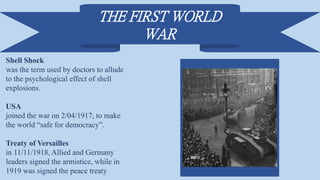
THE FIRST WORLD
WAR
Shell Shock
was the term used by doctors to allude
to the psychological effect of shell
explosions.
USA
joined the war on 2/04/1917, to make
the world “safe for democracy”.
Treaty of Versailles
in 11/11/1918, Allied and Germany
leaders signed the armistice, while in
1919 was signed the peace treaty
THE FIRST WORLD
WAR
A DEEP CULTURAL CRISIS
(1880 1910)
• The positivistic faith in progress and science had led people to believe that all human
misery would be swept away;
• Stability and prosperity proved to belong only to a privileged class;
• Consciences were haunted by the atrocities of the war;
• Lose of valors;
• An increasing feeling of frustration;
• Dissolution of the Empire into a ‘Commonwealth of Nations’.
FIRST WORLD WAR (1914-1918)
A DEEP CULTURAL CRISIS
(1880 1910)
• Nothing seemed to be right or certain;
• New views of man (FREUD) and universe
emerged.
ALBERT EINSTEIN (1879-1955):
• 1905 «Theory of special ralativity»
• Changed the concepts of time and space
ALBERT EINSTEIN
Three Essays on the Theory of
Sexuality
● was published in 1905;
● the text changes the way to people
thought;
● the most important is the “The
transformation of Puberty”;
● he discussed sexuality in
Childhood;
FREUD
The Psyche
● the ID is the set of instincual
impulses;
● the EGO is the realistic part;
● the SUPEREGO has a critical role;
● he explained the development of
the human psyche;
● he influenced a lot of artists;
FREUD

presentation

  • 1.
    THE EDWARDIAN AGE QueenVictoria Edward VII He was able to assist in foreign policy negotiations and visit to Paris helped pave the way for the Anglo French Entente Cordiale (April 1904). In 1902 he founded the Order of Merit to reward those who distinguished themselves in science, art or lierature. In 1906 the Liberals won the general election and created a welfare state: national insurance and old-age pensions were introducted.
  • 2.
    SOCIAL DISORDER: The Edwardianperiod was a time of industrial unrest, strikes and violences 1.STRIKES​ Meant to be weapons against the government, were called because of high prices and low wages. 2. SUFFRAGETTES​ They were educated ladies who had been arguing in favour of voting rights for women since the 1860s. Mrs Pankhurst founded the Woman's Social and Political Union. THE EDWARDIAN AGE 1910: succeded by Where he to be judged by posterity, he would prove to be a model monarch by carring out his royal responsabilities. George V
  • 3.
    Start in 1914 whenthe Austrian Archduke Franz Ferdinand was assassinated in Sarajevo, moreover when Germany invaded Belgium, a neutral territory, in order to attack France The power that fought the war were the Central European Powers and the Triple Entente. THE FIRST WORLD WAR
  • 4.
    Shell Shock was theterm used by doctors to allude to the psychological effect of shell explosions. USA joined the war on 2/04/1917, to make the world “safe for democracy”. Treaty of Versailles in 11/11/1918, Allied and Germany leaders signed the armistice, while in 1919 was signed the peace treaty THE FIRST WORLD WAR
  • 5.
    A DEEP CULTURALCRISIS (1880 1910) • The positivistic faith in progress and science had led people to believe that all human misery would be swept away; • Stability and prosperity proved to belong only to a privileged class; • Consciences were haunted by the atrocities of the war; • Lose of valors; • An increasing feeling of frustration; • Dissolution of the Empire into a ‘Commonwealth of Nations’. FIRST WORLD WAR (1914-1918)
  • 6.
    A DEEP CULTURALCRISIS (1880 1910) • Nothing seemed to be right or certain; • New views of man (FREUD) and universe emerged. ALBERT EINSTEIN (1879-1955): • 1905 «Theory of special ralativity» • Changed the concepts of time and space ALBERT EINSTEIN
  • 7.
    Three Essays onthe Theory of Sexuality ● was published in 1905; ● the text changes the way to people thought; ● the most important is the “The transformation of Puberty”; ● he discussed sexuality in Childhood; FREUD
  • 8.
    The Psyche ● theID is the set of instincual impulses; ● the EGO is the realistic part; ● the SUPEREGO has a critical role; ● he explained the development of the human psyche; ● he influenced a lot of artists; FREUD