MINISTRY OF HEALTHAND SANITATION
SCHOOL OF CLINICAL SCIENCES MAKENI
MAKAMBO
PRESENTATION ON SOCIOLOGY
TOPIC:
G2. Modern And Traditional Health Care Delivery
LECTURER: Mrs. Florence Kadiatu Yagbaji
2.
PRESENTERS
1. Fatima HGKanu 25069
2. James Ibrahim Tarawalie 25117
3. Saudatu sesay 25114
4. Abdanny Sandy Vao 25125
5. Admire Mariatu Sandy 25108
6. Abu S Conteh 25023
7. Mohamed Sanie Kamara 25058
8. Kadiatu G Bangura 25015
9. Kamara Musa Edward:25052
10. Clement Francis A25021
3.
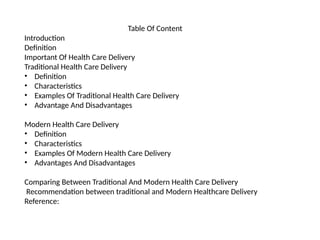
Table Of Content
Introduction
Definition
ImportantOf Health Care Delivery
Traditional Health Care Delivery
• Definition
• Characteristics
• Examples Of Traditional Health Care Delivery
• Advantage And Disadvantages
Modern Health Care Delivery
• Definition
• Characteristics
• Examples Of Modern Health Care Delivery
• Advantages And Disadvantages
Comparing Between Traditional And Modern Health Care Delivery
Recommendation between traditional and Modern Healthcare Delivery
Reference:
4.
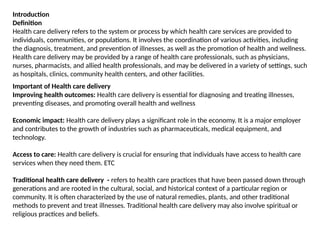
Introduction
Definition
Health care deliveryrefers to the system or process by which health care services are provided to
individuals, communities, or populations. It involves the coordination of various activities, including
the diagnosis, treatment, and prevention of illnesses, as well as the promotion of health and wellness.
Health care delivery may be provided by a range of health care professionals, such as physicians,
nurses, pharmacists, and allied health professionals, and may be delivered in a variety of settings, such
as hospitals, clinics, community health centers, and other facilities.
Important of Health care delivery
Improving health outcomes: Health care delivery is essential for diagnosing and treating illnesses,
preventing diseases, and promoting overall health and wellness
Economic impact: Health care delivery plays a significant role in the economy. It is a major employer
and contributes to the growth of industries such as pharmaceuticals, medical equipment, and
technology.
Access to care: Health care delivery is crucial for ensuring that individuals have access to health care
services when they need them. ETC
Traditional health care delivery - refers to health care practices that have been passed down through
generations and are rooted in the cultural, social, and historical context of a particular region or
community. It is often characterized by the use of natural remedies, plants, and other traditional
methods to prevent and treat illnesses. Traditional health care delivery may also involve spiritual or
religious practices and beliefs.
5.
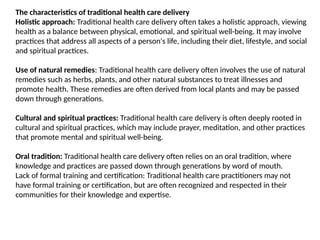
The characteristics oftraditional health care delivery
Holistic approach: Traditional health care delivery often takes a holistic approach, viewing
health as a balance between physical, emotional, and spiritual well-being. It may involve
practices that address all aspects of a person's life, including their diet, lifestyle, and social
and spiritual practices.
Use of natural remedies: Traditional health care delivery often involves the use of natural
remedies such as herbs, plants, and other natural substances to treat illnesses and
promote health. These remedies are often derived from local plants and may be passed
down through generations.
Cultural and spiritual practices: Traditional health care delivery is often deeply rooted in
cultural and spiritual practices, which may include prayer, meditation, and other practices
that promote mental and spiritual well-being.
Oral tradition: Traditional health care delivery often relies on an oral tradition, where
knowledge and practices are passed down through generations by word of mouth.
Lack of formal training and certification: Traditional health care practitioners may not
have formal training or certification, but are often recognized and respected in their
communities for their knowledge and expertise.
6.
Examples of traditionalhealth care delivery
There are many examples of traditional health care delivery practices, which can vary
widely depending on cultural and geographic factors. Some examples include:
Traditional Chinese Medicine: This practice is based on the idea of balancing yin and yang,
and involves the use of acupuncture, herbal remedies, and other therapies to treat a
variety of illnesses and conditions.
Native American medicine: This practice involves the use of natural remedies, plants, and
other therapies to promote health and healing. It often involves the use of traditional
healers and spiritual practices.
Homeopathy: This practice involves the use of highly diluted natural substances to
stimulate the body's healing abilities.
Unani medicine: This practice originated in ancient Greece and was later adopted by
Islamic scholars. It involves the use of natural remedies, massage, and other therapies to
promote health and treat illnesses.
It is important to note that while these practices can be effective in promoting health and
treating illnesses, not all traditional health care delivery practices are safe or effective. It is
important to consult with a qualified health care professional before using any traditional
health care practices.
7.
Advantages of Modernhealth care delivery :
• Access to advanced medical technology: modern healthcare delivery provides access to
advanced medical technology that enables healthcare providers to diagnose and treat
medical conditions more accurately and efficiently
• Improved patient outcomes: modern healthcare delivery systems have led to improved
patient outcomes, as medical professionals have access to the latest research and
technologies that enable them to provide better care.
• Better communication: modern healthcare delivery systems make it easier fro
healthcare providers to communicate with each other, resulting in better coordination
of care and improved patient outcomes.
Disadvantages:
• Cost: the cost of modern healthcare delivery is often high, making it difficult for many
people to access the care they need.
• Lack of accessibility: Despite the advancements made in modern healthcare delivery,
there are still many areas where people have limited access to healthcare services.
• Overreliance on technology: while technology has enabled modern healthcare delivery,
there is a risk of over-reliance on technology that can lead to medical errors or reduced
patient care.
8.
Definition of Modernhealthcare delivery
Modern healthcare delivery - refers to the contemporary systems, processes, and
technologies that are used to provide medical care and services to patients. It includes
the use of advanced medical equipment and technology, electronic health records (EHRs),
and telemedicine to improve the quality and accessibility of healthcare services.
Modern healthcare delivery also emphasizes a patient-centered approach that prioritizes
the patient's needs and preferences, while also considering the cost-effectiveness of care.
This approach often involves multidisciplinary teams of healthcare professionals working
together to provide comprehensive and coordinated care that addresses the physical,
emotional, and social needs of patients.
Additionally, modern healthcare delivery also focuses on disease prevention and health
promotion, using strategies such as population health management and community
health initiatives to improve the overall health of populations. Overall, modern healthcare
delivery aims to provide high-quality, accessible, and affordable care that meets the
diverse needs of patients and communities.
9.
Characteristics of modernhealth care delivery
Modern healthcare delivery is characterized by several key features that distinguish it from
traditional healthcare delivery models. Some of the main characteristics of modern
healthcare delivery include:
Patient-centered care: Modern healthcare delivery prioritizes the needs and preferences
of patients, with a focus on providing individualized care that considers their unique
circumstances and values.
Multidisciplinary care teams: Modern healthcare delivery often involves teams of
healthcare professionals from multiple disciplines working together to provide coordinated
and comprehensive care to patients.
Technology-enabled care: Modern healthcare delivery relies heavily on advanced medical
equipment, electronic health records, telemedicine, and other technologies to enhance
the quality, safety, and efficiency of care.
Therapeutic communication: effective doctor patient communication is a central clinical
function in building a therapeutic doctor-patient relationship which is the heart and art of
medicine.
10.
Examples of modernhealth care delivery
Here are some examples of modern healthcare delivery models:
Telemedicine: This model involves the use of technology to provide remote medical
consultations and services, including video consultations, remote monitoring of vital
signs, and online prescription services.
Accountable care organizations (ACOs): ACOs are groups of healthcare providers who
work together to coordinate care for a specific population of patients. They are typically
paid based on the quality and outcomes of care, rather than on a fee-for-service basis.
Patient-centered medical homes (PCMHs): PCMHs are primary care practices that
provide comprehensive, coordinated, and patient-centered care to individuals and
families. They often involve teams of healthcare professionals, including primary care
physicians, nurses, social workers, and other specialists.
Retail clinics: Retail clinics are walk-in clinics located in retail stores and pharmacies that
provide basic medical services, such as vaccinations, health screenings, and treatment for
minor illnesses and injuries.
Community health centers: Community health centers are community-based clinics that
provide primary care and other medical services to underserved populations, including
low-income individuals and families, rural communities, and ethnic minorities.
Electronic health records (EHRs):
11.
Advantages
Advantages and disadvantagescan apply to many different things, so it's important to
specify what exactly you're looking for. However, here are some general advantages and
disadvantages that can apply to many situations:
• Can help you make informed decisions: By considering the advantages and
disadvantages of a situation, you can make a more informed decision about how to
proceed.
• Can help you anticipate potential problems: By identifying the potential
disadvantages of a situation, you can prepare for them and potentially avoid them
altogether.
Disadvantages:
• Can be time-consuming: Weighing the pros and cons of a situation can take a lot of
time, especially if you're dealing with a complex issue.
• Can be emotionally draining: If you're dealing with a difficult decision, constantly
considering the potential downsides can be emotionally draining.
• Can lead to indecision: In some cases, weighing the advantages and disadvantages
can lead to indecision, as it can be difficult to determine which outweighs the other.
Again, these are just general advantages and disadvantages. The specific advantages and
disadvantages of a situation will depend on the situation itself.
12.
Comparisons between traditionaland modern health care delivery
Traditional and modern healthcare delivery models differ in several ways. Here are
some key comparisons:
Patient-centered care: Traditional healthcare delivery models often focused on the
illness or disease rather than the patient as a whole, whereas modern healthcare
delivery models prioritize patient-centered care that considers the unique needs and
preferences of each individual.
Technology: Modern healthcare delivery models rely heavily on technology, such as
electronic health records, telemedicine, and other digital tools, to enhance the quality,
safety, and efficiency of care. Traditional healthcare delivery models often relied more on
face-to-face interactions between patients and healthcare providers.
Preventive care: Modern healthcare delivery models prioritize preventive care, focusing
on health promotion and disease prevention. Traditional healthcare delivery models
often focused more on treating acute illnesses and injuries.
Access to care: Traditional healthcare delivery models often suffered from limited access
to care, particularly for underserved populations. Modern healthcare delivery models
aim to improve access to care through telemedicine, community health centers, and
other initiatives.
13.
Recommendations between traditionaland modern health care delivery
Here are some recommendations regarding traditional and modern healthcare delivery:
Integrate technology: Incorporating technology in healthcare delivery can improve
efficiency, safety, and quality of care. Traditional healthcare delivery systems should
consider integrating modern digital tools, such as electronic health records and
telemedicine, to enhance patient care.
Focus on patient-centered care: Traditional healthcare delivery models should prioritize
patient-centered care, which considers the patient's unique needs and preferences, and
integrates them into the care plan.
Emphasize preventive care: Both traditional and modern healthcare delivery models
should prioritize preventive care, which focuses on health promotion and disease
prevention. This can help to reduce the burden of chronic diseases and improve overall
health outcomes.
Coordinate care: Both traditional and modern healthcare delivery models should
prioritize coordinated care, which involves multidisciplinary teams of healthcare
providers working together to provide comprehensive care to patients.
Increase access to care: Both traditional and modern healthcare delivery models should
prioritize increasing access to care, particularly for underserved populations. This can be
achieved through initiatives such as community health centers, telemedicine, and mobile
clinics.
14.
Reference
Below are someof the sources that may have contributed to this information including
peer review, journal articles , medical text books and government publications on
health care policy and practice.