Evolution of Healthcare Systems and
Treatment Modalities
Lecture #2
BS Nursing
Healthcare System (Definition)
A health system, health care system or healthcare system is an
organization of people, institutions, and resources that delivers
healthcare services to meet the health needs of target
populations.
Primitive and Ancient Healthcare Practices
• Prehistoric Times:
In early human history, healthcare was rooted in spiritual and
naturalistic understandings. Shamans, herbalists, and traditional
healers played significant roles in treating illnesses, often
attributing disease to supernatural forces, spirits, or gods.
• Religious Influence on Healthcare in Middle Ages (5th–15th
Century):
Religion heavily influenced healthcare, with the Church
providing much of the medical care in monasteries. Islamic
scholars, such as Avicenna, preserved and expanded upon
Greek medical knowledge, influencing European medicine.
Early History of Healthcare Systems:
• Ancient Civilizations:
• Egypt: The Egyptians developed some of the earliest known healthcare practices,
including surgical tools and basic surgical procedures like trepanation (drilling holes
in the skull).
• Greece and Rome: Hippocrates (often called the Father of Medicine) emphasized
natural causes of diseases rather than supernatural explanations.
• The concept of the “four humors” dominated ancient Greek medicine (blood,
phlegm, black bile, yellow bile), and treatments focused on balancing these humors.
• Galen of Rome further advanced medical knowledge, performing early dissections
and advancing anatomical understanding.
Development of Modern Healthcare Systems
Enlightenment and Scientific Revolution (17th–19th Century)
• Rise of Rationalism and Empiricism:
• The 17th and 18th centuries marked the beginning of the modern scientific method.
Physicians began to emphasize observation, experimentation, and rational thought over
religious and superstitious explanations of disease.
• Hospitals and Medical Schools:
• Hospitals evolved from religious institutions into centers of medical learning and
care. This period saw the foundation of institutions like St. Bartholomew’s Hospital in
London founded in 1123.
• Medical Schools began training doctors in formal settings, with advancements in
anatomy, pathology, and pharmacology taking place. 800 years of the world's oldest
medical school - Université de Montpellier. Established in 1220 in France.
• Public Health Initiatives:
• The industrial revolution led to rapid urbanization and new
health challenges (sanitation, infectious disease outbreaks).
Governments began to invest in public health infrastructure,
focusing on clean water, waste management, and vaccination
programs.
• The germ theory of disease (proposed by Louis Pasteur and
Robert Koch) revolutionized the understanding of infectious
diseases, leading to vaccines and antiseptics (Joseph Lister).
The Rise of Professional Medicine and Healthcare Systems (19th–20th
Century)
• Development of National Healthcare Systems:
• Bismarck Model (Germany): Introduced in the late 19th century,
Germany was the first country to establish a national healthcare system
funded by insurance contributions from employers and employees.
• Beveridge Model (UK): The UK introduced the National Health Service
(NHS) in 1948, offering universal healthcare funded through taxation.
• Medicare and Medicaid (USA): Introduced in the 1960s, these
programs provided government-funded healthcare for the elderly and
low-income populations.
Modern and Contemporary Healthcare Systems
Healthcare in the 21st Century
• Technological Advances:
• Medical technology saw rapid advances in the late 20th and 21st centuries. Imaging
technologies like MRI and CT scans, minimally invasive surgeries, and advanced
diagnostics transformed how diseases are diagnosed and treated.
• Genomic Medicine: The sequencing of the human genome in 2003 opened new avenues
for personalized medicine, allowing treatments tailored to individual genetic profiles.
• Pharmaceutical Innovations:
• The development of antibiotics (penicillin) in the 20th century, along with antiviral drugs,
vaccines, and cancer therapies, has revolutionized the treatment of infectious diseases and
chronic conditions.
Healthcare Systems Today
Healthcare systems now operate under various models globally:
• Nationalized healthcare (e.g., UK, Canada) provides universal access
but can face challenges such as long wait times and resource
shortages.
• Private or hybrid models (e.g., USA) offer advanced care but face
criticism for being expensive and inequitable.
• Global Health Initiatives:
• The rise of global health organizations, such as the World Health
Organization (WHO), addresses worldwide health issues like
epidemics (e.g., HIV/AIDS, COVID-19) and promotes healthcare
access in low-income nations.
Healthcare Systems in Asia: An Overview
• Asia is a diverse continent, and its healthcare systems reflect varying
degrees of development and access to medical care. Countries in Asia
typically follow one of the following healthcare models:
• Public Healthcare Systems:
• Countries like Japan, South Korea, and Thailand have strong public
healthcare systems, where the government provides universal or near-
universal coverage. Healthcare is funded through taxes or insurance
schemes, ensuring access for most citizens.
• Mixed Systems:
• Countries like India and China have mixed healthcare systems. There is
a public sector that offers low-cost or free healthcare, but due to resource
constraints, many rely on private healthcare for better quality or faster
service.
• Private Healthcare Dominance:
• In countries like Philippines and Indonesia, private healthcare
plays a significant role due to limited public healthcare
infrastructure, though the government is working towards
expanding public health services.
• Traditional and Complementary Medicine:
• Traditional Chinese Medicine (TCM), Ayurveda (India), and other
indigenous practices coexist with modern medicine in many parts
of Asia. These systems are often integrated into formal healthcare
systems or widely used by the population as complementary
treatments.
Healthcare System in Pakistan
• Public Healthcare:
• Managed at both federal and provincial levels. Public hospitals and clinics provide subsidized
or free healthcare, but they are often underfunded, overcrowded, and suffer from staff
shortages.
• Major services include primary, secondary, and tertiary healthcare facilities, such as Basic
Health Units (BHUs) and Tehsil Headquarter Hospitals (THQs) in rural areas and DHQ
District Headquarters at District level.
• Private Healthcare:
• Private hospitals and clinics play a critical role in providing healthcare, especially in urban
areas. While offering better facilities and shorter waiting times, private care can be expensive
and inaccessible to the poor.
• Charitable Sector:
• Organizations like Edhi Foundation and Shaukat Khanum Memorial Cancer Hospital fill
gaps, especially for underprivileged populations.
Challenges Facing Modern Healthcare Systems
• Health Inequalities:
Social determinants like income, race, and geography continue to influence access to
healthcare. Wealthier nations and populations have better access to advanced
treatments, while low-income populations suffer from inadequate healthcare.
• Aging Populations and Chronic Diseases:
• Developed nations are experiencing aging populations, leading to an increase in
chronic diseases like diabetes, heart disease, and dementia. Healthcare systems face
challenges in managing long-term care for these conditions.
• Costs and Access:
Rising healthcare costs are a significant issue, particularly in countries without universal
healthcare. Balancing innovation with affordability remains a critical concern.
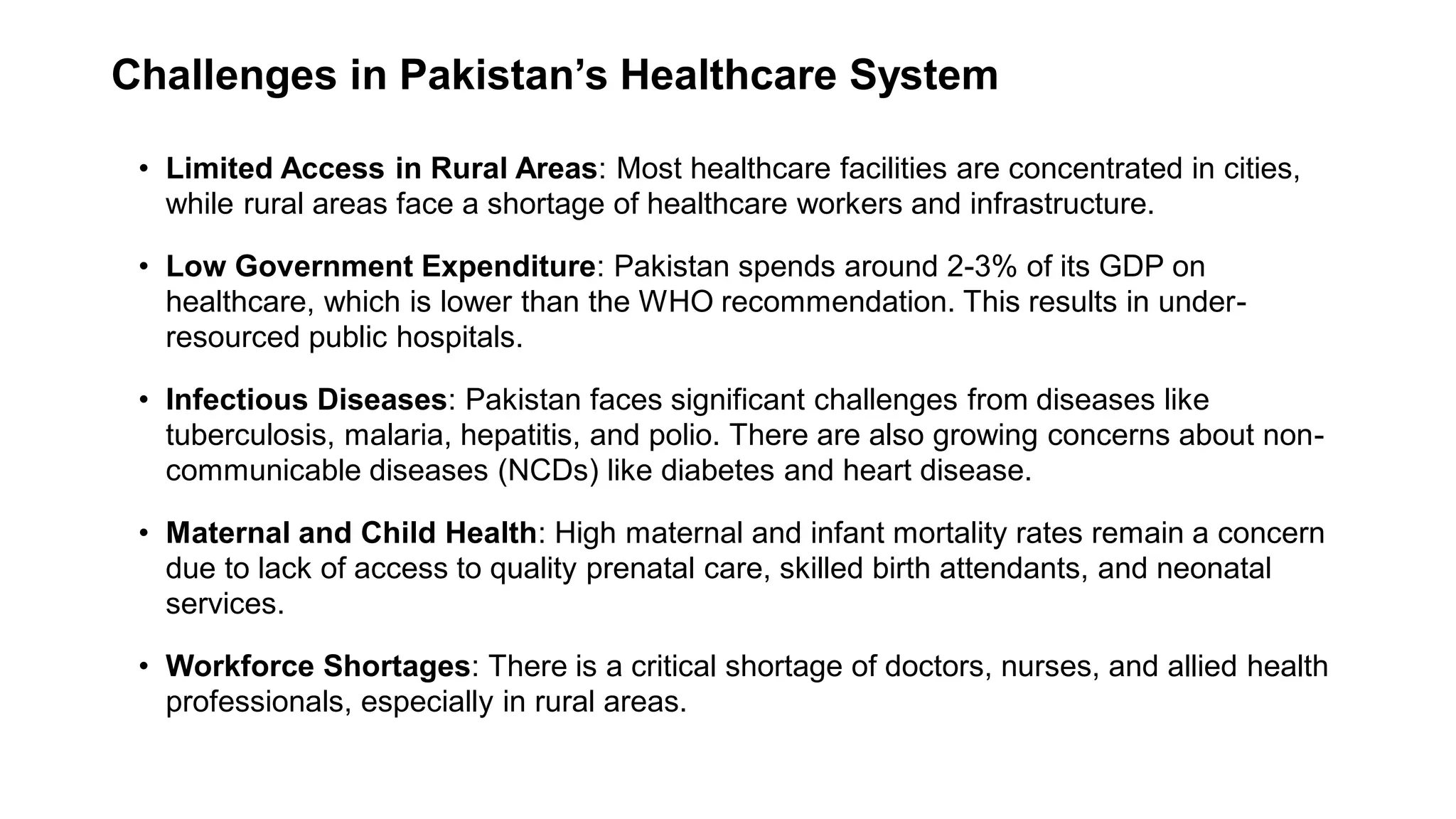
Challenges in Pakistan’s Healthcare System
• Limited Access in Rural Areas: Most healthcare facilities are concentrated in cities,
while rural areas face a shortage of healthcare workers and infrastructure.
• Low Government Expenditure: Pakistan spends around 2-3% of its GDP on
healthcare, which is lower than the WHO recommendation. This results in under-
resourced public hospitals.
• Infectious Diseases: Pakistan faces significant challenges from diseases like
tuberculosis, malaria, hepatitis, and polio. There are also growing concerns about non-
communicable diseases (NCDs) like diabetes and heart disease.
• Maternal and Child Health: High maternal and infant mortality rates remain a concern
due to lack of access to quality prenatal care, skilled birth attendants, and neonatal
services.
• Workforce Shortages: There is a critical shortage of doctors, nurses, and allied health
professionals, especially in rural areas.
Evolution of Treatment Modalities
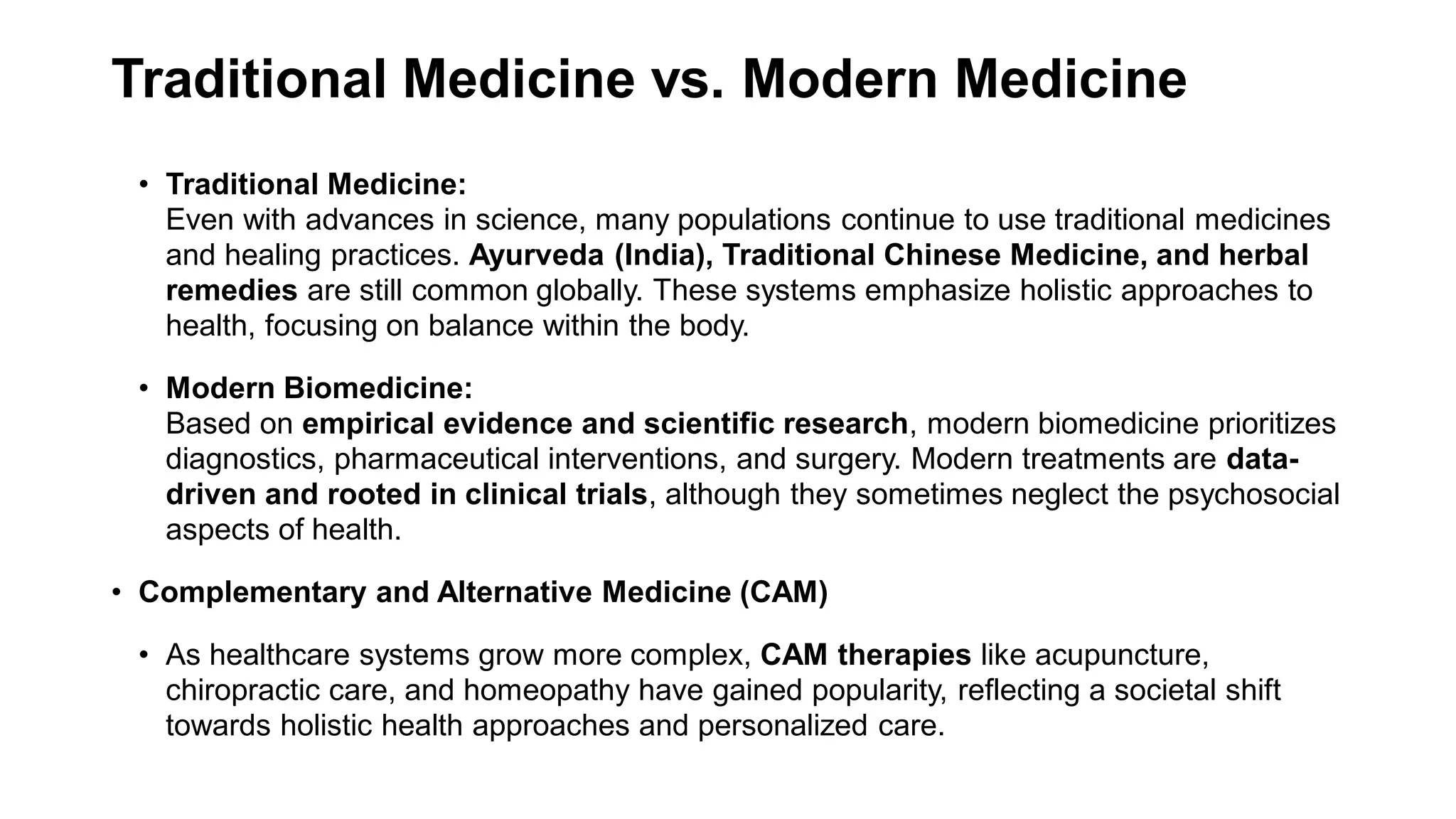
Traditional Medicine vs. Modern Medicine
• Traditional Medicine:
Even with advances in science, many populations continue to use traditional medicines
and healing practices. Ayurveda (India), Traditional Chinese Medicine, and herbal
remedies are still common globally. These systems emphasize holistic approaches to
health, focusing on balance within the body.
• Modern Biomedicine:
Based on empirical evidence and scientific research, modern biomedicine prioritizes
diagnostics, pharmaceutical interventions, and surgery. Modern treatments are data-
driven and rooted in clinical trials, although they sometimes neglect the psychosocial
aspects of health.
• Complementary and Alternative Medicine (CAM)
• As healthcare systems grow more complex, CAM therapies like acupuncture,
chiropractic care, and homeopathy have gained popularity, reflecting a societal shift
towards holistic health approaches and personalized care.
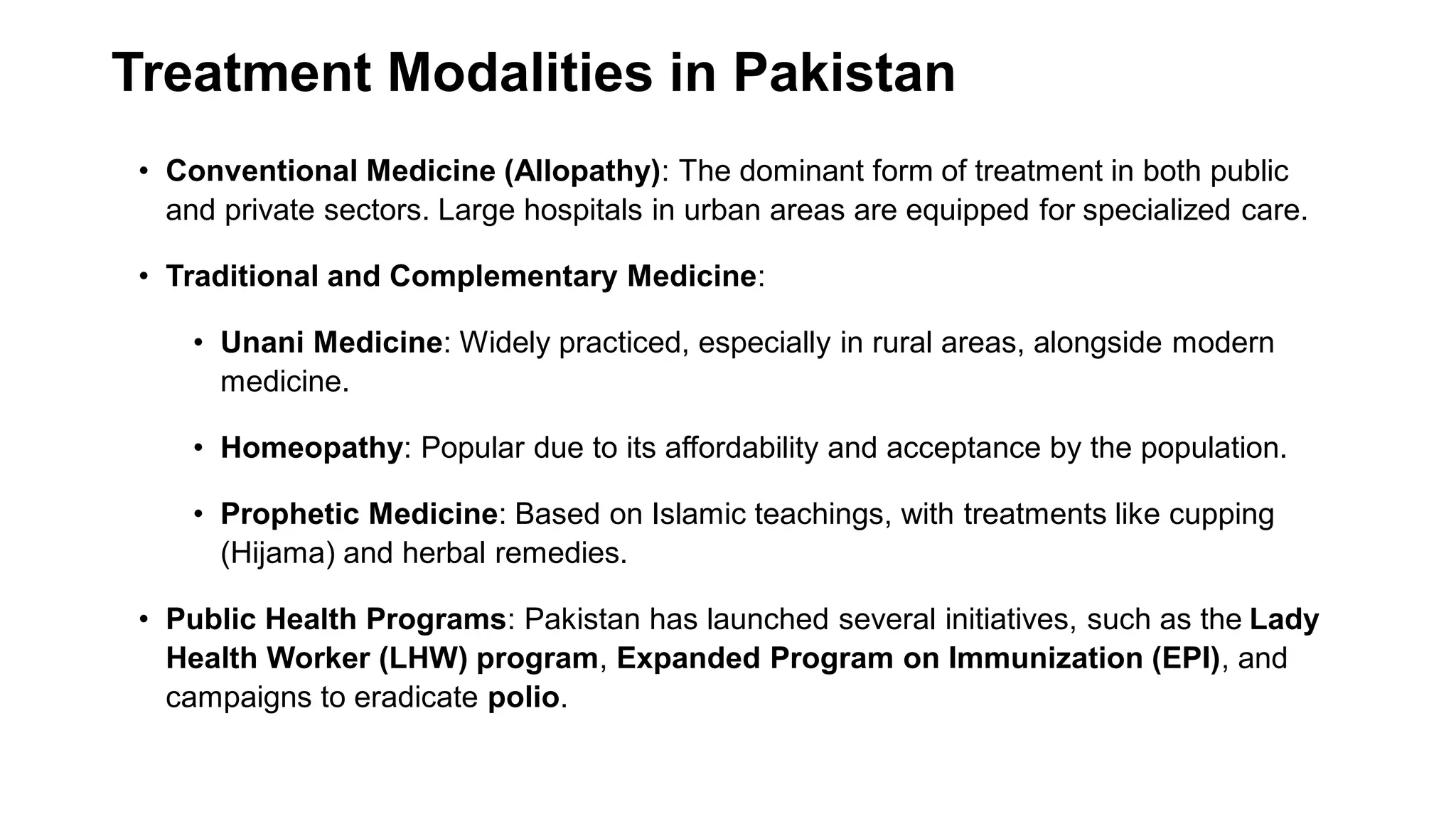
Treatment Modalities in Pakistan
• Conventional Medicine (Allopathy): The dominant form of treatment in both public
and private sectors. Large hospitals in urban areas are equipped for specialized care.
• Traditional and Complementary Medicine:
• Unani Medicine: Widely practiced, especially in rural areas, alongside modern
medicine.
• Homeopathy: Popular due to its affordability and acceptance by the population.
• Prophetic Medicine: Based on Islamic teachings, with treatments like cupping
(Hijama) and herbal remedies.
• Public Health Programs: Pakistan has launched several initiatives, such as the Lady
Health Worker (LHW) program, Expanded Program on Immunization (EPI), and
campaigns to eradicate polio.
Future Trends in Treatment Modalities
• Artificial Intelligence (AI) in Medicine:
AI is playing an increasing role in diagnostics, treatment planning, and drug
development. AI algorithms can detect patterns in medical data that human doctors
might miss, allowing for earlier and more accurate diagnoses.
• Telemedicine:
The COVID-19 pandemic accelerated the adoption of telemedicine, enabling patients
to consult doctors remotely, breaking down geographical barriers to healthcare access.
• Stem Cell Research and Regenerative Medicine:
Advances in stem cell research hold promise for regenerative treatments, potentially
curing previously untreatable conditions by repairing damaged tissues and organs
Thankyou

Lecture 2 Evolution of Healthcare Systems and Treatment Modalities.pdf

  • 1.
    Evolution of HealthcareSystems and Treatment Modalities Lecture #2 BS Nursing
  • 2.
    Healthcare System (Definition) Ahealth system, health care system or healthcare system is an organization of people, institutions, and resources that delivers healthcare services to meet the health needs of target populations.
  • 3.
    Primitive and AncientHealthcare Practices • Prehistoric Times: In early human history, healthcare was rooted in spiritual and naturalistic understandings. Shamans, herbalists, and traditional healers played significant roles in treating illnesses, often attributing disease to supernatural forces, spirits, or gods.
  • 4.
    • Religious Influenceon Healthcare in Middle Ages (5th–15th Century): Religion heavily influenced healthcare, with the Church providing much of the medical care in monasteries. Islamic scholars, such as Avicenna, preserved and expanded upon Greek medical knowledge, influencing European medicine.
  • 5.
    Early History ofHealthcare Systems: • Ancient Civilizations: • Egypt: The Egyptians developed some of the earliest known healthcare practices, including surgical tools and basic surgical procedures like trepanation (drilling holes in the skull). • Greece and Rome: Hippocrates (often called the Father of Medicine) emphasized natural causes of diseases rather than supernatural explanations. • The concept of the “four humors” dominated ancient Greek medicine (blood, phlegm, black bile, yellow bile), and treatments focused on balancing these humors. • Galen of Rome further advanced medical knowledge, performing early dissections and advancing anatomical understanding.
  • 6.
    Development of ModernHealthcare Systems
  • 7.
    Enlightenment and ScientificRevolution (17th–19th Century) • Rise of Rationalism and Empiricism: • The 17th and 18th centuries marked the beginning of the modern scientific method. Physicians began to emphasize observation, experimentation, and rational thought over religious and superstitious explanations of disease. • Hospitals and Medical Schools: • Hospitals evolved from religious institutions into centers of medical learning and care. This period saw the foundation of institutions like St. Bartholomew’s Hospital in London founded in 1123. • Medical Schools began training doctors in formal settings, with advancements in anatomy, pathology, and pharmacology taking place. 800 years of the world's oldest medical school - Université de Montpellier. Established in 1220 in France.
  • 8.
    • Public HealthInitiatives: • The industrial revolution led to rapid urbanization and new health challenges (sanitation, infectious disease outbreaks). Governments began to invest in public health infrastructure, focusing on clean water, waste management, and vaccination programs. • The germ theory of disease (proposed by Louis Pasteur and Robert Koch) revolutionized the understanding of infectious diseases, leading to vaccines and antiseptics (Joseph Lister).
  • 9.
    The Rise ofProfessional Medicine and Healthcare Systems (19th–20th Century) • Development of National Healthcare Systems: • Bismarck Model (Germany): Introduced in the late 19th century, Germany was the first country to establish a national healthcare system funded by insurance contributions from employers and employees. • Beveridge Model (UK): The UK introduced the National Health Service (NHS) in 1948, offering universal healthcare funded through taxation. • Medicare and Medicaid (USA): Introduced in the 1960s, these programs provided government-funded healthcare for the elderly and low-income populations.
  • 10.
    Modern and ContemporaryHealthcare Systems
  • 11.
    Healthcare in the21st Century • Technological Advances: • Medical technology saw rapid advances in the late 20th and 21st centuries. Imaging technologies like MRI and CT scans, minimally invasive surgeries, and advanced diagnostics transformed how diseases are diagnosed and treated. • Genomic Medicine: The sequencing of the human genome in 2003 opened new avenues for personalized medicine, allowing treatments tailored to individual genetic profiles. • Pharmaceutical Innovations: • The development of antibiotics (penicillin) in the 20th century, along with antiviral drugs, vaccines, and cancer therapies, has revolutionized the treatment of infectious diseases and chronic conditions.
  • 12.
    Healthcare Systems Today Healthcaresystems now operate under various models globally: • Nationalized healthcare (e.g., UK, Canada) provides universal access but can face challenges such as long wait times and resource shortages. • Private or hybrid models (e.g., USA) offer advanced care but face criticism for being expensive and inequitable. • Global Health Initiatives: • The rise of global health organizations, such as the World Health Organization (WHO), addresses worldwide health issues like epidemics (e.g., HIV/AIDS, COVID-19) and promotes healthcare access in low-income nations.
  • 13.
    Healthcare Systems inAsia: An Overview • Asia is a diverse continent, and its healthcare systems reflect varying degrees of development and access to medical care. Countries in Asia typically follow one of the following healthcare models: • Public Healthcare Systems: • Countries like Japan, South Korea, and Thailand have strong public healthcare systems, where the government provides universal or near- universal coverage. Healthcare is funded through taxes or insurance schemes, ensuring access for most citizens. • Mixed Systems: • Countries like India and China have mixed healthcare systems. There is a public sector that offers low-cost or free healthcare, but due to resource constraints, many rely on private healthcare for better quality or faster service.
  • 14.
    • Private HealthcareDominance: • In countries like Philippines and Indonesia, private healthcare plays a significant role due to limited public healthcare infrastructure, though the government is working towards expanding public health services. • Traditional and Complementary Medicine: • Traditional Chinese Medicine (TCM), Ayurveda (India), and other indigenous practices coexist with modern medicine in many parts of Asia. These systems are often integrated into formal healthcare systems or widely used by the population as complementary treatments.
  • 15.
    Healthcare System inPakistan • Public Healthcare: • Managed at both federal and provincial levels. Public hospitals and clinics provide subsidized or free healthcare, but they are often underfunded, overcrowded, and suffer from staff shortages. • Major services include primary, secondary, and tertiary healthcare facilities, such as Basic Health Units (BHUs) and Tehsil Headquarter Hospitals (THQs) in rural areas and DHQ District Headquarters at District level. • Private Healthcare: • Private hospitals and clinics play a critical role in providing healthcare, especially in urban areas. While offering better facilities and shorter waiting times, private care can be expensive and inaccessible to the poor. • Charitable Sector: • Organizations like Edhi Foundation and Shaukat Khanum Memorial Cancer Hospital fill gaps, especially for underprivileged populations.
  • 16.
    Challenges Facing ModernHealthcare Systems • Health Inequalities: Social determinants like income, race, and geography continue to influence access to healthcare. Wealthier nations and populations have better access to advanced treatments, while low-income populations suffer from inadequate healthcare. • Aging Populations and Chronic Diseases: • Developed nations are experiencing aging populations, leading to an increase in chronic diseases like diabetes, heart disease, and dementia. Healthcare systems face challenges in managing long-term care for these conditions. • Costs and Access: Rising healthcare costs are a significant issue, particularly in countries without universal healthcare. Balancing innovation with affordability remains a critical concern.
  • 17.
    Challenges in Pakistan’sHealthcare System • Limited Access in Rural Areas: Most healthcare facilities are concentrated in cities, while rural areas face a shortage of healthcare workers and infrastructure. • Low Government Expenditure: Pakistan spends around 2-3% of its GDP on healthcare, which is lower than the WHO recommendation. This results in under- resourced public hospitals. • Infectious Diseases: Pakistan faces significant challenges from diseases like tuberculosis, malaria, hepatitis, and polio. There are also growing concerns about non- communicable diseases (NCDs) like diabetes and heart disease. • Maternal and Child Health: High maternal and infant mortality rates remain a concern due to lack of access to quality prenatal care, skilled birth attendants, and neonatal services. • Workforce Shortages: There is a critical shortage of doctors, nurses, and allied health professionals, especially in rural areas.
  • 18.
  • 19.
    Traditional Medicine vs.Modern Medicine • Traditional Medicine: Even with advances in science, many populations continue to use traditional medicines and healing practices. Ayurveda (India), Traditional Chinese Medicine, and herbal remedies are still common globally. These systems emphasize holistic approaches to health, focusing on balance within the body. • Modern Biomedicine: Based on empirical evidence and scientific research, modern biomedicine prioritizes diagnostics, pharmaceutical interventions, and surgery. Modern treatments are data- driven and rooted in clinical trials, although they sometimes neglect the psychosocial aspects of health. • Complementary and Alternative Medicine (CAM) • As healthcare systems grow more complex, CAM therapies like acupuncture, chiropractic care, and homeopathy have gained popularity, reflecting a societal shift towards holistic health approaches and personalized care.
  • 20.
    Treatment Modalities inPakistan • Conventional Medicine (Allopathy): The dominant form of treatment in both public and private sectors. Large hospitals in urban areas are equipped for specialized care. • Traditional and Complementary Medicine: • Unani Medicine: Widely practiced, especially in rural areas, alongside modern medicine. • Homeopathy: Popular due to its affordability and acceptance by the population. • Prophetic Medicine: Based on Islamic teachings, with treatments like cupping (Hijama) and herbal remedies. • Public Health Programs: Pakistan has launched several initiatives, such as the Lady Health Worker (LHW) program, Expanded Program on Immunization (EPI), and campaigns to eradicate polio.
  • 21.
    Future Trends inTreatment Modalities • Artificial Intelligence (AI) in Medicine: AI is playing an increasing role in diagnostics, treatment planning, and drug development. AI algorithms can detect patterns in medical data that human doctors might miss, allowing for earlier and more accurate diagnoses. • Telemedicine: The COVID-19 pandemic accelerated the adoption of telemedicine, enabling patients to consult doctors remotely, breaking down geographical barriers to healthcare access. • Stem Cell Research and Regenerative Medicine: Advances in stem cell research hold promise for regenerative treatments, potentially curing previously untreatable conditions by repairing damaged tissues and organs
  • 22.