Integrante
Gleidys Contreras
C.I: 26,847,158
Código :42
Sección:3A
The simple past is one of these tenses, present in
different languages. The mention of the past refers
to actions that have already been carried out
previously (that is, they have already been fulfilled).
El pasado simple es uno de estos tiempos, presente
en diferentes idiomas. La mención del pasado se
refiere a acciones que ya se han llevado a cabo
anteriormente (es decir, ya se han cumplido).
1) Indicates an action that was performed at a specific time in
the past
Indica una acción que se realizo en un momento especifico del
pasado
2)Its essential characteristic is that the main verb of the
sentence is always in the past
Su característica esencial es que el verbo principal de la oración
siempre esta en pasado
3)It is the only grammatical time that uses past tense
Es el único tiempo gramatical que usa verbos en pasado
Regular
In English they are called regular verbs to those who
form the past by adding the suffix 'ed' or 'd' to the root
of the verb. This past marker helps to recognize this
type of verbs in a written text.
En inglés se llaman verbos regulares a aquellos que
forman el pasado agregando el sufijo ‘ed’ o ‘d’ a la raíz
del verbo. Este marcador de pasado ayuda a reconocer
a este tipo de verbos en un texto escrito.
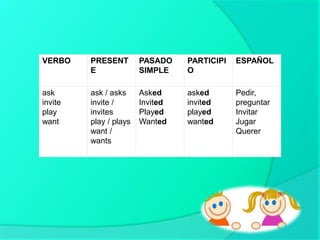
VERBO PRESENT
E
PASADO
SIMPLE
PARTICIPI
O
ESPAÑOL
ask
invite
play
want
ask / asks
invite /
invites
play / plays
want /
wants
Asked
Invited
Played
Wanted
asked
invited
played
wanted
Pedir,
preguntar
Invitar
Jugar
Querer
Irregulares
Unlike regular verbs irregular verbs do not have a past
marker that helps to recognize them. Fortunately, the group
of irregular verbs is composed of a limited number of verbs
(about 350), while there are thousands of regular verbs
A diferencia de los verbos regulares los verbos irregulares
no tienen un marcador de pasado que ayude a
reconocerlos. Afortunadamente, el grupo de verbos
irregulares está compuesto por un número limitado de
verbos (unos 350), mientras que existen miles de verbos
regulares.
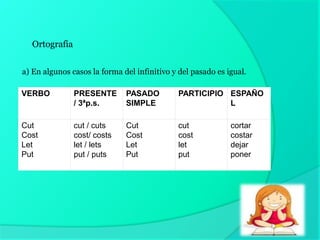
VERBO PRESENTE
/ 3ªp.s.
PASADO
SIMPLE
PARTICIPIO ESPAÑO
L
Cut
Cost
Let
Put
cut / cuts
cost/ costs
let / lets
put / puts
Cut
Cost
Let
Put
cut
cost
let
put
cortar
costar
dejar
poner
a) En algunos casos la forma del infinitivo y del pasado es igual.
Ortografia
1) He drank a lot of water (Él bebió mucho agua).
2) Our mother told us to come early (Nuestra mamá
dijo que regresáramos temprano).
3) Lester learned how to play the piano (Lester
aprendió a tocar el piano).
4) She looked at me in a very bad way (Ella miró de
una muy mala manera).
5) I painted my bedroom yesterday (Pinté mi
recámara ayer).
6) Martha didn´t know about all of this (Martha no
sabía acerca de esto).
Complete the following sentences using the past simple in English:
My father went (go) to work by car yesterday.
2. This morning I had (have) a shower.
3. My sister didn't clean (not clean) her room on Saturday.
4. The birds flew (fly) over our heads.
5. Last week my family bough t (buy) a new table for the dinning room.
6. The other day, I lost (lose) my math’s book.
7. I told (tell) my mother a lie.
8. We heard (hear) a terrible sound outside last night.
9. Did you see (you / see) football match Tuesday night?
10. Paul drank (drink) a litre of coke for lunch yesterday.
.
Complete the following sentences using the past simple in
English:
1. Susan taught [teach] English at university last year.
2. John didn't like [not like] studying
English.www.ejerciciosinglesonline.com Created with
learnclick.com 2
3. My sister broke [break] my computer.
4. Sarah wrote [write] the best poem.
5. Did you know [know] the answer to the question?
6. She was [be] my favourite singer when I was younger.
7. George wasn't [not be] my best friend.
8. Henry VIII had [have] five wives.
9. I studied [study] French two years ago.
10. My daughter drew (draw) a nice brown cat
•Did you work very hard last week?
Yes, I worked very hard last week.
Affirmative
• Did they work together for many years?
Yes, they worked together for many years.
• Did they talk on the phone last week?
No, they didn’t.
Negative
Did you work very hard last week?
No, I didn’t work very hard last week.
Did you work very hard last week?
No, I didn’t.
Did you watch television every night?
No, I didn’t.
Presentación1

Presentación1

  • 1.
  • 2.
    The simple pastis one of these tenses, present in different languages. The mention of the past refers to actions that have already been carried out previously (that is, they have already been fulfilled). El pasado simple es uno de estos tiempos, presente en diferentes idiomas. La mención del pasado se refiere a acciones que ya se han llevado a cabo anteriormente (es decir, ya se han cumplido).
  • 3.
    1) Indicates anaction that was performed at a specific time in the past Indica una acción que se realizo en un momento especifico del pasado 2)Its essential characteristic is that the main verb of the sentence is always in the past Su característica esencial es que el verbo principal de la oración siempre esta en pasado 3)It is the only grammatical time that uses past tense Es el único tiempo gramatical que usa verbos en pasado
  • 4.
    Regular In English theyare called regular verbs to those who form the past by adding the suffix 'ed' or 'd' to the root of the verb. This past marker helps to recognize this type of verbs in a written text. En inglés se llaman verbos regulares a aquellos que forman el pasado agregando el sufijo ‘ed’ o ‘d’ a la raíz del verbo. Este marcador de pasado ayuda a reconocer a este tipo de verbos en un texto escrito.
  • 5.
    VERBO PRESENT E PASADO SIMPLE PARTICIPI O ESPAÑOL ask invite play want ask /asks invite / invites play / plays want / wants Asked Invited Played Wanted asked invited played wanted Pedir, preguntar Invitar Jugar Querer
  • 6.
    Irregulares Unlike regular verbsirregular verbs do not have a past marker that helps to recognize them. Fortunately, the group of irregular verbs is composed of a limited number of verbs (about 350), while there are thousands of regular verbs A diferencia de los verbos regulares los verbos irregulares no tienen un marcador de pasado que ayude a reconocerlos. Afortunadamente, el grupo de verbos irregulares está compuesto por un número limitado de verbos (unos 350), mientras que existen miles de verbos regulares.
  • 7.
    VERBO PRESENTE / 3ªp.s. PASADO SIMPLE PARTICIPIOESPAÑO L Cut Cost Let Put cut / cuts cost/ costs let / lets put / puts Cut Cost Let Put cut cost let put cortar costar dejar poner a) En algunos casos la forma del infinitivo y del pasado es igual. Ortografia
  • 8.
    1) He dranka lot of water (Él bebió mucho agua). 2) Our mother told us to come early (Nuestra mamá dijo que regresáramos temprano). 3) Lester learned how to play the piano (Lester aprendió a tocar el piano). 4) She looked at me in a very bad way (Ella miró de una muy mala manera). 5) I painted my bedroom yesterday (Pinté mi recámara ayer). 6) Martha didn´t know about all of this (Martha no sabía acerca de esto).
  • 9.
    Complete the followingsentences using the past simple in English: My father went (go) to work by car yesterday. 2. This morning I had (have) a shower. 3. My sister didn't clean (not clean) her room on Saturday. 4. The birds flew (fly) over our heads. 5. Last week my family bough t (buy) a new table for the dinning room. 6. The other day, I lost (lose) my math’s book. 7. I told (tell) my mother a lie. 8. We heard (hear) a terrible sound outside last night. 9. Did you see (you / see) football match Tuesday night? 10. Paul drank (drink) a litre of coke for lunch yesterday. .
  • 10.
    Complete the followingsentences using the past simple in English: 1. Susan taught [teach] English at university last year. 2. John didn't like [not like] studying English.www.ejerciciosinglesonline.com Created with learnclick.com 2 3. My sister broke [break] my computer. 4. Sarah wrote [write] the best poem. 5. Did you know [know] the answer to the question? 6. She was [be] my favourite singer when I was younger. 7. George wasn't [not be] my best friend. 8. Henry VIII had [have] five wives. 9. I studied [study] French two years ago. 10. My daughter drew (draw) a nice brown cat
  • 11.
    •Did you workvery hard last week? Yes, I worked very hard last week. Affirmative • Did they work together for many years? Yes, they worked together for many years. • Did they talk on the phone last week? No, they didn’t.
  • 12.
    Negative Did you workvery hard last week? No, I didn’t work very hard last week. Did you work very hard last week? No, I didn’t. Did you watch television every night? No, I didn’t.