On the Complexity of Nash Equilibria in Anonymous
Games
Anthi Orfanou (Columbia University)
06/16/2015 (STOC ’15)
Joint work with Xi Chen (Columbia University) and
David Durfee (Georgia Institute of Technology)
X. Chen, D. Durfee, A. Orfanou On the Complexity of Anonymous Games 06/16/2015 0 / 16
Nash Equilibria
Every game has an equilibrium [Nash 50].
Games with bounded number of players:
2 Players: PPAD-complete [Pap94, DGP09, CDT09]
≥ 3 Players: FIXP-complete [EY10]
X. Chen, D. Durfee, A. Orfanou On the Complexity of Anonymous Games 06/16/2015 1 / 16
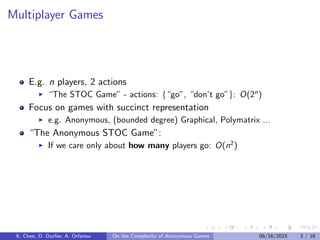
Multiplayer Games
E.g. n players, 2 actions
“The STOC Game” - actions: {“go”, “don’t go”}: O(2n
)
Focus on games with succinct representation
e.g. Anonymous, (bounded degree) Graphical, Polymatrix ...
“The Anonymous STOC Game”:
If we care only about how many players go: O(n2
)
X. Chen, D. Durfee, A. Orfanou On the Complexity of Anonymous Games 06/16/2015 2 / 16
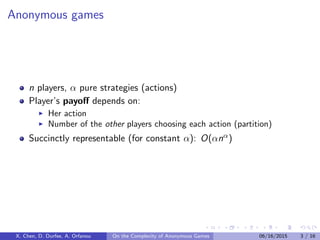
Anonymous games
n players, α pure strategies (actions)
Player’s payoff depends on:
Her action
Number of the other players choosing each action (partition)
Succinctly representable (for constant α): O(αnα)
X. Chen, D. Durfee, A. Orfanou On the Complexity of Anonymous Games 06/16/2015 3 / 16
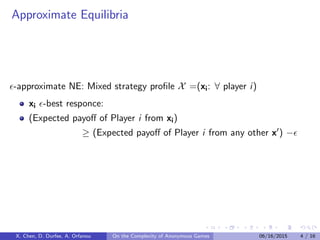
Approximate Equilibria
-approximate NE: Mixed strategy profile X =(xi: ∀ player i)
xi -best responce:
(Expected payoff of Player i from xi)
≥ (Expected payoff of Player i from any other x ) −
X. Chen, D. Durfee, A. Orfanou On the Complexity of Anonymous Games 06/16/2015 4 / 16
Expected payoffs in Anonymous games
n players, 2 actions
Expected payoff of player i:
vi (action 1; 0, n − 1 )×Prob[i “sees” k1 = 0, k2 = n − 1 ]
+ vi (action 1; 1, n − 2 )×Prob[i “sees” k1 = 1, k2 = n − 2 ]
+ vi (action 1; 2, n − 3 )×Prob[i “sees” k1 = 2, k2 = n − 3 ]
. . .
+ vi (action 1; n − 1, 0 )×Prob[i “sees” k1 = n − 1, k2 = 0 ]
linear expression of Partition probabilities
X. Chen, D. Durfee, A. Orfanou On the Complexity of Anonymous Games 06/16/2015 5 / 16
Partition probabilities vs Mixed strategies
NE X = (x1, x2, . . . , xn)
Mixed strategy xi : probability of action 1
Player i observes partition probabilities:
Prob[k1 = 0, k2 = n − 1] = j=i (1 − xj )
Prob[k1 = 1, k2 = n − 2] = j=i xj /∈{i,j}(1 − x )
. . .
Symmetric polynomials of X
helpful in approximation algorithms
obstacle for hardness proof
No change from swapping mixed strategies
X. Chen, D. Durfee, A. Orfanou On the Complexity of Anonymous Games 06/16/2015 6 / 16
Previous Work
Approximation algorithms for Anonymous games:
PTAS: Daskalakis and Papadimitriou [DP14]
2 actions [DP07,Das08] “oblivious”, “non-oblivious” [DP09]
α actions [DP08]
approximate pure NE for Lipschitz games [DP07]
2 actions: Query efficient algorithm [Goldberg and Turchetta 14]
2 actions (Lipschitz) Best response dynamics - O(n log n) steps:
approximate pure NE [Babichenko 13]
X. Chen, D. Durfee, A. Orfanou On the Complexity of Anonymous Games 06/16/2015 7 / 16
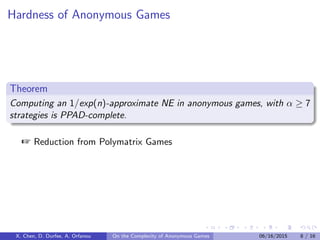
Hardness of Anonymous Games
Theorem
Computing an 1/exp(n)-approximate NE in anonymous games, with α ≥ 7
strategies is PPAD-complete.
Reduction from Polymatrix Games
X. Chen, D. Durfee, A. Orfanou On the Complexity of Anonymous Games 06/16/2015 8 / 16
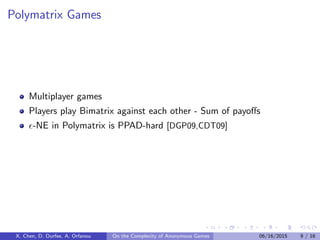
Polymatrix Games
Multiplayer games
Players play Bimatrix against each other - Sum of payoffs
-NE in Polymatrix is PPAD-hard [DGP09,CDT09]
X. Chen, D. Durfee, A. Orfanou On the Complexity of Anonymous Games 06/16/2015 9 / 16
Expected Payoffs in Polymatrix
n players, 2 actions: NE Y
Q1 Q2 · · · Qn
action 1 y1 y2 · · · yn
action 2 1 − y1 1 − y2 · · · 1 − yn
Expected Payoffs: linear expressions of NE Y
ui (action 1) = 2y1 + 1y2 + 4y3 + . . . + 2yn
ui (action 2) = 3y1 + 2y2 + 1y3 + . . . + 5yn
-NE:
If ui (1) > ui (2) + ⇒ yi = 1
If ui (2) > ui (1) + ⇒ yi = 0
X. Chen, D. Durfee, A. Orfanou On the Complexity of Anonymous Games 06/16/2015 10 / 16
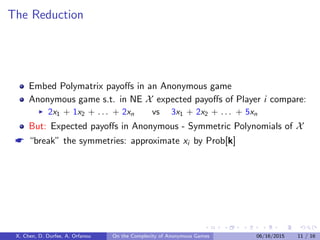
The Reduction
Embed Polymatrix payoffs in an Anonymous game
Anonymous game s.t. in NE X expected payoffs of Player i compare:
2x1 + 1x2 + . . . + 2xn vs 3x1 + 2x2 + . . . + 5xn
But: Expected payoffs in Anonymous - Symmetric Polynomials of X
 “break” the symmetries: approximate xi by Prob[k]
X. Chen, D. Durfee, A. Orfanou On the Complexity of Anonymous Games 06/16/2015 11 / 16
Playing in different scales
Game where players play at different scales in the NE:
2 actions {s, t}
xi = δi
δ = 1/2n
player 1 player 2 . . . player n
s δ δ2 . . . δn
t 1 − δ 1 − δ2 . . . 1 − δn
X. Chen, D. Durfee, A. Orfanou On the Complexity of Anonymous Games 06/16/2015 12 / 16
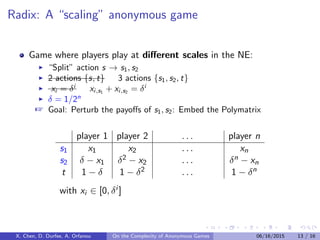
Radix: A “scaling” anonymous game
Game where players play at different scales in the NE:
“Split” action s → s1, s2
2 actions {s, t} 3 actions {s1, s2, t}
xi = δi
xi,s1 + xi,s2 = δi
δ = 1/2n
Goal: Perturb the payoffs of s1, s2: Embed the Polymatrix
player 1 player 2 . . . player n
s1 x1 x2 . . . xn
s2 δ − x1 δ2 − x2 . . . δn − xn
t 1 − δ 1 − δ2 . . . 1 − δn
with xi ∈ [0, δi ]
X. Chen, D. Durfee, A. Orfanou On the Complexity of Anonymous Games 06/16/2015 13 / 16
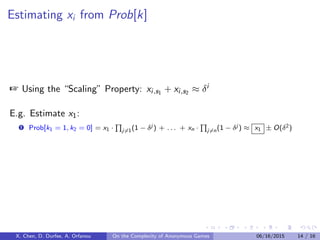
Estimating xi from Prob[k]
Using the “Scaling” Property: xi,s1 + xi,s2 ≈ δi
E.g. Estimate x1:
– Prob[k1 = 1, k2 = 0] = x1 · j=1(1 − δj ) + . . . + xn · j=n(1 − δj ) ≈ x1 ± O(δ2)
X. Chen, D. Durfee, A. Orfanou On the Complexity of Anonymous Games 06/16/2015 14 / 16
Estimating xi from Prob[k]

present_2_new

  • 1.
    On the Complexityof Nash Equilibria in Anonymous Games Anthi Orfanou (Columbia University) 06/16/2015 (STOC ’15) Joint work with Xi Chen (Columbia University) and David Durfee (Georgia Institute of Technology) X. Chen, D. Durfee, A. Orfanou On the Complexity of Anonymous Games 06/16/2015 0 / 16
  • 2.
    Nash Equilibria Every gamehas an equilibrium [Nash 50]. Games with bounded number of players: 2 Players: PPAD-complete [Pap94, DGP09, CDT09] ≥ 3 Players: FIXP-complete [EY10] X. Chen, D. Durfee, A. Orfanou On the Complexity of Anonymous Games 06/16/2015 1 / 16
  • 3.
    Multiplayer Games E.g. nplayers, 2 actions “The STOC Game” - actions: {“go”, “don’t go”}: O(2n ) Focus on games with succinct representation e.g. Anonymous, (bounded degree) Graphical, Polymatrix ... “The Anonymous STOC Game”: If we care only about how many players go: O(n2 ) X. Chen, D. Durfee, A. Orfanou On the Complexity of Anonymous Games 06/16/2015 2 / 16
  • 4.
    Anonymous games n players,α pure strategies (actions) Player’s payoff depends on: Her action Number of the other players choosing each action (partition) Succinctly representable (for constant α): O(αnα) X. Chen, D. Durfee, A. Orfanou On the Complexity of Anonymous Games 06/16/2015 3 / 16
  • 5.
    Approximate Equilibria -approximate NE:Mixed strategy profile X =(xi: ∀ player i) xi -best responce: (Expected payoff of Player i from xi) ≥ (Expected payoff of Player i from any other x ) − X. Chen, D. Durfee, A. Orfanou On the Complexity of Anonymous Games 06/16/2015 4 / 16
  • 6.
    Expected payoffs inAnonymous games n players, 2 actions Expected payoff of player i: vi (action 1; 0, n − 1 )×Prob[i “sees” k1 = 0, k2 = n − 1 ] + vi (action 1; 1, n − 2 )×Prob[i “sees” k1 = 1, k2 = n − 2 ] + vi (action 1; 2, n − 3 )×Prob[i “sees” k1 = 2, k2 = n − 3 ] . . . + vi (action 1; n − 1, 0 )×Prob[i “sees” k1 = n − 1, k2 = 0 ] linear expression of Partition probabilities X. Chen, D. Durfee, A. Orfanou On the Complexity of Anonymous Games 06/16/2015 5 / 16
  • 7.
    Partition probabilities vsMixed strategies NE X = (x1, x2, . . . , xn) Mixed strategy xi : probability of action 1 Player i observes partition probabilities: Prob[k1 = 0, k2 = n − 1] = j=i (1 − xj ) Prob[k1 = 1, k2 = n − 2] = j=i xj /∈{i,j}(1 − x ) . . . Symmetric polynomials of X helpful in approximation algorithms obstacle for hardness proof No change from swapping mixed strategies X. Chen, D. Durfee, A. Orfanou On the Complexity of Anonymous Games 06/16/2015 6 / 16
  • 8.
    Previous Work Approximation algorithmsfor Anonymous games: PTAS: Daskalakis and Papadimitriou [DP14] 2 actions [DP07,Das08] “oblivious”, “non-oblivious” [DP09] α actions [DP08] approximate pure NE for Lipschitz games [DP07] 2 actions: Query efficient algorithm [Goldberg and Turchetta 14] 2 actions (Lipschitz) Best response dynamics - O(n log n) steps: approximate pure NE [Babichenko 13] X. Chen, D. Durfee, A. Orfanou On the Complexity of Anonymous Games 06/16/2015 7 / 16
  • 9.
    Hardness of AnonymousGames Theorem Computing an 1/exp(n)-approximate NE in anonymous games, with α ≥ 7 strategies is PPAD-complete.
  • 10.
    Reduction from PolymatrixGames X. Chen, D. Durfee, A. Orfanou On the Complexity of Anonymous Games 06/16/2015 8 / 16
  • 11.
    Polymatrix Games Multiplayer games Playersplay Bimatrix against each other - Sum of payoffs -NE in Polymatrix is PPAD-hard [DGP09,CDT09] X. Chen, D. Durfee, A. Orfanou On the Complexity of Anonymous Games 06/16/2015 9 / 16
  • 12.
    Expected Payoffs inPolymatrix n players, 2 actions: NE Y Q1 Q2 · · · Qn action 1 y1 y2 · · · yn action 2 1 − y1 1 − y2 · · · 1 − yn Expected Payoffs: linear expressions of NE Y ui (action 1) = 2y1 + 1y2 + 4y3 + . . . + 2yn ui (action 2) = 3y1 + 2y2 + 1y3 + . . . + 5yn -NE: If ui (1) > ui (2) + ⇒ yi = 1 If ui (2) > ui (1) + ⇒ yi = 0 X. Chen, D. Durfee, A. Orfanou On the Complexity of Anonymous Games 06/16/2015 10 / 16
  • 13.
    The Reduction Embed Polymatrixpayoffs in an Anonymous game Anonymous game s.t. in NE X expected payoffs of Player i compare: 2x1 + 1x2 + . . . + 2xn vs 3x1 + 2x2 + . . . + 5xn But: Expected payoffs in Anonymous - Symmetric Polynomials of X “break” the symmetries: approximate xi by Prob[k] X. Chen, D. Durfee, A. Orfanou On the Complexity of Anonymous Games 06/16/2015 11 / 16
  • 14.
    Playing in differentscales Game where players play at different scales in the NE: 2 actions {s, t} xi = δi δ = 1/2n player 1 player 2 . . . player n s δ δ2 . . . δn t 1 − δ 1 − δ2 . . . 1 − δn X. Chen, D. Durfee, A. Orfanou On the Complexity of Anonymous Games 06/16/2015 12 / 16
  • 15.
    Radix: A “scaling”anonymous game Game where players play at different scales in the NE: “Split” action s → s1, s2 2 actions {s, t} 3 actions {s1, s2, t} xi = δi xi,s1 + xi,s2 = δi δ = 1/2n
  • 16.
    Goal: Perturb thepayoffs of s1, s2: Embed the Polymatrix player 1 player 2 . . . player n s1 x1 x2 . . . xn s2 δ − x1 δ2 − x2 . . . δn − xn t 1 − δ 1 − δ2 . . . 1 − δn with xi ∈ [0, δi ] X. Chen, D. Durfee, A. Orfanou On the Complexity of Anonymous Games 06/16/2015 13 / 16
  • 17.
  • 18.
    Using the “Scaling”Property: xi,s1 + xi,s2 ≈ δi E.g. Estimate x1: – Prob[k1 = 1, k2 = 0] = x1 · j=1(1 − δj ) + . . . + xn · j=n(1 − δj ) ≈ x1 ± O(δ2) X. Chen, D. Durfee, A. Orfanou On the Complexity of Anonymous Games 06/16/2015 14 / 16
  • 19.