BID-­‐PRICE	
  HEURISTICS	
  	
  
FOR	
  UNRESTRICTED	
  FARE	
  
STRUCTURES	
  	
  
IN	
  CARGO	
  REVENUE	
  
MANAGEMENT	
  	
  
L.	
  Castelli	
  1,	
  R.	
  Pesen@	
  2,	
  D.	
  Rigonat	
  1	


1	
  Università	
  degli	
  Studi	
  di	
  Trieste,	
  Italy	
  
2	
  Università	
  Ca’Foscari,	
  Venezia,	
  Italy	


Revenue	
  Management	
  &	
  Cargo	
  
A	
  collec'on	
  of	
  pricing,	
  inventory,	
  marke'ng	
  techniques	
  
aimed	
  at	
  predic'ng	
  consumer	
  behaviour	
  and	
  op'mize	
  
product	
  availability	
  and	
  price	
  to	
  maximize	
  revenue	
  growth.	
  	
  
In	
  cargo:	
  
¨  Total	
  available	
  capacity	
  (=	
  product	
  inventory)	
  may	
  be	
  uncertain;	
  
¨  Bi-­‐dimensional	
  capacity	
  (weight,	
  volume);	
  	
  
¨  Tri-­‐dimensional	
  alloca@on;	
  
¨  Product	
  value	
  increases	
  over	
  @me	
  then	
  drops	
  to	
  zero.	
  
Product-­‐oriented	
  vs.	
  Price-­‐oriented	
  Demand	


RM	
  forecasts	
  shiY	
  from	
  restric@on/class-­‐based	
  
to	
  willingness	
  to	
  pay	
  (wtp)-­‐based	
  
Product-­‐oriented	
   Price-­‐oriented	
  
Different	
  fares	
  for	
  different	
  
products	
  
A	
  single	
  type	
  of	
  product	
  
Customer	
  only	
  interested	
  in	
  a	
  
specific	
  fare/product	
  
Customer	
  purchase	
  solely	
  on	
  price	
  
Customer	
  choice	
  independent	
  of	
  
the	
  availability	
  of	
  cheaper	
  services	
  
Customer	
  compare	
  services	
  from	
  
different	
  carriers	
  to	
  get	
  the	
  
cheapest	
  fare	
  
Objec@ve	
  of	
  our	
  study	
  
¨  Study	
  effec@veness	
  of	
  capacity	
  management	
  
algorithms	
  based	
  on	
  willingness	
  to	
  pay;	
  
¨  Develop	
  policies	
  that	
  are	
  suitable	
  for	
  cargo	
  context;	
  
¨  Explore	
  different	
  approaches:	
  
¤  Dynamic	
  Programming	
  (DP)	
  
¤  Bid-­‐Prices	
  (BP)	
  
Roadmap	
  
Defini@on	
  of	
  the	
  scenario	
  
General	
  problem	
  formula@on	
  through	
  
Dynamic	
  Programming	
  (DP)	
  
DP	
  based	
  algorithm	
  
Bid-­‐price	
  (BP)	
  approach:	
  sta@c	
  BP	
  (SBP)	
  and	
  
dynamic	
  BP	
  (DBP)	
  algorithms	
  
Tests	
  on	
  different	
  shipment	
  size	
  /customer	
  
demand	
  combina@on	
  
Problem	
  formula@on	
  -­‐	
  Assump@ons	
  
¨  Cargo	
  scenario	
  (i.e.	
  air	
  cargo):	
  bi-­‐dimensional	
  capacity	
  
(weight,	
  volume);	
  
¨  3-­‐D	
  alloca@on	
  issues	
  are	
  ignored;	
  
¨  Single	
  class	
  of	
  customers;	
  
¨  Customers	
  are	
  served	
  one	
  at	
  a	
  @me	
  (1	
  customer	
  =	
  1	
  
shipment);	
  	
  
¨  A	
  shipment	
  can	
  be	
  accepted	
  only	
  if	
  the	
  flight	
  has	
  residual	
  
capacity	
  (volume	
  and	
  weight)	
  to	
  accommodate	
  it;	
  	
  
¨  A	
  shipment	
  is	
  paid	
  for	
  propor@onally	
  to	
  its	
  weight	
  (revenue	
  =	
  
weight	
  *	
  unitFare).	
  	
  
Problem	
  formula@on	
  -­‐	
  Nota@on	
  
Symbol	
   Meaning	
  
F={f1,…,fM} Set	
  of	
  increasing	
  fares	
  
f ∈ F Generic	
  fare	
  
pkm Willingness	
  of	
  k-­‐th	
  customer	
  to	
  pay	
  fare	
  m	
  
{0,1,…,t,t+1,…,T} Time	
  frame	
  from	
  reserva@on	
  opening	
  to	
  closure	
  
tk ∈ {0,…,T} Generic	
  @me	
  instant	
  
φt probability	
  of	
  a	
  customer	
  showing	
  up	
  at	
  @me	
  t	
  	
  
Cw , Cv AircraY	
  capacity	
  for	
  weight,	
  volume	
  
(w,v) Residual	
  aircraY	
  capacity	
  for	
  weight,	
  volume	
  
(ω,υ) Shipment	
  size	
  
qωυ Probability	
  that	
  a	
  shipment	
  has	
  size	
  (w,u)	
  	
  
Jm(t,w,v) Func@on	
  that	
  returns	
  the	
  expected	
  op@mal	
  revenues	
  from	
  @me	
  t	
  
onwards	
  assuming	
  fare	
  fm	
  is	
  displayed	
  and	
  there	
  are	
  residual	
  
capaci@es	
  (w,v).	


Problem	
  formula@on	
  (DP)	
  
At	
  @me	
  T	
  
No	
  customer	
  
arrives	
  
Revenues	
  in	
  T=	
  
revenues	
  in	
  T+1	
  
A	
  customer	
  
arrives	
  
Shipment	
  
does	
  not	
  fit	
  
Revenues	
  in	
  T=	
  
revenues	
  in	
  T+1	
  
Shipment	
  
fits	
  
We	
  offer	
  
fare	
  f	
  
Customer	
  
refuses	
  f	
  
Revenues	
  in	
  T=	
  
revenues	
  in	
  T+1	
  
Customer	
  
accepts	
  f	
  
Shipm.	
  accepted	
  
	
  Rev	
  =	
  f*w	
  	
  
Cap.	
  w,v	
  updated	
  
We	
  offer	
  
fare	
  f+1	
  
Calculate	
  recursion	
  
for	
  f+1	
  
DP	
  algorithm	
  (DYM)	
  
Assuming	
  that	
  n.	
  of	
  customers,	
  arrival	
  @mes,	
  willingness	
  to	
  pay	
  and	
  
shipment	
  sizes	
  are	
  known	
  in	
  advance,	
  DP	
  is	
  simplified	
  into	
  (2).	
  
Jm(k,w,v) = maxj≥m{ pkj (fjω + Jj(k+1,w-ω,v-υ)) + (1- pkj)Jj(k+1,w,v)} (2)
with final conditions
Jm(k,0,v)= Jm(k,w,0)= Jm(K+1,w,v) = 0 for all 0 ≤ w ≤ Cw and 0 ≤ v ≤ Cv and k ≤ K
For	
  each	
  cust.	
  
arrival	
  k	
  
If	
  shipment	
  
fits	
  
Calculate	
  (2)	
  for	
  
all	
  fares	
  ≥	
  m	
  
Check	
  final	
  
condi@ons	
  
Hence	
  the	
  algorithm:	
  
Bid-­‐price	
  approach	
  -­‐I	
  
Jm(t,w,v) – Jm(t,w-ω,v-υ)
	
  
Represents	
  the	
  opportunity	
  cost	
  at	
  fare fm for	
  a	
  shipment	
  of	
  
size	
   (ω,υ) appearing	
   at	
   @me t when	
   capaci@es w,v are	
   s@ll	
  
available.	
  
	
  Expected	
  loss	
  in	
  future	
  revenue	
  from	
  using	
  the	
  capacity	
  
	
  now	
  rather	
  than	
  reserving	
  it	
  for	
  future	
  use;	


  An	
  op@mal	
  policy,	
  solu@on	
  of	
  DP,	
  accepts	
  a	
  shipment	
  iff	
  
	
  generated	
  revenues	
  are	
  ≥ to	
  its	
  opportunity	
  cost.	
  	
  
Bid-­‐price	
  approach	
  -­‐	
  II	
  
If Jm(t,w,v) is	
   differen@able	
   then	
   ∂Jm(t,w,v)/∂w and	
  
∂Jm(t,w,v)/∂v are	
  the	
  weight	
  marginal	
  opportunity	
  cost	
  and	
  
volume	
  marginal	
  opportunity	
  cost,	
  respec@vely.	


  We	
  can	
  calculate	
  an	
  approxima@on	
  of	
  the	
  marginal	
  
	
  opportunity	
  cost	
  (a	
  bid-­‐price)	
  
	
  We	
  can	
  design	
  policies	
  that	
  accept	
  a	
  shipment	
  only	
  
	
   when	
   its	
   revenue	
   is	
   	
   ≥ to	
   the	
   es@ma@on	
   of	
   the	


  opportunity	
  cost	
  obtained	
  through	
  the	
  BP	
  
Bid-­‐price	
  approach	
  -­‐	
  III	
  
Formally,	
  the	
  acceptance	
  rule	
  for	
  a	
  BP	
  policy	
  is:	
  
Symbol	
   Meaning	
  
r Shipment	
  revenue	
  
πw(w,t) , πv(v,t) Weight	
  and	
  volume	
  BP	
  
πw(w,t)ω + πv(v,t)υ Opportunity	
  cost	
  
f Applied	
  fare	
  
r = fω ≥ πw(w,t)ω + πv(v,t)υ (3)
¨  Sta'c	
  BP:	
  fixed	
  at	
  the	
  beginning	
  of	
  the	
  booking	
  period	
  	
  
i.e.,	
  they	
  do	
  not	
  change	
  over	
  @me	
  and	
  do	
  not	
  depend	
  on	
  the	
  
remaining	
  capacity:	


 πw(w,t) = πw , πv(v,t) = πv.
¨  The	
  chosen	
  fare	
  is	
  unique	
  for	
  all	
  customers:	
  
i.e.	
  the	
  min	
  f s.t.	
  rule	
  (3)	
  is	
  respected	
  by	
  1st	
  accepted	
  customer:	


f = min{fj : fjωh ≥ πwωh + πvυh and phj = 1}
Sta@c	
  BP	
  Algorithm	
  (SBP)	
  -­‐	
  I	
  
Sta@c	
  BP	
  Algorithm	
  (SBP)	
  -­‐	
  II	
  
Calculates	
  op@mal	
  BP	
  for	
  
each	
  instance	
  from	
  a	
  
training	
  set.	
  
Training	
  Phase	
  
SBP-­‐A	
  
Tes@ng	
  Phase	
  
SBP-­‐B	
  
Checks	
  acceptance	
  rule	
  (3)	
  
with	
  avg.	
  op@mal	
  BP	
  (πw	
  , πv)	
  
obtained	
  from	
  training	
  alg.	
  
Op@mal	
  BP	
  per	
  
instance	
  πw	
  , πv
Dynamic	
  BP	
  (DBP)	
  
Limita@ons	
  of	
  SBP:	
  
¨  Revenue	
  depends	
  on	
  willingness	
  to	
  pay	
  of	
  the	
  first	
  
accepted	
  customer:	
  bad	
  for	
  inverse	
  demand;	
  	
  
¨  BP	
  do	
  not	
  change	
  over	
  @me	
  but	
  residual	
  capacity	
  value	
  
increases	
  over	
  @me.	


Idea	
  behind	
  DBP:	
  
¨  Dynamic	
  BP	
  are	
  updated	
  aYer	
  each	
  accepted	
  customer	
  
by	
  running	
  SBP-­‐A	
  on	
  the	
  residual	
  capacity;	
  
¨  Fares	
  are	
  updated	
  based	
  on	
  both	
  users’	
  wtp	
  and	
  dyn.	
  BP	
  
update.	
  
Dynamic	
  BP	
  (DBP)	
  -­‐	
  Algorithm	
  
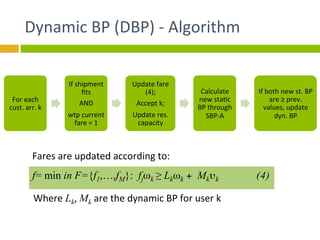
For	
  each	
  
cust.	
  arr.	
  k	
  
If	
  shipment	
  
fits	
  	
  
AND	
  
wtp	
  current	
  
fare	
  =	
  1	
  
Update	
  fare	
  
(4);	
  
Accept	
  k;	
  
Update	
  res.	
  
capacity	
  
Calculate	
  
new	
  sta@c	
  
BP	
  through	
  
SBP-­‐A	
  
If	
  both	
  new	
  st.	
  BP	
  
are	
  ≥	
  prev.	
  
values,	
  update	
  
dyn.	
  BP	
  
f= min in F={f1,…,fM}: fjωk ≥ Lkωk + Mkυk (4)
Fares	
  are	
  updated	
  according	
  to:	
  
Where	
  Lk,	
  Mk	
  are	
  the	
  dynamic	
  BP	
  for	
  user	
  k	
  
Experimental	
  test	
  -­‐	
  Setup	
  
¨  Small	
  shipments	
  (SS):	
  n	
  =	
  750;	
  	
  between	
  2	
  and	
  45	
  Kg	
  
¨  Large	
  shipments	
  (LS):	
  n=	
  450;	
  between	
  46	
  and	
  500	
  Kg	
  
¨  Inverse	
  Demand	
  (ID):	
  wtp	
  decreases	
  with	
  customer	
  arrivals	
  
¨  Random	
  Demand	
  (RD):	
  random	
  wtp	
  
SS-ID SS-RD
LS-ID LS-RD
Test	
  Scenarios:	
  
Experimental	
  test	
  –	
  Results	
  -­‐	
  SR	
  
85 85 85 85
113100 100 100 100 10093 96 97 93
0
Revenues	
   Weight	
  LF	
   Volume	
  LF	
   Accepted	
  
requests	
  (num.)	
  
Running	
  @me	
  
(sec.)	
  
DYM	
  
SBP	
  
DBP	


   DYM	
   SBP	
   DBP	
  
Revenues	
   2,458,003	
   2,283,183	
   2,082,226	
  
Weight	
  LF	
   0.999	
   0.964	
   0.849	
  
Volume	
  LF	
   0.869	
   0.839	
   0.738	
  
Accepted	
  req.	
  (num.)	
   178	
   166	
   152	
  
Running	
  @me	
  (sec.)	
   552	
   0.5	
   624	
  
Small	
  Shipments,	
  Random	
  Demand	
  
Experimental	
  test	
  –	
  Results	
  -­‐	
  LR	
  
100 100 100 100 10098 100 99 96
1
93 94 94 94
3
Revenues	
   Weight	
  LF	
   Volume	
  LF	
   Accepted	
  
requests	
  (num.)	
  
Running	
  @me	
  
(sec.)	
  
DYM	
  
SBP	
  
DBP	


   DYM	
   SBP	
   DBP	
  
Revenues	
   4,752,162	
   4,641,544	
   4,421,279	
  
Weight	
  LF	
   0.82	
   0.816	
   0.77	
  
Volume	
  LF	
   0.997	
   0.992	
   0.935	
  
Accepted	
  req.	
  (num.)	
   51	
   49	
   48	
  
Running	
  @me	
  (sec.)	
   64	
   0.5	
   2	
  
Large	
  Shipments,	
  Random	
  Demand	
  
Experimental	
  test	
  –	
  Results	
  -­‐	
  SI	
  
100 100 100 100 100
76
100 100 101
0
78
100 100 102
21
Revenues	
   Weight	
  LF	
   Volume	
  LF	
   Accepted	
  
requests	
  (num.)	
  
Running	
  @me	
  
(sec.)	
  
DYM	
  
SBP	
  
DBP	


   DYM	
   SBP	
   DBP	
  
Revenues	
   2,712,138	
   2,053,969	
   2,121,717	
  
Weight	
  LF	
   0.999	
   1	
   1	
  
Volume	
  LF	
   0.87	
   0.87	
   0.87	
  
Accepted	
  req.	
  (num.)	
   171	
   173	
   174	
  
Running	
  @me	
  (sec.)	
   594	
   0.5	
   122	
  
Small	
  Shipments,	
  Inverse	
  Demand	
  
Experimental	
  test	
  –	
  Results	
  -­‐	
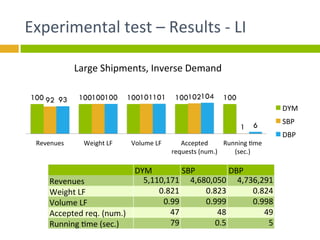
  LI	
  
100 100 100 100 10092 100 101 102
1
93 100 101 104
6
Revenues	
   Weight	
  LF	
   Volume	
  LF	
   Accepted	
  
requests	
  (num.)	
  
Running	
  @me	
  
(sec.)	
  
DYM	
  
SBP	
  
DBP	


   DYM	
   SBP	
   DBP	
  
Revenues	
   5,110,171	
   4,680,050	
   4,736,291	
  
Weight	
  LF	
   0.821	
   0.823	
   0.824	
  
Volume	
  LF	
   0.99	
   0.999	
   0.998	
  
Accepted	
  req.	
  (num.)	
   47	
   48	
   49	
  
Running	
  @me	
  (sec.)	
   79	
   0.5	
   5	
  
Large	
  Shipments,	
  Inverse	
  Demand	
  
Where	
  we	
  go	
  from	
  here..	
  
We	
  proved	
  the	
  reliability	
  of	
  wtp-­‐based	
  policies	
  
within	
  the	
  defined	
  scenario	
  (determinis@c	
  demand,	
  
weight-­‐based	
  pricing	
  etc.)	


Future	
  work:	
  
¨  Improvement	
  to	
  the	
  proposed	
  policies	
  
¨  Comparison	
  with	
  policies	
  developed	
  by	
  other	
  
authors	
  

EWGT 2013 - Bid Price heuristics for unrestricted fare structures in cargo revenue management

  • 1.
    BID-­‐PRICE  HEURISTICS     FOR  UNRESTRICTED  FARE   STRUCTURES     IN  CARGO  REVENUE   MANAGEMENT     L.  Castelli  1,  R.  Pesen@  2,  D.  Rigonat  1       1  Università  degli  Studi  di  Trieste,  Italy   2  Università  Ca’Foscari,  Venezia,  Italy    
  • 2.
    Revenue  Management  &  Cargo   A  collec'on  of  pricing,  inventory,  marke'ng  techniques   aimed  at  predic'ng  consumer  behaviour  and  op'mize   product  availability  and  price  to  maximize  revenue  growth.     In  cargo:   ¨  Total  available  capacity  (=  product  inventory)  may  be  uncertain;   ¨  Bi-­‐dimensional  capacity  (weight,  volume);     ¨  Tri-­‐dimensional  alloca@on;   ¨  Product  value  increases  over  @me  then  drops  to  zero.  
  • 3.
    Product-­‐oriented  vs.  Price-­‐oriented  Demand     RM  forecasts  shiY  from  restric@on/class-­‐based   to  willingness  to  pay  (wtp)-­‐based   Product-­‐oriented   Price-­‐oriented   Different  fares  for  different   products   A  single  type  of  product   Customer  only  interested  in  a   specific  fare/product   Customer  purchase  solely  on  price   Customer  choice  independent  of   the  availability  of  cheaper  services   Customer  compare  services  from   different  carriers  to  get  the   cheapest  fare  
  • 4.
    Objec@ve  of  our  study   ¨  Study  effec@veness  of  capacity  management   algorithms  based  on  willingness  to  pay;   ¨  Develop  policies  that  are  suitable  for  cargo  context;   ¨  Explore  different  approaches:   ¤  Dynamic  Programming  (DP)   ¤  Bid-­‐Prices  (BP)  
  • 5.
    Roadmap   Defini@on  of  the  scenario   General  problem  formula@on  through   Dynamic  Programming  (DP)   DP  based  algorithm   Bid-­‐price  (BP)  approach:  sta@c  BP  (SBP)  and   dynamic  BP  (DBP)  algorithms   Tests  on  different  shipment  size  /customer   demand  combina@on  
  • 6.
    Problem  formula@on  -­‐  Assump@ons   ¨  Cargo  scenario  (i.e.  air  cargo):  bi-­‐dimensional  capacity   (weight,  volume);   ¨  3-­‐D  alloca@on  issues  are  ignored;   ¨  Single  class  of  customers;   ¨  Customers  are  served  one  at  a  @me  (1  customer  =  1   shipment);     ¨  A  shipment  can  be  accepted  only  if  the  flight  has  residual   capacity  (volume  and  weight)  to  accommodate  it;     ¨  A  shipment  is  paid  for  propor@onally  to  its  weight  (revenue  =   weight  *  unitFare).    
  • 7.
    Problem  formula@on  -­‐  Nota@on   Symbol   Meaning   F={f1,…,fM} Set  of  increasing  fares   f ∈ F Generic  fare   pkm Willingness  of  k-­‐th  customer  to  pay  fare  m   {0,1,…,t,t+1,…,T} Time  frame  from  reserva@on  opening  to  closure   tk ∈ {0,…,T} Generic  @me  instant   φt probability  of  a  customer  showing  up  at  @me  t     Cw , Cv AircraY  capacity  for  weight,  volume   (w,v) Residual  aircraY  capacity  for  weight,  volume   (ω,υ) Shipment  size   qωυ Probability  that  a  shipment  has  size  (w,u)     Jm(t,w,v) Func@on  that  returns  the  expected  op@mal  revenues  from  @me  t   onwards  assuming  fare  fm  is  displayed  and  there  are  residual   capaci@es  (w,v).      
  • 8.
    Problem  formula@on  (DP)   At  @me  T   No  customer   arrives   Revenues  in  T=   revenues  in  T+1   A  customer   arrives   Shipment   does  not  fit   Revenues  in  T=   revenues  in  T+1   Shipment   fits   We  offer   fare  f   Customer   refuses  f   Revenues  in  T=   revenues  in  T+1   Customer   accepts  f   Shipm.  accepted    Rev  =  f*w     Cap.  w,v  updated   We  offer   fare  f+1   Calculate  recursion   for  f+1  
  • 9.
    DP  algorithm  (DYM)   Assuming  that  n.  of  customers,  arrival  @mes,  willingness  to  pay  and   shipment  sizes  are  known  in  advance,  DP  is  simplified  into  (2).   Jm(k,w,v) = maxj≥m{ pkj (fjω + Jj(k+1,w-ω,v-υ)) + (1- pkj)Jj(k+1,w,v)} (2) with final conditions Jm(k,0,v)= Jm(k,w,0)= Jm(K+1,w,v) = 0 for all 0 ≤ w ≤ Cw and 0 ≤ v ≤ Cv and k ≤ K For  each  cust.   arrival  k   If  shipment   fits   Calculate  (2)  for   all  fares  ≥  m   Check  final   condi@ons   Hence  the  algorithm:  
  • 10.
    Bid-­‐price  approach  -­‐I   Jm(t,w,v) – Jm(t,w-ω,v-υ)   Represents  the  opportunity  cost  at  fare fm for  a  shipment  of   size   (ω,υ) appearing   at   @me t when   capaci@es w,v are   s@ll   available.    Expected  loss  in  future  revenue  from  using  the  capacity    now  rather  than  reserving  it  for  future  use;        An  op@mal  policy,  solu@on  of  DP,  accepts  a  shipment  iff    generated  revenues  are  ≥ to  its  opportunity  cost.    
  • 11.
    Bid-­‐price  approach  -­‐  II   If Jm(t,w,v) is   differen@able   then   ∂Jm(t,w,v)/∂w and   ∂Jm(t,w,v)/∂v are  the  weight  marginal  opportunity  cost  and   volume  marginal  opportunity  cost,  respec@vely.          We  can  calculate  an  approxima@on  of  the  marginal    opportunity  cost  (a  bid-­‐price)    We  can  design  policies  that  accept  a  shipment  only     when   its   revenue   is     ≥ to   the   es@ma@on   of   the                opportunity  cost  obtained  through  the  BP  
  • 12.
    Bid-­‐price  approach  -­‐  III   Formally,  the  acceptance  rule  for  a  BP  policy  is:   Symbol   Meaning   r Shipment  revenue   πw(w,t) , πv(v,t) Weight  and  volume  BP   πw(w,t)ω + πv(v,t)υ Opportunity  cost   f Applied  fare   r = fω ≥ πw(w,t)ω + πv(v,t)υ (3)
  • 13.
    ¨  Sta'c  BP:  fixed  at  the  beginning  of  the  booking  period     i.e.,  they  do  not  change  over  @me  and  do  not  depend  on  the   remaining  capacity:     πw(w,t) = πw , πv(v,t) = πv. ¨  The  chosen  fare  is  unique  for  all  customers:   i.e.  the  min  f s.t.  rule  (3)  is  respected  by  1st  accepted  customer:     f = min{fj : fjωh ≥ πwωh + πvυh and phj = 1} Sta@c  BP  Algorithm  (SBP)  -­‐  I  
  • 14.
    Sta@c  BP  Algorithm  (SBP)  -­‐  II   Calculates  op@mal  BP  for   each  instance  from  a   training  set.   Training  Phase   SBP-­‐A   Tes@ng  Phase   SBP-­‐B   Checks  acceptance  rule  (3)   with  avg.  op@mal  BP  (πw  , πv)   obtained  from  training  alg.   Op@mal  BP  per   instance  πw  , πv
  • 15.
    Dynamic  BP  (DBP)   Limita@ons  of  SBP:   ¨  Revenue  depends  on  willingness  to  pay  of  the  first   accepted  customer:  bad  for  inverse  demand;     ¨  BP  do  not  change  over  @me  but  residual  capacity  value   increases  over  @me.     Idea  behind  DBP:   ¨  Dynamic  BP  are  updated  aYer  each  accepted  customer   by  running  SBP-­‐A  on  the  residual  capacity;   ¨  Fares  are  updated  based  on  both  users’  wtp  and  dyn.  BP   update.  
  • 16.
    Dynamic  BP  (DBP)  -­‐  Algorithm   For  each   cust.  arr.  k   If  shipment   fits     AND   wtp  current   fare  =  1   Update  fare   (4);   Accept  k;   Update  res.   capacity   Calculate   new  sta@c   BP  through   SBP-­‐A   If  both  new  st.  BP   are  ≥  prev.   values,  update   dyn.  BP   f= min in F={f1,…,fM}: fjωk ≥ Lkωk + Mkυk (4) Fares  are  updated  according  to:   Where  Lk,  Mk  are  the  dynamic  BP  for  user  k  
  • 17.
    Experimental  test  -­‐  Setup   ¨  Small  shipments  (SS):  n  =  750;    between  2  and  45  Kg   ¨  Large  shipments  (LS):  n=  450;  between  46  and  500  Kg   ¨  Inverse  Demand  (ID):  wtp  decreases  with  customer  arrivals   ¨  Random  Demand  (RD):  random  wtp   SS-ID SS-RD LS-ID LS-RD Test  Scenarios:  
  • 18.
    Experimental  test  –  Results  -­‐  SR   85 85 85 85 113100 100 100 100 10093 96 97 93 0 Revenues   Weight  LF   Volume  LF   Accepted   requests  (num.)   Running  @me   (sec.)   DYM   SBP   DBP       DYM   SBP   DBP   Revenues   2,458,003   2,283,183   2,082,226   Weight  LF   0.999   0.964   0.849   Volume  LF   0.869   0.839   0.738   Accepted  req.  (num.)   178   166   152   Running  @me  (sec.)   552   0.5   624   Small  Shipments,  Random  Demand  
  • 19.
    Experimental  test  –  Results  -­‐  LR   100 100 100 100 10098 100 99 96 1 93 94 94 94 3 Revenues   Weight  LF   Volume  LF   Accepted   requests  (num.)   Running  @me   (sec.)   DYM   SBP   DBP       DYM   SBP   DBP   Revenues   4,752,162   4,641,544   4,421,279   Weight  LF   0.82   0.816   0.77   Volume  LF   0.997   0.992   0.935   Accepted  req.  (num.)   51   49   48   Running  @me  (sec.)   64   0.5   2   Large  Shipments,  Random  Demand  
  • 20.
    Experimental  test  –  Results  -­‐  SI   100 100 100 100 100 76 100 100 101 0 78 100 100 102 21 Revenues   Weight  LF   Volume  LF   Accepted   requests  (num.)   Running  @me   (sec.)   DYM   SBP   DBP       DYM   SBP   DBP   Revenues   2,712,138   2,053,969   2,121,717   Weight  LF   0.999   1   1   Volume  LF   0.87   0.87   0.87   Accepted  req.  (num.)   171   173   174   Running  @me  (sec.)   594   0.5   122   Small  Shipments,  Inverse  Demand  
  • 21.
    Experimental  test  –  Results  -­‐  LI   100 100 100 100 10092 100 101 102 1 93 100 101 104 6 Revenues   Weight  LF   Volume  LF   Accepted   requests  (num.)   Running  @me   (sec.)   DYM   SBP   DBP       DYM   SBP   DBP   Revenues   5,110,171   4,680,050   4,736,291   Weight  LF   0.821   0.823   0.824   Volume  LF   0.99   0.999   0.998   Accepted  req.  (num.)   47   48   49   Running  @me  (sec.)   79   0.5   5   Large  Shipments,  Inverse  Demand  
  • 22.
    Where  we  go  from  here..   We  proved  the  reliability  of  wtp-­‐based  policies   within  the  defined  scenario  (determinis@c  demand,   weight-­‐based  pricing  etc.)     Future  work:   ¨  Improvement  to  the  proposed  policies   ¨  Comparison  with  policies  developed  by  other   authors