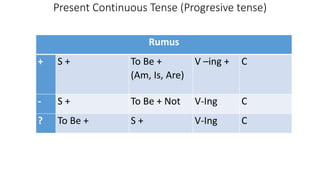
Present Continuous Tense (Progresive tense)
Rumus
+ S + To Be +
(Am, Is, Are)
V –ing + C
- S + To Be + Not V-Ing C
? To Be + S + V-Ing C
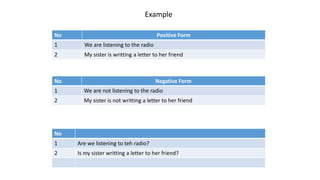
Example
No Positive Form
1 We are listening to the radio
2 My sister is writting a letter to her friend
No Negative Form
1 We are not listening to the radio
2 My sister is not writting a letter to her friend
No
1 Are we listening to teh radio?
2 Is my sister writting a letter to her friend?
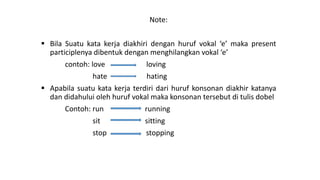
Note:
 Bila Suatu kata kerja diakhiri dengan huruf vokal ‘e’ maka present
participlenya dibentuk dengan menghilangkan vokal ‘e’
contoh: love loving
hate hating
 Apabila suatu kata kerja terdiri dari huruf konsonan diakhir katanya
dan didahului oleh huruf vokal maka konsonan tersebut di tulis dobel
Contoh: run running
sit sitting
stop stopping
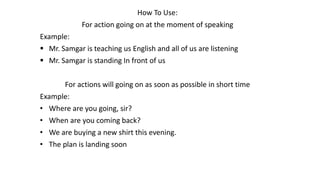
How To Use:
For action going on at the moment of speaking
Example:
 Mr. Samgar is teaching us English and all of us are listening
 Mr. Samgar is standing In front of us
For actions will going on as soon as possible in short time
Example:
• Where are you going, sir?
• When are you coming back?
• We are buying a new shirt this evening.
• The plan is landing soon
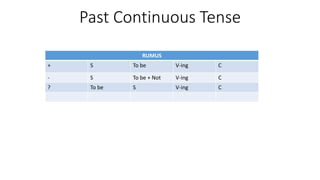
Past Continuous Tense
RUMUS
+ S To be V-ing C
- S To be + Not V-ing C
? To be S V-ing C
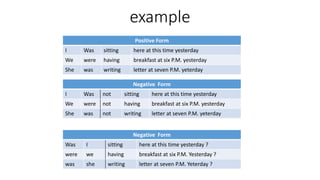
example
Positive Form
I Was sitting here at this time yesterday
We were having breakfast at six P.M. yesterday
She was writing letter at seven P.M. yeterday
Negative Form
I Was not sitting here at this time yesterday
We were not having breakfast at six P.M. yesterday
She was not writing letter at seven P.M. yeterday
Negative Form
Was I sitting here at this time yesterday ?
were we having breakfast at six P.M. Yesterday ?
was she writing letter at seven P.M. Yeterday ?
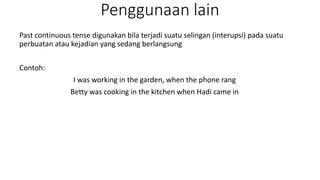
Penggunaan lain
Past continuous tense digunakan bila terjadi suatu selingan (interupsi) pada suatu
perbuatan atau kejadian yang sedang berlangsung
Contoh:
I was working in the garden, when the phone rang
Betty was cooking in the kitchen when Hadi came in
Future Tense
+ S Shall, will, be going to V I C
- S Shall, will, be
going to
Not
? Shall, will, be
going to
S V I C
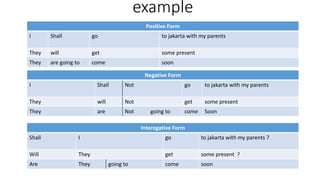
example
I
Positive Form
I Shall go to jakarta with my parents
They will get some present
They are going to come soon
Negative Form
I Shall Not go to jakarta with my parents
They will Not get some present
They are Not going to come Soon
Interogative Form
Shall I go to jakarta with my parents ?
Will They get some present ?
Are They going to come soon
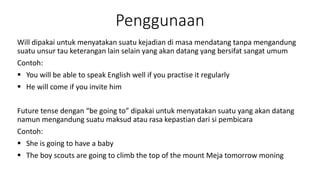
Penggunaan
Will dipakai untuk menyatakan suatu kejadian di masa mendatang tanpa mengandung
suatu unsur tau keterangan lain selain yang akan datang yang bersifat sangat umum
Contoh:
 You will be able to speak English well if you practise it regularly
 He will come if you invite him
Future tense dengan “be going to” dipakai untuk menyatakan suatu yang akan datang
namun mengandung suatu maksud atau rasa kepastian dari si pembicara
Contoh:
 She is going to have a baby
 The boy scouts are going to climb the top of the mount Meja tomorrow moning
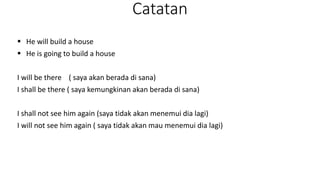
Catatan
 He will build a house
 He is going to build a house
I will be there ( saya akan berada di sana)
I shall be there ( saya kemungkinan akan berada di sana)
I shall not see him again (saya tidak akan menemui dia lagi)
I will not see him again ( saya tidak akan mau menemui dia lagi)
Future Perfect Tense
S AUX. VERBS HAVE V-3 C
S AUX.VERBS NOT HAVE V-3 C
AUX.VERB S HAVE V-3 C
Example
We will have finished Our home work to night
I shall Have read This novel
She may Have come Home tonight
We Will + NOT have finished Our home work to night
I Shall + NOT have read This novel
She May + NOT have come Home tonight
Will we have finished Our home work to night
shall I have read This novel
may she have come Home tonight
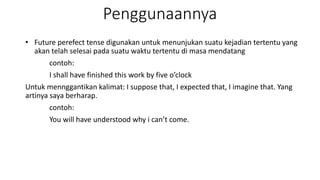
Penggunaannya
• Future perefect tense digunakan untuk menunjukan suatu kejadian tertentu yang
akan telah selesai pada suatu waktu tertentu di masa mendatang
contoh:
I shall have finished this work by five o’clock
Untuk mennggantikan kalimat: I suppose that, I expected that, I imagine that. Yang
artinya saya berharap.
contoh:
You will have understood why i can’t come.
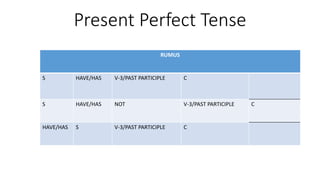
Present Perfect Tense
RUMUS
S HAVE/HAS V-3/PAST PARTICIPLE C
S HAVE/HAS NOT V-3/PAST PARTICIPLE C
HAVE/HAS S V-3/PAST PARTICIPLE C
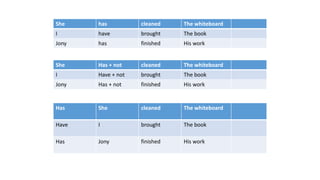
She has cleaned The whiteboard
I have brought The book
Jony has finished His work
She Has + not cleaned The whiteboard
I Have + not brought The book
Jony Has + not finished His work
Has She cleaned The whiteboard
Have I brought The book
Has Jony finished His work
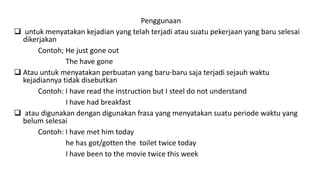
Penggunaan
 untuk menyatakan kejadian yang telah terjadi atau suatu pekerjaan yang baru selesai
dikerjakan
Contoh; He just gone out
The have gone
 Atau untuk menyatakan perbuatan yang baru-baru saja terjadi sejauh waktu
kejadiannya tidak disebutkan
Contoh: I have read the instruction but I steel do not understand
I have had breakfast
 atau digunakan dengan digunakan frasa yang menyatakan suatu periode waktu yang
belum selesai
Contoh: I have met him today
he has got/gotten the toilet twice today
I have been to the movie twice this week
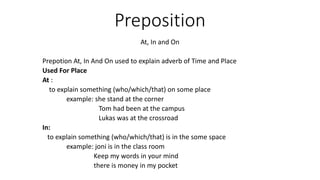
Preposition
At, In and On
Prepotion At, In And On used to explain adverb of Time and Place
Used For Place
At :
to explain something (who/which/that) on some place
example: she stand at the corner
Tom had been at the campus
Lukas was at the crossroad
In:
to explain something (who/which/that) is in the some space
example: joni is in the class room
Keep my words in your mind
there is money in my pocket
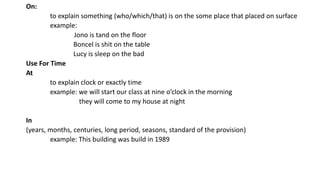
On:
to explain something (who/which/that) is on the some place that placed on surface
example:
Jono is tand on the floor
Boncel is shit on the table
Lucy is sleep on the bad
Use For Time
At
to explain clock or exactly time
example: we will start our class at nine o’clock in the morning
they will come to my house at night
In
(years, months, centuries, long period, seasons, standard of the provision)
example: This building was build in 1989

Present Continuous Tense (Progresive tense).pptx

  • 1.
    Present Continuous Tense(Progresive tense) Rumus + S + To Be + (Am, Is, Are) V –ing + C - S + To Be + Not V-Ing C ? To Be + S + V-Ing C
  • 2.
    Example No Positive Form 1We are listening to the radio 2 My sister is writting a letter to her friend No Negative Form 1 We are not listening to the radio 2 My sister is not writting a letter to her friend No 1 Are we listening to teh radio? 2 Is my sister writting a letter to her friend?
  • 3.
    Note:  Bila Suatukata kerja diakhiri dengan huruf vokal ‘e’ maka present participlenya dibentuk dengan menghilangkan vokal ‘e’ contoh: love loving hate hating  Apabila suatu kata kerja terdiri dari huruf konsonan diakhir katanya dan didahului oleh huruf vokal maka konsonan tersebut di tulis dobel Contoh: run running sit sitting stop stopping
  • 4.
    How To Use: Foraction going on at the moment of speaking Example:  Mr. Samgar is teaching us English and all of us are listening  Mr. Samgar is standing In front of us For actions will going on as soon as possible in short time Example: • Where are you going, sir? • When are you coming back? • We are buying a new shirt this evening. • The plan is landing soon
  • 5.
    Past Continuous Tense RUMUS +S To be V-ing C - S To be + Not V-ing C ? To be S V-ing C
  • 6.
    example Positive Form I Wassitting here at this time yesterday We were having breakfast at six P.M. yesterday She was writing letter at seven P.M. yeterday Negative Form I Was not sitting here at this time yesterday We were not having breakfast at six P.M. yesterday She was not writing letter at seven P.M. yeterday Negative Form Was I sitting here at this time yesterday ? were we having breakfast at six P.M. Yesterday ? was she writing letter at seven P.M. Yeterday ?
  • 7.
    Penggunaan lain Past continuoustense digunakan bila terjadi suatu selingan (interupsi) pada suatu perbuatan atau kejadian yang sedang berlangsung Contoh: I was working in the garden, when the phone rang Betty was cooking in the kitchen when Hadi came in
  • 8.
    Future Tense + SShall, will, be going to V I C - S Shall, will, be going to Not ? Shall, will, be going to S V I C
  • 9.
    example I Positive Form I Shallgo to jakarta with my parents They will get some present They are going to come soon Negative Form I Shall Not go to jakarta with my parents They will Not get some present They are Not going to come Soon Interogative Form Shall I go to jakarta with my parents ? Will They get some present ? Are They going to come soon
  • 10.
    Penggunaan Will dipakai untukmenyatakan suatu kejadian di masa mendatang tanpa mengandung suatu unsur tau keterangan lain selain yang akan datang yang bersifat sangat umum Contoh:  You will be able to speak English well if you practise it regularly  He will come if you invite him Future tense dengan “be going to” dipakai untuk menyatakan suatu yang akan datang namun mengandung suatu maksud atau rasa kepastian dari si pembicara Contoh:  She is going to have a baby  The boy scouts are going to climb the top of the mount Meja tomorrow moning
  • 11.
    Catatan  He willbuild a house  He is going to build a house I will be there ( saya akan berada di sana) I shall be there ( saya kemungkinan akan berada di sana) I shall not see him again (saya tidak akan menemui dia lagi) I will not see him again ( saya tidak akan mau menemui dia lagi)
  • 12.
    Future Perfect Tense SAUX. VERBS HAVE V-3 C S AUX.VERBS NOT HAVE V-3 C AUX.VERB S HAVE V-3 C
  • 13.
    Example We will havefinished Our home work to night I shall Have read This novel She may Have come Home tonight We Will + NOT have finished Our home work to night I Shall + NOT have read This novel She May + NOT have come Home tonight Will we have finished Our home work to night shall I have read This novel may she have come Home tonight
  • 14.
    Penggunaannya • Future perefecttense digunakan untuk menunjukan suatu kejadian tertentu yang akan telah selesai pada suatu waktu tertentu di masa mendatang contoh: I shall have finished this work by five o’clock Untuk mennggantikan kalimat: I suppose that, I expected that, I imagine that. Yang artinya saya berharap. contoh: You will have understood why i can’t come.
  • 15.
    Present Perfect Tense RUMUS SHAVE/HAS V-3/PAST PARTICIPLE C S HAVE/HAS NOT V-3/PAST PARTICIPLE C HAVE/HAS S V-3/PAST PARTICIPLE C
  • 16.
    She has cleanedThe whiteboard I have brought The book Jony has finished His work She Has + not cleaned The whiteboard I Have + not brought The book Jony Has + not finished His work Has She cleaned The whiteboard Have I brought The book Has Jony finished His work
  • 17.
    Penggunaan  untuk menyatakankejadian yang telah terjadi atau suatu pekerjaan yang baru selesai dikerjakan Contoh; He just gone out The have gone  Atau untuk menyatakan perbuatan yang baru-baru saja terjadi sejauh waktu kejadiannya tidak disebutkan Contoh: I have read the instruction but I steel do not understand I have had breakfast  atau digunakan dengan digunakan frasa yang menyatakan suatu periode waktu yang belum selesai Contoh: I have met him today he has got/gotten the toilet twice today I have been to the movie twice this week
  • 18.
    Preposition At, In andOn Prepotion At, In And On used to explain adverb of Time and Place Used For Place At : to explain something (who/which/that) on some place example: she stand at the corner Tom had been at the campus Lukas was at the crossroad In: to explain something (who/which/that) is in the some space example: joni is in the class room Keep my words in your mind there is money in my pocket
  • 19.
    On: to explain something(who/which/that) is on the some place that placed on surface example: Jono is tand on the floor Boncel is shit on the table Lucy is sleep on the bad Use For Time At to explain clock or exactly time example: we will start our class at nine o’clock in the morning they will come to my house at night In (years, months, centuries, long period, seasons, standard of the provision) example: This building was build in 1989