Packet 15, page 1
INFIX,
PREFIX, AND
POSTFIX
EXPRESSIONS
Packet 15, page 2
KHumans usually write algebraic expressions
like this:
a + b
KThis is called infix notation, because the
operator (“+”) is inside the expression
KA problem is that we need parentheses or
precedence rules to handle more
complicated expressions:
a + b * c = (a + b) * c ?
= a + (b * c) ?
Packet 15, page 3
Infix, postfix, and prefix notation
KThere is no reason we can’t place the
operator somewhere else.
Kinfix notation:
a + b
Kprefix notation:
+ a b
Kpostfix notation:
a b +
Packet 15, page 4
Other names
KPrefix notation was introduced by the
Polish logician Lukasiewicz, and is
sometimes called “Polish notation”
KPostfix notation is sometimes called
“reverse Polish notation” or RPN
»Used on some calculators
(the ones without '=' signs)
Packet 15, page 5
KQuestion: Why would anyone ever want to
use anything so “unnatural,” when infix
seems to work just fine?
KAnswer: With postfix and prefix notations,
parentheses are no longer needed!
infix postfix prefix
(a + b) * c a b + c * * + a b c
a + (b * c) a b c * + + a * b c
Packet 15, page 6
Converting
from infix notation to postfix notation
KAssume that your infix expression is of the
form
<identifier> <operator> <identifier>
KA postfix expression is created by rewriting
this as
<identifier> <identifier> <operator>
Packet 15, page 7
Convert these infix expressions to
postfix notation
Kx
Kx + y
K(x + y) - z
Kw * ((x + y) - z)
K(2 * a) / ((a + b) * (a - c))
Packet 15, page 8
Convert these postfix expressions to
infix notation
K3 r -
K1 3 r - +
Ks t * 1 3 r - + +
Kv w x y z * - + *
Packet 15, page 9
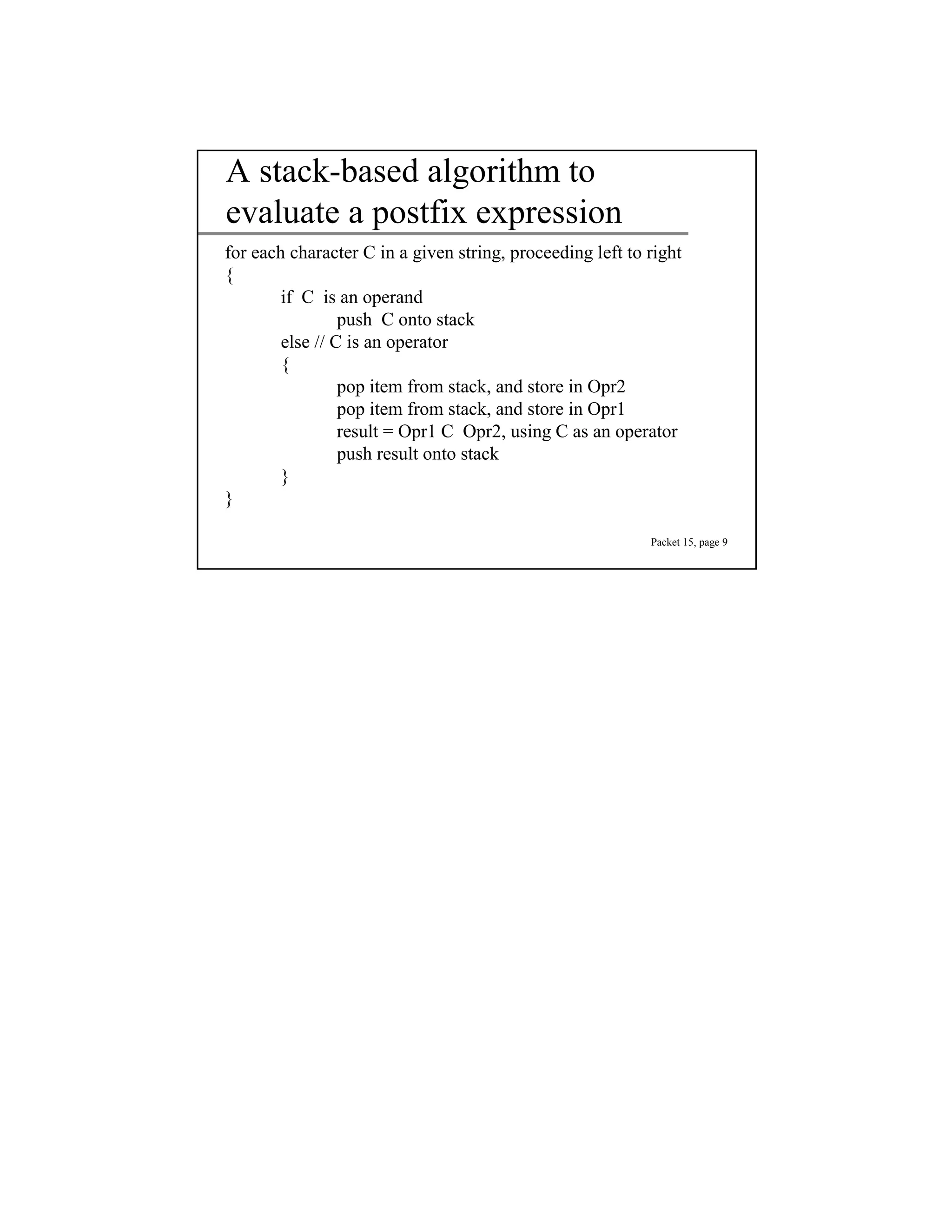
A stack-based algorithm to
evaluate a postfix expression
for each character C in a given string, proceeding left to right
{
if C is an operand
push C onto stack
else // C is an operator
{
pop item from stack, and store in Opr2
pop item from stack, and store in Opr1
result = Opr1 C Opr2, using C as an operator
push result onto stack
}
}

Prepostinfix

  • 1.
    Packet 15, page1 INFIX, PREFIX, AND POSTFIX EXPRESSIONS Packet 15, page 2 KHumans usually write algebraic expressions like this: a + b KThis is called infix notation, because the operator (“+”) is inside the expression KA problem is that we need parentheses or precedence rules to handle more complicated expressions: a + b * c = (a + b) * c ? = a + (b * c) ?
  • 2.
    Packet 15, page3 Infix, postfix, and prefix notation KThere is no reason we can’t place the operator somewhere else. Kinfix notation: a + b Kprefix notation: + a b Kpostfix notation: a b + Packet 15, page 4 Other names KPrefix notation was introduced by the Polish logician Lukasiewicz, and is sometimes called “Polish notation” KPostfix notation is sometimes called “reverse Polish notation” or RPN »Used on some calculators (the ones without '=' signs)
  • 3.
    Packet 15, page5 KQuestion: Why would anyone ever want to use anything so “unnatural,” when infix seems to work just fine? KAnswer: With postfix and prefix notations, parentheses are no longer needed! infix postfix prefix (a + b) * c a b + c * * + a b c a + (b * c) a b c * + + a * b c Packet 15, page 6 Converting from infix notation to postfix notation KAssume that your infix expression is of the form <identifier> <operator> <identifier> KA postfix expression is created by rewriting this as <identifier> <identifier> <operator>
  • 4.
    Packet 15, page7 Convert these infix expressions to postfix notation Kx Kx + y K(x + y) - z Kw * ((x + y) - z) K(2 * a) / ((a + b) * (a - c)) Packet 15, page 8 Convert these postfix expressions to infix notation K3 r - K1 3 r - + Ks t * 1 3 r - + + Kv w x y z * - + *
  • 5.
    Packet 15, page9 A stack-based algorithm to evaluate a postfix expression for each character C in a given string, proceeding left to right { if C is an operand push C onto stack else // C is an operator { pop item from stack, and store in Opr2 pop item from stack, and store in Opr1 result = Opr1 C Opr2, using C as an operator push result onto stack } }