Why Customer Loyalty Is Important
Imagine you are just starting up a business you have a lot of
debts and no reputation; you rely on customers coming in
every day to stay open. Imagine how valuable having a
customer that will come in every day would be. Now scale
that up as your business grows, 10 customers, 100 customers
how much income is that? Regardless of the size or
popularity of your business, you will have good days and bad
days. There will be unforeseen costs or disasters that will eat
at your profit reserves such as Apples recent scandal over
slowing down older iPhones. Your company will need to have
successful months following this in order to recover. The
security of knowing that you will always have a certain
amount of customers coming into the store and purchasing
products is invaluable.
So what is the most important aspect of customer loyalty?
It’s the staff, that’s right the staff. Think about when you got
into a retail store to purchase something, you don’t speak to
the owners or the executives. These are the positions
traditionally considered the most important as they make all
of the decisions. Most of the time you will talk to the staff
and occasionally the manager. Depending on how good of a
job they did will be the difference between you coming back
to the store or not.
Staff will be dealing with all of your queries and will often
determine whether you walk away with a positive or
negative experience. You won’t go back to a store if you have
a negative experience there, so the staff members’ job is
extremely important. For customer loyalty, the way staff
members interact with customers is far more important than
decisions made by those in higher positions. Top positions in
the company could have designed the best loyalty scheme
with amazing benefits for customers. If the customer has a
bad experience in the store or with staff, they won’t want to
be a part of it.
Now that you have seen the importance of staff within
customer loyalty you know how essential it is to train them
correctly and treat them with respect. Their job is far more
than simply stacking shelves or telling customers which aisle
a product is in. Without customers there is no income,
without income, there is no business.
Apple, McDonald’s, Nike. What do all of these businesses
have in common? Staff. One person didn’t build Apple to the
giant is today, even though we all think of Steve Jobs. You
can’t do everything yourself and if you plan to grow your
business you will need staff. Staff can be just as important as
any manager or even the owner. We know the business is
your baby, but you will need to distribute the work so it can
grow. You need to ask yourself, do you want to have a small
business you have complete control over, or a large
multinational business you have less control over but earns
more money.
Think about all of the businesses or brands you buy products
from, there will be a lot that you continually buy from. These
businesses or brands don’t need to do anything to entice you
to buy their products.
The following document will show you the secret strategies
to train your staff effectively. You don’t want to have useless
staff not doing the work you pay them for do you? Higher
productivity, fewer “sick” staff and a better quality of work
are just some of the benefits of training staff correctly. The
University of Warwick found that a happy worker was 12%
more productive while unhappy workers are 10% less
productive. Keeping your staff’s productivity high is directly
tied to their happiness. What makes each staff member
happy will vary, so getting to know your staff members is
essential. You won’t be interested in the same things as your
dad. Between April and June 2017, the average sickness rate
in the UK is 3.80%. That’s around 14 days off a year per
employee. Imagine 2 weeks of work lost per employee, how
much money is that for you? So how do you avoid all of this?
Continue reading the document to discover many more
benefits for your business.
Your business needs customers and it is essential to keep
them happy, so they will keep coming back to your business.
Your customers can be extremely difficult to deal with but
you already know this. Dealing with your customers
professionally can be the difference between them coming
back to your store or leaving a scathing review. You definitely
don’t want new potential customers seeing bad reviews as
their first view of your business. The following tips will help
you deal with your customers professionally and effectively.
Helping your business to retain customers and avoid any
unnecessary bad reviews.
Being friendly is a great first step in establishing a great
relationship with a potential customer. Remember that
customers are people too, you wouldn’t want to talk to staff
that comes across as grumpy or unfriendly.
Having your staff provide a good customer experience can
help massively boost sales. Let’s be honest that’s what you’re
really after. The customer's experience will influence
whether they buy a product or not, sometimes even more
than the product itself. If you went to buy bread but the staff
was rude and unhelpful, you would just buy it somewhere
else.
Not bothering customers is essential; feeling pressured by
the staff to make a purchase will put customers off. Imagine
trying to decide on which product to buy and having a staff
member breathing down your neck. Customers want to feel
free to browse products at their own leisure, talking to staff
when they want to. Finding a balance between giving
customers their space and going over to help them is
difficult. You want to help your customer as much as possible
but sometimes doing nothing is the best idea. Train your staff
to identify when a customer needs help, such as struggling to
take a product off the top shelf. Your staff should avoid
bothering the customer unless they notice one of these signs.
Just imagine a do not disturb sign on someone’s door; unless
the building was burning down you wouldn’t enter.
The end goal of your floor staff is to drive a sale and
customers will be aware of this. Providing a good customer
experience should be your main priority. How many bad
experiences you’ve had in other businesses can you
remember? You will be able to remember a lot of them quite
clearly. You don’t want your business to be known for bad
experiences, provide the best customer experience possible.
Not only will this be a pleasant surprise for the customer but
also make a sale much more likely. A good customer
experience will make them remember your business and
return for repeat purchases. 61% of small and medium
businesses get over half of their revenue from repeat
customers.
One example is advising a customer to purchase a different
product than the one they were originally going to buy. You
will have been in a situation where you can’t decide between
two products. Having a staff member come up and give you
helpful advice will be a relief and you will likely return to that
business. This product may be of a better value to the
customer than the original product. Whilst you might lose
some revenue on items that are exchanged for cheaper
variants, providing this service will build up your reputation.
This will also encourage repeat purchases, which more than
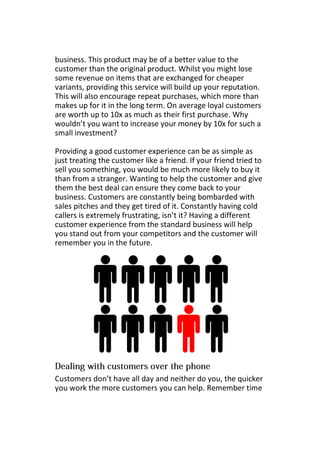
makes up for it in the long term. On average loyal customers
are worth up to 10x as much as their first purchase. Why
wouldn’t you want to increase your money by 10x for such a
small investment?
Providing a good customer experience can be as simple as
just treating the customer like a friend. If your friend tried to
sell you something, you would be much more likely to buy it
than from a stranger. Wanting to help the customer and give
them the best deal can ensure they come back to your
business. Customers are constantly being bombarded with
sales pitches and they get tired of it. Constantly having cold
callers is extremely frustrating, isn’t it? Having a different
customer experience from the standard business will help
you stand out from your competitors and the customer will
remember you in the future.
Customers don’t have all day and neither do you, the quicker
you work the more customers you can help. Remember time
is money. Depending on the size of your business there may
be a large number of customers trying to contact you. The
longer customers are kept waiting the angrier they will get.
Remember the last time you had a problem with a product
and couldn’t get in contact with the business. How angry
with that business did you get? The angrier a customer is, the
more difficult they are to deal with so don’t leave them
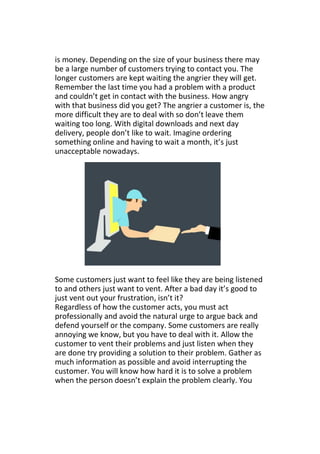
waiting too long. With digital downloads and next day
delivery, people don’t like to wait. Imagine ordering
something online and having to wait a month, it’s just
unacceptable nowadays.
Some customers just want to feel like they are being listened
to and others just want to vent. After a bad day it’s good to
just vent out your frustration, isn’t it?
Regardless of how the customer acts, you must act
professionally and avoid the natural urge to argue back and
defend yourself or the company. Some customers are really
annoying we know, but you have to deal with it. Allow the
customer to vent their problems and just listen when they
are done try providing a solution to their problem. Gather as
much information as possible and avoid interrupting the
customer. You will know how hard it is to solve a problem
when the person doesn’t explain the problem clearly. You
can’t reason with the customer until they are done venting
their problems and interrupting will just make them angrier.
The problem may not always be your company or a staff
members fault, sympathise with the customer and make
them feel as you understand their problem. Phrases such as
“I’m sorry this happened to you” and “I understand
Sir/Madam it must be extremely frustrating for you” can help
the customer feel you care about their problem without
admitting that the company is at fault.
Apologizing is good but you still need to resolve the
customer's issue, sometimes the customer's problem is
unreasonable. If you spent enough time dealing with
customers you will know all about this. Make sure not to
promise anything to the customer that you can’t deliver. You
may have to transfer the customer to another department or
member of staff to resolve the issue. Tell them you will have
to transfer them and explain who they are being transferred
to and why they are qualified to help. Customers don’t want
to be messed around and feel like they are just being
transferred just to avoid dealing with their problem. Some
problems cannot be solved, in this case, offer the customer
the next best solution. If their product is broken it is unlikely
it can be fixed, however you can send them a replacement
for free.
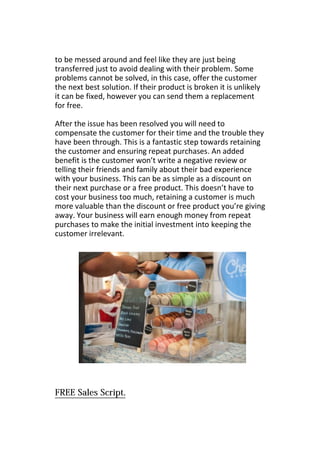
After the issue has been resolved you will need to
compensate the customer for their time and the trouble they
have been through. This is a fantastic step towards retaining
the customer and ensuring repeat purchases. An added
benefit is the customer won’t write a negative review or
telling their friends and family about their bad experience
with your business. This can be as simple as a discount on
their next purchase or a free product. This doesn’t have to
cost your business too much, retaining a customer is much
more valuable than the discount or free product you’re giving
away. Your business will earn enough money from repeat
purchases to make the initial investment into keeping the
customer irrelevant.
Over the next few pages are a free set of templates with a
step by step on how to make your own basic sales script that
can be changed ever so slightly to fit your business (they are
suitable for businesses from most areas of the industry). Just
let your sales staff try it out once you’re done and see the
huge difference it makes, it’s that simple.
Pick any one of the examples from each section, fill in the
blanks as you need and put them all together to make your
own script. I have also included a pre-made example script as
well as one of the basic sales scripts that I give to my starter
sales staff to use. You are free to use this script as well.
Step 1 – introduce yourself to the customer:
Intro1: Hi my name’s ______ I was just wondering whether I
could interest you in _______ today?
Intro2: Hello ______ I’m ________, I see that you ________,
would you by any chance be interested in ________?
Intro3: Hi _____ this is _____ from ______ and I was just
wondering whether ______ would be of any interest to you.
Intro4: Hi ____ . My name is ____ from ____ and I can see
that you _____ I’m guessing that this is because of _____. I
just wanted to let you about a solution to ______.
Step 2 – Tell them the benefits/values of what you’re
offering:
Value1: Multiple businesses within the same area as yourself
have already used ______ and found that it is the perfect
solution to ______.
Value2: Many customers now use ______ because of all of
the great benefits that it brings them such as ______.
Value3: I can see that you already use _____ and that is
great because it tells me that you have knowledge of _____
however most of our customers have found that where
_____ can do ____ & ____ our product/system/service can
also do ______.
Step 3 – Downplay the customers and get them interested in
the offer:
Downplay1: To be honest I’m not entirely sure that _____ is
right for you, do you mind if I ask you a question or two and
hopefully it will prove me wrong.
Downplay2: You might not actually be able to make use of
_____, usually it would only be beneficial to customers who
_______, do you mind if I ask you a few questions to make
sure that I am not going to be wasting your time?
Step 4 – Find out whether or not the customer is actually
worth your time by using multiple questions to qualify
them:
Qualify1: Do you think that you would benefit from ____.
Qualify2: Is it currently challenging to ______.
Qualify3: Are you concerned about ______.
Qualify4: Are you/your business currently looking for ways to
progress in ¬¬¬¬______?
Qualify5: Do you believe that you already know ______.
Qualify6: Do you and your team currently ______.
Qualify7: What is your current process for ______.
Qualify8: How do you currently solve ______.
Step 5 – Reference where others have had issues with the
thing that your offer solves:
Issue1: Usually when speaking to other people from your
retail area we have found that they have had trouble with
______ is that something that you also have trouble with?
Issue2: By any chance do you have problems with ____ as we
have found that most people in the same area of business
also have those problems.
Issue3: Sometimes when speaking to other individuals they
have had problems with ______ does that apply to you as
well?
Step 6 – Rekindle interest in the offer by stating some key
features:
Feature1: Well looking at what you have told me so far I
believe that _____ is perfect for you as it addresses ______
by ______. So I think it would be great to have a more in-
depth discussion at some point
Feature2: If we look at what has been said so far, you can
rest assured knowing that _____ will solve _______. I would
recommend that we have a detailed talk about how to
proceed at a later date.
Feature3: I can tell you that _____ has helped multiple
people solve the same problems that you are having,
however, I believe that we will need to arrange more time for
a longer chat at another time.
Step 7 – Decide which close you are going to use (Trial, Soft
or Hard – use the conversation up until this point to decide):
Trial1: So what do you think about everything that we have
discussed up until now?
Trial2: Would you be interested in discussing what we have
talked about today in more detail?
Trial3: Does this seem like it will be able to solve the
problems that you are having?
Soft1: It would be great if we could organise a 10-20 minute
meeting so that we can further discuss what we have done to
today and go over any further challenges.
Soft2: So would you like to book me in on your calendar
somewhere?
Soft3: It is probably worth us scheduling a 10 minute chat
before you go over any other alternatives just to make sure
that this is perfect for you.
Hard1: Right then, how does next Tuesday at 10am sound for
you, we can have a 15/20 minute meeting and can go over all
of your goals and challenges.
Hard2: So the next free slot I have is this coming Tuesday at
about 10am, how does that work for you, it shouldn’t be any
longer than 20 minutes and we can iron out everything that
we have went over today.
Hard3: Ok, how does your schedule look for next Tuesday
morning for us to set up a 15 to 20 minute chat where we
can discuss the challenges and goals that we have gone over
today, and I can give you a more detailed overview of _____.
Example Customer Loyalty Sales Script.
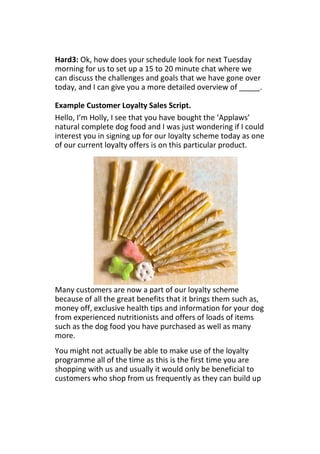
Hello, I’m Holly, I see that you have bought the ‘Applaws’
natural complete dog food and I was just wondering if I could
interest you in signing up for our loyalty scheme today as one
of our current loyalty offers is on this particular product.
Many customers are now a part of our loyalty scheme
because of all the great benefits that it brings them such as,
money off, exclusive health tips and information for your dog
from experienced nutritionists and offers of loads of items
such as the dog food you have purchased as well as many
more.
You might not actually be able to make use of the loyalty
programme all of the time as this is the first time you are
shopping with us and usually it would only be beneficial to
customers who shop from us frequently as they can build up
points but if you don’t mind, could I ask you a few questions
to make sure I’m not going to waste your time?
 Do you believe that you will shop with us again?
 Do you think that you would benefit from
experienced advice on the best care for your dog?
Sometimes when speaking to other individuals they have had
problems with what they want to purchase being in stock in
other stores, does this apply to you as well?
If we look at what you have told me so far, you can be rest
assured knowing that our loyalty programme will give you
what you are looking for and solve some of the problems you
have been experiencing. So I think it would be a good idea to
discuss how the programme works in a bit more detail and
you can decide if you want to sign up or not. So, what do you
think about everything that we have discussed so far?
My Starter Staff Sales Script.
Hi Amanda, this is Kris from Premier EPOS and I was just
wondering whether an electronic point of sale would be any
interest to you.
I can see that you already use an EPOS system within your
business which is great because you’ll already have
knowledge of how they work. However, most of our
customers have found that where general EPOS systems can
report, control and manage stocks and of course organise
and track of sales our system can do all of these things but
also has a customer loyalty section which counts points if you
have a customer loyalty scheme and link offers with loyalty
cards, has a security system built in so there is staff
management, logging, lockout, and restrictions as well as a
customisable sales screen so you can personalise it to your
business plus many more award-winning features.
In my honest opinion I’m not entirely sure whether the
system is right for your business but if you don’t mind I’d like
to ask you a few questions and hopefully, your answers will
prove me wrong.
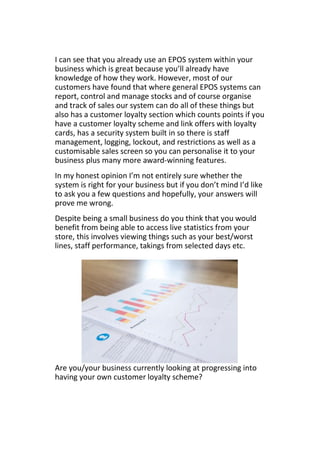
Despite being a small business do you think that you would
benefit from being able to access live statistics from your
store, this involves viewing things such as your best/worst
lines, staff performance, takings from selected days etc.
Are you/your business currently looking at progressing into
having your own customer loyalty scheme?
Usually, when speaking to other people from your retail area
we have found that they have had trouble with the security
of their business and are concerned about the level of
information their staff can access on their current EPOS
system. Is this something you have had trouble with as well?
Would you like to be able to restrict access to certain things?
I can confidently tell you that our EPOS system has helped
multiple people solve these problems and if you are having
the same ones or any others you would like to ask about I
recommend that we have a detailed talk about how to
proceed at a later date. So, would you like me to book you in
on my calendar somewhere?
Business Principles
The next few pages will cover key business principles that
you can adapt and use in any type of business. These
principles will accelerate your businesses growth and
increase your bottom line. Simply try these tips in your
business for a week and see the results for yourself.
Increasing Staff Performance:
Staff performance has a massive impact on all aspects of the
business such as sales and productivity. Improving your
staff’s performance needs to be one of the main priorities of
your business. A lot of time and resources is spent on
recruitment and selection, as well as training the staff
member. This will mean that you want to retain your staff as
long as possible and get a return on investment on them.
Providing incentives for your staff are an excellent way to
increase performance, it doesn’t have to be a higher salary.
Be sure to be public about the rewards for working hard and
tell other staff members when a staff member has earned a
reward. If your staff are aware that they can receive rewards
for working hard, it will encourage staff to work harder. Staff
seeing their co-workers earning rewards will also make them
want to work harder due to jealousy.
Offering extra paid holidays to the staff is a great alternative
to a raise, the extra holidays can help staff relax and recharge
after all of their hard work. Simply congratulating your staff
personally can make them feel you appreciate their hard
work. This can keep staff motivated to keep working as well
as prevent staff from thinking their hard work goes
unnoticed.
Give your staff a sense of accomplishment by having them
play a key part of a larger goal. Customer loyalty schemes are
a fantastic way to do this as staff play a larger role than top
positions in management. No one wants to feel like their job
is useless, so avoid giving staff unnecessary tasks. If staff feel
that their work is unnecessary it can lead to a loss of morale
and a massive drop in their quality of work. Tell staff clearly
what they are doing and more importantly why they are
doing it. Show them the results of their work so they don’t
feel like they have wasted their time and energy.
Skyrocket sales team numbers
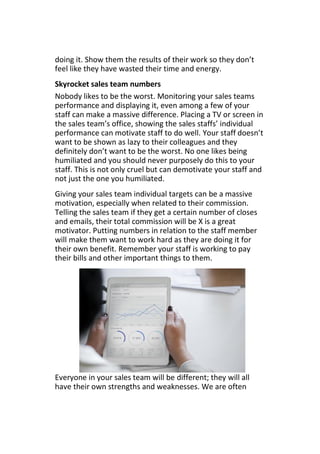
Nobody likes to be the worst. Monitoring your sales teams
performance and displaying it, even among a few of your
staff can make a massive difference. Placing a TV or screen in
the sales team’s office, showing the sales staffs’ individual
performance can motivate staff to do well. Your staff doesn’t
want to be shown as lazy to their colleagues and they
definitely don’t want to be the worst. No one likes being
humiliated and you should never purposely do this to your
staff. This is not only cruel but can demotivate your staff and
not just the one you humiliated.
Giving your sales team individual targets can be a massive
motivation, especially when related to their commission.
Telling the sales team if they get a certain number of closes
and emails, their total commission will be X is a great
motivator. Putting numbers in relation to the staff member
will make them want to work hard as they are doing it for
their own benefit. Remember your staff is working to pay
their bills and other important things to them.
Everyone in your sales team will be different; they will all
have their own strengths and weaknesses. We are often
taught to play to our strengths, while this is good advice it
doesn’t solve the problem. Sit down with staff individually to
talk about their weaknesses and problems. Create a plan
about how they can overcome their weaknesses, by
providing targets for them to show progress. Do this within
their comfort zones; if someone has trouble dealing with
angry customers don’t give them your angriest customer
right away. Start them off slowly with tasks they are
comfortable with, then begin to escalate. Having staff
improve their weakness will not only improve their
motivation but also allow them to do more types of work.
Better sales staff will also be able to get more customers to
sign up for your customer loyalty scheme.
Getting the extra connection with your staff means they have
more respect for you. The staff that respects their bosses or
managers will want to work harder and maybe even take
overtime when needed to not let them down. In order to
know what your staff’s weaknesses are, you may need to
monitor their progress.
Keep in mind these numbers don’t tell the full story, there
may be other factors affecting their work. Sit down and talk
with the staff member to help them, rather than pulling them
up on their shortcomings. Asking the staff member what
skills they’d like to improve or how things are going is a great
way to find their weaknesses while coming across as friendly
and helpful. Avoid saying “I saw your calls were much lower
this month” or “we need to talk about your performance”
This will make the staff member feel attacked and go on the
defensive. You want them to open up to you and feel
comfortable like you are trying to help them, not like they
are on trial.
Conclusion
Now you are armed with all of the resources you need to
train your staff effectively there is only one task left. Go out
and do it. No seriously, do it right now. Don’t just read this
and then put it to the side for later, we both know you won’t
do it. If you don’t put these tips to use then you’ve wasted
your time and time is money. If I asked you to take out
hundreds maybe even thousands and burn it right now,
you’d think that was crazy right? This is no different, so go
and use these tips to start making more money today.

Premier EPOS Staff training manual

  • 2.
    Why Customer LoyaltyIs Important Imagine you are just starting up a business you have a lot of debts and no reputation; you rely on customers coming in every day to stay open. Imagine how valuable having a customer that will come in every day would be. Now scale that up as your business grows, 10 customers, 100 customers how much income is that? Regardless of the size or popularity of your business, you will have good days and bad days. There will be unforeseen costs or disasters that will eat at your profit reserves such as Apples recent scandal over slowing down older iPhones. Your company will need to have successful months following this in order to recover. The security of knowing that you will always have a certain amount of customers coming into the store and purchasing products is invaluable. So what is the most important aspect of customer loyalty? It’s the staff, that’s right the staff. Think about when you got into a retail store to purchase something, you don’t speak to the owners or the executives. These are the positions
  • 3.
    traditionally considered themost important as they make all of the decisions. Most of the time you will talk to the staff and occasionally the manager. Depending on how good of a job they did will be the difference between you coming back to the store or not. Staff will be dealing with all of your queries and will often determine whether you walk away with a positive or negative experience. You won’t go back to a store if you have a negative experience there, so the staff members’ job is extremely important. For customer loyalty, the way staff members interact with customers is far more important than decisions made by those in higher positions. Top positions in the company could have designed the best loyalty scheme with amazing benefits for customers. If the customer has a bad experience in the store or with staff, they won’t want to be a part of it.
  • 4.
    Now that youhave seen the importance of staff within customer loyalty you know how essential it is to train them correctly and treat them with respect. Their job is far more than simply stacking shelves or telling customers which aisle a product is in. Without customers there is no income, without income, there is no business. Apple, McDonald’s, Nike. What do all of these businesses have in common? Staff. One person didn’t build Apple to the giant is today, even though we all think of Steve Jobs. You can’t do everything yourself and if you plan to grow your business you will need staff. Staff can be just as important as any manager or even the owner. We know the business is your baby, but you will need to distribute the work so it can grow. You need to ask yourself, do you want to have a small business you have complete control over, or a large multinational business you have less control over but earns more money. Think about all of the businesses or brands you buy products from, there will be a lot that you continually buy from. These businesses or brands don’t need to do anything to entice you to buy their products. The following document will show you the secret strategies to train your staff effectively. You don’t want to have useless
  • 5.
    staff not doingthe work you pay them for do you? Higher productivity, fewer “sick” staff and a better quality of work are just some of the benefits of training staff correctly. The University of Warwick found that a happy worker was 12% more productive while unhappy workers are 10% less productive. Keeping your staff’s productivity high is directly tied to their happiness. What makes each staff member happy will vary, so getting to know your staff members is essential. You won’t be interested in the same things as your dad. Between April and June 2017, the average sickness rate in the UK is 3.80%. That’s around 14 days off a year per employee. Imagine 2 weeks of work lost per employee, how much money is that for you? So how do you avoid all of this? Continue reading the document to discover many more benefits for your business. Your business needs customers and it is essential to keep them happy, so they will keep coming back to your business. Your customers can be extremely difficult to deal with but you already know this. Dealing with your customers professionally can be the difference between them coming back to your store or leaving a scathing review. You definitely don’t want new potential customers seeing bad reviews as their first view of your business. The following tips will help you deal with your customers professionally and effectively. Helping your business to retain customers and avoid any unnecessary bad reviews.
  • 6.
    Being friendly isa great first step in establishing a great relationship with a potential customer. Remember that customers are people too, you wouldn’t want to talk to staff that comes across as grumpy or unfriendly. Having your staff provide a good customer experience can help massively boost sales. Let’s be honest that’s what you’re really after. The customer's experience will influence whether they buy a product or not, sometimes even more than the product itself. If you went to buy bread but the staff was rude and unhelpful, you would just buy it somewhere else. Not bothering customers is essential; feeling pressured by the staff to make a purchase will put customers off. Imagine trying to decide on which product to buy and having a staff member breathing down your neck. Customers want to feel free to browse products at their own leisure, talking to staff when they want to. Finding a balance between giving customers their space and going over to help them is difficult. You want to help your customer as much as possible but sometimes doing nothing is the best idea. Train your staff to identify when a customer needs help, such as struggling to take a product off the top shelf. Your staff should avoid bothering the customer unless they notice one of these signs.
  • 7.
    Just imagine ado not disturb sign on someone’s door; unless the building was burning down you wouldn’t enter. The end goal of your floor staff is to drive a sale and customers will be aware of this. Providing a good customer experience should be your main priority. How many bad experiences you’ve had in other businesses can you remember? You will be able to remember a lot of them quite clearly. You don’t want your business to be known for bad experiences, provide the best customer experience possible. Not only will this be a pleasant surprise for the customer but also make a sale much more likely. A good customer experience will make them remember your business and return for repeat purchases. 61% of small and medium businesses get over half of their revenue from repeat customers. One example is advising a customer to purchase a different product than the one they were originally going to buy. You will have been in a situation where you can’t decide between two products. Having a staff member come up and give you helpful advice will be a relief and you will likely return to that
  • 8.
    business. This productmay be of a better value to the customer than the original product. Whilst you might lose some revenue on items that are exchanged for cheaper variants, providing this service will build up your reputation. This will also encourage repeat purchases, which more than makes up for it in the long term. On average loyal customers are worth up to 10x as much as their first purchase. Why wouldn’t you want to increase your money by 10x for such a small investment? Providing a good customer experience can be as simple as just treating the customer like a friend. If your friend tried to sell you something, you would be much more likely to buy it than from a stranger. Wanting to help the customer and give them the best deal can ensure they come back to your business. Customers are constantly being bombarded with sales pitches and they get tired of it. Constantly having cold callers is extremely frustrating, isn’t it? Having a different customer experience from the standard business will help you stand out from your competitors and the customer will remember you in the future. Customers don’t have all day and neither do you, the quicker you work the more customers you can help. Remember time
  • 9.
    is money. Dependingon the size of your business there may be a large number of customers trying to contact you. The longer customers are kept waiting the angrier they will get. Remember the last time you had a problem with a product and couldn’t get in contact with the business. How angry with that business did you get? The angrier a customer is, the more difficult they are to deal with so don’t leave them waiting too long. With digital downloads and next day delivery, people don’t like to wait. Imagine ordering something online and having to wait a month, it’s just unacceptable nowadays. Some customers just want to feel like they are being listened to and others just want to vent. After a bad day it’s good to just vent out your frustration, isn’t it? Regardless of how the customer acts, you must act professionally and avoid the natural urge to argue back and defend yourself or the company. Some customers are really annoying we know, but you have to deal with it. Allow the customer to vent their problems and just listen when they are done try providing a solution to their problem. Gather as much information as possible and avoid interrupting the customer. You will know how hard it is to solve a problem when the person doesn’t explain the problem clearly. You
  • 10.
    can’t reason withthe customer until they are done venting their problems and interrupting will just make them angrier. The problem may not always be your company or a staff members fault, sympathise with the customer and make them feel as you understand their problem. Phrases such as “I’m sorry this happened to you” and “I understand Sir/Madam it must be extremely frustrating for you” can help the customer feel you care about their problem without admitting that the company is at fault. Apologizing is good but you still need to resolve the customer's issue, sometimes the customer's problem is unreasonable. If you spent enough time dealing with customers you will know all about this. Make sure not to promise anything to the customer that you can’t deliver. You may have to transfer the customer to another department or member of staff to resolve the issue. Tell them you will have to transfer them and explain who they are being transferred to and why they are qualified to help. Customers don’t want
  • 11.
    to be messedaround and feel like they are just being transferred just to avoid dealing with their problem. Some problems cannot be solved, in this case, offer the customer the next best solution. If their product is broken it is unlikely it can be fixed, however you can send them a replacement for free. After the issue has been resolved you will need to compensate the customer for their time and the trouble they have been through. This is a fantastic step towards retaining the customer and ensuring repeat purchases. An added benefit is the customer won’t write a negative review or telling their friends and family about their bad experience with your business. This can be as simple as a discount on their next purchase or a free product. This doesn’t have to cost your business too much, retaining a customer is much more valuable than the discount or free product you’re giving away. Your business will earn enough money from repeat purchases to make the initial investment into keeping the customer irrelevant.
  • 12.
    Over the nextfew pages are a free set of templates with a step by step on how to make your own basic sales script that can be changed ever so slightly to fit your business (they are suitable for businesses from most areas of the industry). Just let your sales staff try it out once you’re done and see the huge difference it makes, it’s that simple. Pick any one of the examples from each section, fill in the blanks as you need and put them all together to make your own script. I have also included a pre-made example script as well as one of the basic sales scripts that I give to my starter sales staff to use. You are free to use this script as well. Step 1 – introduce yourself to the customer: Intro1: Hi my name’s ______ I was just wondering whether I could interest you in _______ today? Intro2: Hello ______ I’m ________, I see that you ________, would you by any chance be interested in ________? Intro3: Hi _____ this is _____ from ______ and I was just wondering whether ______ would be of any interest to you. Intro4: Hi ____ . My name is ____ from ____ and I can see that you _____ I’m guessing that this is because of _____. I just wanted to let you about a solution to ______. Step 2 – Tell them the benefits/values of what you’re offering:
  • 13.
    Value1: Multiple businesseswithin the same area as yourself have already used ______ and found that it is the perfect solution to ______. Value2: Many customers now use ______ because of all of the great benefits that it brings them such as ______. Value3: I can see that you already use _____ and that is great because it tells me that you have knowledge of _____ however most of our customers have found that where _____ can do ____ & ____ our product/system/service can also do ______. Step 3 – Downplay the customers and get them interested in the offer: Downplay1: To be honest I’m not entirely sure that _____ is right for you, do you mind if I ask you a question or two and hopefully it will prove me wrong. Downplay2: You might not actually be able to make use of _____, usually it would only be beneficial to customers who _______, do you mind if I ask you a few questions to make sure that I am not going to be wasting your time? Step 4 – Find out whether or not the customer is actually worth your time by using multiple questions to qualify them:
  • 14.
    Qualify1: Do youthink that you would benefit from ____. Qualify2: Is it currently challenging to ______. Qualify3: Are you concerned about ______. Qualify4: Are you/your business currently looking for ways to progress in ¬¬¬¬______? Qualify5: Do you believe that you already know ______. Qualify6: Do you and your team currently ______. Qualify7: What is your current process for ______. Qualify8: How do you currently solve ______. Step 5 – Reference where others have had issues with the thing that your offer solves: Issue1: Usually when speaking to other people from your retail area we have found that they have had trouble with ______ is that something that you also have trouble with? Issue2: By any chance do you have problems with ____ as we have found that most people in the same area of business also have those problems. Issue3: Sometimes when speaking to other individuals they have had problems with ______ does that apply to you as well? Step 6 – Rekindle interest in the offer by stating some key features:
  • 15.
    Feature1: Well lookingat what you have told me so far I believe that _____ is perfect for you as it addresses ______ by ______. So I think it would be great to have a more in- depth discussion at some point Feature2: If we look at what has been said so far, you can rest assured knowing that _____ will solve _______. I would recommend that we have a detailed talk about how to proceed at a later date. Feature3: I can tell you that _____ has helped multiple people solve the same problems that you are having, however, I believe that we will need to arrange more time for a longer chat at another time. Step 7 – Decide which close you are going to use (Trial, Soft or Hard – use the conversation up until this point to decide): Trial1: So what do you think about everything that we have discussed up until now? Trial2: Would you be interested in discussing what we have talked about today in more detail? Trial3: Does this seem like it will be able to solve the problems that you are having? Soft1: It would be great if we could organise a 10-20 minute meeting so that we can further discuss what we have done to today and go over any further challenges. Soft2: So would you like to book me in on your calendar somewhere? Soft3: It is probably worth us scheduling a 10 minute chat before you go over any other alternatives just to make sure that this is perfect for you. Hard1: Right then, how does next Tuesday at 10am sound for you, we can have a 15/20 minute meeting and can go over all of your goals and challenges. Hard2: So the next free slot I have is this coming Tuesday at about 10am, how does that work for you, it shouldn’t be any longer than 20 minutes and we can iron out everything that we have went over today.
  • 16.
    Hard3: Ok, howdoes your schedule look for next Tuesday morning for us to set up a 15 to 20 minute chat where we can discuss the challenges and goals that we have gone over today, and I can give you a more detailed overview of _____. Example Customer Loyalty Sales Script. Hello, I’m Holly, I see that you have bought the ‘Applaws’ natural complete dog food and I was just wondering if I could interest you in signing up for our loyalty scheme today as one of our current loyalty offers is on this particular product. Many customers are now a part of our loyalty scheme because of all the great benefits that it brings them such as, money off, exclusive health tips and information for your dog from experienced nutritionists and offers of loads of items such as the dog food you have purchased as well as many more. You might not actually be able to make use of the loyalty programme all of the time as this is the first time you are shopping with us and usually it would only be beneficial to customers who shop from us frequently as they can build up
  • 17.
    points but ifyou don’t mind, could I ask you a few questions to make sure I’m not going to waste your time?  Do you believe that you will shop with us again?  Do you think that you would benefit from experienced advice on the best care for your dog? Sometimes when speaking to other individuals they have had problems with what they want to purchase being in stock in other stores, does this apply to you as well? If we look at what you have told me so far, you can be rest assured knowing that our loyalty programme will give you what you are looking for and solve some of the problems you have been experiencing. So I think it would be a good idea to discuss how the programme works in a bit more detail and you can decide if you want to sign up or not. So, what do you think about everything that we have discussed so far? My Starter Staff Sales Script. Hi Amanda, this is Kris from Premier EPOS and I was just wondering whether an electronic point of sale would be any interest to you.
  • 18.
    I can seethat you already use an EPOS system within your business which is great because you’ll already have knowledge of how they work. However, most of our customers have found that where general EPOS systems can report, control and manage stocks and of course organise and track of sales our system can do all of these things but also has a customer loyalty section which counts points if you have a customer loyalty scheme and link offers with loyalty cards, has a security system built in so there is staff management, logging, lockout, and restrictions as well as a customisable sales screen so you can personalise it to your business plus many more award-winning features. In my honest opinion I’m not entirely sure whether the system is right for your business but if you don’t mind I’d like to ask you a few questions and hopefully, your answers will prove me wrong. Despite being a small business do you think that you would benefit from being able to access live statistics from your store, this involves viewing things such as your best/worst lines, staff performance, takings from selected days etc. Are you/your business currently looking at progressing into having your own customer loyalty scheme?
  • 19.
    Usually, when speakingto other people from your retail area we have found that they have had trouble with the security of their business and are concerned about the level of information their staff can access on their current EPOS system. Is this something you have had trouble with as well? Would you like to be able to restrict access to certain things? I can confidently tell you that our EPOS system has helped multiple people solve these problems and if you are having the same ones or any others you would like to ask about I recommend that we have a detailed talk about how to proceed at a later date. So, would you like me to book you in on my calendar somewhere? Business Principles The next few pages will cover key business principles that you can adapt and use in any type of business. These principles will accelerate your businesses growth and increase your bottom line. Simply try these tips in your business for a week and see the results for yourself. Increasing Staff Performance: Staff performance has a massive impact on all aspects of the business such as sales and productivity. Improving your staff’s performance needs to be one of the main priorities of your business. A lot of time and resources is spent on recruitment and selection, as well as training the staff member. This will mean that you want to retain your staff as long as possible and get a return on investment on them.
  • 20.
    Providing incentives foryour staff are an excellent way to increase performance, it doesn’t have to be a higher salary. Be sure to be public about the rewards for working hard and tell other staff members when a staff member has earned a reward. If your staff are aware that they can receive rewards for working hard, it will encourage staff to work harder. Staff seeing their co-workers earning rewards will also make them want to work harder due to jealousy. Offering extra paid holidays to the staff is a great alternative to a raise, the extra holidays can help staff relax and recharge after all of their hard work. Simply congratulating your staff personally can make them feel you appreciate their hard work. This can keep staff motivated to keep working as well as prevent staff from thinking their hard work goes unnoticed. Give your staff a sense of accomplishment by having them play a key part of a larger goal. Customer loyalty schemes are a fantastic way to do this as staff play a larger role than top positions in management. No one wants to feel like their job is useless, so avoid giving staff unnecessary tasks. If staff feel that their work is unnecessary it can lead to a loss of morale and a massive drop in their quality of work. Tell staff clearly what they are doing and more importantly why they are
  • 21.
    doing it. Showthem the results of their work so they don’t feel like they have wasted their time and energy. Skyrocket sales team numbers Nobody likes to be the worst. Monitoring your sales teams performance and displaying it, even among a few of your staff can make a massive difference. Placing a TV or screen in the sales team’s office, showing the sales staffs’ individual performance can motivate staff to do well. Your staff doesn’t want to be shown as lazy to their colleagues and they definitely don’t want to be the worst. No one likes being humiliated and you should never purposely do this to your staff. This is not only cruel but can demotivate your staff and not just the one you humiliated. Giving your sales team individual targets can be a massive motivation, especially when related to their commission. Telling the sales team if they get a certain number of closes and emails, their total commission will be X is a great motivator. Putting numbers in relation to the staff member will make them want to work hard as they are doing it for their own benefit. Remember your staff is working to pay their bills and other important things to them. Everyone in your sales team will be different; they will all have their own strengths and weaknesses. We are often
  • 22.
    taught to playto our strengths, while this is good advice it doesn’t solve the problem. Sit down with staff individually to talk about their weaknesses and problems. Create a plan about how they can overcome their weaknesses, by providing targets for them to show progress. Do this within their comfort zones; if someone has trouble dealing with angry customers don’t give them your angriest customer right away. Start them off slowly with tasks they are comfortable with, then begin to escalate. Having staff improve their weakness will not only improve their motivation but also allow them to do more types of work. Better sales staff will also be able to get more customers to sign up for your customer loyalty scheme. Getting the extra connection with your staff means they have more respect for you. The staff that respects their bosses or managers will want to work harder and maybe even take overtime when needed to not let them down. In order to know what your staff’s weaknesses are, you may need to monitor their progress. Keep in mind these numbers don’t tell the full story, there may be other factors affecting their work. Sit down and talk with the staff member to help them, rather than pulling them up on their shortcomings. Asking the staff member what skills they’d like to improve or how things are going is a great way to find their weaknesses while coming across as friendly and helpful. Avoid saying “I saw your calls were much lower
  • 23.
    this month” or“we need to talk about your performance” This will make the staff member feel attacked and go on the defensive. You want them to open up to you and feel comfortable like you are trying to help them, not like they are on trial. Conclusion Now you are armed with all of the resources you need to train your staff effectively there is only one task left. Go out and do it. No seriously, do it right now. Don’t just read this and then put it to the side for later, we both know you won’t do it. If you don’t put these tips to use then you’ve wasted your time and time is money. If I asked you to take out hundreds maybe even thousands and burn it right now, you’d think that was crazy right? This is no different, so go and use these tips to start making more money today.