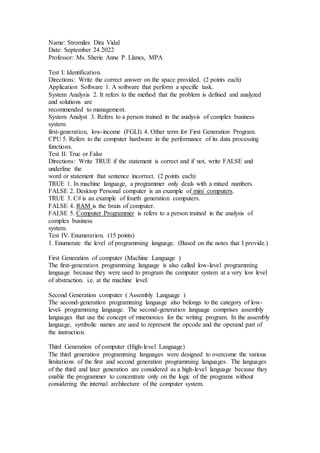
Name: Stromiles Dira Vidal
Date: September 24 2022
Professor: Ms. Sherie Anne P. Llanes, MPA
Test I: Identification.
Directions: Write the correct answer on the space provided. (2 points each)
Application Software 1. A software that perform a specific task.
System Analysis 2. It refers to the method that the problem is defined and analyzed
and solutions are
recommended to management.
System Analyst 3. Refers to a person trained in the analysis of complex business
system.
first-generation, low-income (FGLI) 4. Other term for First Generation Program.
CPU 5. Refers to the computer hardware in the performance of its data processing
functions.
Test II: True or False
Directions: Write TRUE if the statement is correct and if not, write FALSE and
underline the
word or statement that sentence incorrect. (2 points each)
TRUE 1. In machine language, a programmer only deals with a mixed numbers.
FALSE 2. Desktop Personal computer is an example of mini computers.
TRUE 3. C# is an example of fourth generation computers.
FALSE 4. RAM is the brain of computer.
FALSE 5. Computer Programmer is refers to a person trained in the analysis of
complex business
system.
Test IV. Enumeration. (15 points)
1. Enumerate the level of programming language. (Based on the notes that I provide.)
First Generation of computer (Machine Language )
The first-generation programming language is also called low-level programming
language because they were used to program the computer system at a very low level
of abstraction. i.e. at the machine level.
Second Generation computer ( Assembly Language )
The second-generation programming language also belongs to the category of low-
level- programming language. The second-generation language comprises assembly
languages that use the concept of mnemonics for the writing program. In the assembly
language, symbolic names are used to represent the opcode and the operand part of
the instruction.
Third Generation of computer (High-level Language)
The third generation programming languages were designed to overcome the various
limitations of the first and second generation programming languages. The languages
of the third and later generation are considered as a high-level language because they
enable the programmer to concentrate only on the logic of the programs without
considering the internal architecture of the computer system.
Fourth Generation of computer (Very-high Language)
The languages of this generation were considered as very high-level programming
languages required a lot of time and effort that affected the productivity of a
programmer. The fourth-generation programming languages were designed and
developed to reduce the time, cost and effort needed to develop different types of
software applications
Fifth Generation of computer (Artificial Intelligence)
The programming languages of this generation mainly focus on constraint
programming. The major fields in which the fifth generation programming language
are employed are Artificial Intelligence and Artificial Neural Networks. A fifth
generation programming language is any programming language based on problem
solving using constraints given to the program, rather than using an algorithm written
by a programmer. Most constraint-based and logic programming languages and some
other declarative languages are fifth-generation languages.
2. Give 5 advantages of 4th Generation of programming language? (Based on the
notes that I provide.)
1. These programming languages allow the efficient use of data by
implementing the various database.
2. They require less time, cost and effort to develop different types of
software applications.
3. The program developed in these languages are highly portable as
compared to the programs developed in the languages of other
generation.
4. Fourth-generation language (4GL) is friendly for users.
5. This language is easy to develop programs.
3. Give 5 advantages of 1st generation programming language?
1. They are translation free and can be directly executed by the computers.
2. The programs written in these languages are executed very speedily and efficiently
by the CPU of the computer system.
3. The programs written in these languages utilize the memory in an efficient manner
because it is possible to keep track of each bit of data.
4. the first generation only deals with a binary language so is easy to used
5 first generation of computer are often used when dealing machine level code,
especially when programming lower level functions of the system, such an drivers,
interface with firmware and hardware devices.
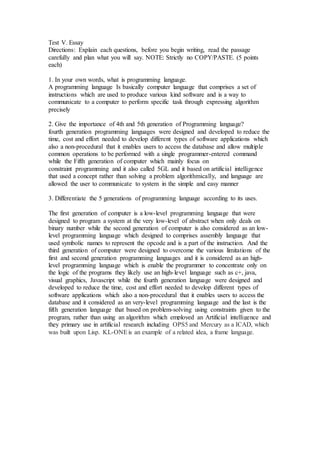
Test V. Essay
Directions: Explain each questions, before you begin writing, read the passage
carefully and plan what you will say. NOTE: Strictly no COPY/PASTE. (5 points
each)
1. In your own words, what is programming language.
A programming language Is basically computer language that comprises a set of
instructions which are used to produce various kind software and is a way to
communicate to a computer to perform specific task through expressing algorithm
precisely
2. Give the importance of 4th and 5th generation of Programming language?
fourth generation programming languages were designed and developed to reduce the
time, cost and effort needed to develop different types of software applications which
also a non-procedural that it enables users to access the database and allow multiple
common operations to be performed with a single programmer-entered command
while the Fifth generation of computer which mainly focus on
constraint programming and it also called 5GL and it based on artificial intelligence
that used a concept rather than solving a problem algorithmically, and language are
allowed the user to communicate to system in the simple and easy manner
3. Differentiate the 5 generations of programming language according to its uses.
The first generation of computer is a low-level programming language that were
designed to program a system at the very low-level of abstract when only deals on
binary number while the second generation of computer is also considered as an low-
level programming language which designed to comprises assembly language that
used symbolic names to represent the opcode and is a part of the instruction. And the
third generation of computer were designed to overcome the various limitations of the
first and second generation programming languages and it is considered as an high-
level programming language which is enable the programmer to concentrate only on
the logic of the programs they likely use an high-level language such as c+, java,
visual graphics, Javascript while the fourth generation language were designed and
developed to reduce the time, cost and effort needed to develop different types of
software applications which also a non-procedural that it enables users to access the
database and it considered as an very-level programming language and the last is the
fifth generation language that based on problem-solving using constraints given to the
program, rather than using an algorithm which employed an Artificial intelligence and
they primary use in artificial research including OPS5 and Mercury as a ICAD, which
was built upon Lisp. KL-ONEis an example of a related idea, a frame language.

Preliminary-Examination.docx

  • 1.
    Name: Stromiles DiraVidal Date: September 24 2022 Professor: Ms. Sherie Anne P. Llanes, MPA Test I: Identification. Directions: Write the correct answer on the space provided. (2 points each) Application Software 1. A software that perform a specific task. System Analysis 2. It refers to the method that the problem is defined and analyzed and solutions are recommended to management. System Analyst 3. Refers to a person trained in the analysis of complex business system. first-generation, low-income (FGLI) 4. Other term for First Generation Program. CPU 5. Refers to the computer hardware in the performance of its data processing functions. Test II: True or False Directions: Write TRUE if the statement is correct and if not, write FALSE and underline the word or statement that sentence incorrect. (2 points each) TRUE 1. In machine language, a programmer only deals with a mixed numbers. FALSE 2. Desktop Personal computer is an example of mini computers. TRUE 3. C# is an example of fourth generation computers. FALSE 4. RAM is the brain of computer. FALSE 5. Computer Programmer is refers to a person trained in the analysis of complex business system. Test IV. Enumeration. (15 points) 1. Enumerate the level of programming language. (Based on the notes that I provide.) First Generation of computer (Machine Language ) The first-generation programming language is also called low-level programming language because they were used to program the computer system at a very low level of abstraction. i.e. at the machine level. Second Generation computer ( Assembly Language ) The second-generation programming language also belongs to the category of low- level- programming language. The second-generation language comprises assembly languages that use the concept of mnemonics for the writing program. In the assembly language, symbolic names are used to represent the opcode and the operand part of the instruction. Third Generation of computer (High-level Language) The third generation programming languages were designed to overcome the various limitations of the first and second generation programming languages. The languages of the third and later generation are considered as a high-level language because they enable the programmer to concentrate only on the logic of the programs without considering the internal architecture of the computer system.
  • 2.
    Fourth Generation ofcomputer (Very-high Language) The languages of this generation were considered as very high-level programming languages required a lot of time and effort that affected the productivity of a programmer. The fourth-generation programming languages were designed and developed to reduce the time, cost and effort needed to develop different types of software applications Fifth Generation of computer (Artificial Intelligence) The programming languages of this generation mainly focus on constraint programming. The major fields in which the fifth generation programming language are employed are Artificial Intelligence and Artificial Neural Networks. A fifth generation programming language is any programming language based on problem solving using constraints given to the program, rather than using an algorithm written by a programmer. Most constraint-based and logic programming languages and some other declarative languages are fifth-generation languages. 2. Give 5 advantages of 4th Generation of programming language? (Based on the notes that I provide.) 1. These programming languages allow the efficient use of data by implementing the various database. 2. They require less time, cost and effort to develop different types of software applications. 3. The program developed in these languages are highly portable as compared to the programs developed in the languages of other generation. 4. Fourth-generation language (4GL) is friendly for users. 5. This language is easy to develop programs. 3. Give 5 advantages of 1st generation programming language? 1. They are translation free and can be directly executed by the computers. 2. The programs written in these languages are executed very speedily and efficiently by the CPU of the computer system. 3. The programs written in these languages utilize the memory in an efficient manner because it is possible to keep track of each bit of data. 4. the first generation only deals with a binary language so is easy to used 5 first generation of computer are often used when dealing machine level code, especially when programming lower level functions of the system, such an drivers, interface with firmware and hardware devices.
  • 3.
    Test V. Essay Directions:Explain each questions, before you begin writing, read the passage carefully and plan what you will say. NOTE: Strictly no COPY/PASTE. (5 points each) 1. In your own words, what is programming language. A programming language Is basically computer language that comprises a set of instructions which are used to produce various kind software and is a way to communicate to a computer to perform specific task through expressing algorithm precisely 2. Give the importance of 4th and 5th generation of Programming language? fourth generation programming languages were designed and developed to reduce the time, cost and effort needed to develop different types of software applications which also a non-procedural that it enables users to access the database and allow multiple common operations to be performed with a single programmer-entered command while the Fifth generation of computer which mainly focus on constraint programming and it also called 5GL and it based on artificial intelligence that used a concept rather than solving a problem algorithmically, and language are allowed the user to communicate to system in the simple and easy manner 3. Differentiate the 5 generations of programming language according to its uses. The first generation of computer is a low-level programming language that were designed to program a system at the very low-level of abstract when only deals on binary number while the second generation of computer is also considered as an low- level programming language which designed to comprises assembly language that used symbolic names to represent the opcode and is a part of the instruction. And the third generation of computer were designed to overcome the various limitations of the first and second generation programming languages and it is considered as an high- level programming language which is enable the programmer to concentrate only on the logic of the programs they likely use an high-level language such as c+, java, visual graphics, Javascript while the fourth generation language were designed and developed to reduce the time, cost and effort needed to develop different types of software applications which also a non-procedural that it enables users to access the database and it considered as an very-level programming language and the last is the fifth generation language that based on problem-solving using constraints given to the program, rather than using an algorithm which employed an Artificial intelligence and they primary use in artificial research including OPS5 and Mercury as a ICAD, which was built upon Lisp. KL-ONEis an example of a related idea, a frame language.