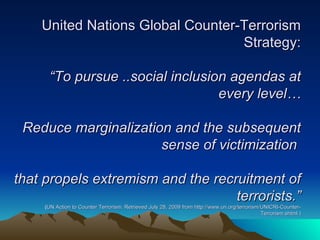
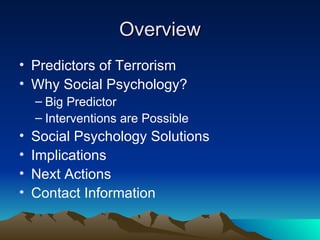
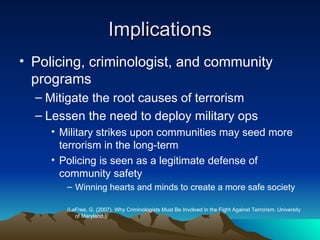
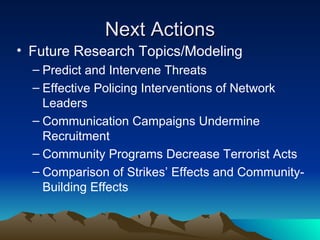
The document discusses social psychological predictors of terrorism and potential interventions. It identifies factors like marginalization, lack of social bonds, and charismatic leaders that can propel extremism. It advocates for community programs in schools and neighborhoods to promote inclusion, provide purposeful activities for youth, and undermine terrorist recruitment networks through policing and communication efforts. The implications are that mitigating root causes through social interventions may be more effective than military operations at reducing terrorism in the long run.
![Predictors of Terrorism Economic Support Geographical Hot Spot Resistance to Modern Society Lack of Access to Political System Young Males Fundamentalism Low Upward Mobility/Entitlement Media Saturation Social Psychological Motivations Tight social bonds with friends inspired joining [Sageman, M. (2004). Understanding Terror Networks . University of Pennsylvania Press: PA.]](https://image.slidesharecdn.com/predictormodeljuly29915pm-090729202541-phpapp02/85/Predictor-Model-July29915pm-4-320.jpg)
![Why Social Psychology? Social Psychological Predictors Self-perception as marginalized (entitlement) “Rebels” without a cause create one Glorification of sacrifice for the cause Traumatized youth/males Charismatic leader network Lack of clear career path/skills Lack of problem-solving skills [Rice, S. (2009). Emotions and terrorism research: A case for a social-psychological agenda. Journal of Criminal Justice, 37 (3), 248-255.]](https://image.slidesharecdn.com/predictormodeljuly29915pm-090729202541-phpapp02/85/Predictor-Model-July29915pm-5-320.jpg)
![Social Psychology Solutions What Can Be Done? First Lines of Prevention: Schools: Identifying and separating ring-leader from pack; inclusion After school: Rebel with a cause programs Mutually-beneficial goals for community Entrepreneurship What works: “Adolescents … participate in concrete, purposeful and common-interest activities” [Williams, R. (2006). Psycho-social consequences of children exposed to terrorism. Current Opinion Psychiatry, 19(4): 337-349, Retrieved July 28, 2009 from http://www.medscape.com/viewarticle/533619_6 .]](https://image.slidesharecdn.com/predictormodeljuly29915pm-090729202541-phpapp02/85/Predictor-Model-July29915pm-6-320.jpg)
![Social Psychology Solutions What Can Be Done? First Lines of Prevention: Policing Identifying and separating leaders from network Freezing economic support Communication undermines the legitimacy of leader Community police partners Refer to programs; mutual common goals for community [Gerwehr, S., & Daly, S. (2006). Al-Qaida: Terrorist selection and recruitment. The RAND Corporation . Retrieved July 28, 2008 from http://www.rand.org/pubs/reprints/2006/RAND_RP1214.pdf .]](https://image.slidesharecdn.com/predictormodeljuly29915pm-090729202541-phpapp02/85/Predictor-Model-July29915pm-7-320.jpg)
![Contact Information Amy Sauers, Ph.D. Social Scientist, Predictive Modeling and Interventions Research [email_address]](https://image.slidesharecdn.com/predictormodeljuly29915pm-090729202541-phpapp02/85/Predictor-Model-July29915pm-10-320.jpg)


