© 2 0 1 9 S P L U N K I N C .
Implementing
Predictive
Maintenance
Young Cho, Sr IoT Practitioner
Sept 8, 2019 | Ver 1.0
During the courseofthis presentation,we maymake forward‐lookingstatementsregarding
future eventsorplans ofthe company.Wecautionyouthat suchstatementsreflectour
currentexpectationsand estimatesbasedonfactorscurrentlyknownto us and that actual
eventsorresultsmaydiffermaterially. Theforward-lookingstatementsmadeinthe this
presentationare beingmadeas of the time and date ofits live presentation.Ifreviewedafter
its live presentation,itmaynot containcurrentoraccurateinformation.Wedo notassume
any obligationto updateanyforward‐lookingstatementsmadeherein.
Inaddition,any informationaboutourroadmapoutlinesourgeneralproductdirectionand is
subjectto changeatany time withoutnotice.Itis forinformationalpurposesonly,and shall
notbe incorporatedinto anycontractorothercommitment.Splunkundertakesno obligation
eitherto developthe featuresorfunctionalitiesdescribedorto includeanysuchfeatureor
functionalityina future release.
Splunk,Splunk>,TurnDataInto Doing,TheEngineforMachineData,SplunkCloud,Splunk
Lightand SPLare trademarksand registeredtrademarksof SplunkInc.inthe United States
and othercountries.Allotherbrandnames,productnames,ortrademarksbelongto their
respectiveowners.© 2019SplunkInc.Allrightsreserved.
Forward-
Looking
Statements
© 2 0 1 9 S P L U N K I N C .
Sr. IoT Practitioner | Splunk Inc
Young Cho
▶ Firm believer of human creativity with data will
conquer all problems in the world.
▶ Long computer and data career journey
− Unix system admin during BBS time
− PERLprogrammer– primarily fordata parsing
− Data ware house designand developmentforTelcos
− Big data consultant and architect
− Splunk solutions architect, product marketing, IoT
practitioner
▶ Amateur “Go” player
− Favorite documentary, Netflix AlphaGo – Story of Deepmind
challenging human “Go” champion
© 2 0 1 9 S P L U N K I N C .
Welcome to “ImplementingPredictive Maintenance”
Why do we care about
Predictive Maintenance?
Intro to the solutionsthat
will make a big impact in
your org.
Get you pragmatic
analytics skills for
Predictive Maintenance.
Why? What? How?
Give you foundational knowledge to make you a PdM practitioner.
© 2 0 1 9 S P L U N K I N C .
1. Introduction to
Predictive Maintenance
1
© 2 0 1 9 S P L U N K I N C .
1) MIT Sloan Review, “GE’s Big Bet on Data and Analytics”
2) ThomasNet, “Downtime Costs Auto Industry $22k/Minute”
3) TechTarget, “Predictive maintenance software points to machinery problems”
“Predictive Maintenance is the Holy Grail of Industrial IoT”
- Heather Ashton, manufacturing industry analyst at IDC3
$25M / Day
Liquefied NaturalGas Platform
$7M / Day
Offshore OilPlatform
$1.3M / Hour
Auto Manufacturing
1 1 2
Equipment Downtime Costs Millions of $
© 2 0 1 9 S P L U N K I N C .
ML
Predictive
Maintenance
Condition-based
Maintenance
Preventative Maintenance
Reactive Maintenance
Scheduled and planned maintenance
based on usage and time
Fix when broken
The global process industry loses $20 billion annually from unplanned downtime*
*ARC Advisory Group
O
E
E
Proactive,
Strategic
Operations
Real-time analytics and sensing
insights to predict machine reliability
Rules-based logic for sensor data
Advanced machine learning and AI
driven maintenance
80% of Industrial Operations Are Reactive
© 2 0 1 9 S P L U N K I N C .
Current Maintenance Strategy / Methods
How the world is maintained.
Failure
Reactive Maintenance Preventive Maintenance
Scheduled
Predictive Maintenance
Optimal time
Per asset
Predicted Failure
• Maintaining when the asset
fails
• Example : Light bulb
• Applies to assets with minimal
failure impact
• Majority of operational asset
can’t not do this. Costly
downtime.
• Maintaining at the regular
schedule regardless of condition
• Example : Engine Oil Change
• Applies to majority of assets in
operation.
• High maintenance expense – time,
availability, materials
• Maintaining at the optimal time
based on data and prediction
• Example : Impact YOU can make!
• Should be applied to all assets in
operation.
• High availability, cost savings,
organizational efficiency
© 2 0 1 9 S P L U N K I N C .
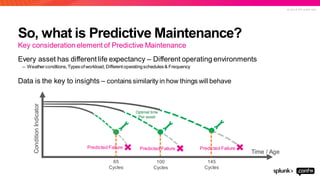
So, what is Predictive Maintenance?
Every asset has different life expectancy – Different operating environments
– Weatherconditions,Typesofworkload,Differentoperatingschedules& Frequency
Data is the key to insights – contains similarity in how things will behave
Key consideration element of Predictive Maintenance
Time / Age
Optimal time
Per asset
Predicted Failure
Predicted Failure Predicted Failure
Condition
Indicator
100
Cycles
65
Cycles
145
Cycles
© 2 0 1 9 S P L U N K I N C .
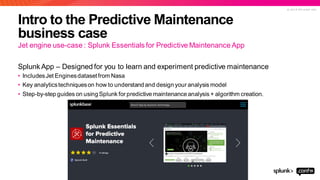
Intro to the Predictive Maintenance
business case
Splunk App – Designed for you to learn and experiment predictive maintenance
• IncludesJet Enginesdatasetfrom Nasa
• Key analyticstechniqueson how to understand and design your analysis model
• Step-by-step guides on using Splunk for predictive maintenance analysis + algorithm creation.
Jet engine use-case : Splunk Essentials for Predictive Maintenance App
© 2 0 1 9 S P L U N K I N C .
Predictive Maintenance And
Business Operations
Introduces challenges and opportunities
© 2 0 1 9 S P L U N K I N C .
Critical Business Implication
It’s not as simples as as we may think it could be
A SafetyThreshold
• Fine balancebetween
efficiency and safety
• Each day of downtimecould
cost up to $1 million USD for a
jumbo jetliner.
© 2 0 1 9 S P L U N K I N C .
Let’s look at what the data look like?
unit_cycle sname_Bleed_Enthalp
y
sname_Bypass_R
atio
sname_Corr_Cor
e_Speed
sname_Corr_Fan
_Speed
sname_Fuel_Flo
w_Ratio
sname_HPC_Outl
et_Temp
sname_HPT_Cool
ant_Bleed
sname_LPC_Outl
et_Temp
sname_LPT_Outl
et_Temp
sname_Phys_Cor
e_Speed
sname_Phys_Fan
_Speed
sname_Static_HP
C_Outlet_Pres
sname_Total_HP
C_Outlet_Pres
1 392 8.4195 8138.62 2388.02 521.66 1589.7 39.06 641.82 1400.6 9046.19 2388.06 47.47 554.36
2 392 8.4318 8131.49 2388.07 522.28 1591.82 39 642.15 1403.14 9044.07 2388.04 47.49 553.75
3 390 8.4178 8133.23 2388.03 522.42 1587.99 38.95 642.35 1404.2 9052.94 2388.08 47.27 554.26
4 392 8.3682 8133.83 2388.08 522.86 1582.79 38.88 642.35 1401.87 9049.48 2388.11 47.13 554.45
5 393 8.4294 8133.8 2388.04 522.19 1582.85 38.9 642.37 1406.22 9055.15 2388.06 47.28 554
6 391 8.4108 8132.85 2388.03 521.68 1584.47 38.98 642.1 1398.37 9049.68 2388.02 47.16 554.67
7 392 8.3974 8132.32 2388.03 522.32 1592.32 39.1 642.48 1397.77 9059.13 2388.02 47.36 554.34
8 391 8.4076 8131.07 2388.03 522.47 1582.96 38.97 642.56 1400.97 9040.8 2388 47.24 553.85
9 392 8.3728 8125.69 2388.05 521.79 1590.98 39.05 642.12 1394.8 9046.46 2388.05 47.29 553.69
10 393 8.4286 8129.38 2388.06 521.79 1591.24 38.95 641.71 1400.46 9051.7 2388.05 47.03 553.59
11 392 8.434 8140.58 2388.01 521.4 1581.75 38.94 642.28 1400.64 9049.61 2388.05 47.15 554.54
12 391 8.3938 8134.25 2388.02 521.8 1583.41 39.06 642.06 1400.15 9049.37 2388.09 47.18 554.52
13 393 8.4152 8128.1 2388.08 521.85 1582.19 38.93 643.07 1400.83 9046.82 2388.12 47.38 553.44
14 393 8.3964 8134.43 2388 521.67 1592.95 39.18 642.35 1399.16 9047.37 2388.09 47.44 554.48
15 391 8.4199 8127.56 2388.08 522.5 1583.82 38.99 642.43 1402.13 9052.22 2388.11 47.3 553.64
16 392 8.3936 8136.11 2388.07 521.49 1587.98 38.97 642.13 1404.5 9049.34 2388.05 47.24 553.94
© 2 0 1 9 S P L U N K I N C .
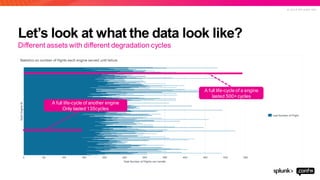
Let’s look at what the data look like?
Different assets with different degradation cycles
A full life-cycle of a engine
lasted 500+ cycles
A full life-cycle of another engine
Only lasted 135cycles
© 2 0 1 9 S P L U N K I N C .
What are we trying to accomplish?
Big difference in length of life
© 2 0 1 9 S P L U N K I N C .
Predictive Maintenance
Solution
Demonstration
1
© 2 0 1 9 S P L U N K I N C .
Demo
© 2 0 1 9 S P L U N K I N C .
Insert your own screenshot here.
For best results, use an image sized at 1450 x 850
© 2 0 1 9 S P L U N K I N C .
Insert your own screenshot here.
For best results, use an image sized at 1450 x 850
© 2 0 1 9 S P L U N K I N C .
Predictive Maintenance
Development Process
0
© 2 0 1 9 S P L U N K I N C .
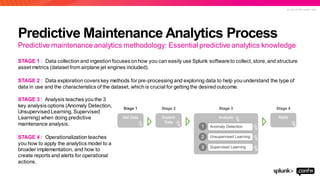
Predictive Maintenance Analytics Process
STAGE 1 : Data collection and ingestion focuses on how you can easily use Splunk software to collect,store,and structure
asset metrics (datasetfrom airplane jet engines included).
STAGE 2 : Data exploration covers key methods for pre-processing and exploring data to help you understand the type of
data in use and the characteristics of the dataset, which is crucial for getting the desired outcome.
Predictive maintenance analytics methodology: Essential predictive analytics knowledge
STAGE 3 : Analysis teaches you the 3
key analysis options (Anomaly Detection,
Unsupervised Learning, Supervised
Learning) when doing predictive
maintenance analysis.
STAGE 4 : Operationalization teaches
you how to apply the analytics model to a
broader implementation, and how to
create reports and alerts for operational
actions.
© 2 0 1 9 S P L U N K I N C .
1. Getting Data In
© 2 0 1 9 S P L U N K I N C .
Splunk for All of Enterprise Asset Data
Universal data platform for events and metrics
© 2 0 1 9 S P L U N K I N C .
How your industrial data is collected
Different protocols and collection methods supported
© 2 0 1 9 S P L U N K I N C .
Insert your own screenshot here.
For best results, use an image sized at 1450 x 850
© 2 0 1 9 S P L U N K I N C .
2. Explore Data /
Feature Engineering
© 2 0 1 9 S P L U N K I N C .
Understand how the asset operate
Turbo Jet Engines has 3 major components
Speed values
Temperature values
Flow / Bypass ratios
Bleed values
Pressure values
© 2 0 1 9 S P L U N K I N C .
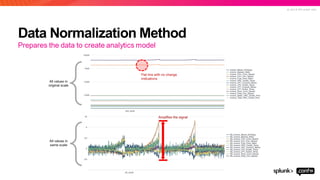
Data Normalization Method
Prepares the data to create analytics model
© 2 0 1 9 S P L U N K I N C .
Event Windowing
Captures a full comparable operational cycle of an asset
© 2 0 1 9 S P L U N K I N C .
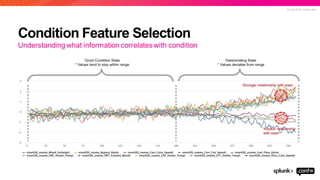
Condition Feature Selection
Understanding what information correlates with condition
© 2 0 1 9 S P L U N K I N C .
Feature Profile for an Asset
Visual inspection and understand of asset characteristics
Speed values
Temperature Values
Flow / Bypass ratios
Bleed values
© 2 0 1 9 S P L U N K I N C .
Feature Engineering
Different types of
condition indicators
• Time based features
• Frequency based
features
Creating new features from statistics – Best condition indicators
© 2 0 1 9 S P L U N K I N C .
Insert your own screenshot here.
For best results, use an image sized at 1450 x 850
© 2 0 1 9 S P L U N K I N C .
Insert your own screenshot here.
For best results, use an image sized at 1450 x 850
© 2 0 1 9 S P L U N K I N C .
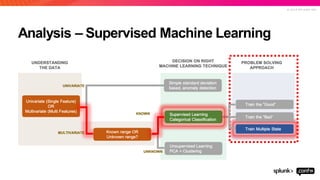
3. Analysis
© 2 0 1 9 S P L U N K I N C .
Predictive Maintenance Analysis Domain
Two main approaches to Predictive Maintenance analysis
• Anomaly Detection
• Remaining Useful Life
• Unsupervised
Learning
• Supervised Learning
Statistical Analysis
Approach
Machine Learning
Approach
© 2 0 1 9 S P L U N K I N C .
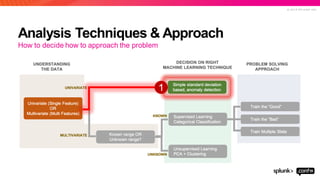
Analysis Techniques & Approach
How to decide how to approach the problem
© 2 0 1 9 S P L U N K I N C .
1. Understand standard deviation
2. Value distribution analysis
3. Defining threshold based on standard
deviation
Statistical
Method
Anomaly
Detection
© 2 0 1 9 S P L U N K I N C .
Analysis – Anomaly Detection
Conditional value “Standard Deviation”
© 2 0 1 9 S P L U N K I N C .
Analysis – Anomaly Detection
Conditional values distribution
© 2 0 1 9 S P L U N K I N C .
Analysis – Anomaly Detection
Standard Deviation Thresholding
© 2 0 1 9 S P L U N K I N C .
Insert your own screenshot here.
For best results, use an image sized at 1450 x 850
© 2 0 1 9 S P L U N K I N C .
1. Asset degradation model
2. Calculating remaining useful life
3. Defining condition indicators
4. Optimizing remaining useful life using
similarity model
Statistical
Method
Remaining
Useful Life
Analysis
© 2 0 1 9 S P L U N K I N C .
Analysis – Remaining Useful Life
What is remaining Useful Life?
Failure Condition
ASSET DEGRADATION MODEL
Condition
Indicator
Remaining Useful Life
Time / Age
Current Condition
© 2 0 1 9 S P L U N K I N C .
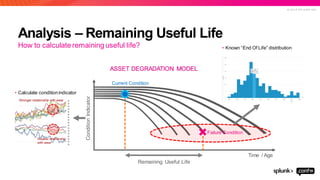
Analysis – Remaining Useful Life
How to calculate remaining useful life?
Failure Condition
Condition
Indicator
Remaining Useful Life
Time / Age
Current Condition
ASSET DEGRADATION MODEL
• Known “End Of Life” distribution
• Calculate conditionindicator
© 2 0 1 9 S P L U N K I N C .
Analysis – Remaining Useful Life
Calculating remaining useful life using similarity model
Failure Condition
Condition
Indicator
Remaining Useful Life
Time / Age
Current Condition
ASSET DEGRADATION MODEL
• Known “End Of Life” distribution
• Calculate condition
indicator
© 2 0 1 9 S P L U N K I N C .
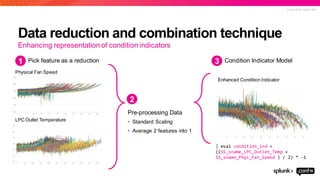
Data reduction and combination technique
Enhancing representation of condition indicators
Physical Fan Speed
LPC Outlet Temperature
Pre-processing Data
• Standard Scaling
• Average 2 features into 1
2
▶ Condition Indicator Model
3
Enhanced Condition Indicator
| eval condition_ind =
((SS_sname_LPC_Outlet_Temp +
SS_sname_Phys_Fan_Speed ) / 2) * -1
▶ Pick feature as a reduction
1
© 2 0 1 9 S P L U N K I N C .
What is remaining useful life?
• Input as current cycle(Age) and
conditional indicator value
• Group similar historical models
(nearest)
• Statistics of known “End of Life” –
mean of known eol.
How to calculate the remaininglife based on historical similarity model
Asset Degradation Model
Failure Condition
Condition
Indicator
Remaining Useful Life
Time / Age
Current Condition
Expected End Of Life
200 270
End Of Life
Range
235
© 2 0 1 9 S P L U N K I N C .
Insert your own screenshot here.
For best results, use an image sized at 1450 x 850
© 2 0 1 9 S P L U N K I N C .
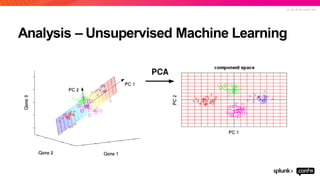
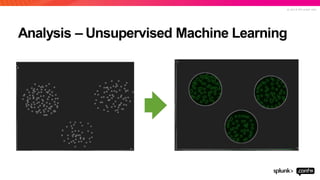
1. Principal ComponentAnalysis
2. Clustering
3. Various visual data explorations
Machine Learning
Approach
Unsupervised
Machine
Learning
© 2 0 1 9 S P L U N K I N C .
Analysis – Unsupervised Machine Learning
© 2 0 1 9 S P L U N K I N C .
Analysis – Unsupervised Machine Learning
© 2 0 1 9 S P L U N K I N C .
Analysis – Unsupervised Machine Learning
© 2 0 1 9 S P L U N K I N C .
Insert your own screenshot here.
For best results, use an image sized at 1450 x 850
© 2 0 1 9 S P L U N K I N C .
1. Convey meaning and be inspirational with
your message when possible
2. Use powerful imagery to support
your point
3. Use animation to support your message,
not just to entertain the audience
Machine Learning
Approach
Supervised
Learning
© 2 0 1 9 S P L U N K I N C .
Analysis – Supervised Machine Learning
© 2 0 1 9 S P L U N K I N C .
Analysis – Supervised Machine Learning
© 2 0 1 9 S P L U N K I N C .
Analysis – Supervised Machine Learning
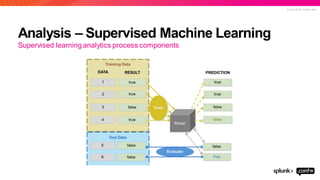
Supervised learning analytics process components
© 2 0 1 9 S P L U N K I N C .
Analysis – Supervised Machine Learning
Applying training the “Good” model approach
When used?:
• Training a “Good” model,when there are other variations (Often many) of patternsnot well known.
• So, anything otherthan a very specific “good”pattern as bad. Pick out rest of non-good pattern as bad.
© 2 0 1 9 S P L U N K I N C .
Analysis – Supervised Machine Learning
Applying training the “Good” model approach
© 2 0 1 9 S P L U N K I N C .
Analysis – Supervised Machine Learning
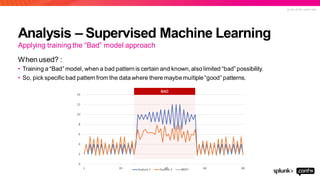
Applying training the “Bad” model approach
When used? :
• Training a “Bad” model, when a bad pattern is certain and known,alsolimited “bad” possibility.
• So, pick specific bad pattern from the data where there maybe multiple “good” patterns.
© 2 0 1 9 S P L U N K I N C .
Analysis – Supervised Machine Learning
Applying training the “Bad” model approach
© 2 0 1 9 S P L U N K I N C .
When used? :
• Training a model with multipleconditions as differentlabels.(0,1,2,3)
• Define multiple different patternsbased on severity or differentsymptom.
Analysis – Supervised Machine Learning
Examples :
• Based on condition
(Good → Warning → Bad)
• Based on differentsymptom
(Compressorfailure vs
fan failure)
© 2 0 1 9 S P L U N K I N C .
Analysis – Supervised Machine Learning
© 2 0 1 9 S P L U N K I N C .
Analysis – Supervised Machine Learning
Define the range of time series data, then label “state=” with numeric value.
Training a multiple conditions example
© 2 0 1 9 S P L U N K I N C .
Analysis – Supervised Machine Learning
Training a multiple conditions pre-training model labeling
© 2 0 1 9 S P L U N K I N C .
Analysis – Supervised Machine Learning
Different machine learning algorithm for trial and error
© 2 0 1 9 S P L U N K I N C .
Analysis – Supervised Machine Learning
Analyzing accuracy and precision of trained machine learning model
Accuracy and precision verification
Confusion Matrix
© 2 0 1 9 S P L U N K I N C .
4. Apply
© 2 0 1 9 S P L U N K I N C .
Apply – Dashboard & Reports
Immediately operationalize Splunk predictive maintenance
Creating Dashboard : Predictive
Maintenance Dashboard
• Use the analyzed prediction,create dashboard to
show the status of engines in different state.
• Use Splunk Dashboard Examples App to
customize visualization and various user inputs
and controls.
Creating Reports : Using Splunk
Enterprise
• Watch training video on "How to create reports in
Splunk"
• Splunk documentation on "How to create reports"
© 2 0 1 9 S P L U N K I N C .
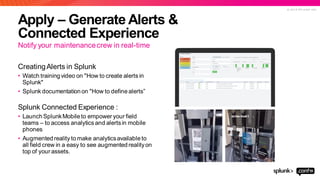
Apply – Generate Alerts &
Connected Experience
Notify your maintenancecrew in real-time
CreatingAlerts in Splunk
• Watch training video on "How to create alerts in
Splunk"
• Splunk documentation on "How to define alerts”
Splunk Connected Experience :
• LaunchSplunkMobile to empower your field
teams – to access analytics and alertsin mobile
phones
• Augmented reality to make analyticsavailable to
all field crew in a easy to see augmented realityon
top of your assets.
© 2 0 1 9 S P L U N K I N C .
Apply – Automate and Control
Automate and Orchestrate your operations
• Process multiple conditions
• Apply logic to decide
• Even involve human
Confirmation
• Interact with any assets with APIs
• Fully automated
response to intergrate
Automation using Phantom
• Define full automation using Phantomand integrate with your legacy assets
© 2 0 1 9 S P L U N K I N C .
5. Wrap Up
© 2 0 1 9 S P L U N K I N C .
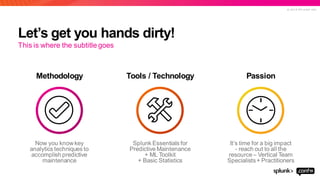
Let’s get you hands dirty!
Methodology Tools / Technology Passion
This is where the subtitle goes
Now you know key
analytics techniques to
accomplishpredictive
maintenance
Splunk Essentials for
Predictive Maintenance
+ ML Toolkit
+ Basic Statistics
It’s time for a big impact
- reach out to all the
resource– Vertical Team
Specialists+ Practitioners
RATE THIS SESSION
Go to the .conf19 mobile app to
© 2 0 1 9 S P L U N K I N C .
You!
Thank

predictive maintenance advanced solution

  • 1.
    © 2 01 9 S P L U N K I N C . © 2 0 1 9 S P L U N K I N C . Implementing Predictive Maintenance Young Cho, Sr IoT Practitioner Sept 8, 2019 | Ver 1.0
  • 2.
    During the courseofthispresentation,we maymake forward‐lookingstatementsregarding future eventsorplans ofthe company.Wecautionyouthat suchstatementsreflectour currentexpectationsand estimatesbasedonfactorscurrentlyknownto us and that actual eventsorresultsmaydiffermaterially. Theforward-lookingstatementsmadeinthe this presentationare beingmadeas of the time and date ofits live presentation.Ifreviewedafter its live presentation,itmaynot containcurrentoraccurateinformation.Wedo notassume any obligationto updateanyforward‐lookingstatementsmadeherein. Inaddition,any informationaboutourroadmapoutlinesourgeneralproductdirectionand is subjectto changeatany time withoutnotice.Itis forinformationalpurposesonly,and shall notbe incorporatedinto anycontractorothercommitment.Splunkundertakesno obligation eitherto developthe featuresorfunctionalitiesdescribedorto includeanysuchfeatureor functionalityina future release. Splunk,Splunk>,TurnDataInto Doing,TheEngineforMachineData,SplunkCloud,Splunk Lightand SPLare trademarksand registeredtrademarksof SplunkInc.inthe United States and othercountries.Allotherbrandnames,productnames,ortrademarksbelongto their respectiveowners.© 2019SplunkInc.Allrightsreserved. Forward- Looking Statements © 2 0 1 9 S P L U N K I N C .
  • 3.
    © 2 01 9 S P L U N K I N C . Sr. IoT Practitioner | Splunk Inc Young Cho ▶ Firm believer of human creativity with data will conquer all problems in the world. ▶ Long computer and data career journey − Unix system admin during BBS time − PERLprogrammer– primarily fordata parsing − Data ware house designand developmentforTelcos − Big data consultant and architect − Splunk solutions architect, product marketing, IoT practitioner ▶ Amateur “Go” player − Favorite documentary, Netflix AlphaGo – Story of Deepmind challenging human “Go” champion
  • 4.
    © 2 01 9 S P L U N K I N C . Welcome to “ImplementingPredictive Maintenance” Why do we care about Predictive Maintenance? Intro to the solutionsthat will make a big impact in your org. Get you pragmatic analytics skills for Predictive Maintenance. Why? What? How? Give you foundational knowledge to make you a PdM practitioner.
  • 5.
    © 2 01 9 S P L U N K I N C . 1. Introduction to Predictive Maintenance 1
  • 6.
    © 2 01 9 S P L U N K I N C . 1) MIT Sloan Review, “GE’s Big Bet on Data and Analytics” 2) ThomasNet, “Downtime Costs Auto Industry $22k/Minute” 3) TechTarget, “Predictive maintenance software points to machinery problems” “Predictive Maintenance is the Holy Grail of Industrial IoT” - Heather Ashton, manufacturing industry analyst at IDC3 $25M / Day Liquefied NaturalGas Platform $7M / Day Offshore OilPlatform $1.3M / Hour Auto Manufacturing 1 1 2 Equipment Downtime Costs Millions of $
  • 7.
    © 2 01 9 S P L U N K I N C . ML Predictive Maintenance Condition-based Maintenance Preventative Maintenance Reactive Maintenance Scheduled and planned maintenance based on usage and time Fix when broken The global process industry loses $20 billion annually from unplanned downtime* *ARC Advisory Group O E E Proactive, Strategic Operations Real-time analytics and sensing insights to predict machine reliability Rules-based logic for sensor data Advanced machine learning and AI driven maintenance 80% of Industrial Operations Are Reactive
  • 8.
    © 2 01 9 S P L U N K I N C . Current Maintenance Strategy / Methods How the world is maintained. Failure Reactive Maintenance Preventive Maintenance Scheduled Predictive Maintenance Optimal time Per asset Predicted Failure • Maintaining when the asset fails • Example : Light bulb • Applies to assets with minimal failure impact • Majority of operational asset can’t not do this. Costly downtime. • Maintaining at the regular schedule regardless of condition • Example : Engine Oil Change • Applies to majority of assets in operation. • High maintenance expense – time, availability, materials • Maintaining at the optimal time based on data and prediction • Example : Impact YOU can make! • Should be applied to all assets in operation. • High availability, cost savings, organizational efficiency
  • 9.
    © 2 01 9 S P L U N K I N C . So, what is Predictive Maintenance? Every asset has different life expectancy – Different operating environments – Weatherconditions,Typesofworkload,Differentoperatingschedules& Frequency Data is the key to insights – contains similarity in how things will behave Key consideration element of Predictive Maintenance Time / Age Optimal time Per asset Predicted Failure Predicted Failure Predicted Failure Condition Indicator 100 Cycles 65 Cycles 145 Cycles
  • 10.
    © 2 01 9 S P L U N K I N C . Intro to the Predictive Maintenance business case Splunk App – Designed for you to learn and experiment predictive maintenance • IncludesJet Enginesdatasetfrom Nasa • Key analyticstechniqueson how to understand and design your analysis model • Step-by-step guides on using Splunk for predictive maintenance analysis + algorithm creation. Jet engine use-case : Splunk Essentials for Predictive Maintenance App
  • 11.
    © 2 01 9 S P L U N K I N C . Predictive Maintenance And Business Operations Introduces challenges and opportunities
  • 12.
    © 2 01 9 S P L U N K I N C . Critical Business Implication It’s not as simples as as we may think it could be A SafetyThreshold • Fine balancebetween efficiency and safety • Each day of downtimecould cost up to $1 million USD for a jumbo jetliner.
  • 13.
    © 2 01 9 S P L U N K I N C . Let’s look at what the data look like? unit_cycle sname_Bleed_Enthalp y sname_Bypass_R atio sname_Corr_Cor e_Speed sname_Corr_Fan _Speed sname_Fuel_Flo w_Ratio sname_HPC_Outl et_Temp sname_HPT_Cool ant_Bleed sname_LPC_Outl et_Temp sname_LPT_Outl et_Temp sname_Phys_Cor e_Speed sname_Phys_Fan _Speed sname_Static_HP C_Outlet_Pres sname_Total_HP C_Outlet_Pres 1 392 8.4195 8138.62 2388.02 521.66 1589.7 39.06 641.82 1400.6 9046.19 2388.06 47.47 554.36 2 392 8.4318 8131.49 2388.07 522.28 1591.82 39 642.15 1403.14 9044.07 2388.04 47.49 553.75 3 390 8.4178 8133.23 2388.03 522.42 1587.99 38.95 642.35 1404.2 9052.94 2388.08 47.27 554.26 4 392 8.3682 8133.83 2388.08 522.86 1582.79 38.88 642.35 1401.87 9049.48 2388.11 47.13 554.45 5 393 8.4294 8133.8 2388.04 522.19 1582.85 38.9 642.37 1406.22 9055.15 2388.06 47.28 554 6 391 8.4108 8132.85 2388.03 521.68 1584.47 38.98 642.1 1398.37 9049.68 2388.02 47.16 554.67 7 392 8.3974 8132.32 2388.03 522.32 1592.32 39.1 642.48 1397.77 9059.13 2388.02 47.36 554.34 8 391 8.4076 8131.07 2388.03 522.47 1582.96 38.97 642.56 1400.97 9040.8 2388 47.24 553.85 9 392 8.3728 8125.69 2388.05 521.79 1590.98 39.05 642.12 1394.8 9046.46 2388.05 47.29 553.69 10 393 8.4286 8129.38 2388.06 521.79 1591.24 38.95 641.71 1400.46 9051.7 2388.05 47.03 553.59 11 392 8.434 8140.58 2388.01 521.4 1581.75 38.94 642.28 1400.64 9049.61 2388.05 47.15 554.54 12 391 8.3938 8134.25 2388.02 521.8 1583.41 39.06 642.06 1400.15 9049.37 2388.09 47.18 554.52 13 393 8.4152 8128.1 2388.08 521.85 1582.19 38.93 643.07 1400.83 9046.82 2388.12 47.38 553.44 14 393 8.3964 8134.43 2388 521.67 1592.95 39.18 642.35 1399.16 9047.37 2388.09 47.44 554.48 15 391 8.4199 8127.56 2388.08 522.5 1583.82 38.99 642.43 1402.13 9052.22 2388.11 47.3 553.64 16 392 8.3936 8136.11 2388.07 521.49 1587.98 38.97 642.13 1404.5 9049.34 2388.05 47.24 553.94
  • 14.
    © 2 01 9 S P L U N K I N C . Let’s look at what the data look like? Different assets with different degradation cycles A full life-cycle of a engine lasted 500+ cycles A full life-cycle of another engine Only lasted 135cycles
  • 15.
    © 2 01 9 S P L U N K I N C . What are we trying to accomplish? Big difference in length of life
  • 16.
    © 2 01 9 S P L U N K I N C . Predictive Maintenance Solution Demonstration 1
  • 17.
    © 2 01 9 S P L U N K I N C . Demo
  • 18.
    © 2 01 9 S P L U N K I N C . Insert your own screenshot here. For best results, use an image sized at 1450 x 850
  • 19.
    © 2 01 9 S P L U N K I N C . Insert your own screenshot here. For best results, use an image sized at 1450 x 850
  • 20.
    © 2 01 9 S P L U N K I N C .
  • 21.
    © 2 01 9 S P L U N K I N C . Predictive Maintenance Development Process 0
  • 22.
    © 2 01 9 S P L U N K I N C . Predictive Maintenance Analytics Process STAGE 1 : Data collection and ingestion focuses on how you can easily use Splunk software to collect,store,and structure asset metrics (datasetfrom airplane jet engines included). STAGE 2 : Data exploration covers key methods for pre-processing and exploring data to help you understand the type of data in use and the characteristics of the dataset, which is crucial for getting the desired outcome. Predictive maintenance analytics methodology: Essential predictive analytics knowledge STAGE 3 : Analysis teaches you the 3 key analysis options (Anomaly Detection, Unsupervised Learning, Supervised Learning) when doing predictive maintenance analysis. STAGE 4 : Operationalization teaches you how to apply the analytics model to a broader implementation, and how to create reports and alerts for operational actions.
  • 23.
    © 2 01 9 S P L U N K I N C . 1. Getting Data In
  • 24.
    © 2 01 9 S P L U N K I N C . Splunk for All of Enterprise Asset Data Universal data platform for events and metrics
  • 25.
    © 2 01 9 S P L U N K I N C . How your industrial data is collected Different protocols and collection methods supported
  • 26.
    © 2 01 9 S P L U N K I N C . Insert your own screenshot here. For best results, use an image sized at 1450 x 850
  • 27.
    © 2 01 9 S P L U N K I N C . 2. Explore Data / Feature Engineering
  • 28.
    © 2 01 9 S P L U N K I N C . Understand how the asset operate Turbo Jet Engines has 3 major components Speed values Temperature values Flow / Bypass ratios Bleed values Pressure values
  • 29.
    © 2 01 9 S P L U N K I N C . Data Normalization Method Prepares the data to create analytics model
  • 30.
    © 2 01 9 S P L U N K I N C . Event Windowing Captures a full comparable operational cycle of an asset
  • 31.
    © 2 01 9 S P L U N K I N C . Condition Feature Selection Understanding what information correlates with condition
  • 32.
    © 2 01 9 S P L U N K I N C . Feature Profile for an Asset Visual inspection and understand of asset characteristics Speed values Temperature Values Flow / Bypass ratios Bleed values
  • 33.
    © 2 01 9 S P L U N K I N C . Feature Engineering Different types of condition indicators • Time based features • Frequency based features Creating new features from statistics – Best condition indicators
  • 34.
    © 2 01 9 S P L U N K I N C . Insert your own screenshot here. For best results, use an image sized at 1450 x 850
  • 35.
    © 2 01 9 S P L U N K I N C . Insert your own screenshot here. For best results, use an image sized at 1450 x 850
  • 36.
    © 2 01 9 S P L U N K I N C . 3. Analysis
  • 37.
    © 2 01 9 S P L U N K I N C . Predictive Maintenance Analysis Domain Two main approaches to Predictive Maintenance analysis • Anomaly Detection • Remaining Useful Life • Unsupervised Learning • Supervised Learning Statistical Analysis Approach Machine Learning Approach
  • 38.
    © 2 01 9 S P L U N K I N C . Analysis Techniques & Approach How to decide how to approach the problem
  • 39.
    © 2 01 9 S P L U N K I N C . 1. Understand standard deviation 2. Value distribution analysis 3. Defining threshold based on standard deviation Statistical Method Anomaly Detection
  • 40.
    © 2 01 9 S P L U N K I N C . Analysis – Anomaly Detection Conditional value “Standard Deviation”
  • 41.
    © 2 01 9 S P L U N K I N C . Analysis – Anomaly Detection Conditional values distribution
  • 42.
    © 2 01 9 S P L U N K I N C . Analysis – Anomaly Detection Standard Deviation Thresholding
  • 43.
    © 2 01 9 S P L U N K I N C . Insert your own screenshot here. For best results, use an image sized at 1450 x 850
  • 44.
    © 2 01 9 S P L U N K I N C . 1. Asset degradation model 2. Calculating remaining useful life 3. Defining condition indicators 4. Optimizing remaining useful life using similarity model Statistical Method Remaining Useful Life Analysis
  • 45.
    © 2 01 9 S P L U N K I N C . Analysis – Remaining Useful Life What is remaining Useful Life? Failure Condition ASSET DEGRADATION MODEL Condition Indicator Remaining Useful Life Time / Age Current Condition
  • 46.
    © 2 01 9 S P L U N K I N C . Analysis – Remaining Useful Life How to calculate remaining useful life? Failure Condition Condition Indicator Remaining Useful Life Time / Age Current Condition ASSET DEGRADATION MODEL • Known “End Of Life” distribution • Calculate conditionindicator
  • 47.
    © 2 01 9 S P L U N K I N C . Analysis – Remaining Useful Life Calculating remaining useful life using similarity model Failure Condition Condition Indicator Remaining Useful Life Time / Age Current Condition ASSET DEGRADATION MODEL • Known “End Of Life” distribution • Calculate condition indicator
  • 48.
    © 2 01 9 S P L U N K I N C . Data reduction and combination technique Enhancing representation of condition indicators Physical Fan Speed LPC Outlet Temperature Pre-processing Data • Standard Scaling • Average 2 features into 1 2 ▶ Condition Indicator Model 3 Enhanced Condition Indicator | eval condition_ind = ((SS_sname_LPC_Outlet_Temp + SS_sname_Phys_Fan_Speed ) / 2) * -1 ▶ Pick feature as a reduction 1
  • 49.
    © 2 01 9 S P L U N K I N C . What is remaining useful life? • Input as current cycle(Age) and conditional indicator value • Group similar historical models (nearest) • Statistics of known “End of Life” – mean of known eol. How to calculate the remaininglife based on historical similarity model Asset Degradation Model Failure Condition Condition Indicator Remaining Useful Life Time / Age Current Condition Expected End Of Life 200 270 End Of Life Range 235
  • 50.
    © 2 01 9 S P L U N K I N C . Insert your own screenshot here. For best results, use an image sized at 1450 x 850
  • 51.
    © 2 01 9 S P L U N K I N C . 1. Principal ComponentAnalysis 2. Clustering 3. Various visual data explorations Machine Learning Approach Unsupervised Machine Learning
  • 52.
    © 2 01 9 S P L U N K I N C . Analysis – Unsupervised Machine Learning
  • 53.
    © 2 01 9 S P L U N K I N C . Analysis – Unsupervised Machine Learning
  • 54.
    © 2 01 9 S P L U N K I N C . Analysis – Unsupervised Machine Learning
  • 55.
    © 2 01 9 S P L U N K I N C . Insert your own screenshot here. For best results, use an image sized at 1450 x 850
  • 56.
    © 2 01 9 S P L U N K I N C . 1. Convey meaning and be inspirational with your message when possible 2. Use powerful imagery to support your point 3. Use animation to support your message, not just to entertain the audience Machine Learning Approach Supervised Learning
  • 57.
    © 2 01 9 S P L U N K I N C . Analysis – Supervised Machine Learning
  • 58.
    © 2 01 9 S P L U N K I N C . Analysis – Supervised Machine Learning
  • 59.
    © 2 01 9 S P L U N K I N C . Analysis – Supervised Machine Learning Supervised learning analytics process components
  • 60.
    © 2 01 9 S P L U N K I N C . Analysis – Supervised Machine Learning Applying training the “Good” model approach When used?: • Training a “Good” model,when there are other variations (Often many) of patternsnot well known. • So, anything otherthan a very specific “good”pattern as bad. Pick out rest of non-good pattern as bad.
  • 61.
    © 2 01 9 S P L U N K I N C . Analysis – Supervised Machine Learning Applying training the “Good” model approach
  • 62.
    © 2 01 9 S P L U N K I N C . Analysis – Supervised Machine Learning Applying training the “Bad” model approach When used? : • Training a “Bad” model, when a bad pattern is certain and known,alsolimited “bad” possibility. • So, pick specific bad pattern from the data where there maybe multiple “good” patterns.
  • 63.
    © 2 01 9 S P L U N K I N C . Analysis – Supervised Machine Learning Applying training the “Bad” model approach
  • 64.
    © 2 01 9 S P L U N K I N C . When used? : • Training a model with multipleconditions as differentlabels.(0,1,2,3) • Define multiple different patternsbased on severity or differentsymptom. Analysis – Supervised Machine Learning Examples : • Based on condition (Good → Warning → Bad) • Based on differentsymptom (Compressorfailure vs fan failure)
  • 65.
    © 2 01 9 S P L U N K I N C . Analysis – Supervised Machine Learning
  • 66.
    © 2 01 9 S P L U N K I N C . Analysis – Supervised Machine Learning Define the range of time series data, then label “state=” with numeric value. Training a multiple conditions example
  • 67.
    © 2 01 9 S P L U N K I N C . Analysis – Supervised Machine Learning Training a multiple conditions pre-training model labeling
  • 68.
    © 2 01 9 S P L U N K I N C . Analysis – Supervised Machine Learning Different machine learning algorithm for trial and error
  • 69.
    © 2 01 9 S P L U N K I N C . Analysis – Supervised Machine Learning Analyzing accuracy and precision of trained machine learning model Accuracy and precision verification Confusion Matrix
  • 70.
    © 2 01 9 S P L U N K I N C .
  • 71.
    © 2 01 9 S P L U N K I N C . 4. Apply
  • 72.
    © 2 01 9 S P L U N K I N C . Apply – Dashboard & Reports Immediately operationalize Splunk predictive maintenance Creating Dashboard : Predictive Maintenance Dashboard • Use the analyzed prediction,create dashboard to show the status of engines in different state. • Use Splunk Dashboard Examples App to customize visualization and various user inputs and controls. Creating Reports : Using Splunk Enterprise • Watch training video on "How to create reports in Splunk" • Splunk documentation on "How to create reports"
  • 73.
    © 2 01 9 S P L U N K I N C . Apply – Generate Alerts & Connected Experience Notify your maintenancecrew in real-time CreatingAlerts in Splunk • Watch training video on "How to create alerts in Splunk" • Splunk documentation on "How to define alerts” Splunk Connected Experience : • LaunchSplunkMobile to empower your field teams – to access analytics and alertsin mobile phones • Augmented reality to make analyticsavailable to all field crew in a easy to see augmented realityon top of your assets.
  • 74.
    © 2 01 9 S P L U N K I N C . Apply – Automate and Control Automate and Orchestrate your operations • Process multiple conditions • Apply logic to decide • Even involve human Confirmation • Interact with any assets with APIs • Fully automated response to intergrate Automation using Phantom • Define full automation using Phantomand integrate with your legacy assets
  • 75.
    © 2 01 9 S P L U N K I N C . 5. Wrap Up
  • 76.
    © 2 01 9 S P L U N K I N C . Let’s get you hands dirty! Methodology Tools / Technology Passion This is where the subtitle goes Now you know key analytics techniques to accomplishpredictive maintenance Splunk Essentials for Predictive Maintenance + ML Toolkit + Basic Statistics It’s time for a big impact - reach out to all the resource– Vertical Team Specialists+ Practitioners
  • 77.
    RATE THIS SESSION Goto the .conf19 mobile app to © 2 0 1 9 S P L U N K I N C . You! Thank