
INNOVATIVE DATA
LEVERAGING FOR
PROCUREMENT ANALYSIS
Please note that your microphones have
been muted for the duration of the webinar.
Having technical issues?
Should you have any technical issues, please let us
know via the 'Questions' box on your GoToWebinar
panel.
Any questions for our Q&A?
Send your questions through to us at any time via the
'Questions' box on your GoToWebinar panel.
We'll then put them to Robert in the Q&A after the
presentation!
Welcome to the webinar
Rob Handfield
Bank of America University Distinguished Professor of Supply
Chain Management | Poole College of Management,
North Carolina State University
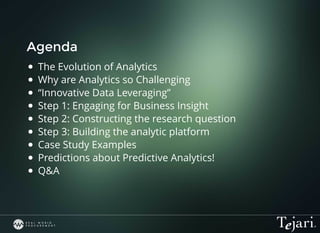
Agenda
The Evolution of Analytics
Why are Analytics so Challenging
“Innovative Data Leveraging”
Step 1: Engaging for Business Insight
Step 2: Constructing the research question
Step 3: Building the analytic platform
Case Study Examples
Predictions about Predictive Analytics!
Q&A​
Elements of S2P - Spend Analytic
Interviewed 24 CPO’s / Senior Directors on a series of calls
Conducted interviews with multiple subject matter experts
Reviewed primary & secondary research
Analyzed written transcripts of documents and compared
maturity levels (Early, Emerging, and Advanced) with level
of analytics activity and procurement systems deployment
to identify trends
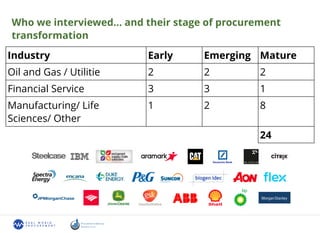
Who we interviewed… and their stage of procurement
transformation
Industry Early Emerging Mature
Oil and Gas / Utilitie 2 2 2
Financial Service 3 3 1
Manufacturing/ Life
Sciences/ Other
1 2 8
24
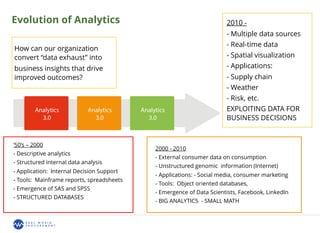
Evolution of Analytics
How can our organization
convert “data exhaust” into
business insights that drive
improved outcomes?
‘50’s – 2000
- Descriptive analytics
- Structured internal data analysis
- Application: Internal Decision Support
- Tools: Mainframe reports, spreadsheets
- Emergence of SAS and SPSS
- STRUCTURED DATABASES
2000 - 2010
- External consumer data on consumption
- Unstructured genomic information (Internet)
- Applications: - Social media, consumer marketing
- Tools: Object oriented databases,
- Emergence of Data Scientists, Facebook, LinkedIn
- BIG ANALYTICS - SMALL MATH
2010 -
- Multiple data sources
- Real-time data
- Spatial visualization
- Applications:
- Supply chain
- Weather
- Risk, etc.
EXPLOITING DATA FOR
BUSINESS DECISIONS
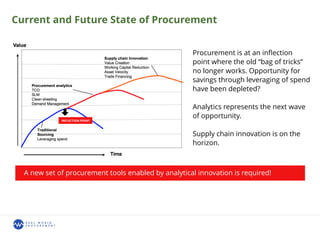
Procurement is at an inflection
point where the old “bag of tricks”
no longer works. Opportunity for
savings through leveraging of spend
have been depleted?
Analytics represents the next wave
of opportunity.
Supply chain innovation is on the
horizon.
A new set of procurement tools enabled by analytical innovation is required!
INFLECTION POINT
Current and Future State of Procurement
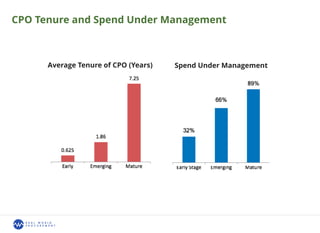
CPO Tenure and Spend Under Management
Average Tenure of CPO (Years) Spend Under Management
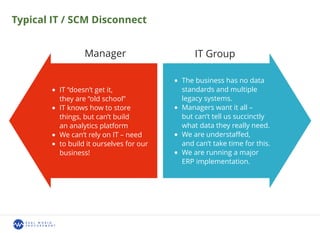
Typical IT / SCM Disconnect
IT “doesn’t get it,
they are “old school”
IT knows how to store
things, but can’t build
an analytics platform
We can’t rely on IT – need
to build it ourselves for our
business!
The business has no data
standards and multiple
legacy systems.
Managers want it all –
but can’t tell us succinctly
what data they really need.
We are understaffed,
and can’t take time for this.
We are running a major
ERP implementation.
Manager IT Group
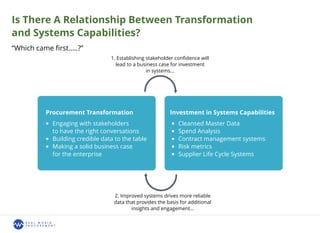
Is There A Relationship Between Transformation
and Systems Capabilities?
“Which came first…..?”
1. Establishing stakeholder confidence will
lead to a business case for investment
in systems…
2. Improved systems drives more reliable
data that provides the basis for additional
insights and engagement…
Engaging with stakeholders
to have the right conversations
Building credible data to the table
Making a solid business case
for the enterprise
Cleansed Master Data
Spend Analysis
Contract management systems
Risk metrics
Supplier Life Cycle Systems
Procurement Transformation Investment in Systems Capabilities
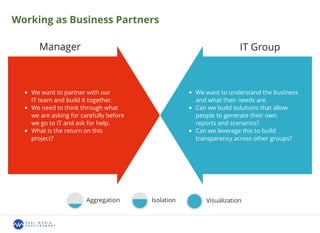
Working as Business Partners
We want to understand the business
and what their needs are.
Can we build solutions that allow
people to generate their own
reports and scenarios?
Can we leverage this to build
transparency across other groups?
We want to partner with our
IT team and build it together.
We need to think through what
we are asking for carefully before
we go to IT and ask for help.
What is the return on this
project?
Manager IT Group
Aggregation Isolation Visualization
Recurring Theme: Predictive Analytics
Every executive we interviewed was seeking to create customized analytical
insights that leverages existing databases and data, along with other databases
and information not contained in their internal corporate procurement or ERP
systems (“mash-ups”)
The key to building stakeholder value and insight:
“Innovation data leveraging”
Innovative Data Leveraging (IDL) is defined as a fact-based, data-driven approach
to driving change and influencing stakeholders to create procurement value for
the business.
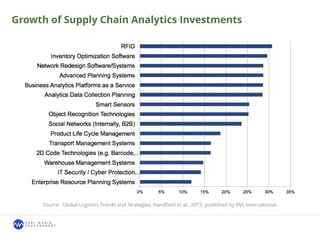
Growth of Supply Chain Analytics Investments
Source: Global Logistics Trends and Strategies, Handfield et al., 2013, published by BVL International.
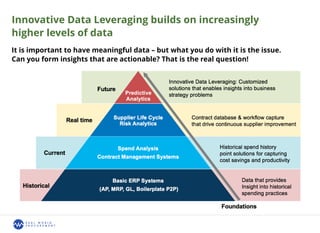
Innovative Data Leveraging builds on increasingly
higher levels of data
It is important to have meaningful data – but what you do with it is the issue.
Can you form insights that are actionable? That is the real question!
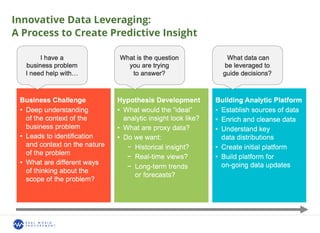
Innovative Data Leveraging:
A Process to Create Predictive Insight
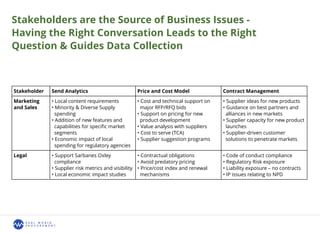
Stakeholders are the Source of Business Issues -
Having the Right Conversation Leads to the Right
Question & Guides Data Collection
Stakeholder Send Analytics Price and Cost Model Contract Management
Marketing
and Sales
• Local content requirements
• Minority & Diverse Supply
spending
• Addition of new features and
capabilities for specific market
segments
• Economic impact of local
spending for regulatory agencies
• Cost and technical support on
major RFP/RFQ bids
• Support on pricing for new
product development
• Value analysis with suppliers
• Cost to serve (TCA)
• Supplier suggestion programs
• Supplier ideas for new products
• Guidance on best partners and
alliances in new markets
• Supplier capacity for new product
launches
• Supplier-driven customer
solutions to penetrate markets
Legal • Support Sarbanes Oxley
compliance
• Supplier risk metrics and visibility
• Local economic impact studies
• Contractual obligations
• Avoid predatory pricing
• Price/cost index and renewal
mechanisms
• Code of conduct compliance
• Regulatory Risk exposure
• Liability exposure – no contracts
• IP issues relating to NPD
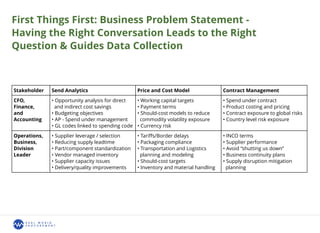
First Things First: Business Problem Statement -
Having the Right Conversation Leads to the Right
Question & Guides Data Collection
Stakeholder Send Analytics Price and Cost Model Contract Management
CFO,
Finance,
and
Accounting
• Opportunity analysis for direct
and indirect cost savings
• Budgeting objectives
• AP - Spend under management
• GL codes linked to spending code
• Working capital targets
• Payment terms
• Should-cost models to reduce
commodity volatility exposure
• Currency risk
• Spend under contract
• Product costing and pricing
• Contract exposure to global risks
• Country level risk exposure
Operations,
Business,
Division
Leader
• Supplier leverage / selection
• Reducing supply leadtime
• Part/component standardization
• Vendor managed inventory
• Supplier capacity issues
• Delivery/quality improvements
• Tariffs/Border delays
• Packaging compliance
• Transportation and Logistics
planning and modeling
• Should-cost targets
• Inventory and material handling
• INCO terms
• Supplier performance
• Avoid “shutting us down”
• Business continuity plans
• Supply disruption mitigation
planning
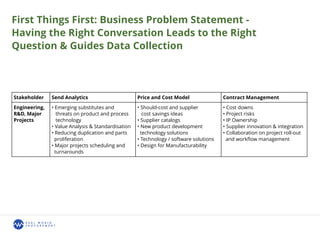
First Things First: Business Problem Statement -
Having the Right Conversation Leads to the Right
Question & Guides Data Collection
Stakeholder Send Analytics Price and Cost Model Contract Management
Engineering,
R&D, Major
Projects
• Emerging substitutes and
threats on product and process
technology
• Value Analysis & Standardisation
• Reducing duplication and parts
proliferation
• Major projects scheduling and
turnarounds
• Should-cost and supplier
cost savings ideas
• Supplier catalogs
• New product development
technology solutions
• Technology / software solutions
• Design for Manufacturability
• Cost downs
• Project risks
• IP Ownership
• Supplier innovation & integration
• Collaboration on project roll-out
and workflow management
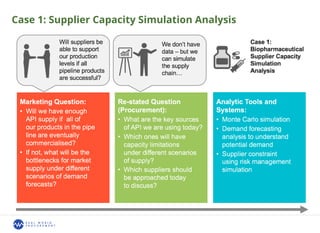
Case 1: Supplier Capacity Simulation Analysis
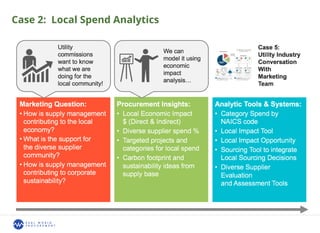
Case 2: Local Spend Analytics
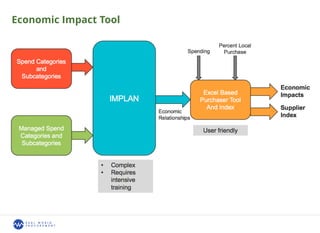
Economic Impact Tool
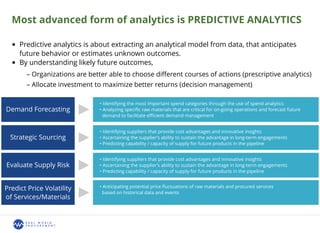
Most advanced form of analytics is PREDICTIVE ANALYTICS
Predictive analytics is about extracting an analytical model from data, that anticipates
future behavior or estimates unknown outcomes.
By understanding likely future outcomes,
– Organizations are better able to choose different courses of actions (prescriptive analytics)
– Allocate investment to maximize better returns (decision management)
• Identifying the most important spend categories through the use of spend analytics
• Analyzing specific raw materials that are critical for on-going operations and forecast future
demand to facilitate efficient demand management
Demand Forecasting
• Identifying suppliers that provide cost advantages and innovative insights
• Ascertaining the supplier’s ability to sustain the advantage in long-term engagements
• Predicting capability / capacity of supply for future products in the pipeline
Strategic Sourcing
• Identifying suppliers that provide cost advantages and innovative insights
• Ascertaining the supplier’s ability to sustain the advantage in long-term engagements
• Predicting capability / capacity of supply for future products in the pipeline
Evaluate Supply Risk
• Anticipating potential price fluctuations of raw materials and procured services
based on historical data and events
Predict Price Volatility
of Services/Materials
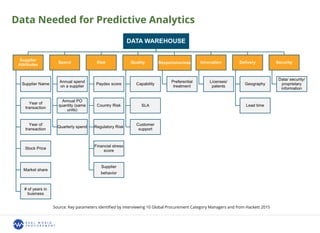
Data Needed for Predictive Analytics
Source: Key parameters identified by interviewing 10 Global Procurement Category Managers and from Hackett 2015
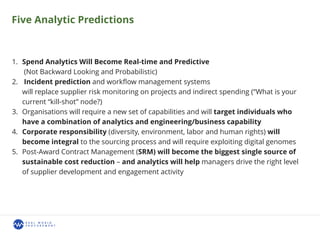
Five Analytic Predictions
1. Spend Analytics Will Become Real-time and Predictive
(Not Backward Looking and Probabilistic)
2. Incident prediction and workflow management systems
will replace supplier risk monitoring on projects and indirect spending (“What is your
current “kill-shot” node?)
3. Organisations will require a new set of capabilities and will target individuals who
have a combination of analytics and engineering/business capability
4. Corporate responsibility (diversity, environment, labor and human rights) will
become integral to the sourcing process and will require exploiting digital genomes
5. Post-Award Contract Management (SRM) will become the biggest single source of
sustainable cost reduction – and analytics will help managers drive the right level
of supplier development and engagement activity
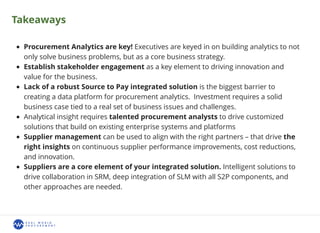
Takeaways
Procurement Analytics are key! Executives are keyed in on building analytics to not
only solve business problems, but as a core business strategy.
Establish stakeholder engagement as a key element to driving innovation and
value for the business.
Lack of a robust Source to Pay integrated solution is the biggest barrier to
creating a data platform for procurement analytics. Investment requires a solid
business case tied to a real set of business issues and challenges.
Analytical insight requires talented procurement analysts to drive customized
solutions that build on existing enterprise systems and platforms
Supplier management can be used to align with the right partners – that drive the
right insights on continuous supplier performance improvements, cost reductions,
and innovation.
Suppliers are a core element of your integrated solution. Intelligent solutions to
drive collaboration in SRM, deep integration of SLM with all S2P components, and
other approaches are needed.
Q&A

Innovative Data Leveraging for Procurement Analytics

  • 1.
  • 2.
    Please note thatyour microphones have been muted for the duration of the webinar. Having technical issues? Should you have any technical issues, please let us know via the 'Questions' box on your GoToWebinar panel. Any questions for our Q&A? Send your questions through to us at any time via the 'Questions' box on your GoToWebinar panel. We'll then put them to Robert in the Q&A after the presentation! Welcome to the webinar
  • 3.
    Rob Handfield Bank ofAmerica University Distinguished Professor of Supply Chain Management | Poole College of Management, North Carolina State University
  • 4.
    Agenda The Evolution ofAnalytics Why are Analytics so Challenging “Innovative Data Leveraging” Step 1: Engaging for Business Insight Step 2: Constructing the research question Step 3: Building the analytic platform Case Study Examples Predictions about Predictive Analytics! Q&A​
  • 5.
    Elements of S2P- Spend Analytic Interviewed 24 CPO’s / Senior Directors on a series of calls Conducted interviews with multiple subject matter experts Reviewed primary & secondary research Analyzed written transcripts of documents and compared maturity levels (Early, Emerging, and Advanced) with level of analytics activity and procurement systems deployment to identify trends
  • 6.
    Who we interviewed…and their stage of procurement transformation Industry Early Emerging Mature Oil and Gas / Utilitie 2 2 2 Financial Service 3 3 1 Manufacturing/ Life Sciences/ Other 1 2 8 24
  • 7.
    Evolution of Analytics Howcan our organization convert “data exhaust” into business insights that drive improved outcomes? ‘50’s – 2000 - Descriptive analytics - Structured internal data analysis - Application: Internal Decision Support - Tools: Mainframe reports, spreadsheets - Emergence of SAS and SPSS - STRUCTURED DATABASES 2000 - 2010 - External consumer data on consumption - Unstructured genomic information (Internet) - Applications: - Social media, consumer marketing - Tools: Object oriented databases, - Emergence of Data Scientists, Facebook, LinkedIn - BIG ANALYTICS - SMALL MATH 2010 - - Multiple data sources - Real-time data - Spatial visualization - Applications: - Supply chain - Weather - Risk, etc. EXPLOITING DATA FOR BUSINESS DECISIONS
  • 8.
    Procurement is atan inflection point where the old “bag of tricks” no longer works. Opportunity for savings through leveraging of spend have been depleted? Analytics represents the next wave of opportunity. Supply chain innovation is on the horizon. A new set of procurement tools enabled by analytical innovation is required! INFLECTION POINT Current and Future State of Procurement
  • 9.
    CPO Tenure andSpend Under Management Average Tenure of CPO (Years) Spend Under Management
  • 10.
    Typical IT /SCM Disconnect IT “doesn’t get it, they are “old school” IT knows how to store things, but can’t build an analytics platform We can’t rely on IT – need to build it ourselves for our business! The business has no data standards and multiple legacy systems. Managers want it all – but can’t tell us succinctly what data they really need. We are understaffed, and can’t take time for this. We are running a major ERP implementation. Manager IT Group
  • 11.
    Is There ARelationship Between Transformation and Systems Capabilities? “Which came first…..?” 1. Establishing stakeholder confidence will lead to a business case for investment in systems… 2. Improved systems drives more reliable data that provides the basis for additional insights and engagement… Engaging with stakeholders to have the right conversations Building credible data to the table Making a solid business case for the enterprise Cleansed Master Data Spend Analysis Contract management systems Risk metrics Supplier Life Cycle Systems Procurement Transformation Investment in Systems Capabilities
  • 12.
    Working as BusinessPartners We want to understand the business and what their needs are. Can we build solutions that allow people to generate their own reports and scenarios? Can we leverage this to build transparency across other groups? We want to partner with our IT team and build it together. We need to think through what we are asking for carefully before we go to IT and ask for help. What is the return on this project? Manager IT Group Aggregation Isolation Visualization
  • 13.
    Recurring Theme: PredictiveAnalytics Every executive we interviewed was seeking to create customized analytical insights that leverages existing databases and data, along with other databases and information not contained in their internal corporate procurement or ERP systems (“mash-ups”) The key to building stakeholder value and insight: “Innovation data leveraging” Innovative Data Leveraging (IDL) is defined as a fact-based, data-driven approach to driving change and influencing stakeholders to create procurement value for the business.
  • 14.
    Growth of SupplyChain Analytics Investments Source: Global Logistics Trends and Strategies, Handfield et al., 2013, published by BVL International.
  • 15.
    Innovative Data Leveragingbuilds on increasingly higher levels of data It is important to have meaningful data – but what you do with it is the issue. Can you form insights that are actionable? That is the real question!
  • 16.
    Innovative Data Leveraging: AProcess to Create Predictive Insight
  • 17.
    Stakeholders are theSource of Business Issues - Having the Right Conversation Leads to the Right Question & Guides Data Collection Stakeholder Send Analytics Price and Cost Model Contract Management Marketing and Sales • Local content requirements • Minority & Diverse Supply spending • Addition of new features and capabilities for specific market segments • Economic impact of local spending for regulatory agencies • Cost and technical support on major RFP/RFQ bids • Support on pricing for new product development • Value analysis with suppliers • Cost to serve (TCA) • Supplier suggestion programs • Supplier ideas for new products • Guidance on best partners and alliances in new markets • Supplier capacity for new product launches • Supplier-driven customer solutions to penetrate markets Legal • Support Sarbanes Oxley compliance • Supplier risk metrics and visibility • Local economic impact studies • Contractual obligations • Avoid predatory pricing • Price/cost index and renewal mechanisms • Code of conduct compliance • Regulatory Risk exposure • Liability exposure – no contracts • IP issues relating to NPD
  • 18.
    First Things First:Business Problem Statement - Having the Right Conversation Leads to the Right Question & Guides Data Collection Stakeholder Send Analytics Price and Cost Model Contract Management CFO, Finance, and Accounting • Opportunity analysis for direct and indirect cost savings • Budgeting objectives • AP - Spend under management • GL codes linked to spending code • Working capital targets • Payment terms • Should-cost models to reduce commodity volatility exposure • Currency risk • Spend under contract • Product costing and pricing • Contract exposure to global risks • Country level risk exposure Operations, Business, Division Leader • Supplier leverage / selection • Reducing supply leadtime • Part/component standardization • Vendor managed inventory • Supplier capacity issues • Delivery/quality improvements • Tariffs/Border delays • Packaging compliance • Transportation and Logistics planning and modeling • Should-cost targets • Inventory and material handling • INCO terms • Supplier performance • Avoid “shutting us down” • Business continuity plans • Supply disruption mitigation planning
  • 19.
    First Things First:Business Problem Statement - Having the Right Conversation Leads to the Right Question & Guides Data Collection Stakeholder Send Analytics Price and Cost Model Contract Management Engineering, R&D, Major Projects • Emerging substitutes and threats on product and process technology • Value Analysis & Standardisation • Reducing duplication and parts proliferation • Major projects scheduling and turnarounds • Should-cost and supplier cost savings ideas • Supplier catalogs • New product development technology solutions • Technology / software solutions • Design for Manufacturability • Cost downs • Project risks • IP Ownership • Supplier innovation & integration • Collaboration on project roll-out and workflow management
  • 20.
    Case 1: SupplierCapacity Simulation Analysis
  • 21.
    Case 2: LocalSpend Analytics
  • 22.
  • 23.
    Most advanced formof analytics is PREDICTIVE ANALYTICS Predictive analytics is about extracting an analytical model from data, that anticipates future behavior or estimates unknown outcomes. By understanding likely future outcomes, – Organizations are better able to choose different courses of actions (prescriptive analytics) – Allocate investment to maximize better returns (decision management) • Identifying the most important spend categories through the use of spend analytics • Analyzing specific raw materials that are critical for on-going operations and forecast future demand to facilitate efficient demand management Demand Forecasting • Identifying suppliers that provide cost advantages and innovative insights • Ascertaining the supplier’s ability to sustain the advantage in long-term engagements • Predicting capability / capacity of supply for future products in the pipeline Strategic Sourcing • Identifying suppliers that provide cost advantages and innovative insights • Ascertaining the supplier’s ability to sustain the advantage in long-term engagements • Predicting capability / capacity of supply for future products in the pipeline Evaluate Supply Risk • Anticipating potential price fluctuations of raw materials and procured services based on historical data and events Predict Price Volatility of Services/Materials
  • 24.
    Data Needed forPredictive Analytics Source: Key parameters identified by interviewing 10 Global Procurement Category Managers and from Hackett 2015
  • 25.
    Five Analytic Predictions 1.Spend Analytics Will Become Real-time and Predictive (Not Backward Looking and Probabilistic) 2. Incident prediction and workflow management systems will replace supplier risk monitoring on projects and indirect spending (“What is your current “kill-shot” node?) 3. Organisations will require a new set of capabilities and will target individuals who have a combination of analytics and engineering/business capability 4. Corporate responsibility (diversity, environment, labor and human rights) will become integral to the sourcing process and will require exploiting digital genomes 5. Post-Award Contract Management (SRM) will become the biggest single source of sustainable cost reduction – and analytics will help managers drive the right level of supplier development and engagement activity
  • 26.
    Takeaways Procurement Analytics arekey! Executives are keyed in on building analytics to not only solve business problems, but as a core business strategy. Establish stakeholder engagement as a key element to driving innovation and value for the business. Lack of a robust Source to Pay integrated solution is the biggest barrier to creating a data platform for procurement analytics. Investment requires a solid business case tied to a real set of business issues and challenges. Analytical insight requires talented procurement analysts to drive customized solutions that build on existing enterprise systems and platforms Supplier management can be used to align with the right partners – that drive the right insights on continuous supplier performance improvements, cost reductions, and innovation. Suppliers are a core element of your integrated solution. Intelligent solutions to drive collaboration in SRM, deep integration of SLM with all S2P components, and other approaches are needed.
  • 27.