International Journal of Game Theory and Technology (IJGTT), Vol.10, No.4, December 2024
DOI : 10.5121/ijgtt.2024.10401 1
PREDICTING THE REPLICATOR EQUATION USING
DEEP LEARNING IN EVOLUTIONARY DYNAMICS
Advait Chandorkar
Department of Mechanical Engineering, Indian Institute of Technology Ropar,
Rupnagar, India
ABSTRACT
This paper introduces a physics-informed deep learning approach for predicting the replicator equation,
enabling precise forecasting of population dynamics. This innovative methodology allows for the
derivation of governing differential or difference equations for systems without explicit mathematical
models. Using the SINDy framework, as pioneered by Fasel, Kaiser, Kutz, Brunton, and Brunt in 2016, we
extracted the replicator equation, offering a transformative step forward in understanding evolutionary
biology, economic systems, and social dynamics. By refining predictive models across multiple disciplines,
including ecology, social structures, and moral behaviours, our work offers new insights into the complex
interplay of variables shaping evolutionary outcomes in dynamic systems
KEYWORDS
evolutionary game theory, deep learning, replicator equation, non-linear dynamics
1. INTRODUCTION
Game theory provides a framework for understanding the evolution and persistence of strategic
behaviors in biological, social, and economic systems involving interactions among individuals.
It also sheds light on the development and maintenance of complex social behaviors and
strategies across diverse scenarios. By applying the principles of Nash equilibrium (NE), as
defined by John F. Nash, Jr (1), researchers can gain valuable insights into the stability and
evolution of strategies within populations. This perspective enhances theoretical comprehension
and offers practical applications in fields such as biology and economics.
The concept of evolutionary game theory was first proposed by John Maynard Smith and George
R Martin (2) which extends classical game theory by focusing on the dynamics of strategy
evolution within populations over time. Unlike traditional game theory, which typically analyses
the strategic interactions of rational, decision-making individuals aiming to maximize their
payoffs, EGT considers populations of interacting agents whose strategies evolve based on their
success. In EGT, strategies represent phenotypic traits, such as aggression or body size, that
impact fitness and survival. The success of a strategy is determined by its reproductive success in
the population, influenced by selective pressures. This approach permits the mathematical
analysis of the development of strategies, giving us an understanding of the evolutionary stability
of behaviours and characteristics in biological populations. The replicator equation plays a key
role in evolutionary game theory. used to model the dynamics of strategy distribution within a
population. The replicator is a non-linear differential equation that allows us to capture the real
world strategies and interactions. The replicator dynamics can be used to find out how the percent
of people using one particular strategy varies over time and other parameters like changing
payoffs. Beyond its classical applications, the replicator equation has been employed in diverse
International Journal of Game Theory and Technology (IJGTT), Vol.10, No.4, December 2024
2
optimization and control scenarios, such as bandwidth allocation (4) and service levels in water
distribution systems (5).
Predicting the behaviour of non-linear differential equations from their trajectories is challenging
due to non-linear systems often exhibit sensitivity to initial conditions, where small variations in
starting points can lead to vastly different outcomes due to system the system being chaotic
(butterfly effect). This sensitivity makes long-term prediction unreliable due to finite precision
error. Third, the presence of multiple equilibrium and bifurcations in non-linear systems
complicates the analysis, as trajectories can converge to different stable states depending on
initial conditions and perturbations. Nonlinear systems can also have tipping points which by just
monitoring the population we won’t be able to exactly predict when the tipping point may occur.
A method discovered by Bongard and Lipson (5), as well as Schmidt and Lipson (6), presented a
method for uncovering the underlying structure of nonlinear dynamical systems from data. This
approach used genetic programming (7) to derive nonlinear differential equations. Additional
methods for recognizing dynamic systems from data include methods for extracting governing
equations from time-series data equation-free modelling (7), empirical dynamic modelling (9,
10), modelling emergent behaviours (11), and automated dynamic inference (11–13).
In this paper, the aim is to predict the replicator equation using the SINDy (Sparse Identification
of Nonlinear Dynamical systems) architecture that can be used to solve ordinary and partial
differential equations and validate its use in this field, first introduced by Steven L. Brunton,
Joshua L. Proctor, and J. Nathan Kutz in (8). Sparse identification of nonlinear dynamical
systems (SINDy) uses the fact that the sparsity of most physical systems, only have few functions
as their basis function to define the dynamics which is generally the case in Evolutionary game
theory, resulting in governing equations that are sparse in a high-dimensional nonlinear function
space. The SINDy framework identifies these sparse representations efficiently, even in complex
systems, and has demonstrated success in capturing the essential dynamics with minimal
computational overhead. Additionally, a weak form of SINDy was developed by A.Messenger,
Dall’Anese(14) Bortzto handle noisy data, as there is always some noise in the data collected
from real world applications. SINDy can be applied to a variety of contexts, including
discretetime systems, nonlinear systems, and other complex dynamical systems, making it a
versatile tool for discovering underlying dynamics from data. Its adaptability to different types of
systems and robustness against noise make it useful for finding the replicator equation.
2. NETWORK ARCHITECTURE
The sparse identification of nonlinear dynamical systems uses the fact that most differential
equations have very few terms that define the dynamics, making the governing equations sparse
in a high-dimensional nonlinear function spaceuses sparse regression techniques to reduce the
unwanted terms in the differential equation due to noise in the data. Progress in compressed
sensing and sparse regression has made the concept of sparsity advantageous. These
advancements allow us to identify non-zero terms without resorting to a combinatorial,
intractable brute-force search. This ensures that we can find the sparse solution with high
probability using convex methods that efficiently scale to large problems, in line with Moore's
law. Consequently, the identified sparse model strikes a balance between complexity (i.e., the
sparsity of the righthand-side dynamics) and accuracy, thus preventing overfitting to the data.
2.1. Data
The sparse identification of nonlinear dynamical systems takes either x(t) or x˙(t) for continuous
time, or x[n] or ∆x[n] for discrete-time. The sparse identification of nonlinear dynamical systems
International Journal of Game Theory and Technology (IJGTT), Vol.10, No.4, December 2024
3
takes either x(t) or x˙(t) for continuous time, or x[n] or ∆x[n] for discrete-time. The x and x˙
sampled over time are arranged in a matrix as shown below, where t1,t2,...,tm are the time points
sampled in increasing order.
Then a matrix Θ(X) consisting of the functions that may be present in the basis functions X.
needs to be constructed based on the functions that may be present in the differential equations
Θ(X) = [1 X2
· · · sin(X) cos(X)]
Its capabilities were extended to models trained using multiple dynamic trajectories, and the
generation of many models with subsampling and ensembling methods by U. Fasel, J. N. Kutz,
B. W. Brunton and S. L. Brunton(15) which will be useful when the dynamics of the replicator
equation gets complicated helping it in accurately predicting the equation. One recent
development is that researchers have started considering feedback like Joshua S. Weitza,b,1,
Ceyhun Eksin a,c, Keith Paarpornc , Sam P. Brown, and William C. Ratcliff .
The weak form of Sparse Identification of Nonlinear Dynamics (SINDy) builds upon the idea of
discovering governing equations of a system from data by leveraging a variational approach. In
the weak form, instead of directly fitting differential equations to time series data, the dynamics
are identified by integrating the equations against a set of compactly supported test functions.
This reduces sensitivity to noise and irregularities in data. Specifically, the method constructs a
library of trial functions representing potential dynamics and uses them to form a regression
problem. By minimizing a least-squares objective, coefficients are learned for the sparse
representation of the dynamics. The weak form framework integrates flexibility to handle noisy,
incomplete, or irregularly sampled data, enabling robust and accurate discovery of dynamics in
reduced-order models or latent spaces.
3. METHODOLOGY
3.1. Data Generation
To train the SINDy model, we generated data by simulating the game under study. Leveraging
the known dynamics of the game, we derived the replicator equation to model the evolution of
strategies. To ensure a diverse set of trajectories, we employed the Runge-Kutta algorithm to
generate random paths. These trajectories were then transformed into barycentric coordinates,
which are particularly well-suited for capturing the proportions of strategies within a simplex.
International Journal of Game Theory and Technology (IJGTT), Vol.10, No.4, December 2024
4
In real-world scenarios, such data can be obtained by monitoring the population or frequency of
strategies in a system or by sampling a small subset of the space and generalizing from it.
However, for this study, we relied on simulation to generate the necessary data.
3.2. Model Training and Prediction
In the context of replicator dynamics for n strategies, the sum of the strategy frequencies xi must
always equal. This constraint allows us to reduce the number of equations that need to be
predicted using the SINDy model. Instead of predicting all n equations, we only need to predict
n-1 equations, as the final one can be determined directly from the constraint. There is no need to
explicitly substitute one variable (example 𝑥𝑛 ) into the system to match the
solution for verification.
By reducing the number of equations, the process becomes computationally less taxing,
especially for smaller models. This allows the already-built SINDy model to perform faster,
without sacrificing accuracy, making it more efficient while maintaining the ability to accurately
capture the system's dynamics.
4. REPLICATOR EQUATION
The replicator equation tells how individuals or populations change over time. The most famous
game is of rock paper scissors with the origin of RPS has been difficult to trace, but there is some
written evidence suggesting the Chinese played it already in the Han Dynasty more than 2000
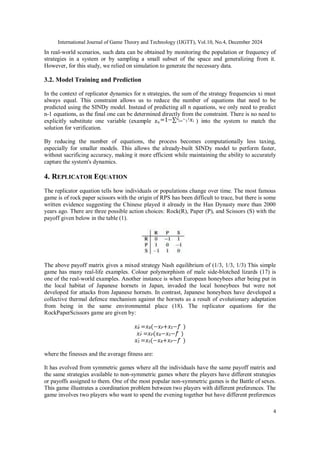
years ago. There are three possible action choices: Rock(R), Paper (P), and Scissors (S) with the
payoff given below in the table (1).
The above payoff matrix gives a mixed strategy Nash equilibrium of (1/3, 1/3, 1/3) This simple
game has many real-life examples. Colour polymorphism of male side-blotched lizards (17) is
one of the real-world examples. Another instance is when European honeybees after being put in
the local habitat of Japanese hornets in Japan, invaded the local honeybees but were not
developed for attacks from Japanese hornets. In contrast, Japanese honeybees have developed a
collective thermal defence mechanism against the hornets as a result of evolutionary adaptation
from being in the same environmental place (18). The replicator equations for the
RockPaperScissors game are given by:
𝑥𝑅̇ =𝑥𝑅(−𝑥𝑃+𝑥𝑆−𝑓̅ )
𝑥𝑃̇ =𝑥𝑃(𝑥𝑅−𝑥𝑆−𝑓̅ )
𝑥𝑆̇ =𝑥𝑆(−𝑥𝑅+𝑥𝑃−𝑓̅ )
where the finesses and the average fitness are:
It has evolved from symmetric games where all the individuals have the same payoff matrix and
the same strategies available to non-symmetric games where the players have different strategies
or payoffs assigned to them. One of the most popular non-symmetric games is the Battle of sexes.
This game illustrates a coordination problem between two players with different preferences. The
game involves two players who want to spend the evening together but have different preferences
International Journal of Game Theory and Technology (IJGTT), Vol.10, No.4, December 2024
5
over two activities: football and ballet or any other conflicting hobbies. The husband prefers
football, while the wife prefers ballet. Despite their different preferences, both players would
prefer to be together than apart. This creates a situation where they need to coordinate their
choices, leading to multiple equilibria.
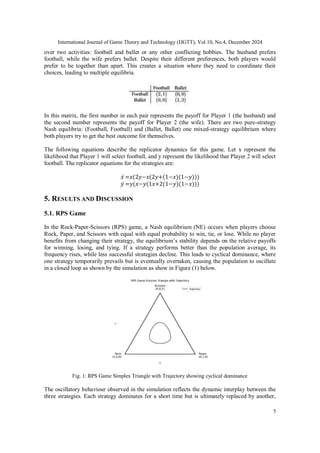
In this matrix, the first number in each pair represents the payoff for Player 1 (the husband) and
the second number represents the payoff for Player 2 (the wife). There are two pure-strategy
Nash equilibria: (Football, Football) and (Ballet, Ballet) one mixed-strategy equilibrium where
both players try to get the best outcome for themselves.
The following equations describe the replicator dynamics for this game. Let x represent the
likelihood that Player 1 will select football, and y represent the likelihood that Player 2 will select
football. The replicator equations for the strategies are:
𝑥̇ =𝑥(2𝑦−𝑥(2𝑦+(1−𝑥)(1−𝑦)))
𝑦̇ =𝑦(𝑥−𝑦(1𝑥+2(1−𝑦)(1−𝑥)))
5. RESULTS AND DISCUSSION
5.1. RPS Game
In the Rock-Paper-Scissors (RPS) game, a Nash equilibrium (NE) occurs when players choose
Rock, Paper, and Scissors with equal with equal probability to win, tie, or lose. While no player
benefits from changing their strategy, the equilibrium’s stability depends on the relative payoffs
for winning, losing, and tying. If a strategy performs better than the population average, its
frequency rises, while less successful strategies decline. This leads to cyclical dominance, where
one strategy temporarily prevails but is eventually overtaken, causing the population to oscillate
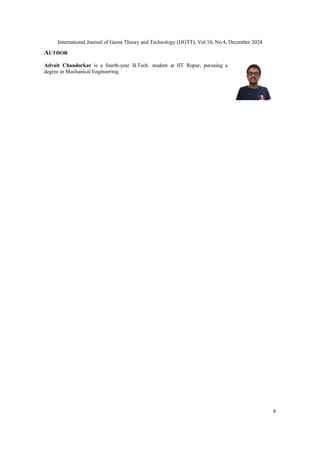
in a closed loop as shown by the simulation as show in Figure (1) below.
Fig. 1: RPS Game Simplex Triangle with Trajectory showing cyclical dominance
The oscillatory behaviour observed in the simulation reflects the dynamic interplay between the
three strategies. Each strategy dominates for a short time but is ultimately replaced by another,
International Journal of Game Theory and Technology (IJGTT), Vol.10, No.4, December 2024
6
ensuring that no single strategy is stable in the long run. This cyclical dominance is a key
characteristic of many biological and social systems modelled by evolutionary game theory,
where species, strategies, or behaviours rise and fall over time due to competition and adaptation.
For the RPS game, a single trajectory of 1000 data points was enough for sindy to predict the
replicator equation SINDy is easily able to predict the replicator equation for RPS game taking a
smaller number of data points than these correctly predict the basis functions but the coefficients
were slightly off.
5.2. Battle of Sexe
The Battle of the Sexes game has two pure strategy Nash equilibria, where both players
coordinate on the same outcome: Both players choose Outcome A. The payoffs are (2, 1). Both
players choose Outcome B. The payoffs are (1, 2).
In addition to these pure strategy equilibria, there is a mixed strategy Nash equilibrium where
both players play a mix of strategies. In this equilibrium, each player assigns probabilities to their
choices such that they are indifferent to the other player's strategy. The mixed strategy
equilibrium can be found by solving the following system:
Let p represent the likelihood that Player 1 choose Outcome A, and 1-p represent the likelihood
that Player 1 selects Outcome B. Let q represent the likelihood that Player 2 choose Outcome A,
and let 1-q represent the likelihood that Player 2 selects Outcome B. The mixed strategy
equilibrium is given by:
P=1/3 Q=2/3
In this equilibrium, each player chooses according to these probabilities, leading to expected
payoffs where neither player has an incentive to deviate from their mixed strategy.
To analyse the dynamics of the Battle of the Sexes using replicator dynamics, we consider the
evolution of the strategies over time. The replicator equation for this game describes how the
proportion of players using each strategy changes based on their relative fitness.
For the battle of sexes game, the number of data points required were considerably more. In order
to reduce the number of data points, multiple shorter trajectories were generated which gave
better results compared to a single larger trajectory.
6. CONCLUSION
In conclusion, by applying the SINDy (Sparse Identification of Nonlinear Dynamics) framework,
we can derive the replicator equation directly from observed data points (changes in the number
of species). This approach enables us to get the underlying differential equation which will help
us predicting the future outcomes.
By understanding how the population of a species evolves over time, it will become possible to
identify critical tipping points where the population of one species may blow up or go extinct due
to over-harvesting or environmental changes. The governing equation will provide insights for
preventing a species from being driven to extinction in a local environment.
International Journal of Game Theory and Technology (IJGTT), Vol.10, No.4, December 2024
7
7. FUTURE WORK
In future research, we aim to explore the application of the weak form of SINDy, developed by
A. Messenger, Dall’Anese, and Bortz (13), which is specifically designed to handle noisy data.
This extension would enable us to test the robustness of our approach in scenarios where the data
is not ideal, as often encountered in real-world applications. The ability of the weak form of
SINDy needs to be
DATA AVAILABILITY STATEMENT
The datasets and the code generated during and analysed during the current study are available
from the corresponding author on reasonable request.
REFERENCES
[1] W. H. Thompson and R. A. Birney, "The Logical Form of the Law of Change," Proc. Nat. Acad.
Sci., vol. 36, no. 1, pp. 48–54, Jan. 1950. doi: 10.1073/pnas.36.1.48.
[2] J. Maynard Smith and G. R. Price, "The logic of animal conflict," Nature, vol. 246, no. 5427, pp.
15–18, 1973.
[3] R. Cressman and Y. Tao, "The Replicator Equation and Other Game Dynamics," Proc. Nat. Acad.
Sci., vol. 111, pp. 10810–10817, 2014. doi: 10.1073/pnas.23800665.
[4] J. Poveda and N. Quijano, "Dynamic bandwidth allocation in wireless networks using a shahsha
hani gradient based extremum seeking control," in Proc. 2012 6th Int. Conf. on Network Games,
Control and Optimization (NetGCooP), Paris, France, 2012, pp. 44–50.
[5] E. Ramírez-Llanos and N. Quijano, "A population dynamics approach for the water distribution
problem," Int. J. Control, vol. 83, no. 9, pp. 1947–1964, 2010.
[6] J. R. Koza, Genetic Programming: On the Programming of Computers by Means of Natural
Selection, vol. 1. Cambridge, MA: MIT Press, 1992.
[7] J. P. Crutchfield and B. S. McNamara, "Equations of motion from a data series," Complex Syst.,
vol. 1, no. 3, pp. 417–452, 1987.
[8] I. G. Kevrekidis, C. W. Gear, and G. Hummer, "Equation-free, coarse-grained multiscale
computation: Enabling microscopic simulators to perform system-level analysis," Commun. Math.
Sci., vol. 1, no. 4, pp. 715–762, 2003.
[9] W. H. Thompson and R. A. Birney, "The Logical Form of the Law of Change," Proc. Nat. Acad.
Sci., vol. 36, no. 1, pp. 48–54, Jan. 1950. doi: 10.1073/pnas.36.1.48.
[10] M. D. Schmidt, C. A. Myers, and H. Lipson, "Automated refinement and inference of analytical
models for metabolic networks," Phys. Biol., vol. 8, no. 5, p. 055011, 2011.
[11] B. C. Daniels and I. Nemenman, "Automated adaptive inference of phenomenological dynamical
models," Nat. Commun., vol. 6, p. 8133, 2015.
[12] B. C. Daniels and I. Nemenman, "Efficient inference of parsimonious phenomenological models of
cellular dynamics using S-systems and alternating regression," PLoS One, vol. 10, no. 3, p.
e011982, 2015.
[13] D. A. Messenger, E. Dall'Anese, and D. Bortz, "Online weak-form sparse identification of partial
differential equations," in Proc. Math. Sci. Machine Learning, vol. 190, pp. 241–256, 2022
[14] J. Burton, R. Brockett, and B. S. Meyers, "Ensemble-SINDy: Robust sparse model discovery in the
low-data, high-noise limit, with active learning and control," arXiv preprint arXiv:2111.10992, 2021
[15] H. J. Zhou, "The rock–paper–scissors game," Contemp. Phys., vol. 57, no. 2, pp. 151–163, 2015.
doi: 10.1080/00107514.2015.1026556.
[16] B. Sinervo and C. Lively, "The rock-paper-scissors game and the evolution of alternative male
strategies," Nature, vol. 380, pp. 240–243, 1996.
[17] M. Ono, T. Igarashi, E. Ohno, and M. Sasaki, "Unusual thermal defence by a honeybee against mass
attack by hornets," Nature, vol. 377, 1995.
[18] A. R. Tilman, J. B. Plotkin, and E. Akçay, "Evolutionary games with environmental feedbacks,"
Nat. Commun., vol. 11, no. 915, 2020. doi: 10.1038/s41467-020-14531-6.
International Journal of Game Theory and Technology (IJGTT), Vol.10, No.4, December 2024
8
AUTHOR
Advait Chandorkar is a fourth-year B.Tech. student at IIT Ropar, pursuing a
degree in Mechanical Engineering.

PREDICTING THE REPLICATOR EQUATION USING DEEP LEARNING IN EVOLUTIONARY DYNAMICS

  • 1.
    International Journal ofGame Theory and Technology (IJGTT), Vol.10, No.4, December 2024 DOI : 10.5121/ijgtt.2024.10401 1 PREDICTING THE REPLICATOR EQUATION USING DEEP LEARNING IN EVOLUTIONARY DYNAMICS Advait Chandorkar Department of Mechanical Engineering, Indian Institute of Technology Ropar, Rupnagar, India ABSTRACT This paper introduces a physics-informed deep learning approach for predicting the replicator equation, enabling precise forecasting of population dynamics. This innovative methodology allows for the derivation of governing differential or difference equations for systems without explicit mathematical models. Using the SINDy framework, as pioneered by Fasel, Kaiser, Kutz, Brunton, and Brunt in 2016, we extracted the replicator equation, offering a transformative step forward in understanding evolutionary biology, economic systems, and social dynamics. By refining predictive models across multiple disciplines, including ecology, social structures, and moral behaviours, our work offers new insights into the complex interplay of variables shaping evolutionary outcomes in dynamic systems KEYWORDS evolutionary game theory, deep learning, replicator equation, non-linear dynamics 1. INTRODUCTION Game theory provides a framework for understanding the evolution and persistence of strategic behaviors in biological, social, and economic systems involving interactions among individuals. It also sheds light on the development and maintenance of complex social behaviors and strategies across diverse scenarios. By applying the principles of Nash equilibrium (NE), as defined by John F. Nash, Jr (1), researchers can gain valuable insights into the stability and evolution of strategies within populations. This perspective enhances theoretical comprehension and offers practical applications in fields such as biology and economics. The concept of evolutionary game theory was first proposed by John Maynard Smith and George R Martin (2) which extends classical game theory by focusing on the dynamics of strategy evolution within populations over time. Unlike traditional game theory, which typically analyses the strategic interactions of rational, decision-making individuals aiming to maximize their payoffs, EGT considers populations of interacting agents whose strategies evolve based on their success. In EGT, strategies represent phenotypic traits, such as aggression or body size, that impact fitness and survival. The success of a strategy is determined by its reproductive success in the population, influenced by selective pressures. This approach permits the mathematical analysis of the development of strategies, giving us an understanding of the evolutionary stability of behaviours and characteristics in biological populations. The replicator equation plays a key role in evolutionary game theory. used to model the dynamics of strategy distribution within a population. The replicator is a non-linear differential equation that allows us to capture the real world strategies and interactions. The replicator dynamics can be used to find out how the percent of people using one particular strategy varies over time and other parameters like changing payoffs. Beyond its classical applications, the replicator equation has been employed in diverse

  • 2.
    International Journal ofGame Theory and Technology (IJGTT), Vol.10, No.4, December 2024 2 optimization and control scenarios, such as bandwidth allocation (4) and service levels in water distribution systems (5). Predicting the behaviour of non-linear differential equations from their trajectories is challenging due to non-linear systems often exhibit sensitivity to initial conditions, where small variations in starting points can lead to vastly different outcomes due to system the system being chaotic (butterfly effect). This sensitivity makes long-term prediction unreliable due to finite precision error. Third, the presence of multiple equilibrium and bifurcations in non-linear systems complicates the analysis, as trajectories can converge to different stable states depending on initial conditions and perturbations. Nonlinear systems can also have tipping points which by just monitoring the population we won’t be able to exactly predict when the tipping point may occur. A method discovered by Bongard and Lipson (5), as well as Schmidt and Lipson (6), presented a method for uncovering the underlying structure of nonlinear dynamical systems from data. This approach used genetic programming (7) to derive nonlinear differential equations. Additional methods for recognizing dynamic systems from data include methods for extracting governing equations from time-series data equation-free modelling (7), empirical dynamic modelling (9, 10), modelling emergent behaviours (11), and automated dynamic inference (11–13). In this paper, the aim is to predict the replicator equation using the SINDy (Sparse Identification of Nonlinear Dynamical systems) architecture that can be used to solve ordinary and partial differential equations and validate its use in this field, first introduced by Steven L. Brunton, Joshua L. Proctor, and J. Nathan Kutz in (8). Sparse identification of nonlinear dynamical systems (SINDy) uses the fact that the sparsity of most physical systems, only have few functions as their basis function to define the dynamics which is generally the case in Evolutionary game theory, resulting in governing equations that are sparse in a high-dimensional nonlinear function space. The SINDy framework identifies these sparse representations efficiently, even in complex systems, and has demonstrated success in capturing the essential dynamics with minimal computational overhead. Additionally, a weak form of SINDy was developed by A.Messenger, Dall’Anese(14) Bortzto handle noisy data, as there is always some noise in the data collected from real world applications. SINDy can be applied to a variety of contexts, including discretetime systems, nonlinear systems, and other complex dynamical systems, making it a versatile tool for discovering underlying dynamics from data. Its adaptability to different types of systems and robustness against noise make it useful for finding the replicator equation. 2. NETWORK ARCHITECTURE The sparse identification of nonlinear dynamical systems uses the fact that most differential equations have very few terms that define the dynamics, making the governing equations sparse in a high-dimensional nonlinear function spaceuses sparse regression techniques to reduce the unwanted terms in the differential equation due to noise in the data. Progress in compressed sensing and sparse regression has made the concept of sparsity advantageous. These advancements allow us to identify non-zero terms without resorting to a combinatorial, intractable brute-force search. This ensures that we can find the sparse solution with high probability using convex methods that efficiently scale to large problems, in line with Moore's law. Consequently, the identified sparse model strikes a balance between complexity (i.e., the sparsity of the righthand-side dynamics) and accuracy, thus preventing overfitting to the data. 2.1. Data The sparse identification of nonlinear dynamical systems takes either x(t) or x˙(t) for continuous time, or x[n] or ∆x[n] for discrete-time. The sparse identification of nonlinear dynamical systems
  • 3.
    International Journal ofGame Theory and Technology (IJGTT), Vol.10, No.4, December 2024 3 takes either x(t) or x˙(t) for continuous time, or x[n] or ∆x[n] for discrete-time. The x and x˙ sampled over time are arranged in a matrix as shown below, where t1,t2,...,tm are the time points sampled in increasing order. Then a matrix Θ(X) consisting of the functions that may be present in the basis functions X. needs to be constructed based on the functions that may be present in the differential equations Θ(X) = [1 X2 · · · sin(X) cos(X)] Its capabilities were extended to models trained using multiple dynamic trajectories, and the generation of many models with subsampling and ensembling methods by U. Fasel, J. N. Kutz, B. W. Brunton and S. L. Brunton(15) which will be useful when the dynamics of the replicator equation gets complicated helping it in accurately predicting the equation. One recent development is that researchers have started considering feedback like Joshua S. Weitza,b,1, Ceyhun Eksin a,c, Keith Paarpornc , Sam P. Brown, and William C. Ratcliff . The weak form of Sparse Identification of Nonlinear Dynamics (SINDy) builds upon the idea of discovering governing equations of a system from data by leveraging a variational approach. In the weak form, instead of directly fitting differential equations to time series data, the dynamics are identified by integrating the equations against a set of compactly supported test functions. This reduces sensitivity to noise and irregularities in data. Specifically, the method constructs a library of trial functions representing potential dynamics and uses them to form a regression problem. By minimizing a least-squares objective, coefficients are learned for the sparse representation of the dynamics. The weak form framework integrates flexibility to handle noisy, incomplete, or irregularly sampled data, enabling robust and accurate discovery of dynamics in reduced-order models or latent spaces. 3. METHODOLOGY 3.1. Data Generation To train the SINDy model, we generated data by simulating the game under study. Leveraging the known dynamics of the game, we derived the replicator equation to model the evolution of strategies. To ensure a diverse set of trajectories, we employed the Runge-Kutta algorithm to generate random paths. These trajectories were then transformed into barycentric coordinates, which are particularly well-suited for capturing the proportions of strategies within a simplex.
  • 4.
    International Journal ofGame Theory and Technology (IJGTT), Vol.10, No.4, December 2024 4 In real-world scenarios, such data can be obtained by monitoring the population or frequency of strategies in a system or by sampling a small subset of the space and generalizing from it. However, for this study, we relied on simulation to generate the necessary data. 3.2. Model Training and Prediction In the context of replicator dynamics for n strategies, the sum of the strategy frequencies xi must always equal. This constraint allows us to reduce the number of equations that need to be predicted using the SINDy model. Instead of predicting all n equations, we only need to predict n-1 equations, as the final one can be determined directly from the constraint. There is no need to explicitly substitute one variable (example 𝑥𝑛 ) into the system to match the solution for verification. By reducing the number of equations, the process becomes computationally less taxing, especially for smaller models. This allows the already-built SINDy model to perform faster, without sacrificing accuracy, making it more efficient while maintaining the ability to accurately capture the system's dynamics. 4. REPLICATOR EQUATION The replicator equation tells how individuals or populations change over time. The most famous game is of rock paper scissors with the origin of RPS has been difficult to trace, but there is some written evidence suggesting the Chinese played it already in the Han Dynasty more than 2000 years ago. There are three possible action choices: Rock(R), Paper (P), and Scissors (S) with the payoff given below in the table (1). The above payoff matrix gives a mixed strategy Nash equilibrium of (1/3, 1/3, 1/3) This simple game has many real-life examples. Colour polymorphism of male side-blotched lizards (17) is one of the real-world examples. Another instance is when European honeybees after being put in the local habitat of Japanese hornets in Japan, invaded the local honeybees but were not developed for attacks from Japanese hornets. In contrast, Japanese honeybees have developed a collective thermal defence mechanism against the hornets as a result of evolutionary adaptation from being in the same environmental place (18). The replicator equations for the RockPaperScissors game are given by: 𝑥𝑅̇ =𝑥𝑅(−𝑥𝑃+𝑥𝑆−𝑓̅ ) 𝑥𝑃̇ =𝑥𝑃(𝑥𝑅−𝑥𝑆−𝑓̅ ) 𝑥𝑆̇ =𝑥𝑆(−𝑥𝑅+𝑥𝑃−𝑓̅ ) where the finesses and the average fitness are: It has evolved from symmetric games where all the individuals have the same payoff matrix and the same strategies available to non-symmetric games where the players have different strategies or payoffs assigned to them. One of the most popular non-symmetric games is the Battle of sexes. This game illustrates a coordination problem between two players with different preferences. The game involves two players who want to spend the evening together but have different preferences
  • 5.
    International Journal ofGame Theory and Technology (IJGTT), Vol.10, No.4, December 2024 5 over two activities: football and ballet or any other conflicting hobbies. The husband prefers football, while the wife prefers ballet. Despite their different preferences, both players would prefer to be together than apart. This creates a situation where they need to coordinate their choices, leading to multiple equilibria. In this matrix, the first number in each pair represents the payoff for Player 1 (the husband) and the second number represents the payoff for Player 2 (the wife). There are two pure-strategy Nash equilibria: (Football, Football) and (Ballet, Ballet) one mixed-strategy equilibrium where both players try to get the best outcome for themselves. The following equations describe the replicator dynamics for this game. Let x represent the likelihood that Player 1 will select football, and y represent the likelihood that Player 2 will select football. The replicator equations for the strategies are: 𝑥̇ =𝑥(2𝑦−𝑥(2𝑦+(1−𝑥)(1−𝑦))) 𝑦̇ =𝑦(𝑥−𝑦(1𝑥+2(1−𝑦)(1−𝑥))) 5. RESULTS AND DISCUSSION 5.1. RPS Game In the Rock-Paper-Scissors (RPS) game, a Nash equilibrium (NE) occurs when players choose Rock, Paper, and Scissors with equal with equal probability to win, tie, or lose. While no player benefits from changing their strategy, the equilibrium’s stability depends on the relative payoffs for winning, losing, and tying. If a strategy performs better than the population average, its frequency rises, while less successful strategies decline. This leads to cyclical dominance, where one strategy temporarily prevails but is eventually overtaken, causing the population to oscillate in a closed loop as shown by the simulation as show in Figure (1) below. Fig. 1: RPS Game Simplex Triangle with Trajectory showing cyclical dominance The oscillatory behaviour observed in the simulation reflects the dynamic interplay between the three strategies. Each strategy dominates for a short time but is ultimately replaced by another,
  • 6.
    International Journal ofGame Theory and Technology (IJGTT), Vol.10, No.4, December 2024 6 ensuring that no single strategy is stable in the long run. This cyclical dominance is a key characteristic of many biological and social systems modelled by evolutionary game theory, where species, strategies, or behaviours rise and fall over time due to competition and adaptation. For the RPS game, a single trajectory of 1000 data points was enough for sindy to predict the replicator equation SINDy is easily able to predict the replicator equation for RPS game taking a smaller number of data points than these correctly predict the basis functions but the coefficients were slightly off. 5.2. Battle of Sexe The Battle of the Sexes game has two pure strategy Nash equilibria, where both players coordinate on the same outcome: Both players choose Outcome A. The payoffs are (2, 1). Both players choose Outcome B. The payoffs are (1, 2). In addition to these pure strategy equilibria, there is a mixed strategy Nash equilibrium where both players play a mix of strategies. In this equilibrium, each player assigns probabilities to their choices such that they are indifferent to the other player's strategy. The mixed strategy equilibrium can be found by solving the following system: Let p represent the likelihood that Player 1 choose Outcome A, and 1-p represent the likelihood that Player 1 selects Outcome B. Let q represent the likelihood that Player 2 choose Outcome A, and let 1-q represent the likelihood that Player 2 selects Outcome B. The mixed strategy equilibrium is given by: P=1/3 Q=2/3 In this equilibrium, each player chooses according to these probabilities, leading to expected payoffs where neither player has an incentive to deviate from their mixed strategy. To analyse the dynamics of the Battle of the Sexes using replicator dynamics, we consider the evolution of the strategies over time. The replicator equation for this game describes how the proportion of players using each strategy changes based on their relative fitness. For the battle of sexes game, the number of data points required were considerably more. In order to reduce the number of data points, multiple shorter trajectories were generated which gave better results compared to a single larger trajectory. 6. CONCLUSION In conclusion, by applying the SINDy (Sparse Identification of Nonlinear Dynamics) framework, we can derive the replicator equation directly from observed data points (changes in the number of species). This approach enables us to get the underlying differential equation which will help us predicting the future outcomes. By understanding how the population of a species evolves over time, it will become possible to identify critical tipping points where the population of one species may blow up or go extinct due to over-harvesting or environmental changes. The governing equation will provide insights for preventing a species from being driven to extinction in a local environment.
  • 7.
    International Journal ofGame Theory and Technology (IJGTT), Vol.10, No.4, December 2024 7 7. FUTURE WORK In future research, we aim to explore the application of the weak form of SINDy, developed by A. Messenger, Dall’Anese, and Bortz (13), which is specifically designed to handle noisy data. This extension would enable us to test the robustness of our approach in scenarios where the data is not ideal, as often encountered in real-world applications. The ability of the weak form of SINDy needs to be DATA AVAILABILITY STATEMENT The datasets and the code generated during and analysed during the current study are available from the corresponding author on reasonable request. REFERENCES [1] W. H. Thompson and R. A. Birney, "The Logical Form of the Law of Change," Proc. Nat. Acad. Sci., vol. 36, no. 1, pp. 48–54, Jan. 1950. doi: 10.1073/pnas.36.1.48. [2] J. Maynard Smith and G. R. Price, "The logic of animal conflict," Nature, vol. 246, no. 5427, pp. 15–18, 1973. [3] R. Cressman and Y. Tao, "The Replicator Equation and Other Game Dynamics," Proc. Nat. Acad. Sci., vol. 111, pp. 10810–10817, 2014. doi: 10.1073/pnas.23800665. [4] J. Poveda and N. Quijano, "Dynamic bandwidth allocation in wireless networks using a shahsha hani gradient based extremum seeking control," in Proc. 2012 6th Int. Conf. on Network Games, Control and Optimization (NetGCooP), Paris, France, 2012, pp. 44–50. [5] E. Ramírez-Llanos and N. Quijano, "A population dynamics approach for the water distribution problem," Int. J. Control, vol. 83, no. 9, pp. 1947–1964, 2010. [6] J. R. Koza, Genetic Programming: On the Programming of Computers by Means of Natural Selection, vol. 1. Cambridge, MA: MIT Press, 1992. [7] J. P. Crutchfield and B. S. McNamara, "Equations of motion from a data series," Complex Syst., vol. 1, no. 3, pp. 417–452, 1987. [8] I. G. Kevrekidis, C. W. Gear, and G. Hummer, "Equation-free, coarse-grained multiscale computation: Enabling microscopic simulators to perform system-level analysis," Commun. Math. Sci., vol. 1, no. 4, pp. 715–762, 2003. [9] W. H. Thompson and R. A. Birney, "The Logical Form of the Law of Change," Proc. Nat. Acad. Sci., vol. 36, no. 1, pp. 48–54, Jan. 1950. doi: 10.1073/pnas.36.1.48. [10] M. D. Schmidt, C. A. Myers, and H. Lipson, "Automated refinement and inference of analytical models for metabolic networks," Phys. Biol., vol. 8, no. 5, p. 055011, 2011. [11] B. C. Daniels and I. Nemenman, "Automated adaptive inference of phenomenological dynamical models," Nat. Commun., vol. 6, p. 8133, 2015. [12] B. C. Daniels and I. Nemenman, "Efficient inference of parsimonious phenomenological models of cellular dynamics using S-systems and alternating regression," PLoS One, vol. 10, no. 3, p. e011982, 2015. [13] D. A. Messenger, E. Dall'Anese, and D. Bortz, "Online weak-form sparse identification of partial differential equations," in Proc. Math. Sci. Machine Learning, vol. 190, pp. 241–256, 2022 [14] J. Burton, R. Brockett, and B. S. Meyers, "Ensemble-SINDy: Robust sparse model discovery in the low-data, high-noise limit, with active learning and control," arXiv preprint arXiv:2111.10992, 2021 [15] H. J. Zhou, "The rock–paper–scissors game," Contemp. Phys., vol. 57, no. 2, pp. 151–163, 2015. doi: 10.1080/00107514.2015.1026556. [16] B. Sinervo and C. Lively, "The rock-paper-scissors game and the evolution of alternative male strategies," Nature, vol. 380, pp. 240–243, 1996. [17] M. Ono, T. Igarashi, E. Ohno, and M. Sasaki, "Unusual thermal defence by a honeybee against mass attack by hornets," Nature, vol. 377, 1995. [18] A. R. Tilman, J. B. Plotkin, and E. Akçay, "Evolutionary games with environmental feedbacks," Nat. Commun., vol. 11, no. 915, 2020. doi: 10.1038/s41467-020-14531-6.
  • 8.
    International Journal ofGame Theory and Technology (IJGTT), Vol.10, No.4, December 2024 8 AUTHOR Advait Chandorkar is a fourth-year B.Tech. student at IIT Ropar, pursuing a degree in Mechanical Engineering.