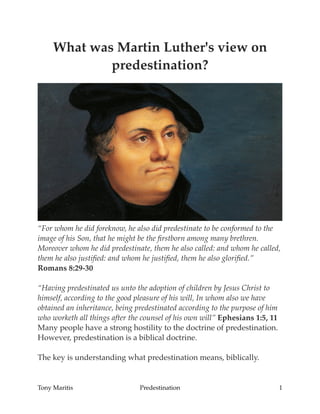
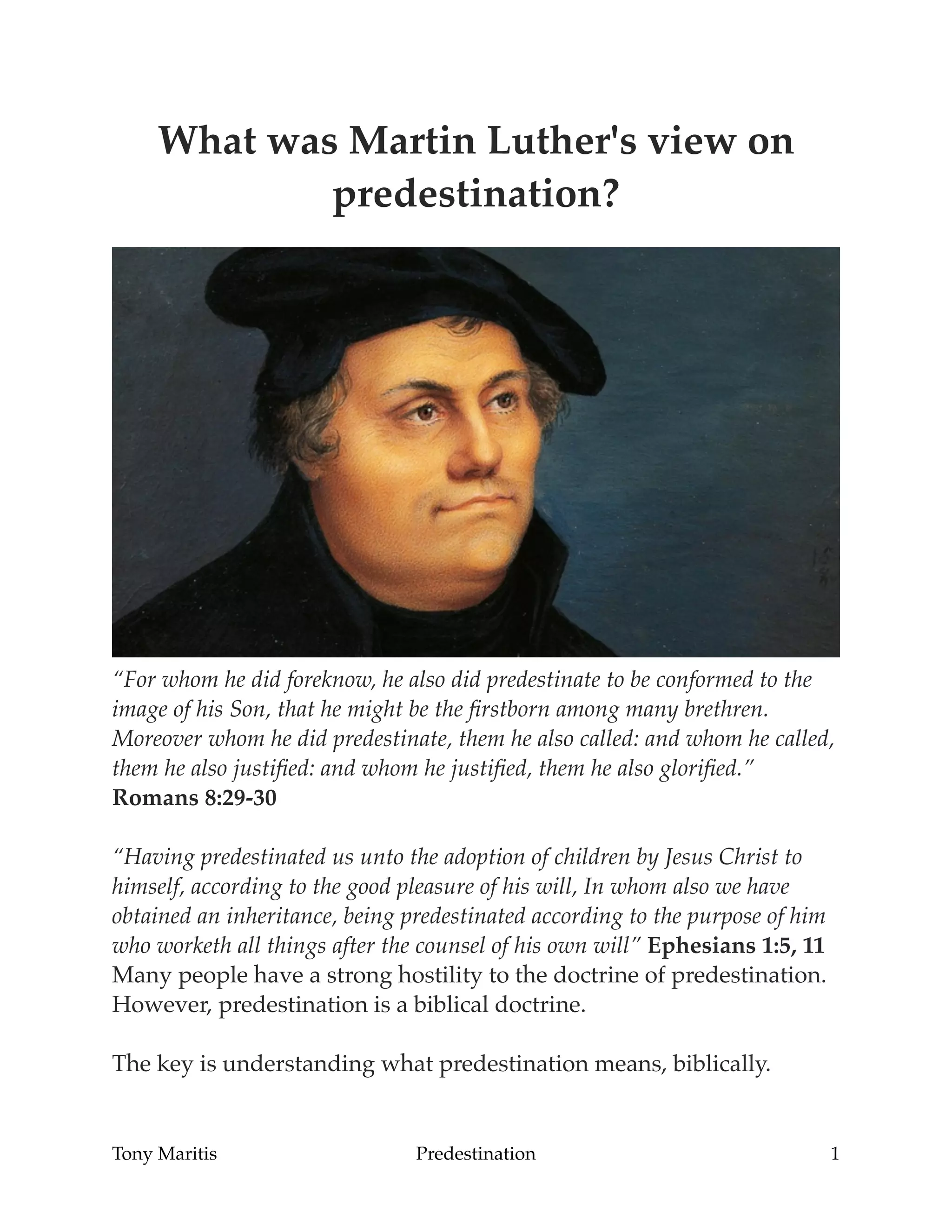
What was Martin Luther's view on
predestination?
“For whom he did foreknow, he also did predestinate to be conformed to the
image of his Son, that he might be the firstborn among many brethren.
Moreover whom he did predestinate, them he also called: and whom he called,
them he also justified: and whom he justified, them he also glorified.”
Romans 8:29-30
“Having predestinated us unto the adoption of children by Jesus Christ to
himself, according to the good pleasure of his will, In whom also we have
obtained an inheritance, being predestinated according to the purpose of him
who worketh all things after the counsel of his own will” Ephesians 1:5, 11
Many people have a strong hostility to the doctrine of predestination.
However, predestination is a biblical doctrine.
The key is understanding what predestination means, biblically.
Tony Maritis Predestination 1
The words translated “predestined” in the Scriptures referenced above
are from the Greek word proorizo, which carries the meaning of
“determining beforehand,” “ordaining,” “deciding ahead of time.” So,
predestination is God determining certain things to occur ahead of
time.
According to Romans 8:29-30, God predetermined that certain
individuals would be conformed to the likeness of His Son, be called,
justified, and glorified. Essentially, God predetermines that certain
individuals will be saved. Numerous scriptures refer to believers in
Christ being chosen (Matthew 24:22, 31; Mark 13:20, 27; Romans 8:33,
9:11, 11:5-7, 28; Ephesians 1:11; Colossians 3:12; 1 Thessalonians 1:4; 1
Timothy 5:21; 2 Timothy 2:10; Titus 1:1; 1 Peter 1:1-2, 2:9; 2 Peter 1:10).
Predestination is the biblical doctrine that God in His sovereignty
chooses certain individuals to be saved, but this does not mean that all
those who are saved were chosen in advance, just a select few for His
purposes.
The most common objection to the doctrine of predestination is that it
is unfair. Why would God choose certain individuals and not others?
The important thing to remember is that no one deserves to be saved.
We have all sinned (Romans 3:23) and are all worthy of eternal
punishment (Romans 6:23). As a result, God would be perfectly just in
allowing all of us to spend eternity in hell. However, God chooses to
save some of us. He is not being unfair to those who are not chosen,
because they are receiving what they deserve. God’s choosing to be
gracious to some is not unfair to the others. No one deserves anything
from God; therefore, no one can object if he does not receive anything
from God. An illustration would be a man randomly handing out
money to five people in a crowd of twenty. Would the fifteen people
who did not receive money be upset? Probably so. Do they have a
right to be upset? No, they do not. Why? Because the man did not owe
anyone money. He simply decided to be gracious to some.
Tony Maritis Predestination 2
If God is choosing who is saved, doesn’t that undermine our free will
to choose and believe in Christ? The Bible says that we have the choice
—all who believe in Jesus Christ will be saved (John 3:16; Romans
10:9-10). This is what is typically misunderstood about predestination,
which means outside of those who God chose in advance, everyone
else has to make their own choice, whereby salvation is available to
those who choose Christ.
The Bible never describes God rejecting anyone who believes in Him
or turning away anyone who is seeking Him (Deuteronomy 4:29).
Somehow, in the mystery of God, predestination works hand-in-hand
with a person being drawn by God (John 6:44) and believing unto
salvation (Romans 1:16). God predestines who will be saved, and we
must choose Christ in order to be saved. Both facts are equally true.
This is what Martin Luther believed..
“O the depth of the riches both of the wisdom and knowledge of God! how
unsearchable are his judgments, and his ways past finding out!” Romans
11:33
Tony Maritis Predestination 3

Predestination

  • 1.
    What was MartinLuther's view on predestination? “For whom he did foreknow, he also did predestinate to be conformed to the image of his Son, that he might be the firstborn among many brethren. Moreover whom he did predestinate, them he also called: and whom he called, them he also justified: and whom he justified, them he also glorified.” Romans 8:29-30 “Having predestinated us unto the adoption of children by Jesus Christ to himself, according to the good pleasure of his will, In whom also we have obtained an inheritance, being predestinated according to the purpose of him who worketh all things after the counsel of his own will” Ephesians 1:5, 11 Many people have a strong hostility to the doctrine of predestination. However, predestination is a biblical doctrine. The key is understanding what predestination means, biblically. Tony Maritis Predestination 1
  • 2.
    The words translated“predestined” in the Scriptures referenced above are from the Greek word proorizo, which carries the meaning of “determining beforehand,” “ordaining,” “deciding ahead of time.” So, predestination is God determining certain things to occur ahead of time. According to Romans 8:29-30, God predetermined that certain individuals would be conformed to the likeness of His Son, be called, justified, and glorified. Essentially, God predetermines that certain individuals will be saved. Numerous scriptures refer to believers in Christ being chosen (Matthew 24:22, 31; Mark 13:20, 27; Romans 8:33, 9:11, 11:5-7, 28; Ephesians 1:11; Colossians 3:12; 1 Thessalonians 1:4; 1 Timothy 5:21; 2 Timothy 2:10; Titus 1:1; 1 Peter 1:1-2, 2:9; 2 Peter 1:10). Predestination is the biblical doctrine that God in His sovereignty chooses certain individuals to be saved, but this does not mean that all those who are saved were chosen in advance, just a select few for His purposes. The most common objection to the doctrine of predestination is that it is unfair. Why would God choose certain individuals and not others? The important thing to remember is that no one deserves to be saved. We have all sinned (Romans 3:23) and are all worthy of eternal punishment (Romans 6:23). As a result, God would be perfectly just in allowing all of us to spend eternity in hell. However, God chooses to save some of us. He is not being unfair to those who are not chosen, because they are receiving what they deserve. God’s choosing to be gracious to some is not unfair to the others. No one deserves anything from God; therefore, no one can object if he does not receive anything from God. An illustration would be a man randomly handing out money to five people in a crowd of twenty. Would the fifteen people who did not receive money be upset? Probably so. Do they have a right to be upset? No, they do not. Why? Because the man did not owe anyone money. He simply decided to be gracious to some. Tony Maritis Predestination 2
  • 3.
    If God ischoosing who is saved, doesn’t that undermine our free will to choose and believe in Christ? The Bible says that we have the choice —all who believe in Jesus Christ will be saved (John 3:16; Romans 10:9-10). This is what is typically misunderstood about predestination, which means outside of those who God chose in advance, everyone else has to make their own choice, whereby salvation is available to those who choose Christ. The Bible never describes God rejecting anyone who believes in Him or turning away anyone who is seeking Him (Deuteronomy 4:29). Somehow, in the mystery of God, predestination works hand-in-hand with a person being drawn by God (John 6:44) and believing unto salvation (Romans 1:16). God predestines who will be saved, and we must choose Christ in order to be saved. Both facts are equally true. This is what Martin Luther believed.. “O the depth of the riches both of the wisdom and knowledge of God! how unsearchable are his judgments, and his ways past finding out!” Romans 11:33 Tony Maritis Predestination 3